Maybe you saw it on social media. Someone breathes out, their stomach disappears under their ribs, and the caption promises a smaller waist in two weeks. Or you remember the old bodybuilding photos with the impossibly narrow middle. Either way, you're wondering whether stomach vacuums are worth your time.
If your midsection is the part of your body you feel most self-conscious about, a move that promises to pull it in is hard to ignore. So is the letdown when two weeks of daily vacuums leave your waist the same size it was.
The stomach vacuum is a real exercise with real uses, and the waist claim is the weakest one. Below is how to do it, five positions from easiest to hardest, what the studies say it trains, what the waist evidence shows, where the move came from, and who should skip it.
What Is a Stomach Vacuum?
A stomach vacuum, also called an ab vacuum, belly vacuum or vacuum hold, is an isometric core exercise: you empty your lungs, draw your abdominal wall in toward your spine and hold it there without moving. In physical therapy research, the breathing version is called the abdominal drawing-in maneuver, or hollowing. The bodybuilding version adds a breath hold on empty lungs and lifts the belly up under the rib cage, which makes the stomach look deeply hollow.
Yoga has a close cousin in uddiyana bandha, an exhale-and-lift of the belly. Physiotherapy has hypopressive exercise, which pairs the same empty-lung breath hold with an outward pull of the ribs. Studies of all three help answer what the vacuum does, so this guide names which version each study tested.
How to Do a Stomach Vacuum Exercise Correctly
Learn it lying on your back first. Gravity helps your belly fall toward your spine, so you can feel the movement without fighting your own weight.
- Lie on your back with your knees bent and feet flat, and rest your hands on your lower belly, just inside your hip bones.
- Breathe in through your nose for about four seconds, letting your belly and sides expand.
- Breathe out slowly through your mouth until your lungs feel empty, then push out the last bit of air with your abs. Frank Zane, the bodybuilder most linked with the vacuum, describes this step as tightening your abs to squeeze out the very last of the air.
- Without breathing in, draw your belly button in toward your spine and up under your ribs. Your hands should feel your lower belly sink away from them.
- Hold for 10 to 15 seconds, then let go and breathe normally. Rest 20 to 30 seconds.
- Repeat 3 to 5 times.
The breathing version (start here)
If holding your breath on empty lungs makes you dizzy, or you have high blood pressure, keep breathing. Draw your lower belly in about halfway, then take small, slow breaths into your chest and sides while the belly stays in. This is the drawing-in maneuver used in most of the studies below, and it's the version to build long holds on.
Form cues that make it work
- Relax your shoulders and neck. The work happens below your belly button.
- Leave your spine where it is. Tucking your pelvis or pressing your lower back into the floor can fake the look without the deep muscle doing the work.
- Keep your ribs from flaring forward. On the breath-hold version your ribs rise a little as the belly lifts under them, but they shouldn't pop forward. If they do, our guide to rib flare has breathing drills that help.
- Practice on an empty or nearly empty stomach. A full stomach makes the hold uncomfortable, which is why many people do vacuums before breakfast.
- Stop if you feel light-headed. Breathe normally and switch to the breathing version.
Stomach Vacuum Progressions: Lying, Kneeling, Seated and Standing
Once you can hold 15 seconds lying down, change your position before you add time. Each step takes away some help from gravity or asks you to hold the vacuum while your trunk stays upright.
| # | Position | How to set up | What changes |
|---|---|---|---|
| 1 | Lying on your back | Knees bent, feet flat, hands on your lower belly | Gravity pulls your belly toward your spine, so it's the easiest place to learn |
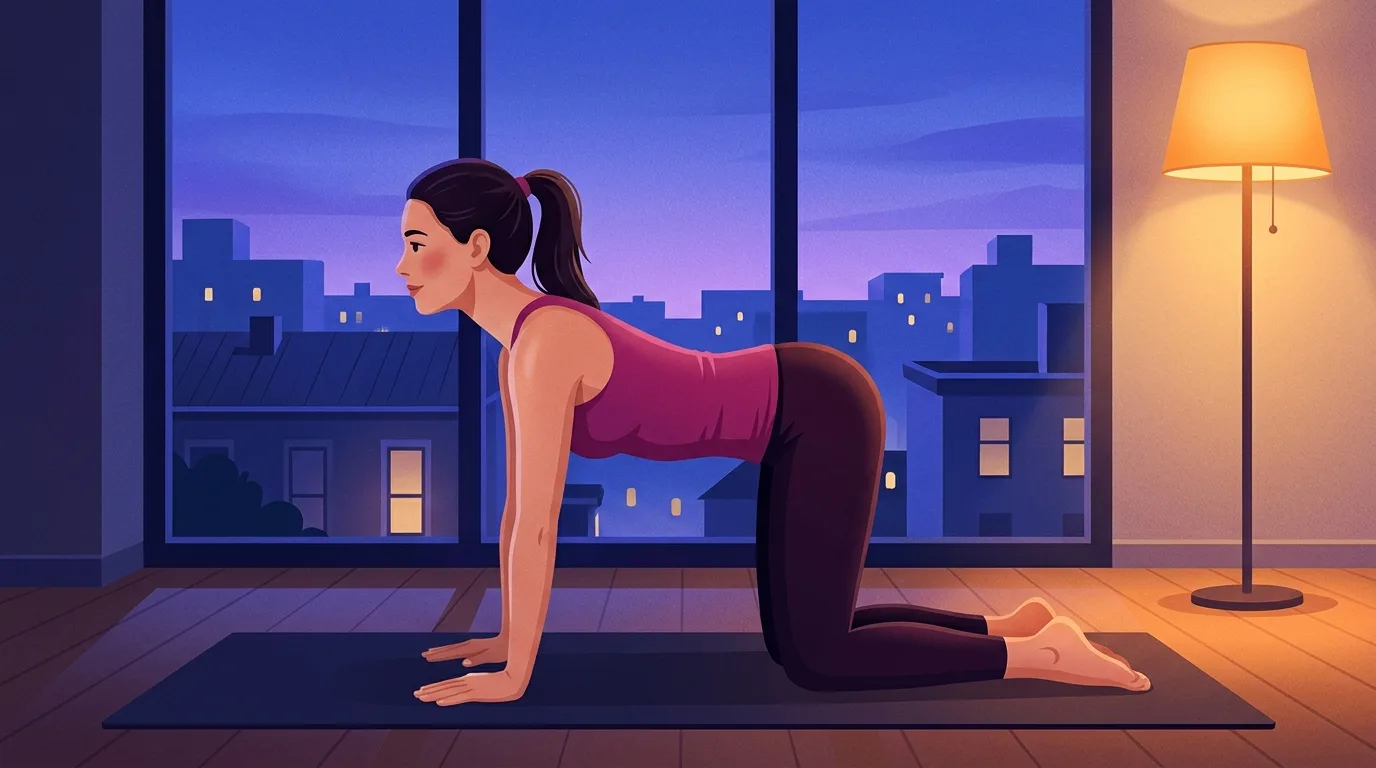
| 2 | Kneeling on all fours | Hands under shoulders, knees under hips, back flat | Your belly hangs toward the floor, so you lift it against gravity, and you can see it move |
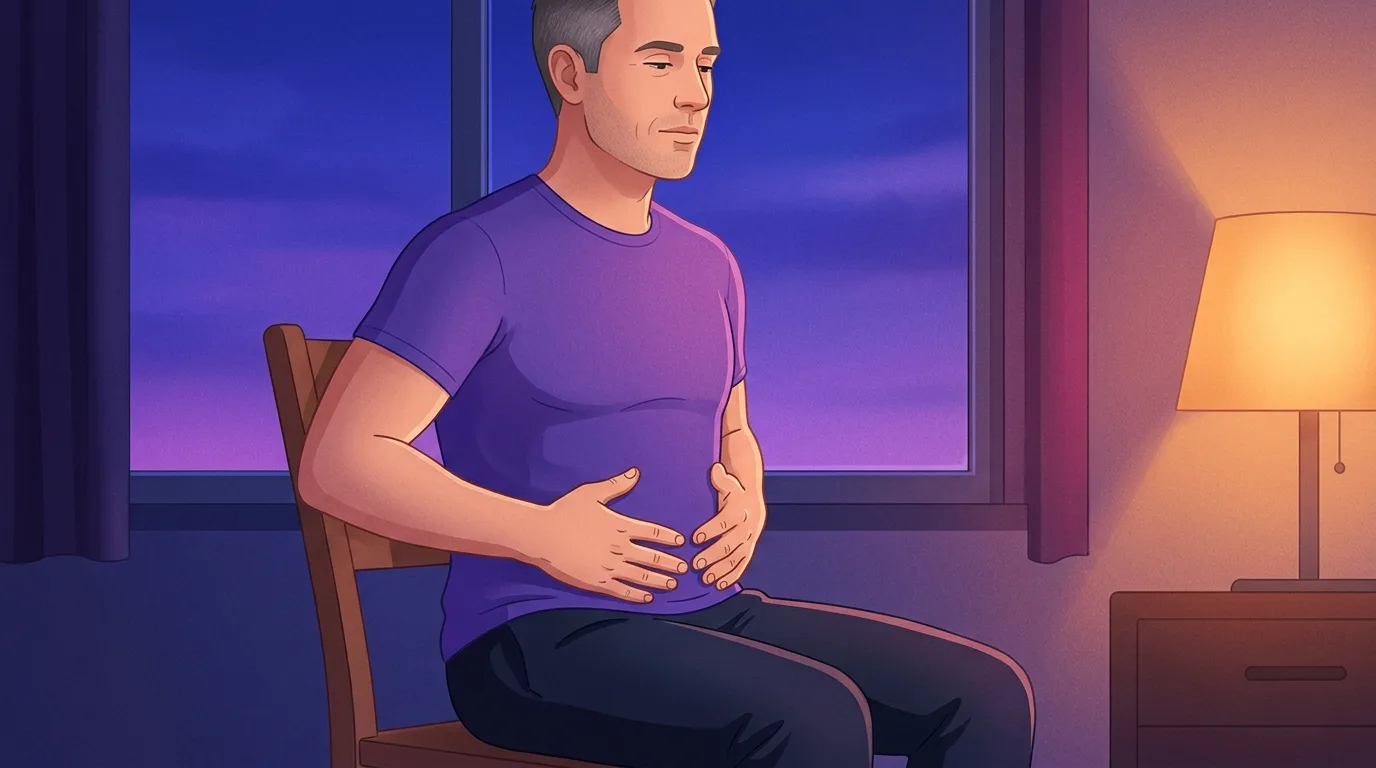
| 3 | Seated | Sit tall near the front of a chair, feet flat | You're upright with no help from gravity, and you can practice at a desk |
| 4 | Standing | Feet hip-width, knees soft, hands on your hips | The position you spend your day in, with your whole trunk to hold upright |
| 5 | Standing, hands behind your head | As above, elbows wide, ribs lifted | The classic posing vacuum, with the abdominal wall stretched by your raised arms |
The order is a coaching progression, not a ranking from a study, but research supports moving upright. In an ultrasound study by Mew (2009), 28 healthy adults thickened their transverse abdominis more during hollowing when standing than when lying with their knees bent, and the muscle worked more selectively compared with the internal oblique. Even at rest, the muscle measured about 21 percent thicker standing than lying down. So standing vacuums ask more of the deep muscle as well as being harder to hold.
Build each position to three to five holds of 20 to 30 seconds with the breathing version before you move on. On the breath-hold version, keep each hold to what you can manage on one breath, usually 10 to 20 seconds, and never strain to stretch it.
Find out what's really holding you back
FitCraft, our mobile fitness app, pairs you with an AI coach who builds you a personalized plan around your goals, schedule, and fitness level. Every FitCraft program is designed by Domenic Angelino, MPH (Brown University) and NSCA-CSCS, with research published in the Journal of Strength and Conditioning Research and Medicine & Science in Sports & Exercise.
Take the Free Assessment Free • 2 minutes • No credit cardWhat Does a Stomach Vacuum Exercise Train?
The main target is the transverse abdominis, the deepest layer of your abdominal wall, which wraps around your waist like a wide belt. Three kinds of study show the vacuum and its breathing version reach it.
- Ultrasound during the drawing-in maneuver. In a trial by Teyhen and colleagues (2005), 30 people with low back pain learned the drawing-in maneuver, and their transverse abdominis roughly doubled in thickness during the hold. Adding ultrasound biofeedback didn't make them better at it in the short term.
- Fine-wire EMG during drawing-in. Urquhart and colleagues (2005) placed fine-wire electrodes in the abdominal muscles. Drawing the lower belly in while lying on the back produced more transverse abdominis activity than activity in the obliques or the rectus abdominis, the most independent transverse abdominis activity of the exercises they tested. Bracing, by contrast, mostly recruited the external oblique.
- EMG of the vacuum itself. Willett and colleagues (2001) recorded 25 healthy adults during five ab exercises, including the vacuum. It produced moderate external oblique activity and very little rectus abdominis activity. The study didn't record the transverse abdominis, so it shows what the vacuum doesn't train: your six-pack muscle.
The breath-hold versions involve the pelvic floor too. In a 2026 study of 36 women new to hypopressive exercise, Saraiva and McLean found the maneuvers activated the pelvic floor muscles to 37 to 47 percent of a maximal contraction. Despite the method's name, they didn't lower the pressure inside the abdomen.
Training the transverse abdominis regularly can make it bigger. In a six-week trial of 30 middle-aged women by Koh, Cho and Kim (2014), drawing-in exercise grew the muscle's cross-sectional area, and our guide to deep core exercises covers that trial along with the dead bug, bird dog and other moves that train the same deep layer.
Do Stomach Vacuums Work for a Smaller Waist?
This is the claim most videos lead with, so here's what the evidence does and doesn't support.
What's supported
Your waist is smaller while you hold the vacuum, because the abdominal wall moves inward. Over weeks of practice, the hold gets deeper and easier, and you get better at drawing your belly in lightly when you choose to, for a photo or on a stage.
What isn't supported
A smaller waist at rest, after you let go. We found no controlled trial of the stomach vacuum that measured resting waist size. The closest evidence comes from hypopressive exercise. A 2024 systematic review by Martins Rodrigues and colleagues found five studies of hypopressive training in healthy women, and waist circumference, the outcome of most interest, went down with exercise. The same authors wrote that the studies had serious methodological problems, said they couldn't recommend the practice on that evidence, and called for better trials.
A vacuum also won't burn the fat that sits on top of your abs. In a six-week trial by Vispute and colleagues (2011), ab exercises alone didn't change abdominal fat or waist size. Our abs workout at home guide has a six-week plan for the muscles underneath, and losing the fat itself comes from your overall eating and activity over months. Waist trainers make the same promise and hit the same limit, as our article on whether waist trainers work explains.
Stomach vacuum before and after photos
Most stomach vacuum before-and-after photos compare a relaxed belly with a belly mid-vacuum, or a belly before months of fat loss with the same belly after. Neither shows what the vacuum did. If you want to track your own waist, measure it relaxed, at the same time of day, at the end of a normal breath out.
The Ab Vacuum in Bodybuilding: From Muscle Control to Classic Physique
The vacuum is much older than the gym videos. Muscle-control performers in the early 1900s already showed off the ability to pull the abdomen in, according to bodybuilding historian Conor Heffernan, quoted in a BarBend history of the move. Its best-known era came in the 1970s. Frank Zane, who won Mr. Olympia in 1977, 1978 and 1979, is quoted in the same article saying he performed it at the 1970 Mr. Universe, and that Arnold Schwarzenegger told him afterward it was maybe his best pose and to do it at the end of his routine.
The appeal was visual. A deep vacuum under a wide chest and back made the waist look narrow and the shoulders look wider, the V shape judges rewarded. BarBend calls the vacuum a staple of today's Classic Physique division, which is judged on proportions closer to that era.
Stage vacuums differ from the version you'd practice at home. They're short, done on empty lungs, often with the hands behind the head, and rehearsed for weeks before a show. Zane suggests practicing them when you get hungry. None of that changes the waist evidence above. On stage, the vacuum shows control of a waist that diet and training have already made lean.

How Often Should You Do Stomach Vacuums, and How Long Until Results?
Stomach vacuums are low-load, so most healthy adults can practice them daily. A simple plan:
- Weeks 1 and 2: lying and on all fours, 3 to 5 holds of 10 to 20 seconds, once or twice a day.
- Weeks 3 and 4: seated and standing, 3 to 5 holds of 20 to 30 seconds.
- Week 5 on: standing holds of 30 to 60 seconds with the breathing version, or short holds during daily moments such as waiting for the kettle.
Studies give a rough timeline for the muscles involved. The drawing-in trial that grew the transverse abdominis ran six weeks, with three sessions a week. In a 2026 randomized trial, Moreira and colleagues split 44 women, 45 days to 6 months after giving birth and with a gap between their ab muscles, into supervised 30-minute hypopressive sessions twice a week for 12 weeks or no training. The trained group held a front plank 34 seconds longer and side planks 12 to 16 seconds longer than the controls, felt better about their bodies and reported fewer pelvic floor complaints. The gap itself changed no more than it did in the women who didn't train.
So after a week of stomach vacuums, expect better control: a deeper, steadier hold. Expect stronger deep core holds after six to twelve weeks. Don't expect a different tape measure reading unless your body fat changes too.
Stomach Vacuum Side Effects and Who Should Skip It
For most healthy adults, the main side effect is feeling light-headed if you hold your breath too long on empty lungs. Stop, breathe normally and use the breathing version. Some groups should take more care. The evidence for each is thin, so treat these as precautions:
- High blood pressure or heart disease. Skip the breath-hold version. In a case series of 10 women with normal blood pressure, de Lucena and colleagues (2021) found that seated hypopressive breath holds raised systolic blood pressure and mean arterial pressure during the sets. Keep breathing during holds, and ask your doctor first.
- Pregnancy. We found no studies of the full breath-hold vacuum in pregnancy. Other core training has been tested: in a randomized trial of 96 pregnant women with a widened gap between their ab muscles, Theodorsen and colleagues (2024) found that 12 weeks of abdominal and pelvic floor exercise had a negligible effect on the gap. Ask your midwife or doctor before you start, and use the breathing version.
- The first months after birth. In a study of 84 first-time mothers by Mota and colleagues (2015), the gap between the rectus muscles was measured while the women did each exercise. Drawing in narrowed it just below the belly button by 3.8 mm late in pregnancy but widened it by about 2 to 3 mm between 6 and 26 weeks after birth, while crunches narrowed it. The change was small, but if you have diastasis recti, a pelvic health physical therapist can tell you which core work suits you.
- Recent abdominal surgery or a hernia. We found no studies of vacuums after abdominal surgery or with a hernia. Wait for your surgeon's clearance before any core work that pulls hard on the abdominal wall.
- Right after a meal. A full stomach makes the hold uncomfortable, so practice before you eat.
Stomach Vacuum vs Bracing and Other Deep Core Training
The vacuum is the strongest form of drawing in, and drawing in is only one way to use your deep core. Bracing, which tightens your whole waist without pulling it in, suits lifting or carrying something heavy: in a modeling study of eight men holding weights, bracing gave the spine more stability than hollowing (Grenier and McGill 2007). The deep core exercises guide linked above compares the two in the studies and lays out a 10-minute routine for the transverse abdominis, pelvic floor and diaphragm, so use the vacuum as one drill in that mix.
If you'd rather not plan your core and strength work yourself, an AI personal trainer app can carry it. In FitCraft, each exercise comes with an interactive 3D demo you can zoom in on that highlights the working muscles, and your AI coach says your name while you train. Your workouts adjust as you progress, and streaks help short core sessions stick.
The Bottom Line
The stomach vacuum is a useful drill for finding and training your transverse abdominis, and it's the pose that made 1970s waists famous. It won't shrink your waist at rest or burn belly fat on its own. Learn it lying down, move it to standing, keep breathing if you have high blood pressure or are pregnant, and pair it with the rest of your training.
Working out consistently is hard, but it doesn't have to be. As Stacy, 41, said after four months of training, "After my second kid, I needed something stupidly simple." A few vacuum holds before breakfast are about as simple as core training gets.
Frequently Asked Questions
Does the stomach vacuum actually work?
Yes, for training your deepest ab muscle, the transverse abdominis: in an ultrasound study, the breathing version of the move roughly doubled that muscle's thickness during the hold. No controlled trial shows that stomach vacuums shrink your waist at rest or burn belly fat. Use them to build deep core control, not as a fat-loss tool.
How often should you vacuum your stomach?
Most healthy adults can do stomach vacuums every day, because the load is low. Three to five holds of 10 to 30 seconds, once or twice a day, is plenty. Trials of related deep core exercises used two or three sessions a week, so daily practice is optional.
Does vacuuming your stomach help reduce belly fat?
No. A stomach vacuum doesn't burn the fat on your stomach, because no ab exercise reduces fat in one spot. Belly fat comes down with your overall eating and activity, while the vacuum trains the muscle underneath it.
How long should I do stomach vacuums to see results?
Expect a deeper, steadier hold within one to two weeks of regular practice. In trials of related exercises, the deep core muscle grew within six weeks and plank holds improved within twelve. Your relaxed waist measurement only changes if your body fat does.
What are the side effects of stomach vacuums?
The most common side effect is feeling light-headed from holding your breath on empty lungs, so stop and breathe normally if it happens. Breath-hold versions raised blood pressure in a small study, so people with high blood pressure or heart disease should use the breathing version and check with a doctor first. We found no studies of the breath-hold vacuum in pregnancy, so if you're pregnant, use the breathing version and check with your midwife or doctor first.
What is a vacuum hold?
A vacuum hold is the held position of a stomach vacuum: after breathing out, you keep your belly drawn in toward your spine for a set time, usually 10 to 60 seconds. Beginners hold it while taking small breaths, and bodybuilders hold it on empty lungs for shorter periods.