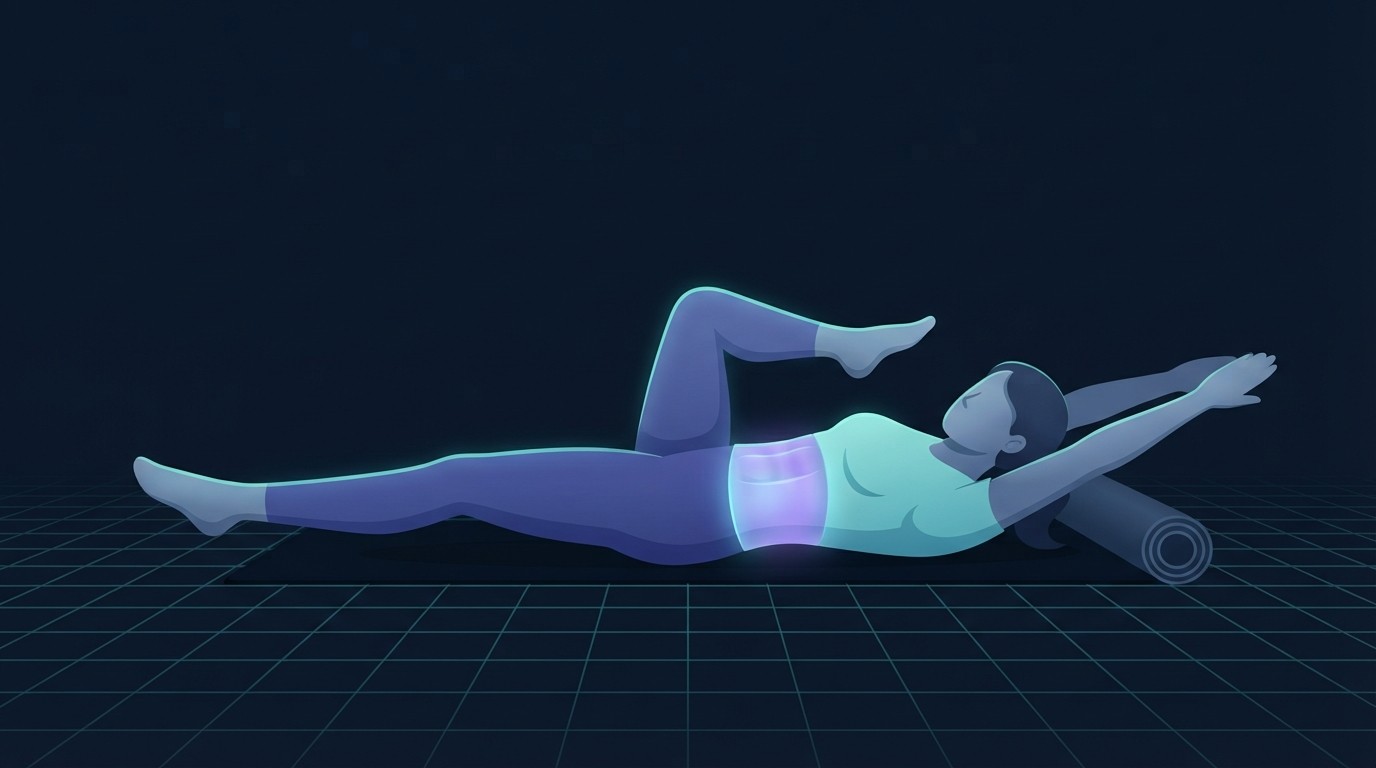
Most home ab routines fail for one of two reasons. Either they're a list of 20 exercises you do once and never repeat, or they're the same three sets of crunches you've been doing since high school, which stopped being hard around week two and have been coasting ever since.
The fix is not a longer list. It is six movements that cover every job the core actually does, plus a rule for making them harder every week when you own no weights and no equipment.
Here is the plan, the progression, and the honest part about what ab training will and will not do for your waistline.
What Is the Best Abs Workout at Home With No Equipment?
Your core has four jobs, and a good routine trains all of them. It resists your spine bending backwards (anti-extension), resists it bending sideways (anti-lateral-flexion), resists it twisting (anti-rotation), and it flexes the trunk to bring the ribs and the pelvis together. Most home routines only train the last one, over and over.
Six exercises cover the set.
| Exercise | What it trains | Sets x work |
|---|---|---|
| Dead bug | Anti-extension, deep core | 2-3 x 8-12 per side |
| Forearm plank | Anti-extension, isometric | 2-3 x 20-45 sec |
| Side plank | Anti-lateral-flexion, obliques | 2-3 x 15-40 sec per side |
| Reverse crunch | Trunk flexion, pelvis end | 2-3 x 8-15 |
| Hollow hold | Trunk flexion, isometric | 2-3 x 15-40 sec |
| Bird dog | Anti-rotation, spinal extensors | 2 x 8-10 per side |
Run them in that order, resting 20 to 30 seconds between exercises and 45 to 60 seconds between rounds. One round takes about four minutes. Two rounds is a real session on a bad day, four rounds is a hard one.
Three details matter more than the exercise selection.
- The lower back stays flat on dead bugs, hollow holds and reverse crunches. The moment it arches off the floor, the hip flexors have taken over and the abs have stopped working. Shorten the range or bend the knees rather than pushing through.
- Planks end when the hips sag, not when the timer does. A 60-second plank where the last 30 seconds are a sagging mess is a 30-second plank plus a lower back complaint.
- Reverse crunches curl the pelvis, they do not swing the legs. Think about lifting your tailbone off the floor an inch. If the movement looks big, it's momentum.
How Do You Progress an Abs Workout at Home Over Six Weeks?
This is the part almost every home ab routine skips, and it's why they stop working. Without weights you cannot add load, so you add three other things: time under tension, reps, and lever length. Longer lever means the working limb sits further from the joint the muscle is bracing against, which is why a straight-leg dead bug is harder than a bent-knee one with no extra weight involved.
Progressive difficulty is not optional. Schoenfeld, Ogborn and Krieger's 2017 meta-analysis in the Journal of Sports Sciences pooled 34 treatment groups from 15 studies and found a graded dose-response between weekly sets per muscle and hypertrophy: each additional weekly set was worth an effect-size increase of 0.023, and the 10-or-more-sets group beat the under-five group. Volume drives the adaptation, and volume only rises if the plan tells it to.
| Week | Rounds | Holds | Reps | What changes |
|---|---|---|---|---|
| 1 | 2 | 20 sec | 8 per side | Learn the positions. Bent knees on dead bugs and hollow holds. |
| 2 | 2 | 25 sec | 10 per side | Same positions, more time and reps. |
| 3 | 3 | 25 sec | 10 per side | Add a third round. This is the biggest jump in the plan. |
| 4 | 3 | 30 sec | 12 per side | Straighten the dead bug leg. Hollow hold with arms at your sides. |
| 5 | 3 | 35 sec | 12 per side | Elevate the hips on a cushion for reverse crunches. |
| 6 | 4 | 40 sec | 12-15 per side | Full hollow hold, arms overhead. Add a 2 second pause at the top of each reverse crunch. |
If week 3 feels like a wall, repeat week 2 and move on the following week. The sequence matters more than the calendar. If week 6 feels easy, you are ready for the harder swaps below rather than a seventh week of the same thing.
Harder versions when the six-week block runs out
- Forearm plank becomes plank walks or spider planks.
- Side plank becomes side plank raises.
- Reverse crunches become leg raises.
- Bird dogs become plank twists.
- Hollow holds get an added arm sweep, or become bicycle crunches done slowly for time.
The same progressive overload logic runs through every bodyweight movement, not just core work. Our guide to home workouts that actually work covers how to apply it across a full-body plan.
Find out what's really holding you back
FitCraft, our mobile fitness app, pairs you with an AI coach who builds you a personalized plan around your goals, schedule, and fitness level. Every FitCraft program is designed by Domenic Angelino, MPH (Brown University) and NSCA-CSCS, with research published in the Journal of Strength and Conditioning Research and Medicine & Science in Sports & Exercise.
Take the Free Assessment Free • 2 minutes • No credit card
Does an Abs Workout at Home Burn Belly Fat?
No, and this is the single most tested version of the spot-reduction claim.
Vispute and colleagues (2011), in the Journal of Strength and Conditioning Research, randomized 24 healthy sedentary adults aged 18 to 40 to either an ab-training group or a control group. The training group did seven abdominal exercises for two sets of 10 reps, five days a week, for six weeks. Everyone held an isocaloric diet throughout, so calories were not the variable.
After six weeks there was no significant effect on body weight, body fat percentage, android fat percentage, abdominal circumference, abdominal skinfold or suprailiac skinfold. What did change was endurance: the training group managed 47 curl-ups on average against 32 in the control group.
That is a clean result. Thirty ab sessions across six weeks bought a large improvement in core endurance and zero centimeters off the waist.
The same logic applies to the sides of the waist: our guide on how to get rid of love handles walks through why oblique work alone does not empty the flank and what does.
So the plan splits in two. Core training builds and strengthens the muscle. A calorie deficit, driven by what you eat and how much you move across the whole day, reduces the fat covering it. Doing more crunches is not a substitute for the second one, and the people who look like they have abs mostly have a smaller number in the second column, not a bigger one in the first. We went deeper on that split in the research on skinny fat body composition.
Is There Really a Separate Lower Abs Workout?
The rectus abdominis is a single sheet of muscle running from the lower ribs to the pubic bone. It's crossed by tendinous bands, which is what creates the six-pack look, but it is one muscle with one nerve supply.
Lehman and McGill (2001), in Physical Therapy, put EMG electrodes over the upper and lower portions of the rectus abdominis in 11 lean athletic subjects and compared activity across a range of trunk exercises. Once the signals were normalized, the differences between the two regions were small enough that the authors concluded they may lack clinical or therapeutic relevance.
Which does not mean reverse crunches and leg raises are pointless. Moving the pelvis toward the ribs feels different from moving the ribs toward the pelvis, it recruits the hip flexors differently, and it's often harder. Keep both directions in the plan. Just drop the idea that you're hitting a separate muscle.
Which Ab Exercises Produce the Most Muscle Activation?
Escamilla and colleagues (2006), also in Physical Therapy, ran surface EMG on 21 healthy adults across a long list of traditional and non-traditional abdominal exercises. Upper and lower rectus abdominis and internal oblique activity were highest for ab wheel movements (pike, knee-up and roll-out), hanging knee-ups with straps, and the reverse crunch performed on a 30 degree incline. External oblique activity was highest for the same rollout and hanging-knee-up group.
Two of those three need equipment. The third does not, which is why the reverse crunch in this plan gets an incline in week 5: propping your hips on a firm cushion reproduces roughly the same setup with a couch and a pillow.
The same paper flagged the trade-off. The highest-activation exercises also recruited the most extraneous musculature, particularly the hip flexors and lats. That's fine if your back tolerates it, and it's the reason a beginner starts with dead bugs and planks rather than hanging leg raises.
How Hard Does a Bodyweight Set Need to Be?
Hard enough that the last two or three reps are a genuine fight. This isn't a motivational point, it's the mechanism.
Schoenfeld and colleagues (2017) pooled 21 studies comparing low-load training at 60% of one-rep max or below against heavier training, with sets in both conditions taken to momentary muscular failure. Muscle growth was similar between them. Maximal strength favored the heavy loads, as you would expect, but the size outcome held.
The condition attached to that finding is the whole story: taken close to failure. Bodyweight core work has no load to add, so effort is the variable you control. Thirty easy crunches do nothing at all. Twelve slow reverse crunches with a two-second pause do most of what a weighted set would.
Which is why the tempo instructions are not decorative. Slowing a rep down roughly doubles the time under tension and brings a bodyweight set into the range where the muscle actually has to adapt. The broader case for training without equipment is in our review of what bodyweight training actually produces, and the low-load evidence gets its own page in whether light weights build muscle.
How Often Should You Train Abs at Home?
Three sessions a week, on non-consecutive days. Monday, Wednesday, Friday works. So does Tuesday, Thursday, Sunday.
The reasoning comes back to the volume meta-analysis. Three sessions of four to six working sets each puts you between 12 and 18 weekly sets for the core, comfortably inside the 10-or-more band that outperformed lower volumes. Daily ab work is not harmful, but in practice it means every session is easy enough to repeat tomorrow, which is the opposite of what drives an adaptation.
Two other scheduling notes. Put core work at the end of a session rather than the start, because a fatigued core makes squats and push-ups worse. And treat soreness in the first two weeks as normal and not as a target: you are not chasing soreness, you are chasing an extra rep.
What Does Core Training Actually Do for You?
Beyond appearance, which the research above already separated out, core training has two well-supported payoffs.
The first is performance. Rodriguez-Perea and colleagues (2023), in Biology of Sport, screened 3,223 records and meta-analyzed 21 studies covering 935 participants. Core training produced a large improvement in balance (effect size 1.17), and moderate to large improvements in vertical jump (0.69) and horizontal jump (0.84). Throwing and hitting velocity did not move significantly.
The second is the back. Guo and colleagues (2025), in Frontiers in Physiology, pooled 57 randomized controlled trials covering 7,705 people with chronic nonspecific low back pain. All three training types studied reduced pain, and core resistance training produced the largest improvement in functional status (SMD 0.76), slightly ahead of Pilates and core stability work. Their pooled protocols ran three to four sessions a week, which is roughly what this plan does.
So the case for training your core is a lot stronger than the case for training your core to see abs. One is about how you move and how your back feels. The other is a food question wearing a workout costume.
The Bottom Line
Six exercises, three days a week, six weeks of progression, no equipment. The plan works because it covers all four core jobs, and because it tells you exactly what to add each week instead of leaving you to guess.
Set your expectations in the right place. You will feel the difference in your planks, your balance and your lower back within a month. Whether you see anything is a separate project, run in the kitchen and across your whole day, and no amount of extra crunches will do it for you. For a month-long version that adds dumbbells and a calorie deficit, see our guide on how to get abs in 30 days, which shows what those four weeks can change at your starting body fat.
If you want the routine handed to you and the progression tracked rather than remembered, that's what an app is for. FitCraft is built around bodyweight and strength programs run by an AI coach as a 3D character, with interactive 3D exercise demos you can rotate and zoom to see what a straight plank line is supposed to look like. Calendar tracking keeps the three-a-week rhythm visible. The equipment-free case is covered in more depth on our home workout app for training with no equipment.
Frequently Asked Questions
What is the best abs workout at home with no equipment?
Six exercises that cover all four jobs the core does: dead bugs and forearm planks for resisting extension, side planks for resisting sideways bending, bird dogs for resisting rotation, and reverse crunches plus hollow holds for trunk flexion. Run them as a circuit two to four rounds through, three times a week on non-consecutive days, and add reps, seconds or a longer lever every week rather than adding new exercises. That takes 10 to 20 minutes and needs nothing but floor space.
How long does it take to see abs from a home ab workout?
Core strength and endurance improve within four to six weeks, and you will feel that long before you see anything. Visible definition is a body fat question, not a training question, so the timeline depends on how much fat sits over the muscle and how big a calorie deficit you can hold. Vispute and colleagues ran 24 adults through seven ab exercises five days a week for six weeks on a calorie-matched diet and measured no change at all in abdominal fat, body fat percentage or waist circumference. Their curl-up endurance improved a lot. Their waistline did not move.
How many times a week should I do abs at home?
Three times a week on non-consecutive days is the sweet spot for most people. Schoenfeld and colleagues' 2017 meta-analysis found a graded dose-response between weekly sets per muscle and muscle growth, with 10 or more weekly sets outperforming fewer than five, so three sessions of four to six sets each lands you in the productive range. Daily ab work is not dangerous, but it usually means every session is too easy to drive an adaptation.
Do ab workouts burn belly fat?
No. Spot reduction does not work, and abdominal training is the most directly tested version of that claim. In the 2011 Vispute trial, six weeks of ab training five days a week produced no significant change in abdominal fat, android fat percentage, waist circumference or abdominal skinfold when calories were held constant. Ab training builds the muscle underneath. A calorie deficit is what uncovers it, and that deficit comes from food intake plus total daily activity, not from crunches.
Are planks better than crunches?
They train different jobs, so the honest answer is that you want both. Planks train the core to resist movement, which is what it does for most of the day, and they load the spine in a neutral position. Crunches and reverse crunches train the rectus abdominis through its actual range of motion, which is what makes the muscle bigger. Escamilla and colleagues' EMG work found the highest abdominal activation in rollouts, hanging knee-ups and reverse crunches performed on a 30 degree incline, all of which are dynamic rather than isometric.
Can you get abs with bodyweight exercises alone?
Yes, provided the sets get genuinely hard. Schoenfeld and colleagues' 2017 meta-analysis of 21 studies found that low-load training taken close to failure produced muscle growth comparable to heavy training. That is the mechanism that makes bodyweight core work count. A set of 30 easy crunches does nothing. A set where the last two or three reps are a real fight does most of what a loaded set would, which is why the progression in this plan lengthens levers and slows tempo instead of adding weight.
Is there a separate lower abs workout?
Not really. The rectus abdominis is one sheet of muscle running from the ribs to the pelvis, and Lehman and McGill measured EMG activity in its upper and lower portions across a range of trunk exercises. Once the signals were normalized, the differences between the two regions were small and probably not clinically meaningful. What people call lower ab exercises, reverse crunches and leg raises, do bias the pelvis end of the movement, so they are worth doing. They are not activating a different muscle.