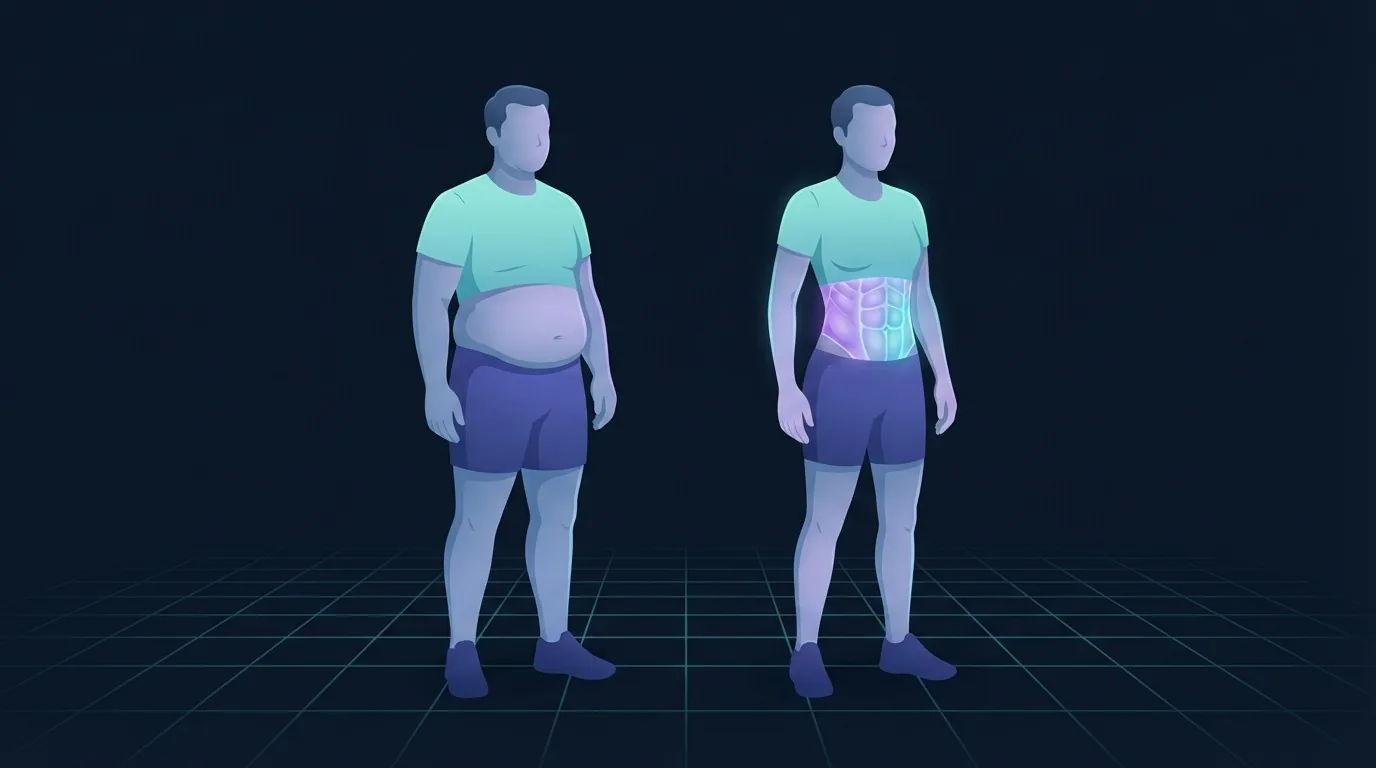
Almost every question about abs is really a question about body fat. People ask which exercise works best, how many reps, whether to train them daily. The honest answer is that exercise selection barely matters compared to the number that decides whether anything shows at all. Your rectus abdominis is already there. It has been there the whole time. What you're actually asking is how to remove the subcutaneous fat sitting between it and the light.
That reframe changes what you spend your effort on. If abs are a fat problem, then the plan is a fat loss plan with enough resistance training and protein attached that the weight you lose comes off as fat instead of muscle. Crunches are a small piece of it. The kitchen and the barbell are the big pieces.
This guide gives you the ranges, the arithmetic for your own timeline, and the parts of the plan that the research actually supports. It also flags where the numbers get soft, because a lot of what gets stated as fact about abs is a coaching estimate wearing a lab coat.
What body fat percentage do you need to see abs?
No trial has scanned people at every body fat percentage and recorded the moment their abs became visible. Anyone quoting a precise threshold is repeating field observation, not a study. What the literature does give you is a reliable frame for where those numbers sit relative to health. Gallagher, Heymsfield, Heo, Jebb, Murgatroyd, and Sakamoto (2000), publishing in the American Journal of Clinical Nutrition, measured body fat in 1,626 adults across three ethnic groups using four-compartment and DXA reference methods, then mapped the healthy BMI band onto predicted body fat. For men aged 20 to 39 the healthy band came out at roughly 8 to 20 percent. For women in the same age band it was roughly 21 to 33 percent. Both bands drift upward with age: men aged 40 to 59 land at about 11 to 22 percent, women at about 23 to 34 percent.
Set the visible-abs ranges against that and something useful falls out. For men, a visible four-pack sits comfortably inside the healthy band. For women, it sits at the very bottom edge of it or slightly below. That's not a reason to avoid the goal, but it explains why women often find the last few percentage points harder to hold without it affecting sleep, mood, training quality or menstrual function.
| Body fat (men) | Body fat (women) | What the midsection typically looks like |
|---|---|---|
| 25% and above | 35% and above | No definition at all. Waist circumference is the visible feature. Training the abs here changes how they feel, not how they look. |
| 20 to 24% | 30 to 34% | Flatter, but no separation between segments. Some people catch a faint outline after a hard session and lose it by evening. |
| 15 to 19% | 25 to 29% | The upper two rows appear in direct light, especially after training or first thing in the morning. Obliques start to show at the waist. |
| 12 to 14% | 20 to 24% | A four-pack is visible standing relaxed in normal light. This is what most people picture when they say they want abs. |
| 10 to 11% | 18 to 19% | Full six-pack with defined obliques and visible serratus. Maintainable for many men, demanding for most women. |
| Under 10% | Under 18% | Stage-lean. Reachable for a photoshoot or a competition, not a year-round set point. Hunger, sleep and training performance all degrade here. |
Treat this table as a map, not a measurement. Two people at an identical 14 percent can look meaningfully different, because fat distribution is largely genetic and because most consumer body fat measurements carry an error bar of several percentage points. A smart scale, a caliper reading and a DXA scan on the same person on the same morning will disagree. What matters is that whichever method you pick trends down over months, not that the absolute number is exactly right. Our body fat calculator gives you a repeatable starting estimate from tape measurements, which is good enough to track a trend. For the healthy ranges by age and sex, and how far each way of measuring can be off, see our post on what is a healthy body fat percentage.
Why don't crunches burn belly fat?
Because the body doesn't draw fuel from the fat cells nearest the working muscle. This is the spot reduction question, and it has been tested directly more than once.
The cleanest test on the abdomen specifically is Vispute, Smith, LeCheminant, and Hurley (2011) in the Journal of Strength and Conditioning Research. Twenty-four healthy sedentary adults aged 18 to 40, fourteen men and ten women, were randomised to either an abdominal exercise group or a control group. The training group performed seven abdominal exercises, two sets of ten repetitions each, five days a week for six weeks. Everyone held an isocaloric diet for the duration. After six weeks there was no significant change in body weight, body fat percentage, android fat percentage, android fat, abdominal circumference, abdominal skinfold or suprailiac skinfold. What did change was endurance: the training group managed 47 curl-up repetitions on the posttest versus 32 in the control group.
The same result shows up when researchers train a single limb, which is a stronger design because each participant acts as their own control. Ramirez-Campillo, Andrade, Campos-Jara, Henriquez-Olguin, Alvarez-Lepin, and Izquierdo (2013) had eleven young adults train only their non-dominant leg for 12 weeks, three sessions a week, at 960 to 1,200 repetitions per session on the leg press. Total body fat mass fell 5.1 percent. But the fat didn't come off the trained leg. It came off the trunk, down 6.9 percent, and the upper extremities, down 10.2 percent, and the reduction in those untrained regions was significantly greater than the change in the trained leg.
Kostek and colleagues (2007), in Medicine and Science in Sports and Exercise, ran the same design on the arm with a much larger sample: 104 adults, 45 men and 59 women, training the non-dominant arm for 12 weeks with MRI and skinfold measurement before and after. Their conclusion was that resistance training produced generalised rather than localised subcutaneous fat loss.
Three studies, three body regions, one answer. Training a muscle hard makes that muscle better. It doesn't tell your body where to spend fat. If you want the fat off your abdomen, you need a systemic energy deficit and the patience to let your genetics decide the order. For the training side of that, our guide to the best exercises to lose belly fat covers what actually moves visceral fat and how much of it you need each week.
What actually drives fat loss?
Three variables carry almost all of the result: the size of the energy deficit, the protein intake, and whether you're lifting hard enough to give your body a reason to keep the muscle.
Set the deficit slow, not aggressive
Garthe, Raastad, Refsnes, Koivisto, and Sundgot-Borgen (2011) at the Norwegian School of Sport Sciences randomised 24 elite athletes to lose weight at either 0.7 percent of bodyweight per week or 1.4 percent per week, both groups doing four resistance training sessions a week. Both lost about 5.5 percent of bodyweight. The difference was in what came off. The slow group lost 31 percent of their fat mass and gained 2.1 percent lean body mass. The fast group lost 21 percent of their fat mass and their lean mass didn't budge, at minus 0.2 percent. Same total weight loss, very different bodies at the end.
Helms, Aragon, and Fitschen (2014), reviewing the evidence for natural bodybuilding contest preparation in the Journal of the International Society of Sports Nutrition, landed in the same place: set calories so bodyweight falls at approximately 0.5 to 1 percent per week. That's the range that keeps muscle while fat comes off. Going faster doesn't really get you there sooner, because you arrive at your goal weight with less muscle and a softer look at the same body fat percentage.
Get protein high and keep it there
Longland, Oikawa, Mitchell, Devries, and Phillips (2016) at McMaster University ran the most-quoted trial on this. Forty young men spent four weeks in a roughly 40 percent energy deficit, training six days a week with resistance work plus intervals, randomised to either 1.2 or 2.4 g/kg/day of protein. The higher-protein group gained 1.2 kg of lean mass and lost 4.8 kg of fat. The lower-protein group held lean mass essentially flat at plus 0.1 kg and lost 3.5 kg of fat. In a deficit steep enough that muscle loss should have been the default, the high-protein group added muscle.
Helms et al. (2014) put the practical target at 2.3 to 3.1 g/kg of lean body mass per day, with the higher end reserved for people who are already lean and in a large deficit. For anyone not dieting for a stage, somewhere around 1.6 to 2.2 g per kilogram of total bodyweight lands inside that window and is far easier to plan. Our guide to how much protein you need per day works through the arithmetic, and the protein distribution research review covers how to spread it across the day.
Lift heavy enough that your body keeps the muscle
Resistance training is what tells your body the muscle is still needed. Without it, a deficit pulls energy from wherever it likes, and a meaningful share comes out of lean tissue. Both the Garthe and Longland trials included substantial resistance work in every arm, which is exactly why they were able to show lean mass being held or added during weight loss.
The practical version is three to four full-body or upper-lower sessions a week built around compound patterns: a squat, a hinge, a horizontal press, a vertical pull. Add a little each week using progressive overload, whether that's another rep, a slightly heavier load, or a shorter rest. Heavy compound work also loads the trunk hard, which is a large part of why lifters who never do a dedicated ab session still end up with a strong midsection.
Find out what's really holding you back
FitCraft, our mobile fitness app, pairs you with an AI coach who builds you a personalized plan around your goals, schedule, and fitness level. Every FitCraft program is designed by Domenic Angelino, MPH (Brown University) and NSCA-CSCS, with research published in the Journal of Strength and Conditioning Research and Medicine & Science in Sports & Exercise.
Take the Free Assessment Free • 2 minutes • No credit cardHow long does it take to get abs?
You can calculate this yourself, and doing so is more useful than any generic answer. Take the sustainable rate of 0.5 to 1 percent of bodyweight per week from Helms et al. (2014) and Garthe et al. (2011), then work out how many percentage points of body fat you need to shed.
Here's the arithmetic on a worked example. An 85 kg man at 25 percent body fat is carrying 21.3 kg of fat and 63.7 kg of everything else. If he holds his lean mass and drops to 13 percent, he'll weigh about 73 kg, which means losing roughly 12 kg of fat. At 0.7 percent of bodyweight per week, which starts near 0.6 kg and slows as he gets lighter, that's somewhere in the region of 22 to 26 weeks. Call it two to three weeks per percentage point of body fat, and the table below falls out.
| Starting body fat | Points to lose for a visible four-pack | Realistic time at 0.5 to 1% of bodyweight per week |
|---|---|---|
| Men 32% / Women 40% | About 19 points (men), 17 points (women) | 12 to 18 months, usually split into diet phases with maintenance breaks between them |
| Men 28% / Women 36% | About 15 points (men), 13 points (women) | 9 to 14 months |
| Men 25% / Women 33% | About 12 points (men), 10 points (women) | 7 to 10 months |
| Men 20% / Women 28% | About 7 points (men), 5 points (women) | 4 to 6 months |
| Men 16% / Women 26% | About 3 points (men), 2 points (women) | 2 to 4 months |
| Men 14% / Women 24% | You're there or close | Weeks. The focus shifts from losing fat to building the muscle underneath |
Two honest caveats about this table. It assumes you hold your lean mass, which requires the resistance training and protein described above. Skip either one and you'll hit your goal weight at a higher body fat percentage than the arithmetic promised. And almost nobody diets continuously for twelve months. Longer cuts are normally run in blocks of 8 to 16 weeks with periods at maintenance in between, which stretches the calendar but makes the whole thing survivable. If your rate of loss stalls for three or more weeks with everything else held constant, that's a real plateau, and the fix is usually a diet break rather than a smaller deficit. Our guide to why weight loss stalls covers what to do. If you only have a month, our guide on how to get abs in 30 days shows what four weeks can change from each starting body fat and lays out the plan session by session.
One more thing worth naming. If you're starting from a normal BMI but a soft midsection, you're in the skinny fat pattern, and your timeline is shorter than the table suggests because you're not only losing fat, you're adding the muscle that gives a midsection its shape. That's body recomposition, and the body recomposition research review covers who it works fastest for.
How should you actually train your abs?
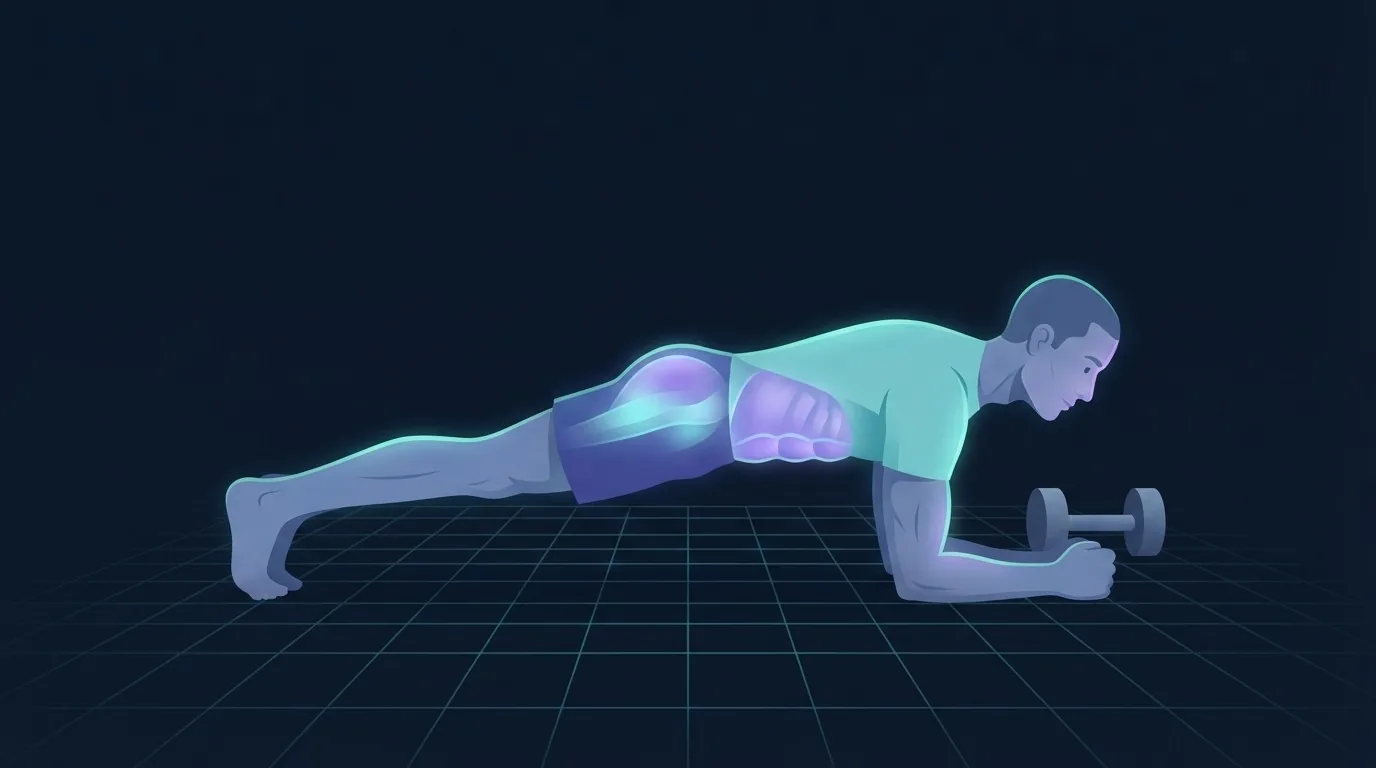
With the fat question settled, the training question gets a straightforward answer: treat the abs like any other muscle. They respond to load and progression, not to volume for its own sake. Two or three sessions a week, five to ten hard sets in total, is enough.
Cover three jobs rather than doing three versions of the same one:
- Flexion under load. The rectus abdominis shortens the distance between ribcage and pelvis. Hanging leg raises and weighted cable crunches load this pattern properly. Bodyweight crunches are a reasonable entry point, but they stop being a growth stimulus once you can knock out forty of them.
- Anti-extension. Resisting the pull of gravity on your lower back is what the trunk does during heavy lifting. Forearm planks and hollow holds train this, and both should be progressed by leverage or added load rather than by holding them longer and longer.
- Anti-rotation and rotation. The obliques and deep core resist twist. Russian twists, cable or band chops, and side planks cover this. Obliques thicken with heavy work, which some people want and some don't, so keep the load moderate if you're after a narrower waist.
Two things worth knowing. Endless daily high-rep ab work does very little that eight to fifteen hard progressive reps won't do better, and it eats recovery you'd rather spend on the compound lifts driving the fat loss. And a strong core makes your squat and deadlift safer and more stable, which matters because those lifts are doing most of the work on your body composition.
The 6 pack abs workout: what a real session looks like
Everything above says the fat layer decides whether anything shows. This section is what to do about the muscle underneath, because once you are lean enough for the outline to appear, thickness is what makes it look like a six pack rather than a flat stomach with lines on it.
The programming rules are the ordinary ones. Schoenfeld, Ogborn, and Krieger (2017) found muscle growth continuing up to at least ten hard sets per muscle per week, and a separate 2017 meta-analysis from Schoenfeld, Grgic, Ogborn, and Krieger found similar hypertrophy anywhere from roughly six to twenty reps when sets finish close to failure. Nothing about the abdominal wall exempts it from either. What that buys you is permission to stop doing four hundred crunches: ten hard weekly sets, split across two sessions, is the whole prescription.
| Session | Movement | Pattern it trains | Sets and reps | How to progress it |
|---|---|---|---|---|
| A | Hanging leg raise | Loaded flexion, pelvis travelling toward the ribs | 3 x 6 to 12 | Bent knees first, then straight legs, then a light dumbbell held between the feet |
| A | Forearm plank | Anti-extension | 2 x 20 to 45 sec | Walk the elbows forward to lengthen the lever, then a plate on the upper back |
| B | Reverse crunch | Flexion driven from the pelvis rather than the ribs | 3 x 10 to 15 | Lower over a four-count, then add an ankle weight |
| B | Side plank | Anti-lateral flexion | 1 x 20 to 45 sec per side | Raise the top leg, then hold a dumbbell at the hip |
| B | Band Pallof press | Anti-rotation | 1 x 8 to 12 per side | Step further from the anchor, or use a heavier band |
That is five hard sets in session A and five in session B, which lands exactly in the five to ten weekly range described earlier and leaves your recovery for the compound lifting that is actually driving the fat loss. Put each session at the end of a lifting day rather than defending a standalone ab day in a busy week. If you train without a bar to hang from or a band to anchor, our abs workout at home guide swaps every movement here for a floor equivalent with the same progression logic.
One thing this session is not doing is burning abdominal fat, for the reasons Vispute et al. (2011) established earlier on this page. It is building the muscle that becomes worth looking at once the fat layer is thin enough. Those are two separate projects that happen to run at the same time.
How to get lower abs (and why they show up last)
This is the most common follow-up question on the whole topic, and the honest answer has two halves that both disappoint people slightly.
The first half is that you cannot train the lower part of the muscle separately from the upper part. Lehman and McGill (2001), writing in Physical Therapy, put electrodes on the upper and lower portions of the rectus abdominis plus the external oblique in eleven participants chosen for low body fat so the signal would be clean, then measured activity across curl-ups, abdominal muscle lifts, leg raises and restricted versions of both, controlling for spine curvature, range of motion and posture. They found no differences in activity between the upper and lower portions of the rectus abdominis, either within an exercise or between exercises. External oblique activity did differ between exercises, so the method was sensitive enough to detect a real difference when one existed. Their conclusion was that differences between the portions are small and may lack clinical or therapeutic relevance. The rectus abdominis is one sheet with tendinous bands crossing it, not two muscles stacked on top of each other.
The second half is that the lower abdomen is where most people hold their last few percentage points of fat, which is covered in the timeline section above and is not a training problem at all. That combination is why the bottom row appears months after the top two and why no amount of reverse crunches accelerates it. Adding lower-ab work to make lower-ab fat leave is the spot reduction error in a different costume.
What is still worth doing, for reasons that have nothing to do with the word "lower": movements where the pelvis travels toward the ribs load the muscle through a range a curl-up never enters. Reverse crunches, hanging knee raises and hanging leg raises all do this, the hips get involved in a way sit-ups do not allow, and most people find those movements harder for the same effort. So keep one of them in the rotation, as session B above does. Just expect it to build the muscle rather than to uncover it.
What most people get wrong
Chasing the last three percent too early
The gap between 18 percent and 13 percent for a man feels like it should be the same amount of work as the gap between 28 percent and 23 percent. It isn't. The leaner you get, the smaller the absolute fat stores you're pulling from, the slower the arithmetic runs, and the harder hunger and low energy push back. Helms et al. (2014) note that leaner dieters need higher protein and shallower deficits precisely because the risk of losing muscle rises as body fat falls. Plan for the last stretch to take disproportionately long.
Cutting calories instead of adding training
The instinct when progress slows is to eat less. Garthe et al. (2011) is the argument against it: doubling the rate of loss didn't double the fat lost, it just cost the lean mass. A deficit already running at 0.5 to 1 percent a week doesn't need to be deeper. If your fat loss has genuinely stalled, look at daily movement first, since NEAT quietly falls during a diet and can wipe out a large fraction of the deficit you think you have.
Expecting the fat to leave in the order you want
The abdomen, and specifically the lower abdomen, is the last place many people lose fat. That's why you often see the upper two rows well before the bottom row shows up at all. Nothing about the training changes this ordering. It's genetically determined, it differs between people, and the only response available to you is more time in a modest deficit.
The sides of the waist run on the same clock, and our guide to how to get rid of love handles covers that depot along with the flat stomach and smaller waist questions.
Treating consistency as a willpower problem
A twelve-month timeline isn't hard because the individual days are hard. It's hard because keeping any behaviour going for fifty weeks is hard, and most abs plans die in month two rather than at the finish line. That's a design problem more than a discipline problem, and it's the reason to pick a training and eating approach you can imagine doing in February as well as in January. If accountability is where you personally break down, our roundup of the best workout apps for weight loss compares the tools built around sticking with it.
The bottom line
Getting abs is a fat loss project with a resistance training program attached, running on a calendar measured in months. Pick your target range from the table, work out the gap, divide by a sustainable rate, and you'll have a number that's probably longer than you hoped and considerably more likely to happen than the six-week version. Keep protein high, lift hard, keep the deficit modest, and give the abs two or three honest sessions a week so there's something worth revealing at the end of it.
You're not missing a secret exercise. You're at the part of the process where the answer is boring and the only variable left is how long you keep going.
References
- Vispute SS, Smith JD, LeCheminant JD, Hurley KS. "The effect of abdominal exercise on abdominal fat." Journal of Strength and Conditioning Research 25.9 (2011): 2559-2564. doi:10.1519/JSC.0b013e3181fb4a46.
- Ramirez-Campillo R, Andrade DC, Campos-Jara C, Henriquez-Olguin C, Alvarez-Lepin C, Izquierdo M. "Regional fat changes induced by localized muscle endurance resistance training." Journal of Strength and Conditioning Research 27.8 (2013): 2219-2224. doi:10.1519/JSC.0b013e31827e8681.
- Kostek MA, Pescatello LS, Seip RL, Angelopoulos TJ, Clarkson PM, Gordon PM, Moyna NM, Visich PS, Zoeller RF, Thompson PD, Hoffman EP, Price TB. "Subcutaneous fat alterations resulting from an upper-body resistance training program." Medicine and Science in Sports and Exercise 39.7 (2007): 1177-1185. doi:10.1249/mss.0b0138058a5cb.
- Gallagher D, Heymsfield SB, Heo M, Jebb SA, Murgatroyd PR, Sakamoto Y. "Healthy percentage body fat ranges: an approach for developing guidelines based on body mass index." American Journal of Clinical Nutrition 72.3 (2000): 694-701. doi:10.1093/ajcn/72.3.694.
- Garthe I, Raastad T, Refsnes PE, Koivisto A, Sundgot-Borgen J. "Effect of two different weight-loss rates on body composition and strength and power-related performance in elite athletes." International Journal of Sport Nutrition and Exercise Metabolism 21.2 (2011): 97-104. doi:10.1123/ijsnem.21.2.97.
- Helms ER, Aragon AA, Fitschen PJ. "Evidence-based recommendations for natural bodybuilding contest preparation: nutrition and supplementation." Journal of the International Society of Sports Nutrition 11 (2014): 20. doi:10.1186/1550-2783-11-20.
- Longland TM, Oikawa SY, Mitchell CJ, Devries MC, Phillips SM. "Higher compared with lower dietary protein during an energy deficit combined with intense exercise promotes greater lean mass gain and fat mass loss: a randomized trial." American Journal of Clinical Nutrition 103.3 (2016): 738-746. doi:10.3945/ajcn.115.119339.
- Lehman GJ, McGill SM. "Quantification of the differences in electromyographic activity magnitude between the upper and lower portions of the rectus abdominis muscle during selected trunk exercises." Physical Therapy 81.5 (2001): 1096-1101. doi:10.1093/ptj/81.5.1096.
- Schoenfeld BJ, Ogborn D, Krieger JW. "Dose-response relationship between weekly resistance training volume and increases in muscle mass: a systematic review and meta-analysis." Journal of Sports Sciences 35.11 (2017): 1073-1082. doi:10.1080/02640414.2016.1210197.
- Schoenfeld BJ, Grgic J, Ogborn D, Krieger JW. "Strength and hypertrophy adaptations between low- vs. high-load resistance training: a systematic review and meta-analysis." Journal of Strength and Conditioning Research 31.12 (2017): 3508-3523. doi:10.1519/JSC.0000000000002200.
Frequently Asked Questions
What body fat percentage do you need to see abs?
Most men start to see a defined upper two rows somewhere around 15 to 19 percent body fat and a full four-pack at rest around 12 to 14 percent. Most women see the same progression roughly 8 to 10 percentage points higher, with definition appearing around 25 to 29 percent and a visible four-pack around 20 to 24 percent. Those numbers are coaching field estimates rather than a trial result, and individual variation is large because fat distribution is heavily genetic. For context on where those numbers sit against health guidelines, Gallagher et al. (2000) in the American Journal of Clinical Nutrition mapped the healthy body fat band to roughly 8 to 20 percent for men aged 20 to 39 and 21 to 33 percent for women in the same age band.
Do crunches and ab workouts burn belly fat?
No. Vispute et al. (2011) in the Journal of Strength and Conditioning Research randomised 24 sedentary adults to six weeks of abdominal training, seven exercises, two sets of ten reps, five days a week, or to a control group, with diet held isocaloric. There was no significant change in body weight, body fat percentage, android fat, abdominal circumference, abdominal skinfold or suprailiac skinfold. The training group did improve abdominal muscular endurance, performing 47 curl-ups on the posttest versus 32 in the control group. Ab training builds the abdominal muscles. It does not remove the fat sitting over them.
How long does it take to get abs?
Work backwards from your starting body fat. A sustainable rate of loss is 0.5 to 1 percent of bodyweight per week, per Helms et al. (2014), and Garthe et al. (2011) found 0.7 percent per week preserved and even added lean mass in trained athletes while 1.4 percent per week did not. At that pace each single percentage point of body fat takes roughly two to three weeks. A man at 25 percent aiming for 13 percent is looking at seven to ten months. A man at 18 percent aiming for the same target is looking at two to four months. Women follow the same arithmetic from a higher starting band.
Can you get abs without losing weight?
Sometimes, if you have never trained seriously. Body recomposition means losing fat and adding muscle at the same time, which can leave scale weight flat while the waist shrinks. Longland et al. (2016) showed the mechanism clearly: young men in a 40 percent energy deficit eating 2.4 g/kg/day of protein and training six days a week gained 1.2 kg of lean mass while losing 4.8 kg of fat over four weeks. Beginners, returning lifters and people carrying more body fat see this most often. If you are already lean and trained, expect scale weight to fall as body fat falls.
Why can I see my top two abs but not the bottom ones?
Fat comes off in a genetically determined order, and for most people the lower abdomen and the area just above the hip bones is the last place to give it up. That is why the top rows appear first and the bottom row appears several percentage points later. It is also why the last stretch feels disproportionately slow. Nothing about your training is broken. You are simply at the part of the curve where the remaining fat is the most stubborn stored fat you have, and the only lever is more time in a modest deficit.
How often should you train abs?
Two to three sessions a week of direct core work is plenty, five to ten hard sets in total, treated like any other muscle with progressive overload rather than endless high-rep sets. Heavy compound lifting already loads the trunk, so the direct work is a supplement rather than the main event. Pick two or three movements that cover flexion, anti-extension and anti-rotation, such as hanging leg raises, planks and cable or band rotations, and add load or leverage over time instead of adding reps forever.
What does a 6 pack abs workout actually look like?
Two short sessions a week, five hard sets each, covering loaded flexion, anti-extension, anti-lateral flexion and anti-rotation. Session A is three sets of hanging leg raises and two sets of forearm planks. Session B is three sets of reverse crunches, one set of side planks per side and one set of band Pallof presses per side. Schoenfeld, Ogborn, and Krieger (2017) found growth continuing up to at least ten hard sets per muscle per week, and their 2017 load meta-analysis found similar hypertrophy anywhere from roughly six to twenty reps when sets finish close to failure, so progress by adding load or leverage rather than by adding reps forever. Attach each session to the end of a lifting day. None of it burns abdominal fat, which is a separate project run through the energy deficit.
How do you get lower abs?
The short version of how to get lower abs is that you get them the same way you get the rest of them, because there is no separate lower muscle to train. Lehman and McGill (2001) in Physical Therapy measured EMG activity in the upper and lower portions of the rectus abdominis during curl-ups, abdominal lifts, leg raises and restricted variations in eleven participants, controlling for spine curvature, range of motion and posture, and found no differences between the two portions within or between exercises, while external oblique activity did differ. The reason the bottom row shows up last is fat distribution, not training. Movements where the pelvis travels toward the ribs, such as reverse crunches and hanging leg raises, are still worth keeping because they load the muscle through a range a curl-up never enters, but they build the muscle rather than uncovering it.
Does everyone have a six-pack under the fat?
Everyone has a rectus abdominis, but the number of visible segments is set by your tendinous intersections, the bands of connective tissue that cross the muscle. Most people have three, giving the classic six-pack. Some have two, some have four, and the pattern is often asymmetric, which is why one side can look higher than the other. None of that is trainable. Getting lean reveals the pattern you were born with, it does not change it.