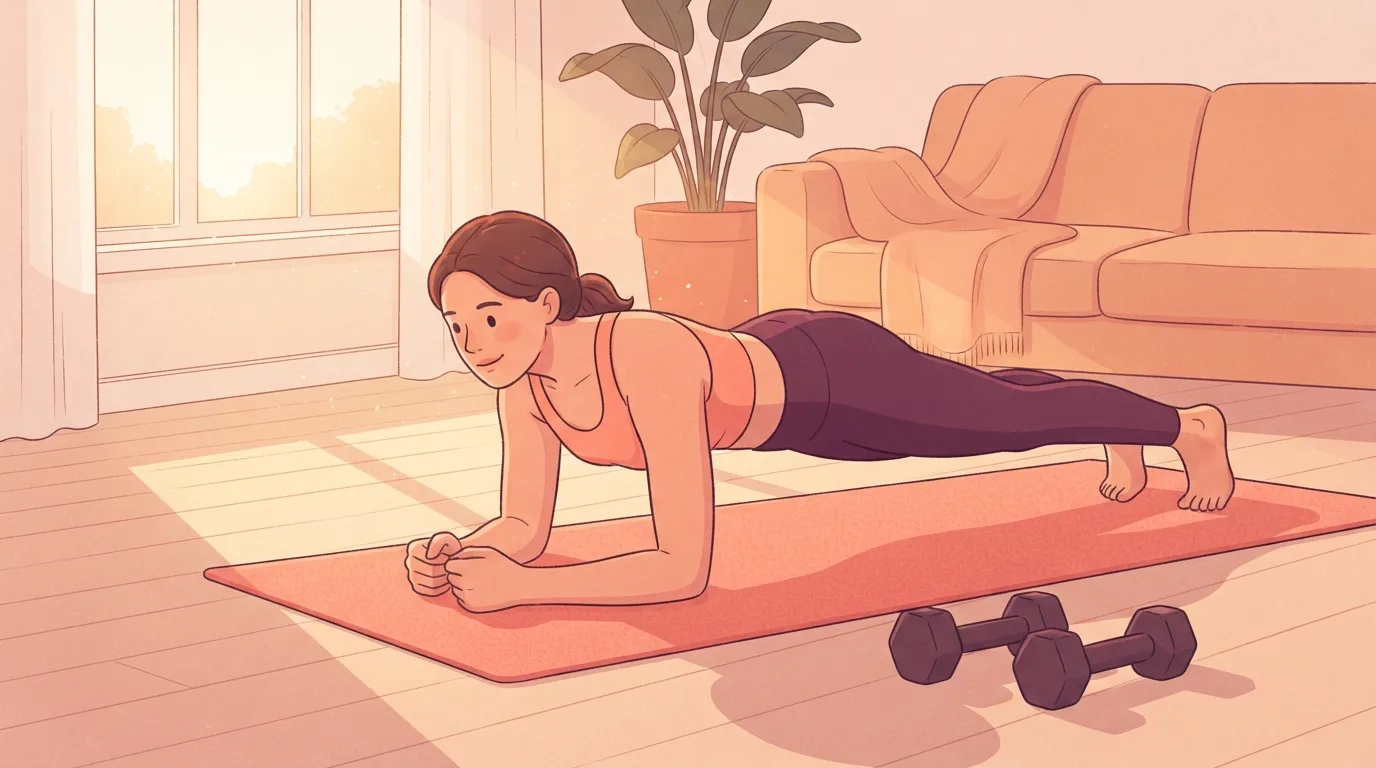
The 30-day ab challenge is one of the most popular plans in fitness, and most of the before-and-after photos attached to it come from people who were already close. They started lean, trained hard for a month, took the after photo in better light, and the internet filled in the rest. If you've tried one of those challenges and finished day 30 looking roughly like day 1, nothing was wrong with you.
It still stings. A month of daily crunches is real effort, and ending it with no visible change makes it easy to decide that abs are for other people, or that you lack discipline. Usually the plan was the problem: hundreds of reps of one movement that doesn't remove fat, and nothing aimed at the fat itself.
This guide does two jobs. First it shows you, with numbers, what a month can and can't change from where you're starting. Then it gives you a 30-day plan, week by week, built on a pair of dumbbells and your floor, that works on the muscle and on the fat covering it. Can you get abs in a month? Maybe. Can you finish the month leaner, stronger and with a smaller waist? Almost certainly.
Can You Get Abs in a Month?
Yes, if you start lean enough. Whether abs show depends on how much fat sits over the muscle, and our main guide on how to get abs puts a visible four-pack at about 12 to 14 percent body fat for most men and 20 to 24 percent for most women. So the useful question is how many percentage points one month can remove.
A sustainable pace of fat loss is about 0.5 to 1 percent of your body weight per week. The International Society of Sports Nutrition's position stand on diets and body composition (Aragon and colleagues, 2017) adds a rule that matters for a short plan: the more body fat you start with, the bigger the deficit you can handle, while leaner people keep more muscle at a slower pace. Over 30 days, that pace removes about 2 to 4 percent of your body weight. If most of it comes from fat, which takes resistance training and enough protein, your body fat drops by roughly 1.5 to 3.5 percentage points.
Run that arithmetic on a man who weighs 80 kg (176 lb) at 15 percent body fat and he finishes the month at about 11 to 13 percent, inside the four-pack range. The same man starting at 25 percent finishes around 22 to 23 percent. Both did the same month of work, and only one of them sees abs at the end of it.
What 30 Days Can Change at Your Starting Body Fat
Find the row closest to where you are now. The numbers assume an 80 kg (176 lb) man and a 65 kg (143 lb) woman who lose 0.5 to 1 percent of body weight a week for 30 days, all of it fat, which is the best case.
| Starting body fat | Body fat on day 30 | What you'll probably see |
|---|---|---|
| Men about 15% Women about 24% | Men 11 to 13% Women 21 to 22.5% | A four-pack at rest in decent light is realistic. Many 30-day transformation videos come from people in this row. |
| Men about 18% Women about 27% | Men 14.5 to 16% Women 24 to 25.5% | The upper two rows in direct light, mostly in the morning or right after training. Not a full six-pack yet. |
| Men about 22% Women about 31% | Men 18.5 to 20% Women 28 to 29.5% | A flatter, firmer stomach and a smaller waist, with little or no separation between the rows. |
| Men 28% or more Women 36% or more | Men about 25 to 26.5% Women about 33 to 34.5% | No visible abs yet. Clothes fit looser and the core is much stronger, which sets up the next two or three months. |
Real months rarely run at the best case. A slow week, a holiday weekend or a few days of poor sleep usually take a little off, and if you're in the top row, aim for the slower end of the range so the weight you lose stays fat rather than muscle. If you don't know your body fat, don't worry about a precise number. The waist and photo checks later on this page tell you more over 30 days than any bathroom scale estimate.
What Changes First: Water, Waist, Strength, Then Muscle
A month isn't one change. Four things move on four different clocks, and knowing the order keeps you from misreading week one or quitting in week three.
Days 1 to 7: water and bloat
Your body stores carbohydrate as glycogen, and glycogen holds a lot of water. Kreitzman and colleagues (1992) describe glycogen as stored with three to four parts water, and they discuss how drawing it down early in a diet makes weight fall fast at first and rebound fast if carbohydrate floods back in. That's why the scale often drops 1 to 2 kg in the first week and then slows down. Less food and fluid in your gut also makes your stomach look flatter by day five or six. Enjoy it, and don't count it as fat.
Weeks 1 to 4: the waist
Waist size follows weight loss closely. Miyatake and colleagues (2007) followed 2,635 Japanese adults for a year and found that losing 3 kg went with a waist about 3.45 cm smaller at the navel in men and 2.83 cm smaller in women. Applied to the table above, a month of steady fat loss takes roughly 2 to 4 cm off a man's waist and 1.5 to 2.5 cm off a woman's. That study tracked a year, not a month, so treat it as a rough guide. It's still the most useful number you have, because a tape at the navel picks up change weeks before the mirror does.
Weeks 1 to 3: strength and endurance
Your core gets stronger quickly, and most of that early gain is your nervous system learning to use the muscle you already have. Moritani and deVries (1979) tracked eight weeks of strength training and found that neural factors accounted for most of the gain early on, with muscle growth becoming the main driver only after three to five weeks. Expect your plank, your side plank and your dumbbell rows to improve noticeably by the end of week two.
After week 3: muscle
Real muscle growth starts later than most 30-day plans admit. Damas and colleagues (2016) took muscle biopsies from 10 young men at the start of a training programme, at week 3 and at week 10. Fibre size hadn't increased measurably at week 3 and had increased by week 10. Early in a programme, much of the muscle's effort goes into repairing damage from unfamiliar training. So the ab muscle you build in month one is real, but it mostly shows up in months two and three, which is one more reason to keep going after day 30.
Why a 30-Day Abs Plan Is Mostly a Fat-Loss Plan
Ab exercises build the muscle, and they don't remove the fat covering it. Controlled trials that added weeks of ab training to the same diet found no extra loss of belly fat, and our main guide on how to get abs walks through those trials along with the deficit, protein and lifting rules behind them. For a 30-day plan, the short version is this: lose 0.5 to 1 percent of your body weight a week, eat protein at every meal, and keep lifting so the weight that comes off is fat. The rest of this page is how to do that for four weeks.
Find out what's really holding you back
FitCraft, our mobile fitness app, pairs you with an AI coach who builds you a personalized plan around your goals, schedule, and fitness level. Every FitCraft program is designed by Domenic Angelino, MPH (Brown University) and NSCA-CSCS, with research published in the Journal of Strength and Conditioning Research and Medicine & Science in Sports & Exercise.
Take the Free Assessment Free • 2 minutes • No credit cardThe 30-Day Abs Plan, Week by Week
You need a pair of dumbbells you can row about 10 times with good form, a mat and about 40 minutes three times a week, plus a daily walk. Every strength day ends with a core block, and the core block changes each week. The other days stay light on purpose, so your abs get the rest they need between hard sessions.

The weekly structure
| Day | What you do |
|---|---|
| Monday, Wednesday, Friday | Full-body dumbbell session (about 30 minutes), then that week's core block (10 to 12 minutes) |
| Tuesday, Thursday, Saturday | A brisk 30 to 45 minute walk, plus an optional 5 minutes of easy dead bugs and bird dogs |
| Sunday | Rest, or an easy walk |
The full-body session stays the same all month: goblet squats, dumbbell Romanian deadlifts, push-ups and one-arm dumbbell rows, 3 sets of 8 to 12 reps each, stopping one or two reps before you'd fail. Add a rep or a little weight each week. This is the part that keeps the weight you lose coming from fat, and the squat and row train your trunk hard too.
Whether you can train abs on the in-between days depends on how hard those days are, and our post on can I do abs every day explains where the line sits. In this plan, easy daily movement is fine and the hard core work stays on three days.
Week 1 (days 1 to 7): set your baseline
- Core block: dead bug 2 x 8 per side, forearm plank 2 x 20 to 30 seconds, side plank 2 x 15 to 20 seconds per side.
- Eating: eat about 300 to 500 calories a day less than usual. The simplest version is to drop sugary drinks and one daily snack. Aim for about 1.6 grams of protein per kilogram of body weight, roughly 130 grams a day at 80 kg.
- Walking: add about 2,000 steps to your current daily average.
- Day 1 only: take your measurements and photos (see the measuring section below).
The protein number comes from Morton and colleagues (2018), a meta-analysis of 49 trials with 1,863 people, which found that protein intakes above about 1.6 grams per kilogram a day added no further muscle gain during strength training. In a calorie deficit, the ISSN position stand points lean lifters toward higher intakes, so treat 1.6 as the floor and move toward 2.2 grams if you're already lean or often hungry.
Week 2 (days 8 to 14): add load
- Core block: dumbbell dead bug (one dumbbell held above your chest with both hands) 3 x 8 per side, forearm plank 3 x 30 to 40 seconds, suitcase hold (one heavy dumbbell at your side, standing tall without leaning) 3 x 30 seconds per side, reverse crunch 2 x 10.
- Eating: compare this week's average morning weight with last week's. If it hasn't dropped by about 0.5 percent, trim another 150 to 200 calories a day.
- Walking: keep the step target and take one walk straight after your biggest meal.
Week 3 (days 15 to 21): longer levers and anti-rotation
- Core block: renegade row 3 x 6 per side, dumbbell crunch (dumbbell held on your chest) 3 x 10 to 12, side plank with the top leg raised 3 x 20 to 30 seconds per side, hollow hold 2 x 20 seconds with knees bent if needed.
- Eating: spread protein across three or four meals so each one has a solid portion.
- Walking: stretch one weekend walk to 60 minutes.
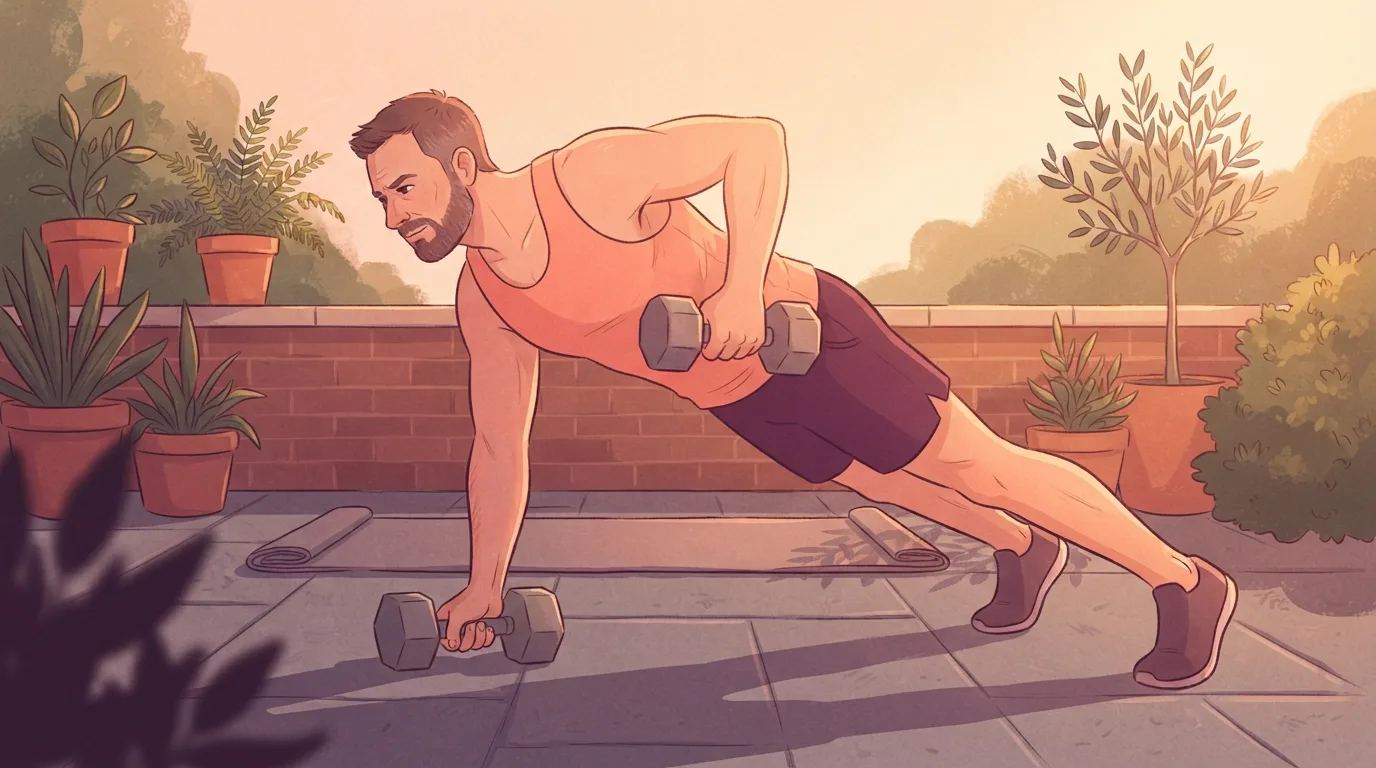
The renegade row is the hardest new move of the month, so set it up carefully. Start from a high plank with your hands on two dumbbells and your feet wider than your hips. Row one dumbbell to your ribs while your hips stay level, as if a glass of water sat on your lower back. If your hips swing, widen your feet or use lighter dumbbells.
Week 4 (days 22 to 28): peak week
- Core block: renegade row 3 x 8 per side, dumbbell crunch with a 2-second squeeze at the top 3 x 12 to 15, suitcase carry (walk with one heavy dumbbell) 3 x 40 seconds per side, hollow hold 3 x 25 to 30 seconds.
- Eating: hold the same calories. Don't slash food in the last week to chase a better photo, because the water you'd lose comes straight back.
- Walking: keep the step target.
Days 29 and 30: retest
Take day 29 easy with a walk. On day 30, repeat every measurement from day 1 under the same conditions, then test your longest forearm plank with good form and your longest side plank on each side. Write the numbers down next to day 1. That comparison, not the mirror alone, tells you what the month did.
How to Measure Your 30-Day Ab Transformation
Most abs before and after photos aren't fake, but very few are fair. Light from directly overhead deepens every shadow on the stomach. A pump after training, a morning with an empty stomach, a slight lean back and a flexed brace can each make the same body look leaner in the second photo. If you want your own ab transformation to tell you something true, control those things:
- Same time: morning, after the bathroom and before you eat or drink.
- Same light: stand side-on to a window, with no overhead light on.
- Same camera position: phone at belly-button height, same distance, same spot on the floor.
- Two shots each time: one fully relaxed and one with your abs braced, from the front and the side.
- Waist tape: measured at the navel, the level the Miyatake study used, after a normal breath out.
- Weight: the 7-day average, not one morning, since water alone can move the scale by a kilogram.
A fair day-30 photo usually shows a smaller waist, a flatter lower belly and sharper outlines at the sides before it shows the classic six-pack. That's what progress looks like at most starting points.
Can You Get Abs Faster Than 30 Days?
Going faster means a bigger deficit, and the best evidence on that is a laboratory ceiling, not a plan. Longland and colleagues (2016) gave 40 young men a diet about 40 percent below their energy needs for four weeks, with every meal provided, plus resistance training and interval sessions six days a week. The higher-protein group lost about 4.8 kg of fat and still gained lean mass. That's close to the best case for a single month, and it took a research kitchen, daily supervised training and a deficit most people can't hold at home.
The leaner you already are, the worse an aggressive month works. Aragon and colleagues' position stand notes that leaner dieters keep more muscle at slower rates, and the top row of the table is exactly where people are tempted to crash diet. The other shortcut, cutting carbs and water for a few days before a photo, works through the glycogen effect described above. It sharpens the lines for a day or two and reverses as soon as you eat and drink normally.
So the quickest honest route to ripped abs is the plan on this page run at the faster end of the range if you have more fat to lose, the slower end if you're already lean, and photos taken under the same conditions each time.
What to Do on Day 31
If you can see your abs on day 30, stop the deficit and eat at maintenance for a few weeks, keep the three strength sessions, and keep two or three hard core blocks a week to build the muscle you've uncovered. If you can't see them yet, compare your day-1 and day-30 numbers. Your waist change and weekly rate of loss tell you how many more months the job takes, and the timeline table in our main abs guide turns that into a calendar. If you'd rather train without weights from here, our abs workout at home guide gives a six-week no-equipment core progression that picks up where this month ends.
Month two is where most plans die. The first 30 days run on novelty, and the next 30 run on habit, which is a design problem more than a discipline problem. If you'd like the sessions laid out for you, our page on a home workout app with no equipment needed shows how FitCraft runs dumbbell and bodyweight programs at home. An AI coach demonstrates each exercise as an interactive 3D character, says your name during the workout, and keeps a streak going, so skipping a session feels like it costs something.
The Bottom Line
How to get abs in 30 days comes down to where you start. From about 15 percent body fat as a man or 24 percent as a woman, a month of steady fat loss and hard core work can reveal a four-pack. From higher up, the same month takes off a few kilograms of fat and a few centimeters of waist, makes your core much stronger, and puts you months closer to the goal than doing nothing would.
As Mike, 23, put it after four months of training: "The streak system got me hooked. I didn't want to break my chain." That's the real target for these 30 days. Finish the month, keep the chain going, and let the next two months build on it.
Frequently Asked Questions
Can I gain abs in 1 month?
You can build a noticeably stronger core in one month, and you can reveal abs in one month if you start lean, around 15 percent body fat for men or 24 percent for women. A steady month of fat loss lowers body fat by about 1.5 to 3.5 percentage points. Visible new ab muscle takes longer: in Damas and colleagues (2016), muscle fibres had not grown measurably after three weeks of training and had grown by week 10.
Can you get abs in 25 days?
Only if you're already close. Twenty-five days at a sustainable 0.5 to 1 percent of body weight per week removes roughly 2 to 3.5 percent of your body weight, which lowers body fat by about 1.5 to 3 percentage points if most of the loss is fat. A man starting near 14 percent or a woman near 23 percent can get there. From higher starting points, 25 days builds strength and shrinks the waist but doesn't uncover abs.
How rare is 4 pack abs?
A genetic four-pack is uncommon. In two cadaver studies covering 86 adults, Broyles and colleagues (2018) and Anita and colleagues (2015) found that 82 had three tendinous intersections on the rectus abdominis, the pattern behind a six-pack, three had four and one had five, and none had only two. Most people who see a four-pack have a six-pack whose lowest row is still covered by fat, which is the last fat to go for many people.
Will 100 sit ups a day give me abs?
Not on their own. A hundred sit-ups a day for 30 days will make you better at sit-ups and strengthen the muscle, but they burn very little energy and don't remove the fat covering your abs. Visible abs in a month come from starting lean and running a modest calorie deficit, with a few hard core sessions a week rather than one high-rep exercise every day.
How do you get abs in 30 days at home without weights?
Run the same plan and swap each dumbbell move for a harder bodyweight version: a straight-leg dead bug for the dumbbell dead bug, a plank with alternating arm reaches for the renegade row, a slow reverse crunch with a pause for the dumbbell crunch, and a single-arm side plank hold for the suitcase carry. Make each week harder with longer levers, slower reps and more rounds. The fat-loss side doesn't change.
How can a woman get abs in 30 days?
The method is the same as for men, and the starting line sits higher. A visible four-pack usually appears around 20 to 24 percent body fat in women, so a woman starting near 24 to 26 percent can see upper ab definition within a month of steady fat loss. Keep protein around 1.6 grams per kilogram of body weight, lift three times a week and stay near 0.5 percent of body weight lost per week if you're already lean.
What results can you get from an ab wheel in 30 days?
Expect a big jump in how far you can roll out with a flat lower back, from short kneeling rollouts in week one to full-range kneeling rollouts for many people by week four, because early strength gains are mostly the nervous system learning the movement. Expect no change in belly fat from the wheel itself. Treat it as a hard anti-extension exercise two or three times a week, not a daily fat burner.