You finally found an ab routine you like, and you're wondering whether doing it every day would get you there faster. Or you've been doing it every day for three weeks, your abs are sore all the time, and nothing looks different. Both questions lead to the same place.
Ask a forum whether you can do abs everyday and you'll get two confident and opposite answers. One camp says abs are an endurance muscle you can hit daily. The other says abs are a muscle like any other and need rest. Each camp is half right, and the half each one gets wrong decides whether daily ab work helps you or just keeps you busy.
This post settles it with the research on abdominal muscle fibres, training frequency and spine loading, then gives you a week that uses the daily habit without wasting it.
Can You Train Abs Everyday?
Yes, as long as you separate two very different kinds of ab work. Light core work keeps your trunk muscles working at a low level, puts little load on your spine and leaves almost no fatigue behind. Hard ab training takes a muscle close to failure, often with added weight, and that's the stimulus that makes the muscle grow. Your body handles the first kind daily without complaint. The second kind needs recovery time.
| Light core work | Hard ab training | |
|---|---|---|
| Examples | Dead bugs, bird dogs, short side planks, curl-ups, breathing with a gentle brace | Weighted crunches, slow reverse crunches, hollow holds, ab wheel rollouts, renegade rows |
| How it feels | You could easily do more. No burning at the end | The last two or three reps are a real fight |
| How often | Every day is fine | Two to four days a week, with a day between |
| What it builds | Control, endurance and a daily habit | Muscle size and strength |
So the honest answer to "should I do abs everyday" is that you can, and you'll get more from it if only some of those days are hard. Most people who train abs daily make every session the same medium effort: too hard to be truly light, too easy to drive growth.
Do Abs Recover Faster Than Other Muscles?
Not in any way that justifies hard daily training. The idea that abs can be trained like a postural muscle comes from the fact that they work all day to hold you upright. That's true of the deep core, and it's why light daily work is fine. It doesn't make the rectus abdominis, the six-pack muscle, a different kind of tissue.
Häggmark and Thorstensson took biopsies from all four muscles of the abdominal wall in 13 adults having gall-bladder surgery: the rectus abdominis, the external and internal obliques and the transversus abdominis. The average mix was 55 to 58 percent type I (slow-twitch) fibres and the rest fast-twitch, with little difference between the four muscles and large differences between people. That's a mixed muscle, not a fatigue-proof one. Load it hard and it gets damaged and sore like your quads or chest would.
That explains the familiar pattern. Easy daily planks rarely leave you sore. A first session of slow weighted crunches can make it hurt to laugh for two days. The muscle is the same, and only the dose has changed. When your abs are still sore from the last hard session, that's the signal to keep today light.
How Often Should You Train Abs?
Two to four hard sessions a week works for almost everyone, and the research says the exact number matters less than the total work you put in across the week.
Schoenfeld, Grgic and Krieger (2019) pooled 25 studies on how often a muscle should be trained. When the weekly number of sets was the same, training a muscle once, twice or three or more times a week produced no meaningful difference in growth. Their conclusion was that you can pick your weekly frequency by preference once the volume is set. A single trial makes the point concrete for a near-daily schedule: Saric and colleagues (2019) split the same weekly workload across either three or six sessions for six weeks in 27 trained men, and both groups gained similar strength and muscle thickness.
For abs, that gives you a simple rule. Decide your weekly hard sets first, somewhere around 6 to 12 for most people, then spread them however suits your week. Three sessions of three or four hard sets works. So do six tiny sessions of one or two hard sets, as long as no single day is so long that it leaves you too tired for the next. What doesn't work is the same 15-minute grind every day with nothing close to failure in it.
Is It Better to Do Abs Every Day or Every Other Day?
For hard sessions, every other day is better. For light work, every day is fine. Most people do best with a mix of the two:
- Monday, Wednesday, Friday: a hard ab block of 10 to 15 minutes at the end of your workout, three or four hard sets.
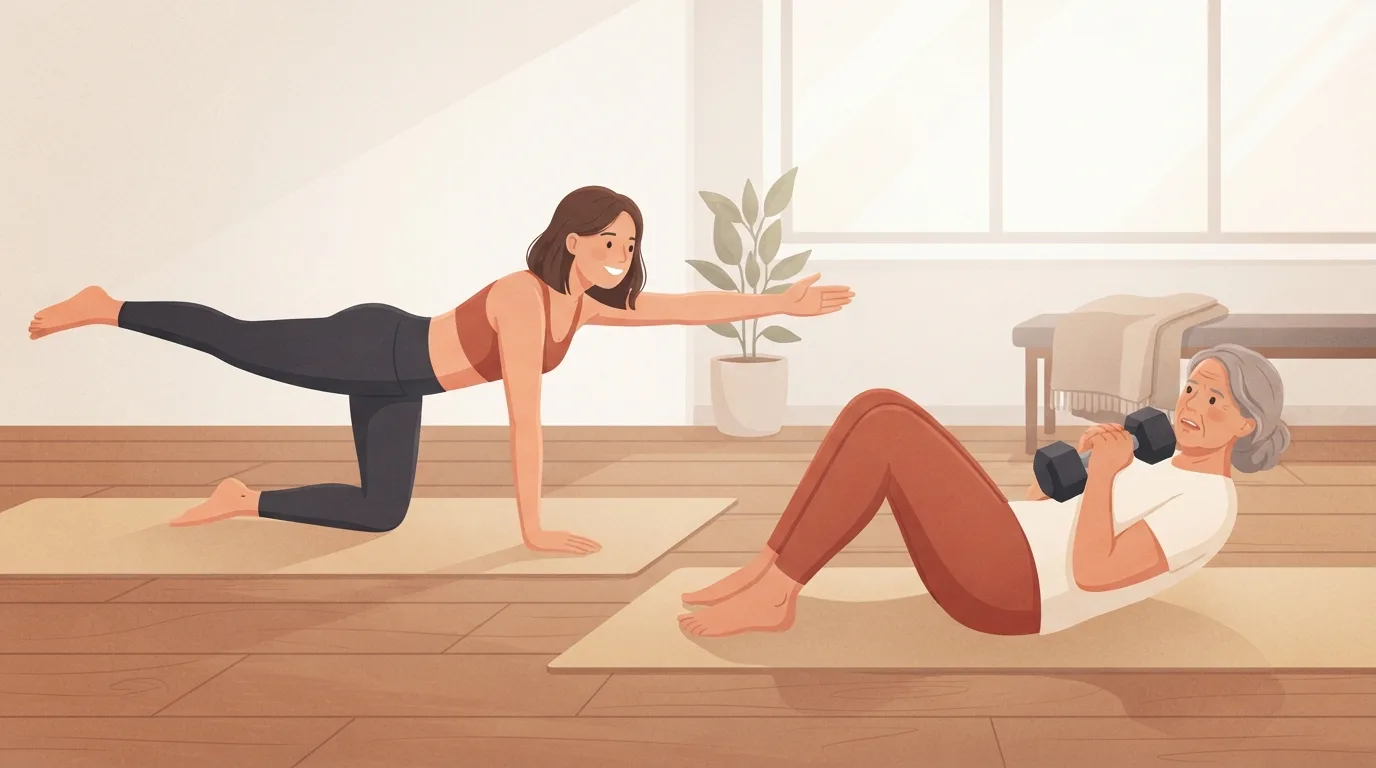
- Tuesday, Thursday, Saturday: five minutes of light core work, such as dead bugs, bird dogs and short side planks.
- Sunday: nothing, or a walk.
If you prefer an every-day habit, flip it: one or two hard sets a day on six days, with the rest of each short session light. The weekly total ends up in the same place. The choice that doesn't hold up is hard work every single day with no easier days, which the broader research on whether it's bad to work out every day flags as the fast route to a stalled program.
Knowing what to do is the easy part.
FitCraft, our mobile fitness app, pairs you with an AI coach who builds you a personalized plan around your goals, schedule, and fitness level. Every FitCraft program is designed by Domenic Angelino, MPH (Brown University) and NSCA-CSCS, with research published in the Journal of Strength and Conditioning Research and Medicine & Science in Sports & Exercise.
Take the Free Assessment Free • 2 minutes • No credit cardWhat Daily Ab Work Means for Your Lower Back
This is the part of the question most answers skip. Muscles recover. The discs between your vertebrae adapt more slowly, and some ab exercises load them a lot more than others.
Axler and McGill (1997) measured abdominal muscle activity and estimated lumbar spine compression in nine volunteers across 12 abdominal exercises, then ranked each exercise by how much muscle challenge it gave per unit of spine load. Partial curl-ups gave the best ratio overall, and no single exercise trained all the abdominal muscles while keeping spine loads low. The authors concluded that a mix of exercises, chosen for the job, works better than one favourite repeated forever.
The worry about daily bending comes from Callaghan and McGill (2001), who bent pig spine segments back and forth under modest compression, up to 86,400 times at one cycle per second, and produced disc herniations. That's a strong signal that repeated flexion under load can injure a disc. It's also a lab model: dead tissue, a pig neck, continuous bending with no rest. Contreras and Schoenfeld (2011) reviewed that work and argued that living discs adapt to training and get rest between sets, so crunch-style exercises are reasonable for healthy people in sensible doses, while people with disc problems should be more careful.
Two practical rules come out of this. First, make your daily exercises the low-spine-cost ones, like dead bugs, bird dogs, side planks and curl-ups, and save the loaded bending for your hard days. Second, don't do your ab work in the first hour after you get up. Snook and colleagues (1998) randomized 85 adults with chronic low back pain, and those taught to avoid bending forward in the early morning, when the discs hold the most fluid, reported less pain than a group given sham exercises.
Can I Do Abs Every Day to Lose Belly Fat?
No. Daily ab work strengthens the muscle and doesn't shrink the fat in front of it. Kordi and colleagues (2015) put 40 women with overweight or obesity on the same diet, added 12 weeks of abdominal resistance training for half of them, and measured belly fat with ultrasound. Both groups lost weight and belly fat, and the ab training added nothing measurable. Our guide on how to get abs covers the rest of that evidence and what does work: a modest calorie deficit, enough protein and full-body strength training.
Daily Abs Exercises That Are Safe to Repeat
A good daily routine is short, uses low spine load and finishes with you feeling better than when you started. Here's a five-to-ten-minute version you can repeat every day:
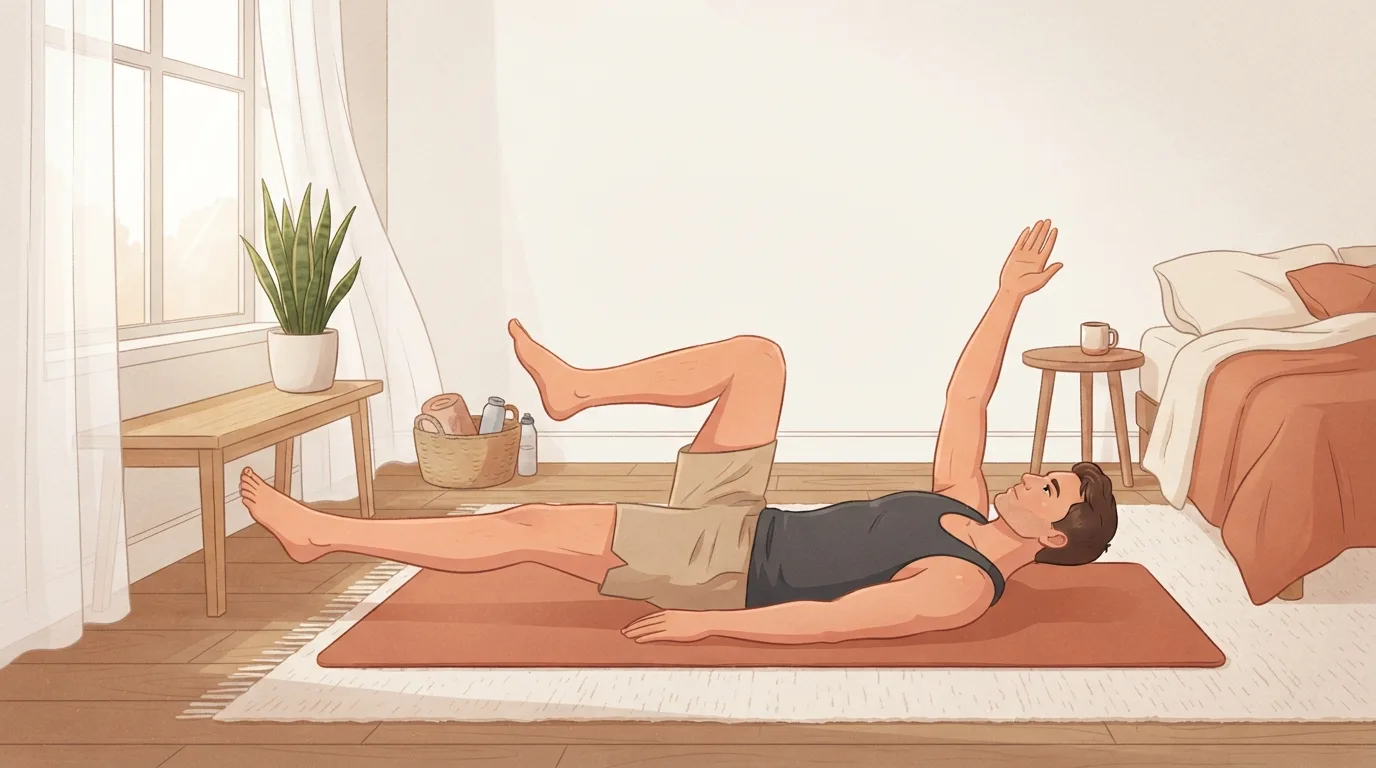
- Breathing with a brace, 1 minute. Lie on your back with knees bent, breathe slowly into your belly, then tighten your trunk gently as if bracing for a light poke while you keep breathing.
- Dead bug, 2 x 6 to 8 per side. Lower back stays in contact with the floor the whole time.
- Bird dog, 2 x 6 per side. Hold each rep for a slow count of five without letting your hips rotate.
- Side plank, 2 x 10 to 20 seconds per side. From the knees if the full version shakes badly.
- Curl-up, 1 or 2 x 6 to 8. Hands under your lower back, one knee bent, lift only your head and shoulders a few centimeters.
On your hard days, add three or four sets of one or two harder moves, such as reverse crunches with a pause, crunches holding a dumbbell on your chest, hollow holds, renegade rows or ab wheel rollouts. Take each set to within two or three reps of failure. If you train at home with no equipment, our abs workout at home guide has a six-week progression for the hard days that needs nothing but floor space.
Signs You're Doing Too Much Ab Work
- Your abs are sore most days. Some soreness after a new hard session is normal. Soreness that never clears means the hard days are too close together.
- Your numbers have stopped moving. If your plank time and reps have been flat for two or three weeks, more sessions won't fix it. Harder sets with more rest usually will.
- The front of your hips aches. Leg raises and sit-ups lean heavily on the hip flexors. Swap some of them for dead bugs and reverse crunches.
- Your lower back complains. Drop the loaded bending for a week, keep the bracing and side planks, and if pain persists or travels down a leg, see a clinician.
- Your other lifts get worse. A tired core makes squats and rows less stable, which is one reason to put hard ab work at the end of a session.
The Real Benefit of Doing Abs Every Day
The best argument for daily ab work isn't physiological. It's behavioral. Habits form through repetition in the same context, and a short routine at the same time each day gives you far more repetitions than longer sessions on scattered days. Lally and colleagues (2010) followed 96 volunteers who picked one daily behaviour to repeat in the same context for 12 weeks. Reaching full automaticity took anywhere from 18 to 254 days, and missing a single day didn't materially set the process back.
That's the case for a five-minute daily core habit: it keeps you showing up, and the days you miss don't undo it. If the daily part is where you usually fall off, our roundup of the best fitness apps for staying consistent compares tools built around exactly that. FitCraft is one of them: streaks make a missed day visible, and your AI coach says your name and demonstrates each exercise as an interactive 3D character, so a light day still feels like a session.
What This Means for You
Yes, you can do abs every day. Make most of those days light and short, make two to four of them genuinely hard, and choose low-spine-load exercises for the daily part. Your core will get stronger and more stable within a few weeks, and you'll build a habit that makes the hard days easier to keep.
Whether anyone sees your abs is a separate question, and it depends on body fat more than on how often you train. If you want to know what a single month can realistically change from where you're starting, our guide on how to get abs in 30 days runs the numbers and lays out a week-by-week plan.
Frequently Asked Questions
Is 20 minutes of abs a day enough?
Twenty minutes a day is more than most people need. Two to four hard sessions of 10 to 15 minutes a week, plus five minutes of easy core work on the other days, covers what the frequency research supports. If you want to spend 20 minutes every day, keep most of those days easy and put the extra time into walking or full-body strength training, which do far more for visible abs.
If I do abs every day, when will I see results?
You'll feel results within two to three weeks, as planks get longer and crunches get easier. Seeing results depends on body fat rather than on the number of ab days. A month of steady fat loss lowers body fat by only a few percentage points, so visible abs within weeks are realistic only for people who start lean. Our 30-day abs plan shows the numbers for each starting point.
Will 100 sit ups a day give me abs?
No. A hundred sit-ups burn very little energy, so they don't shrink the fat layer that hides the muscle, and repeating the same loaded spine bend every day is the pattern back researchers worry about most. You'd get more from a few hard sets of crunches or reverse crunches three times a week, light core work on the other days and a modest calorie deficit.
Can you do 10-minute abs everyday?
Yes, if you rotate the intensity. Make two to four of the week's 10-minute sessions hard, with loaded crunches, reverse crunches or hollow holds taken close to failure, and make the rest easy, with dead bugs, bird dogs and short side planks. Doing the same hard 10 minutes every day leaves no time to recover and usually stops working within a few weeks.
Does getting abs flatten your stomach?
Partly. Stronger abs help you hold your trunk upright and can make your stomach look a little tighter, but they don't remove the fat over the muscle. In Kordi and colleagues (2015), 40 women on the same diet lost similar amounts of belly fat with or without 12 weeks of abdominal resistance training. A flatter stomach comes mainly from losing body fat.
Is it better to do abs everyday or every other day?
Every other day is better for hard ab training, and every day is fine for light core work. A 2019 meta-analysis of 25 studies found that how often you train a muscle makes little difference to growth once the weekly volume is the same, so the best schedule is the one that lets each hard session be genuinely hard.
Does abs in 30 days work?
Thirty days of ab training works for strength: most people hold planks longer and find hard sets easier within two or three weeks. It works for visible abs only when you start lean, since four weeks of fat loss takes off just a few points of body fat. For everyone else, the month is a strong start rather than the finish, and our guide on how to get abs in 30 days shows what a month changes at each starting point.
How long do abs realistically take?
For most people, several months. Visible abs need a low enough body fat, roughly 12 to 14 percent for men and 20 to 24 percent for women for a four-pack, and a sustainable fat-loss pace lowers body fat by about one percentage point every two to three weeks. People who start lean can get there in a month or two.