
The question "is it bad to workout every day" hides an ambiguity that changes the answer. A daily 30-minute walk and a daily 90-minute heavy lifting session are both "working out". One is what the world's largest public health authorities actively want you to do. The other is a fast track to a stalled program, an injury, or both. Same word, opposite prescription.
The confusion matters because the internet's default answer, "yes, always take rest days", is roughly half wrong. Rest days are per muscle group, not per person. Your body was built to move every day, and it was not built to squat heavy every day. Splitting those two ideas apart is what makes a seven-day training week sustainable and what saves the tired-and-frustrated version of you from quitting in month two.
Here is what the research says, what it does not, and how to build a week you can actually hold to.
What Counts as a "Workout"?
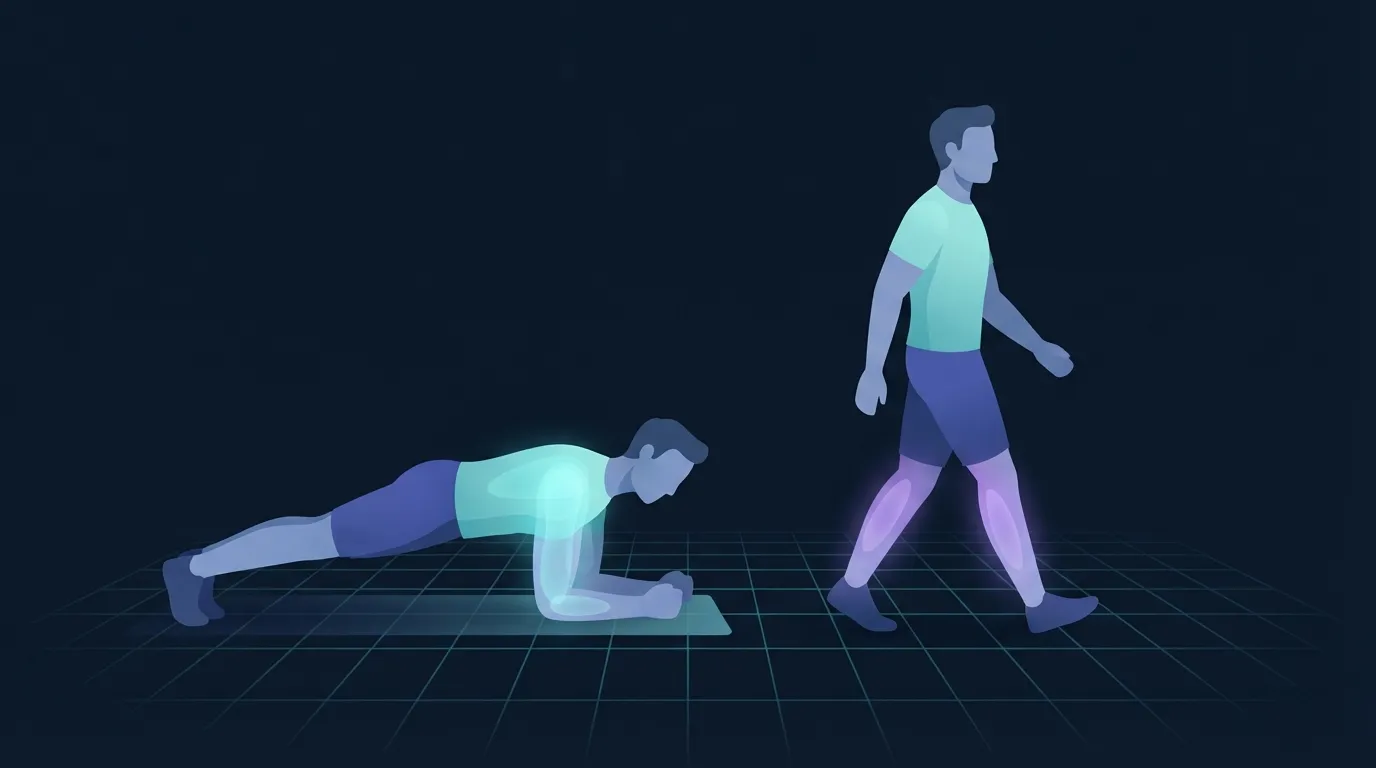
Public health people separate physical activity into two big buckets. Aerobic activity, which includes walking, cycling, swimming and any steady-state cardio. And muscle-strengthening activity, which is anything that overloads a muscle enough to make it adapt, from bodyweight push-ups to heavy squats. These two buckets recover on completely different clocks.
Aerobic activity at moderate intensity does not need 48 hours between sessions. Walking every day is fine. Zone 2 cycling every day is fine. Recovery for easy aerobic work happens in hours, not days, which is why marathoners routinely run six or seven days a week without exploding.
Hard resistance training does need 48 hours between sessions for the same muscle group. A trained muscle takes roughly two days to recover its full contractile capacity after a hard session that took it close to failure. That is why bro splits and upper/lower rotations exist. You can lift six days a week if each day is a different body part, because any given muscle is still getting its two days.
High-intensity intervals sit in the middle. They are aerobic in the sense that they train the cardiovascular system, but they cost enough recovery that most people can only tolerate one or two truly hard interval sessions a week without their easy work getting compromised.

What the Guidelines Actually Say
The 2018 US Physical Activity Guidelines for Americans, published as a JAMA article by Piercy and colleagues, ask adults for 150 to 300 minutes a week of moderate aerobic activity, or 75 to 150 minutes of vigorous, plus muscle-strengthening work on two or more days a week. The paper is unusually explicit that there is no known upper limit of benefit within the range they measured. Movement is dose-responsive right up the curve.
Break 150 minutes across seven days and you get about 22 minutes a day. That is 20 minutes of brisk walking after dinner, or a couple of stops earlier on the way home. The floor for real health benefit is a daily habit that fits inside a single podcast episode, not a gym session. If your "every day" workout is that shape, you are inside the guidelines, not outside them.
The 300-minute upper end of the recommendation, and the "no upper limit" note, is where the daily-workout question actually lives. Movement seven days a week is not the problem the guidelines were written to solve. Absence of movement is.
Overtraining Is Real, But It Is Rarer Than the Internet Suggests
The word "overtraining" gets flung around a lot for what is usually one bad session, one bad week, or a poorly planned block. Actual overtraining syndrome is a specific clinical picture, and the 2013 ECSS and ACSM joint consensus statement by Meeusen and colleagues in Medicine and Science in Sports and Exercise laid out the taxonomy that everyone in the field now uses.
There are three tiers. Functional overreaching is a short-term dip in performance that resolves after a few days of easy work and full-value nights of sleep. Every serious program produces some of this on purpose. It is the intended stimulus. Non-functional overreaching is a longer dip that takes weeks to clear, with worse mood and worse sleep along the way. Overtraining syndrome, the real thing, is months of unresolved fatigue, plummeting performance, and clinical symptoms that persist despite proper rest.
The consensus statement is explicit that overtraining syndrome requires excessive training load plus inadequate recovery, food or sleep, sustained across weeks. It does not happen because you trained five days in a row. It happens because you trained hard for a month while sleeping five hours a night, eating too little, and ignoring the warning signs. If you are eating and sleeping and your fatigue clears with three easier days, you are not overtrained. You needed a lighter week.
Knowing what to do is the easy part.
FitCraft, our mobile fitness app, pairs you with an AI coach who builds you a personalized plan around your goals, schedule, and fitness level. Every FitCraft program is designed by Domenic Angelino, MPH (Brown University) and NSCA-CSCS, with research published in the Journal of Strength and Conditioning Research and Medicine & Science in Sports & Exercise.
Take the Free Assessment Free • 2 minutes • No credit cardWhen Working Out Every Day IS a Problem
Four scenarios turn a daily habit from a strength into a liability. If you see yourself in any of them, that is the fix.
Same muscle group hammered every day. Doing the same 3-set bench-press session every morning is the classic. Progress stalls in about two weeks and stays stalled, because the muscle is being asked to perform before it has finished repairing from the previous session. Schoenfeld and colleagues pooled 10 studies in Sports Medicine and found that training a muscle group twice a week produced more hypertrophy than training it once a week (effect size 0.49 versus 0.30). Nothing in that literature suggested seven times was better than three. Abs are the most common version of this mistake, and our post on can I do abs every day shows how to split light daily core work from the hard ab sessions that need rest. Daily squats follow the same rule: easy bodyweight sets are fine every day, while harder goblet squat sessions work better a day apart, as our guide to how many squats a day explains.
Every session at the same medium-hard intensity. The intermediate lifter's version of the same trap. All sessions land at a 7 or 8 out of 10, none easy enough to build a base, none hard enough to force a real adaptation. Weight on the bar plateaus, energy leaks out through the week, and you feel like you are working hard while getting nowhere. Structure the week into easy days and hard days on purpose.
Adding sessions without adding food or sleep. Recovery is not free. Going from three sessions a week to six does not just double the training load. It doubles the caloric and sleep demand along with it. Doing the extra work while eating and sleeping like a three-day-a-week trainee is what actually tips people into non-functional overreaching, not the training itself.
Ignoring the warning signs. Resting heart rate up 5 or 6 beats above your normal for a week. Sleep breaking up in the second half of the night. Getting sick more than usual. Motivation to train dropping. These are not character flaws, they are gauges. If two or three light up at once, take a lighter week rather than push through. Our deeper science page on overtraining syndrome covers what the trials show about these markers and how to read them.
A Weekly Template That Works Seven Days a Week
If you enjoy training and you want to be doing something every day, structure the week so no single muscle group gets hammered on back-to-back days and no more than three sessions land in the hard bucket. And if your calendar only offers two small windows instead of one big one, the same logic covers splitting a day into two sessions, as long as only one of them is hard.
| Day | What | Bucket |
|---|---|---|
| Mon | Full-body strength (compound lifts, 45 min) | Hard |
| Tue | Brisk walk or easy bike (30 to 40 min) | Easy |
| Wed | Full-body strength (different lifts than Mon, 45 min) | Hard |
| Thu | Mobility, yoga or easy swim (20 to 30 min) | Easy |
| Fri | Interval session (bike, run, or bodyweight, 20 to 25 min) | Hard |
| Sat | Longer easy activity: hike, long walk, easy ride | Easy |
| Sun | Full rest, or a stroll and stretching | Rest |
Three hard sessions, three easy sessions, one true rest day. Six out of seven days you are moving. Nothing on the plate exceeds what a trained muscle can recover from before its next hard session. The version people fail with reverses the ratio: five hard, two easy. That is not a training week, that is a fatigue accumulation strategy dressed up as one.
If you want to lean even further toward daily activity, swap the Sunday rest for a 20-minute stroll. That still qualifies as movement to your cardiovascular and joint health, and it costs almost nothing to recover from. Rest days are not a moral requirement. They are a physiological one, and only for the hard work.
The Bottom Line
Working out every day is not bad in the way the question implies. It is bad only when "every day" means the same hard work on the same muscles with the same effort, week after week, on top of poor sleep and food. Structure that same seven-day week around three hard sessions and four easy or restful ones, and you get more consistency, more results, and a lower injury rate than someone doing five hard days on and two off. Our guide on why consistency beats intensity is the next step if the sustainability question is the one you keep running into.
You are not lazy for wanting a rest day, and you are not a fanatic for wanting to move every day. Both instincts are correct at the same time. The trick is knowing which one gets which day.
Frequently Asked Questions
Is it bad to workout every day?
Not by itself. It depends on what you mean by workout. Walking every day is not just fine, it is what the 2018 US Physical Activity Guidelines actively recommend. Lifting hard on the same muscle groups every day is a problem, because a muscle needs roughly 48 hours to recover from a hard session. The rule that fits almost everyone: yes to daily movement, no to daily hard work on the same lift or the same muscle group.
How many days a week should I take off?
One to two full rest days a week is the normal range for most people. What matters more is rest per muscle group. A hard leg session needs about 48 hours before the same muscles get trained hard again. If you want a seven-day training week, structure it: three or four hard sessions rotating muscle groups, and fill the rest with walking, mobility or easy cardio. That way the calendar reads seven days on and the muscles read three hard, four easy.
Can I workout every day if I do different muscles?
Yes, and this is how most competitive athletes and dedicated lifters actually train. A body-part split (chest one day, back the next, legs after that) or an upper and lower rotation gives each muscle group four to seven days between hard sessions while your calendar stays busy. The catch is that central fatigue is real. Sleep, appetite, and mood are the honest read-outs, not the day of the week.
What are the signs of working out too much?
The reliable ones are performance dropping despite continued effort, resting heart rate creeping up, disrupted sleep, unusual mood dips, unexplained soreness that will not clear, and getting sick more than usual. The 2013 ECSS and ACSM joint consensus statement on overtraining syndrome lists these as the core warning signs. One bad day is a bad day. Two or three of these lined up for a couple of weeks is a signal to take a lighter week and eat and sleep more, not to push through.
Is 30 minutes of exercise every day too much?
No, and it is basically the target. Thirty minutes a day of moderate movement across the week hits the 150 to 300 minutes the 2018 US Physical Activity Guidelines recommend. That amount is where most of the mortality benefit sits, and there is no upper limit on the benefit in the range they studied. If those 30 minutes are all high-intensity intervals on the same muscle groups, that is a different question. If they are walking, cycling, easy lifting rotated across body parts, keep going.
How long should I take off if I feel burnt out?
A deload week is the usual first move. Cut volume by roughly a third to half, keep intensity moderate, and see how the following week feels. If it does not clear, take five to seven days completely off. Meeusen and colleagues classified anything that resolves inside a couple of weeks of rest as functional overreaching, which is normal in a training block. Only fatigue that persists past a couple of weeks of proper recovery meets the threshold for non-functional overreaching or overtraining syndrome, and those are much rarer than internet advice makes them sound.