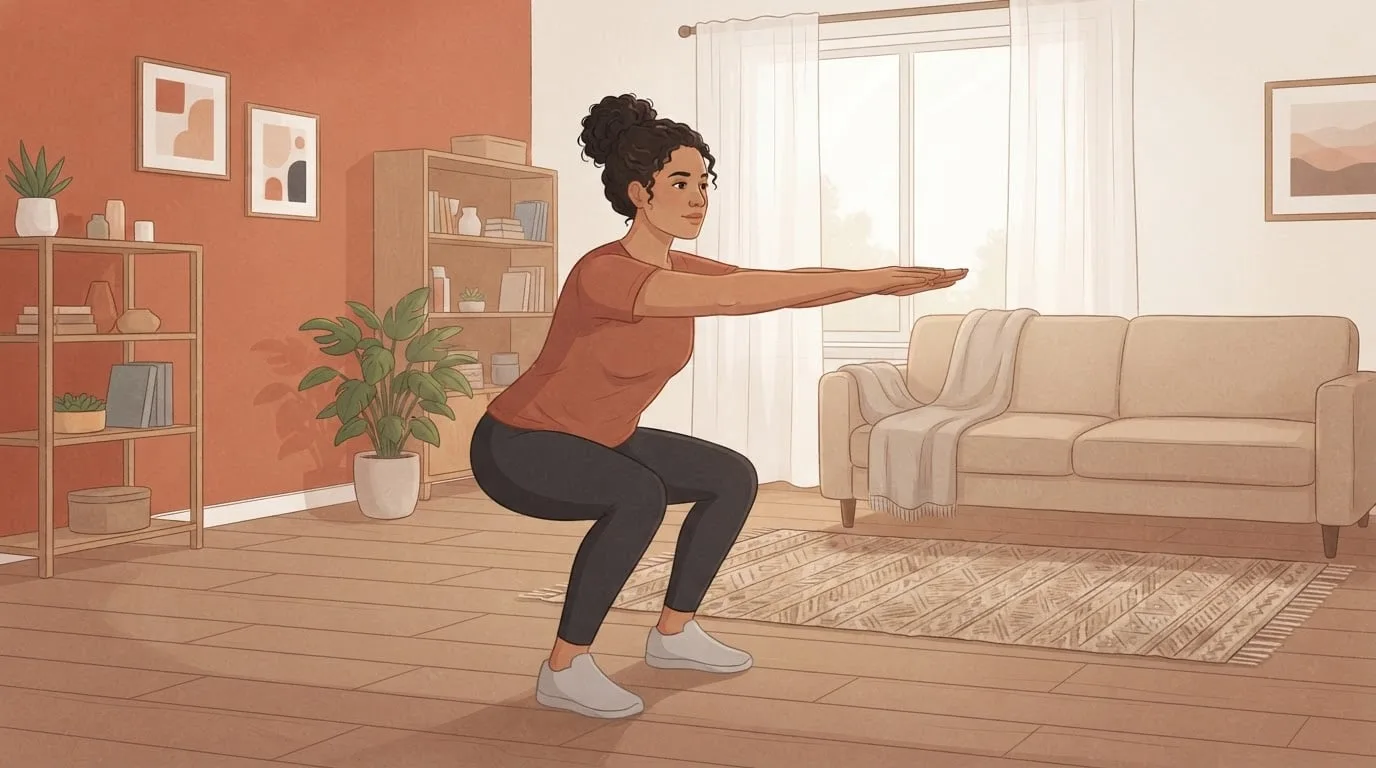
You've probably seen the 100-squats-a-day videos. Someone does them for a month, the thumbnail promises "life-changing results," and you wonder whether that number is the one to aim for.
Then you try it. The first week your thighs burn on the stairs. By the third week the squats feel easy, and a month later your legs look about the same. It's easy to decide squats don't work for you. They do. The daily number just stopped asking your legs for anything new.
So the real question behind how many squats should I do a day is what you want them for. Below you'll find a daily range for each goal, whether you can do squats every day, the weekly volume that builds muscle, form checkpoints, a daily plan and an every-other-day goblet squat plan, and what 100 squats a day does and doesn't do.
How Many Squats Should I Do a Day? Ranges by Goal and Level
Most beginners should do 20 to 30 bodyweight squats a day, and people training for general fitness can do 50 to 100 a day. Use the row that matches your goal. The numbers are bodyweight squats unless the row says otherwise, and they assume you can already squat to a chair height without pain.
| Goal or level | Squats a day | How to split them | Days a week |
|---|---|---|---|
| Beginner (first month) | 20 to 30 | 2 or 3 sets of 10 | Daily, or 3 to 4 days |
| General fitness | 50 to 100 | Sets of 15 to 25, spread through the day | Most days |
| Muscular endurance | 100 to 150 | Sets of 25 to 50, built up over weeks | 4 to 6 days, with easier days |
| Muscle and strength | No daily target | 3 or 4 sets of 8 to 15 goblet squats close to failure | 2 to 3 days, a day apart |
The beginner row lines up with the American College of Sports Medicine's position stand on resistance training (2009), which recommends that novices use sets of 8 to 12 reps on 2 to 3 days a week, and sets of more than 15 reps with short rests for muscular endurance. Doing a few easy sets every day is fine too, because bodyweight squats at that dose recover overnight. Our squat exercise guide shows the full technique if you're starting from scratch.
The muscle row looks different because muscle doesn't respond to a daily count. It responds to how hard each set is and how many hard sets you do in a week, which is what the next three sections explain.
Can You Do Squats Every Day?
Yes, if the daily sets are easy. Light bodyweight squats that stop well short of tiring your legs out can be done every day, and they're a good way to get up and move. Hard sets are different. If your legs are still sore or your squats feel weaker than last time, take a day off, because hard leg training needs time to recover.
Frequency matters less than most people think. A meta-analysis by Schoenfeld, Grgic and Krieger (2019) pooled 25 studies and found that when total weekly volume was the same, training a muscle once, twice or three or more times a week produced similar muscle growth. A trial by Saric and colleagues (2019) then compared 3 against 6 sessions a week with the same total volume over 6 weeks in resistance-trained men. Lower-body strength rose 22 percent with 3 sessions and 18 percent with 6, and thigh muscle thickness grew about the same in both groups.
So squatting every day is a choice, not a requirement. Pick the schedule you'll keep. Daily suits short, easy sets and squat breaks during the workday. Every other day suits harder, weighted sessions.
Why Daily Squats Stop Working
Your legs adapt to exactly what you ask of them. The first time you do 50 squats, it's a real challenge, so your body adapts. Three weeks later the same 50 are easy, the challenge is gone, and so is the reason to keep changing. That's the principle of progressive overload: to keep improving, the work has to get gradually harder.
High reps build endurance more than muscle
Adding more reps of the same easy squat mainly trains endurance. In a classic study by Campos and colleagues (2002), untrained men trained the squat, leg press and knee extension for 8 weeks with either heavy sets of 3 to 5 reps, moderate sets of 9 to 11 or light sets of 20 to 28. The light, high-rep group gained the most muscular endurance, while the heavy and moderate groups grew their muscle fibers and the high-rep group's fibers didn't grow significantly.
Light loads build muscle only when the set is hard
Light weights can still build muscle, with one condition. A meta-analysis of 21 studies by Schoenfeld and colleagues (2017) found muscle growth was similar with light and heavy loads when every set was taken to failure, while heavy loads built more maximal strength. Most daily bodyweight squats stop far from failure. For a fit adult, a set of 20 bodyweight squats might leave 30 more in the tank, which is why it does little for muscle. A dumbbell held at your chest, a slower lowering or a single-leg variation brings the set close to failure in far fewer reps.
Depth changes what grows
How low you go matters as much as how many. Kubo and colleagues (2019) had men train full or half squats twice a week for 10 weeks and measured their muscles with MRI. The gluteus maximus grew 6.7 percent with full squats and 2.2 percent with half squats, and the adductors showed a similar gap. Squat as deep as you can while keeping your heels down and your back neutral.
Find out what's really holding you back
FitCraft, our mobile fitness app, pairs you with an AI coach who builds you a personalized plan around your goals, schedule, and fitness level. Every FitCraft program is designed by Domenic Angelino, MPH (Brown University) and NSCA-CSCS, with research published in the Journal of Strength and Conditioning Research and Medicine & Science in Sports & Exercise.
Take the Free Assessment Free • 2 minutes • No credit cardHow Many Squats a Week? Weekly Volume for Muscle
For muscle, count hard sets per week instead of squats per day. A hard set is one you finish with only 1 to 3 good reps left, sometimes called 1 to 3 reps in reserve. A meta-analysis by Schoenfeld, Ogborn and Krieger (2017) found a graded dose-response: more weekly sets per muscle produced more growth, and each extra weekly set added roughly 0.4 percent to the gain. Groups doing 10 or more sets per muscle a week trended toward the biggest gains. Our review of how many sets per muscle group per week covers the newer studies.
For your legs, that works out to something like this:
- Starting out: 6 to 9 hard sets a week, for example 3 sets of goblet squats on 2 or 3 days.
- Building muscle: 10 to 15 hard leg sets a week, split between squats and a single-leg move such as split squats or reverse lunges.
- Easy squats on top: daily bodyweight squat breaks don't count toward that total, because they stop far from failure, but they won't hurt your recovery either.
Squat Form Checkpoints (and How to Warm Up Before Squatting)
More squats only help if each one is a good one. Run through these six checkpoints on your first set of the day:
- Feet: about shoulder-width apart, toes turned out slightly, whole foot on the floor.
- Brace: take a breath into your belly and tighten your midsection before you lower.
- Hips and knees together: sit back and down at the same time, as if aiming for a chair behind you.
- Knees track your toes: let them point the same way as your feet. Knees moving forward past your toes is normal, but knees caving inward isn't.
- Depth with control: go as low as you can with your heels down and your lower back neutral, ideally with your thighs at or below parallel.
- Drive up: push through your whole foot and stand tall, squeezing your glutes at the top.
To warm up before squatting, walk or march in place for a minute or two, do a few hip circles each way, then 8 to 10 slow bodyweight squats to half depth followed by a few to full depth. Before goblet squats, do one light set of 8 with half the weight you plan to use. If your knees ache, shorten the range for now and check the knee checkpoint first.
Sample Plans: A Daily Squat Plan and an Every-Other-Day Plan
Pick one of the two plans below. Both use only your body weight and a single dumbbell.
Plan 1: Daily bodyweight squats for four weeks
This plan builds the habit and your squat endurance. Each week makes the squats a little harder, by adding reps first and then by slowing them down.
| Week | Daily sets and reps | Squats a day | What changes |
|---|---|---|---|
| 1 | 2 sets of 10 | 20 | Learn the six checkpoints |
| 2 | 3 sets of 12 | 36 | More reps |
| 3 | 3 sets of 15, lowering for 3 seconds | 45 | Slower lowering |
| 4 | 3 sets of 15 with a 2-second pause at the bottom | 45 | Pause at the bottom |
Take a day off whenever your legs feel heavy. After week 4, adding still more reps mostly adds endurance. To keep building strength, move to Plan 2 or swap one daily set for split squats on each leg.
Plan 2: Goblet squats every other day
This is the plan for muscle and strength. Do it 3 days a week with a day between sessions, such as Monday, Wednesday and Friday.
- Warm-up: the warm-up above, then one light set of 8 goblet squats.
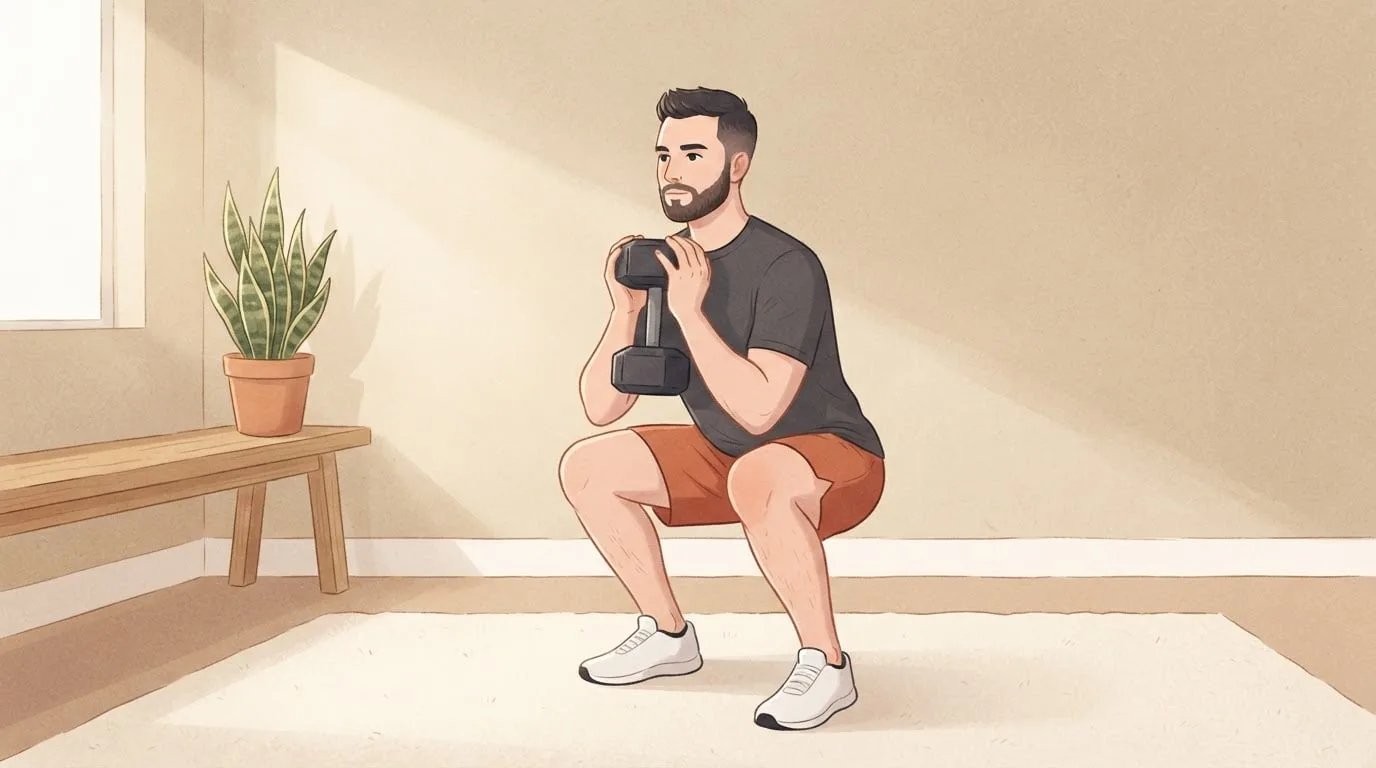
- Goblet squats: 3 sets of 8 to 12 reps, holding one dumbbell upright against your chest. Stop each set with 1 to 3 good reps left, and rest about 90 seconds.
- Split squats or reverse lunges: 2 sets of 8 to 10 reps per leg, with or without the dumbbell.
- Progress: when you reach 12 reps on all three goblet squat sets, use a heavier dumbbell or add a fourth set. If you don't have a heavier dumbbell, slow the lowering to 3 or 4 seconds or add a pause at the bottom.
- Off days: walk, or do 2 easy sets of 15 bodyweight squats as a break from sitting.
That gives you 9 sets of goblet squats and 6 sets of split squats a week, 15 hard leg sets in all, which sits in the range the volume research supports. If you'd like the progression planned for you, FitCraft's strength workouts use dumbbells and bodyweight, an AI coach demonstrates each exercise on an interactive 3D model, and the workouts adjust as you progress. Our page on the dumbbell workout app shows how the programs work. A gym barbell squat is a fine alternative if you train in a gym, but you don't need one to follow this plan.
Is 10 Squats Equal to a 30-Minute Walk? Squat Breaks and Blood Sugar
Not exactly, but short squat breaks spread through a day of sitting beat one walk for blood sugar in a recent trial. Gao and colleagues (2024) had 18 young men with overweight or obesity spend four separate 8.5-hour days mostly sitting. On one day they sat the whole time. On the others they either took one 30-minute walk, or broke up their sitting every 45 minutes, 10 times in all, with a 3-minute walk or a squatting break of matched length and energy cost.
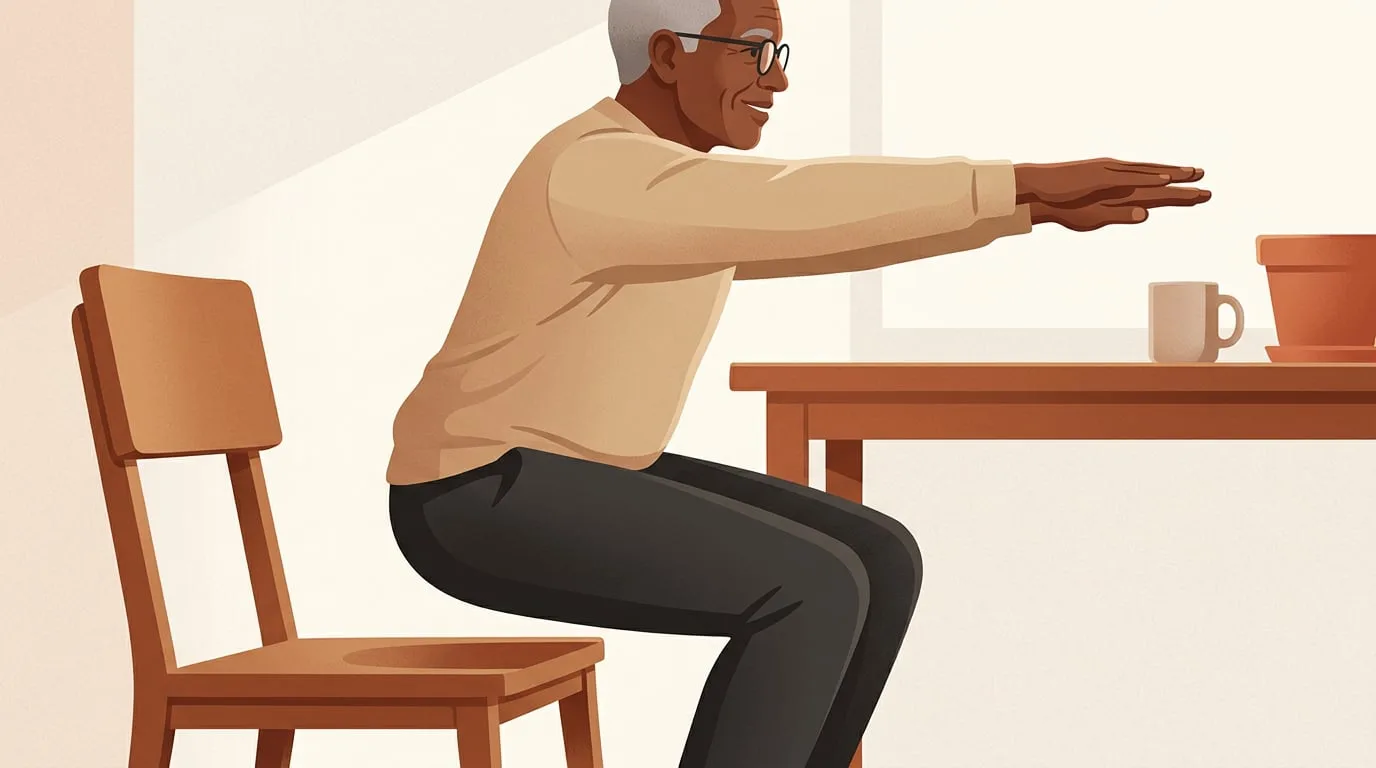
All three ways of moving lowered blood sugar after meals compared with sitting all day. The frequent squat breaks and the frequent 3-minute walks both lowered it more than the single 30-minute walk, about 23 percent below sitting against about 10 percent for the single walk, based on the average glucose responses the study reported. The more the thigh and glute muscles worked, the lower the glucose response.
The popular phrase "10 squats every 45 minutes" mixes up the numbers. The 10 in the study is the number of breaks in the day, and the abstract describes each break by its length, not by a rep count. Two other limits matter. The participants were all young men with overweight or obesity, and the study measured one day of blood sugar, not long-term health. Still, if you sit for work, a set of 10 to 15 squats every hour or so is an easy habit, and it adds up to 80 to 120 squats a day without a workout.
What Happens If You Do 100 Squats a Day?
For a beginner, 100 squats a day is a big jump: work up to it over several weeks rather than starting there. Once you can do it comfortably, here's what it does and doesn't do.
What 100 squats a day does
- Builds muscular endurance in your thighs and glutes, so stairs, hikes and long days on your feet get easier.
- Grooves the squat pattern, which helps with getting up from chairs and the floor.
- Breaks up sitting, especially if you spread the 100 across the day as squat breaks.
- Builds some muscle in the first weeks if you're new to training, because at first even bodyweight squats are hard.
What 100 squats a day doesn't do
- Burn many calories. Using the 2024 Adult Compendium of Physical Activities, which rates bodyweight exercises such as squats at 3.0 METs for general effort and 6.5 at high intensity, 100 squats in about 5 minutes burn roughly 20 to 40 calories for a 70-kilogram (154-pound) person.
- Keep building muscle once the reps are easy, because each set stops far from failure.
- Burn fat from your thighs specifically. You can't choose where you lose fat by training that area.
- Replace the rest of a workout. Your upper body, your back and your heart and lungs need their own training.
So is 100 squats a day good? It's a good habit and a poor plan. Keep it as a movement habit if you enjoy it, and get your strength from two or three harder sessions a week.
The Bottom Line
As a beginner, aim for 20 to 30 bodyweight squats a day. For general fitness, 50 to 100 spread through the day works well. For endurance, build up to 100 to 150 over several weeks. For muscle, stop counting daily squats and do 3 or 4 hard sets of goblet squats 2 to 3 days a week, making them heavier or slower as they get easier. Squat breaks during long sitting are a bonus for blood sugar.
The number matters less than keeping the squats a little harder than last month, and showing up for the weeks it takes to see the change. As one FitCraft user, Mike, put it: "The streak system got me hooked." Find the version you'll repeat, then make it harder.
Frequently Asked Questions
How many squats a day to see results?
For a beginner, 20 to 30 bodyweight squats a day is enough to feel squats get easier within 2 to 3 weeks. Visible changes in your legs take longer, usually a couple of months, and they come from making the squats harder over time rather than from the daily count. Most training studies that measure muscle growth run for 8 to 12 weeks.
How many calories does 100 squats burn?
100 squats burn roughly 20 to 40 calories for a 70-kilogram (154-pound) person, assuming the reps take about 5 minutes. That estimate uses the 2024 Adult Compendium of Physical Activities, which rates bodyweight exercises such as squats at 3.0 METs for general effort and 6.5 METs at high intensity. Heavier people and faster sets burn a little more.
How many squats a day to lose weight?
No number of squats a day will cause weight loss on its own, because even 100 squats burn only about 20 to 40 calories. Weight loss comes from a calorie deficit. Squats help as part of strength training 2 to 3 times a week, which keeps muscle while you lose fat, alongside daily walking and changes to what you eat.
Do squats regulate blood sugar?
Squats can help control blood sugar after meals, mostly by putting your large thigh and glute muscles to work. In a 2024 trial of 18 young men with overweight or obesity, squatting breaks every 45 minutes during a day of sitting lowered blood sugar after meals more than one 30-minute walk did. Squats aren't a treatment for diabetes, so talk to your doctor if you have it or take glucose-lowering medicine.
How many squats a day should a woman do?
The same ranges apply to women and men: 20 to 30 bodyweight squats a day as a beginner, 50 to 100 for general fitness, and harder weighted sets 2 to 3 times a week for muscle and glutes. A meta-analysis found that women and men gain muscle and lower-body strength at similar rates on the same training program.
What happens if you do 50 squats a day for 30 days?
If you're new to exercise, 50 squats a day for 30 days usually makes squats feel much easier, improves leg endurance and may leave your legs feeling a little firmer. You probably won't see a big change in leg shape in a month, especially if the 50 never get harder. To keep improving after the first few weeks, add a dumbbell, slow the lowering or switch to split squats.
Is 200 a good squat?
If you mean a 200-pound barbell back squat, that's a loaded gym lift, and whether it's good depends on your body weight, age and training history rather than the number alone. If you mean 200 bodyweight squats a day, that's an endurance amount to build up to gradually. For strength and muscle, fewer, harder squats 2 to 3 times a week do more.