The goblet squat looks simple. Hold a dumbbell at your chest, squat down, stand back up. That simplicity hides what makes it the single best teaching tool in the lower-body toolbox.
The front-loaded position forces your torso upright. The elbows tucked between the knees teaches knee tracking. The weight against the sternum gives your core something concrete to brace against. Every form fault that hides in a bodyweight squat becomes obvious the moment you add a dumbbell at the chest.
This guide covers the full picture: the goblet hold itself, the squat mechanics, the mistakes that show up under load, and the progression path from a light dumbbell through the heavy kettlebell variations that strength coaches lean on for general-population programming.
Quick Facts: Goblet Squat
- Equipment needed: One dumbbell or kettlebell
- Difficulty: Beginner (light dumbbell) to Intermediate (heavy kettlebell)
- Modality: Strength
- Body region: Lower body (with significant upper-back and core demand)
- FitCraft quest category: Strength
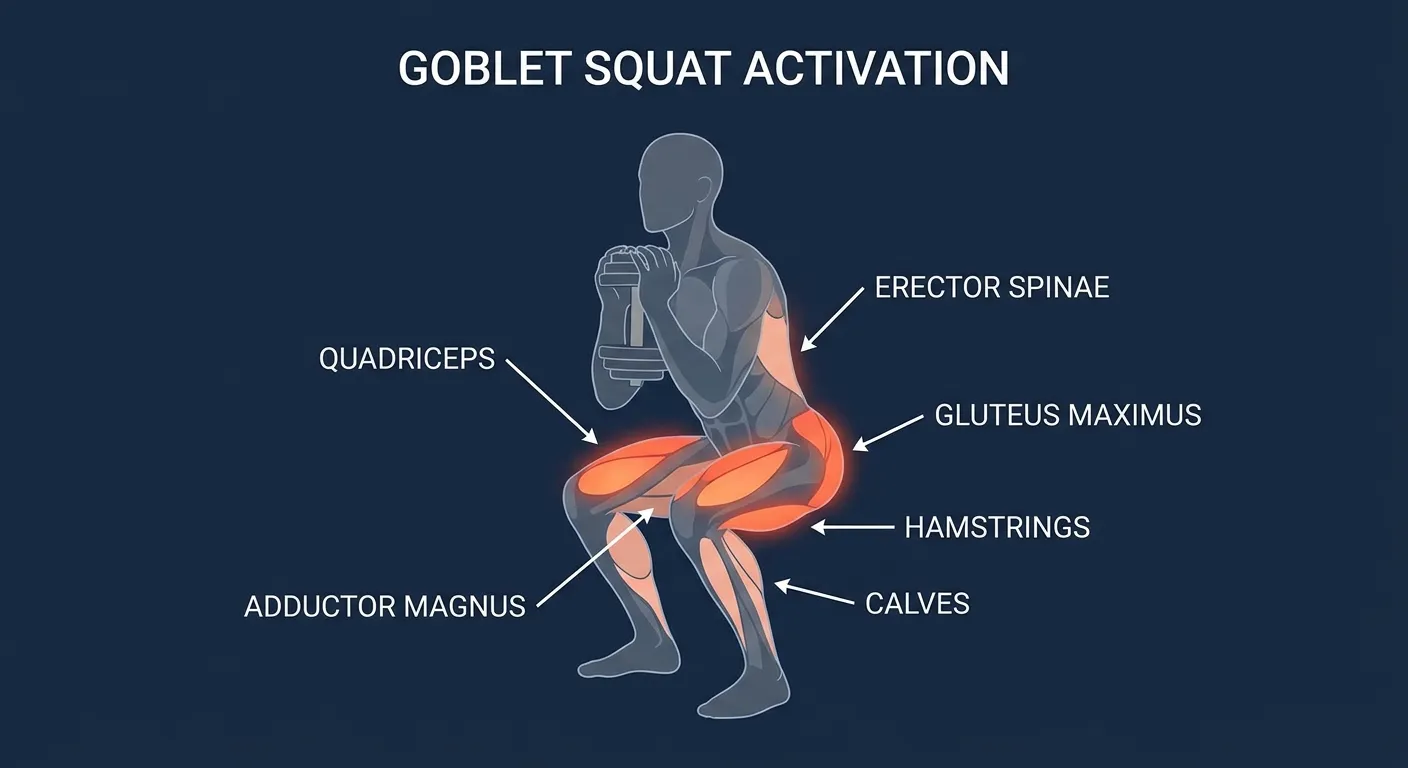
Muscles Worked
Primary movers: the quadriceps (rectus femoris and vasti) drive knee extension on the ascent. The gluteus maximus drives hip extension. The adductor magnus contributes meaningfully at the bottom of a deep squat as a hip extensor (and it carries more load on goblet squats than back squats because the depth tends to be greater). All three lengthen under load on the way down and shorten to drive you back up.
Secondary movers: the hamstrings work eccentrically during the descent and assist hip extension out of the hole. The gastrocnemius and soleus (calves) stabilize the ankle and assist plantarflexion as you rise. The erector spinae work isometrically to keep the spine extended through the descent.
Stabilizers: the upper back (rhomboids, mid and lower trapezius) and posterior shoulder (rear deltoids) work isometrically to hold the dumbbell or kettlebell tight against your chest. The biceps brachii holds elbow flexion under the goblet load. The entire anterior core (rectus abdominis, transverse abdominis, obliques) braces against the front-loaded torso. This is why goblet squats are often called a full-body lift dressed up as a leg exercise. The upper body usually becomes the limit before the legs do as load increases.
Mechanism (why the front load matters): a front-loaded squat shifts the center of mass forward of the hips, which forces the torso to stay vertical or risk dumping the weight forward. Back squats let lifters lean forward, which can mask hip mobility limits and quietly load the lumbar spine. The goblet position removes that option. The torso has to stay upright or the rep fails, which is why it's used universally as a teaching tool by strength coaches and physical therapists alike. Depth also tends to be greater, which recruits the gluteus maximus and adductor magnus more than partial-depth back squats.
Step-by-Step: How to Perform a Goblet Squat
The squat mechanics are the same as a bodyweight squat. The difference is everything that happens before you start moving.
Step 1: Set Up the Goblet Hold
Stand with your feet shoulder-width apart, toes turned out 15-30 degrees. Hold a dumbbell vertically by cupping both hands under the top bell against your chest, or hold a kettlebell by the horns at chest height with elbows tucked in. The bottom of the weight rests just above your sternum, and your forearms point straight up.
Coach Ty's cue: "Hug the dumbbell. The weight stays glued to your chest from the first rep to the last."
Step 2: Brace Your Core
Stand tall, take a deep breath into your belly, and engage your core as if someone were about to tap your stomach. Pull your shoulder blades down and back. The brace at the top is what protects the lower back when you sit deep.
Ty's cue: "The brace happens at the top, not on the way down. Big breath, tight belly, then squat."
Step 3: Initiate the Descent
Push your hips back and bend your knees at the same time. Drive your knees out over your toes as you lower. The weight pulls you forward, so consciously sit back as you go down.
Ty's key cue: "Knees out, hips back. The dumbbell wants to pull you forward, fight that with the hips."
Step 4: Squat to Depth
Lower until your elbows touch the inside of your knees, or your thighs reach at least parallel to the floor, whichever happens first while keeping a neutral spine. The goblet position usually allows deeper squats than a back squat, which is part of why it's such a good teacher.
As Ty coaches it: "Elbows brush the inside of your knees at the bottom. That's your depth check."
Step 5: Drive Back Up
Press through the heels and squeeze the glutes to stand. Exhale on the ascent. Keep the chest tall and the dumbbell glued to your sternum the entire time.
Ty's reminder: "Drive the floor away with your heels. Chest up the whole way, dumbbell never leaves the chest."
Get this exercise in a personalized workout
FitCraft, our mobile fitness app, uses its AI coach Ty to program compound strength exercises like this into your plan at the right volume and load, based on your level, goals, and equipment. Ty was designed and trained by Domenic Angelino, MPH (Brown University) and NSCA-CSCS, with research published in the Journal of Strength and Conditioning Research and Medicine & Science in Sports & Exercise.
Take the Free Assessment Free · 2 minutes · No credit card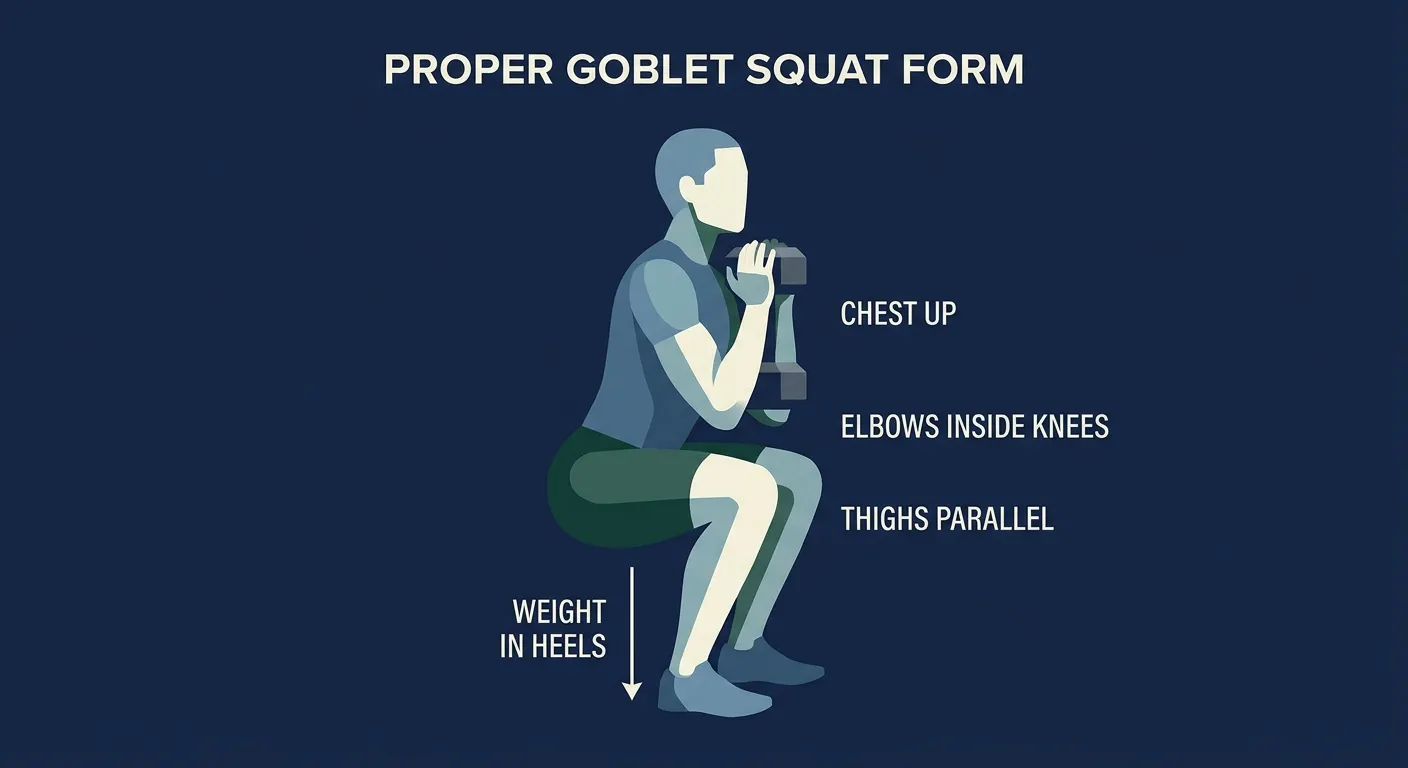
Common Mistakes (and How to Fix Them)
Goblet squats expose every fault a bodyweight squat hides. Here's what Ty corrects most often.
- Letting the dumbbell drift away from the chest. The bell starts at your sternum and gradually slides down or forward as the set goes on. It looks small. It's not. The moment the weight leaves the chest, the upper back gives up and the spine starts to flex. Fix: cue "hug the bell" and treat upper-back fatigue as the signal to stop the set, even if your legs feel fine.
- Knees caving inward. Loading the squat exposes weak glutes or tight hips. Fix: actively drive the knees out over the toes throughout the rep. The elbows-touch-inside-of-knees cue at depth gives you a tactile checkpoint.
- Going too deep with a rounding lower back. The goblet position lets you sit very deep, which is great until your pelvis tucks under and your lumbar rounds. Fix: stop the descent at the depth where your back stays neutral. Mobility work over time pushes that depth lower; forcing it under load is how people hurt themselves.
- Heels lifting at the bottom. Limited ankle dorsiflexion shows up the moment you load the squat. Fix: cue weight through the heels, work ankle mobility drills, or elevate the heels slightly (small plates or weightlifting shoes) while you build the mobility.
- Rushing reps for tempo. Speed under load is sloppy. Fix: 2-3 second descent, brief pause at depth, controlled ascent. The goblet squat builds the most strength when each rep looks the same as the first.
- Going too heavy too soon. If you can't reach parallel with the dumbbell you grabbed, the weight is wrong, not your legs. Fix: drop the load until you can hit clean depth for 8-10 reps, then progress weekly.
Goblet Squat Variations: Regressions and Progressions
Start where your form is solid and progress when the current variation feels controlled at the target rep range.
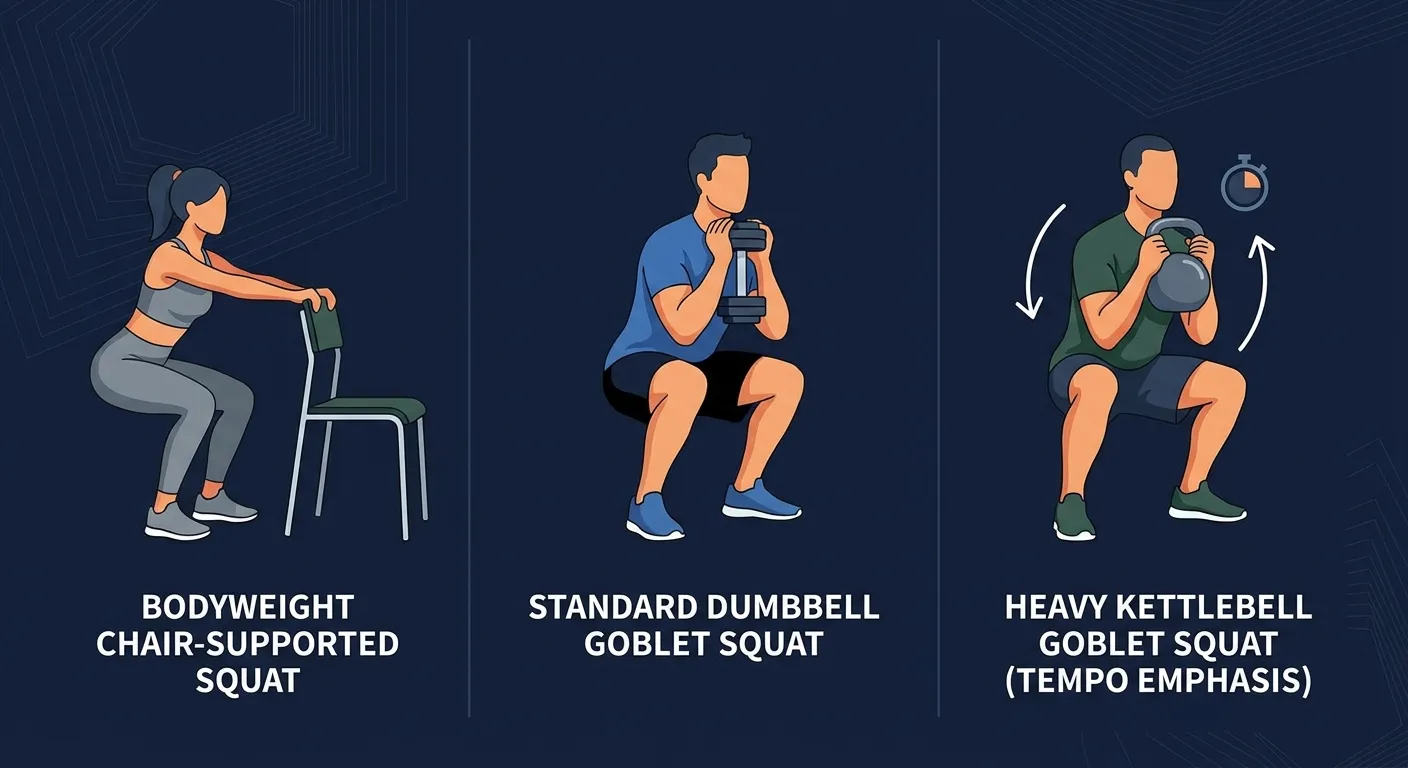
Bodyweight Squat (Beginner Regression)
Master the bodyweight squat to parallel before adding a dumbbell. The goblet squat amplifies whatever pattern you bring to it, so it's worth getting the unloaded pattern clean first.
Light Goblet Squat (Beginner Entry)
One light dumbbell (10-25 lb) for 8-12 reps. The goal is to learn the goblet hold and feel how the front-loaded position changes the squat. Don't chase load here, chase position.
Standard Goblet Squat (Intermediate)
Moderate dumbbell (30-50 lb) or medium kettlebell (12-20 kg) for 3-4 sets of 8-12. This is the workhorse range for general-population strength training and the format most strength coaches default to for non-competitive lifters.
Tempo or Paused Goblet Squat (Advanced Variation)
Same weight, slower descent (3-5 seconds) or 2-3 second pause at the bottom. Drastically increases time under tension and exposes any compensations. Brutal at moderate loads.
Front Squat (Advanced Progression)
Barbell racked in the front position. Heavier than the goblet squat, more quad-dominant, and uncompromising about upright posture. The natural next step when the dumbbell or kettlebell gets too heavy for the upper-back hold.
Bulgarian Split Squat (Unilateral Progression)
Hold the same dumbbell goblet-style and elevate the rear foot on a bench. The goblet position teaches torso control while the unilateral pattern exposes side-to-side imbalances.
When to Avoid or Modify Goblet Squats
Goblet squats are one of the most forgiving loaded lower-body exercises, but a few conditions still call for modification or temporarily regressing to bodyweight squats. None of these are permanent restrictions. Always consult your physician or physical therapist for personalized guidance.
- Patellofemoral knee pain or recent knee surgery. Adding load to a sore knee usually makes it worse. Drop to bodyweight squats or wall sits, slow the tempo, and stay above the depth where pain begins. Get clearance from your surgeon or PT after any knee procedure before reloading.
- Acute lower-back pain or known disc pathology. The goblet position is actually one of the safest loaded squats for the lower back because it forces an upright torso, but if bracing under any load makes things worse, return to bodyweight and rebuild core bracing with deadbugs, bird-dogs, and forearm planks first.
- Uncontrolled hypertension or known cardiovascular disease. Heavy goblet squats and the Valsalva brace spike intrathoracic and intra-arterial pressure. Use lighter loads, longer rest, and follow your cardiologist's exercise guidance.
- Pregnancy, especially second and third trimester. A light goblet squat with a small dumbbell is usually well tolerated through most of pregnancy and is often preferred over back squats because of the upright torso position. Stay above parallel, avoid the Valsalva, and stop and consult your OB if you feel pelvic pressure, dizziness, or any pain.
- First 6-8 weeks postpartum or active diastasis recti. The front-loaded brace can widen abdominal separation. Start with glute bridges and bodyweight partial squats. Rebuild deep-core function with deadbugs and bird-dogs before reloading.
- Shoulder or upper-back injury that limits the goblet hold. If you can't hold the dumbbell securely at chest height, the goblet squat is the wrong choice this week. Use bodyweight squats or the front-rack position with a light barbell (front squat) once shoulders permit.
Related Exercises
If goblet squats are part of your routine, these movements complement or extend the same training pattern:
- Same movement pattern (squat variations): Bodyweight Squats for the unloaded pattern, Front Squats as the loaded progression, Sumo Squats for adductor and inner-thigh bias, and Bulgarian Split Squats for unilateral work.
- Same movement pattern (hinge): Deadlifts, Romanian Deadlifts, and Good Mornings train the hip-hinge pattern that pairs with squats in a balanced lower-body program.
- Unilateral lower body: Rear Lunges, Side Lunges, and Split Squats develop single-leg strength and expose side-to-side imbalances.
- Glute-focused accessory: Glute Bridges and Single-Leg Deadlifts isolate the gluteus maximus and posterior chain.
- Core foundation for spinal bracing: Deadbugs, Bird-Dogs, and Forearm Planks train the bracing pattern goblet squats rely on as load increases.
How to Program Goblet Squats
Goblet squat programming follows the same evidence-based ranges as any compound lower-body lift, with the caveat that the upper-back hold caps the load before the legs do. The American College of Sports Medicine (ACSM) Position Stand on resistance training recommends roughly 8-12 reps per set for strength and hypertrophy, with at least 48 hours between sessions training the same muscle group (Ratamess et al., 2009).
| Level | Sets × Reps | Rest between sets | Frequency |
|---|---|---|---|
| Beginner (10-25 lb dumbbell) | 2-3 × 8-12 | 90-120 seconds | 2-3 sessions/week |
| Intermediate (30-50 lb dumbbell, 12-20 kg kettlebell) | 3-4 × 6-12 | 120-180 seconds | 2-4 sessions/week |
| Advanced (heavy kettlebell, tempo or paused) | 3-4 × 5-10 | 180-240 seconds | 2-3 sessions/week (graduate to front squat for heavier loading) |
Where in your workout: Goblet squats belong first or second in a lower-body session, when you're fresh. They pair well with a hinge pattern (Romanian deadlift, good morning) for a balanced day. In a full-body session, they go in the first half before isolation work. They also work as a teaching set before a heavier back squat in the same workout (3 sets of 6-8 light goblet squats as a warm-up, then the working sets of back squat).
Form floor over rep targets: if the dumbbell starts drifting away from your chest or your back starts rounding, the set is done, regardless of the rep target. The upper-back is the limit. Treat its fatigue as the signal, not your legs.
How FitCraft Programs This Exercise
Knowing how to do a goblet squat is step one. Knowing how heavy to go, when to add load, and when to graduate to the front squat or back squat is where most people get stuck.
FitCraft's AI coach Ty handles that. During your personalized diagnostic assessment, Ty maps your fitness level, goals, mobility, and available equipment. Then Ty builds a program that slots goblet squats into a balanced training plan at the right load for your level.
As you get stronger, Ty adjusts the variation and load to match your level. Light goblet becomes moderate. Moderate becomes heavy or tempo or paused. Heavy graduates to the front squat or back squat when the upper-back hold becomes the limit. Every program is designed by an Ivy League-trained exercise scientist and NSCA-certified strength coach using evidence-based periodization, then adapted to you by the AI.
Frequently Asked Questions
What muscles do goblet squats work?
Goblet squats primarily target the quadriceps, gluteus maximus, and adductors, with secondary work from the hamstrings, calves, and erector spinae. The front-loaded position also creates a heavy isometric demand on the upper back, biceps, and entire anterior core, which is why goblet squats are often called a full-body lift dressed up as a leg exercise.
How heavy should my dumbbell be for goblet squats?
Beginners: start with 10-25 lb (about 5-12 kg) and prioritize depth and form over load. Intermediates: 30-50 lb (15-25 kg) for 8-12 rep sets. Advanced lifters often work up to 70-100 lb (32-45 kg), but at that point the upper-back becomes the limit before the legs do. If the dumbbell starts to pull away from your chest, the weight is too heavy or your core brace is breaking down.
Are goblet squats better than back squats for beginners?
For most beginners, yes. The front-loaded position forces an upright torso, which protects the lower back, makes proper depth easier to achieve, and teaches the bracing pattern you'll need for back squats later. Most strength coaches use the goblet squat as the bridge between bodyweight squats and the barbell back squat.
Why do my upper back and arms get tired before my legs?
That's the goblet squat doing its job. Holding the dumbbell at your chest is an isometric workout for your upper back, biceps, and entire anterior core. As load goes up, the upper body becomes the limit before the legs do, which is exactly when most people graduate to the front squat or back squat.
Can I do goblet squats if I have knee pain?
Adding load to a painful knee usually makes things worse. Drop to bodyweight squats or wall sits, reduce depth to above where pain begins, and slow the tempo to 3-4 seconds on the descent. Reintroduce the dumbbell only when bodyweight squats are pain-free through full range. For ongoing patellofemoral pain, see a physical therapist before reloading the squat.