The deadlift looks simple. Dumbbells at your sides. Pick them up. Put them down. That description is also why people get hurt: they grab two heavy dumbbells and yank instead of executing the most technical hinge in the gym.
A deadlift is a hip hinge with a brace. Treat it like a squat or treat it like a back lift and you will hurt yourself. Once the hinge-and-brace idea clicks, everything else falls into place: the setup, the path the dumbbells travel, the lockout, even the grip.
This guide covers exactly how to set up with a pair of dumbbells, how to build tension before you lift, the five-step sequence, the mistakes that quietly load your lumbar spine, and how to scale from light dumbbells up to a meaningful working weight.
Quick Facts: Dumbbell Deadlift
- Equipment needed: Dumbbells
- Difficulty: Beginner to Intermediate (the pattern is beginner-accessible; loading is the variable)
- Modality: Strength
- Body region: Full body (posterior-chain dominant)
- FitCraft quest category: Strength
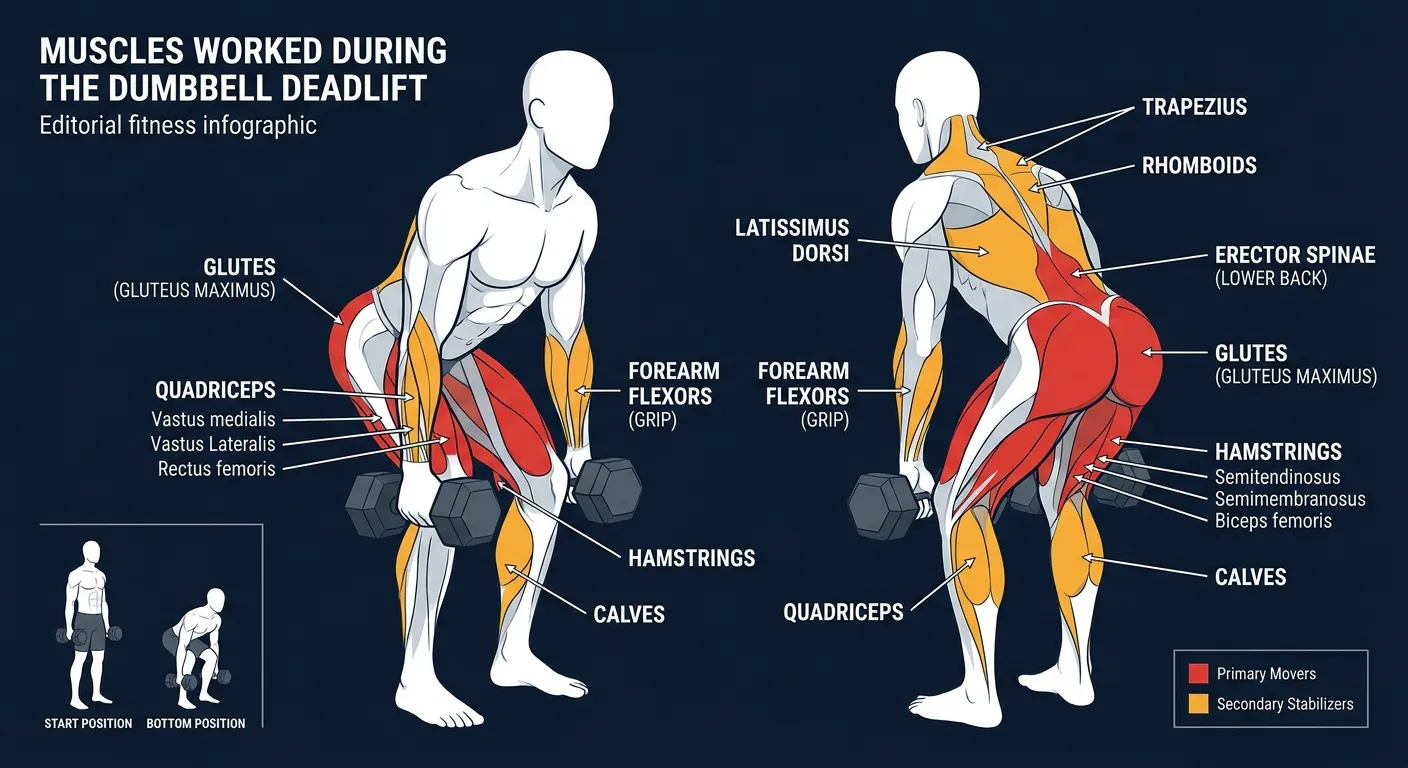
Muscles Worked
Primary movers: the gluteus maximus, the hamstrings (biceps femoris, semitendinosus, semimembranosus), the erector spinae (the deep column of muscles running along the spine), and the quadriceps. The glutes and hamstrings drive hip extension, the quads drive knee extension, and the erectors hold the spine rigid throughout. These four muscle groups working together is what makes the dumbbell deadlift one of the most stimulating single exercises you can do with a pair of dumbbells for the entire posterior chain.
Secondary movers: the latissimus dorsi (which fires hard to keep the dumbbells pinned close to the body), the trapezius (upper and middle, which support the shoulder girdle under load), the rhomboids, and the forearm flexors (grip is often the limiter for taller lifters and beginners). The biceps brachii also stabilize the elbow joint and should not actively bend during the lift.
Stabilizers: the entire core (rectus abdominis, transverse abdominis, obliques) working isometrically against the bracing pressure of the breath. The calves stabilize the ankle during the drive off the floor. The rotator cuff holds the shoulders in their sockets while the lats fire.
How the dumbbell version differs: dumbbells let your hands sit in a neutral grip (palms facing your thighs) rather than a pronated overhead grip on a bar in front of you. The load is split into two independent weights at your sides instead of a single bar locked in front of your body, which eliminates the rigid bar-path constraint that forces a barbell deadlifter to drag the bar up the shins. Your shoulders can settle into a slightly more natural position, the lever arm against your lumbar spine is shorter at the bottom of the lift, and you can bail from a rep just by letting go of the dumbbells, which a loaded barbell does not permit. The hip-hinge pattern, the bracing demand, and the muscles worked are the same. The risk profile and the entry point are friendlier.
Step-by-Step: How to Perform a Dumbbell Deadlift
The setup is the lift. If your stance, grip, and brace are right before the dumbbells leave the floor, the hinge itself becomes almost mechanical.
Step 1: Set Your Stance and Pick Up the Dumbbells
Stand with your feet about hip-width apart, toes pointed forward or angled out slightly (5 to 15 degrees). Pick up a dumbbell in each hand with palms facing your thighs (neutral grip). Let the dumbbells hang at arm's length just outside your legs. Shoulders back and down, chest up, weight balanced over the middle of your feet.
Coach Ty's cue: "Palms facing your thighs, dumbbells just outside your legs. If your hands rotate so palms face behind you, reset."
Step 2: Hinge at the Hips
Push your hips straight back like you are closing a car door with your backside. As your hips travel back, your torso angles forward and the dumbbells slide down the outside of your legs, staying close to your body. Add a little more knee bend once the dumbbells pass below your knees so the weights can keep tracking close to your shins. From the side, your shoulders should be slightly in front of the dumbbells and your hips above your knees.
Ty's cue: "Hinge first, bend second. If your knees shoot forward before your hips go back, you are squatting the deadlift. Stand back up and redo it."
Step 3: Build Tension and Brace
At the bottom position, your shins should be roughly vertical and your back flat in a neutral spine. Pull your chest up and engage your lats by trying to squeeze the dumbbells into the outside of your legs. Take a deep breath into your belly (not your chest), and brace your core like you are about to be punched in the stomach. The body should feel locked together from head to heels before the dumbbells move back up.
Ty's key cue: "Big breath in, brace hard, then lift. If you are still inhaling when the dumbbells leave the bottom, you skipped the brace."
Step 4: Push the Floor Away
Drive your feet through the floor as if you are leg-pressing the ground down. The dumbbells should leave the bottom with your hips and shoulders rising at the same rate. Keep the dumbbells tracking straight up the outside of your legs. They travel in a vertical line, not looping out in front of you.
As Ty coaches it: "Push the floor away. The dumbbells come up because the floor goes down. If your hips shoot up first, the weight is too heavy."
Step 5: Lock Out and Lower With Control
Finish standing tall by squeezing your glutes and bringing your hips through to meet the dumbbells. Do not lean back at the top. A tall standing position is the lockout. To lower, push your hips back first, then bend your knees once the dumbbells pass them. Reset between reps: pause briefly at the top, rebuild tension, take a new breath, then hinge again.
Ty's reminder: "Hips through, not back. The lockout is just standing tall with your glutes squeezed. Lean back and you are crushing your lower back for no reason."
Get this exercise in a personalized workout
FitCraft, our mobile fitness app, uses its AI coach Ty to program compound strength exercises like this into your plan at the right volume and intensity, based on your level, goals, and equipment. Ty was designed and trained by Domenic Angelino, MPH (Brown University) and NSCA-CSCS, with research published in the Journal of Strength and Conditioning Research and Medicine & Science in Sports & Exercise.
Take the Free Assessment Free · 2 minutes · No credit card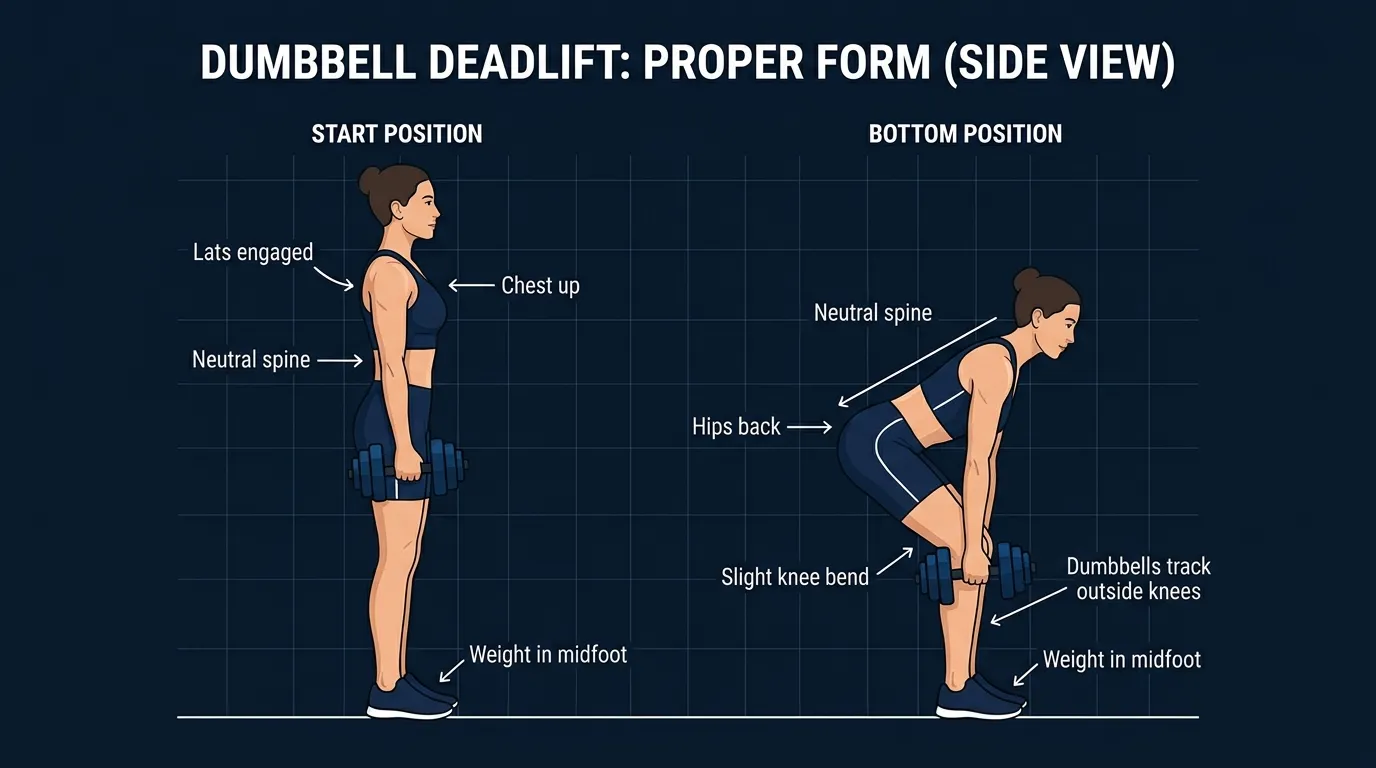
Common Mistakes (and How to Fix Them)
Here are the mistakes Ty corrects most often on the dumbbell deadlift.
- Hips shooting up first. The hips fly up while the dumbbells barely move, leaving the lift entirely to the lower back. Almost always a sign the weight is too heavy or you skipped tensioning the lats. Fix: drop to a lighter pair of dumbbells, re-cue "chest up, push the floor away," and start the lift with hips and shoulders rising together.
- Rounded lower back. The lumbar spine flexes under load. This is the single highest-risk position in the lift. Fix: go lighter, cue "chest up" before you lift, and add Romanian deadlifts and good-mornings to build erector endurance.
- Dumbbells drifting forward. The dumbbells loop out in front of your thighs instead of tracking close to the body. Doubles the lever arm against your back. Fix: actively pull the dumbbells toward the outside of your legs by engaging your lats (think "squeeze the dumbbells into your pants seam"). If the heads of the dumbbells catch on your thighs, rotate your hands a few degrees so the long axis of the dumbbell lines up with your leg.
- Squatting the deadlift. Knees travel forward before the hips travel back, turning the lift into a partial squat with weights at your sides. Fix: stand back up, push your hips back first, and only bend the knees once the dumbbells pass your knees on the way down.
- Hyperextending at the top. Leaning back at lockout to "finish" the rep. Crushes the lumbar discs at the worst possible joint angle. Fix: stand tall (glutes squeezed, ribs over hips, head neutral). That is the lockout. No leaning back.
- Jerking the weight up. Yanking the dumbbells off the floor instead of pulling smoothly. The jerk hides a weak brace and spikes the load on your lower back. Fix: take the slack out of your arms first, build full-body tension, then drive the floor away. The dumbbells should move because your hips moved, not because you snatched the weights upward.
Dumbbell Deadlift Variations: Regressions and Progressions
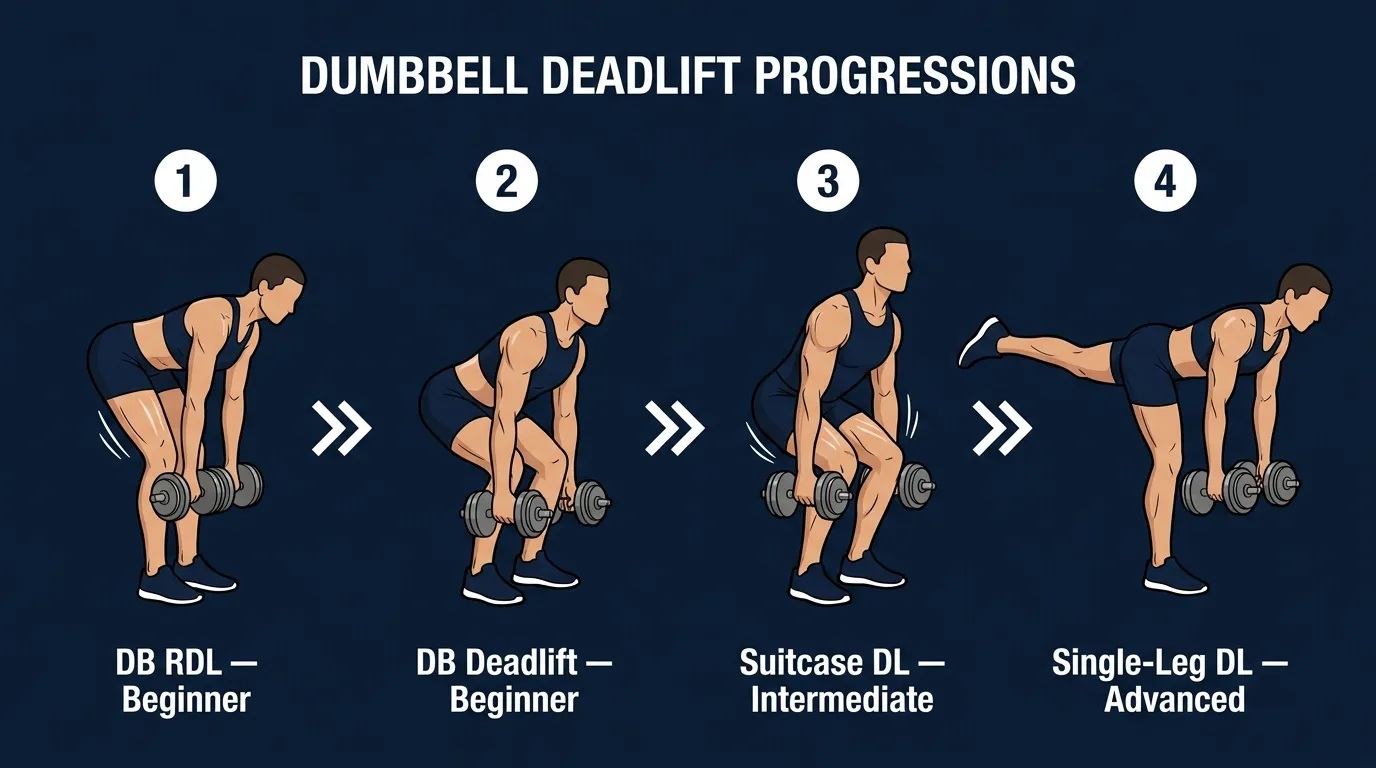
The deadlift family scales beautifully with dumbbells. You can train the hip-hinge pattern with almost no equipment and progress through several distinct variations as you get stronger.
Glute Bridge (Hinge Pattern Beginner Regression)
Lie on your back with knees bent and feet flat on the floor. Drive through your heels to lift your hips toward the ceiling, squeezing your glutes at the top. Teaches hip extension with zero spinal load and zero balance demand. The right starting point for anyone who feels their lower back working before their glutes do on the dumbbell deadlift.
Dumbbell Romanian Deadlift (Hamstring-Focused Variation)
Start standing with dumbbells in front of your thighs. Push your hips back and lower the dumbbells to about mid-shin while keeping a small, fixed knee bend. Drives the hamstrings and glutes through a long eccentric and teaches the hip-hinge pattern in near-isolation. Useful as an accessory for the dumbbell deadlift, or as the primary hinge for beginners who want to bias the hamstrings.
Dumbbell Deadlift (Standard)
The full lift described above. Dumbbells in a neutral grip, hip-width stance, hinge to roughly mid-shin, drive back up. The default version of this exercise.
Suitcase Deadlift (Grip and Anti-Rotation Variation)
Same dumbbells, same stance, but place the dumbbells flat on the floor on the outside of each foot at the start of each rep. Pick them up like you are picking up two suitcases. The longer range of motion (the dumbbells touch the floor between reps) adds a grip and forearm challenge, and the lateral position of the load demands more anti-rotation core work to keep your torso square.
Single-Leg Dumbbell Deadlift (Balance and Unilateral Progression)
Stand on one leg holding a dumbbell (or two), hinge forward, and extend the opposite leg straight behind you for balance. The standing leg does all the work. Hammers single-leg glute and hamstring strength, exposes left-right imbalances, and loads the spine far less than a bilateral lift at the same per-leg intensity. An accessory progression for intermediate lifters and a useful substitute when lower-back load needs to come down.
When to Avoid or Modify Dumbbell Deadlifts
The dumbbell deadlift is safe and beneficial for most healthy adults. The combination of external load and a spinal-bracing demand still warrants modification or temporary substitution in a few situations. Always consult your physician or physical therapist for personalized guidance.
- Acute lower-back pain or known disc pathology. A loaded hinge is the wrong time to find out your discs are unhappy. Drop loaded deadlifts entirely until the acute episode resolves. Keep training the pattern with bodyweight hip hinges, single-leg deadlifts at very light load (much lower spinal load per unit of training effect), and core bracing with deadbugs, bird-dogs, and forearm planks. Return to loaded dumbbells on a PT-guided ramp.
- Recent spine, shoulder, hip, or knee surgery. Compound lifts under external load impose joint stress that can re-aggravate a healing structure. Get clearance from your surgeon. Most post-surgical pulling progressions start with bodyweight hinges and glute bridges, then light dumbbell deadlifts, before progressing the load.
- Uncontrolled hypertension or known cardiovascular disease. The breath-hold brace under heavy load spikes intrathoracic and intra-arterial pressure. Use lighter dumbbells with higher reps, longer rest between sets, avoid 1-rep-max attempts, and follow your cardiologist's exercise guidance. The dumbbell Romanian deadlift at moderate load is usually a safer alternative.
- Pregnancy, especially second and third trimester. The combination of bracing pressure on the abdomen and the increased ligament laxity of late pregnancy raises injury risk. Drop the dumbbell weight substantially, prefer the dumbbell Romanian deadlift (more upright torso, shorter range of motion), and stop if you feel any pelvic-floor pressure or low-back discomfort.
- First 6-8 weeks postpartum or active diastasis recti. Heavy bracing raises intra-abdominal pressure and can widen abdominal separation. Restore deep-core function first with diaphragmatic breathing, deadbugs, and bird-dogs. Reintroduce the hinge pattern with bodyweight before reloading the dumbbells.
- Hamstring strain or recent tear. The deadlift loads the hamstrings under high tension at the bottom of the lift. Shorten the range of motion by stopping the descent just below the knees until the strain heals, then return to full range gradually.
Related Exercises
If the dumbbell deadlift is part of your routine, these movements complement or extend the same training pattern:
- Same movement pattern (hinge): Romanian Deadlift isolates the hip hinge and trains the hamstrings and glutes through a long eccentric. Single-Leg Deadlift challenges balance and hip stability with far less spinal load. Good Mornings teach the hinge with a dumbbell held against the chest.
- Complementary lower-body lift (squat): Squats and Bulgarian Split Squats pair with the dumbbell deadlift as the two-pattern foundation of any lower-body program. Most strength templates run a squat day and a hinge day each week.
- Same muscle group (posterior chain accessory): Glute Bridges isolate the glutes for accessory work. Iso Ham Raise loads the hamstrings eccentrically.
- Same muscle group (back, for grip and lat strength): Bent-Over Rows train the lats and mid-back in the hinged position the deadlift demands. Inverted Rows are a bodyweight alternative.
- Core foundation for spinal bracing: Deadbugs, Bird-Dogs, and Forearm Planks build the anti-extension and anti-rotation strength the deadlift relies on. If your back rounds under load, the fix often lives here.
- Postural support and grip: Superman Holds build erector endurance; the heavy grip demand of dumbbell deadlifts can also be supported with Engaged Hangs from a pull-up bar.
How to Program Dumbbell Deadlifts
Dumbbell deadlift programming follows the same evidence-based ranges as any heavy compound lift, with reps tilted slightly higher than barbell work because the load ceiling is the dumbbells you own. The American College of Sports Medicine (ACSM) Position Stand on resistance training recommends 6-12 reps per set for hypertrophy and 1-6 reps per set for maximal strength, with 2-5 minutes of rest between heavy sets to allow CNS recovery (Ratamess et al., 2009). Because most home and small-gym setups top out around 50-100 lb dumbbells, the dumbbell deadlift usually programs in the 8-15 rep range; pure 1-3 rep strength work is rare with dumbbells in hand.
| Level | Sets × Reps | Rest between sets | Frequency |
|---|---|---|---|
| Beginner (10-25 lb dumbbells) | 2-3 × 8-12 | 60-90 seconds | 1-2 sessions/week |
| Intermediate (25-50 lb dumbbells) | 3-4 × 8-12 | 90-120 seconds | 1-2 sessions/week |
| Advanced (50+ lb dumbbells, tempo, single-leg) | 3-5 × 6-10 | 120-180 seconds | 1-2 sessions/week |
Where in your workout: the dumbbell deadlift belongs first or second in a lower-body or pull session, when you are fresh. It demands maximum CNS recruitment and tight technical execution, so a fatigued nervous system is the wrong context. If you are combining the dumbbell deadlift with squats on the same day, do the squat first only if it is the priority lift that week. Otherwise hinge first.
Form floor over rep targets: if your last 2 reps of a set break form (rounded back, hips shooting up, dumbbells drifting out), stop the set there. Hitting a target rep count with broken form on a deadlift is much worse than hitting fewer clean reps. The injury cost of bad reps is higher here than on almost any other lift.
How FitCraft Programs This Exercise
Knowing how to dumbbell deadlift is step one. Knowing when to do it, how heavy, how often, and when to progress is where most people get stuck.
FitCraft's AI coach Ty handles that. During your personalized diagnostic assessment, Ty maps your fitness level, goals, and available dumbbell weights. Then Ty builds a personalized program that slots the dumbbell deadlift (or the right variation for your level: glute bridge, dumbbell RDL, suitcase deadlift, single-leg dumbbell deadlift) into a balanced training plan.
As you get stronger, Ty adjusts the variation and load to match your level. Every program is designed by an Ivy League-trained exercise scientist and NSCA-certified strength coach using evidence-based periodization, then adapted to you by the AI.
Frequently Asked Questions
How much weight should a beginner dumbbell deadlift?
Start with a pair of dumbbells in the 10-25 lb range and prove the pattern first. Spend your first 2 to 4 weeks at a weight where you can do 3 sets of 8 with picture-perfect form. Once the technique holds, add 5 lb per dumbbell (10 lb total) per session for as long as your form stays clean. Most untrained adults build to a pair of 30-50 lb dumbbells for sets of 8-12 within 3 to 6 months.
What muscles does the dumbbell deadlift work?
The dumbbell deadlift is the most complete posterior-chain exercise you can do without a barbell. Primary movers are the gluteus maximus, hamstrings (biceps femoris, semitendinosus, semimembranosus), erector spinae, and quadriceps. Secondary movers include the latissimus dorsi, trapezius (upper and middle), rhomboids, and forearm flexors (grip). Stabilizers include the entire core (rectus abdominis, transverse abdominis, obliques) and the calves. Few other single exercises train this much musculature in one movement.
Should the dumbbells touch my legs?
They should track close to your legs, not pressed against them. Aim for the dumbbells to brush the outside of your thighs and shins on the way down and back up. Any horizontal drift out in front of you turns the lift into a long lever arm against your lower back. Squeeze your lats and think "dumbbells follow the seam of my pants" to keep the path clean.
Is the dumbbell deadlift safer than a barbell deadlift?
Generally yes, for two reasons. First, the load is split into two independent dumbbells held at your sides instead of a single bar locked in front of you, which lets your shoulders settle into a more natural position and reduces the lever arm against your spine. Second, you can drop a dumbbell at any point in the rep if something goes wrong, where a loaded barbell across your hips is much harder to bail from. The hip-hinge pattern itself still loads your spine, so technique and load selection still matter.
Can I dumbbell deadlift if I have lower-back pain?
If the pain is acute (within the last few weeks) or a known disc issue, drop loaded deadlifts entirely and consult a physical therapist before returning. While you heal, you can usually keep training the hinge pattern with bodyweight or very light unilateral variations like the single-leg deadlift (which loads the spine far less than a bilateral lift), plus core-bracing work like deadbugs, bird-dogs, and forearm planks. Most lifters return to loaded dumbbell deadlifts after rehab, often stronger than before. The pattern itself is therapeutic when loaded correctly; the acute episode just needs to settle first.