Quick Facts: Side Lunges
- Equipment needed: None for the standard version; optional dumbbell, kettlebell, slider, or towel for progressions
- Difficulty: Beginner-supported to advanced full-depth
- Modality: Strength, mobility, and frontal-plane lower-body control
- Body region: Lower body with hip, knee, ankle, and trunk stabilization
- FitCraft quest category: Strength
Muscles Worked
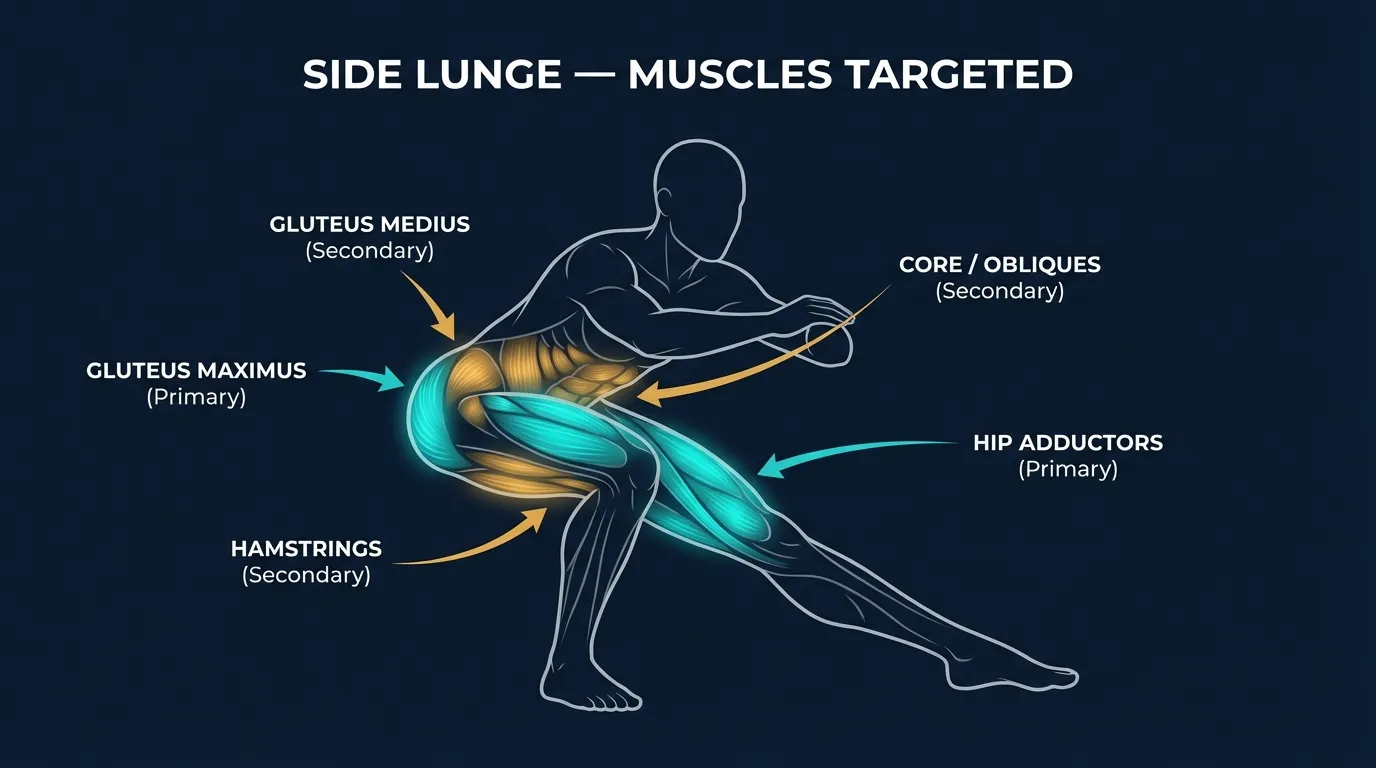
Primary movers: the gluteus maximus, quadriceps, and hip adductors on the working side. The quads control knee flexion on the way down and extend the knee on the way up. The gluteus maximus extends the hip as you push back to standing. The adductors, especially adductor magnus and adductor longus, lengthen under tension as you sit into the side lunge and then help pull the body back toward center.
Secondary movers: the gluteus medius and minimus help control the pelvis and keep the working knee from drifting inward. The hamstrings assist hip extension and help brake the descent. The calf muscles and smaller foot muscles help keep the working foot flat and stable as your weight shifts sideways.
Stabilizers: the rectus abdominis, transverse abdominis, obliques, and spinal erectors brace the trunk so the torso does not collapse forward or tip toward the stepping leg. The ankle stabilizers on both sides also work hard because the movement shifts load laterally rather than straight forward and back.
Why the lateral step changes the stimulus: standard squats and forward lunges train mostly in the sagittal plane. Side lunges move through the frontal plane, which increases demand on the adductors and lateral hip stabilizers. No exercise-specific PubMed, PMC, or DOI citation is included for side lunges in the verified FitCraft citation library, so this section uses mechanism-based biomechanics instead of a proxy citation.
Most leg exercises move you straight forward or straight up and down. Squats, deadlifts, step-ups, and reverse lunges all build useful strength, but they do not ask your hips to control a big sideways shift. Side lunges fill that gap. They teach the body to load one leg, open the opposite inner thigh, and return to center without the knee caving or the torso folding.
That makes the exercise useful for people who want stronger adductors, better hip mobility, and more control in side-to-side movement. It also makes the movement demanding. If your stance is wider than your mobility allows, the foot lifts, the knee drops inward, or the low back rounds. Start with the clean range you have today. Build depth from there.
How to Do Side Lunges Step by Step
-
Stand with feet hip-width apart. Keep your hands clasped at chest height for counterbalance, or place them on your hips. Brace your core, pull your shoulders back, and look straight ahead.
Coach Ty's cue: "Start tall before you step. A messy start gives you a messy lunge."
-
Step wide to one side. Take a large step to the right and plant the right foot flat. Point the toes mostly forward or turn them out only slightly. Keep the left leg long as your stance opens.
Coach Ty's cue: "Step wide enough to feel the inner thigh, but only as wide as you can control."
-
Sink into the lunge. Bend the right knee and push your hips back as if sitting into a chair on your right side. Lower until your right thigh approaches parallel, or stop earlier if your chest drops, heel lifts, or knee caves inward.
Coach Ty's cue: "Hips go back first. Think lateral squat, then stand it up."
-
Drive back to standing. Push through the heel and midfoot of the right foot to return to center. Squeeze the right glute and inner thigh as you stand, then repeat on the left side.
Coach Ty's cue: "Push the floor away with the whole foot, then snap back to tall."
-
Breathe with the effort. Inhale as you step out and lower. Exhale as you push back to standing. Keep the ribs down so the core stays active through the return.
Coach Ty's cue: "Exhale on the push. That is where the rep is won."
Get this exercise in a personalized workout
FitCraft, our mobile fitness app, uses its AI coach Ty to program compound strength exercises like this into your plan at the right volume and intensity, based on your level, goals, and equipment. Ty was designed and trained by Domenic Angelino, MPH (Brown University) and NSCA-CSCS, with research published in the Journal of Strength and Conditioning Research and Medicine & Science in Sports & Exercise.
Take the Free Assessment Free · 2 minutes · No credit card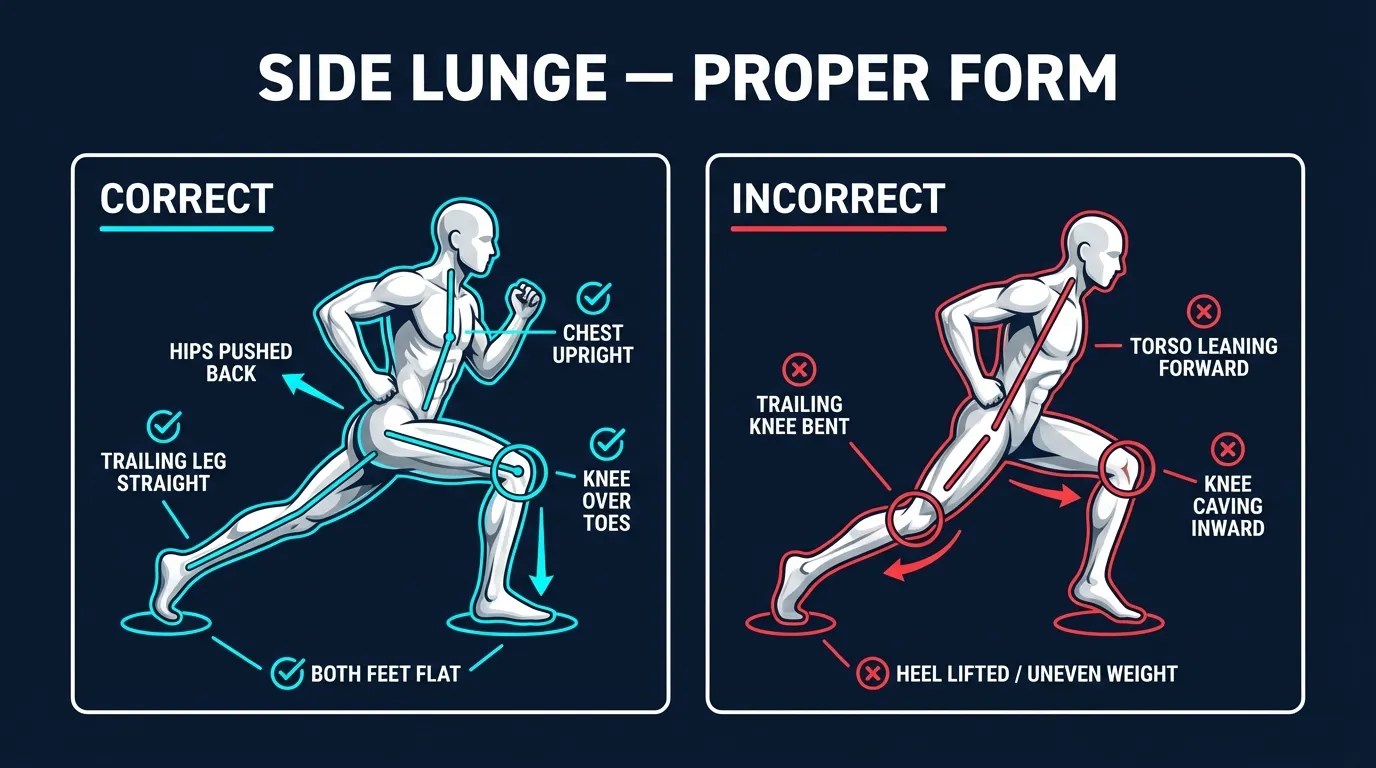
Common Mistakes to Avoid
- Knee collapsing inward. When the working knee drifts inside the foot, the medial knee and groin take stress they are not ready to absorb. Narrow the step and push the knee toward the second and third toes.
- Stepping wider than your hips can control. A wide stance is useful only when both feet stay flat, the trailing leg stays long, and the torso stays organized. If any of those fail, shorten the step.
- Dropping straight down. A side lunge is a sideways squat pattern. Push the hips back first so the glutes and adductors load instead of driving the knee forward into a jammed position.
- Leaning the torso forward or sideways. A small forward angle is normal, but folding at the waist shifts work away from the hips and toward the low back. Reduce depth until you can stay tall.
- Rushing the return. The push back to center is where the working leg has to produce force. Drive up with control instead of bouncing off the bottom or dragging the trailing foot in early.
- Letting the trailing foot lift. Keep the long-leg foot flat unless you are intentionally doing a slider variation. If the heel lifts, your stance is too wide or your ankle and adductor mobility need more time.
Side Lunge Variations: Regressions and Progressions
Supported Side Lunge
Hold a wall, rack, or sturdy chair and use your arms lightly for balance. This lets you practice the lateral hip shift without turning the rep into a balance test.
Half-Depth Side Lunge
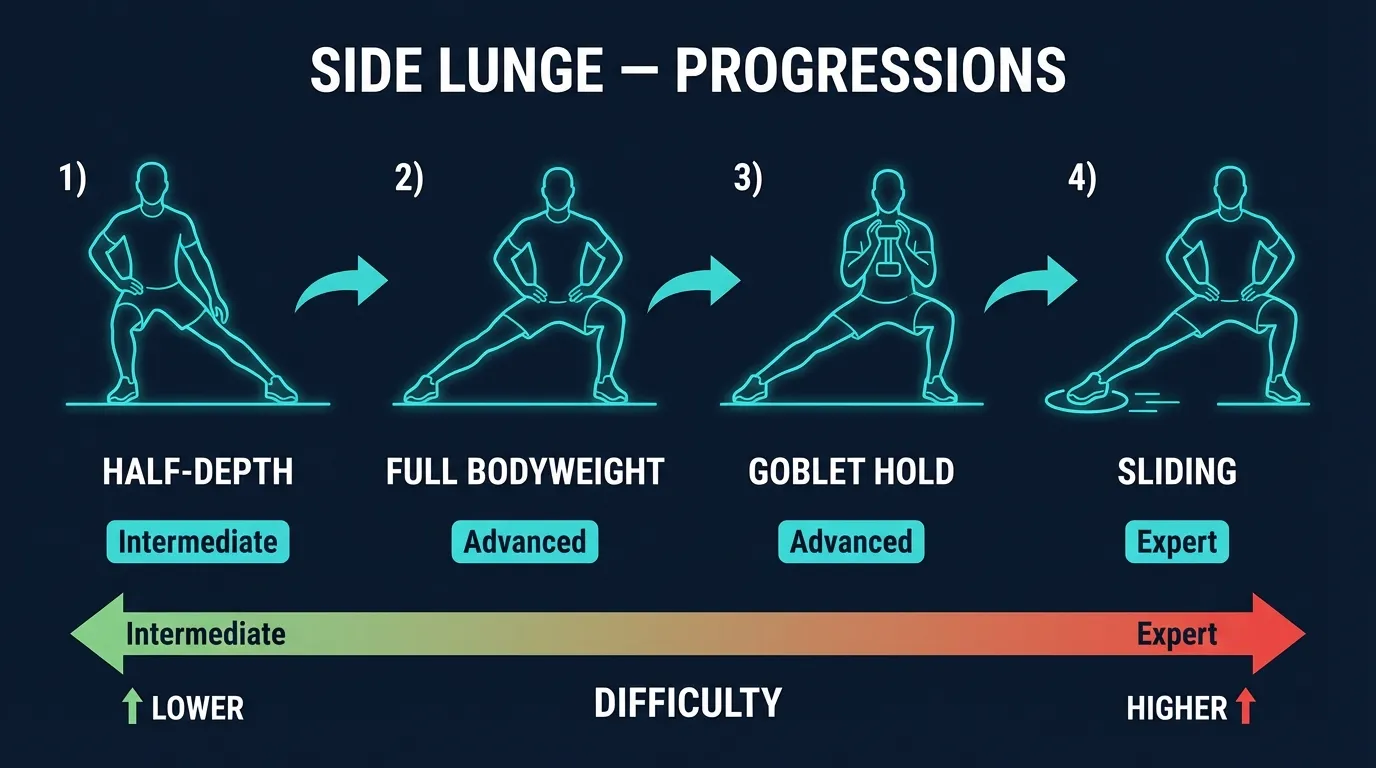
Step sideways and lower only halfway. Use this version if full depth makes your knee cave, heel lift, or torso fold. Add depth gradually over several weeks.
Bodyweight Side Lunge
This is the standard version: full lateral step, working thigh moving toward parallel, both feet flat, and the trailing leg long. Own 3 clean sets of 8 to 12 reps per side before loading it.
Goblet Side Lunge
Hold a dumbbell or kettlebell at chest height. The front load can help you stay upright, but it also increases the demand on the glutes, quads, and adductors.
Sliding Side Lunge
Place a slider, towel, or paper plate under the trailing foot. Slide the trailing leg out as you lower and pull it back in as you stand. This keeps tension on the adductors through the whole rep.
When to Avoid or Modify Side Lunges
Side lunges are safe for most healthy adults, but a few conditions call for modification, a shallower range, or a different exercise. Always consult your physician or a qualified physical therapist for personal guidance, especially when pain, injury, pregnancy, or surgery history is involved.
- Knee pain, meniscus irritation, or ligament instability. The lateral step can stress the knee if the joint caves inward. Use supported half-depth reps, shorten the stance, or substitute rear lunges until knee tracking is reliable.
- Groin strain or irritated adductors. Side lunges load the inner thigh in a lengthened position. Regress to sumo squats, short-range side lunges, or gentle mobility work until the adductors tolerate stretch under load.
- Hip impingement, labral symptoms, or sharp pinching. Deep side lunges close the working hip into flexion and can provoke symptoms. Reduce depth, turn the toes out slightly, or use glute bridges and fire hydrants while you rebuild hip control.
- Recent knee, hip, ankle, or groin surgery. Get clearance before adding lateral loading. Most return-to-training plans restore bilateral patterns before unilateral lateral patterns.
- Pregnancy, early postpartum, or pelvic-floor symptoms. Use a supported stance, smaller step, and lower depth. If pressure, heaviness, leakage, or pelvic pain appears, pause the exercise and work with a pelvic-floor physical therapist.
- Vertigo or balance disorders. The sideways weight shift can increase fall risk. Hold a stable support or use stationary alternatives like squats until balance is steady.
Related Exercises
- Same lateral pattern: side lunge lean and side lunge toe touch train similar hip positions with different reach and conditioning demands.
- Adductor-biased strength: sumo squats build inner-thigh and glute strength from a more stable two-leg base.
- Unilateral lower-body strength: rear lunges, split squats, and Bulgarian split squats train one leg at a time without the same lateral range.
- Side-hip accessories: curtsy lunges and fire hydrants challenge the gluteus medius and pelvic control from different angles.
- Core foundation: deadbugs, bird-dogs, and forearm planks build the trunk stiffness that keeps side lunges from folding forward.
How to Program Side Lunges
Side lunge programming follows the same broad progression principles as other unilateral compound lower-body exercises. The ACSM Position Stand on resistance training recommends matching volume, rest, and frequency to training status while progressing gradually across weeks (Ratamess et al., 2009).
| Level | Sets × Reps | Rest between sets | Frequency |
|---|---|---|---|
| Beginner | 2-3 × 6-10 per side, supported or half-depth | 90-120 seconds | 2-3 sessions/week |
| Intermediate | 3-4 × 8-12 per side, full bodyweight range | 120-180 seconds | 2-4 sessions/week |
| Advanced | 3-5 × 6-12 per side, goblet load, tempo, or slider | 180-240 seconds | 2-4 sessions/week |
Place side lunges after your heaviest squat or hinge when the hips are warm, or use them as the main lower-body strength move in a bodyweight session. They also pair well with glute bridges or sumo squats when you want a hip-focused lower-body day.
Let form set the ceiling. Stop the set when the knee caves, the working heel lifts, the torso folds, or the trailing leg bends because the stance is too wide.
FitCraft's AI coach Ty can place lateral strength work like side lunges inside a broader lower-body plan without overloading the adductors too quickly. The app can also scale the pattern down to supported or partial-depth work when your plan needs a cleaner entry point.
Frequently Asked Questions
Can I do side lunges with knee pain?
Side lunges may aggravate knee pain if the working knee caves inward, the stance is too wide, or depth exceeds your hip and ankle mobility. Start with supported half-depth reps, narrow the step, and stop if pain appears. If knee pain persists, work with a qualified healthcare provider or physical therapist before continuing lateral lunges.
What muscles do side lunges work?
Side lunges primarily work the gluteus maximus, quadriceps, and hip adductors. The gluteus medius, hamstrings, calves, and core stabilizers assist by controlling the pelvis, trunk, knee, and foot as you step sideways and return to center.
Are side lunges good for beginners?
Full-depth side lunges are usually intermediate because they demand hip mobility, adductor tolerance, and lateral balance. Beginners can use a chair, wall, or suspension trainer for support, shorten the step, and build from half-depth reps before moving to the standard bodyweight version.
How many side lunges should I do?
Start with 2 to 3 sets of 6 to 10 reps per side. Intermediate lifters can use 3 to 4 sets of 8 to 12 reps per side, and advanced lifters can add a dumbbell or slow tempo for 3 to 5 sets of 6 to 12 reps per side. End the set when knee tracking, foot pressure, or torso position breaks.
What is the difference between a side lunge and a lateral lunge?
Side lunge and lateral lunge usually mean the same exercise. Both involve stepping sideways, bending the working leg, keeping the opposite leg long, and driving back to standing through the working foot.