The dumbbell front squat asks more of your shoulders and upper back than any other squat you can do at home. Two dumbbells sit at your shoulders. Each one has to stay put on its own front-delt shelf. The moment one elbow drops, that dumbbell slides forward, your torso folds, and the set ends.
That demand is the point. You either own the front-rack hold or the squat falls apart. A back squat lets you grind through bad reps. A goblet squat shares the load across both hands. The dumbbell front squat does neither.
This guide covers exactly how to lift a pair of dumbbells into the shoulder rack, how to keep them there through the descent, the mistakes that quietly turn the lift into something else, and how to scale from a light pair of dumbbells up to a working weight.
Quick Facts: Dumbbell Front Squat
- Equipment needed: Dumbbells (pair)
- Difficulty: Intermediate to Advanced (after mastering the goblet squat)
- Modality: Strength
- Body region: Lower body (with significant upper-back and core demand)
- FitCraft quest category: Strength
Muscles Worked
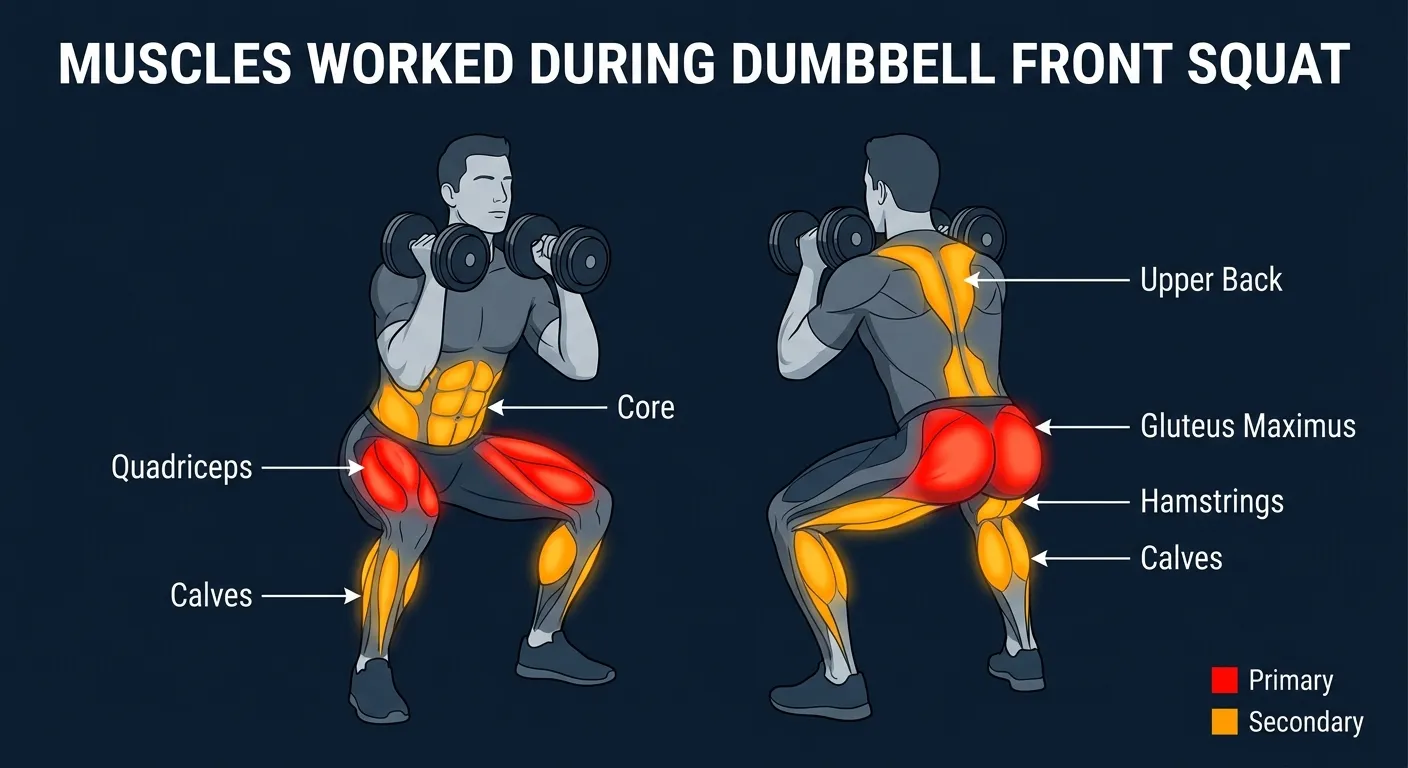
Primary movers: the quadriceps (rectus femoris, vastus lateralis, vastus medialis, vastus intermedius) drive knee extension on the ascent. The front-loaded position of the dumbbells means the squat is more knee-flexion-dominant than a back squat, which biases the quads more aggressively. The gluteus maximus drives hip extension. The adductor magnus contributes meaningfully at depth as a hip extensor.
Secondary movers: the hamstrings work eccentrically during the descent and assist hip extension out of the hole. The gastrocnemius and soleus stabilize the ankle and assist plantarflexion as you rise. The erector spinae work isometrically to keep the spine extended through the descent under load.
Stabilizers: the upper back (rhomboids, mid and lower trapezius, rear deltoids) works isometrically to maintain the shoulder rack and keep the elbows up. The entire anterior core (rectus abdominis, transverse abdominis, obliques) braces against the front-loaded torso, which is a much higher demand than the back squat at comparable loads. The front deltoids hold the platform that the dumbbells rest on. The biceps brachii and forearms keep each dumbbell pinned in place against the shoulder.
How the dumbbell version differs from a barbell front squat: with a barbell, the bar locks the hands and shoulders into one shared rack, and the load can climb as high as you can rack and squat. With dumbbells, each shoulder holds its own independent weight, which exposes any left-right asymmetry in your front-rack hold and front deltoid endurance. The dumbbell version is also self-limiting: the upper-back fatigue cap usually arrives before the leg-strength cap, so the dumbbell front squat tops out lower than what a barbell front squat would allow for the same lifter. For a home or small-gym setup with no barbell, the dumbbell front squat keeps the same quad-dominant, vertical-torso pattern available at a meaningful working weight.
Step-by-Step: How to Perform a Dumbbell Front Squat
The setup is the lift. If the dumbbells are racked properly on your shoulders before you start descending, the squat itself is straight up and down.
Step 1: Lift the Dumbbells to Your Shoulders
Stand with your feet shoulder-width apart, toes turned out 15-30 degrees. Curl or clean a dumbbell up to each shoulder so the inside head of each dumbbell rests on the front of your shoulder, on the same shelf made by the front deltoid and the very top of the chest where a barbell would rack. Palms face each other (neutral grip), elbows pointing forward and slightly up. The dumbbells are sitting on you, not held by your hands.
Coach Ty's cue: "Dumbbells on the shoulders, not in the hands. If your knuckles go white squeezing them, they are in the wrong place."
Step 2: Set the Front-Rack Position
Drive your elbows up so your upper arms are roughly parallel to the floor. The dumbbells should feel like they would stay on your shoulders even if your hands were open. Pull your shoulder blades down and back, chest up, ribs stacked over hips. This is the position you need to defend through the entire rep.
Ty's cue: "Elbows up like you're showing the ceiling. The elbows tell you whether the rack is alive. The moment they drop, the dumbbells slide forward."
Step 3: Brace and Initiate the Descent
Take a deep breath into your belly (not your chest), and brace your core like you are about to be punched in the stomach. Push your hips back and bend your knees at the same time. Drive your knees out over your toes as you lower. The torso stays vertical from the first inch. The dumbbells stay glued to the shoulders.
Ty's key cue: "Squat between your knees, not behind them. The front squat is straight up and down. Hips back at the same time the knees bend, not before."
Step 4: Squat to Depth
Lower until your hip crease drops below the top of your knee, or at least to parallel, with your torso still vertical and your elbows still pointing forward. Most lifters can hit deeper depth on a front squat than a back squat because the upright torso requires and rewards it.
As Ty coaches it: "The rack fails before the legs fail. If your elbows drop or the dumbbells start sliding forward at the bottom, the set is over. Stand back up and rack down."
Step 5: Drive Back Up
Press through your heels and midfoot, squeeze your glutes, and stand. Exhale through the sticking point. Fully extend your hips at the top without hyperextending your back. Keep the elbows up the entire ascent.
Ty's reminder: "Elbows lead the ascent. If they drop, the chest drops, and the dumbbells slide off you. Drive the elbows up, drive the floor down."
Get this exercise in a personalized workout
FitCraft, our mobile fitness app, uses its AI coach Ty to program compound strength exercises like this into your plan at the right load and volume, based on your level, goals, and equipment. Ty was designed and trained by Domenic Angelino, MPH (Brown University) and NSCA-CSCS, with research published in the Journal of Strength and Conditioning Research and Medicine & Science in Sports & Exercise.
Take the Free Assessment Free · 2 minutes · No credit card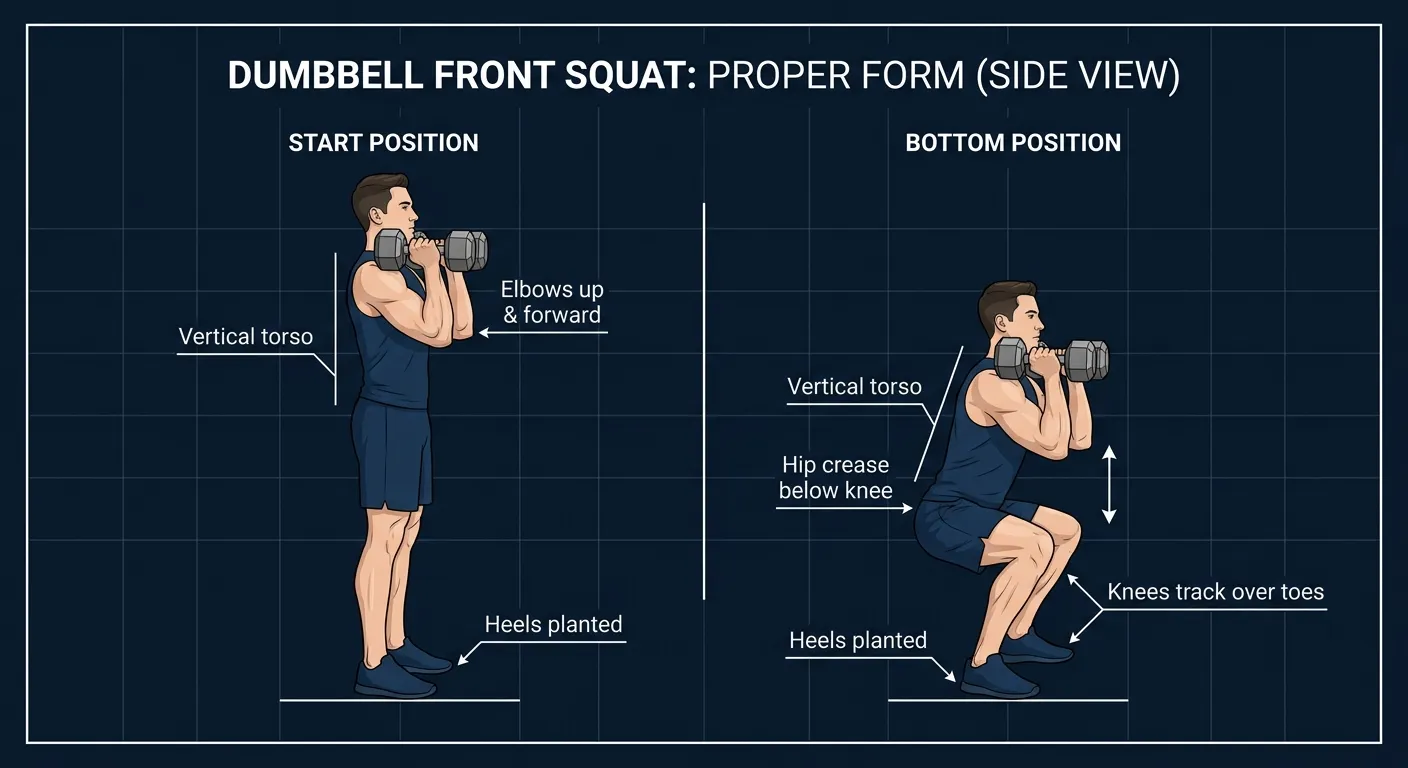
Common Mistakes (and How to Fix Them)
Here are the dumbbell-specific form breakdowns Ty corrects most often on the dumbbell front squat.
- Dumbbells drifting forward off the shoulders. The dumbbells slide down and out off the front-delt shelf as the descent deepens, ending up in front of the chest instead of on it. Doubles the lever arm against your lower back and forces the torso to fold. Fix: re-rack at the top with the inside head of each dumbbell pressed against the front of the shoulder, drive the elbows up, and cue "dumbbells back into the shoulders" through the descent. If they still drift, the load is too heavy for your current upper-back endurance.
- Elbows dropping at the bottom. The single most common rack failure. Elbows drop, chest collapses, dumbbells follow. Fix: cue "elbows up" through every inch of the descent and ascent. If you cannot hold them up even with light dumbbells, regress to the goblet squat until upper-back endurance catches up.
- Torso folding forward mid-rep. The torso wants to lean as the dumbbells get heavy. The front rack punishes this by dumping the dumbbells. Fix: stop short of the depth where the lean starts, then build hip and ankle mobility so you can hit depth with a vertical torso. Tempo work (3-second descent) at lighter loads teaches the position.
- Holding the dumbbells with the hands instead of the shoulders. The dumbbells belong on the front-delt shelf with the hands just holding them in place. Lifters often grip-and-curl them up to chest height and squat with the dumbbells supported by biceps and forearms. Fix: rack them lower so they sit on the shoulder shelf. If your wrists or fingers are doing the work, the dumbbells are too high or too far forward.
- Heels lifting at the bottom. Ankle dorsiflexion limit. Fix: small plates under the heels (or weightlifting shoes) while you work ankle mobility, plus the chair-sit cue to drive the hips back rather than the knees forward.
- Insufficient bracing. Without a hard belly brace, the front-loaded dumbbells drive through the lumbar and the lower back rounds. Fix: big breath into the belly at the top, tighten as if bracing for a punch, hold the breath through the rep, exhale through the sticking point.
- Skipping the goblet squat prerequisite. Lifters who jump from bodyweight squats straight to a pair of dumbbells at the shoulders usually have a poor rack and a torso that folds under load. Fix: master the goblet squat for 3 sets of 8-12 with a heavy dumbbell first. The hold pattern is the same; you are just going from one dumbbell on two hands to two dumbbells on two shoulders.
Dumbbell Front Squat Variations: Regressions and Progressions
The front-loaded squat family scales cleanly with dumbbells. You can train the pattern with very little equipment and progress through several distinct variations as you get stronger.
Goblet Squat (Prerequisite Regression)
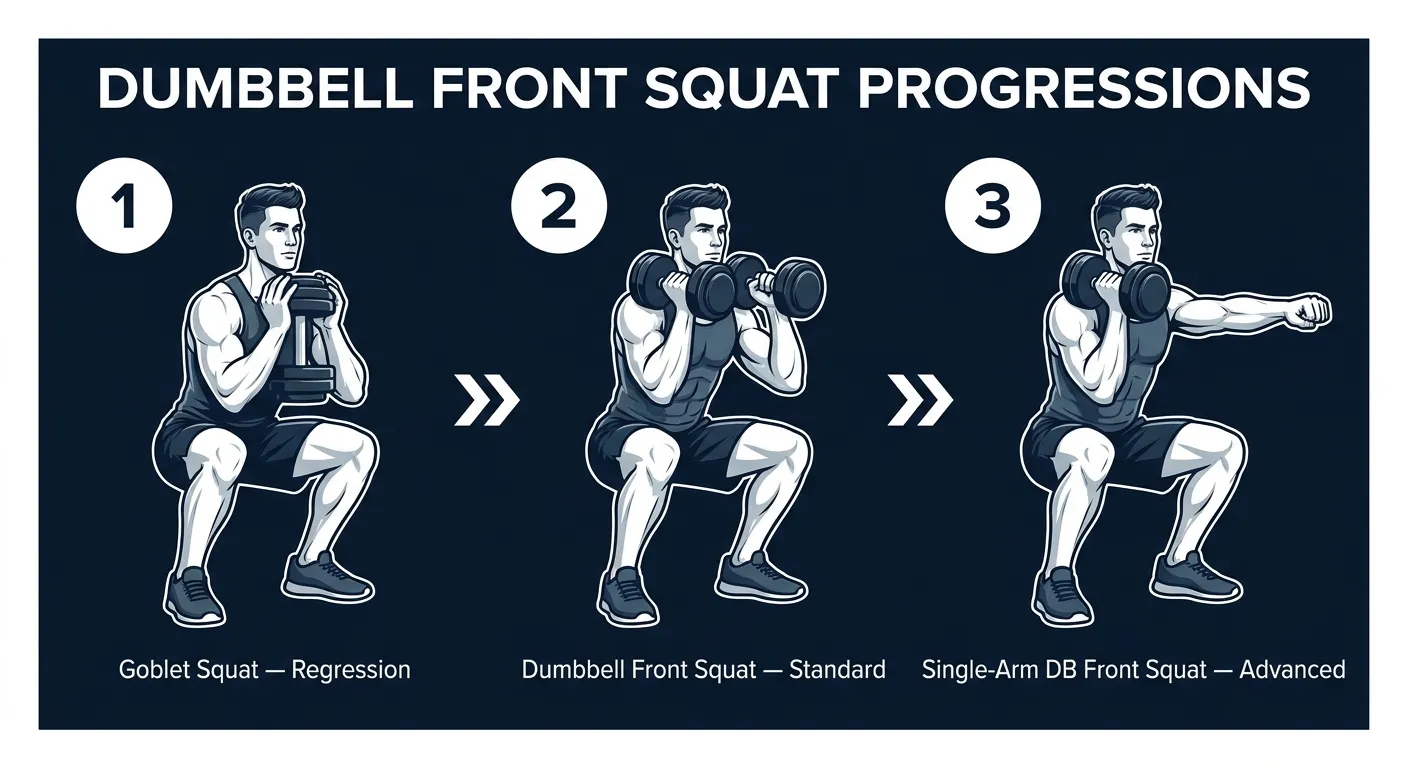
One dumbbell or kettlebell held vertically at the chest with both hands cupping the top bell. Same upright-torso, front-loaded pattern as the dumbbell front squat. The right starting point because the load is shared across both hands and the upper-back endurance demand is lower. Master this for 3 sets of 8-12 with a heavy dumbbell before holding two dumbbells at the shoulders.
Dumbbell Front Squat (Standard)
The full lift described above. A pair of dumbbells racked at the shoulders in a front-rack position, hip-width to shoulder-width stance, squat to depth with a vertical torso. The default version of this exercise.
Single-Arm Dumbbell Front Squat (Unilateral Progression)
One dumbbell racked at one shoulder, the other arm free at your side or extended for balance. The asymmetric load demands hard anti-rotation core work to keep the torso square through the rep. Exposes left-right imbalances in front-rack endurance. Useful as an accessory or as a substitute when you only have one dumbbell heavy enough to make the squat challenging.
Tempo or Paused Dumbbell Front Squat (Advanced Variation)
Same setup, slower descent (3-5 seconds) or 2-3 second pause at the bottom. Exposes any compensations in the rack or torso position and builds the strength to drive out of the hole.
Jump Squat (Power Progression)
Drop the dumbbells, switch to bodyweight, and add an explosive jump at the top of each rep. Trains the same lower-body pattern for power rather than strength and pairs well with dumbbell front squats in the same session (strength first, power second).
When to Avoid or Modify Dumbbell Front Squats
The dumbbell front squat is a demanding lift that loads the knees, hips, lower back, and shoulders. A few conditions call for modification or substituting the goblet squat or a bodyweight squat. Always consult your physician or physical therapist for personalized guidance.
- Patellofemoral knee pain or recent knee surgery. The quad-dominant pattern increases knee compression compared to a back squat or a hinge. Drop to bodyweight squats or wall sits while symptoms settle, then reintroduce loaded squats from the goblet squat before holding two dumbbells at the shoulders.
- Acute lower-back pain or known disc pathology. Any loaded squat in an acute back episode is the wrong choice. Drop the dumbbells, rebuild bracing with deadbugs, bird-dogs, and forearm planks, then reintroduce loaded squats from a light goblet hold.
- Shoulder mobility limit or recent shoulder surgery. Holding a pair of dumbbells at the shoulders with elbows up demands real shoulder and thoracic mobility. If you cannot keep the elbows up unloaded, the position is not ready for load. Use the goblet squat until the shoulders tolerate the rack. Get surgical clearance before loading the front-rack position after any procedure.
- Wrist or elbow injury. The front-rack hold puts the wrists in flexion and loads the elbows under the dumbbell weight. Pain in either joint usually means the dumbbells are sitting wrong (in the hands instead of the shoulders). Re-rack first. If the position still hurts, regress to the goblet squat until the joint tolerates the rack.
- Uncontrolled hypertension or known cardiovascular disease. Heavy squats and the Valsalva brace spike intrathoracic and intra-arterial pressure. Use lighter dumbbells, longer rest between sets, no 1-rep-max attempts. Follow your cardiologist's exercise guidance.
- Pregnancy, especially second and third trimester. The combination of bracing demand and the front-loaded position is high. Most lifters transition to a light goblet squat or bodyweight squat for the rest of pregnancy. Stop and consult your OB if you feel pelvic pressure, dizziness, or any pain.
- First 6-8 weeks postpartum or active diastasis recti. Heavy bracing widens abdominal separation. Start with glute bridges and bodyweight squats. Rebuild deep-core function with deadbugs and bird-dogs before reloading with dumbbells.
Related Exercises
If the dumbbell front squat is part of your routine, these movements complement or extend the same training pattern:
- Same movement pattern (squat variations): Bodyweight Squats and Goblet Squats as the prerequisite work. Jump Squats for power progression in the same pattern.
- Same movement pattern (unilateral lower body): Bulgarian Split Squats and Split Squats develop single-leg strength and pair naturally with the dumbbell front squat in a balanced lower-body week.
- Complementary lower-body pattern (hinge): the Dumbbell Deadlift and Single-Leg Deadlift train the hip-hinge pattern that pairs with squats in any complete lower-body program.
- Glute-focused accessory: Glute Bridges isolate the gluteus maximus and balance the quad bias of the front squat.
- Core foundation for spinal bracing: Deadbugs, Bird-Dogs, and Forearm Planks train the bracing pattern the front rack relies on as loads increase.
How to Program Dumbbell Front Squats
Dumbbell front squat programming follows the same evidence-based ranges as any compound lower-body lift, with reps tilted slightly higher than the barbell version because the dumbbell load ceiling is lower and the rack fatigue cap usually arrives before the legs do. The American College of Sports Medicine (ACSM) Position Stand on resistance training recommends roughly 6-12 reps per set for hypertrophy, with at least 48 hours between heavy sessions training the same muscle group (Ratamess et al., 2009).
| Level | Sets × Reps | Rest between sets | Frequency |
|---|---|---|---|
| Beginner (10-20 lb dumbbells, after mastering the goblet squat) | 2-3 × 8-12 | 90-120 seconds | 1-2 sessions/week |
| Intermediate (20-35 lb dumbbells) | 3-4 × 8-12 | 120-180 seconds | 1-2 sessions/week |
| Advanced (35+ lb dumbbells, tempo, single-arm) | 3-5 × 6-10 | 120-180 seconds | 1-2 sessions/week |
Where in your workout: dumbbell front squats belong first in a lower-body session, when you are fresh and the front-rack hold is at its best. They are not a finisher. Pair them with a hinge pattern (dumbbell deadlift, Romanian deadlift) for a balanced day.
Form floor over rep targets: if your elbows drop or the dumbbells start sliding forward, the set is done, regardless of the rep target. You cannot push through a broken rack. The dumbbells will end up in front of your chest with your torso folded over them. Treat the rack as the rep cap, not the legs.
How FitCraft Programs This Exercise
Knowing how to dumbbell front squat is step one. Knowing when you are ready for two dumbbells at the shoulders, how heavy, and how to load it into a balanced lower-body week is where most lifters get stuck.
FitCraft's AI coach Ty handles that. During your personalized diagnostic assessment, Ty maps your training history, available dumbbells, and goals. Then Ty builds a program that introduces the dumbbell front squat at the right moment (after the goblet squat is solid) and slots it into a balanced training plan that pairs squats with hinges, unilateral work, and core foundation work.
As you get stronger, Ty adjusts the variation and load. Goblet squat becomes dumbbell front squat. Light becomes moderate becomes heavy or tempo or single-arm. Every program is designed by an Ivy League-trained exercise scientist and NSCA-certified strength coach using evidence-based periodization, then adapted to you by the AI.
Frequently Asked Questions
What muscles do dumbbell front squats work?
Dumbbell front squats are a quadriceps-dominant compound lift. Primary movers are the quadriceps, gluteus maximus, and adductor magnus, with secondary work from the hamstrings, calves, and erector spinae. The shoulder-rack hold also creates a significant isometric demand on the upper back (rhomboids, mid and lower trapezius), anterior core (rectus abdominis, transverse abdominis, obliques), and the front deltoids that the dumbbells rest on.
Dumbbell front squat vs goblet squat: what's the difference?
The goblet squat holds one dumbbell vertically at the chest with both hands. The dumbbell front squat holds two separate dumbbells at the shoulders, mimicking the barbell front rack. The dumbbell front squat is the more advanced version because each shoulder has to hold its own load, the upper-back endurance demand is higher, and the position falls apart if your elbows drop. Most people graduate to the dumbbell front squat once the goblet squat becomes too heavy for the upper-back hold.
How heavy should the dumbbells be?
Most untrained adults start with a pair of 10-20 lb dumbbells and prove the front-rack hold before adding load. The dumbbells will feel light for your legs but heavy for the position. Spend your first 2 to 4 weeks at a weight where you can do 3 sets of 8-12 with elbows up and torso vertical. Once the hold is rock solid, add 5 lb per dumbbell per session for as long as your form stays clean. Most people build to a pair of 25-40 lb dumbbells for sets of 8-12 within 3 to 6 months.
Should the dumbbells touch my shoulders?
Yes. The inside head of each dumbbell should rest directly on the front of the shoulder, on the same shelf made by the front deltoid and the very top of the chest where you would rack a barbell. The hands are there to keep the dumbbells in place, not to hold their full weight. If your wrists or fingers are taking the load, the dumbbells are sitting too high or too far in front. Re-rack so they sit on the shelf, then keep your elbows driving up.
Can I do dumbbell front squats if I have knee pain?
Quad-dominant squats load the knees more than back squats at comparable weights. If you have patellofemoral pain or are post-knee-surgery, drop the dumbbells entirely until symptoms settle and rebuild the pattern from bodyweight squats or wall sits. When you reintroduce load, start from the goblet squat and only move back to dumbbell front squats once the goblet version is pain-free for 3 sets of 8-12. Persistent knee pain warrants a physical therapy referral before continuing.