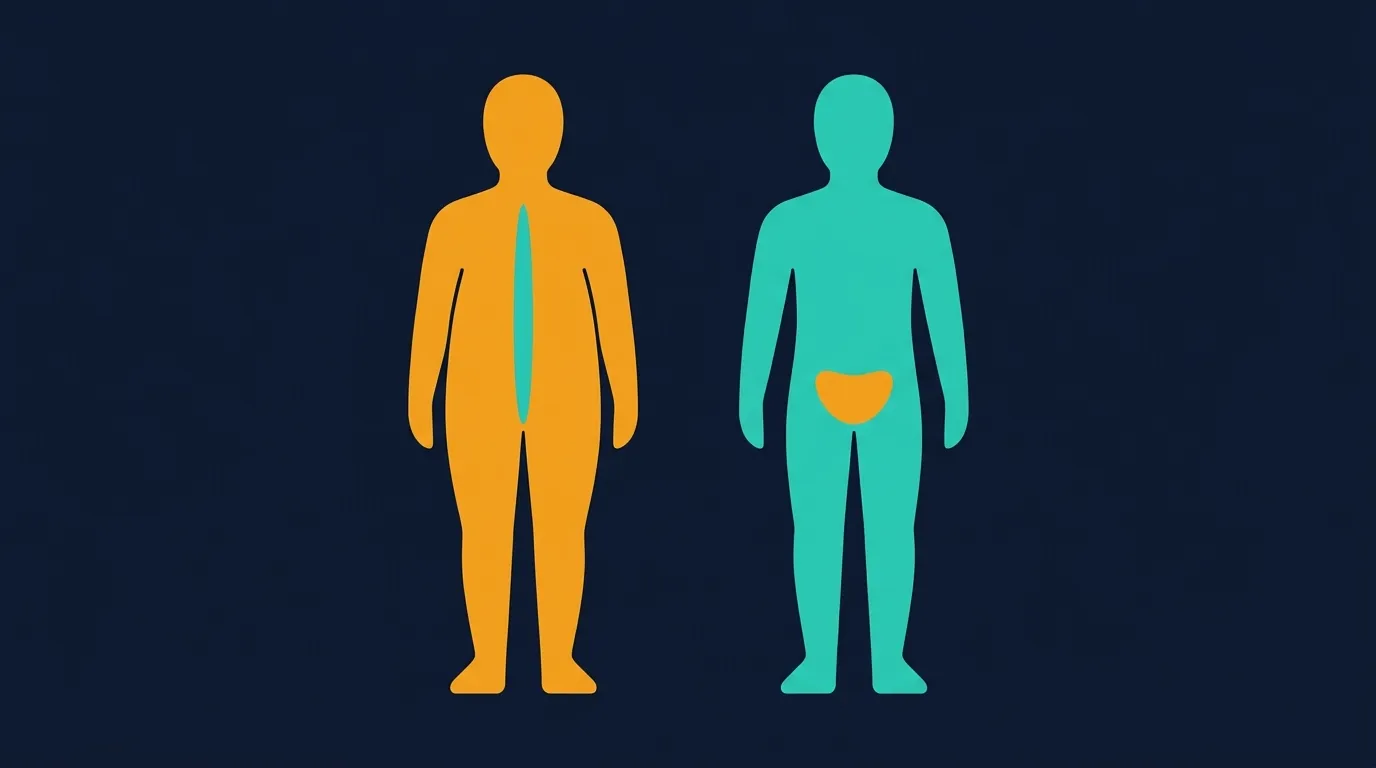
The "skinny fat" phrase gets thrown around a lot, and most of it is aesthetic. Under it, though, is a real medical phenotype with a name (normal weight obesity), a definition (normal BMI plus body fat above roughly the top tertile for your sex), and a cardiovascular mortality signal strong enough to show up in NHANES data. It is a case where the scale lies and the mirror is partly right.
The reason it matters is simple. BMI was built to be cheap. Height and weight. Nothing about muscle, nothing about fat, nothing about where fat sits on the body. For most people, most of the time, BMI tracks reasonably well with cardiometabolic risk. But there is a subgroup where BMI reads normal while body composition is quietly bad. That subgroup is who this article is about. If your BMI is 22 but your waist keeps drifting up and your last blood panel had triglycerides in the danger zone, this piece explains what the trials say and what the protocol looks like.
The good news is that the fix is well-defined. It is not exotic. And it does not need a hard deficit or a punishing training program. It needs the right lever, applied consistently, for long enough to move body composition. Cardio alone will not do it. Diet alone will not do it. The specific combination that works is what the trials converge on, and that is what the practical section below lays out.
The Research: What Studies Show
Romero-Corral 2010: The Original Cardiovascular Mortality Signal
The foundational paper on normal weight obesity is Romero-Corral, Somers, Sierra-Johnson, Korenfeld, Boarin, Korinek, Jensen, Parati, and Lopez-Jimenez (2010) from Mayo Clinic, published in the European Heart Journal. The team analyzed 6,171 adults over age 20 from NHANES III, cross-linked to the NHANES III mortality file, with a median 8.8-year follow-up. They defined normal weight obesity as a BMI in the normal range (18.5 to 24.9 kg/m²) combined with a body fat percentage in the top sex-specific tertile, which came out to above 33.3% for women and above 23.1% for men. For comparison, the healthy ranges most body fat charts use top out at about 33 percent for women and 20 percent for men under 40, and our post on what is a healthy body fat percentage lays out the full table by age.
The NWO group carried a metabolic syndrome prevalence of 16.6%, almost four times the 4.8% rate in the low-body-fat normal-weight group. Cardiovascular mortality was where the numbers got serious. Women with normal weight obesity had a 2.2-fold higher hazard of cardiovascular mortality compared with the low-body-fat reference group (HR 2.2, 95% CI 1.03 to 4.67, after adjustment for age, ethnicity, physical activity, smoking, and other cardiovascular risk factors). The men trended in the same direction but with a wider confidence interval and less certainty.
The takeaway from Romero-Corral is not that BMI is useless. It is that BMI misses a real subgroup whose risk profile is worse than their scale weight suggests, and that women are the population most at risk of being falsely reassured by a normal BMI. If a routine physical uses only BMI to sort people into risk categories, someone with normal weight obesity looks fine on paper and gets no intervention while quietly running double the cardiovascular mortality risk.
Mohammadian Khonsari 2022: The Meta-Analysis
The single-cohort finding held up in the pooled evidence. Mohammadian Khonsari, Khashayar, Shahrestanaki, Kelishadi, and colleagues (2022), publishing in Frontiers in Endocrinology, systematically reviewed 25 studies and meta-analyzed 177,792 participants aged 13 to 75. The definition of normal weight obesity varied slightly by study (different fat-percentage cutoffs, different measurement modalities), but the direction of the results was consistent.
Pooled odds ratios for the classic cardiometabolic risk factors:
- Metabolic syndrome: OR 1.92 (95% CI 1.58 to 2.26)
- High triglycerides: OR 1.90 (95% CI 1.44 to 2.35)
- Dyslipidemia (combined): OR 1.83 (95% CI 1.61 to 2.04)
- Hyperglycemia: OR 1.50 (95% CI 1.23 to 1.76)
- Hypertension: OR 1.40 (95% CI 1.28 to 1.51)
- Diabetes: OR 1.39 (95% CI 1.30 to 1.49)
- Low HDL: OR 1.28 (95% CI 1.06 to 1.49)
None of these are the size of the odds ratios seen in frank obesity (BMI over 30). But every one is significant, and the point of the meta-analysis is that a normal BMI is not a metabolic clean bill of health when body fat percentage is elevated. The authors flag chronic low-grade inflammation as the likely mediator, since C-reactive protein and interleukin-6 tend to run higher in NWO than in metabolically healthy normal-weight controls.
Longland 2016: The Recomposition Proof-of-Concept
The mechanism argument for how to reverse skinny fat is grounded in the body recomposition literature. The cleanest single trial is Longland, Oikawa, Mitchell, Devries, and Phillips (2016) at McMaster University, in the American Journal of Clinical Nutrition. Forty young men were randomized to a 40% energy deficit for 4 weeks with either a lower-protein diet (1.2 g/kg/day) or a higher-protein diet (2.4 g/kg/day). Both groups did resistance training and high-intensity interval training six days per week.
The higher-protein group gained 1.2 kg of lean body mass and lost 4.8 kg of fat mass. The lower-protein group essentially held lean mass flat (+0.1 kg) and lost 3.5 kg of fat. Read that again. In a heavy deficit that would normally erode muscle, the high-protein arm added muscle. The mechanism is the point: when protein is high and resistance training is progressive, the body preferentially uses stored fat as substrate for muscle building even when total energy intake is below expenditure. That is exactly the physiology skinny fat needs.
The trial has limits (young men, controlled environment, short duration, high training volume), but the finding is durable and reproducible. The FitCraft body recomposition research review walks through the broader trial base, including the Garthe (2011) elite-athlete data and the Antonio (2015) high-protein-without-deficit result.
Barakat 2020: The Practical Protocol
The literature got its clearest synthesis with Barakat, Pearson, Escalante, Campbell, and De Souza (2020) in the Strength and Conditioning Journal. The review pulled the RCT and observational evidence together and asked whether body recomposition works in trained populations. Answer: yes, with conditions. Progressive resistance training. Sufficient protein (their range: 1.6 to 2.4 g/kg/day). Moderate energy status (small deficit, maintenance, or a slight surplus with high protein).
Barakat also flagged the populations most likely to see fast change. Novices and returning lifters, who capture the beginner adaptation window. People with more body fat to lose, who have stored substrate for muscle building. Detrained individuals coming off a long layoff. Most people who identify as skinny fat sit squarely in one or more of these buckets, which is why the protocol tends to work quickly in this population. Advanced lean lifters trying to squeeze the last few percentage points of body fat while still gaining muscle are a different problem entirely.

Lahav 2026: Only Resistance Training Adds Muscle
The most recent piece of the puzzle isolates the training variable. Lahav, Yavetz, and Gepner (2026) at Tel Aviv University, in Frontiers in Endocrinology, tracked 304 adults (183 men, 121 women, ages 20 to 74, BMI 18.5 to 45) through a supervised weight-loss program that included one of three training modalities: resistance training, aerobic training, or no structured exercise. All groups ate a similar hypocaloric diet.
The resistance training group was the only one that added lean mass. Men gained 0.8 kg of fat-free mass while losing 8.9 kg of fat and 9.0 cm of abdominal circumference. Women gained 0.9 kg of fat-free mass while losing 6.4 kg of fat and 7.5 cm of abdominal circumference. The aerobic and no-exercise groups lost weight but did not add lean mass; in some subgroups they lost lean mass.
The most useful ratio from Lahav is what they call quality of weight loss: for every 1 kg of body weight the resistance group lost, roughly 1.1 kg of it was fat (they lost more fat than total weight because they simultaneously added a small amount of muscle). Aerobic training averaged 0.86 kg fat per kg weight lost, and no exercise averaged 0.7 kg. Translated to the skinny fat context: a diet-plus-cardio approach will lower the scale but will not shift the ratio that defines the problem. Only resistance training does.
Why This Matters for Your Fitness
The mainstream fix for a normal BMI who feels "out of shape" is cardio. Walk more. Add a class. Maybe start running. Cardio has real health benefits, especially for cardiovascular risk factors and mental health. What it does not do, on its own, is fix the composition problem. If you weigh 145 pounds now at 32% body fat and you drop to 135 pounds through cardio and food, you will still be at roughly 32% body fat. Smaller version, same shape.
This is why skinny fat is often the frustrating middle. The scale reads normal, the doctor does not flag anything, but the mirror shows soft. Aggressive dieting makes it worse, because a hard deficit without resistance training pulls muscle out of you along with fat, and you land at a lower weight with an even worse composition. Adding "healthy eating" without adding lifting produces slow, small change that never seems to close the gap. The lever that closes the gap is progressive resistance training. That is what all three of the recomposition trials share and what the Lahav 2026 comparison isolates.
There is a psychological piece too. Most people who identify as skinny fat have never done a structured resistance program. That is not a personality flaw. It is just a training-history fact. And it is why the fix moves faster in this population than in already-trained lifters: the beginner adaptation window is wide open. If you have never progressively loaded a squat, hinge, push, and pull pattern with real intent for 12 weeks, the first 12 weeks will do more for your body composition than anything else you have tried. The FitCraft body recomposition home workout guide walks through the training piece in detail.
Get an evidence-based plan built for you
FitCraft, our mobile fitness app, pairs you with an AI coach who builds you a personalized plan around your goals, schedule, and fitness level. Every FitCraft program is designed by Domenic Angelino, MPH (Brown University) and NSCA-CSCS, with research published in the Journal of Strength and Conditioning Research and Medicine & Science in Sports & Exercise.
Take the Free Assessment Free • 2 minutes • No credit cardHow to Fix Skinny Fat in Practice
The trials converge on a fairly narrow set of design features. Match them and the composition moves. Miss them and it stalls. Here is the practical translation.
| Variable | What the successful trials used |
|---|---|
| Training modality | Progressive resistance training as the anchor. 3 to 4 sessions per week, full body or upper/lower split, hitting each muscle group twice weekly. Cardio is optional, added on top. Lahav (2026) confirms cardio alone does not add muscle. |
| Rep ranges | 8 to 30 reps per set, taken close to failure (2 to 3 reps in reserve). Both low-rep-heavy and higher-rep-moderate work drive muscle growth. Pick what you can execute with clean form. |
| Progressive overload | Add small increments week to week: another rep, a bit more load, a shorter rest. A static routine will not drive recomposition. Barakat (2020) treats progressive overload as non-negotiable. |
| Protein | 1.6 to 2.4 g/kg body weight per day. Longland (2016) used 2.4 g/kg in a heavy deficit and got measurable muscle gain. Spread it across 3 to 5 meals of 30 to 40 g. See the FitCraft protein distribution research review for meal-timing details. |
| Calories | Maintenance or a small deficit (200 to 400 kcal/day under maintenance). Larger deficits still lose weight but blunt lean-mass gains, per Murphy and Koehler (2022). Skinny fat responds better to a slow, sustainable ramp than to a hard cut. |
| Cardio | Optional. 2 to 3 moderate sessions per week (zone 2 walking, cycling, or slow jogging) supports cardiovascular and metabolic health. Not a substitute for resistance training. |
| Sleep | 7 to 9 hours nightly. Chronic sleep restriction elevates cortisol and biases weight loss toward lean mass, which is exactly what skinny fat cannot afford to lose. |
| Timeline | 12 to 24 weeks for visibly different composition. Track girth (waist, hips, thighs) and monthly progress photos in the same lighting, not just scale weight. Barakat (2020) recommends 12-week evaluation windows. |
One more design principle. The scale is the least useful metric in a recomposition. You are trying to swap fat for muscle at similar total weight, so scale changes will be small and slow. If you rely on the scale to tell you if it is working, you will quit in week 4 because it barely moved. Photos and girth measurements catch the actual change. So does clothing fit. The pants that were snug in the waist and loose in the thighs at week 1 will reverse over 12 weeks even if the scale is flat.
Common Misconceptions
Misconception: "Skinny fat just means you need to lose weight."
Losing weight from a skinny fat body composition without resistance training reliably makes the composition worse. Lahav (2026) documented this: the no-exercise weight-loss group lost weight but did not add lean mass and in some subgroups lost lean mass. If you start at 145 pounds and 32% body fat and diet down to 135 pounds, you can easily end up at 33% body fat because you lost roughly equal parts fat and muscle. The scale moved and the mirror looks smaller but softer. The fix is not to weigh less. The fix is to change what the weight is made of.
Misconception: "You need to bulk first, then cut."
This is bodybuilding advice applied to a general-fitness problem. It works for people trying to add serious mass, but it is not the fastest path for the skinny fat phenotype. Longland (2016) demonstrated that muscle gain is possible in a deficit when protein is high and training is progressive. Antonio (2015) showed body composition improvements without a deliberate deficit. Barakat (2020) explicitly notes that the recomposition path (add muscle and lose fat simultaneously) is the appropriate strategy for people carrying more body fat, which describes skinny fat by definition. A bulk-then-cut cycle usually adds more fat than muscle in this population and creates two problems where there was one.
Misconception: "Cardio is what burns fat, so cardio is what fixes skinny fat."
Cardio burns calories during the session and improves cardiovascular health. It does not build the muscle mass that skinny fat is missing, and it does not shift body composition in the way resistance training does. Lahav (2026) put this on a stopwatch: the aerobic-only group in their 304-person cohort added zero lean mass, versus small but measurable lean-mass gains in the resistance group. Cardio is a useful addition on top of a resistance training program. It is not a replacement.
Misconception: "I'm too old / too female / too out of shape to build muscle."
None of these hold up in the trials. Women build muscle at similar relative rates to men when training and nutrition are equivalent. Adults over 60 build muscle at meaningful rates with resistance training, though absolute gains are smaller than in young adults; the FitCraft strength training after 60 research covers the specifics. And people with the least training history (most skinny fat adults) capture the fastest early adaptations. Barakat (2020) flags novices and detrained adults as the populations that see recomposition fastest. The barrier is not biology. It is starting a progressive program and staying with it.
What the Research Suggests Going Forward
The core findings are stable. Normal weight obesity is a real cardiometabolic risk phenotype with a measurable cardiovascular mortality signal, particularly in women, that gets missed by BMI-only screening. Progressive resistance training plus 1.6 to 2.4 g/kg/day protein at maintenance or a small deficit is the training-and-nutrition combination the trials converge on. Cardio is a useful addition but not a substitute. Timeline is measured in months, not weeks.
Where the literature is still thin: long-duration trials past 6 months are rare in the skinny fat population specifically. Most of the recomposition trial evidence comes from young or middle-aged adults, so the size of the effect in older skinny fat adults is less precisely characterized (though the direction of change is the same). And direct measurement of body composition with DEXA or BodPod is uncommon in general population studies, so most people who fit the phenotype are self-identifying rather than working from a lab-measured body fat percentage. If you have access to a DEXA scan, use it as a baseline. If not, waist circumference and progress photos are the practical stand-in. Once you have any body fat estimate, the FFMI calculator turns it into lean body mass and a fat-free mass index, which shows whether the muscle side of your composition is below average for your height.
For the reader whose BMI reads normal but whose composition does not feel it, the takeaway is direct. Start progressive resistance training three or four times per week. Get protein up to 1.6 to 2.4 g/kg/day. Keep calories at maintenance or a small deficit. Add moderate cardio if you enjoy it or need it for cardiovascular health. Measure with girth and photos, not just the scale. Give it 12 weeks before evaluating. Recomposition rewards consistency over intensity. The lever is training. The variable is time.

References
- Romero-Corral A, Somers VK, Sierra-Johnson J, Korenfeld Y, Boarin S, Korinek J, Jensen MD, Parati G, Lopez-Jimenez F. "Normal weight obesity: a risk factor for cardiometabolic dysregulation and cardiovascular mortality." European Heart Journal 31.6 (2010): 737-746. doi:10.1093/eurheartj/ehp487.
- Mohammadian Khonsari N, Khashayar P, Shahrestanaki E, Kelishadi R, Mohammadpoor Nami S, Heidari-Beni M, Esmaeili Abdar Z, Tabatabaei-Malazy O, Qorbani M. "Normal Weight Obesity and Cardiometabolic Risk Factors: A Systematic Review and Meta-Analysis." Frontiers in Endocrinology 13 (2022): 857930. doi:10.3389/fendo.2022.857930.
- Longland TM, Oikawa SY, Mitchell CJ, Devries MC, Phillips SM. "Higher compared with lower dietary protein during an energy deficit combined with intense exercise promotes greater lean mass gain and fat mass loss: a randomized trial." American Journal of Clinical Nutrition 103.3 (2016): 738-746. doi:10.3945/ajcn.115.119339.
- Barakat C, Pearson J, Escalante G, Campbell B, De Souza EO. "Body Recomposition: Can Trained Individuals Build Muscle and Lose Fat at the Same Time?" Strength and Conditioning Journal 42.5 (2020): 7-21. doi:10.1519/SSC.0000000000000584.
- Lahav Y, Yavetz R, Gepner Y. "Resistance training as a key strategy for high-quality weight loss in men and women." Frontiers in Endocrinology 16 (2026): 1725500. doi:10.3389/fendo.2025.1725500.
Frequently Asked Questions
What does skinny fat actually mean in medical terms?
Skinny fat is the popular label for what the medical literature calls normal weight obesity (NWO): a body mass index inside the normal range (18.5 to 24.9 kg/m²) paired with a body fat percentage above the healthy cutoff. Romero-Corral et al. (2010) in the European Heart Journal used the top tertile of body fat (above 33.3% in women and above 23.1% in men) as their NWO threshold when analyzing NHANES III data on 6,171 adults. The pattern combines low muscle mass with above-normal fat mass, which is why the scale reads normal but the body composition is not.
Is skinny fat actually unhealthy or just a cosmetic issue?
It is a real cardiometabolic risk, not just a mirror problem. Romero-Corral et al. (2010) reported that women with normal weight obesity had a 2.2-fold higher risk of cardiovascular mortality compared to normal-weight women with lower body fat (HR 2.2, 95% CI 1.03 to 4.67, median 8.8 year follow-up). Metabolic syndrome prevalence was almost four times higher in the NWO group (16.6% vs 4.8%). Mohammadian Khonsari et al. (2022) meta-analyzed 25 studies and 177,792 participants and found NWO raised the odds of metabolic syndrome 1.92-fold, high triglycerides 1.90-fold, low HDL 1.28-fold, hypertension 1.40-fold, and diabetes 1.39-fold.
How do you fix a skinny fat body?
The evidence-based protocol is progressive resistance training plus high protein, at maintenance calories or a small deficit. Lahav et al. (2026) in Frontiers in Endocrinology tracked 304 adults and found resistance training was the only modality that both reduced fat mass and added lean mass (men gained 0.8 kg lean while losing 8.9 kg fat; women gained 0.9 kg lean while losing 6.4 kg fat). Longland et al. (2016) showed 2.4 g/kg/day protein plus resistance training produced 1.2 kg lean gain and 4.8 kg fat loss in a 4-week deficit. Barakat et al. (2020) landed on 1.6 to 2.4 g/kg/day protein, progressive resistance training hitting each muscle group twice weekly, and a modest deficit (under 500 kcal/day) as the practical recomposition recipe. Cardio alone will make you smaller but keep the composition problem intact.
Can you be skinny fat and still have a low BMI?
Yes. That is the whole definition. BMI does not distinguish muscle from fat, so a sedentary person can hit a normal BMI while carrying above-normal fat mass and below-normal muscle mass. Mohammadian Khonsari et al. (2022) note that this is why NWO gets missed in most clinical screenings: a normal BMI reads as low-risk in a two-minute doctor's visit, even when body composition is worse than that of many overweight but muscular people. If your BMI is 22 but your waist is expanding and you have never done regular resistance training, the skinny fat pattern is plausible.
Does cardio help with being skinny fat?
Cardio helps with fat loss but does not solve the composition problem. Lahav et al. (2026) tracked 304 adults and found the aerobic-only group lost weight but did not add lean mass (women in the aerobic group added zero lean mass on average, versus +0.9 kg in the resistance group). If your body composition is skinny fat, cardio without resistance training will make you a smaller version of the same shape. Resistance training first, then add cardio for cardiovascular and metabolic health. A reasonable pattern is 3 progressive resistance sessions per week plus 2 to 3 moderate cardio sessions per week.
How long does it take to fix skinny fat?
Plan on 12 to 24 weeks for visibly different body composition, longer for a full reset. Barakat et al. (2020) recommend 12-week evaluation windows for body recomposition and note that people newer to structured resistance training (which most skinny fat adults are) see the fastest changes because they capture the beginner adaptation window. The scale may barely move for the first 6 to 8 weeks, because you are losing fat and adding muscle at similar rates. Track girth measurements at the waist, hips, and thighs, plus monthly progress photos in the same lighting, not just scale weight.