- The headline finding. In 1,104 active middle-aged men followed 10 years, those completing 40 or more push-ups at baseline had a 96% lower incidence of cardiovascular events than peers doing fewer than 10 (Yang et al., JAMA Network Open, 2019).
- Push-ups beat the treadmill. In the same study, push-up capacity was more strongly associated with future cardiovascular disease than submaximal treadmill testing. That’s counterintuitive, and it’s why the paper went viral.
- The mechanism is indirect. Push-ups measure muscular strength and endurance, not aerobic fitness. The link runs through what push-up capacity co-varies with: total activity, lean mass, metabolic health, and body composition.
- Generalizability is limited. The cohort was all male, all occupationally active firefighters. Broader meta-analyses of ~2 million adults confirm the muscular-fitness-to-mortality relationship in both sexes, but the exact push-up threshold hasn’t been validated for women or sedentary populations.
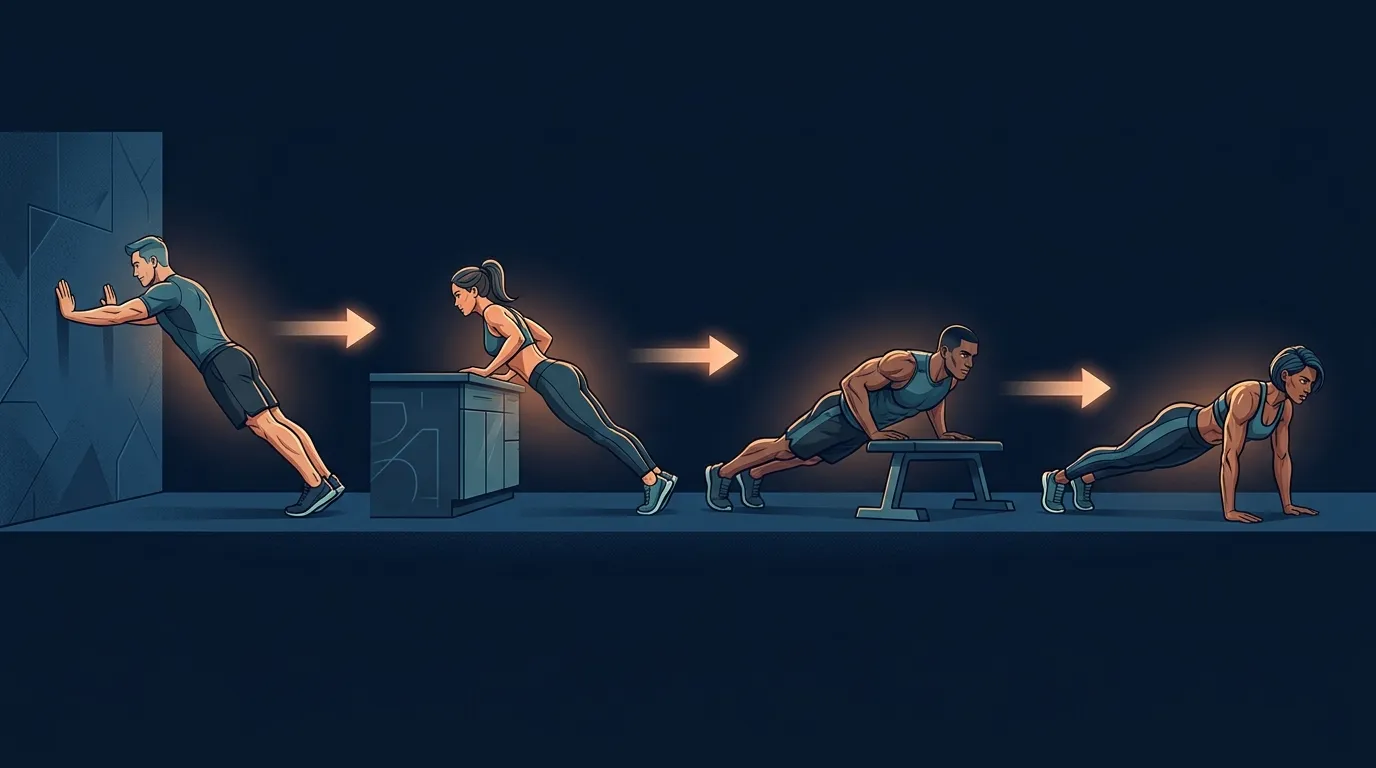
- You can train it from zero. Incline push-ups (wall → countertop → bench → floor) move most sedentary adults to 15 full-range push-ups in 8 to 12 weeks. No equipment required.
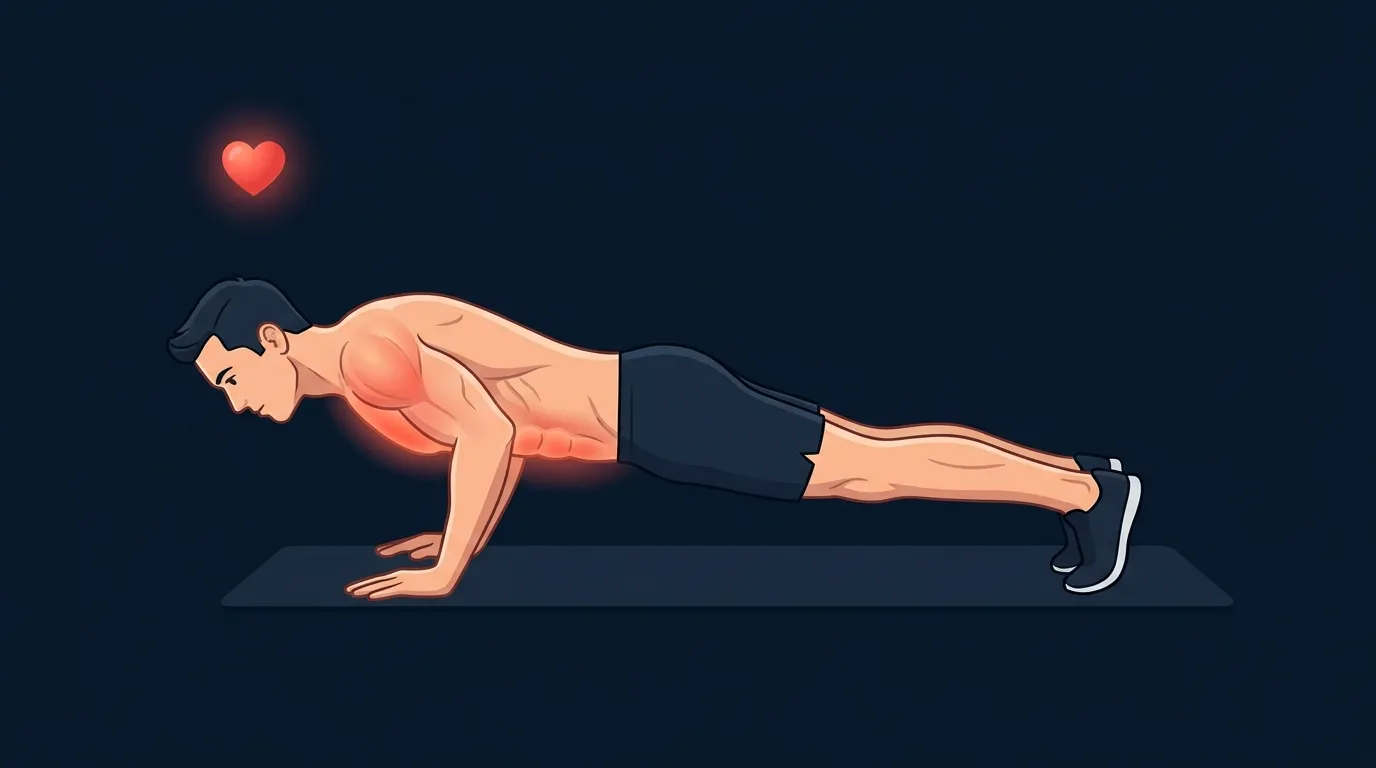
Every so often a fitness test goes viral for good reason. Grip strength did it. Sit-to-stand did it. The 60-second dead hang did it. In 2019 a paper in JAMA Network Open did the same for push-ups, and the headline was hard to ignore. Middle-aged men who could crank out 40 or more push-ups in a row had a 96% lower rate of cardiovascular events over the next decade than men who couldn’t do 10.
That number sounds too clean to be real. So does it hold up? Mostly, yes. But the study has real limits, and a lot of the internet coverage skipped over them. This piece walks through what the research actually says, what the push-up test is really measuring, and how to train it from wherever you’re starting.
Short version: push-up capacity is a legitimate, cheap, portable window into a fitness quality that peer-reviewed studies keep linking to lower mortality. It’s not a diagnostic test. It is a strong signal worth paying attention to.
The Research: What Studies Show
Yang et al. (2019): The Study That Made Push-Ups Famous
The primary source is Yang and colleagues (2019), published in JAMA Network Open. The team, led by researchers at Harvard T.H. Chan School of Public Health, used physical fitness data collected from Indiana firefighters as part of routine occupational health exams between 2000 and 2010. Every man in the study did a standardized push-up test to fatigue (cadenced to a metronome), and 1,104 of them had complete data for the analysis. They were then tracked for 10 years for cardiovascular events (heart disease diagnoses, coronary events, other major cardiovascular problems).
Participants were sorted into five push-up bins: 0-10, 11-20, 21-30, 31-40, and 41 or more. Compared with the lowest group, every higher bin showed a lower cardiovascular event rate. The pattern was dose-response, and it was steep. Men in the 41-plus group had an incidence rate ratio of 0.04 (95% CI, 0.01 to 0.36) versus the lowest group, which is where the 96% risk reduction figure comes from. Even the 11-20 bin cut risk by roughly two-thirds.
What made the paper stand out wasn’t just the magnitude. It was that the same firefighters also did a submaximal treadmill test the same day, and push-up count out-predicted the treadmill result for future cardiovascular events. That’s counterintuitive because treadmills are supposed to measure the cardiorespiratory system directly. It suggests push-up capacity captures something the treadmill test misses in an active-adult population.
Grip and Muscular Strength Predict Mortality Across Millions of Adults
The push-up finding fits inside a much bigger body of research on muscular fitness and longevity. The largest single dataset is the Prospective Urban Rural Epidemiology study, published in The Lancet in 2015 by Leong et al., which followed 139,691 adults across 17 countries. Every 5 kg drop in maximum handgrip strength raised all-cause mortality risk by 16%, cardiovascular mortality by 17%, and myocardial infarction risk by 7%. Grip force out-predicted systolic blood pressure for both endpoints.
Meta-analyses have pooled that evidence. A 2018 review by Garcia-Hermoso and colleagues in Archives of Physical Medicine and Rehabilitation pulled together roughly 1.9 million men and women across 38 studies. Higher handgrip strength was associated with a 31% lower risk of all-cause mortality (HR 0.69, 95% CI 0.64 to 0.74). Higher knee-extension strength cut risk by 14% (HR 0.86, 95% CI 0.80 to 0.93). The handgrip effect was slightly stronger in women (HR 0.60) than in men (HR 0.69).
A more recent dose-response meta-analysis by Lopez-Bueno et al. (2022) in Ageing Research Reviews pooled 3,135,473 participants across 48 studies. Every additional kilogram of handgrip strength between roughly 26 and 50 kg was linked to a lower risk of all-cause mortality. Above that range, additional strength kept helping, with diminishing returns past the strongest bins.
Why Push-Ups Fit the Pattern
A dynamometer measures peak grip force in a two-second squeeze. A push-up test measures upper-body strength AND endurance over 30 to 90 seconds under bodyweight load. The two are related but not identical. What they share is what makes muscular fitness a mortality signal in the first place: they proxy for total lean muscle mass, neuromuscular health, and the years of activity that built both.
A cross-sectional study by Ajisafe (2019) in BMC Pediatrics tested 210 youth aged 8 to 12 and found that 90-degree push-up count correlated significantly with PACER shuttle-run cardiorespiratory fitness scores (r = 0.53, p < 0.001). That doesn’t make push-ups an aerobic test. It confirms that push-up capacity and cardiorespiratory fitness co-vary because both reflect general physical fitness.
What the Push-Up Test Actually Measures
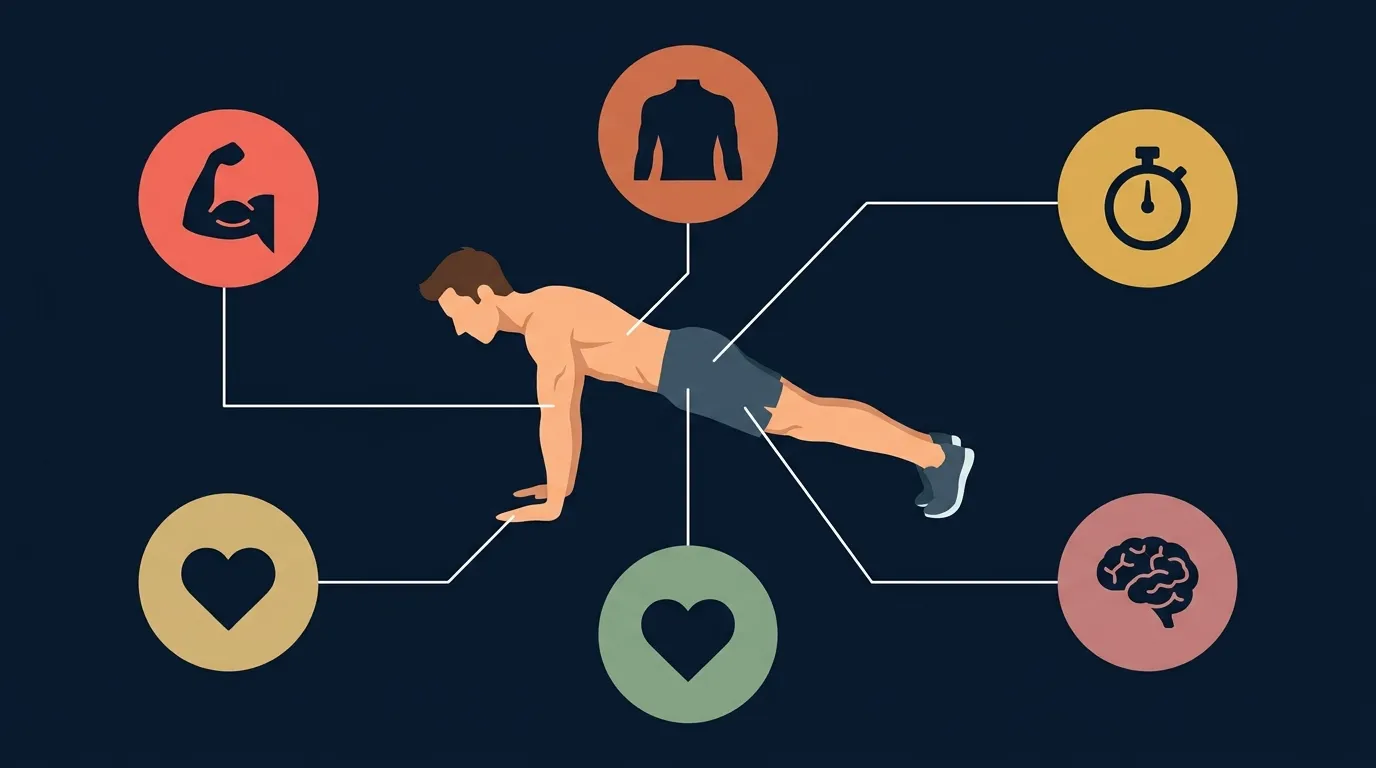
Getting the mechanism right matters. The push-up test doesn’t train or measure your heart. It tests a fitness constellation that includes:
- Upper-body strength. Chest, shoulders, and triceps produce the pressing force.
- Muscular endurance. Repeat submaximal contractions require a well-trained oxidative capacity in the recruited muscles.
- Core stability. Holding a rigid plank line for 30 to 90 seconds is an isometric core demand.
- Lean mass to body-weight ratio. A lighter, leaner body has less load to press per rep. Push-up count implicitly reflects body composition.
- Neuromuscular coordination. Movement quality under fatigue reflects how well your nervous system organizes multi-joint work.
Each of those has independent associations with cardiovascular health. Add them up and it starts to make sense why 40-plus push-ups predicts something the treadmill couldn’t. It’s not that push-ups have a special cardiac magic. It’s that they capture five overlapping signals of physical reserve at once.
Where the Coverage Overstated the Evidence
Now the honest part. The Yang paper is real. The 96% figure is real. And a chunk of the online coverage still overshot.
The Cohort Was Narrow
Every participant was a male firefighter, active in a physically demanding job, seen at occupational-health exams in Indiana. They were not sedentary office workers. They were not women. They were not older adults. Extrapolating exact thresholds from an active-adult male occupational cohort to the general population is a stretch the authors themselves acknowledged.
The direction of the finding almost certainly generalizes. The mechanism is the same one big meta-analyses keep confirming. The specific 40-push-up cutoff and the 96% number are cohort-specific artifacts that shouldn’t be treated as clinical benchmarks.
Association Is Not Causation
Men who can crush 40 push-ups tend to be leaner, more active overall, free from painful shoulder or wrist pathology, and often ex-athletes or lifelong trainees. All of those confound the push-up signal. If you scrubbed out those factors statistically, the pure “push-up capacity itself” effect would shrink. Training push-ups isn’t what protects your heart. Being the kind of person who can do 40 push-ups is a proxy for the trajectory that does.
The good news: that trajectory is trainable. Building strength, adding lean mass, staying active, keeping body composition in check, sleeping well, eating decently. Those upstream inputs move both push-up count and cardiovascular risk in the same direction. You’re not chasing a number. You’re changing what the number reflects.
“Push-Ups Beat the Treadmill” Doesn’t Mean What It Sounds Like
The treadmill test in the study was submaximal, meaning participants weren’t taken to true VO2 max. A submaximal treadmill assessment in a heterogeneous active-adult sample has its own noise. A maximal graded exercise test (the gold standard) would probably tie or beat push-ups on prediction. The push-up win here is meaningful, but it’s a win over submaximal treadmill testing in this specific population. Not a knock on cardiorespiratory testing overall.
Get an evidence-based plan built for you
FitCraft, our mobile fitness app, pairs you with an AI coach who builds you a personalized plan around your goals, schedule, and fitness level. Every FitCraft program is designed by Domenic Angelino, MPH (Brown University) and NSCA-CSCS, with research published in the Journal of Strength and Conditioning Research and Medicine & Science in Sports & Exercise.
Take the Free Assessment Free • 2 minutes • No credit cardPractical Push-Up Targets (Not Clinical Cutoffs)
Two things to note before the table. First, these are training targets calibrated from field-testing norms and the Yang cohort, not diagnostic thresholds pulled from a mixed-population cohort study. Second, form matters more than count. A strict push-up means chest to fist, elbows tracking back at roughly 45 degrees, hips level with shoulders. Half-reps don’t count.
| Age | Passable | Solid | Strong |
|---|---|---|---|
| Under 40 (men) | 15 reps | 30 reps | 40+ reps |
| Under 40 (women) | 8 reps | 20 reps | 30+ reps |
| 40–60 (men) | 10 reps | 20 reps | 30+ reps |
| 40–60 (women) | 5 reps | 12 reps | 20+ reps |
| 60+ (men) | 5 reps | 10 reps | 20+ reps |
| 60+ (women) | 3 reps | 6 reps | 12+ reps |
Below the “passable” column isn’t a health verdict. It’s a signal that upper-body strength has room to grow. Which is trainable. Fast.
How to Train Push-Ups From Any Starting Point
The single biggest mistake is picking a variation that’s too hard. If you can only do 3 sloppy floor push-ups, the answer is not to grind out those 3 reps three times a week and hope. It’s to regress the variation until you can do 8 to 12 clean reps, then progress.
Level 1: Wall & Incline Push-Ups (Weeks 1–4)
Hands on a wall, feet stepped back a foot or two. Lower your chest toward the wall, elbows about 45 degrees, then press back. When 3 sets of 10 to 12 feel controlled, move to a countertop. Then a sturdy bench. Each incline lowers the difficulty by roughly 20 to 30% versus the floor.
- 3 sets of 8–12 reps
- 60–90 seconds rest between sets
- 3 sessions per week, 48 hours between
- Progression: drop the incline height when 3 sets of 12 feel easy
Level 2: Floor Push-Ups (Weeks 4–12)
Once a bench push-up is comfortable, move to the floor. Expect the first floor rep to feel harder than the last bench rep. That’s normal. Aim for 3 sets of 5 reps to start, adding 1 to 2 reps per set each week. Most sedentary adults hit 3 sets of 10 within 8 to 12 weeks of consistent work.
- 3 sets, starting at 5 reps and adding 1–2/week
- 90–120 seconds rest
- 3 sessions per week
- Goal by week 12: 3 sets of 10 clean floor reps
Level 3: Volume, Tempo, and Loaded Progressions
Once 3 sets of 10 feel easy, adding raw reps hits diminishing returns. Better options: slow-tempo push-ups (3-second down, 1-second up), close-grip variants that shift load to the triceps, decline push-ups from a low bench, or weighted push-ups with a backpack loaded with books. All of them let you keep progressive overload going without needing a gym.
For step-by-step form cues and the full variation ladder, see the exercise page on push-up form and progressions. If you’re building a broader bodyweight routine around this, the home workouts guide is a good starting scaffold.
Common Misconceptions
“If you can’t do 40 push-ups, your heart is in trouble.”
Overstatement. The 40-push-up threshold came from a cohort of active middle-aged male firefighters. It’s a stretch to apply that exact number to a 55-year-old woman, a 70-year-old man, or a sedentary office worker of any age. The direction of the finding is real. The specific cutoff is not universal.
“Push-ups train your cardiovascular system.”
Not really. A set of 15 push-ups will bump your heart rate briefly, but it’s a strength-endurance stimulus, not an aerobic one. If push-up capacity is your only fitness marker, you’re missing cardiorespiratory fitness (which independently predicts mortality) and lower-body strength (same). A serious fitness base needs all three. Push-ups plus walking plus some form of squatting gets most adults 80% of the way there with zero equipment.
“More push-ups is always better.”
Past about 50 to 60 clean reps, additional volume buys diminishing returns for both muscular fitness and cardiovascular risk. At that point you’re better served by shifting to harder variations (weighted, single-arm progressions, tempo work) or by adding pull-based upper-body training to balance the pushing volume. Being able to do 100 push-ups doesn’t give you double the health effect of 50.
What the Research Suggests Going Forward
The pattern that keeps showing up in longevity research: the strongest signals come from people who trained multiple fitness qualities across their lives, not people who optimized one number. Push-up capacity, grip strength, walking speed, single-leg balance, sit-to-stand power. Each captures a slightly different slice of “can your body still do useful work?” None of them alone is the whole picture. Together they form a much better one.
The push-up test earns its spot in that constellation because it costs nothing, tests everywhere, and reveals a real capacity gap when it exists. Whether you ever hit 40 reps matters less than whether you can do 5 more this quarter than you could last quarter. That’s the outcome the research actually supports, and it’s the outcome that changes what your body can handle in daily life.
For related functional-fitness signals, see our companion pieces on the dead hang, grip strength and mortality, and the sit-to-stand test. Each covers a different quality worth training and tracking.
References
- Yang J, Christophi CA, Farioli A, et al. Association Between Push-up Exercise Capacity and Future Cardiovascular Events Among Active Adult Men. JAMA Network Open. 2019;2(2):e188341. DOI: 10.1001/jamanetworkopen.2018.8341.
- Leong DP, Teo KK, Rangarajan S, et al. Prognostic value of grip strength: findings from the Prospective Urban Rural Epidemiology (PURE) study. The Lancet. 2015;386(9990):266–273. PMID: 25982160.
- Garcia-Hermoso A, Cavero-Redondo I, Ramirez-Velez R, et al. Muscular Strength as a Predictor of All-Cause Mortality in an Apparently Healthy Population: A Systematic Review and Meta-Analysis of Data From Approximately 2 Million Men and Women. Archives of Physical Medicine and Rehabilitation. 2018;99(10):2100–2113.e5. DOI: 10.1016/j.apmr.2018.01.008.
- Lopez-Bueno R, Andersen LL, Koyanagi A, et al. Thresholds of handgrip strength for all-cause, cancer, and cardiovascular mortality: A systematic review with dose-response meta-analysis. Ageing Research Reviews. 2022;82:101778. DOI: 10.1016/j.arr.2022.101778.
- Ajisafe T. Association between 90° push-up and cardiorespiratory fitness: cross-sectional evidence of push-up as a tractable tool for physical fitness surveillance in youth. BMC Pediatrics. 2019;19:458. PMC6876100 · DOI: 10.1186/s12887-019-1840-9.
Frequently Asked Questions
How many push-ups should a healthy adult be able to do?
The most-cited benchmark comes from Yang et al. (JAMA Network Open, 2019): middle-aged men who could complete 40 or more consecutive push-ups had a 96% lower incidence of cardiovascular events over 10 years than those completing fewer than 10. That’s a heart-health signal drawn from active-duty firefighters, not a clinical cutoff for the general population. Sensible working targets: under 40, aim for 30 standard push-ups (men) or 20 (women); 40 to 60, aim for 20 and 12; 60-plus, aim for 10 and 6. Being able to do any push-ups at all beats being unable to do one.
Is the push-up test really a cardiovascular test?
Not directly. Push-ups measure upper-body strength and endurance, not aerobic capacity. But push-up capacity turned out to predict future cardiovascular events better than submaximal treadmill testing in the Yang et al. cohort. The mechanism is indirect. Muscular fitness tracks with total physical activity, body composition, and metabolic health, all of which drive cardiovascular risk. Push-up count is a cheap, portable proxy for a general fitness reserve that has real cardiovascular implications.
Do the push-up findings apply to women?
The original Yang et al. study only enrolled male firefighters, so the exact 96% figure does not transfer directly to women. What does transfer is the underlying relationship between muscular fitness and cardiovascular outcomes, which has been replicated in mixed-sex meta-analyses. A 2018 meta-analysis of roughly 2 million adults (Garcia-Hermoso et al., Archives of Physical Medicine and Rehabilitation) found stronger inverse mortality associations in women (HR 0.60) than men (HR 0.69) per unit of muscular strength. The signal is real in both sexes. The specific push-up thresholds still need women-specific cohort validation.
How do I train my push-up capacity from zero?
Start with incline push-ups against a wall, then progress to a countertop, then a bench, then the floor. Do 3 sets of 6 to 10 quality reps, 3 days per week, with 48 hours of recovery between sessions. Add 1 to 2 reps per set each week. Most sedentary adults can reach 15 consecutive floor push-ups inside 8 to 12 weeks, and 30 within 6 months. What matters is honest reps with a straight body line and full range of motion, not sloppy volume.
Should I get a heart checkup before training push-ups aggressively?
For most healthy adults, low-volume push-up training carries minimal risk. Talk to a healthcare provider before pushing intensity if you have cardiovascular disease, uncontrolled hypertension, recent chest pain or unexplained fatigue, or if you have been sedentary for years. Isometric strain during near-maximal effort briefly raises blood pressure, which matters more if your resting numbers are already elevated. When in doubt, get a baseline check and start conservatively.