- The dead hang is a proxy, not a proven mortality test. No peer-reviewed study has directly linked hang time to lifespan. What’s well established: maximum grip strength predicts mortality, and hanging is one of the simplest ways to train and expose that quality.
- Grip strength predicts death better than blood pressure. The PURE study of 139,691 adults across 17 countries (Lancet, 2015) found each 5 kg drop in grip strength raised all-cause mortality risk by 16%.
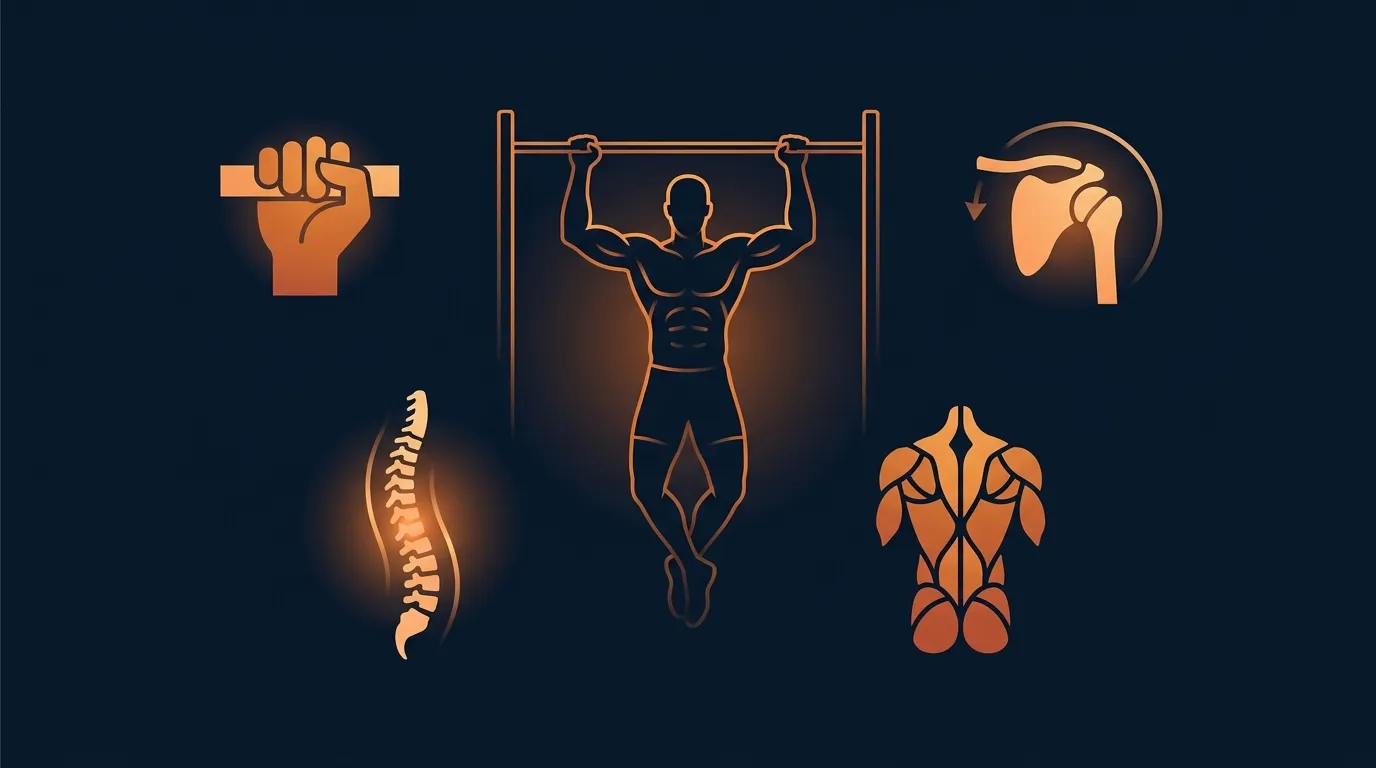
- Hanging trains several longevity-adjacent qualities at once: grip endurance, shoulder capsule mobility, scapular control, and posterior chain isometric endurance.
- Practical benchmarks (not clinical cutoffs): under 40, aim for 45–60 seconds. Ages 40–60, aim for 30–45. 60+, aim for 15–30 and hold it as a maintenance target.
- You can train it from zero. Feet-supported hangs progress most sedentary adults to a 30-second full hang inside 12 weeks.
Every few months a longevity test goes viral. Grip strength. Sit-to-stand. Walking speed. Right now the dead hang is having its moment. Videos on Instagram tell you that if you can’t hang from a bar for 60 seconds after 50, you’re fast-tracking a shorter life. The claim gets big engagement. It also glosses over what the research actually says.
So what does peer-reviewed science actually support about hanging from a bar? Some of it holds up. Some of it is a stretch. This piece walks through the evidence honestly, then translates it into a way to train hang time from wherever you’re starting.
The short version: the dead hang itself hasn’t been directly tested against mortality, but the qualities it exposes (grip strength, grip endurance, shoulder integrity, and total-body strength reserve) have been. Training those qualities is a defensible use of your time, whether or not you ever care about the stopwatch number.
What the Research Actually Shows
Grip Strength Predicts All-Cause Mortality
The load-bearing evidence for the dead hang story lives in the grip strength literature. The Prospective Urban Rural Epidemiology (PURE) study, published in The Lancet in 2015 by Leong et al., followed 139,691 adults from 17 countries for a median of 4 years. Every 5 kg drop in dominant-hand grip strength was associated with a 16% higher risk of all-cause death (HR 1.16, 95% CI 1.13–1.20), a 17% higher risk of cardiovascular death, and a 7% higher risk of myocardial infarction. Grip strength was a stronger predictor of both all-cause and cardiovascular mortality than systolic blood pressure.
Later meta-analyses replicated the finding across millions of participants. Weaker grip, worse outcomes. That relationship is well established. What’s important to notice: these studies measured maximum grip force with a handheld dynamometer, not hang time. The dead hang is a related but distinct test. More on the distinction below.
Grip Is a Window Into Total-Body Strength and Biological Age
Grip strength doesn’t live in your hands alone. It correlates strongly with total-body muscular strength, so weak grip usually reflects a whole system that’s lost muscle mass and function. Bohannon’s 2019 review in Clinical Interventions in Aging called grip strength “an indispensable biomarker for older adults” because it maps onto so many aging outcomes: physical function, fall risk, hospital length of stay, mortality.
It also tracks biological age. Chang et al. (2021) in The Journals of Gerontology Series A followed 9,581 adults for 20 years and found that longer midlife leukocyte telomere length predicted stronger handgrip in late life, with roughly a third of the genetic effect on grip strength operating through telomere biology. In plain language: people whose cells are aging more slowly tend to keep their grip longer.
What the Dead Hang Adds That a Dynamometer Doesn’t
A dynamometer captures maximum grip force in a two-second squeeze. The dead hang captures three things at once: grip endurance (holding force under load), full-body isometric endurance (your lats, core, and posterior chain are all firing to keep you rigid), and shoulder tolerance (the capsule and rotator cuff have to accept passive traction). Those are related qualities, but not the same.
Someone with a strong squeeze can still fall off a bar in 15 seconds because grip endurance is a different capacity. Someone else with a moderate squeeze can hang for 90 seconds because they’ve trained the endurance side. The dead hang tests the intersection, which is closer to what real-world grip demands (carrying groceries, catching yourself in a fall, hauling luggage) actually look like.
Where the Longevity Claims Overstate the Evidence
Here’s where the honest science part matters. A lot of the dead-hang-as-longevity-test content online extrapolates from grip strength data and treats hang time like a validated clinical measure. It isn’t. Yet.
No Peer-Reviewed Norm Table for Dead Hang Time
Search PubMed for “dead hang mortality” and you’ll find nothing directly on the topic. There are age- and sex-specific norms for handgrip force (see Wang & Bohannon, 2018, in the Journal of Orthopaedic & Sports Physical Therapy), but the dead hang benchmarks circulating on social media come from field-testing communities, not epidemiology. The 60-seconds-after-50 line is a training target that’s useful as a goal. It is not a clinical threshold pulled from a longitudinal cohort study.
That doesn’t make hang time useless. It makes it a folk metric that maps onto real underlying qualities. Treat it like your walking pace, not like your LDL cholesterol.
The “Longevity Test” Framing Skips Confounders
People who can hang for 60 seconds tend to be leaner, more active, and free from painful shoulder pathology. All three predict better health outcomes on their own. If we saw a straight association between hang time and mortality in a cohort study (we don’t yet, because no one has run the study), a chunk of the effect would be explained by those confounders. Just like grip strength research, hang time would be part correlation, part causation.
None of this means the dead hang is bunk. It means the interesting question isn’t “does hang time itself extend life?” The interesting question is “does training my hang make me a person who’s harder for aging to take down?” That’s the framing the evidence supports.
Why Hanging Might Still Be Worth Your Time
Shoulder Capsule and Scapular Control
Modern life keeps your shoulders in a narrow range of motion. Desk work rounds them forward. Phone use shortens the anterior chain. Overhead reach almost never happens with load. Hanging is one of the few movements that pulls the humerus into full overhead flexion under bodyweight, which stretches the capsule and forces the scapular stabilizers to engage.
Clinicians who work with overhead athletes and older adults often program active hangs (a subtle shoulder shrug down from a passive hang) to train scapular control. Building tolerance to hanging positions is protective against the impingement-and-tendon-fraying pattern that ages so many shoulders past 40.
Grip Endurance Transfers to Function
You almost never need one huge squeeze in daily life. You need moderate grip force sustained for a while. Carrying two grocery bags to the car. Holding a stair rail while helping a kid down. Catching yourself with one hand as you slip. These are grip endurance problems, and they’re the situations where poor grip does actual damage.
Hang time trains exactly this quality. So do farmer’s carries, loaded suitcase walks, and pull-up work. Any of them build the same base. The dead hang has the advantage of needing zero equipment beyond a sturdy bar.
Isometric Loading and Blood Pressure
A large network meta-analysis by Edwards et al. (2023) in the British Journal of Sports Medicine pooled 270 randomised controlled trials and 15,827 participants across exercise modalities. Isometric training produced the largest reductions in resting blood pressure of any modality tested, roughly −8.2 mmHg systolic and −4.0 mmHg diastolic. That’s in the range of what a first-line blood pressure medication can do.
Most of that literature used handgrip isometric protocols, not dead hangs, but the mechanism (sustained submaximal isometric contraction driving downstream vascular adaptations) applies broadly. If you can hold a 30 to 60 second hang two or three times per session, you’re already inside the loading pattern that isometric training research uses.
Get an evidence-based plan built for you
FitCraft, our mobile fitness app, pairs you with an AI coach who builds you a personalized plan around your goals, schedule, and fitness level. Every FitCraft program is designed by Domenic Angelino, MPH (Brown University) and NSCA-CSCS, with research published in the Journal of Strength and Conditioning Research and Medicine & Science in Sports & Exercise.
Take the Free Assessment Free • 2 minutes • No credit cardHow to Train the Dead Hang
Almost everyone can improve. The trick is meeting your current capacity where it is, not where a social media video says it should be.
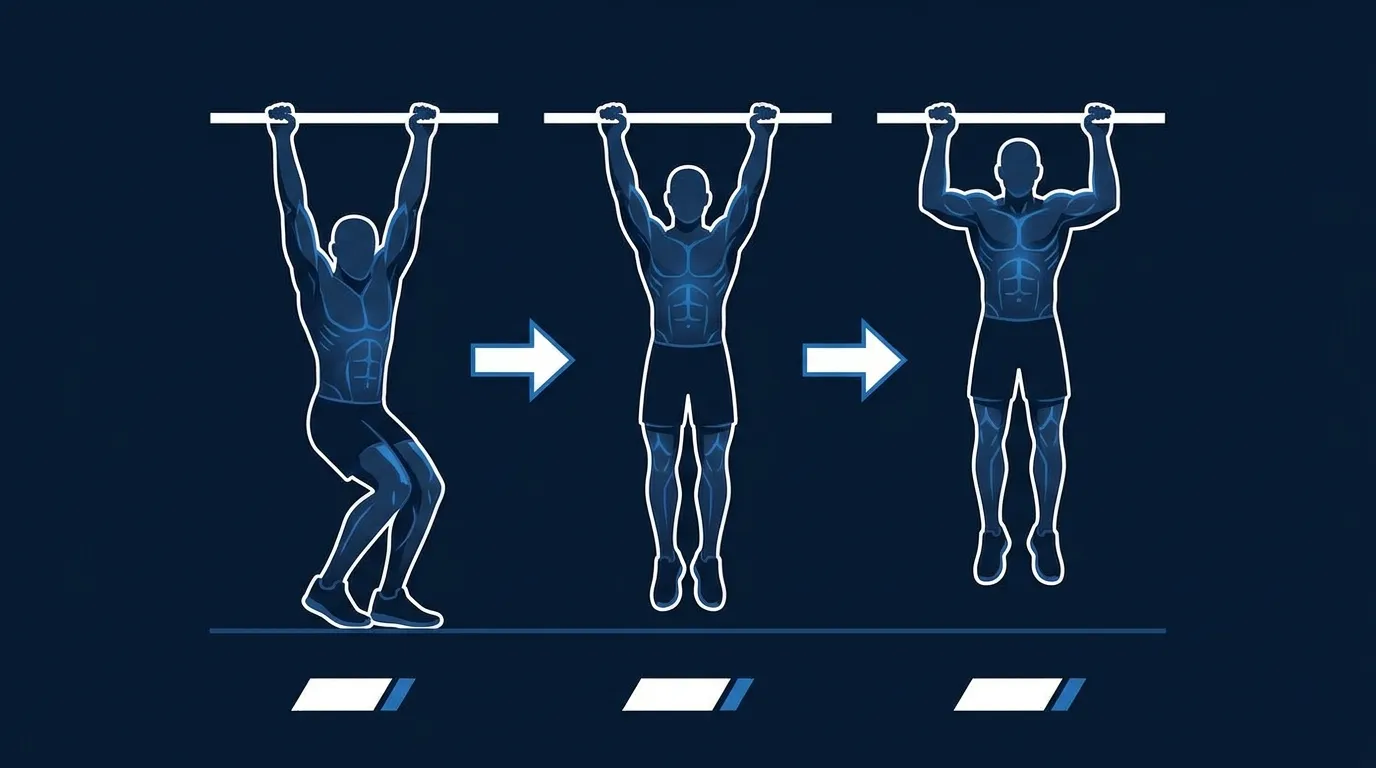
Level 1: Feet-Supported Hangs (Weeks 1–3)
If a full hang lasts under 10 seconds, or you can’t hang at all, start here. Set the bar low enough that your feet touch the ground when your arms are fully extended overhead. Bend your knees so some weight goes through your feet. Adjust that fraction until you can hold the position for 15–20 seconds without dropping.
- 3 sets of 15–20 seconds
- 60–90 seconds rest between sets
- 2–3 sessions per week
- Progression: shift more weight into your hands each week until you’re at a full hang
Level 2: Full Passive Hangs (Weeks 3–10)
Once you can hold a full hang for 5–10 seconds, drop the feet support. Shoulders relaxed, arms straight, breathing steady. Aim to add 2–5 seconds per week. Most people plateau for a while around 20–25 seconds, then jump. That’s normal.
- 3 sets of maximum hold, minus a few seconds for reserve
- 90–120 seconds rest
- 3 sessions per week
- Goal: one 30 to 45 second set by week 10
Level 3: Active Hangs and Loaded Carries
Once 45 seconds is comfortable, most of the training benefit comes from harder variations, not longer holds. Alternating between active hangs (small shoulder shrug down and hold) and farmer’s carries with heavy dumbbells hits the same qualities from complementary angles. This is also where you can add mixed-grip work (one palm forward, one back) and single-arm progressions if the shoulder allows.
For sequencing this into a broader routine, see our guide to home workouts and the exercise page for the dead hang form and progressions.
Practical Benchmarks (Not Clinical Cutoffs)
These are training targets, not diagnostic thresholds. Use them to set a goal, not to catastrophize a bad day.
| Age | Passable | Solid | Strong |
|---|---|---|---|
| Under 40 (men) | 30 sec | 60 sec | 90+ sec |
| Under 40 (women) | 20 sec | 45 sec | 70+ sec |
| 40–60 (men) | 20 sec | 45 sec | 75+ sec |
| 40–60 (women) | 15 sec | 30 sec | 55+ sec |
| 60+ (men) | 10 sec | 25 sec | 50+ sec |
| 60+ (women) | 8 sec | 20 sec | 40+ sec |
Below “passable” isn’t a diagnosis. It’s a signal that grip endurance and shoulder tolerance need some work. Both are trainable.
Common Misconceptions
“If you can’t hang for 60 seconds, you’re dying young.”
Overstatement. No study has linked hang time to mortality directly. Grip strength predicts mortality, hang time is a proxy for grip endurance, and the two are related but not interchangeable. Someone with a moderate hang time and a strong overall training history is in a very different place from someone who can’t hang at all and never trains.
“Hanging fixes back pain.”
Sometimes. Traction from bodyweight hanging temporarily creates space between vertebrae, which some clinicians use as part of a low-back plan. The effect is short-lived and it doesn’t address disc pathology on its own. If your back hurts, hanging can be a piece of a plan built with a qualified provider, not a standalone treatment.
“Longer is always better.”
Past about 60–90 seconds, additional hang time buys diminishing returns for grip and shoulder health. Loaded carries, pull-up progressions, and mixed-grip variations give more transfer per minute of training time once your base is built.
What the Research Suggests Going Forward
The pattern that keeps showing up: the strongest longevity signals come from people who trained multiple qualities across their lives, not people who optimized one number. Grip endurance is worth training. So is grip force. So is cardiorespiratory fitness. So is walking speed. So is single-leg balance. Each one captures a slightly different slice of “can your body still handle real-world demands?” None of them alone is the answer. For a training-focused list of movements that cover these bases, see our roundup of the best exercises for longevity.
The dead hang earns its spot in that constellation because it exposes several of those qualities in a movement that costs nothing and takes 60 seconds. Whether you ever hit the viral benchmark matters less than whether you can pick up the bar in six months and last a little longer than you can today. That’s the outcome the research actually supports.
For a deeper look at max grip force specifically, see our companion piece on grip strength and mortality. If you’re interested in other simple longevity self-tests, our write-ups on the sit-to-stand test and walking speed cover complementary evidence.
References
- Leong DP, Teo KK, Rangarajan S, et al. Prognostic value of grip strength: findings from the Prospective Urban Rural Epidemiology (PURE) study. The Lancet. 2015;386(9990):266–273. PMID: 25982160.
- Edwards JJ, Deenmamode AHP, Griffiths M, et al. Exercise training and resting blood pressure: a large-scale pairwise and network meta-analysis of randomised controlled trials. British Journal of Sports Medicine. 2023;57(20):1317–1326. PMID: 37491419.
- Chang X, Chua KY, Wang L, et al. Midlife Leukocyte Telomere Length as an Indicator for Handgrip Strength in Late Life. The Journals of Gerontology Series A. 2021;76(1):172–178. PMID: 33045076.
- Bohannon RW. Grip Strength: An Indispensable Biomarker For Older Adults. Clinical Interventions in Aging. 2019;14:1681–1691. PMC6778477.
- Wang YC, Bohannon RW, Li X, Sindhu B, Kapellusch J. Hand-Grip Strength: Normative Reference Values and Equations for Individuals 18 to 85 Years of Age Residing in the United States. Journal of Orthopaedic & Sports Physical Therapy. 2018;48(9):685–693. DOI: 10.2519/jospt.2018.7851.
Frequently Asked Questions
What is a good dead hang time by age?
There’s no peer-reviewed clinical norm for hang time, so practical benchmarks come from field-testing communities. A rough guide: adults under 40 should hang 45–60 seconds; ages 40–60 aim for 30–45 seconds; 60+ aim for at least 15–30 seconds. These are goals to work toward, not diagnostic cutoffs. What matters more than the absolute number is that you can hang at all and that your time improves with training.
Is a dead hang really a longevity test?
The dead hang itself hasn’t been directly tested as a mortality predictor. What has: maximum handgrip strength, which the dead hang trains. The PURE study (Lancet, 2015, 139,691 adults) found each 5 kg drop in grip strength raised all-cause mortality risk by 16%. Hang time correlates with grip endurance and total-body strength reserve, so it’s a reasonable proxy for the strength qualities that peer-reviewed studies link to longevity.
How do I train dead hang endurance from zero?
Start with feet-supported hangs. Grab the bar with your feet lightly touching the floor and take 30–50% of your weight through your hands. Hold for 15–20 seconds, three sets, three days per week. Progress to full hangs of 5–10 seconds, then add 2–5 seconds per week. Most sedentary adults reach 30 seconds within 8–12 weeks and 60 seconds within 6 months of consistent practice.
Does hanging decompress the spine?
Traction from bodyweight hanging creates temporary space in the spinal segments, which some clinicians use as a component of low-back care. The effect is short-lived and there’s no strong evidence it treats disc pathology on its own. The clearer benefit is at the shoulder joint, where hanging positions the humerus in a way that stretches the capsule and challenges scapular stabilizers, exposures shoulders rarely get in daily life.
Is the dead hang safe for older adults?
For most older adults, feet-supported and short passive hangs are safe and can help preserve shoulder mobility and grip function. Full-weight hangs are riskier if you have shoulder impingement, rotator cuff pathology, uncontrolled hypertension, osteoporosis with fragility fracture history, or acute back pain. Always consult a qualified healthcare provider before adding hanging work if you have any of those conditions.