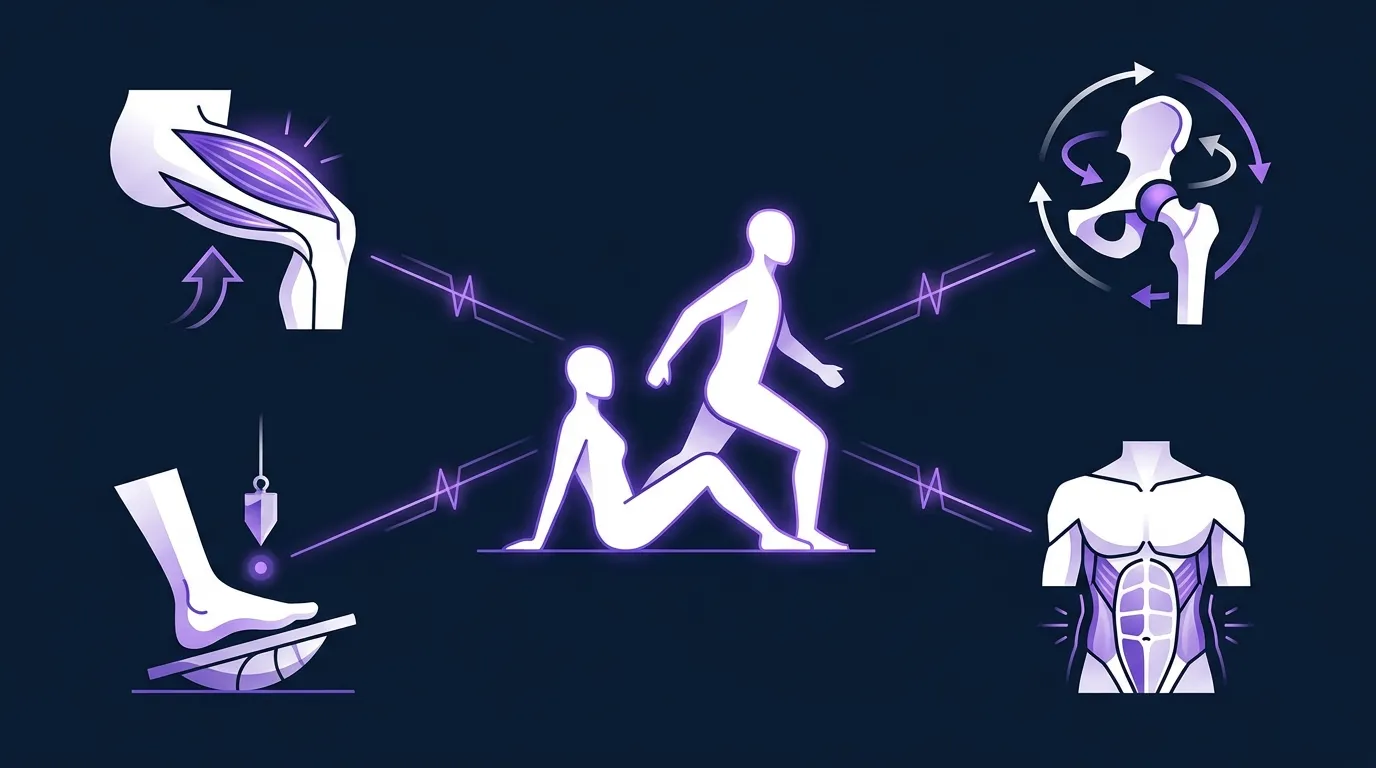
You can probably stand up from a chair without thinking. Getting up off the floor is a different story. No armrests, no leverage point, just your legs and your hips and whatever balance you still have. It turns out that ordinary ability, scored on a 10-point scale, predicts how long you are going to live with surprising accuracy.
The test is called the sitting-rising test, or SRT. A Brazilian sports-medicine clinic developed it in the 1990s and has been validating it ever since. The 2014 paper that put it on the global map followed 2,002 adults aged 51 to 80 for a median 6.3 years. People who scored 0-3 had a six times higher mortality risk than people who scored 8-10. Each single point on the scale shifted the hazard. The numbers are striking enough that they get quoted in cardiology journals, longevity podcasts, and AARP newsletters.
And the SRT is not a one-off curiosity. It joins a wider literature on functional capability tests like grip strength, walking pace, and chair stands that all converge on the same finding. Your body's ability to do basic things under its own power tells you more about your remaining life expectancy than most expensive lab markers. Here is what the studies actually show, what they do not, and what the test is good for.
The Research: What Studies Show
Brito et al. (2014): The 2,002-Adult SRT Cohort
This is the foundational paper. Brito and colleagues at the CLINIMEX exercise medicine clinic in Rio enrolled 2,002 adults aged 51 to 80 (68% men) and scored each one on the sitting-rising test at baseline. Then they tracked the cohort until October 2011, a median 6.3 years. There were 159 deaths over follow-up.
The dose-response was clean. Compared with people who scored 8-10:
- Scores of 0-3: 6.5x higher all-cause mortality (HR 6.5, 95% CI 2.7-15.4)
- Scores of 3.5-5.5: 3.8x higher (HR 3.8, 95% CI 1.6-8.9)
- Scores of 6-7.5: 1.8x higher (HR 1.8, 95% CI 0.7-4.7)
Per single-point reduction, mortality risk rose by 21% (HR 1.21, 95% CI 1.13-1.30, p<0.001). The signal stayed after adjusting for age, sex, and body mass index. In plain terms, two 65-year-olds with the same age, sex, and weight had measurably different mortality outlooks based only on whether they needed two hands or none to get up off the floor.
The newer 2025 follow-up by the same group extended the analysis to natural and cardiovascular causes of death and found the SRT score still predicted both, with the cardiovascular signal stronger than the cancer signal. That is the same pattern that shows up in walking-pace and grip-strength research.
Citation: Brito LBB, Ricardo DR, Araujo DSMS, et al. Ability to sit and rise from the floor as a predictor of all-cause mortality. Eur J Prev Cardiol. 2014;21(7):892-898.
Cooper et al. (2010, BMJ): The Capability Meta-Analysis
The SRT is one specific instrument in a broader family of functional-capability tests. Cooper and colleagues pulled together every prospective study they could find that linked objectively measured grip strength, walking speed, chair-rise time, or standing-balance time to mortality. They ended up with 57 studies and a sample running into hundreds of thousands of community-dwelling adults.
All four capability measures predicted death. For chair-rise time (the close cousin of the SRT), people in the slowest quarter of their cohort had roughly twice the mortality of people in the fastest quarter (HR 1.96, 95% CI 1.36-2.81). Grip strength, walking speed, and balance time showed similar magnitudes. The meta-analysis concluded that "muscular strength, balance and walking speed are all consistent predictors of mortality in older community-dwelling populations."
What matters about this paper is the convergence. Several independent tests, run in different countries, on different cohorts, with different measurement protocols, all pointed at the same underlying signal. Functional capability is a real, robust predictor. It is not a quirk of one Brazilian clinic.
Citation: Cooper R, Kuh D, Hardy R; Mortality Review Group. Objectively measured physical capability levels and mortality: systematic review and meta-analysis. BMJ. 2010;341:c4467.
Guralnik et al. (1994): The Short Physical Performance Battery
Before the SRT got famous, the workhorse functional-test in epidemiology was the Short Physical Performance Battery (SPPB), developed by Guralnik and colleagues at the National Institute on Aging. The SPPB combines a balance test, a gait-speed test, and a 5-times chair stand. They scored over 5,000 adults aged 71 and older and tracked them for 4 years.
People in the lowest SPPB quartile had a 4.2 times higher mortality risk than people in the highest quartile, after adjusting for age, sex, and chronic conditions. They also had 4.9 times higher risk of nursing home admission. The chair-stand component alone, timed at 5 stand-sits from a hard chair, contributed independently to the risk gradient.
The SPPB became the standard geriatric-clinic instrument because it is fast (about 10 minutes), free, and works. The Brito SRT is a more demanding cousin. It loads hip mobility and floor-to-stand strength that the seated chair-stand test does not capture, which is part of why the SRT discriminates more sharply across the middle of the population.
Citation: Guralnik JM, Simonsick EM, Ferrucci L, et al. A short physical performance battery assessing lower extremity function. J Gerontol. 1994;49(2):M85-M94.
Bohannon (2006): The 5-Times Chair Stand Reference Values
If you have ever taken a 5-times sit-to-stand test (5xSTS) at a clinic, the cutoffs almost certainly came from Bohannon's 2006 meta-analysis. He pulled together 13 papers covering older adults and calculated age-banded reference values for time to complete five chair stands.
The cutoffs that flag worse-than-average performance:
- Ages 60-69: slower than 11.4 seconds
- Ages 70-79: slower than 12.6 seconds
- Ages 80-89: slower than 14.8 seconds
Times above these thresholds get flagged in clinical practice as elevated fall risk and as candidates for further frailty assessment. A 2024 Tromso Study analysis compared chair-stand performance against grip strength as a mortality predictor and found chair-stand carried slightly stronger predictive value for all-cause mortality in older adults. The chair version is easier to administer than the floor-rise SRT, which is why it dominates clinical use, but the principle is the same.
Citation: Bohannon RW. Reference values for the five-repetition sit-to-stand test. Percept Mot Skills. 2006;103(1):215-222.
Why This Matters for Your Fitness
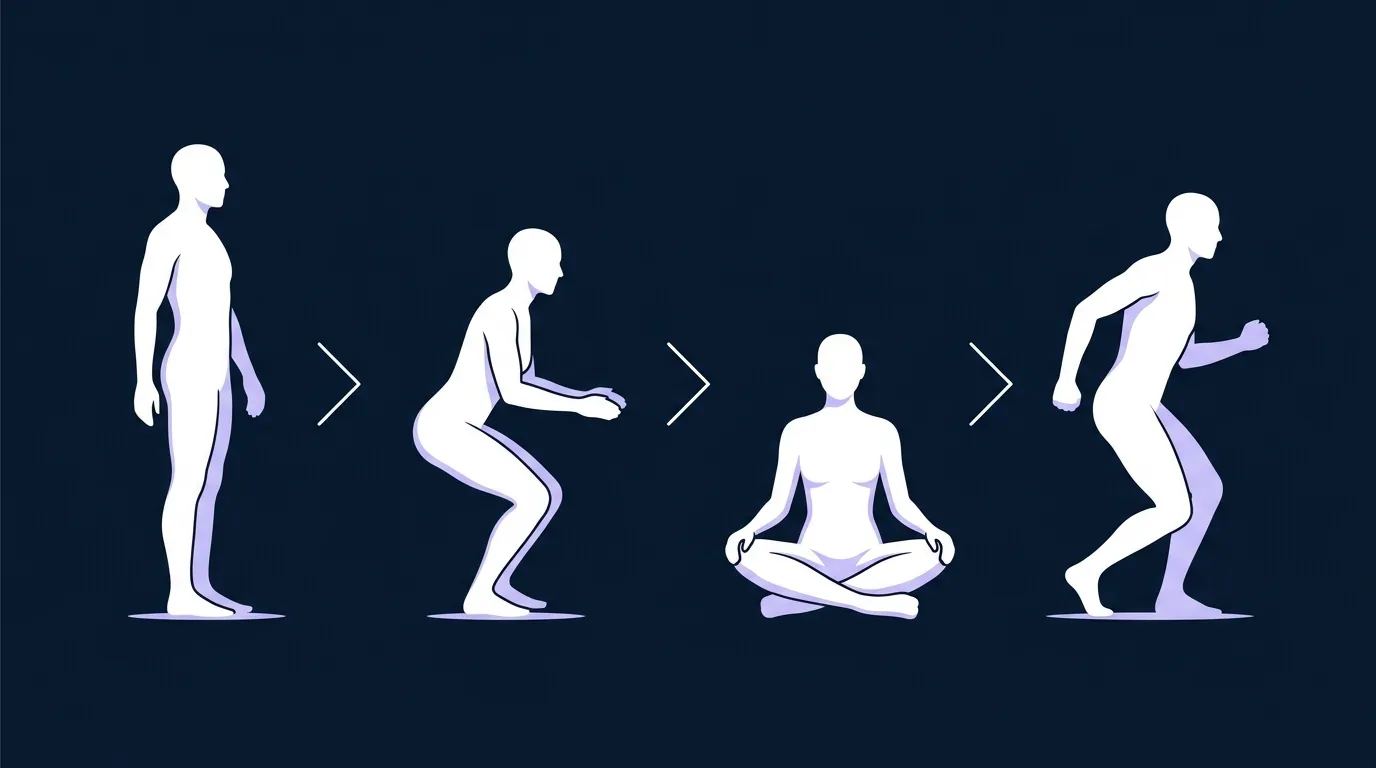
The SRT works because it crams several aging systems into a single 10-second movement. Going down to the floor cross-legged loads hip mobility, ankle range, and eccentric leg strength. Coming back up demands single-leg power, balance, and the kind of core stiffness that lets your trunk move on top of your legs without flopping. Body composition matters too, because a heavier torso increases the leverage your legs need to produce.
Lose strength in any one of those, and the score drops. Which means a low score is not telling you something exotic about your cells. It is telling you that the basic mechanical systems you have been ignoring for a decade are starting to fail their job, and that the rest of your physiology probably reflects the same drift.
For a 30-year-old reader the absolute numbers are not the point. You can almost certainly score a 10. But the underlying systems (hip mobility, leg strength, balance) start their decline in your 30s and 40s, and how much they have eroded by age 65 depends entirely on what you do in the intervening decades. The Brazilian dataset reads as a warning shot, not a sentence. Train the systems now. The decline still happens, but from a higher start.
This is the same logic behind walking pace as a longevity marker, grip strength as a longevity marker, and stair-climbing capacity. All four are functional-capability tests that measure different slices of the same underlying physiology, and they all carry independent mortality signals. The cluster is real.
How to Apply This in Practice
You can score yourself in two minutes. Wear comfortable clothes you can move in, take your shoes off, and find a flat surface clear of furniture you might grab. Stand with your feet at hip width.
- Start at 5 points for the descent and 5 points for the ascent (10 total).
- Lower yourself to the floor into a cross-legged seated position, without grabbing, leaning on a knee or hand, or using a wall.
- From that seated position, stand back up, again without using support.
- Subtract one point for each support used: a hand on the floor, a knee on the floor, a forearm, the side of a leg.
- Subtract half a point for any visible loss of balance during either phase.
Take three trials. Use your best score. Be honest. The temptation is to fudge the scoring on the descent because the descent feels easier. Score what you actually did, not what you meant to do.
If your number is on the lower end, three things move it within 8 to 12 weeks, all consistent with what the research supports:
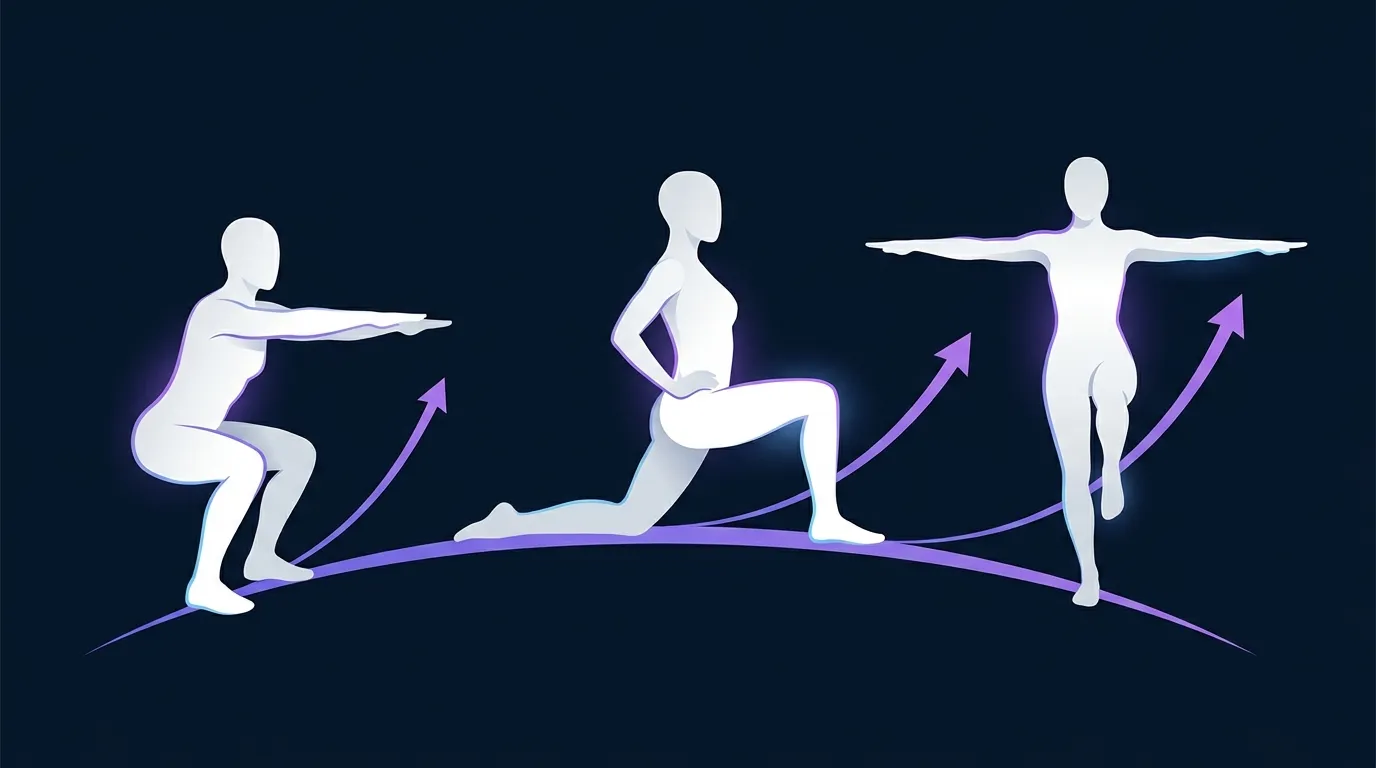
- Lower-body strength. Bodyweight squats, split squats, step-ups, and (if you have them) goblet squats with a dumbbell or kettlebell. Two sessions a week of 3-4 sets is the floor that the resistance-training and mortality literature consistently identifies.
- Hip and ankle mobility. Most low SRT scores have a mobility component as much as a strength component. Sitting on the floor for 5-10 minutes a day, simple hip openers, and ankle dorsiflexion work all chip away at the restrictions that block a clean descent.
- Balance and single-leg work. Standing on one foot while brushing your teeth, slow tempo split-squats, and any kind of yoga or tai chi practice train the small stabilizers that let you trust a movement without grabbing for support.
Test yourself again 8 weeks in. The number moves. A 12-week functional resistance program in mobility-limited older adults improved chair-stand performance by 4.2 extra stands in 30 seconds and cut 5-times sit-to-stand time by 2.3 seconds. The SRT itself responds similarly to consistent strength and mobility work.
Get an evidence-based plan built for you
FitCraft, our mobile fitness app, pairs you with an AI coach who builds you a personalized plan around your goals, schedule, and fitness level. Every FitCraft program is designed by Domenic Angelino, MPH (Brown University) and NSCA-CSCS, with research published in the Journal of Strength and Conditioning Research and Medicine & Science in Sports & Exercise.
Take the Free Assessment Free • 2 minutes • No credit cardCommon Misconceptions
Misconception: "A low SRT score means I have years to live"
It does not. The Brito 2014 hazard ratios are population-level statistics. A 6.5x higher relative risk inside a cohort with 159 deaths in 6 years still means most low-scoring individuals are alive at the end of the follow-up. The test points at risk, not at fate. People with very low SRT scores who then train consistently almost always move out of the high-risk band on the test itself, and the systems the test measures (strength, balance, mobility) are the same systems that drive the underlying mortality risk.
Misconception: "The test is just measuring whether you are flexible"
Mobility matters, but it is not the whole story. The 21%-per-point hazard ratio held after adjusting for body mass index. People with bad hips can still score 8 or 9 if they have the leg strength and balance to compensate. People with great mobility but weak legs still lose points on the ascent. The test loads multiple systems, which is the entire reason it predicts so well.
Misconception: "It only matters if you are over 60"
The published cohort started at age 51, and the functional-capability literature shows the same physical-decline trajectory begins in the 30s and 40s. A 40-year-old who scores 6 today is almost certainly going to score 4 at 55, with the same proportional erosion happening across the rest of the cohort. The earlier you train the underlying systems, the higher the curve sits when you reach the age range where the absolute mortality risk gets meaningful.
What the Research Suggests Going Forward
The settled part of the picture: the SRT and its functional-capability cousins (chair stand, grip, walking pace, balance time) all predict mortality with consistent dose-response relationships across cohorts and continents. The convergence is strong enough that the 2010 Cooper meta-analysis and the 2014 Brito paper now show up in clinical-practice guidelines as legitimate screening tools alongside blood pressure and lipid panels.
What is less settled: how much of the relationship is causal. Nobody has randomized people to "train your SRT score" versus "do nothing" and followed them for 20 years to see who lived longer. The mechanism is plausible (the systems the test measures actually do drive longevity through fall prevention, cardiovascular reserve, and metabolic capacity), and intervention studies show the test scores respond to training, but the final causal link rests on triangulation, not on a controlled experiment. That is the same evidential basis cardiology uses for things like LDL cholesterol management.
What this means in practice: do not treat the SRT as a number to game. Treat it as a periodic check on whether the underlying systems are holding up. If your score is dropping over years, that is information about strength, mobility, or balance you have been neglecting. The intervention is not "practice the test." The intervention is "train the things the test measures."
That happens to align with what almost every other line of fitness research already recommends: progressive lower-body strength work, some balance training, regular mobility, and walking. The SRT just gives you a free, honest, hard-to-fake feedback signal on whether the program is working. For the regular mobility part, our guide to the best mobility exercises has a 10-minute full body routine that keeps the ankles, hips and spine ready for the floor.
Honest Limitations
A few caveats worth keeping in mind. The Brito 2014 cohort was Brazilian, predominantly male (68%), and drawn from a single sports-medicine clinic. The participants were healthy enough to attempt a floor-to-stand test in the first place, so the very-frail end of the population was probably underrepresented. Generalizing the exact 21%-per-point hazard to a different population requires assuming the underlying physiology is similar, which it usually is, but the precise effect size could shift.
The SRT also has a learning component. People who have not sat on the floor in 20 years often add 1-2 points after one or two practice attempts, simply by figuring out the movement pattern. That is real (and probably reflects motor reorganization the body had not had a reason to do), but it does mean a single first-try test is not the cleanest measurement. The published research used standardized protocols with practice trials.
And the test, like all functional-capability assessments, is a population-level instrument that gets noisier when applied to individuals. Two people with the same score can have very different underlying trajectories. The score is one data point in a larger picture. It is not a verdict.
References
- Brito LBB, Ricardo DR, Araujo DSMS, Ramos PS, Myers J, Araujo CGS. "Ability to sit and rise from the floor as a predictor of all-cause mortality." European Journal of Preventive Cardiology 21.7 (2014): 892-898. doi:10.1177/2047487312471759
- Cooper R, Kuh D, Hardy R; Mortality Review Group. "Objectively measured physical capability levels and mortality: systematic review and meta-analysis." BMJ 341 (2010): c4467. doi:10.1136/bmj.c4467
- Guralnik JM, Simonsick EM, Ferrucci L, et al. "A short physical performance battery assessing lower extremity function: association with self-reported disability and prediction of mortality and nursing home admission." Journal of Gerontology 49.2 (1994): M85-M94. doi:10.1093/geronj/49.2.M85
- Bohannon RW. "Reference values for the five-repetition sit-to-stand test: a descriptive meta-analysis of data from elders." Perceptual and Motor Skills 103.1 (2006): 215-222. doi:10.2466/pms.103.1.215-222
- Strand BH, Cooper R, Bergland A, et al. "The association of grip strength from midlife onwards with all-cause and cause-specific mortality over 17 years of follow-up in the Tromso Study." Journal of Epidemiology and Community Health 70.12 (2016): 1214-1221. doi:10.1136/jech-2015-206776
Frequently Asked Questions
What is the sit-to-stand test and why does it predict longevity?
The sitting-rising test (SRT) scores your ability to lower yourself to the floor and stand back up, starting at 10 and subtracting a point for each hand, knee, forearm, or side-of-leg support used. In a 2,002-adult cohort followed by Brito et al. (European Journal of Preventive Cardiology, 2014), each one-point lower SRT score was associated with a 21% higher risk of all-cause mortality over a median 6.3 years. The test loads strength, balance, mobility, and body composition into one observable score.
How do you score the sitting-rising test?
Start standing barefoot on a non-slip surface with no chair, bar, or wall nearby. Lower yourself to a seated cross-legged position on the floor, then stand back up. Score 5 points for the descent and 5 for the ascent, then subtract one point each time you use a hand, knee, forearm, or side of the leg for support, and half a point for any visible loss of balance. The maximum is 10. Brito et al. reported substantially higher mortality below a score of 8.
How is the sit-to-stand test different from the 5-times chair stand test?
The sitting-rising test (SRT) measures whole-body ability to get to and from the floor and is scored 0 to 10. The 5-times sit-to-stand test (5xSTS) times how long it takes to stand and sit from a chair five times. Bohannon's 2006 meta-analysis put the older-adult cutoffs at 11.4 seconds (60-69), 12.6 seconds (70-79), and 14.8 seconds (80-89). Both tests track leg strength, balance, and mortality risk, but the SRT also captures floor mobility and hip flexibility, which is why it tends to discriminate more strongly across the middle of the population.
Can you train the sit-to-stand test and improve your score?
Yes. Repeated sit-to-stand practice, lower-body strength training, and balance work consistently improve scores within 8 to 12 weeks. A 12-week functional resistance program improved chair-stand performance by 4.2 stands and cut 5-times sit-to-stand time by 2.3 seconds in mobility-limited older adults. Whether improving the test score itself extends life has not been proven, but training the underlying strength and balance systems is what every longevity guideline already recommends.
Does FitCraft train the strength and balance behind the sit-to-stand test?
Yes. FitCraft programs include strength training (bodyweight, dumbbells, resistance bands), mobility, and balance-relevant work like single-leg patterns and yoga, with an AI coach that demonstrates each movement through interactive 3D models. Programs adapt as you progress, so the leg strength, hip mobility, and floor-to-stand patterns the sitting-rising test measures are trained directly, not as an afterthought.