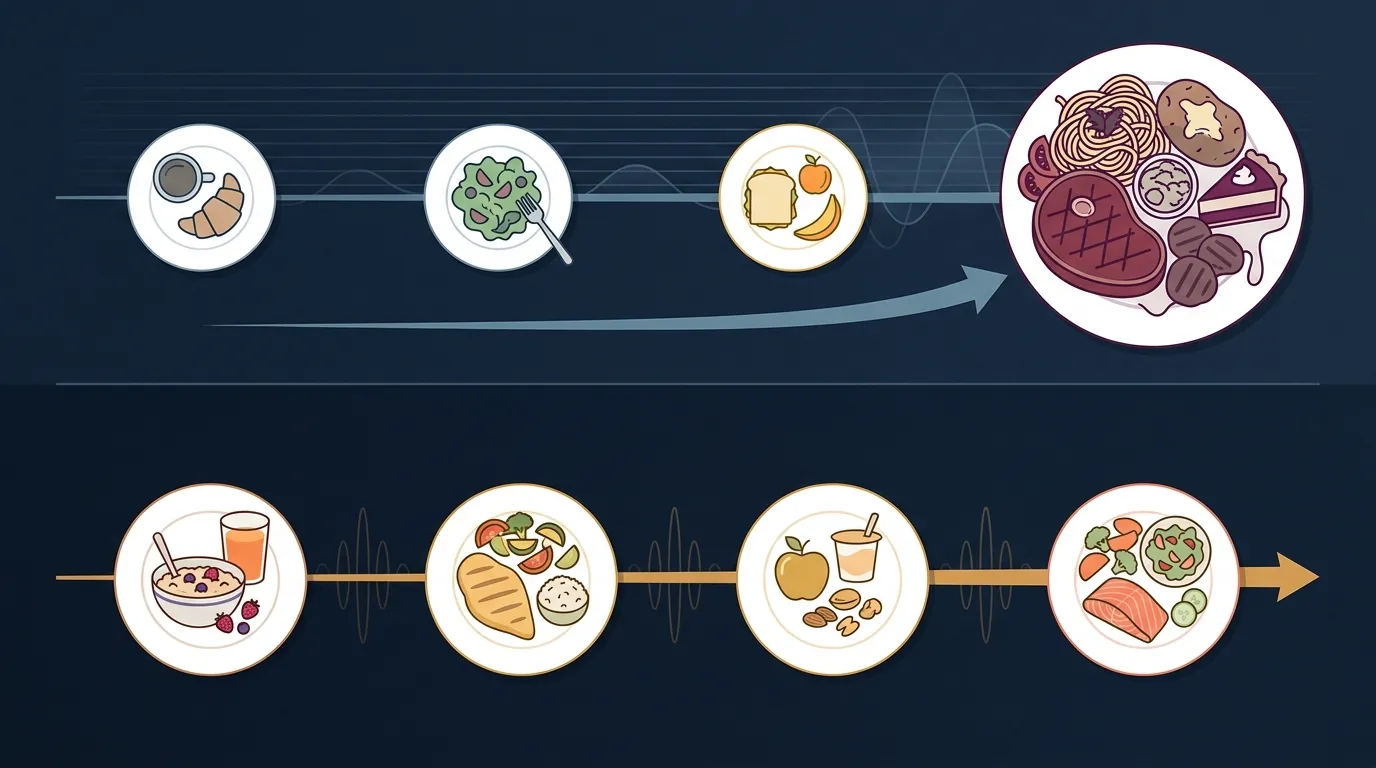
Most protein advice stops at "get enough." That's fair. Total daily protein is by far the biggest lever for muscle growth. Miss the total and nothing else matters. Hit the total and most other timing questions become minor.
But there's one exception the research keeps pointing to. Two people can eat exactly the same daily total, work out identically, and produce different amounts of muscle protein synthesis over 24 hours. The difference isn't what they ate. It's how they spread it out.
This is the distribution question. Should you eat 30g of protein at four meals? Cram 90g into dinner and call it a day? Sip whey every ninety minutes? The Maastricht and Baylor groups spent a decade running the controlled trials. Results are surprisingly consistent, and the practical answer is simple enough to fit on a napkin.
The Research: What Studies Show
Mamerow et al. (2014): Even Beats Skewed
The cleanest test of distribution is Mamerow et al. (2014), published in the Journal of Nutrition. The design was a within-subject crossover in 8 healthy adults. Each participant ate two 24-hour patterns on different days, separated by a washout period. Total daily protein was identical (about 90g). Total daily calories were identical. The only variable was distribution across three meals:
- Even pattern: roughly 30g of protein at breakfast, 30g at lunch, and 30g at dinner.
- Skewed pattern: 10g at breakfast, 15g at lunch, and 65g at dinner.
Researchers infused a stable-isotope tracer and measured mixed-muscle protein synthesis directly from a biopsy over the 24-hour period. The result was striking. The even distribution produced a 25% higher 24-hour muscle protein synthesis rate than the skewed distribution. Same food. Same total protein. Different anabolic output.
The mechanism is what's now called the muscle-full effect. Past a certain per-meal dose, additional amino acids don't stimulate additional synthesis. They get oxidized, converted to glucose, or used for non-muscle protein turnover. In the skewed pattern, the 65g dinner blew past the ceiling. The excess couldn't be used for muscle. Meanwhile the 10g breakfast fell below the threshold to produce a robust synthesis response at all. Two meals were suboptimal, and the third was over-shooting. The even pattern hit the sweet spot three times in a row.
Areta et al. (2013): Testing Four Meals vs Two and Eight
Mamerow answered "even vs skewed at three meals." The next question was how the number of meals interacts with distribution. That's what Areta et al. (2013) in the Journal of Physiology tested. The team recruited 24 resistance-trained men, had them perform a bout of lower-body resistance exercise, and then randomized them across a 12-hour recovery window to one of three feeding patterns:
- PULSE: 8 servings of 10g whey protein every 90 minutes.
- INTERMEDIATE: 4 servings of 20g whey protein every 3 hours.
- BOLUS: 2 servings of 40g whey protein every 6 hours.
Total protein was matched across groups (80g). Myofibrillar protein synthesis was measured with a phenylalanine tracer and muscle biopsies at 1, 4, 6, and 12 hours post-exercise. The intermediate pattern (4×20g) produced significantly higher myofibrillar synthesis than the pulse or the bolus. The pulse pattern's 10g dose was too small to fully activate the muscle protein synthesis response each time. The bolus pattern's 40g dose spent much of its amino acid load on the muscle-full ceiling, and the six-hour spacing left the muscle in a "refractory" period where it stopped responding to further amino acids. Four servings of 20g, every 3 hours, was the practical sweet spot.
Areta's finding is where the "4 meals of 20 to 40g each, spaced 3 to 5 hours apart" rule of thumb comes from. It's not arbitrary. It's the pattern that actually won the head-to-head.
Moore et al. (2015): Per-Meal Doses in Younger and Older Adults
The distribution question interacts with an age question. Moore et al. (2015) in the Journal of Gerontology pooled data from prior dose-response trials in younger and older men, testing per-meal doses of egg protein ranging from 0 to 40g at rest and after resistance exercise. They fit a curve and extracted the dose that maximally stimulates myofibrillar protein synthesis in each group. The numbers were:
- Younger adults (mean age ~22): maximally stimulated at about 0.24g of protein per kg of bodyweight per meal.
- Older adults (mean age ~71): maximally stimulated at about 0.40g of protein per kg of bodyweight per meal.
For an 80 kg lifter, that's the difference between roughly 19g per meal for a 20-year-old and 32g per meal for a 70-year-old. The older group needed almost twice the dose to produce the same synthesis response. This is anabolic resistance quantified. It also means that a distribution pattern that works fine for a college athlete (three modest protein hits) can under-feed an older adult on the exact same schedule.
Practically, this pushes the older-adult per-meal target closer to 35 to 40g of protein, not 20 to 25g. That's a hard number to hit without deliberate planning, and it's why the population that most needs muscle mass is often the population that under-eats protein per meal.
Schoenfeld and Aragon (2018): The Practical Synthesis
By 2018, there was enough evidence to synthesize a practical recommendation. Schoenfeld and Aragon (2018) in the Journal of the International Society of Sports Nutrition reviewed the acute trials, the chronic hypertrophy literature, and the aging data. They landed on a distribution recommendation that's now widely cited:
"To maximize anabolism one should consume protein at a target intake of 0.4g/kg/meal across a minimum of four meals in order to reach a minimum of 1.6g/kg/day."
The 0.4g/kg per meal figure is the conservative upper end. It sits close to the older-adult saturation dose and comfortably above the younger-adult one. Choosing the higher number as the per-meal target is a small hedge that likely works in either direction. Multiplied by four meals, it also hits the modern hypertrophy-optimized daily total of 1.6g/kg. And it does so with a schedule people can actually follow.
The review also flagged that the chronic training data (weeks-to-months trials measuring actual muscle mass) is thinner than the acute muscle protein synthesis data. Acute trials show clear distribution effects. Chronic trials mostly find modest advantages to even distribution, but with small sample sizes and short durations. The mechanism is strong. The magnitude at the whole-body level is real but not dramatic.
Get an evidence-based plan built for you
FitCraft, our mobile fitness app, pairs you with an AI coach who builds you a personalized plan around your goals, schedule, and fitness level. Every FitCraft program is designed by Domenic Angelino, MPH (Brown University) and NSCA-CSCS, with research published in the Journal of Strength and Conditioning Research and Medicine & Science in Sports & Exercise.
Take the Free Assessment Free • 2 minutes • No credit cardThe Muscle-Full Effect (Why More Isn't Always More)
The mechanism that ties all of this together is the muscle-full effect. It's a physiological ceiling. When you eat protein, blood amino acids rise, mTOR-mediated signaling kicks on, and muscle protein synthesis increases. Up to a point. Past a per-meal dose of roughly 30 to 40g in most adults, the marginal synthesis response flattens out. Additional amino acids in that same meal are still absorbed, but they're used for other purposes. Oxidized for energy. Converted to glucose. Used for non-muscle protein synthesis (gut, immune, plasma). They don't produce further muscle.
This is why 65g of protein at dinner isn't twice as anabolic as 33g. It's roughly the same, plus some extra amino acid oxidation. And it's why 4×20g beats 2×40g across the same 12-hour window, even at identical totals.
There's also a refractory period. After a synthesis-stimulating dose, the muscle takes a few hours to become responsive to another dose. If you eat again too soon (say, 90 minutes later), the second meal produces a much smaller synthesis response. This is the "muscle-full" phase in real time. The 3-hour spacing in Areta's intermediate pattern lets the muscle come back to baseline responsiveness before the next dose lands.
Put together, the ceiling and the refractory period explain the shape of the ideal pattern. Meals large enough to fully stimulate synthesis (at least ~0.24g/kg, more like 0.4g/kg for safety), spaced far enough apart to reset responsiveness (about 3 to 5 hours), and repeated 3 to 5 times across the waking day. That's what all four studies point to.
Practical Distribution: What This Looks Like
For an 80 kg lifter aiming at 1.6 to 2.0 g/kg per day (128 to 160g total), one clean distribution:
- Breakfast (7 AM): 30 to 40g. Three eggs plus Greek yogurt, or a protein oats bowl.
- Lunch (12 PM): 30 to 40g. Chicken bowl, tuna salad, tofu-and-rice.
- Snack or pre-workout (4 PM): 20 to 30g. Protein shake, cottage cheese, jerky.
- Dinner (7 PM): 30 to 40g. Salmon, steak, or a lentil-based main.
Total: roughly 130 to 150g of protein across four meals, each above the muscle protein synthesis threshold, spaced about 4 to 5 hours apart. That's exactly the Areta 4×20 pattern scaled up for bodyweight.
If you train in the evening and want to add a fifth feeding, a bedtime slow-digesting protein dose (casein, cottage cheese, or Greek yogurt) is one of the better ones to stack. We cover the mechanism in our pre-sleep protein research writeup. Older adults or people on a caloric deficit tend to see the largest benefit from that fifth feeding.
Who Benefits Most From Fixing Distribution
The Big-Dinner Eater
This is the most common under-distributed pattern. Coffee and a pastry for breakfast (5g protein). Salad with a sad piece of chicken for lunch (20g). A big steak-and-sides dinner at 8 PM (60g). Same 85g of total protein as an even day, but the anabolic output is meaningfully lower. Fixing this is high-yield. Add 30g at breakfast (eggs, Greek yogurt, protein shake) and 10 to 15g at lunch (extra chicken, cottage cheese). No calorie increase needed. Just a redistribution.
Older Adults
The anabolic-resistance ceiling makes distribution especially important past 60. Paddon-Jones and Rasmussen (2009) in Current Opinion in Clinical Nutrition and Metabolic Care argued the sarcopenia-prevention case: 25 to 30g of high-quality protein at each of three or four meals produces stronger cumulative synthesis than the same daily total back-loaded. For anyone in a similar age range, distribution is not optional. Our fitness over 60 guide covers the training side of the same equation.
People in a Caloric Deficit
When calories are limited, every gram of protein has to do more work. A skewed distribution wastes a portion of the anabolic potential of your intake. The Trommelen, Betz, and van Loon (2019) Sports Medicine review notes that during a caloric deficit, maintaining a robust muscle protein synthesis signal is one of the primary defenses against lean mass loss. Even distribution helps hold on to muscle while you cut.
Vegetarians and Plant-Based Eaters
Plant proteins have lower per-gram leucine content and often lower digestibility. To hit the same synthesis-stimulating dose, plant-based lifters need slightly higher per-meal amounts (typically 30 to 40g of plant protein per meal even at younger ages). This makes distribution more important, not less. Consolidating into two meals leaves too much on the table.
Who Benefits Least
Not every eater needs to change their pattern. Distribution matters less if:
- Your total is at the top of the range. If you're already eating well above 2.2g/kg per day, the marginal loss from a skewed distribution matters less because the total keeps synthesis stimulated most of the time.
- You're not resistance training. Distribution interacts with training. Without progressive overload, the extra synthesis from an even pattern has nowhere useful to go.
- You're an intermittent faster with a well-designed eating window. A 4- to 8-hour window with two large protein-rich meals (40 to 50g each) sits inside the muscle-full ceiling and covers the trainable window. The chronic hypertrophy data on intermittent fasting versus even distribution is mixed and mostly shows no advantage either way when total protein is matched.
Common Misconceptions
"The Body Can Only Absorb 30g Per Meal"
This one gets repeated forever. It's wrong, or at least imprecise. Your body absorbs essentially all the protein you eat. Digestion isn't the ceiling. What's capped is the muscle-full effect: the additional muscle protein synthesis triggered by a single meal plateaus above about 40g in most adults. The excess amino acids are still absorbed. They just don't produce more muscle synthesis from that particular meal. So if you eat 60g at dinner because that's what fits your schedule, you're not "wasting" 30g. You're getting most of the synthesis effect and using the remainder for other purposes.
"Distribution Matters More Than Total"
Also wrong. Total daily protein is dominant. Distribution is a secondary optimization on top of an adequate total. If you're hitting 0.8g/kg per day and back-loading, fixing the total (getting to 1.6g/kg) matters far more than fixing the distribution. Distribution is a lever that becomes meaningful once the total is already in range.
"You Need to Eat Every 2 Hours to Maximize Growth"
The pulse pattern in Areta 2013 tested this. Eight servings of 10g every 90 minutes underperformed both the 4-meal and 2-meal patterns. The muscle needs enough per dose to fully activate synthesis, and enough time between doses to reset responsiveness. Eating every 2 hours is not helpful. It's actually worse than 4 evenly-spaced meals.
"Protein Timing Doesn't Matter, Only Total Matters"
Overcorrection. Total is dominant. But distribution is a second-order effect the acute data supports. Saying "timing doesn't matter" is close enough to true for a hobbyist to not worry. For a serious lifter or an older adult trying to preserve muscle, the distribution effect is real and worth fixing. The classic post-workout "anabolic window" claim is largely debunked (see our anabolic window myth piece). But 24-hour distribution across meals is a different question with a different, real answer.

What the Research Suggests Going Forward
The distribution literature is unusually well-designed compared to most nutrition research. Small sample sizes, but rigorous within-subject crossover designs and direct stable-isotope tracer measurements of muscle protein synthesis. The acute effects are consistent across labs. The chronic hypertrophy translation is where the picture gets softer.
A few honest limitations. Most trials are 12- to 24-hour acute studies, not multi-month training interventions. The chronic muscle-mass benefit of even versus skewed distribution has been shown in some trials and not others, and the effect sizes are modest. Female participants remain underrepresented, though the mechanism is expected to be similar. And the trials tend to use isolated protein sources (whey, casein, egg), leaving mixed-macronutrient meals as an extrapolation rather than a direct test.
The practical takeaway is stable across all of this. Hit your daily protein total (roughly 1.6 to 2.2g per kg of bodyweight for people who train). Distribute it across 3 to 5 meals. Each meal should contain about 0.4g/kg (roughly 25 to 40g for most adults, higher for older adults). Space meals 3 to 5 hours apart. And if you're eating a huge protein-heavy dinner after skipping breakfast and eating a light lunch, that's the highest-yield thing to change. For the broader picture of how protein interacts with training frequency, our piece on the training frequency research covers the lifting side of the same equation. If you want to see the total-protein question upstream of distribution, our how much protein per day writeup handles that.
References
- Mamerow MM, Mettler JA, English KL, Casperson SL, Arentson-Lantz E, Sheffield-Moore M, Layman DK, Paddon-Jones D. "Dietary protein distribution positively influences 24-h muscle protein synthesis in healthy adults." Journal of Nutrition. 2014;144(6):876-880. doi:10.3945/jn.113.185280
- Areta JL, Burke LM, Ross ML, Camera DM, West DW, Broad EM, Jeacocke NA, Moore DR, Stellingwerff T, Phillips SM, Hawley JA, Coffey VG. "Timing and distribution of protein ingestion during prolonged recovery from resistance exercise alters myofibrillar protein synthesis." Journal of Physiology. 2013;591(9):2319-2331. doi:10.1113/jphysiol.2012.244897
- Moore DR, Churchward-Venne TA, Witard O, Breen L, Burd NA, Tipton KD, Phillips SM. "Protein ingestion to stimulate myofibrillar protein synthesis requires greater relative protein intakes in healthy older versus younger men." Journal of Gerontology Series A: Biological Sciences and Medical Sciences. 2015;70(1):57-62. doi:10.1093/gerona/glu103
- Schoenfeld BJ, Aragon AA. "How much protein can the body use in a single meal for muscle-building? Implications for daily protein distribution." Journal of the International Society of Sports Nutrition. 2018;15:10. doi:10.1186/s12970-018-0215-1
- Trommelen J, Betz MW, van Loon LJC. "The muscle protein synthetic response to meal ingestion following resistance-type exercise." Sports Medicine. 2019;49(2):185-197. doi:10.1007/s40279-019-01053-5
- Paddon-Jones D, Rasmussen BB. "Dietary protein recommendations and the prevention of sarcopenia." Current Opinion in Clinical Nutrition and Metabolic Care. 2009;12(1):86-90. doi:10.1097/MCO.0b013e32831cef8b
Frequently Asked Questions
Does spreading protein evenly across meals build more muscle?
The acute research says yes for muscle protein synthesis. A 2014 crossover trial by Mamerow et al. in the Journal of Nutrition compared 8 healthy adults eating three meals with either an even distribution (about 30g of protein per meal) or a skewed distribution (10g breakfast, 15g lunch, 65g dinner). Same total daily protein, same total daily calories. The evenly distributed pattern produced a 25% higher 24-hour muscle protein synthesis rate. Areta et al. (2013) in the Journal of Physiology extended this to trained lifters and found 4 servings of 20g every 3 hours beat 2 servings of 40g every 6 hours and 8 mini-servings of 10g every 90 minutes. Whether this translates into meaningfully more muscle over months is less well-established, but the mechanism is real.
How much protein per meal maximizes muscle protein synthesis?
For most healthy adults, the per-meal dose that maximally stimulates muscle protein synthesis lands between 0.24g and 0.40g per kg of bodyweight. For an 80 kg (176 lb) person that's about 20g to 32g per meal. Moore et al. (2015) in the Journal of Gerontology found younger adults maximized synthesis at about 0.24g/kg per meal, while older adults needed roughly 0.40g/kg per meal to hit the same response. The Schoenfeld and Aragon 2018 review in JISSN recommended targeting 0.4g/kg per meal across 4 or more meals to maximize hypertrophy, which is the conservative upper end that works for most people, most of the time.
Is 4 meals better than 3 for building muscle?
Probably, though the effect is small. Areta et al. (2013) directly tested 2 versus 4 versus 8 protein feedings across a 12-hour post-exercise recovery window in trained men. Same total protein (80g). Four servings of 20g every 3 hours produced significantly higher myofibrillar protein synthesis than either 2 servings of 40g or 8 servings of 10g. The 4-meal pattern seems to hit a sweet spot: each dose is large enough to fully stimulate synthesis, spacing is long enough to allow the muscle to become responsive again, and the day is covered without micromanagement. Beyond 4 to 6 meals the returns diminish and eating schedules become impractical.
Does back-loading protein at dinner hurt muscle gains?
The Mamerow 2014 trial found the skewed pattern (10g breakfast, 15g lunch, 65g dinner) produced 25% lower 24-hour muscle protein synthesis than the same total spread evenly. The mechanism is the muscle-full effect: past about 40g of protein in a single meal, additional amino acids are largely oxidized or used for other purposes rather than stimulating additional synthesis. A 65g dinner over-shoots the ceiling and wastes the excess. In practice, back-loaded eating is common (coffee, quick lunch, huge dinner) and it's the most common protein-distribution mistake. Adding protein to breakfast and lunch (eggs, Greek yogurt, deli turkey) fixes it without changing the total.
Does protein distribution matter more for older adults?
Yes. Older adults experience anabolic resistance, a blunted muscle protein synthesis response to protein. Moore et al. (2015) in the Journal of Gerontology showed the per-meal dose needed to maximally stimulate synthesis is about 0.40g/kg for older adults versus 0.24g/kg for younger adults. That's the difference between a 30g and a 40g meal for a 100 kg lifter. Paddon-Jones and Rasmussen (2009) argued that sarcopenia prevention requires 25 to 30 grams of high-quality protein at each of three or four meals across the day rather than back-loading dinner. For older adults, the distribution isn't optional.