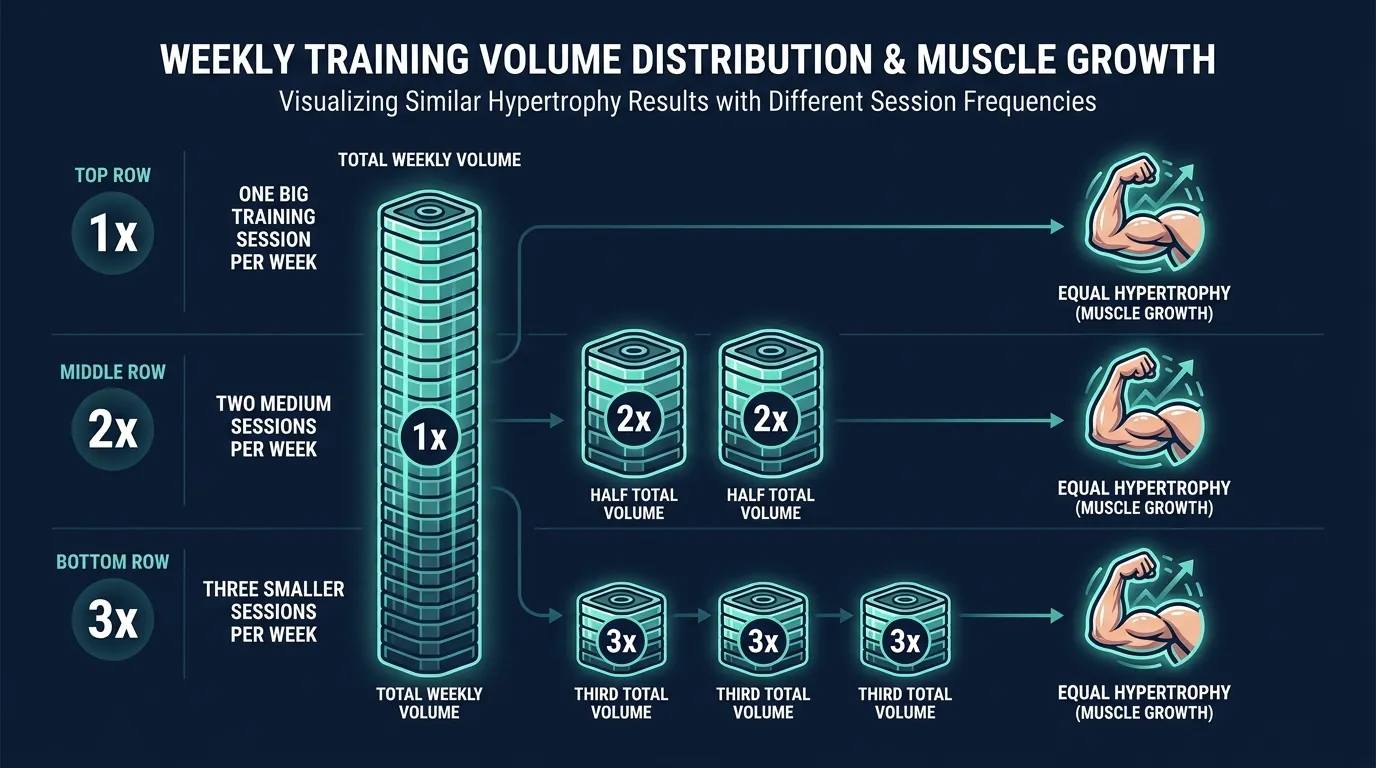
- Volume drives muscle growth. Frequency just distributes it. Schoenfeld and colleagues (2019) pooled 25 volume-equated trials and found no significant hypertrophy difference between low and high training frequencies.
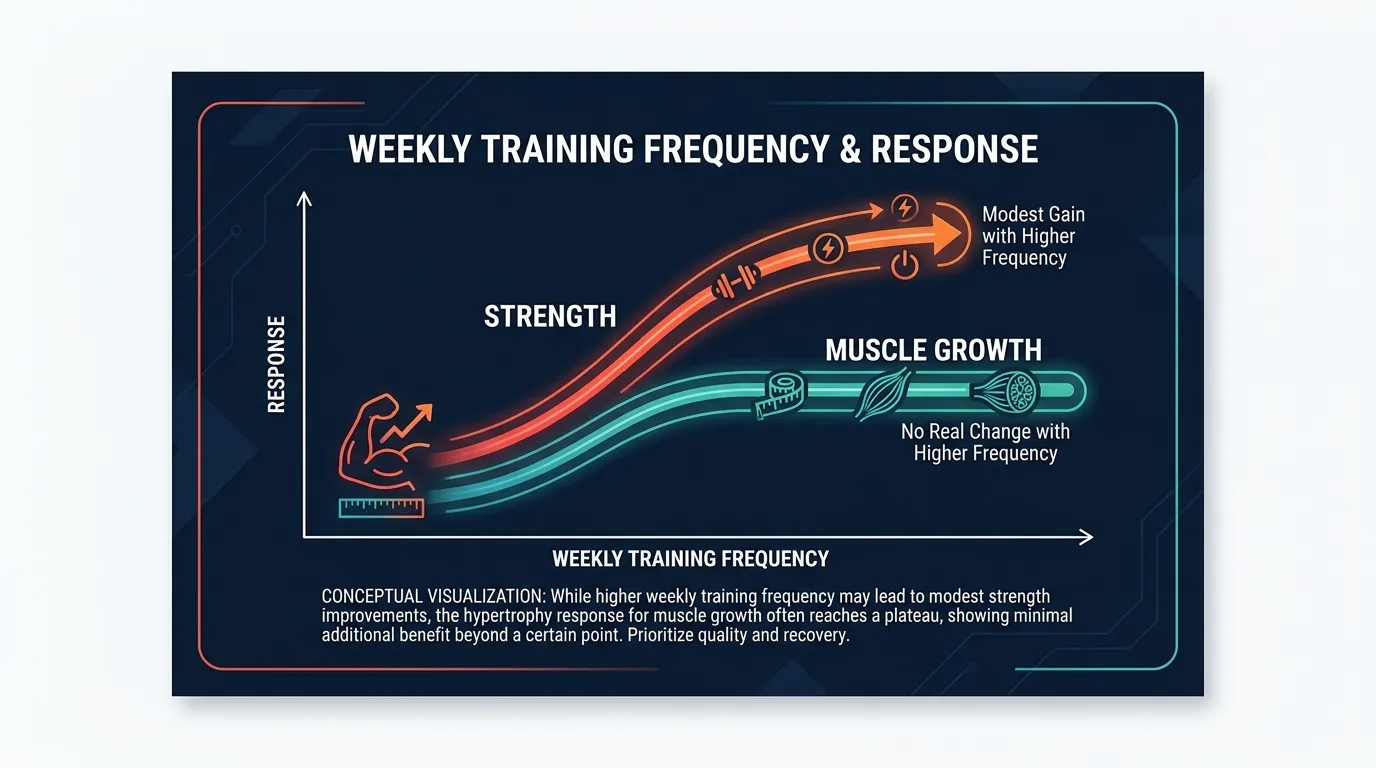
- Strength gets a small frequency boost. Grgic et al. (2018) and Ralston et al. (2018) both found training a muscle two or more times per week produced modest but real strength gains over training it once.
- Twice a week per muscle is the practical sweet spot. It captures the small strength benefit, lets you spread weekly sets across two sessions, and is easy to recover from.
- Very high frequencies do not add more growth in trained athletes. Cuthbert et al. (2021) in well-trained populations found no advantage to four-plus sessions per muscle per week when weekly volume was matched.
- Bodyweight skill work is the exception. Daily light practice of pull-ups, pistol squats, or handstand holds builds the skill faster than weekly max attempts because the dose per rep is low.
The "how often should I train each muscle group" question gets asked twice on every fitness forum and answered three different ways. Bro-split tradition says once a week with brutal volume. Mainstream coaching says two or three times a week. The high-frequency crowd says every single day. So who is right?
Honestly, almost everyone is partly right. The research over the last decade keeps converging on a quieter answer than any of the camps argue for. When you match weekly volume (the total number of hard sets per muscle group per week), the frequency you spread that work across barely moves the muscle-growth needle. Strength is a slightly different story. Higher frequency does help a little.
So here is the plan. We will walk through the four meta-analyses that anchor the modern consensus (Schoenfeld 2016, Grgic 2018, Ralston 2018, and Schoenfeld 2019). We will look at one well-trained-population paper (Cuthbert 2021) that addressed the "is higher always better" question in serious athletes. We will untangle three of the most common misconceptions. And we will close with a practical, no-equipment-needed way to set your weekly schedule.
The Research: What Studies Show
This topic is one of the better-resourced areas in resistance training science. There are clean meta-analyses on both sides of the muscle-growth and strength question, and the picture they paint is more boring than the marketing around training frequency suggests. For the applied version of that trade-off, our six-day and three-day push pull legs templates show what one exposure a week versus two actually looks like on the calendar.
Schoenfeld 2016: The First Frequency Meta-Analysis for Hypertrophy
The starting point is Schoenfeld, Ogborn, and Krieger (2016), published in Sports Medicine. The team pooled 10 studies that compared resistance training frequencies of one versus two-plus sessions per muscle per week. Across the pooled data, higher-frequency conditions produced a slightly larger effect size for muscle hypertrophy than lower-frequency conditions.
The trap in citing this paper alone is that most of the included studies were not volume-equated. In other words, the higher-frequency groups often did more total weekly sets too. So the meta-analysis could not cleanly separate the frequency effect from the volume effect. The authors said as much in the discussion. They concluded that when training is performed at equal volumes, evidence to determine the optimal frequency is lacking and recommended muscles be trained "at least twice a week" as a sensible default.
Grgic 2018: Frequency Effects on Strength
Grgic and colleagues (2018), also in Sports Medicine, ran the parallel meta-analysis for strength. They pooled 22 studies and found higher training frequencies (two or three times per muscle per week) produced significantly greater strength gains than lower frequencies (one session per muscle per week) under both 1RM-tested and isokinetic conditions. The effect size was small to moderate.
The strength benefit held when the authors restricted the analysis to volume-equated trials. That is the cleaner subgroup, and it produced a small but real effect favoring higher frequency. The likely mechanism is neural. More frequent practice of the movement pattern improves the nervous system's efficiency at recruiting motor units and coordinating muscle action, which translates to better strength expression on a 1RM test.
Ralston 2018: A Second Strength Meta-Analysis
The same year, Ralston and colleagues (2018), in Sports Medicine - Open, ran an independent strength meta-analysis with slightly different inclusion criteria. They pooled studies separately by training status and movement type, then compared the strength effect across one, two, and three-plus weekly sessions per muscle.
The pattern matched Grgic's. Training a muscle two or more times per week produced larger strength gains than training it once. Going from two to three did not add meaningful extra strength in most subgroups. The bench press subgroup showed the cleanest dose response, with the three-session-per-week condition producing the largest gains. Lower-body strength gains were similar across two and three sessions per week.
Schoenfeld 2019: The Volume-Equated Hypertrophy Picture
The cleanest answer for muscle growth came in Schoenfeld, Grgic, and Krieger (2019), published in the Journal of Sports Sciences. The authors re-ran the 2016 analysis with stricter volume-equated inclusion criteria. Twenty-five studies made the cut.
When weekly volume was held constant, training frequency did not significantly influence muscle hypertrophy. Splitting a given weekly set count across one, two, or three sessions per muscle produced essentially the same growth response. The 95% confidence interval crossed zero. The authors concluded that, for a given weekly volume, frequency is a scheduling choice rather than a growth lever. They still recommended training each muscle at least twice a week as a practical default, mostly because higher frequencies make it easier to accumulate adequate weekly volume. Our guide to the 4 day workout split turns that finding into a week, since a fourth training day is only worth adding when it carries hard sets the previous three could not fit.
Cuthbert 2021: Well-Trained Populations
One reasonable critique of the prior meta-analyses is that most participants were untrained or moderately trained college students. Does the picture change in serious athletes? Cuthbert and colleagues (2021), in Sports Medicine, pooled studies in well-trained populations (athletes with at least two years of consistent resistance training experience).
The answer was largely the same. Higher frequencies produced small additional strength benefits in some subgroups, but the effects were modest and not consistent across all comparisons. When weekly volume was equated, no clear advantage emerged for very high frequencies (four to six sessions per muscle per week) over moderate frequencies (two to three). The takeaway for athletes is the same as for beginners. Distribute your weekly volume across at least two sessions per muscle, do not stress about hitting three or four if your schedule does not allow it, and put your attention on actually accumulating the volume.
| Meta-analysis | Outcome | Volume-equated? | Finding |
|---|---|---|---|
| Schoenfeld 2016 | Hypertrophy | Mostly no | Higher frequency looked slightly better, but confounded by volume |
| Grgic 2018 | Strength | Yes (subgroup) | Training 2+ times/week beat once; small-to-moderate effect |
| Ralston 2018 | Strength | Yes | 2+ sessions beat once; 2 vs 3 broadly similar |
| Schoenfeld 2019 | Hypertrophy | Yes | No significant frequency effect when volume was matched |
| Cuthbert 2021 | Strength (well-trained) | Yes | No advantage to very high frequency when volume was matched |
Why does volume drive muscle growth more than frequency?
Volume wins because muscle protein synthesis responds to a dose of mechanical tension at the cellular level, and that dose accumulates across sets, not across sessions. A muscle does not know whether you gave it 12 hard sets in one day or split them into three sessions of four sets. The total signal is what shapes the adaptation over weeks and months. That is why frequency mostly disappears once you control for volume.
Frequency starts to matter for two practical reasons. First, very high single-session volumes (think 20 sets for one muscle in one workout) hit diminishing returns within the session. The last few sets contribute less because of accumulated fatigue. Splitting the volume across two sessions keeps every set closer to peak quality. Second, schedule adherence is real. A 90-minute leg day twice a week is harder to recover from and easier to skip than 45 minutes of legs three times a week. The meta-analyses cannot capture adherence, but it shows up in long-term outcomes.
The strength advantage to higher frequency is mostly neural. Lifting heavier loads is a motor skill. The more you practice the movement pattern (especially competition lifts like the squat, bench, and deadlift, or their bodyweight analogues like pistol squats, dips, and pull-ups), the better your nervous system gets at expressing strength on demand. That neural skill benefit is what Grgic and Ralston are picking up. It is real but small, and it does not translate to extra muscle growth on its own.
If you want a deeper read on the volume side of the equation, our piece on why light weights can build muscle walks through the mechanical-tension model that underpins the modern hypertrophy consensus. For a related schedule question, see training to failure versus reps in reserve.
How should you set your training frequency?
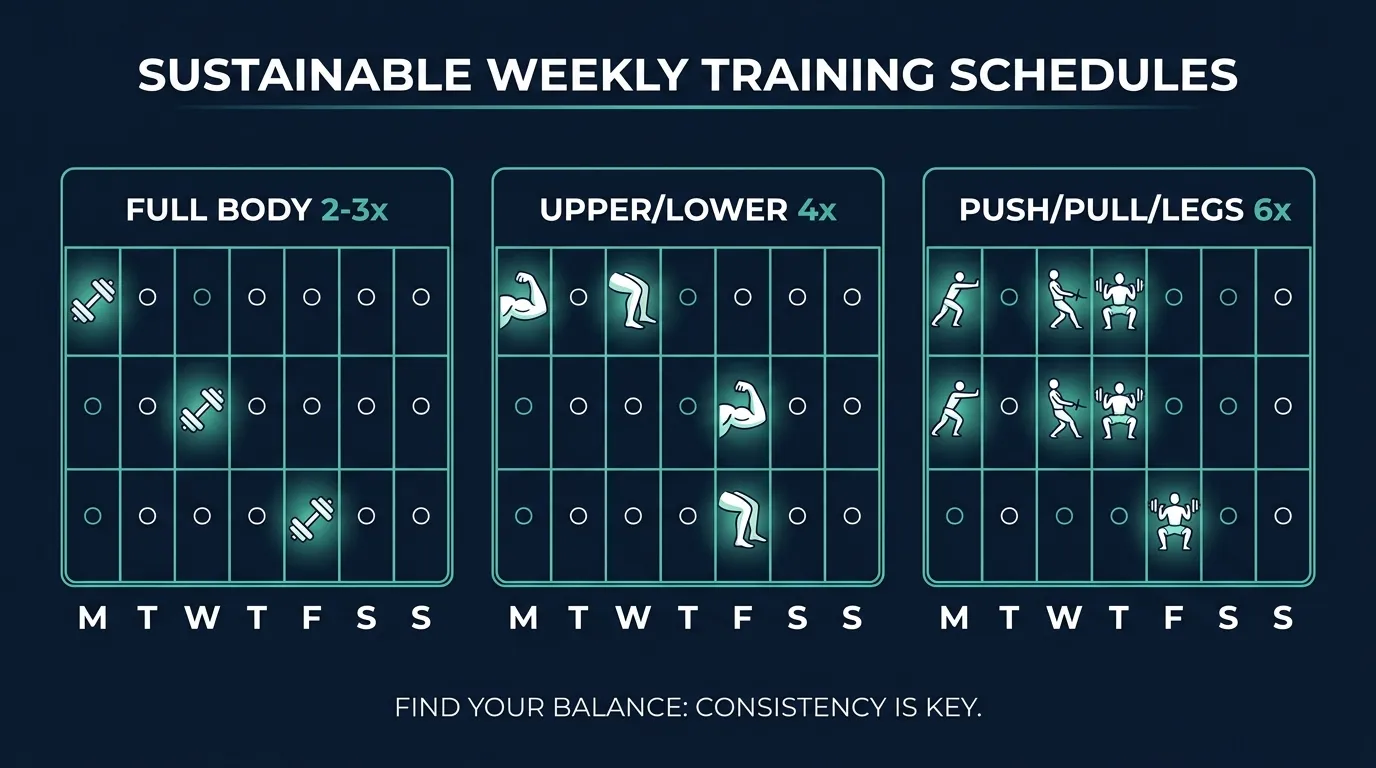
Train each major muscle group about twice a week as your default, then let your experience level pick the split. Beginners do best with full-body sessions, intermediates with an upper/lower split, and advanced lifters with push/pull/legs. Here is the practical translation, with the honest version of what the science supports. The same volume-first logic decides whether training twice in one day buys you anything or just adds fatigue.
Beginner or returning trainee. Full-body, two or three days a week. Pick six to eight movements that cover the major patterns (squat, hinge, push, pull, lunge, carry, core). Do two to three working sets of each. This hits every muscle group two or three times per week, which is in the sweet spot the strength meta-analyses identify, and the total session volume stays manageable.
Intermediate trainee. Upper/lower split, four days a week. Two upper-body sessions and two lower-body sessions per week. Each muscle group still gets trained twice. You have more time per session for the secondary movements (curls, lateral raises, calf work) that bigger volumes start to call for. This is the lowest-friction four-day split in the literature.
Advanced trainee with high volume targets. Push/pull/legs, six days a week, or an upper/lower split with the volume cranked up. Once weekly per-muscle volume crosses 15 hard sets, splitting that work into smaller daily doses keeps every set close to peak quality. The catch is recovery management. If you cannot get seven to nine hours of sleep and three real meals a day, dial back the frequency and the volume together.
Bodyweight or skill-focused training. Daily light practice of the skill move (handstand work, pull-up volume, pistol squats) plus two or three honest strength sessions a week. Greasing the groove (frequent submaximal practice) is the bodyweight community's version of the high-frequency strength finding. It works for skill, not for pure hypertrophy.
The non-negotiable. Whatever frequency you pick, the schedule has to be sustainable for months, not weeks. The meta-analyses measured 6 to 12 week interventions. Real progress lives on the timescale of quarters and years. Pick the frequency you can actually keep showing up for. That is the lever that compounds.
Get an evidence-based plan built for you
FitCraft, our mobile fitness app, pairs you with an AI coach who builds you a personalized plan around your goals, schedule, and fitness level. Every FitCraft program is designed by Domenic Angelino, MPH (Brown University) and NSCA-CSCS, with research published in the Journal of Strength and Conditioning Research and Medicine & Science in Sports & Exercise.
Take the Free Assessment Free • 2 minutes • No credit cardCommon Misconceptions
Misconception 1: "Training once a week is too infrequent to grow."
The volume-equated meta-analyses say otherwise. Schoenfeld 2019 pooled 25 trials and found no significant hypertrophy difference between low and high frequencies when weekly volume was held constant. If you can only train each muscle once a week, the muscle will still respond as long as the total weekly set count is adequate. The catch is that fitting 10 to 20 hard sets for one muscle into a single session gets uncomfortable fast, and the last sets are lower quality than the first. So once-a-week is rarely the most efficient option, even if it is technically not less effective.
Misconception 2: "More frequent always means more muscle."
This is the mirror image of the first misconception, and it is the more popular one right now. The Cuthbert 2021 meta-analysis specifically addressed it in well-trained athletes and found no consistent advantage to extremely high frequencies when weekly volume was matched. More sessions just means smaller sessions. The muscle still adapts to the total weekly dose. If you have the time and prefer the schedule, daily training is fine. If you have to compress your work into three weekly sessions, you are not leaving growth on the table.
Misconception 3: "Different goals need totally different frequencies."
Strength does pick up a small frequency advantage that hypertrophy does not. But the size of that advantage is modest. Grgic 2018 and Ralston 2018 both place the strength effect in the small-to-moderate range. The practical schedule for someone whose primary goal is muscle growth and the schedule for someone whose primary goal is strength end up looking very similar (twice or three times per muscle per week). The differences are in load (heavier for strength, moderate for hypertrophy) and rep range (lower for strength, moderate for hypertrophy), not in how many days a week you train.
What the Research Suggests Going Forward
Pull back the camera and the modern frequency picture is one of the most settled topics in resistance training science. The Schoenfeld 2019 hypertrophy meta-analysis, the Grgic 2018 and Ralston 2018 strength meta-analyses, and the Cuthbert 2021 well-trained-population update all point in the same direction. Total weekly volume per muscle group is the primary driver of growth. Spreading that volume across at least two sessions per week captures a small strength advantage and makes the work more sustainable. Beyond that, the schedule is a personal-preference decision.
Three honest caveats stay in play. First, almost all the included studies were 6 to 12 weeks long. Whether the small strength advantage of higher frequency holds across multi-year training careers is not as well-characterized. Anecdotal evidence from competitive lifters suggests it does, but the meta-analytic confidence interval comes mostly from short trials. Second, the participant pool skews toward college-aged men. There is much less frequency data on women, older adults, and post-menopausal trainees specifically. The mechanistic picture should generalize, but the specific dose recommendations come with that caveat. Third, frequency interacts with intensity and exercise selection. Daily heavy squatting is a different demand than daily light squatting. The meta-analyses pooled across that variability, which is appropriate for a general recommendation but loses fidelity at the individual programming level.
The practical forward advice is genuinely simple. Pick a schedule that gets each major muscle group trained two or three times a week. Make sure each session does enough hard sets to add up to a reasonable weekly volume (10 to 20 per muscle is a sensible target range for hypertrophy, somewhat less for pure strength). Show up consistently for a few months, then track your progress on the trend, not the day-to-day. The frequency itself is the smallest lever in this whole conversation. Volume, intensity, and adherence are bigger by an order of magnitude. If you want that translated into an actual week, our guide to the upper lower split lays out the four-day and two-day versions with the sets already counted.
References
- Schoenfeld BJ, Ogborn D, Krieger JW. "Effects of Resistance Training Frequency on Measures of Muscle Hypertrophy: A Systematic Review and Meta-Analysis." Sports Medicine 46.11 (2016): 1689-1697. PMID: 27102172
- Grgic J, Schoenfeld BJ, Davies TB, Lazinica B, Krieger JW, Pedisic Z. "Effect of Resistance Training Frequency on Gains in Muscular Strength: A Systematic Review and Meta-Analysis." Sports Medicine 48.5 (2018): 1207-1220. PMID: 29470825
- Ralston GW, Kilgore L, Wyatt FB, Buchan D, Baker JS. "Weekly Training Frequency Effects on Strength Gain: A Meta-Analysis." Sports Medicine - Open 4.1 (2018): 36. PMID: 30076500
- Schoenfeld BJ, Grgic J, Krieger J. "How many times per week should a muscle be trained to maximize muscle hypertrophy? A systematic review and meta-analysis of studies examining the effects of resistance training frequency." Journal of Sports Sciences 37.11 (2019): 1286-1295. PMID: 30558493
- Cuthbert M, Haff GG, Arent SM, Ripley N, McMahon JJ, Evans M, Comfort P. "Effects of Variations in Resistance Training Frequency on Strength Development in Well-Trained Populations and Implications for In-Season Athlete Training: A Systematic Review and Meta-Analysis." Sports Medicine 51.9 (2021): 1967-1982. PMID: 33886099
Frequently Asked Questions
How often should you train each muscle group per week?
When weekly volume is matched, the research finds little difference between training a muscle once, twice, or three times per week for muscle growth. Schoenfeld, Grgic, and Krieger (2019) pooled 25 studies in the Journal of Sports Sciences and concluded that frequency did not significantly influence hypertrophy when volume was held constant. For strength, higher frequency has a small edge. Grgic et al. (2018) and Ralston et al. (2018) both found a modest but real strength benefit to training a muscle two or more times per week compared with once. The practical answer for most people is twice per week per muscle group.
Does training a muscle once a week build less muscle than three times a week?
Not when weekly volume is the same. The Schoenfeld 2016 meta-analysis in Sports Medicine compared frequency studies and found higher frequencies produced slightly more hypertrophy than lower ones, but most of those studies were not volume-equated. When Schoenfeld and colleagues ran the analysis again in 2019 with stricter volume-equated criteria, the frequency effect on muscle growth disappeared. What matters is hitting enough total weekly sets per muscle group.
Is full-body training three times a week better than a body-part split?
For beginners and intermediate trainees, full-body three times a week is usually the easiest path to consistent progress. It hits every muscle group twice or three times per week, which is in the range the strength meta-analyses associate with optimal gains. Advanced trainees who need 15 to 25 weekly sets per muscle group may find that volume hard to fit into full-body sessions and benefit from splits like upper/lower or push/pull/legs. The split is a tool for distributing volume when full-body sessions get too long.
Can you train the same muscle every day?
You can, but the dose per session has to drop accordingly. Daily light practice is the basis of skill-based bodyweight progressions, where the goal is to accumulate practice reps without ever reaching failure. For pure muscle growth at moderate to high intensity, daily training leads to incomplete recovery and diminishing returns. The Cuthbert 2021 meta-analysis in Sports Medicine found no extra benefit to extremely high frequencies over moderate frequencies in well-trained athletes when weekly volume was matched.
How does training frequency apply to bodyweight workouts?
Bodyweight training tolerates higher frequency than barbell or heavy-load training because the absolute load per rep is lower and the neuromuscular demand is gentler. For skill-based moves like pull-ups, pistol squats, and handstand work, daily light practice (sometimes called greasing the groove) builds the movement faster than once-a-week max attempts. For pure hypertrophy with bodyweight progressions, the same rules from the meta-analyses still apply.