
The premise sounds too easy to work. Do a few pull-ups every time you walk past a doorway, never strain, never get sore, and four weeks later your max goes from 6 to 10. So is greasing the groove a viable method, or just a clever rebrand of "practice the thing you want to get better at"?
Mostly the second one, honestly. But the rebrand matters because the framing is right. Strength is partly a skill. Skills improve through frequent, submaximal practice with high movement quality. The traditional "three hard sets twice a week" model is one valid way to train. Greasing the groove is another, and for certain goals (specifically, getting better at one bodyweight movement) it can outperform the traditional model in the first 6-8 weeks.
The catch shows up in the research the moment you ask GTG to do things outside its lane. It is not great for hypertrophy. It does not produce a balanced physique on its own. And it has a hard ceiling that practitioners hit around the time neural adaptation runs out and load progression has to take over. Below is what the actual frequency and neural-adaptation literature says, where Pavel Tsatsouline's method maps onto it, and how to use the approach without falling into its predictable traps.
What Greasing the Groove Actually Is
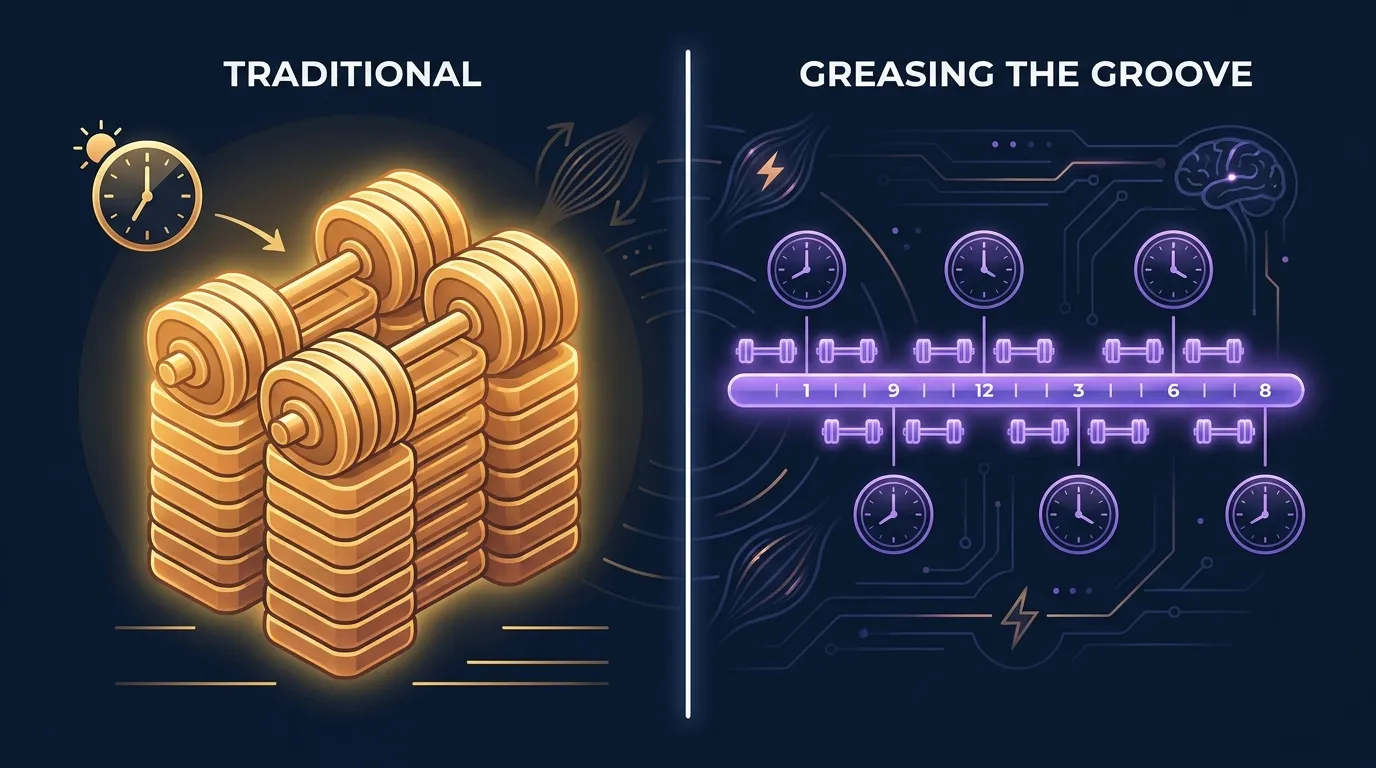
Pavel Tsatsouline, a former Soviet special forces instructor turned American strength coach, named the method in his 2003 book The Naked Warrior. The rules are simple. Pick one movement you want to get better at. Compute your max reps with strict form. Use roughly half that number as your set count. Do that submaximal set many times a day, at least 15 minutes apart, never approaching failure, never accumulating fatigue. Sleep, eat, repeat. After a few weeks, retest your max. Most people see a jump.
The phrase "grease the groove" came from Soviet strength training language. The "groove" is the motor pattern, the precise sequence of muscle activations your nervous system uses to perform a movement. "Greasing" it means making it smoother through repetition, so that more of the muscle you actually have gets recruited and the supporting stabilizers fire in the right order. The result, in theory, is more force output from the same muscle mass.
That theory is not a Pavel-original. It is a popularization of mainstream neuromuscular physiology, which is why the method holds up better than most fitness folklore.
The Research: What the Frequency Literature Shows
Sale (1988): The Neural Adaptation Foundation
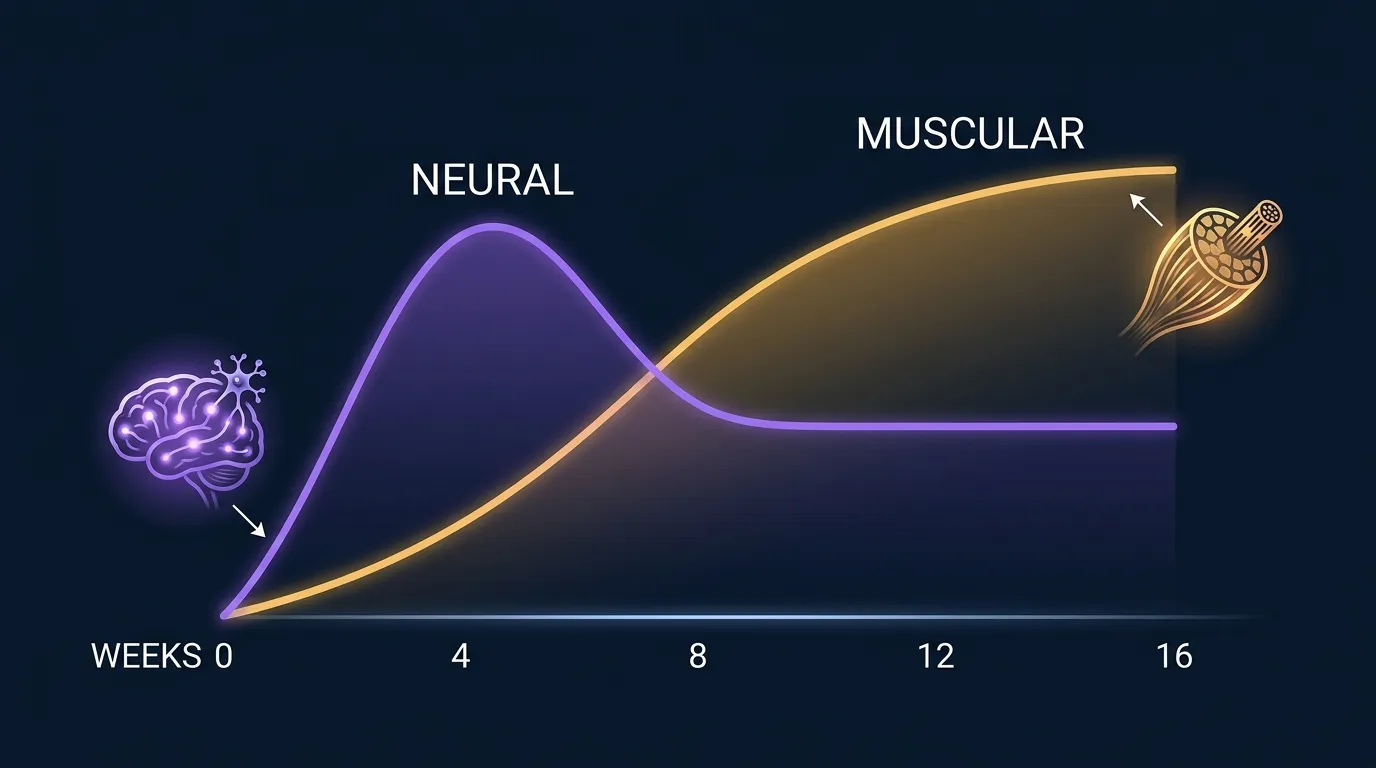
Sale's 1988 review in Medicine and Science in Sports and Exercise is still the foundational paper on why people get stronger before they get bigger. He synthesized a decade of EMG, twitch-interpolation, and reflex studies and concluded that the first 4-8 weeks of any new strength program produce gains that exceed what the modest hypertrophy of that period can explain. The remainder comes from neural changes.
The specific mechanisms he described. Increased motor-unit recruitment, meaning the brain learns to call on a larger fraction of available muscle fibers per contraction. Higher firing rates, so the units that do fire produce more force per unit time. Improved synchronization, where multiple motor units contract more nearly simultaneously to produce a sharper peak force. And reduced co-contraction of antagonist muscles, which previously bled away force by pulling in the opposite direction.
The implication for greasing the groove is direct. If neural adaptation is the dominant strength driver in the first 4-8 weeks, and neural adaptation responds to frequent specific practice, then doing many short sets of one movement should produce strength gains efficiently. That is exactly what GTG predicts.
Citation: Sale DG. Neural adaptation to resistance training. Med Sci Sports Exerc. 1988;20(5 Suppl):S135-S145.
Folland and Williams (2007): The Modern Reconfirmation
Almost twenty years after Sale, Folland and Williams updated the picture in Sports Medicine with newer imaging and electromyography. Same conclusion. Roughly the first 4-6 weeks of any strength program are neurally dominated. Measurable changes in muscle cross-sectional area lag behind strength gains by several weeks. By weeks 8-12, hypertrophy starts contributing meaningfully to strength. By week 16 and beyond, muscle size becomes the larger contributor.
They also made a point that matters for GTG. The neural side of strength is highly specific. Practicing a movement improves performance on that exact movement far more than it improves performance on closely related movements. So greasing the groove on pull-ups raises your pull-up max sharply, but barely moves your lat-pulldown numbers. The motor-pattern improvements do not generalize. This is a feature when your goal is a specific exercise (one-arm push-up, muscle-up progression, max pistol squat reps). It is a bug when your goal is total-body strength, because the gains do not spread.
Folland and Williams also discussed why some people see disproportionately large early gains. Lower initial neural efficiency means more room for improvement. Untrained or undertrained people typically only recruit 70-85 percent of their available motor units in a maximal effort. Trained lifters recruit closer to 95 percent. The first group has more headroom for neural-only strength gains and tends to respond fastest to GTG-style work.
Citation: Folland JP, Williams AG. The adaptations to strength training: morphological and neurological contributions to increased strength. Sports Med. 2007;37(2):145-168.
Grgic et al. (2018): Frequency and Strength Gains
The most direct test of "does training a movement more often build more strength?" comes from Grgic and colleagues' 2018 meta-analysis in Sports Medicine. They pooled data from 22 studies covering different training frequencies and measured the effect on maximal strength.
The headline finding. Effect sizes for strength gains scaled with frequency. Training one time per week produced an effect size of 0.74. Two times per week, 0.82. Three times per week, 0.93. Four or more times per week, 1.08. More frequent is better for strength, with diminishing returns at the high end.
The important caveat the authors raised. When they did a subgroup analysis on volume-equated studies (where total weekly sets were held constant and just spread across more or fewer sessions), the frequency effect mostly disappeared. So part of what their main analysis was picking up was simply that high-frequency programs tend to have more total volume. But not all of it. Even in some volume-equated comparisons there was a small frequency benefit for strength specifically.
For GTG, which by definition stacks frequency to the ceiling, the practical read is: this is a method that exploits whatever frequency-specific advantage exists for strength gains, while also accumulating real total volume across the week. Both contribute. The strength effect is real, and Pavel was not making it up.
Citation: Grgic J, Schoenfeld BJ, Davies TB, Lazinica B, Krieger JW, Pedisic Z. Effect of resistance training frequency on gains in muscular strength: a systematic review and meta-analysis. Sports Med. 2018;48(5):1207-1220.
Schoenfeld, Grgic & Krieger (2019): The Hypertrophy Limit
The same research group ran a parallel meta-analysis on training frequency and muscle growth. Schoenfeld, Grgic, and Krieger's 2019 paper in the Journal of Sports Sciences pooled 25 studies on resistance-training frequency for hypertrophy outcomes.
The headline finding here was different. When volume was equated across conditions (same weekly sets, different number of sessions), frequency had no significant effect on muscle growth. Spreading the work out did not produce more hypertrophy than concentrating it, as long as the total set count was the same and the sets were taken close enough to failure to drive a growth signal.
This is the ceiling on GTG. Most GTG sets are deliberately stopped at half the rep max, well short of failure. The hypertrophy literature, including Schoenfeld, Ogborn, and Krieger's earlier 2017 dose-response meta-analysis in the same journal, repeatedly shows that proximity to failure matters for muscle protein synthesis and growth signaling. We covered the practical implications in our RIR and failure science piece. Submaximal sets accumulate volume, but the per-set growth stimulus is small. You build the neural pattern. You do not build much new tissue.
So GTG and traditional hypertrophy training are complementary tools rather than competitors. If you want bigger arms, train arms hard with 8-15 weekly sets close to failure. If you want a bigger one-arm pull-up max, grease the groove. The two goals are not the same.
Citation: Schoenfeld BJ, Grgic J, Krieger J. How many times per week should a muscle be trained to maximize muscle hypertrophy? A systematic review and meta-analysis of studies examining the effects of resistance training frequency. J Sports Sci. 2019;37(11):1286-1295.
Schoenfeld, Ogborn & Krieger (2017): The Volume Dose-Response
The companion paper that anchors why GTG is not a hypertrophy tool is Schoenfeld, Ogborn, and Krieger's 2017 dose-response meta-analysis. They synthesized 15 studies and found a near-linear relationship between weekly set count (per muscle group) and hypertrophy, up to roughly 10-20 sets per week. Beyond that point the curve flattens. Below about 5 weekly sets per muscle, growth is minimal.
What this means for GTG. If you do 8 sets of 5 pull-ups every day for a week, your weekly back-and-bicep volume is 280 reps, which is a lot. But spread across very low intensity (50 percent of max effort), the hypertrophy stimulus per rep is small. Many GTG practitioners do hit weekly rep counts that should drive some hypertrophy, but the growth is modest compared to the same weekly set count done at higher intensity per set. The volume is real. The growth signal per rep is weak.
Citation: Schoenfeld BJ, Ogborn D, Krieger JW. Dose-response relationship between weekly resistance training volume and increases in muscle mass: A systematic review and meta-analysis. J Sports Sci. 2017;35(11):1073-1082.
Why This Matters for Your Fitness
The takeaway from these five papers, when you stack them, is that greasing the groove is a strength method, not a physique method. The neural-adaptation literature gives it solid mechanistic backing for getting better at a specific movement. The hypertrophy literature explains why it cannot replace traditional training for muscle growth. Both things are true at once.
There is a behavioral angle worth naming too. If you have ever tried to commit to "three workouts a week" and watched your consistency drift in the second month, GTG offers a different relationship with training. You are not driving to a gym. You are not blocking 60 minutes. You are walking past a doorway, doing three pull-ups, and walking on. The activation energy per session is near zero, which our piece on building an exercise habit without willpower covers from the habit-formation side. People who quit traditional programs sometimes thrive on GTG simply because the start-cost is gone.
That said, GTG also has an underrated cost. It requires a pull-up bar or open floor space in places you spend the day. It works for people who work from home or have control over their physical environment, less well for office workers, parents managing kids, or anyone with a chaotic schedule. The method's elegance assumes a controllable space. Most people's days are not that controllable.
How to Apply Greasing the Groove
Five rules that map the research onto a workable protocol.
1. Pick one or two movements, not five. The neural-adaptation literature is clear that the gains are movement-specific. If you spread GTG across pull-ups, push-ups, pistol squats, and dips simultaneously, each individual movement gets less practice and the neural pattern develops more slowly. Pick one upper-body pull (pull-ups or chin-ups) and optionally one upper-body push (push-ups, pike push-ups). Train those for 4-6 weeks. Retest. Then rotate.
2. Set count = half your max. If your max strict pull-up is 8 reps, your GTG sets are 4 reps. This is the most common GTG miscalibration. People do "easy" sets that are actually still 70-80 percent of max and accumulate too much per-set fatigue to hit the daily set count. Stay closer to 50 percent. The session should feel like you barely did anything. That is the point.
3. Spread sets across the day, with real rest between. 15 minutes is the absolute floor between GTG sets, and longer (1-3 hours) is better. The whole point is to keep each set fresh and neurally clean. Doing 8 sets of 4 push-ups in a 30-minute block is just a regular workout, and the per-set fatigue accumulates the way it does in any workout. Spread across 6-10 hours, each set lands while you are fully recovered.
4. Cap the protocol at 4-8 weeks. The neural-adaptation window has a duration. Sale (1988) and Folland and Williams (2007) both put it at roughly 4-8 weeks for any new stimulus. After that, gains plateau unless you change the variable: increase the movement difficulty (move from regular pull-ups to weighted pull-ups or to one-arm pull-up progressions), or layer in traditional volume-and-load training. Running GTG for 6 months on the same exact movement at the same difficulty stops working around week 8.
5. Use it as a supplement, not a replacement. If you have a balanced training program with strength and conditioning across multiple movements, GTG slots in as a way to push one specific movement upward without disrupting the rest. If you are using GTG as your only training, you will get strong at one or two movements and stay generally undertrained. The neural-strength literature does not generalize across movements, so single-exercise GTG leaves the rest of your fitness flat.
For most readers, the cleanest use of GTG is a 4-6 week focused block to add a specific milestone (your first pull-up, your tenth push-up, a 30-second handstand hold), then back into regular training. Our first pull-up guide uses essentially this logic, and our home workout guide covers how to integrate GTG-style frequency into a balanced bodyweight plan.
Enjoying the article?
Start a new fitness routine today, written by me and coached by the AI I designed.
Take the Free Assessment Free • 2 minutes • No credit cardCommon Misconceptions
Misconception: "GTG is just doing a lot of reps"
It is not. The defining feature of GTG is submaximal effort per set with full neural recovery between sets. Doing 100 push-ups in a single Tabata block is high-volume training, not GTG, and the per-set fatigue is so high you cannot maintain quality movement patterns. The whole mechanism (clean neural rehearsal of the motor pattern) requires that every rep look essentially identical to a fresh max-quality rep. Once form starts to degrade, you are training a degraded pattern, which is the opposite of what greasing the groove is meant to do.
Misconception: "GTG works for everything"
It works best for bodyweight movements where neural skill is a substantial share of total performance. Pull-ups, push-ups, pistol squats, handstand holds, dips. It works much less well for heavily loaded movements where absolute muscle force is the limiter. It also works poorly for endurance-style outcomes (running, cycling), where the limiting factor is cardiovascular and metabolic rather than neural. Pavel's original framing emphasized strength-skill movements, and the research supports that boundary. Trying to "grease the groove" on a 5K run time is not the same thing and will not produce the same results.
Misconception: "If a little is good, a lot is better"
GTG has a diminishing-returns curve like any training method. Doing 20 sets of 4 push-ups a day instead of 8 sets of 4 does not produce 2.5 times the gain. The neural pattern gets reinforced past the point where additional reps add information. And in practice, the people who push GTG volume highest tend to lose the submaximal discipline and start grinding sets, which collapses the entire mechanism. Stick to 5-10 sets a day for the work movement, well-spaced, with deliberate form on every rep. More than that is usually counterproductive.
Misconception: "GTG replaces strength training"
For one or two specific bodyweight movements, GTG can be your only training of that movement for 4-6 weeks and still work. For overall strength and physique development, no. The hypertrophy meta-analyses are unambiguous: muscle growth requires per-set proximity to failure and adequate total weekly volume, neither of which GTG provides. Treat GTG as a focused strength-skill block, not a complete training system. Most coaches who use it well rotate GTG blocks into a broader program rather than living on it permanently.
What the Research Suggests Going Forward
The training-frequency literature has converged on a fairly clear picture over the last decade. Strength responds to frequency more than hypertrophy does. Volume-equated, frequency contributes a small additional strength benefit beyond what total volume explains. Hypertrophy depends on weekly volume and per-set effort more than on how the sessions are distributed. GTG, as a high-frequency, low-per-set-fatigue protocol, fits neatly into this framework as a tool for the neural-strength end of the spectrum.
What is still being worked out. The exact mechanism of "movement specificity" in neural-strength gains, and whether deliberate variations in technique within a single movement (different grip widths, different tempos) extend the adaptation window. The interaction between GTG and concurrent traditional strength training is also underexplored: most studies look at one or the other, not both layered. And the ceiling of GTG, the point where neural adaptation saturates and additional frequency stops helping, has not been studied formally outside coaching reports.
One useful direction for any reader: pair GTG with a structured measurement habit. Test your max reps on the target movement every 7-10 days, log them, and watch the curve. Within 6-8 weeks the gains will plateau visibly, which is your signal to either progress the movement difficulty or switch back to traditional training for that movement. The data is its own coach, and most people who run GTG endlessly without measuring are surprised to learn they stopped gaining 4 weeks earlier than they realized.
Honest Limitations
A few caveats are worth naming. Almost all of the formal research on training frequency comes from traditional gym programs, not GTG specifically. We extrapolate from "more frequent training builds more strength" to "many short submaximal daily sets build strength" with reasonable mechanistic grounding, but there is not a clean randomized trial that pits GTG against a matched traditional program. The 20-40 percent rep-improvement figures quoted by GTG practitioners come from coaching reports rather than controlled studies. The direction (it works) is well supported. The exact effect size is not.
The neural-strength specificity is also a real constraint that GTG proponents sometimes downplay. Getting your pull-up max from 6 to 12 over six weeks is a genuine accomplishment, and it is not nothing for general upper-body strength. But it does not mean you are now generally stronger in a way that transfers to other pulling tasks (rowing, climbing) the way a full-body resistance program would. The transfer is limited.
And the underlying assumption that bodyweight strength is the goal does not apply to everyone. People training for body composition, general health, or balanced muscle development should probably spend most of their training time on volume-and-load work and treat GTG as a focused supplement. We covered the general case for resistance training and longevity in our resistance training and mortality piece, and the recommendation there is consistent: total weekly volume across the major movement patterns matters more than any single specialized technique.
References
- Sale DG. "Neural adaptation to resistance training." Medicine and Science in Sports and Exercise 20.5 Suppl (1988): S135-S145. PMID 3057313
- Folland JP, Williams AG. "The adaptations to strength training: morphological and neurological contributions to increased strength." Sports Medicine 37.2 (2007): 145-168. doi:10.2165/00007256-200737020-00004
- Grgic J, Schoenfeld BJ, Davies TB, Lazinica B, Krieger JW, Pedisic Z. "Effect of resistance training frequency on gains in muscular strength: a systematic review and meta-analysis." Sports Medicine 48.5 (2018): 1207-1220. doi:10.1007/s40279-018-0872-x
- Schoenfeld BJ, Grgic J, Krieger J. "How many times per week should a muscle be trained to maximize muscle hypertrophy? A systematic review and meta-analysis of studies examining the effects of resistance training frequency." Journal of Sports Sciences 37.11 (2019): 1286-1295. doi:10.1080/02640414.2018.1555906
- Schoenfeld BJ, Ogborn D, Krieger JW. "Dose-response relationship between weekly resistance training volume and increases in muscle mass: A systematic review and meta-analysis." Journal of Sports Sciences 35.11 (2017): 1073-1082. doi:10.1080/02640414.2016.1210197
Frequently Asked Questions
What is greasing the groove?
Greasing the groove (GTG) is a training method popularized by Pavel Tsatsouline in his 2003 book The Naked Warrior. You pick one bodyweight movement, typically pull-ups, push-ups, pistol squats, or a handstand hold, and you do brief submaximal sets many times throughout the day. The intensity per set stays low (around 40-60 percent of your max reps), so you never approach failure. The volume over the week is high because you might do 8-15 short sets a day. The mechanism is neural: frequent practice of a specific motor pattern under load improves motor unit recruitment and coordination, which translates to a higher 1-rep max even without traditional gym training.
Does greasing the groove actually work?
For neural-strength gains on a specific movement, yes. The mechanism is well established. Sale's 1988 review in Medicine and Science in Sports and Exercise documented that early strength gains (the first 4-8 weeks) come primarily from neural adaptations rather than muscle growth. Folland and Williams (2007) confirmed the same pattern in their Sports Medicine review. Grgic and colleagues (2018) in their training-frequency meta-analysis found that higher frequency produced larger strength gains than lower frequency in non-volume-equated comparisons. GTG is essentially a high-frequency, low-fatigue protocol, and the neural-strength literature supports the approach. GTG is less effective for muscle growth, because hypertrophy depends on total weekly volume and proximity to failure rather than frequency alone.
How many reps per set should I do when greasing the groove?
Stop well short of failure. The standard rule from Pavel Tsatsouline and most coaches who teach the method is to use roughly half your max reps per set. If you can do 10 push-ups before form breaks, you do sets of 5. If you can do 6 pull-ups, you do sets of 3. The point is to make each set feel easy and to rest 15 minutes to a few hours between sets. Submaximal effort keeps neural fatigue low so you can hit many sets across the day without compromising movement quality. Going to failure even occasionally negates the method, because failure-driven fatigue requires longer recovery and degrades the next several sets.
How long does it take to see results from greasing the groove?
Most practitioners and coaching reports describe 20-40 percent increases in max reps within 4-6 weeks on a specific bodyweight movement. That timeline fits the neural-adaptation window documented in the resistance-training literature: Sale (1988) and Folland and Williams (2007) both noted that strength gains in the first 4-8 weeks of any new training stimulus are dominated by motor-unit recruitment and coordination improvements, with muscle hypertrophy contributing more meaningfully after 8-12 weeks. GTG is essentially a method designed to maximize that neural window. After the initial gains, progress plateaus unless you add load, increase the difficulty of the movement (harder push-up or pull-up variations), or layer in traditional strength training.
Can greasing the groove build muscle?
Not very efficiently. Hypertrophy depends on total weekly volume and proximity to failure, both of which GTG deliberately limits. Schoenfeld, Grgic, and Krieger (2019) in their training-frequency meta-analysis found that when weekly volume was equated, frequency itself did not meaningfully affect muscle growth. Schoenfeld, Ogborn, and Krieger (2017) found a dose-response of about 0.4 percent more hypertrophy per additional weekly set up to roughly 10-20 sets per muscle per week. GTG accumulates volume but rarely pushes close enough to failure to drive the muscle-protein-synthesis response that builds tissue. If size is the goal, train the movement traditionally with hard sets near failure, and use GTG as a skill-and-neural-strength supplement, not the main driver.