- Most beginners get their first strict pull-up in 8 to 12 weeks of training 3 to 4 times a week. The progression is what matters, not the bar time.
- Five exercises do most of the work: dead hangs, scapular pull-ups, Australian rows, negative pull-ups, and band-assisted pull-ups. Each builds a piece of the movement you can train at your current level.
- Negatives are the secret weapon. You're roughly 1.4x stronger lowering than lifting, so you can train the pulling muscles eccentrically before you can lift yourself up. Roig et al. 2009 (20-study meta-analysis) found eccentric training builds strength faster than concentric.
- 3 to 4 sessions per week, not daily. The pulling muscles need 36 to 48 hours between hard sessions. Daily attempts cause more elbow tendinitis than progress.
- Bodyweight is half the equation. The lighter you are, the less you pull. Strength gains and a few pounds off can both shorten the timeline.
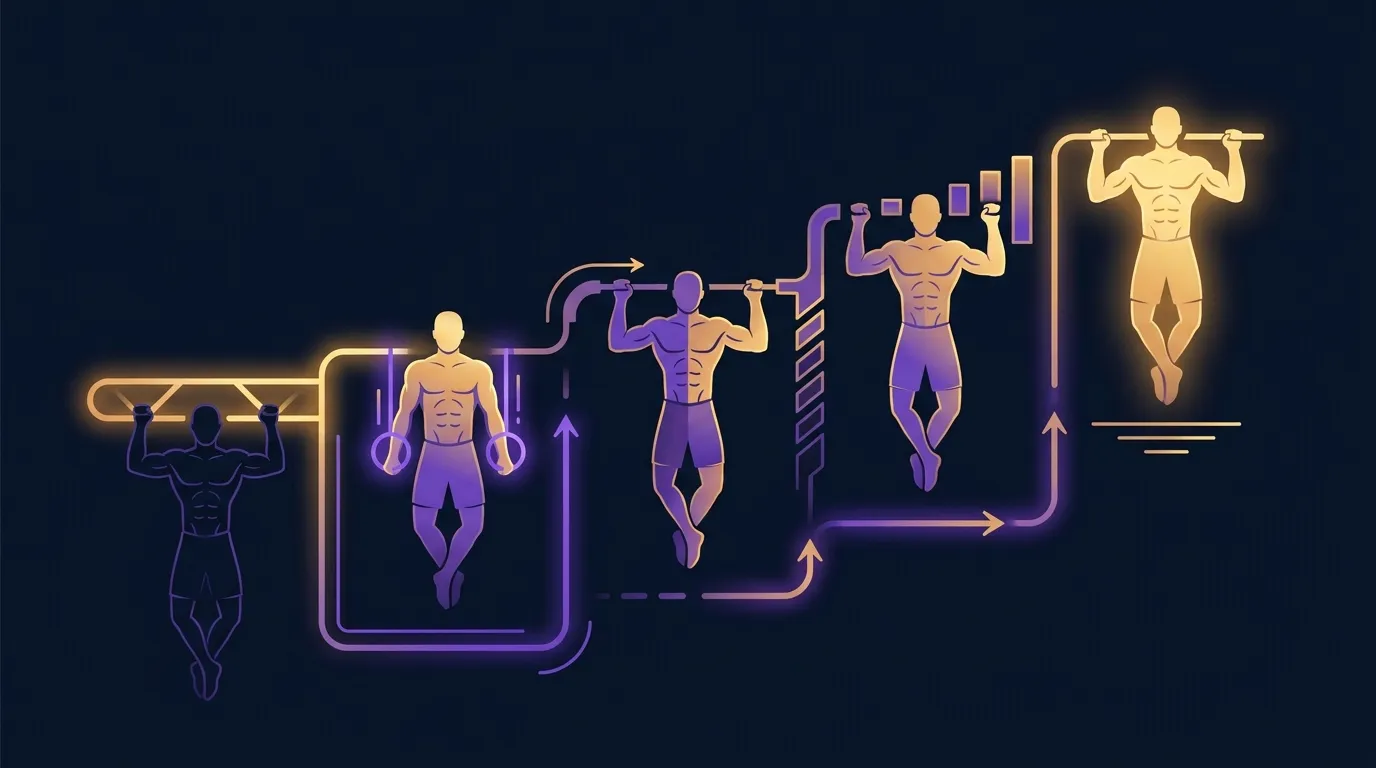
Almost everyone wants a pull-up. Almost nobody can do one cold. The most upvoted r/Fitness pull-up thread of all time (over 14,000 upvotes) is exactly this question, asked exactly this way: how do you do your first pull-up if you can't do any? The honest answer isn't "just keep trying." It's a structured progression that respects how strength actually adapts. Done right, the first rep usually shows up between weeks 8 and 12.
Here's the path. We'll cover why your starting point isn't broken, the five exercises that build the actual movement, why negative pull-ups punch above their weight, and a sample 12-week plan you can drop into. We'll also link to the chin-up exercise reference and the related chin-up negative demo if you want to see the form in motion.
Why You Can't Do a Pull-Up Yet (And Why That's Fine)
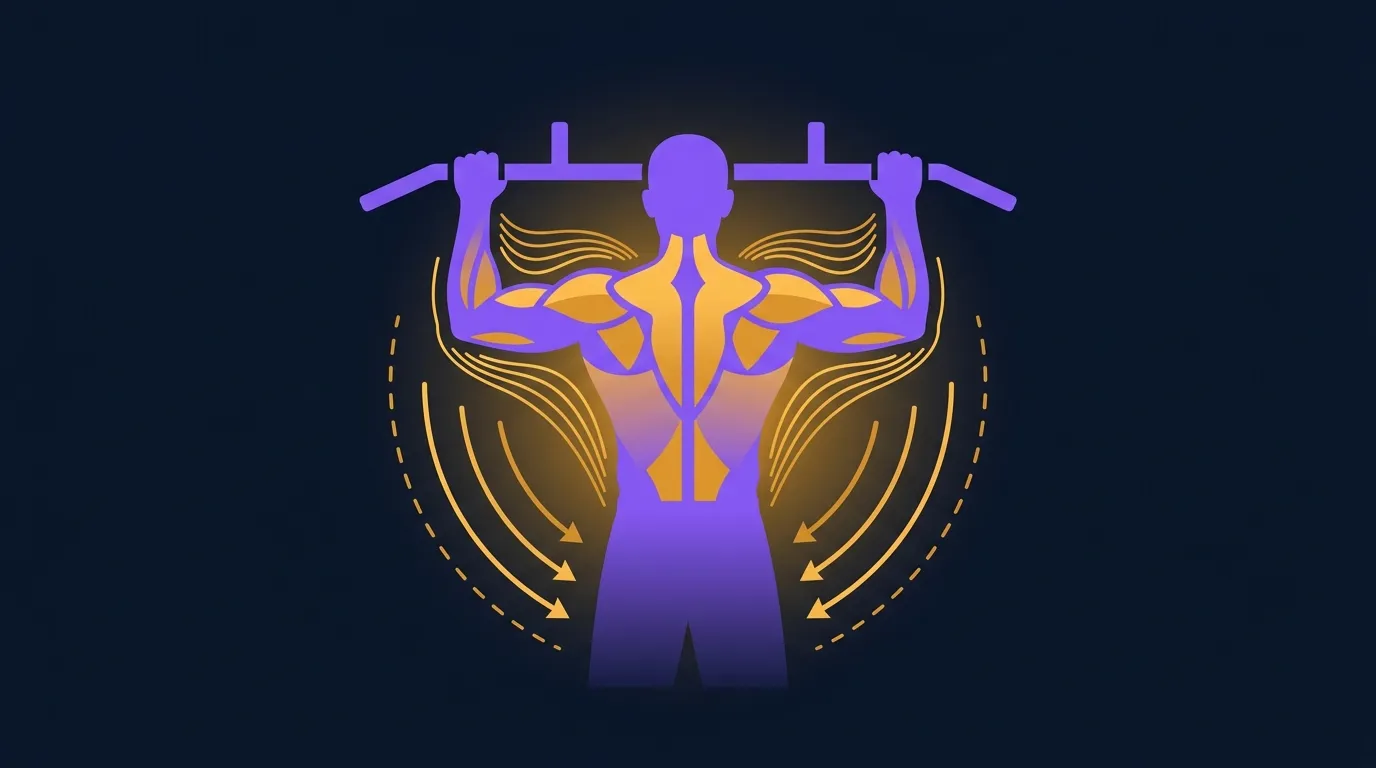
A strict pull-up requires you to lift your entire bodyweight using your latissimus dorsi, biceps, posterior shoulders, and grip. That's a lot of strength concentrated in a small group of muscles most people don't train directly. If you've never done any pulling work, the gap between your current strength and a pull-up isn't a character flaw. It's just untrained territory.
The other variable is body composition. Pull-ups are a strength-to-bodyweight ratio movement. Two people with identical absolute pulling strength will have very different pull-up timelines if one weighs 140 pounds and the other weighs 220. This isn't about fat-shaming; it's just leverage. Dropping a few pounds while training reduces the load you have to pull, which is why the same person can sometimes get their first pull-up after a small body recomp without their pulling strength changing much.
And the last variable: how you train. Just hanging from the bar and trying isn't training. It's testing. Without a progression that builds the specific strength you need, most people stall for months at "I almost got my chin to the bar."
The 5 Exercises That Build a Pull-Up
The classic beginner progression uses five exercises in roughly this order. You don't have to wait until one is "done" before adding the next. Most weeks you'll be working on three or four at once, with the focus shifting as your strength builds.
1. Dead Hangs (Foundation)
Hang from a bar with straight arms, shoulder blades pulled down slightly, feet off the floor. Hold for as long as you can with good form. Aim for 30 seconds, then build to 60. If your arms cannot reach straight overhead without your ribs flaring, sort that out first with our shoulder mobility exercises before you add hanging volume.
Why it matters: dead hangs build grip endurance, shoulder stability, and connective-tissue tolerance for the bar. The grip is often the weakest link for beginners. If your hands give out before your back does, no amount of pulling work can compensate. Lum and Barbosa (2019) reviewed isometric strength training and found that holding positions under load builds strength that transfers to dynamic movements at similar joint angles. For pull-ups, that means hanging at the bottom trains the position you'll start every rep from.
Programming: 3 sets, 30 to 60 seconds, 2 to 3 days per week. Add a few seconds per session.
2. Scapular Pull-Ups (Initiation Strength)
Hang from the bar with straight arms. Without bending your elbows, pull your shoulder blades down and back, lifting your body about 1 to 2 inches. Lower with control. Repeat.
Why it matters: most beginners can't initiate a pull-up because they don't know how to fire the scapular retractors and depressors. They try to muscle the rep with arms-only and stall immediately. Scapular pull-ups train the first inch of the movement, which is where the lats engage. Once this fires automatically, the full movement gets a lot easier. If your shoulders sit forward all day, that first inch is harder than it needs to be, and our guide on how to fix rounded shoulders covers the upper-back work that fixes it.
Programming: 3 sets of 8 to 12 reps, 2 to 3 days per week. Tempo matters. Slow and deliberate beats fast and sloppy here.
3. Australian Rows (Horizontal Pulling Strength)
Set a bar at hip or chest height (a Smith machine, a low pull-up bar, a sturdy table edge). Lie underneath, grip the bar overhand, and pull your chest up to it. Body straight from heels to head. Lower with control.
Why it matters: Australian rows (also called inverted rows or bodyweight rows) train the same upper-back muscles as pull-ups but at a fraction of the load. You can scale them by adjusting the bar height or your foot position. They're how you accumulate the volume of pulling work that builds the muscle, without crushing yourself with full bodyweight reps you can't yet do.
Programming: 3 to 4 sets of 8 to 15 reps, taken close to failure. The research on low-load training consistently shows that lighter loads build the same muscle as heavy loads, provided sets reach close to failure. Rows are the perfect application of that principle for first-pull-up training.
4. Negative Pull-Ups (The Secret Weapon)
Use a box, a chair, or a low platform under the bar. Step up so your chin is already over the bar (top of the pull-up position). Take your feet off the box. Lower yourself slowly under control, fighting the descent. Aim for 3 to 5 seconds at first, then build to 8 to 10 seconds. Step back up. Repeat.
Why this is the secret weapon: humans are stronger eccentrically (lowering) than concentrically (lifting), by roughly 40%. So you can train the exact pulling muscles you need to do a full pull-up before you can do a full pull-up. Roig and colleagues (2009) in the British Journal of Sports Medicine pooled 20 RCTs and found that eccentric training produced significantly greater strength gains than concentric training. The effect size was meaningful enough that eccentric work has become a staple in physical therapy and sports science.
Programming: 3 sets of 3 to 5 reps with 3 to 5 second descents at first. Build to 5 sets of 5 reps with 8 to 10 second descents. 2 to 3 days per week, with at least 48 hours between sessions. This is the highest-fatigue exercise in the progression. Don't overdo it.
5. Band-Assisted Pull-Ups (Bridging the Gap)
Loop a heavy resistance band over the bar. Step into the band with one foot. The band reduces your effective bodyweight, letting you do full-range pull-ups at a lighter load. As you get stronger, switch to a lighter band, then a thinner band, then drop the band entirely.
Why it matters: at some point, you need to practice the full movement, top to bottom, with momentum cues and breathing patterns intact. Bands let you do that before your unassisted strength is there. They also tend to provide more help at the bottom (where you're weakest) and less at the top (where you're strongest), which matches the strength curve of the movement.
Programming: 3 sets of 5 to 8 reps. Drop band tension every 2 to 3 weeks as strength builds.
The 12-Week Plan: How It Fits Together
Here's how to actually structure the work. Three sessions per week, alternating with rest or light cardio days. Each session takes 25 to 35 minutes once you have the rhythm down.
Weeks 1 to 4: Foundation
- Dead hangs: 3 sets, build from 30 to 60 seconds.
- Scapular pull-ups: 3 sets of 8 to 12 reps.
- Australian rows: 3 sets of 10 to 15 reps. Adjust foot position to make sets challenging by rep 10.
- Skip negatives this phase. Build the prerequisites first.
Goal: comfortable hanging for 60 seconds, clean scapular pulls, rows that fatigue around 12 reps. Most people hit this by week 3 or 4.
Weeks 5 to 8: Add the Eccentric
- Dead hangs: 3 sets, 60 to 90 seconds. Maintenance only.
- Scapular pull-ups: 3 sets of 10 to 15 reps.
- Australian rows: 3 sets of 10 to 15 reps. Move feet farther in, or elevate them, to keep difficulty up.
- Negative pull-ups: 3 sets of 3 reps with 3 to 5 second descents.
Goal: clean 5-second negatives, all 3 reps controlled. Form on the negatives is the priority. If you can't slow the descent, drop the rep count and rebuild.
Weeks 9 to 12: Full-Movement Focus
- Negative pull-ups: 4 sets of 4 to 5 reps with 6 to 10 second descents.
- Band-assisted pull-ups: 3 sets of 5 to 8 reps. Reduce band tension over the weeks.
- Australian rows: 3 sets of 8 to 12 reps. Maintenance.
- Try a strict pull-up at the end of each session. Don't grind. Just attempt one.
Most people get their first strict pull-up somewhere in this phase. When it happens, it usually feels almost easier than the negatives you've been doing. That's because you've built the strength patiently across 12 weeks instead of trying to brute-force it.
Common Mistakes That Stall Progress
Training Daily
The pulling muscles need 36 to 48 hours to recover between hard sessions. Daily pull-up attempts compound fatigue without adding adaptation. The 2011 ACSM position stand by Garber and colleagues recommends 2 to 3 resistance training days per week for novices, with adequate recovery between. The pull-up literature largely supports 3 to 4 days for this specific goal. More than that almost always backfires.
Skipping the Negatives
Negatives feel awkward and hard to load correctly. They also drive most of your strength gain. Skipping them and grinding band-assisted reps is the most common reason people stall at "almost there" for months. The eccentric is the engine.
Going Too Fast on the Bar
Rushing reps wastes the stimulus. Pull-up muscles respond to time under tension and proximity to failure, not to how many reps you can crank out. A 3-second pull-up gives more total load than three 1-second reps. Slow it down.
Ignoring Bodyweight
Strength-to-bodyweight ratio matters. If you're carrying 30 pounds you don't want to be carrying, training pull-ups while letting that 30 pounds drop slowly across 12 weeks (no aggressive cuts, just consistent eating) shortens the timeline noticeably. We covered the broader principle in our research-backed piece on body composition and fitness outcomes.
Knowing what to do is the easy part.
Take the free FitCraft assessment and get a personalized plan based on behavioral science, not willpower.
Take the Free Assessment Free • 2 minutes • No credit cardWhat If You're Stuck After 12 Weeks?
Some people need 16 weeks. A few need 20. If you're past 12 and not there yet, here's the diagnostic checklist.
Are you training consistently? Three sessions a week, every week, for 12 weeks, is 36 sessions. Most people who say "I trained for 12 weeks" actually trained for 25 sessions, with two missed weeks and a few half-effort days. The plan assumes consistency. Without it, the timeline stretches.
Are your negatives actually slow? Look at video of yourself. If the descent takes less than 4 seconds, the eccentric isn't loaded enough to drive adaptation. Fight the descent harder.
Is your grip the limiter? If you fall off the bar before your back fatigues, dead hangs and farmer's carries should get more attention. Grip strength is often the silent ceiling.
Are you carrying a lot of body fat above the average for your frame? No judgment here, just leverage math. The pull-up is hard for everyone but it's specifically harder the more you weigh. A modest body recomp can move the timeline forward by weeks.
Are you old enough that joint patience matters? If you're 50+, the connective tissue of the elbows and shoulders takes longer to adapt. The plan is the same, but expect 16 to 20 weeks instead of 8 to 12. We covered the fitness over 60 timing principles in detail elsewhere.
Why It's Worth It
The pull-up is a milestone movement. It marks the line between "I do some pushing exercises" and "I have legitimate functional pulling strength." It builds back muscle that holds your posture upright through the rest of your life. It improves shoulder health when programmed well. And it's one of the few exercises that translates directly to real-world tasks, from carrying groceries to climbing a fence.
It's also the kind of goal that compounds. Once you have one, two becomes a question of weeks, not months. Five often takes another month or two. By the time you can do five clean reps, you've built upper-body pulling strength that puts you ahead of most adults of any age.
Frequently Asked Questions
How long does it take to do your first pull-up?
Most beginners get their first strict pull-up in 8 to 12 weeks of consistent training, 3 to 4 sessions per week. Heavier individuals or people starting with very little upper-body strength may need 12 to 16 weeks. The variation is wide and depends mostly on body composition (the lighter you are, the less you have to pull) and on training history. The single most important variable in the timeline is consistency. Missing two sessions a week roughly doubles the time to your first rep.
Why are negative pull-ups so important for beginners?
Negative pull-ups train the eccentric (lowering) portion of the movement, where humans are about 1.4 times stronger than they are concentrically. So you can absorb a load you can't yet lift. A 2009 meta-analysis by Roig and colleagues in the British Journal of Sports Medicine pooled 20 randomized controlled trials and found that eccentric training produced significantly greater strength gains than concentric training. For pull-ups specifically, this means you can build the exact pulling strength you need before you can pull yourself up cleanly. Aim for 3 to 5 reps at 3 to 5 seconds per rep, then progress to 8 to 10 second descents over a few weeks.
Can you do pull-ups if you can't do a single rep?
Yes. The trick is that pull-up training for beginners isn't just attempting pull-ups and failing. It's building the prerequisite strength through assisted variations: dead hangs (grip and shoulder stability), scapular pull-ups (initiation strength), Australian rows under a bar (horizontal pulling), negative pull-ups (eccentric pulling strength), and band-assisted pull-ups (full range with reduced load). Each one targets a piece of the movement you can train at your current level. After 8 to 12 weeks of progressive work across all five, the full pull-up usually appears.
How often should you train for pull-ups?
3 to 4 sessions per week, with at least one rest day between hard sessions. Pull-ups load the same muscle groups (lats, biceps, posterior shoulders, grip) heavily on each rep, and these muscles need 36 to 48 hours to recover and adapt. Daily attempts almost always backfire with elbow tendinitis or stalled progress. The American College of Sports Medicine position stand (Garber 2011) recommends 2 to 3 days per week of resistance training for novices, and the pull-up literature largely supports the upper end of that range.
Do dead hangs help with pull-ups?
Yes, but mostly as a foundation. Dead hangs build grip endurance, shoulder stability, and connective-tissue tolerance for the pull-up bar. They aren't going to give you a pull-up by themselves, but they make every other progression safer and more effective. Lum and Barbosa (2019) reviewed the isometric strength training literature and found that holding positions under load builds strength that transfers to dynamic movements at similar joint angles. For pull-ups, that means hanging at the bottom position trains the part of the movement closest to where you start, which is also where most beginners are weakest.