The chin up negative strips the exercise down to its most useful piece: the lowering phase. You jump or step to the top of the bar, chin above it, then fight gravity all the way down. That's one rep. It sounds simple because it is. But simple and easy are different things entirely.
Here's why negatives work so well. Your muscles are stronger eccentrically than concentrically. You can resist more force on the way down than you can produce on the way up. So even if you can't pull yourself up to the bar, you can lower yourself from it with control. And that controlled descent builds the exact strength you need for the concentric pull. A 2017 meta-analysis in the British Journal of Sports Medicine found that eccentric training produced greater muscle growth (10.0%) than concentric-only training (6.8%), though the difference did not reach statistical significance (Schoenfeld et al., 2017). The practical takeaway: negatives build muscle and strength at least as well as full reps, and sometimes better.
If you've been staring at the pull-up bar wondering when you'll be able to use it, negative chin ups are how you bridge that gap. Not band-assisted reps (which change the strength curve), not lat pulldowns (which don't transfer as well as you'd think), but negatives. Controlling your own body weight through the exact movement pattern you're trying to learn.
Quick Facts: Chin Up Negative
- Equipment needed: Pull-up bar, plus a box or bench to step up
- Difficulty: Intermediate (eccentric-only pulling)
- Modality: Strength (eccentric)
- Body region: Upper body and grip
- FitCraft quest category: Strength
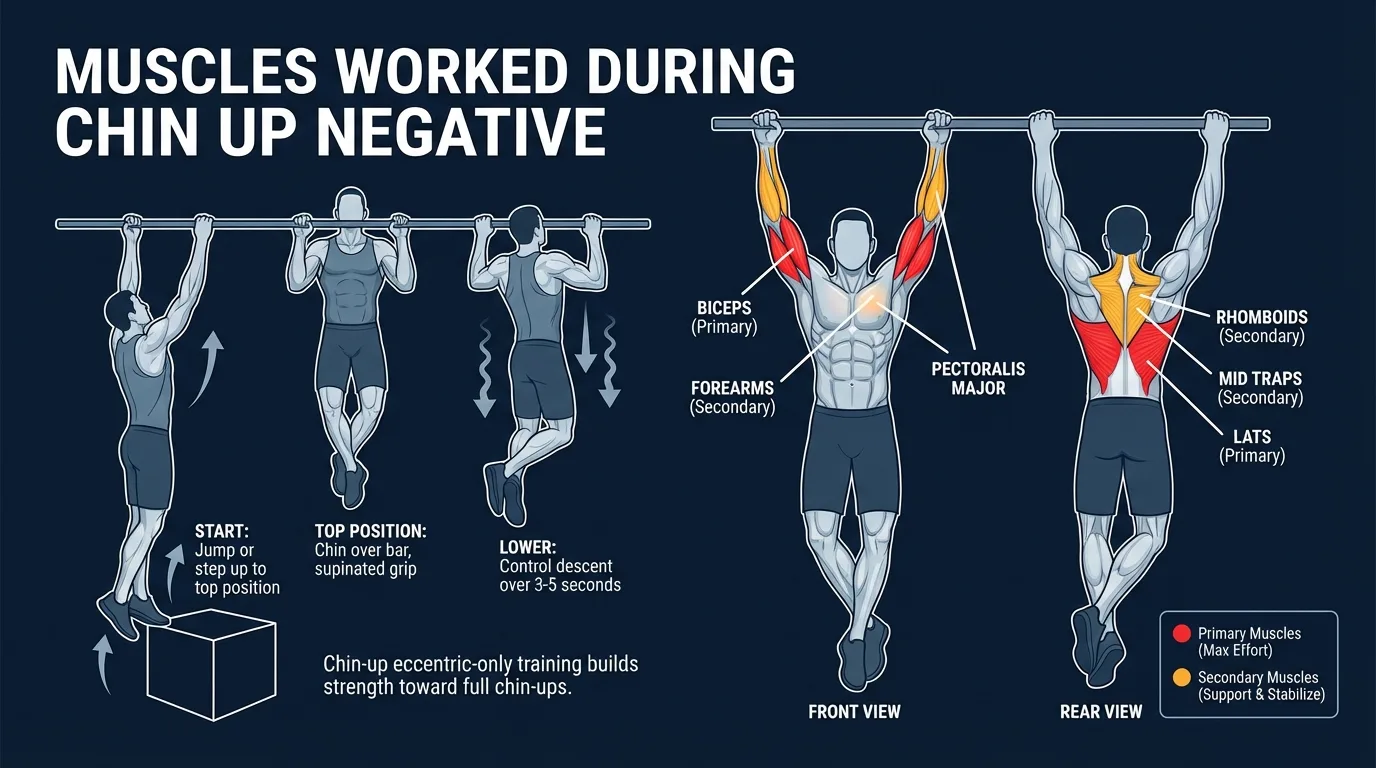
Muscles Worked
Primary movers: the latissimus dorsi (the broad back muscle that drives shoulder adduction) and the biceps brachii (which crosses the elbow and shoulder, biased by the supinated grip). On a chin up negative these muscles work eccentrically, lengthening under tension as you control the descent from chin-over-bar to dead hang. Eccentric loading produces high mechanical tension across a long range of motion, which is one of the strongest hypertrophy and strength stimuli available.
Secondary movers: the brachialis (the muscle beneath the biceps that often drives more elbow flexion than the biceps itself), the brachioradialis (forearm), the posterior deltoid (assists shoulder extension), and the rhomboids and lower trapezius (which retract and depress the scapulae throughout the descent).
Stabilizers: the forearm flexors and extensors maintain the grip on the bar under your full bodyweight, the rotator cuff controls the shoulder joint as the lats load, the serratus anterior and lower trapezius keep the scapula tracking well, and the entire core works isometrically to prevent body swing during the descent. Grip is often the limiter on early sets, which is why dead hang work is a prerequisite for productive negatives.
Why the eccentric phase is so productive: muscles can resist roughly 30-50% more force eccentrically than they can produce concentrically. That means you can load the same muscles with a heavier stimulus on the descent than you could ever lift on a concentric pull. Combined with the long range of motion the chin up provides (from arms fully extended to chin above the bar), the negative chin up delivers high mechanical tension across nearly the full length-tension curve of the lats and biceps. A 2022 meta-analysis in Sports Medicine found that eccentric durations of 3-6 seconds produced the best strength gains for upper-limb exercises (Li et al., 2022), which is why the 5-second descent target sits in the sweet spot.
How to Do a Chin Up Negative (Step-by-Step)
- Get to the top position. Stand on a box or bench positioned under the pull-up bar. Grip the bar with a supinated (underhand) grip, palms facing you, hands shoulder-width apart. Step off the box or jump so your chin is above the bar. Your chest should be close to the bar, shoulders packed down and back, core braced. This is your starting position for every rep.
Coach Ty's cue: "Pack the shoulders before you leave the box. Lats engaged, chest up, then start the descent."
- Begin the controlled descent. Start lowering yourself as slowly as you can. Fight gravity the whole way. Aim for at least 5 seconds from chin-over-bar to full arm extension. Keep your shoulder blades retracted and depressed. Don't let your shoulders shrug up toward your ears as you lower. That's the lats disengaging, and you want them loaded the entire time.
Ty's cue: "Count to five out loud. If you're not counting, you're going faster than you think."
- Control through the mid-range. When your elbows hit roughly 90 degrees, you'll feel the urge to speed up. This is the sticking point where most people lose control. Deliberately slow down here. The eccentric stimulus is highest in this range. Maintain a straight body line. No swinging, no kipping, no leg kick.
Ty's cue: "The middle is where the work happens. Stay slow through ninety degrees."
- Reach full extension. Continue lowering until your arms are completely straight in a dead hang. Don't drop the last few inches. The bottom portion, where the lats are stretched under load, drives both strength and muscle development. Breathe out steadily through the entire descent.
Ty's cue: "Own the bottom. The stretched position is where the adaptation happens."
- Reset and repeat. Step back onto the box or jump back to the top position. Re-establish your grip, pack your shoulders, brace your core, and begin the next rep. Take a full breath between reps. Rushing the setup leads to sloppy negatives, and sloppy negatives don't build chin ups.
Ty's cue: "Quality over quantity, always. Three controlled reps beat eight rushed ones."
Get this exercise in a personalized workout
FitCraft, our mobile fitness app, uses its AI coach Ty to program pulling exercises like this into your plan at the right volume and intensity, based on your level, goals, and equipment. Ty was designed and trained by Domenic Angelino, MPH (Brown University) and NSCA-CSCS, with research published in the Journal of Strength and Conditioning Research and Medicine & Science in Sports & Exercise.
Take the Free Assessment Free · 2 minutes · No credit card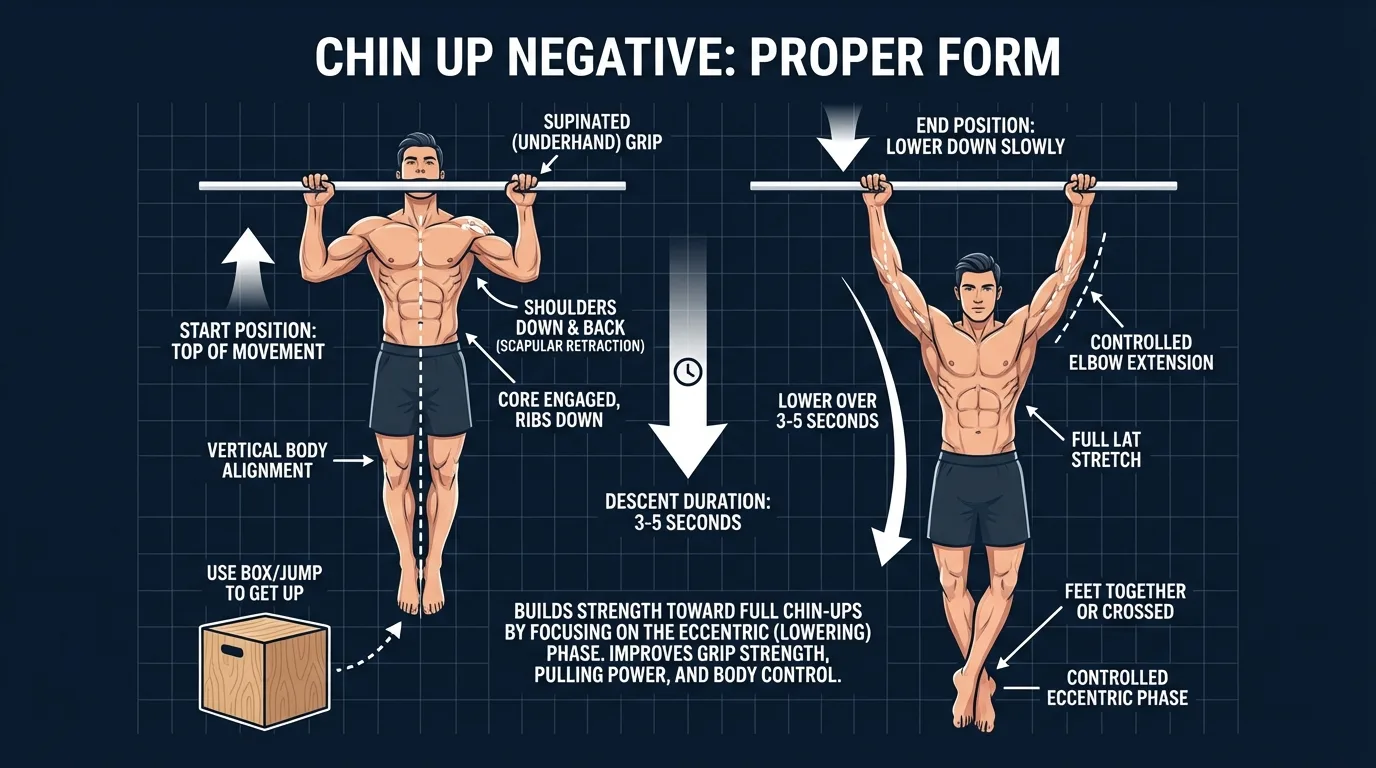
Common Mistakes (and How to Fix Them)
The negative chin up has a small number of moving parts, but the errors that creep in undermine the whole point of the exercise:
- Dropping too fast. This is the most common mistake and it defeats the purpose of the exercise. If you're finishing each rep in under 3 seconds, you're not getting enough time under tension for the eccentric adaptation to happen. A 2022 meta-analysis in Sports Medicine found that eccentric durations of 3-6 seconds produced the best strength gains for upper-limb exercises (Li et al., 2022). Slow down. Count out loud. Five seconds minimum.
- Losing shoulder position. When the shoulders shrug up and the shoulder blades wing out, the lats disengage and the exercise becomes an arm-only lowering. This happens most in the bottom half of the descent. The fix: actively depress your shoulder blades throughout. Think about keeping your shoulders as far from your ears as possible the entire time.
- Skipping the bottom range. Letting go or dropping for the last 20% of the movement misses the stretched-position loading where the lats and biceps receive the most eccentric stimulus. Lower all the way to a full dead hang. Control every inch.
- Too many reps. Negatives are demanding on the tendons and connective tissue, particularly at the elbows. Doing high-volume negative sets before your connective tissue has adapted is a fast track to elbow tendinitis. Start with 3 sets of 3 reps. Build to 3 sets of 5. That's enough stimulus without overloading the joints.
- Inconsistent jump height. If you jump to a different height each rep, the starting position changes and so does the movement. Use a box or bench to get to a consistent chin-over-bar starting position. This standardizes every rep and makes your progress measurable.
- Craning the neck to start. At the top, your chin should be above the bar because your body got high enough, not because you jutted your neck forward. Jumping a little higher or using a taller box is safer than loading the cervical spine under your full bodyweight.
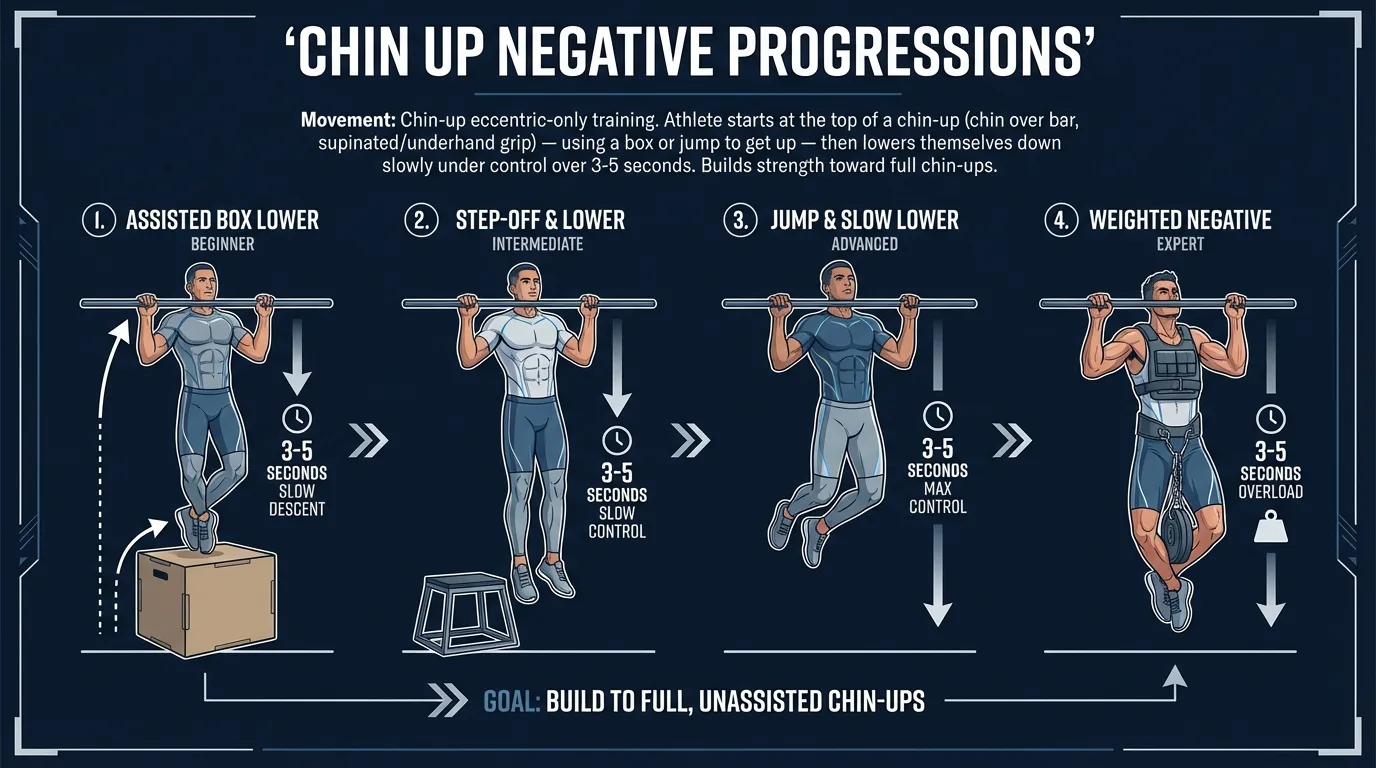
Chin Up Negative Variations: Regressions and Progressions
Engaged Hang (Foundation)
Before negatives, you need to hang. Grip the bar with an underhand grip and hold a dead hang for 20-30 seconds with your shoulders actively packed down. If you can't hold a 20-second hang, negatives will be too advanced because your grip will fail before your lats get any meaningful work. Build to 3 sets of 30 seconds, then move to negatives.
Top Chin Hold / Flexed-Arm Hang (Beginner-Intermediate)
Jump to the top position and hold. Chin above the bar, chest close, shoulders packed. Hold for 10-20 seconds. This builds isometric strength at the top range where the concentric pull finishes. Pair this with negatives: hold at the top for 5 seconds, then lower for 5 seconds. That combination covers both the isometric and eccentric strength you need.
Slow Negatives at 8-10 Seconds (Advanced Eccentric)
Once you can control a 5-second negative for 3 sets of 5 reps, increase the tempo to 8-10 seconds per rep. This extended time under tension builds more strength and muscle. Reduce the reps to 3 sets of 3. You'll feel the difference in your lats and biceps within the first set.
Full Chin Up (Progression Target)
When 5-second negatives feel controlled for 3 sets of 5, attempt a full chin up. Start from a dead hang, depress your shoulder blades, and pull. If you get stuck mid-way, keep training negatives and add top chin holds at the sticking point angle. Most trainees get their first full chin up within 4-8 weeks of consistent negative training.
Alternative and Complementary Exercises
- Inverted rows: A horizontal pulling exercise that builds back and biceps strength with lower difficulty than vertical pulling. Useful as a complement to negatives, especially on recovery days.
- Band-assisted chin ups: A resistance band looped over the bar supports part of your bodyweight. Useful but not a full replacement for negatives because bands change the strength curve. They assist most at the bottom (where you need to build strength) and least at the top.
When to Avoid or Modify Chin Up Negatives
Chin up negatives are safe for most healthy adults, but a few conditions warrant modification or temporarily swapping the exercise for an easier pulling pattern. None of these are permanent restrictions. They're starting points. Always consult your physician or physical therapist for personalized guidance.
- Tennis elbow / medial or lateral epicondylitis. Grip and pull patterns aggravate the elbow tendons. Reduce volume to 1-2 sets of 2-3 reps at a controlled tempo, use a thicker bar grip to spread load across the hand, and follow a PT's reintroduction protocol. Eccentric loading is part of tendinopathy rehab, but it must be reintroduced gradually after the acute phase.
- Acute shoulder injury or rotator cuff irritation. Hanging from a bar loads the shoulder at full elevation, which can flare an impinged or irritated cuff. Skip negatives until cleared by a PT. Substitute with supported rows or high-angle inverted rows, which load the same muscles with the shoulder in a more neutral position.
- Recent shoulder or elbow surgery. Get clearance from your surgeon. Most post-surgical protocols start with scapular activation and assisted variations, then progress through inverted rows and assisted chin ups before introducing bodyweight negatives on a controlled timeline.
- Lower-back pain that flares with body swing. Negatives can shift into a lumbar-loading exercise if you swing or kip during the descent. Reinforce a hollow body position, reduce reps, and rebuild core anti-swing strength with deadbugs and bird-dogs before returning to bar work.
- Wrist pain. Sustained hang loads the wrists at full extension. Use a neutral-grip or thick-grip bar if available, reduce hold time at the top, and consider inverted rows on a low bar as a substitute while wrist symptoms settle.
- Grip endurance under 20 seconds in a dead hang. If you can't hold a 20-second hang, your grip will fail before your lats get any meaningful eccentric stimulus. Build grip first with engaged hangs, then return to negatives.
Related Exercises
If chin up negatives are part of your routine, these movements complement or extend the same pulling pattern:
- Progression target: Chin Ups are the full concentric-eccentric version of the same movement. Once your 5-second negative is consistent for 3 sets of 5, test a full rep.
- Grip and shoulder foundation: Engaged Hangs and Top Chin Holds build the isometric strength and scapular control that negatives demand.
- Easier regression: Inverted Rows, Supported Rows, Corner Rows, and Reverse Rows load the same back and biceps pattern at a fraction of the difficulty. Useful for accumulating pulling volume on recovery days.
- Same muscle group (loaded pull): Bent-Over Rows and Overhead Pullovers with dumbbells let you isolate the lat-and-biceps complex with an external load.
- Core anti-swing foundation: Deadbugs and Bird-Dogs build the anti-rotation and anti-extension strength that keeps body swing out of your negatives.
How to Program Chin Up Negatives
Chin up negative programming follows the same evidence-based principles as any pulling exercise. The American College of Sports Medicine (ACSM) Position Stand on resistance training recommends roughly 8-12 reps per set for strength and 12-20 for muscular endurance, with at least 48 hours between sessions training the same muscle group (Ratamess et al., 2009). For eccentric-only work like negatives, rep ranges sit at the lower end because each rep is so demanding on the connective tissue.
| Level | Sets × Reps | Rest between sets | Frequency |
|---|---|---|---|
| Beginner (engaged hangs and top holds first) | 2-3 × 5-10 (hang seconds) | 60-90 seconds | 2-3 sessions/week |
| Intermediate (3-5 second controlled negatives) | 3 × 3-5 reps | 90-120 seconds | 2-3 sessions/week |
| Advanced (5-10 second slow negatives, transition to full chin ups) | 3-4 × 3-5 reps | 120-180 seconds | 2-3 sessions/week |
Where in your workout: place chin up negatives early in an upper-body session, when your grip and central nervous system are fresh. Pulling is grip-limited; doing negatives after heavy carries, dumbbell rows, or barbell deadlifts will under-train the back because the grip gives out first. If you're combining negatives with weighted pulling, do the negatives first and use rows as accessory volume.
Form floor over rep targets: if you can't hold the 5-second tempo, do fewer reps. A clean 3-second descent is more useful than a dropped 5-second target. Hitting a rep count by free-falling the last two reps is worse than stopping the set when the tempo breaks.
How FitCraft Programs This Exercise
Knowing how to do a chin up negative is step one. Knowing when to do it, what tempo to use, and when to attempt a full chin up is where most people get stuck.
FitCraft's AI coach Ty handles that. During your personalized diagnostic assessment, Ty maps your fitness level, goals, available equipment, and current pulling strength. If you can't yet do a full chin up, Ty programs negatives as the primary path to your first rep, paired with engaged hangs and top chin holds at the right volume for your recovery capacity. As you get stronger, Ty adjusts the tempo and volume to match your level. Three-second negatives become five. Five becomes eight. Then full chin ups start showing up in your plan. The 3D demonstrations from multiple angles make the tempo cues and shoulder position details click in a way text descriptions can't always capture.
Frequently Asked Questions
Can I do chin up negatives if I have elbow pain or tendinopathy?
Negatives are demanding on the elbow tendons and connective tissue. If you have active tennis or golfer's elbow, hold off on heavy negative volume until pain is well-managed by a physical therapist. Once cleared, eccentric loading is actually one of the rehab tools for tendinopathy, but it must be reintroduced gradually with lighter assisted negatives or band-assisted variations before bodyweight. Start with 1-2 sets of 2-3 reps at a controlled tempo, not 3 sets of 5. Use a thicker bar grip to spread load across the hand if possible.
How long should a negative chin up take?
Aim for a 5-second controlled descent as a starting target. As you get stronger, work up to 8-10 seconds per rep. Research suggests that eccentric durations of 3-6 seconds produce the best strength gains for upper-body exercises. If you can't control the descent for at least 3 seconds, the exercise is too advanced. Start with dead hangs and flexed-arm hangs first.
How many negative chin ups should I do?
Start with 3 sets of 3-5 reps, 2-3 times per week. Quality matters more than quantity with negatives. Each rep should be a slow, controlled 5-second descent. When you can do 3 sets of 5 reps with a consistent 5-second tempo, you are likely strong enough to attempt your first full chin up.
What muscles do negative chin ups work?
Negative chin ups work the same muscles as full chin ups: primarily the latissimus dorsi and biceps brachii, with secondary activation of the brachialis, brachioradialis, posterior deltoid, rhomboids, lower trapezius, and core stabilizers. The eccentric phase recruits more muscle fibers than the concentric phase, which is why negatives are so effective for building the strength needed for full chin ups.
Can negative chin ups build muscle?
Yes. A 2017 meta-analysis in the British Journal of Sports Medicine found that eccentric training produced a mean muscle growth of 10.0% compared to 6.8% for concentric-only training. Negatives create high mechanical tension on the muscle during the lengthening phase, which is a primary driver of hypertrophy. They are one of the most effective ways to build pulling strength when you cannot yet do a full chin up.
How long until negative chin ups lead to a full chin up?
Most people achieve their first full chin up within 4-8 weeks of consistent negative training, training 2-3 times per week. The timeline depends on your starting strength, bodyweight, and consistency. When you can do 3 sets of 5 negatives with a controlled 5-second descent, try one full chin up. If you can control the negative but cannot pull up yet, add flexed-arm hang holds at the top to build concentric strength.