The reverse row with dumbbells is a neutral-grip bent-over row that trains the lats, rhomboids, middle traps, rear delts, and biceps while your spinal erectors and core hold the hinge. The defining cue is simple: keep the torso quiet and pull your elbows toward your hips. Start with chest-supported rows if your lower back takes over, then progress to free-standing dumbbell rows, slower lowering phases, and heavier loads once every rep stays controlled.
Reverse rows are useful when you want a back exercise that feels less wristy and more lat-focused than a wide-elbow row. The neutral grip lets the elbows travel close to the body, which usually makes it easier to feel the pull through the sides of the back instead of only in the arms.
Quick Facts: Reverse Rows with Dumbbells
- Equipment needed: Pair of dumbbells
- Difficulty: Intermediate to advanced
- Modality: Strength
- Body region: Upper body and posterior chain
- FitCraft quest category: Strength
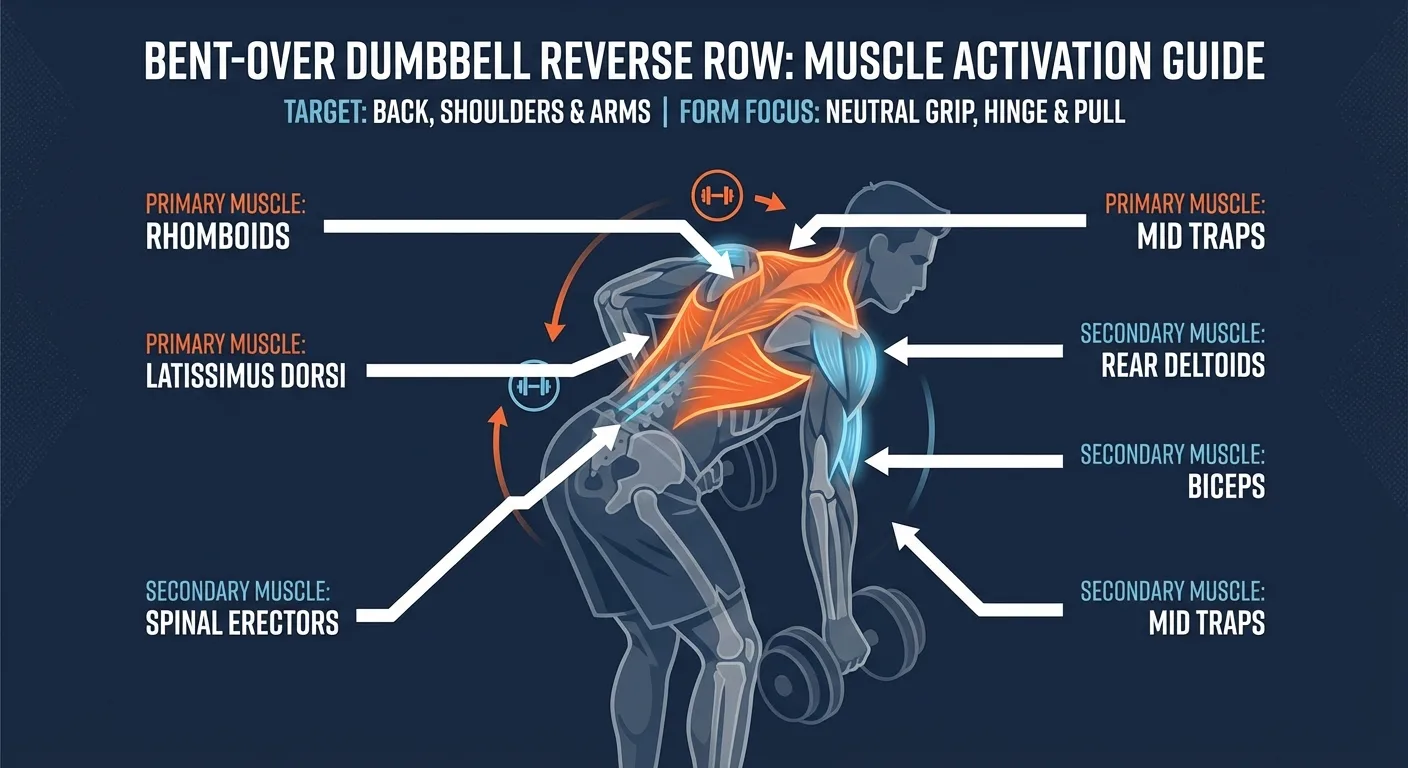
Muscles Worked
The primary movers are the latissimus dorsi, rhomboids, middle trapezius, and rear deltoids. They drive the concentric pull as the dumbbells travel toward your ribs and hips, then control the eccentric lowering phase as your arms return to full reach.
The biceps brachii, brachialis, brachioradialis, and forearm flexors assist elbow flexion and grip. Teres major helps extend the shoulder when the elbows track close to the body, while the lower trapezius helps keep the shoulder blades from shrugging upward.
Stabilizers include the erector spinae, glutes, hamstrings, deep abdominal wall, obliques, rotator cuff, and grip musculature. These muscles work mostly isometrically so the hinge, ribs, pelvis, and shoulder position do not drift while the arms move.
The neutral grip changes the row path. Pulling toward the hips emphasizes shoulder extension and lat contribution, while keeping the torso fixed prevents momentum from replacing upper-back work.
Step-by-Step: How to Do a Reverse Row
- Set your stance. Stand with your feet about shoulder-width apart and hold one dumbbell in each hand. Turn your palms toward each other so the dumbbells hang naturally under your shoulders.
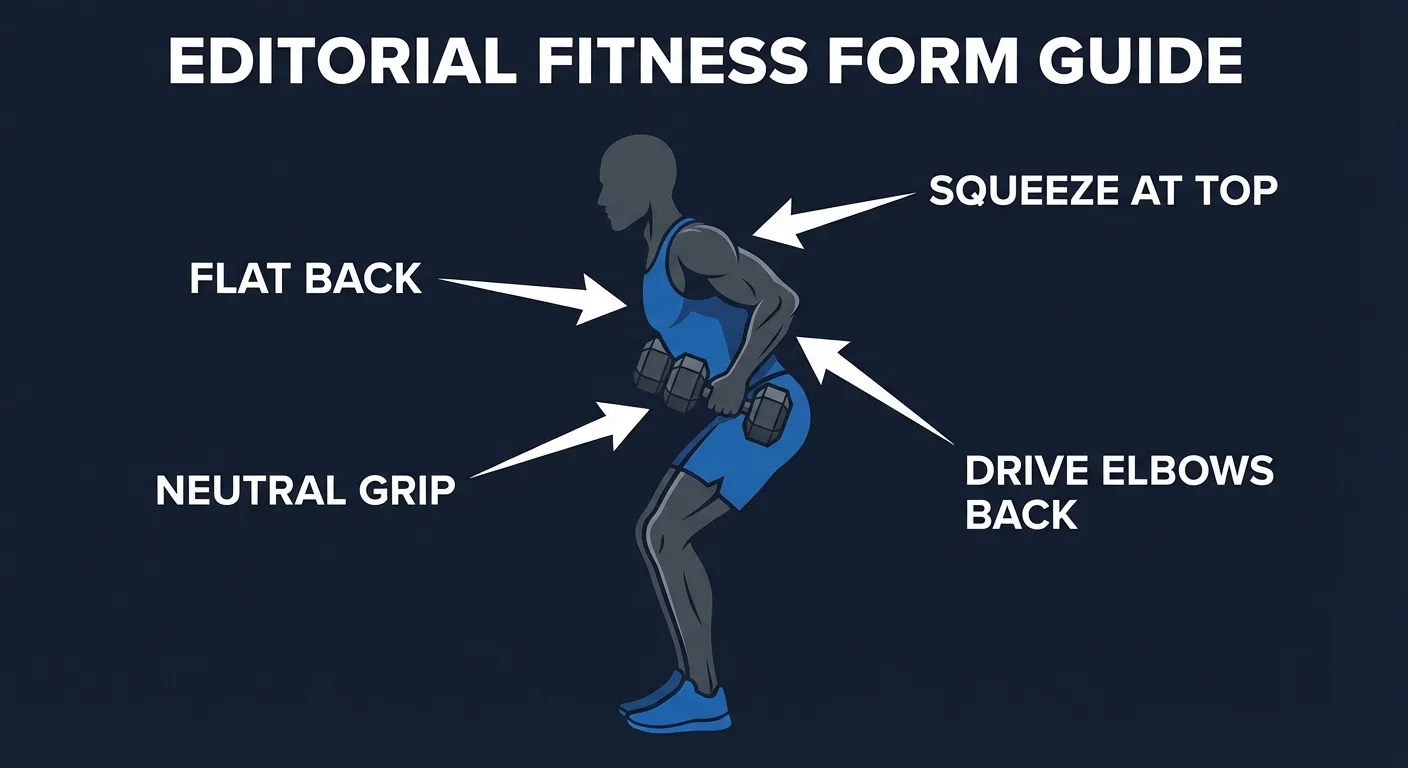
- Hinge at the hips. Push your hips back, soften your knees, and lean your torso forward until you can hold a flat back. If your low back rounds, stand a little taller or use lighter dumbbells.
- Brace before you pull. Pull your ribs down, tighten your abs, and keep your neck long. Coach Ty's cue: "Freeze the torso before the weights move."
- Row with your elbows. Pull the dumbbells toward your hips by driving your elbows back along your sides. Keep your hands quiet and let your shoulder blades move without shrugging.
- Pause, then lower. Pause for a beat near the top, then lower until your arms are straight again. Keep the hinge angle the same from first rep to last rep.
Common Mistakes and How to Fix Them
Rounding the Lower Back
What it looks like: Your spine curves as you hinge or as the set gets hard.
Why it's a problem: A loaded rounded hinge shifts stress away from the target muscles and into the lumbar spine.
The fix: Use lighter dumbbells, stand slightly more upright, and brace before every rep. If you still cannot keep position, switch to a chest-supported row.
Pulling With the Hands
What it looks like: The rep turns into a curl and your biceps fatigue before your back does.
Why it's a problem: The back stops being the limiter, so the row loses its purpose.
The fix: Think of the hands as hooks and the elbows as the handles. Start each rep by moving the upper arm, then let the dumbbell follow.
Heaving the Torso
What it looks like: Your chest pops up on every rep to help the dumbbells move.
Why it's a problem: Momentum makes the lift look stronger while the lats and upper back do less work.
The fix: Pause for one second at the bottom. If you need a torso swing to start the rep, lower the weight.
Shrugging at the Top
What it looks like: Your shoulders creep toward your ears as the dumbbells reach the top.
Why it's a problem: Shrugging shifts work into the upper traps and can irritate the neck.
The fix: Keep the neck long and pull the elbows back, not up toward your ears.
Stopping the Range Short
What it looks like: You never let the arms fully lengthen at the bottom or never bring the elbows behind the torso.
Why it's a problem: Short reps reduce the stretch and the top contraction.
The fix: Reach long at the bottom without losing your back position, then row until the elbows pass your ribs.
Get this exercise in a personalized workout
FitCraft, our mobile fitness app, uses its AI coach Ty to program compound strength exercises like this into your plan at the right volume and intensity, based on your level, goals, and equipment. Ty was designed and trained by Domenic Angelino, MPH (Brown University) and NSCA-CSCS, with research published in the Journal of Strength and Conditioning Research and Medicine & Science in Sports & Exercise.
Take the Free Assessment Free • 2 minutes • No credit cardReverse Row Variations: Regressions and Progressions
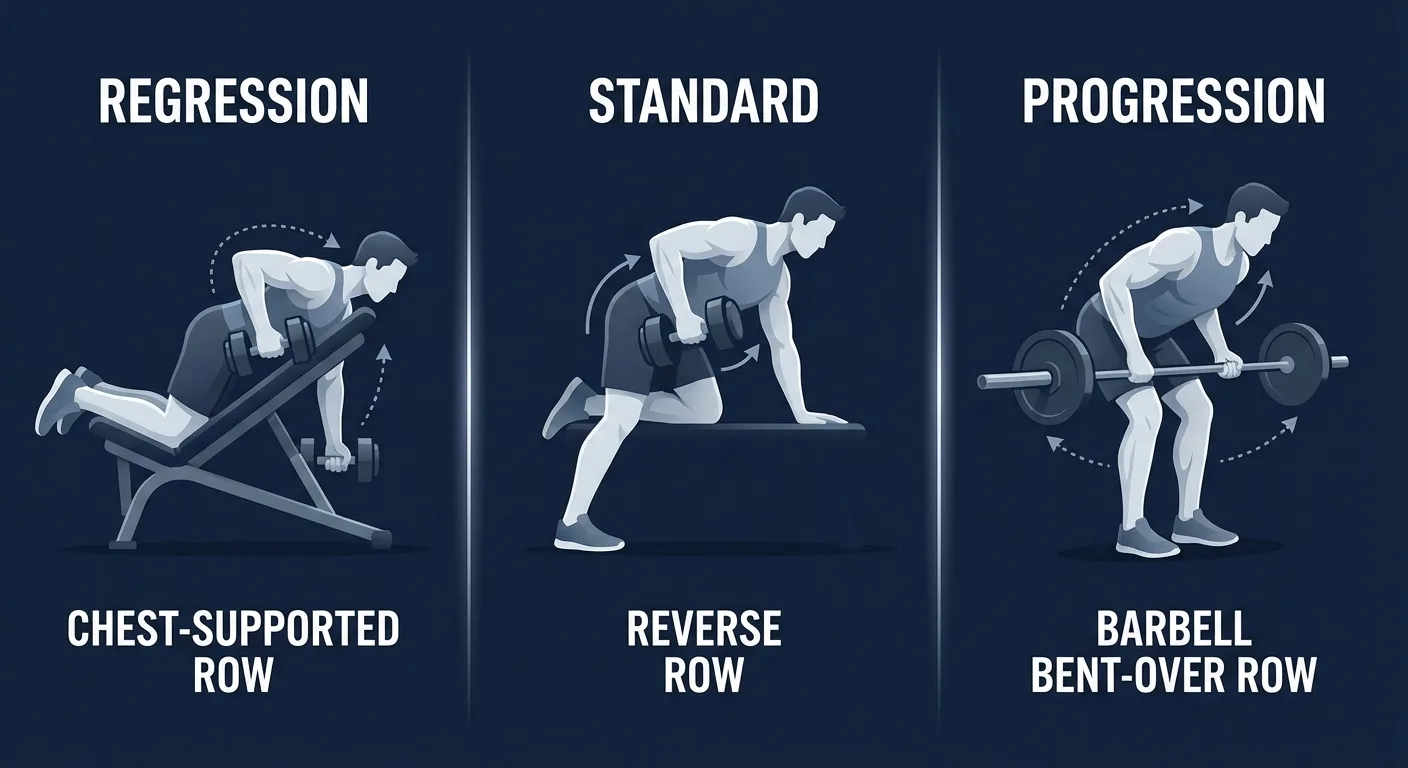
Chest-Supported Dumbbell Row
Set an incline bench under your chest and row from support. This is the best regression when your back muscles are ready to pull but your hinge position is not ready to hold load.
Bent-Over Rows
Use a more traditional row path when you want a broader upper-back emphasis. Keep the same hinge discipline and avoid turning it into a standing shrug.
Inverted Rows
Use a bodyweight horizontal pull when you want to train the same broad pattern without loading the lower back with dumbbells.
Slow-Eccentric Reverse Row
Lower each rep for three to four seconds. This progression builds control and makes lighter dumbbells feel harder without needing a barbell.
When to Avoid or Modify Reverse Rows
Reverse rows are safe for most healthy adults, but loaded hip-hinge pulling has a few situations where the better move is to modify first. Always consult your physician or a qualified physical therapist before training through pain, returning after injury, or adding load after a long layoff.
- Acute lower-back pain or known disc irritation. The hinge position can aggravate symptoms. Use chest-supported rows and rebuild trunk control with deadbugs and bird-dogs.
- Recent spine, shoulder, hip, or elbow surgery. Get clearance before returning to loaded compound rows. Start with unloaded scapular work and supported pulls.
- Shoulder pain or rotator cuff irritation. Keep the elbows closer to the body, reduce the range, and use lighter dumbbells. Stop if the front of the shoulder pinches.
- Uncontrolled hypertension or known cardiovascular disease. Heavy bracing can spike blood pressure. Use lighter loads, breathe through the rep, and follow your clinician's exercise guidance.
- Pregnancy, early postpartum, or active diastasis recti. Heavy hinge bracing can be poorly tolerated. Use supported rows and restore deep-core control before free-standing loaded rows.
Related Exercises
- Same muscle group: Bent-Over Rows and Overhead Pullover train pulling muscles with dumbbells.
- Bodyweight pull option: Inverted Rows let you train a horizontal pull without a loaded hinge.
- Hinge complement: Romanian Deadlift builds posterior-chain strength for holding the bent-over position.
- Core foundation: Deadbugs and Bird-Dogs build the bracing control rows rely on.
How to Program Reverse Rows
Ratamess et al., 2009 summarizes ACSM resistance-training progression models that scale sets, reps, rest, and frequency by training level. Reverse rows fit that model best as a moderate-load compound pull where form quality sets the ceiling.
| Level | Sets × Reps | Rest between sets | Frequency |
|---|---|---|---|
| Beginner | 2-3 × 8-12 with support or light dumbbells | 90-120 seconds | 2-3 sessions/week |
| Intermediate | 3-4 × 6-12 | 120-180 seconds | 2-4 sessions/week |
| Advanced | 3-5 × 6-10 with strict control | 180-240 seconds | 2-4 sessions/week |
Place reverse rows early in an upper-body or full-body strength session, usually after the warm-up and before smaller isolation work. They pair well with dumbbell presses, shoulder presses, or lower-body hinge work when grip fatigue is managed.
Stop the set when the torso starts moving, the low back rounds, or the elbows stop traveling behind the ribs. The form floor matters more than hitting a planned rep number.
FitCraft, our mobile fitness app, uses its AI coach Ty to place pulling and compound strength exercises at the right point in your plan based on your level, goals, and equipment. Ty adjusts the variation and volume to match your progress without claiming a specific row variation is required for every user.
Frequently Asked Questions
Can I do reverse rows with lower-back pain?
Modify reverse rows if the hip-hinge position bothers your lower back. Use a chest-supported dumbbell row, reduce the load, or build bracing strength with deadbugs and bird-dogs before returning to the free-standing version.
What muscles do reverse rows work?
Reverse rows with dumbbells train the latissimus dorsi, rhomboids, middle trapezius, and rear deltoids. The biceps, brachialis, forearms, rotator cuff, spinal erectors, glutes, and deep core help control the weight and hold the hinge.
What's the difference between a reverse row and a bent-over row?
This reverse row uses a neutral grip and rows the dumbbells toward the hips, which tends to feel more lat-focused. A bent-over row can use a pronated grip and a wider elbow path, which shifts more work toward the upper back and rear delts.
How heavy should reverse rows be?
Choose a load you can row for clean sets of 8 to 12 reps while keeping your torso still. If your back rounds, your torso bounces, or your elbows stop reaching behind you, the dumbbells are too heavy.
Are reverse rows good for posture?
Reverse rows can support better shoulder position because they strengthen the upper back and lats. They work best when paired with chest mobility, shoulder control work, and enough pulling volume to balance your pressing.