Quick Facts: Dumbbell Pullovers
- Equipment needed: One dumbbell. A flat bench is optional and adds range of motion (decline bench for the expert variation)
- Difficulty: Intermediate (with beginner regressions and advanced progressions)
- Modality: Compound, stretch-loaded, shoulder extension and humeral adduction
- Body region: Upper body (mainly the lats, with the serratus and chest assisting)
- FitCraft quest category: Strength
The dumbbell pullover is one of those exercises that almost disappeared. It was everywhere in the 1970s, then it got labeled old-fashioned for a few decades, and now it's showing up in modern programs again because the research on stretch-mediated hypertrophy caught up with what Arnold and company already knew. It trains muscle in a lengthened position. And all it needs is one dumbbell and the floor.
Here's the part most people get wrong. Because you feel your chest working, it's easy to assume the pullover builds the chest and the back equally. It mostly trains the lats. The resistance comes through shoulder extension, which is one of the lats' main jobs. The chest only helps near the top of the arc, when the dumbbell is almost directly over your shoulders, and at that point the weight sits so close to the shoulder joint that it barely loads the chest. You feel it, but it isn't much of a growth stimulus.
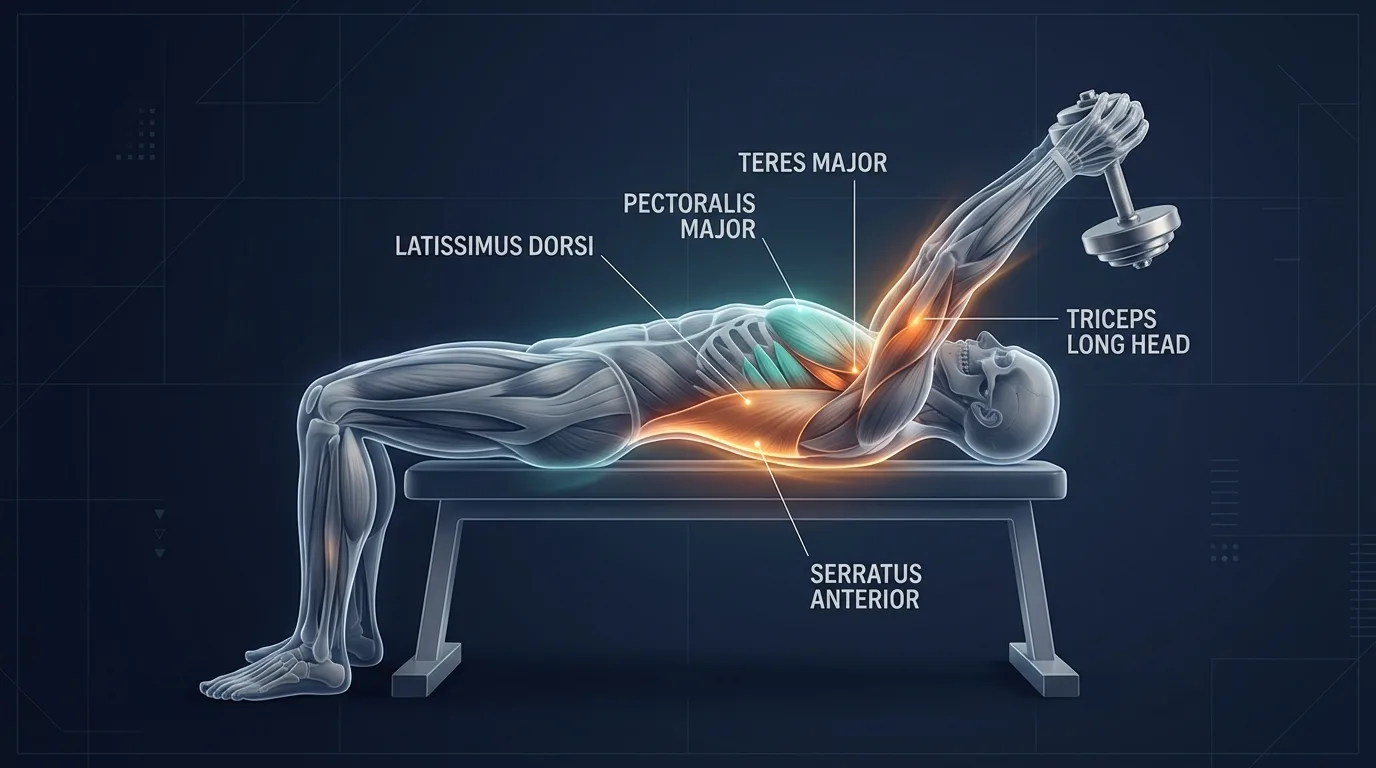
Muscles Worked
Primary mover. The latissimus dorsi drives the concentric phase from the bottom of the arc back to the start. The resistance comes through shoulder extension (pulling the upper arm from overhead back down toward the torso), one of the lats' primary actions. The sternal head of the pectoralis major assists near the top of the arc, but the dumbbell is close to the shoulder joint there, so the chest gets only a small growth stimulus. Through the eccentric, the lats control the descent of the dumbbell behind the head against gravity.
Secondary movers. The teres major assists the lats in shoulder extension, especially in the lower half of the range. The triceps long head, which crosses the shoulder, contributes to the shoulder-extension action while keeping the elbow locked at its fixed angle. The rhomboids and lower trapezius help control scapular position as the arms sweep overhead.
Stabilizers. The serratus anterior works isometrically to keep the scapula protracted and pinned against the floor or bench through the overhead range, which protects the shoulder joint. The rotator cuff stabilizes the glenohumeral joint as the humerus sweeps through deep flexion. The rectus abdominis, transverse abdominis, and obliques brace to prevent the lower back from arching when the dumbbell goes overhead. Grip and forearm musculature secure the dumbbell in the diamond hold.
Mechanism. The pullover is a stretch-loaded compound. The bottom of the range puts the lats into deep lengthening under load, which is the stimulus that drives stretch-mediated hypertrophy. The longer the muscles spend in that lengthened position with tension applied, the larger the mechanical signal for growth. That's why the controlled eccentric and the brief paused stretch at the bottom matter more than the weight on the dumbbell. The fixed-elbow geometry is what forces the load to stay on the lats rather than dumping it onto the triceps the way a skull crusher would.
How to Do the Dumbbell Pullover (Step-by-Step)
- Set up on the floor or a flat bench. Lie on your back on the floor with your knees bent and feet flat, or lie flat on a bench with your feet planted on the floor. The bench lets you lower further; the floor version still works and needs nothing but a dumbbell. Hold a single dumbbell vertically over your chest with both hands, palms pressing against the underside of the top plate in a diamond grip. Arms start nearly straight with a slight, locked-in bend at the elbows, roughly 15 to 20 degrees. Brace your core and pull your ribs down so your lower back stays flat. This setup matters more than most people realize. Bad setup means shoulder problems later. Coach Ty's cue: "Glue the lower back down before the dumbbell ever moves. If it floats up later, you stop and reset."
- Lower in a controlled arc. The movement happens at the shoulder joint, not the elbow. Lock that slight elbow bend and keep it locked. Then lower the dumbbell in a wide arc behind your head, breathing in as you descend. Your upper arms sweep, your forearms stay rigid, and the dumbbell travels in a half-circle behind your head. Go until you feel a deep stretch through your lats, ideally until your upper arms are roughly in line with your head. On the floor, the floor limits the range: go as low as you can without the dumbbell touching the ground. Coach Ty's cue: "Lock the elbows. The second they collapse, you've turned this into a skull crusher."
- Hold the stretch for a beat. Pause at the bottom for about half a second. This is the money position. You should feel the stretch across your lats and the sides of your rib cage. Keep your lower back pressed down. If it starts to arch up, you've gone too deep. Shorten the range on the next rep. Coach Ty's cue: "Feel the stretch, don't fight to escape it. The pause is the point."
- Pull back to the start. Pull the dumbbell back up along the same arc, exhaling as you come up. Think about pulling with your lats, not lifting with your arms. Stop when the dumbbell is just above shoulder height; going further shifts the work to other muscles. Keep that same elbow angle locked from start to finish. Coach Ty's cue: "Pull with your armpits. The arms are levers, not engines."
Common Mistakes to Avoid
- Letting the elbows collapse. This is mistake number one. The dumbbell gets heavy at the bottom, the arms fatigue, and the elbows start bending to cheat the weight. Once that happens, you've turned a lat exercise into a triceps burner. Pick a lighter weight and don't let the elbow angle change.
- Arching the lower back. The overhead position pulls on your lats, which pulls on your thoracolumbar fascia, which wants to pull your lumbar spine into extension. Fight that. Brace your core, pull your ribs down, and keep your lower back flat the entire set. If you can't keep your back flat, shorten your range.
- Going too deep. More range isn't always better. The bottom of a pullover is a loaded stretch position, which is great for hypertrophy and harsh on shoulders that aren't ready for it. Lower until you feel a strong stretch without pain. Most working ranges stop when the upper arms hit parallel to the floor. Going past that for the sake of "more range" is how shoulders get hurt.
- Pulling with the arms instead of the lats. If you're thinking about your biceps or triceps on a pullover, the cue is wrong. The mental cue should be pulling with your armpits. Think about dragging your elbows toward your ribs. The arms are levers. The lats are the engine.
- Going too heavy too soon. This is a stretch-loaded movement, which means the demand at the bottom is much higher than the demand at the top. A 30 lb pullover done with a full stretch and a controlled eccentric does more for hypertrophy than a 50 lb pullover done with a half rep and bouncing.
Get this exercise in a personalized workout
FitCraft, our mobile fitness app, uses its AI coach Ty to program compound strength exercises like this into your plan at the right volume and intensity, based on your level, goals, and equipment. Ty was designed and trained by Domenic Angelino, MPH (Brown University) and NSCA-CSCS, with research published in the Journal of Strength and Conditioning Research and Medicine & Science in Sports & Exercise.
Take the Free Assessment Free · 2 minutes · No credit card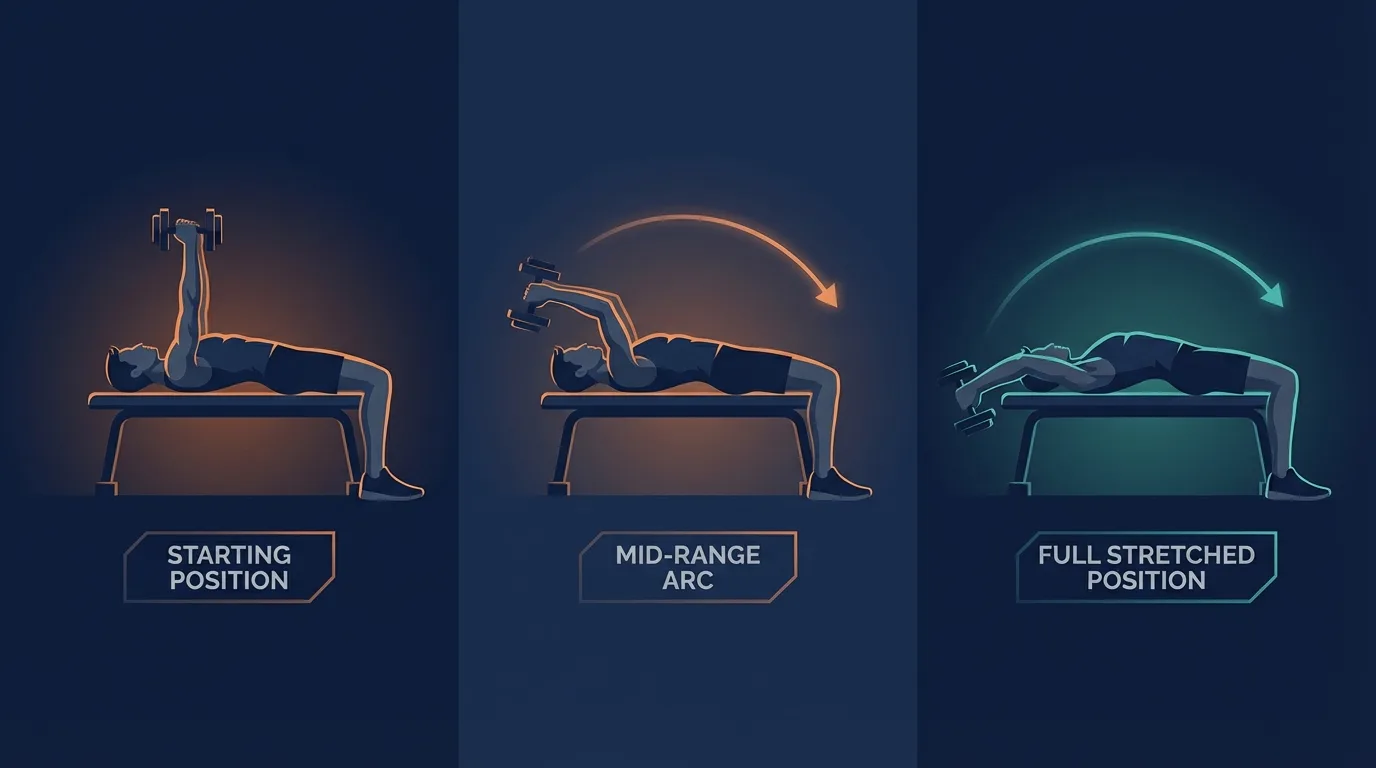
Variations: From Bent-Arm to Decline Bench
Bent-Arm Pullover (Regression)
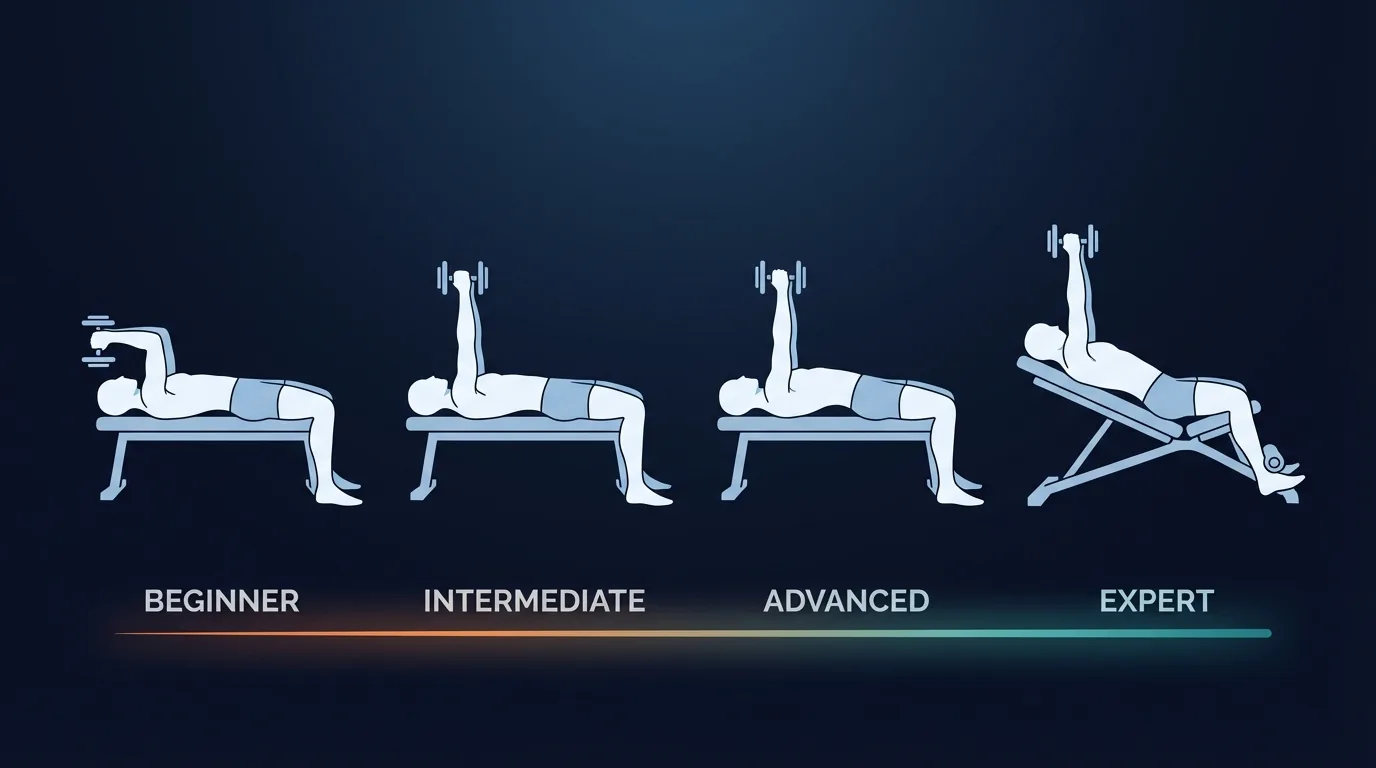
Instead of locking a slight bend, you start with your elbows more flexed, around 90 degrees, and keep that angle throughout. The shorter moment arm reduces the demand on the shoulders and the stretched position feels less intense. Good for anyone new to pullovers, or for lifters with iffy shoulder mobility who need to work into the movement over time. Use the same weight range as the straight-arm version.
Floor Pullover (No Bench)
The version FitCraft's 3D trainer demonstrates. Lie on your back on the floor with your knees bent and feet flat, and run the same fixed-elbow arc. You don't need a bench. The floor limits how far the dumbbell can travel behind your head, so the stretch is shorter, but it's still an effective lat exercise and far better than skipping it.
Flat Bench Straight-Arm Pullover (More Range)
The same movement on a flat bench, with your feet planted on the floor. With nothing behind your head, the dumbbell can travel further, so you get a longer stretch through the lats without the shoulder demand of the advanced variations. If you have a bench, this is the version most lifters should stick with.
Legs-Raised Pullover (Core Emphasis)
Instead of planting your feet, hold your legs straight and elevated, as if you were about to do a leg raise, and keep them there for the whole set. It won't train the lats any harder, but it adds a lot of work for the transverse abdominis and the rest of your abdominal wall, so it's a good option on days when core strength or endurance matters more to you.
Cross-Bench Pullover (Advanced)
Lie perpendicular across the bench with only your upper back and shoulders supported. Hips dropped below the bench, feet flat on the floor. This was Arnold's preferred variation. The dropped hips create a bigger range of motion at the bottom, which deepens the stretch on the lats and rib cage. It demands more core stability and more shoulder mobility, so only move here once the flat version feels easy. And drop the weight when you do.
Decline Bench Pullover (Expert)
Same movement on a decline bench. The decline angle increases the range of motion even further. This is a specialty variation. Useful for experienced lifters chasing an even longer stretch, but not something that belongs in most programs. Use the lightest weight of all the variations because the stretch is brutal.
Alternative Exercises
- Dumbbell chest fly: Targets the stretch-loaded position of the pectoralis major in a similar arc, minus the lat component. Good alternative if shoulder mobility is the limiting factor on pullovers.
- Bent-over rows: Hits the lats and mid-back through a contraction pattern instead of a stretch. Pair with pullovers for complete lat training across both ends of the length-tension curve.
- Stiff-arm pulldown: Same fixed-elbow shoulder-extension action as the pullover, but standing with a cable or band. Easier on the shoulder at the bottom of the range.
When to Avoid or Modify Dumbbell Pullovers
Dumbbell pullovers are safe for most healthy adults with adequate shoulder mobility, but several conditions warrant modification or substitution. Always consult a qualified healthcare provider or physical therapist before starting or returning to any exercise program, especially if any of the situations below apply.
- Recent shoulder, spine, or rib injury or surgery. The overhead loaded stretch position imposes glenohumeral and lumbar stress that can re-aggravate a healing joint. Get clearance from your surgeon or PT before adding the pullover back in, and start with the bent-arm regression at a fraction of your previous load.
- Shoulder impingement, labral pathology, or rotator cuff symptoms. Deep shoulder flexion under load is one of the positions most likely to flare these conditions. Use the bent-arm pullover with a reduced range (stop short of full overhead) or substitute the chest fly and stiff-arm pulldown until the shoulder is asymptomatic through overhead flexion.
- Uncontrolled hypertension or known cardiovascular disease. The supine overhead position combined with breath-holding spikes intrathoracic pressure. Use a lighter dumbbell, breathe through every rep, avoid Valsalva, and follow your cardiologist's exercise guidance.
- Pregnancy, especially second and third trimester. Supine positions after the first trimester can compress the vena cava and reduce return blood flow. Substitute with the standing stiff-arm pulldown or upright row variations that allow torso vertical.
- First 6 to 8 weeks postpartum or active diastasis recti. The overhead position requires strong anterior-core bracing that the recovering linea alba may not yet support. Restore deep-core function with deadbugs and bird-dogs first.
- Acute lower-back pain or known disc pathology. The lat tension at the bottom can pull the lumbar spine into extension if the core isn't holding the brace. Skip the pullover until the symptoms resolve, build trunk stability with forearm planks, deadbugs, and bird-dogs, and consult a PT.
- Limited overhead shoulder mobility. If you can't get your arms fully overhead in a supine position without your lower back lifting off the floor or bench, you don't yet have the range for the pullover. Work on thoracic extension and shoulder flexion mobility first, and run the bent-arm regression in the meantime.
Related Exercises
- Same muscle group (pull side): Bent-over rows hit the lats through contraction; stiff-arm pulldown mirrors the pullover's shoulder-extension action standing.
- Same muscle group (push side): Chest fly targets the sternal pec through a similar arc minus the lats; chest press trains the pec through full elbow extension.
- Shoulder pressing accessory: Shoulder press and Arnold press build the overhead stability and rotator-cuff strength that supports better pullover positioning.
- Hinge and posterior chain pair: Romanian deadlift and single-leg deadlift develop the same posterior-chain bracing pattern from the other end of the body.
- Core foundation for spinal bracing: Deadbugs, bird-dogs, and forearm planks build the anterior-core endurance that keeps your lower back flat through every rep.
How to Program Dumbbell Pullovers
Loading and frequency for the dumbbell pullover follow the general resistance-training principles laid out in the ACSM Position Stand on resistance training (Ratamess et al., 2009), with one caveat specific to stretch-loaded movements: load conservatively, because the bottom of the range is where injury risk concentrates.
| Level | Sets × Reps | Rest between sets | Frequency |
|---|---|---|---|
| Beginner | 2-3 × 12-15 (bent-arm, light load) | 60-90 seconds | 1-2 sessions/week |
| Intermediate | 3 × 12-15 (floor or flat bench straight-arm) | 90-120 seconds | 1-2 sessions/week |
| Advanced | 3-4 × 12-15 (cross-bench or decline) | 120-180 seconds | 2 sessions/week |
Why higher reps. The pullover only moves your arms from behind your head to just above your shoulders. That's a small part of the range your lats can work through, from fully overhead all the way down to your sides. Sets of 12 to 15 reps make up for the shorter range.
Where in your workout. Program the pullover as an accessory after your primary compound press or pull of the day. It fits best on a back or upper-body day, after rows or pulldowns, as a stretch-loaded lat accessory. Don't lead with it. Your shoulders need to be warm and the heavy compound work already banked.
Form floor over rep targets. If the elbow angle starts changing, the rib cage starts flaring, or the lower back peels off the floor or bench, the set is done. Stop short of the target rep count rather than push through with degraded form. Pullover injuries almost always come from chasing the rep target after technique has already broken down. Drop one weight increment and rebuild from there.
FitCraft's AI coach Ty programs the dumbbell pullover based on your shoulder mobility, training experience, and how much back work your program already has that week. Ty adjusts the variation and volume to match your level so you build into the loaded stretch over time rather than landing in it cold. The 3D demonstrations show the locked elbow angle from multiple angles so you can see exactly what "slight bend" looks like in practice.
Frequently Asked Questions
Can I do dumbbell pullovers if I have shoulder pain or impingement?
Not without modification. The overhead range of a pullover puts the shoulder into deep flexion under load, which can aggravate impingement, labral irritation, and rotator cuff symptoms. If you have current shoulder pain, get cleared by a PT or physician first. Then test the range of motion with no weight at all to find which part of it, if any, feels safe. When you return to the movement, reduce the range (don't go all the way down behind the head), use a much lighter dumbbell, keep your ribs pulled down and lower back flat, and consider the bent-arm pullover regression to shorten the moment arm at the bottom. Chest fly and stiff-arm pulldown are useful alternatives while the shoulder recovers.
What muscles do dumbbell pullovers work?
Mainly the lats. The latissimus dorsi is the primary mover, because the resistance comes through shoulder extension, one of the lats' main jobs. The teres major, triceps long head, rhomboids and serratus anterior assist, and the serratus also works to keep the shoulder blade stable through the stretched position. You'll feel your chest working too, but it gets only a small growth stimulus: it mainly helps hold the weight near the top, where the dumbbell sits almost directly over the shoulder and loads it very little.
Is the dumbbell pullover a chest or back exercise?
Mainly a back exercise. The resistance comes through shoulder extension, a primary lat action, so the lats do most of the work. Many people feel their chest working and assume it builds the chest too, but the chest only helps near the top of the arc, where the dumbbell is almost directly over the shoulder and puts very little load on it. Program it as a lat accessory, and train the chest with presses or flyes.
How heavy should I go on dumbbell pullovers?
Lighter than you think. Most intermediate lifters use 20 to 35 pound dumbbells. The pullover is a stretch-loaded exercise, which means the demand at the bottom of the range is much higher than at the top. Heavy pullovers are how people tweak shoulders and lower backs. Prioritize feeling the stretch in your lats, control the eccentric over 3 seconds, and only progress the load when your bracing and range stay clean across all working sets.
Do dumbbell pullovers actually expand the rib cage?
Not in adults. Once your growth plates fuse in your late teens or early twenties, the bony structure of the rib cage doesn't change from exercise. The 1970s claim was based on training adolescents whose skeletons were still growing. What pullovers do accomplish in adults is strengthening the serratus anterior and stretching the intercostals and pec minor, which can improve posture and the visual appearance of the chest and ribs. So the expansion is real in a cosmetic sense, but not a skeletal one.