If you feel rows and chin-ups mostly in your arms, stiff-arm pulldowns can help. The exercise teaches shoulder extension without much elbow bending, so the lats get a cleaner job: pull the upper arm down and back.
Use it as a warm-up drill before heavier pulling, an accessory exercise after rows, or a lower-load back option when you train at home with bands.
Quick Facts: Stiff-Arm Pulldowns
- Equipment needed: Resistance band and secure overhead anchor
- Difficulty: Beginner to Intermediate
- Modality: Strength
- Body region: Upper body
- FitCraft quest category: Strength
Muscles Worked
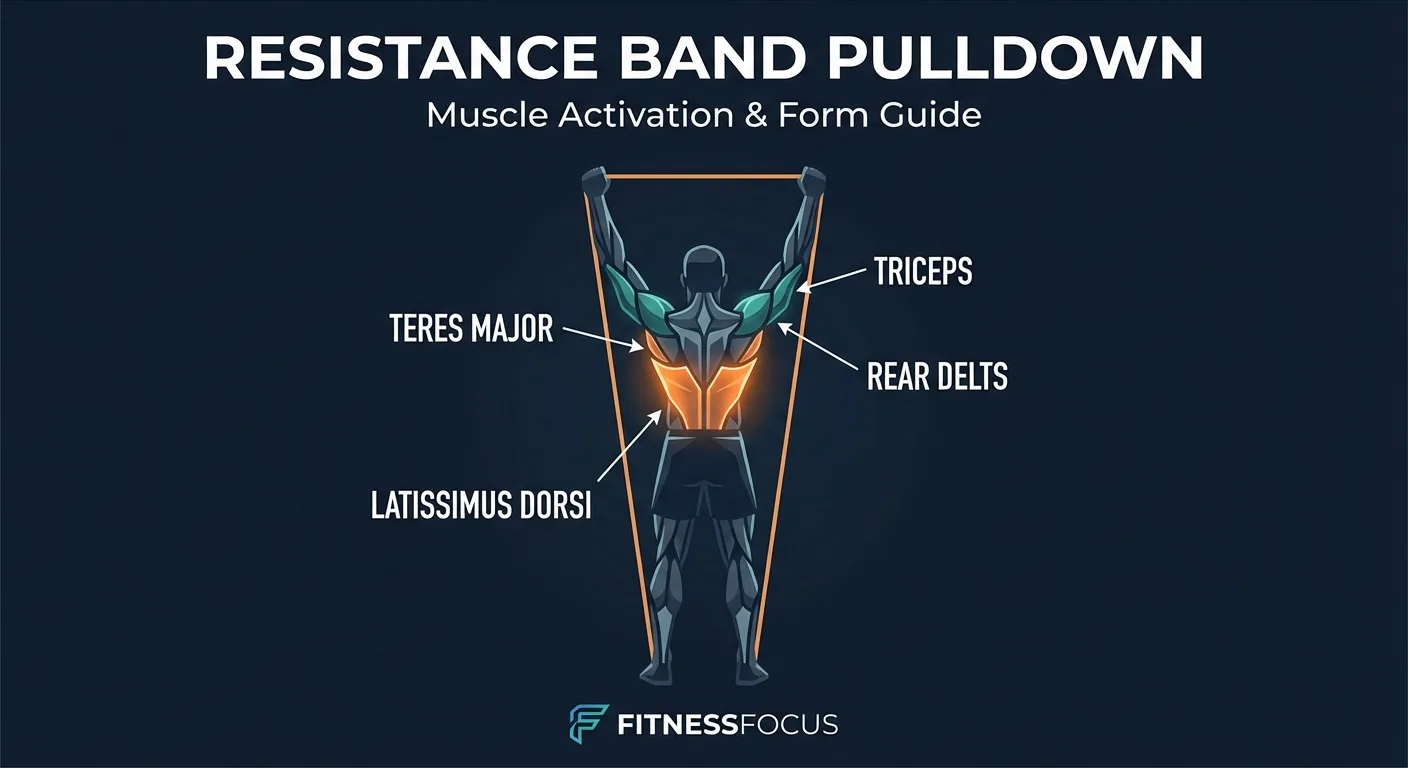
Primary movers: the latissimus dorsi drives the pulldown by extending the shoulder from an overhead position toward the thighs. It shortens as you pull the band down, then lengthens under tension as your arms return overhead.
Secondary movers: teres major assists the lat in shoulder extension. The long head of the triceps helps keep the elbow angle fixed, while the rear deltoids assist near the bottom of the pull.
Stabilizers: the rotator cuff centers the shoulder joint, the forearms hold the band, and the rectus abdominis, transverse abdominis, obliques, glutes, and spinal erectors hold your ribs and pelvis stacked. If the torso rocks, the lats lose clean tension.
Why the exercise feels so specific: keeping the elbows nearly fixed reduces biceps contribution. That does not remove every assisting muscle, but it gives the lats a clearer shoulder-extension task than a row or chin-up. The band also gets harder near the bottom, where the lats need to finish the squeeze without the shoulders dumping forward.
Step-by-Step: How to Do a Stiff-Arm Pulldown
- Anchor the band. Loop a resistance band around a secure anchor point above head height, such as a pull-up bar, a door anchor at the top of the door, or a sturdy high hook. Grab the band with both hands, palms facing down.
- Set your stance. Step back until the band has tension with your arms extended overhead. Stand with feet shoulder-width apart. Keep your ribs down, chest tall, and spine neutral.
- Brace your core. Tighten your abs and glutes before the first rep. Your torso should stay still while the arms move.
- Pull down with nearly straight arms. Keep a soft but fixed elbow angle and pull the band down in a smooth arc toward your thighs. Think about driving your upper arms down through your lats.
- Squeeze and return. Pause when your hands reach your thighs, squeeze the sides of your back, then let the band pull your arms back overhead under control. Keep your neck neutral and shoulders away from your ears.
Get this exercise in a personalized workout
FitCraft, our mobile fitness app, uses its AI coach Ty to program compound strength exercises like this into your plan at the right volume and intensity, based on your level, goals, and equipment. Ty was designed and trained by Domenic Angelino, MPH (Brown University) and NSCA-CSCS, with research published in the Journal of Strength and Conditioning Research and Medicine & Science in Sports & Exercise.
Take the Free Assessment Free • 2 minutes • No credit card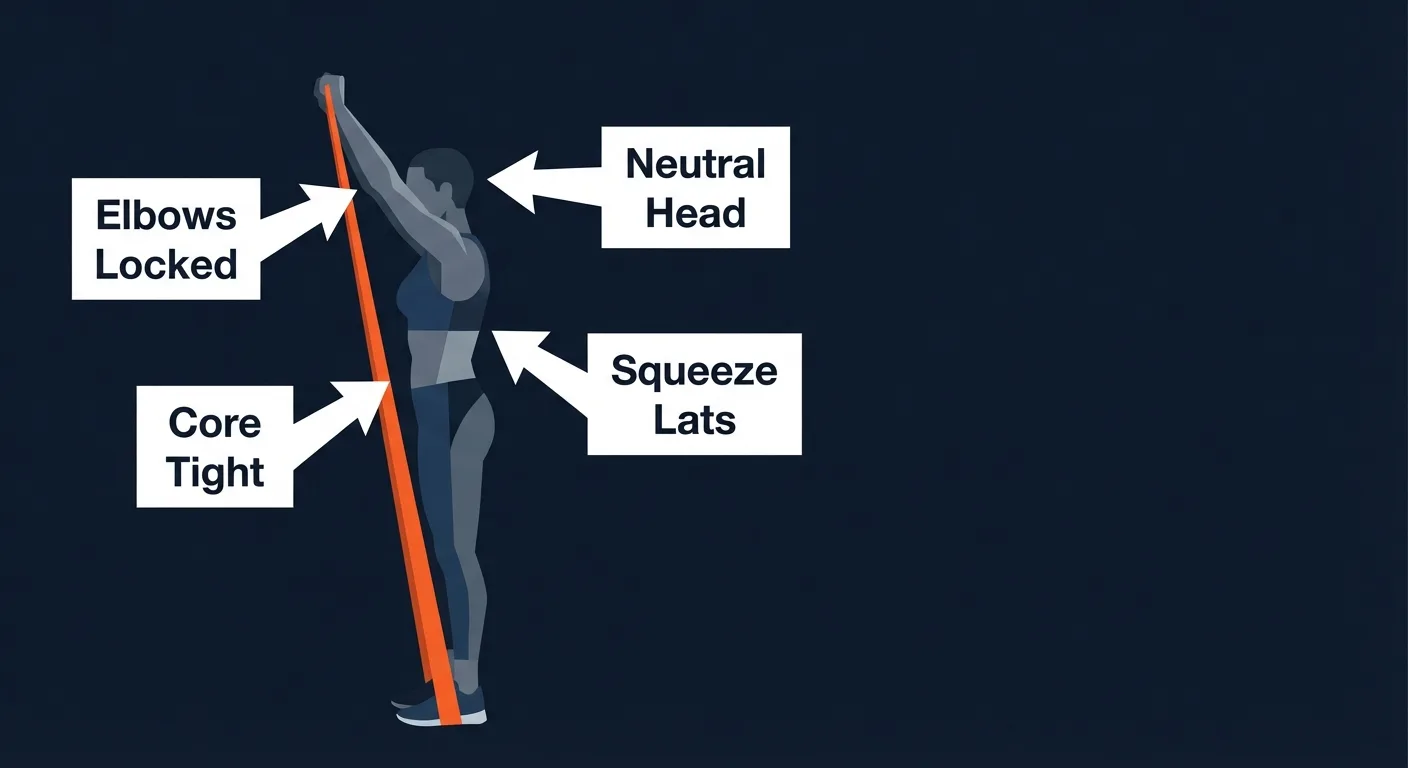
Common Mistakes (and How to Fix Them)
Bending the Elbows
What it looks like: Your elbows start to flex as you pull, turning the movement into a banded lat pulldown.
Why it's a problem: The more your elbows bend, the more your biceps help. That blunts the lat-isolation goal.
The fix: Set a soft bend at the start and hold that angle. If you cannot keep the angle fixed, use a lighter band.
Swaying the Torso
What it looks like: Your upper body rocks forward and back with each rep, using momentum to move the band.
Why it's a problem: Momentum takes tension away from the lats and can irritate the lower back over repeated sets.
The fix: Brace before the first pull. Step closer to the anchor or use a lighter band if the band is yanking your torso out of position.
Pulling Past the Thighs
What it looks like: Your hands shoot behind your hips after they pass the thighs.
Why it's a problem: The shoulder starts moving into excessive extension and the lats stop being the clean limiter.
The fix: Stop at the thighs. Squeeze there, pause briefly, and return.
Shrugging at the Start
What it looks like: The shoulders climb toward your ears when the band pulls your arms overhead.
Why it's a problem: Shrugging shifts tension to the neck and upper traps instead of setting the shoulder blades for a clean pull.
The fix: Reach overhead without losing your neck. Keep space between your ears and shoulders before each rep.
Cranking the Neck
What it looks like: Your chin juts forward, or you look up at the anchor through every rep.
Why it's a problem: It strains the neck and breaks the stacked rib-and-pelvis position you need for strict reps.
The fix: Keep your eyes forward or slightly down. Let the band move, not your head.
Stiff-Arm Pulldown Variations: Regressions and Progressions
Choose the version that lets you keep the elbows fixed, torso quiet, and shoulders pain-free.
Short-Range Stiff-Arm Pulldown (Beginner Regression)
Pull the band only halfway down while you learn the shoulder path. This keeps the load lower and helps you feel the top half of the lat contraction.
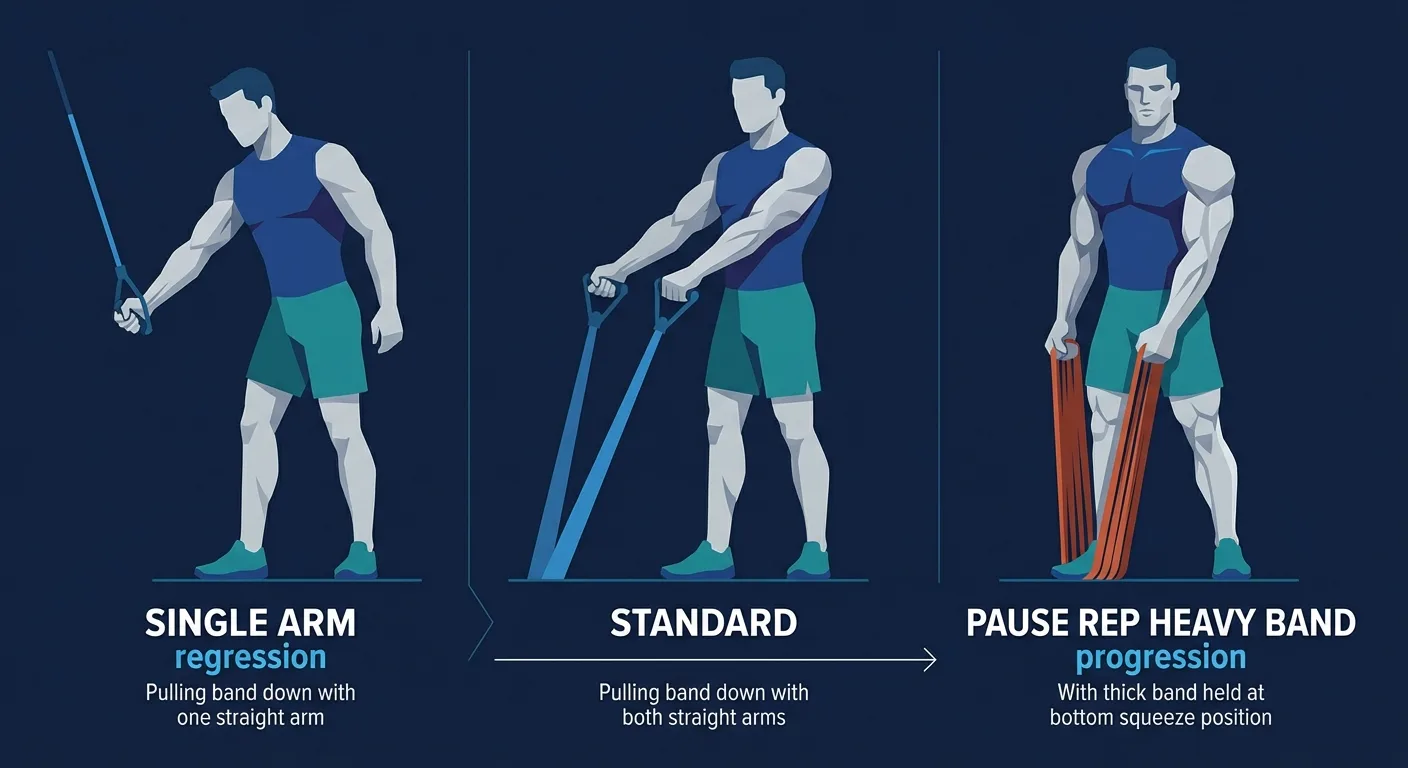
Single-Arm Stiff-Arm Pulldown
Use one hand at a time with a lighter band. It reduces total load and lets you compare left and right lat control without hiding behind your stronger side.
Standard Two-Arm Band Stiff-Arm Pulldown
Use both hands, pull toward the thighs, and return slowly. This is the main version for most home workouts.
Pause-Rep Stiff-Arm Pulldown
Hold the bottom squeeze for 2 to 3 seconds before returning overhead. The pause removes bounce and makes the lats finish each rep.
Slow Eccentric Stiff-Arm Pulldown
Take 3 to 4 seconds to return overhead. The slow return adds time under tension without needing a much heavier band.
When to Avoid or Modify Stiff-Arm Pulldowns
Stiff-arm pulldowns are safe for most healthy adults, but the overhead start position and loaded shoulder-extension arc deserve respect. Modify the exercise when symptoms change your form, and always consult your physician or physical therapist for personalized guidance.
- Recent shoulder, spine, rib, elbow, or wrist injury. The band pulls your arms overhead and asks the shoulder to control a long lever. Use a shorter range, lighter band, or a chest-supported row until you are cleared for loaded shoulder motion.
- Shoulder impingement, labral symptoms, or rotator cuff irritation. Overhead positions can pinch or feel unstable. Keep the range pain-free, avoid shrugging, and substitute bent-over rows or overhead pullovers only when those options are symptom-free.
- Uncontrolled hypertension or known cardiovascular disease. Heavy band tension and breath-holding can spike pressure. Use lighter bands, breathe continuously, and follow your clinician's exercise guidance.
- Pregnancy, early postpartum, or active diastasis recti. Strong bracing and overhead tension can be uncomfortable or poorly tolerated. Keep loads light, avoid breath-holding, and rebuild trunk control with deadbugs, bird-dogs, and forearm planks.
- Acute lower-back pain or disc pathology. If bracing against the band causes lumbar extension or pain, use less band tension or swap to supported pulling work until symptoms settle.
- Limited overhead shoulder mobility. If you cannot start overhead without flaring the ribs or shrugging, shorten the range and build shoulder control first.
Related Exercises
If stiff-arm pulldowns fit your routine, these exercises build the same pulling pattern or the stability needed to do it well:
- Same muscle group: Bent-Over Rows, Upright Rows, and Overhead Pullover all train the upper back or lats from different angles.
- Vertical pulling progression: Chin-Ups turn lat strength into a larger compound pulling pattern.
- Shoulder-control accessory: Pull-Apart builds rear-delt and scapular control that supports cleaner pulldown mechanics.
- Core foundation for bracing: Deadbugs, Bird-Dogs, and Forearm Planks help keep the ribs and pelvis stacked while the band pulls overhead.
How to Program Stiff-Arm Pulldowns
Program stiff-arm pulldowns like a controlled resistance exercise, then let form decide the load. The American College of Sports Medicine Position Stand on resistance training supports progressive sets, reps, rest, and weekly frequency matched to training level (Ratamess et al., 2009).
| Level | Sets × Reps | Rest between sets | Frequency |
|---|---|---|---|
| Beginner | 2-3 × 8-12 | 90-120 seconds | 2-3 sessions/week |
| Intermediate | 3-4 × 10-15 | 90-150 seconds | 2-4 sessions/week |
| Advanced | 3-5 × 8-12 with pauses or slow eccentrics | 120-180 seconds | 2-4 sessions/week |
Where in your workout: use stiff-arm pulldowns early as a lat activation drill before rows or chin-ups, or later as an accessory after heavier pulling. If you use them first, keep the band light enough that you do not fatigue your grip before compound work.
Form floor over rep targets: stop a set when your elbows start bending, shoulders shrug, torso sways, or the bottom position turns into a forced shoulder stretch. A clean set of 10 beats a messy set of 15.
How FitCraft Programs This Exercise
FitCraft uses Ty to place pulling exercises inside a balanced strength program built around your level, goals, and available equipment. For a movement like stiff-arm pulldowns, that usually means matching the resistance and volume to your current pulling strength instead of chasing a heavier band before the lats are doing the work.
As you get stronger, Ty can adjust the exercise variation and volume to match your level. The goal is steady progress with form that still looks controlled.
Frequently Asked Questions
What muscles does the stiff-arm pulldown work?
The stiff-arm pulldown primarily trains the latissimus dorsi through shoulder extension. Teres major, the long head of the triceps, rear deltoids, rotator cuff, forearms, and core help stabilize the shoulder, elbow, grip, and torso.
Can I do stiff-arm pulldowns with shoulder pain?
Modify or skip stiff-arm pulldowns if the overhead start position causes shoulder pain, pinching, instability, or symptoms from a recent shoulder injury. Use a shorter range, a lighter band, or a chest-supported row instead, and get personalized guidance from a physical therapist if pain persists.
Is the stiff-arm pulldown good for beginners?
Yes. A light resistance band makes the exercise beginner friendly because the movement is simple and the load is easy to scale. It is especially useful for learning what a lat contraction feels like before heavier rows or chin-ups.
Can I do stiff-arm pulldowns without a cable machine?
Yes. This guide uses a resistance band anchored overhead, which works well at home if the anchor is secure and high enough. A cable machine is an option in a gym, but it is not required for the movement pattern.
How heavy should my resistance band be?
Start lighter than you think. If your elbows bend, shoulders shrug, or torso sways to finish the rep, the band is too heavy. Pick a band that lets you control 10 to 15 clean reps with a clear lat squeeze.
How is the stiff-arm pulldown different from a lat pulldown?
A standard lat pulldown bends the elbows and uses the biceps more. A stiff-arm pulldown keeps the elbows nearly fixed, which shifts the work toward shoulder extension and makes the lats easier to feel.