The supported row exists because a bent-over row has one built-in limiter: your lower back has to hold the hinge for the whole set. If your spinal erectors fatigue before your lats do, the set ends for the wrong reason.
Bracing one hand on a bench or box changes the job. Your torso stays steady, your working arm has room to pull, and your back gets most of the training stress. That makes the supported row useful for home dumbbell training, back hypertrophy, and rebuilding a pulling pattern when strict unsupported rows feel too demanding.
Quick Facts: Supported Row
- Equipment needed: One dumbbell and a bench, box, or sturdy elevated support
- Difficulty: Beginner to Intermediate
- Modality: Strength
- Body region: Upper body, posterior chain
- FitCraft quest category: Strength
Muscles Worked
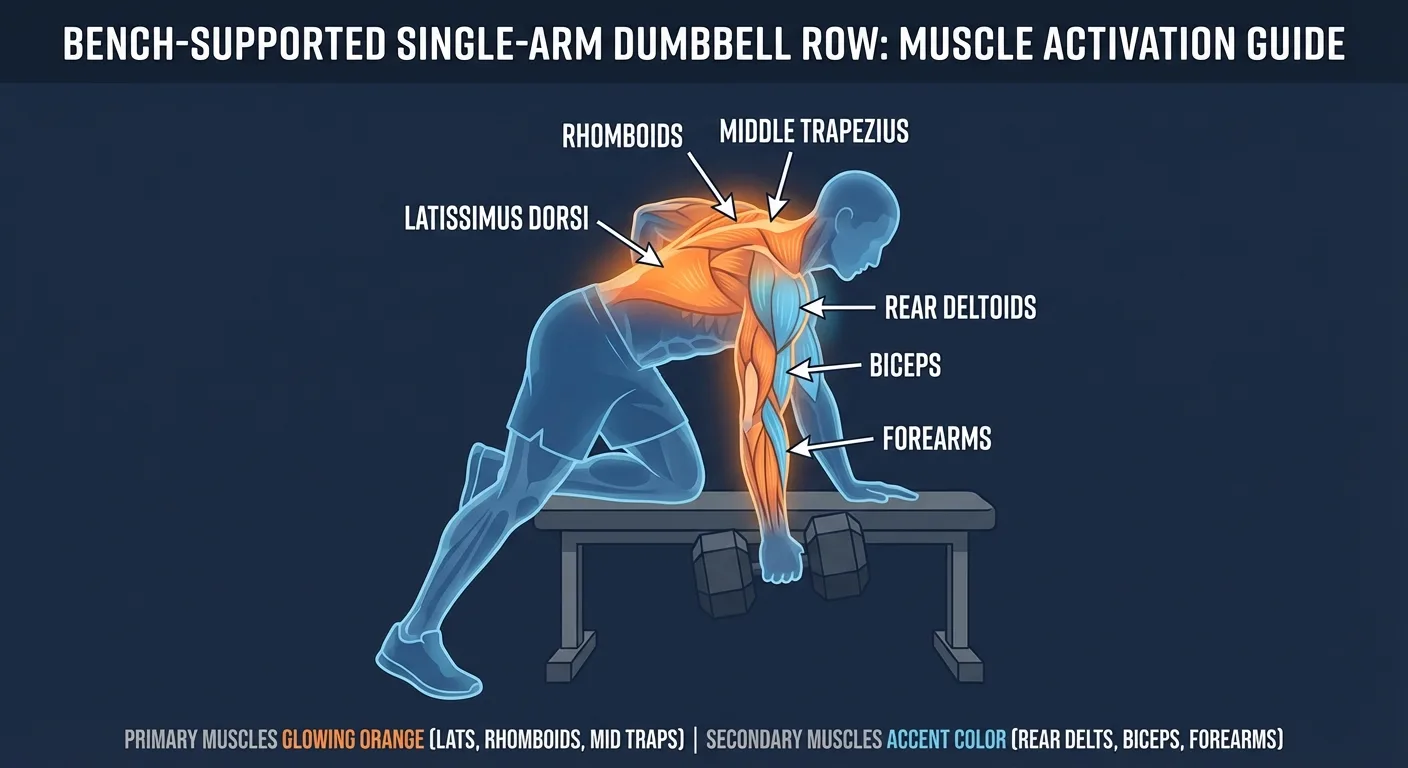
Primary movers: the latissimus dorsi, rhomboids, middle trapezius, lower trapezius, and posterior deltoids. These muscles retract and depress the shoulder blade, extend the shoulder, and pull the upper arm back toward the torso. They shorten during the row and lengthen under tension as you lower the dumbbell.
Secondary movers: the biceps brachii, brachialis, and brachioradialis help bend the elbow. The rear deltoid assists shoulder extension when the elbow tracks slightly away from the ribs, while the lower traps help keep the shoulder from shrugging into the neck.
Stabilizers: the forearm flexors and extensors hold the dumbbell, the rotator cuff centers the shoulder during the pull, and the core keeps your ribs, pelvis, and spine from rotating. The serratus anterior and lower trapezius also help control the shoulder blade so the rep stays smooth.
Why the support matters: the braced hand and knee reduce the need to hold a long unsupported hip hinge. That shifts the limiting factor away from lower-back endurance and toward the working side of the upper back. Keep the support stable, keep your chest square, and the row becomes a cleaner back-building drill.
Step-by-Step: How to Do a Supported Row
Step 1: Set Up the Support
Place one hand and the same-side knee on a flat bench, box, or sturdy elevated surface. Your other foot stays planted on the floor. Let the dumbbell hang under your free shoulder with your palm facing in.
Coach Ty's cue: "Stack your support hand under your shoulder before you row."
Step 2: Create a Flat Back
Hinge from your hips until your torso is close to parallel with the floor. Brace your core, keep your ribs down, and keep your gaze on the floor so your neck stays neutral.
Coach Ty's cue: "Make your back a tabletop. Nothing should twist when the weight moves."
Step 3: Pull to Your Ribs
Row the dumbbell toward your lower ribs by driving your elbow up and back. Keep the elbow close to your body if you want more lat emphasis.
Coach Ty's cue: "Lead with your elbow instead of your hand."
Step 4: Squeeze at the Top
Pause briefly when your elbow reaches your torso. Squeeze the shoulder blade toward your spine without rolling your chest open or shrugging toward your ear.
Coach Ty's cue: "Pocket the shoulder blade, then hold it for a beat."
Step 5: Lower Under Control
Lower the dumbbell until your arm is straight again. Keep the descent controlled so your back works through the eccentric phase too. Exhale on the pull and inhale on the way down.
Coach Ty's cue: "Own the lowering. Don't let the dumbbell fall away from you."
Get this exercise in a personalized workout
FitCraft, our mobile fitness app, uses its AI coach Ty to program pulling exercises like this into your plan at the right volume and intensity, based on your level, goals, and equipment. Ty was designed and trained by Domenic Angelino, MPH (Brown University) and NSCA-CSCS, with research published in the Journal of Strength and Conditioning Research and Medicine & Science in Sports & Exercise.
Take the Free Assessment Free • 2 minutes • No credit card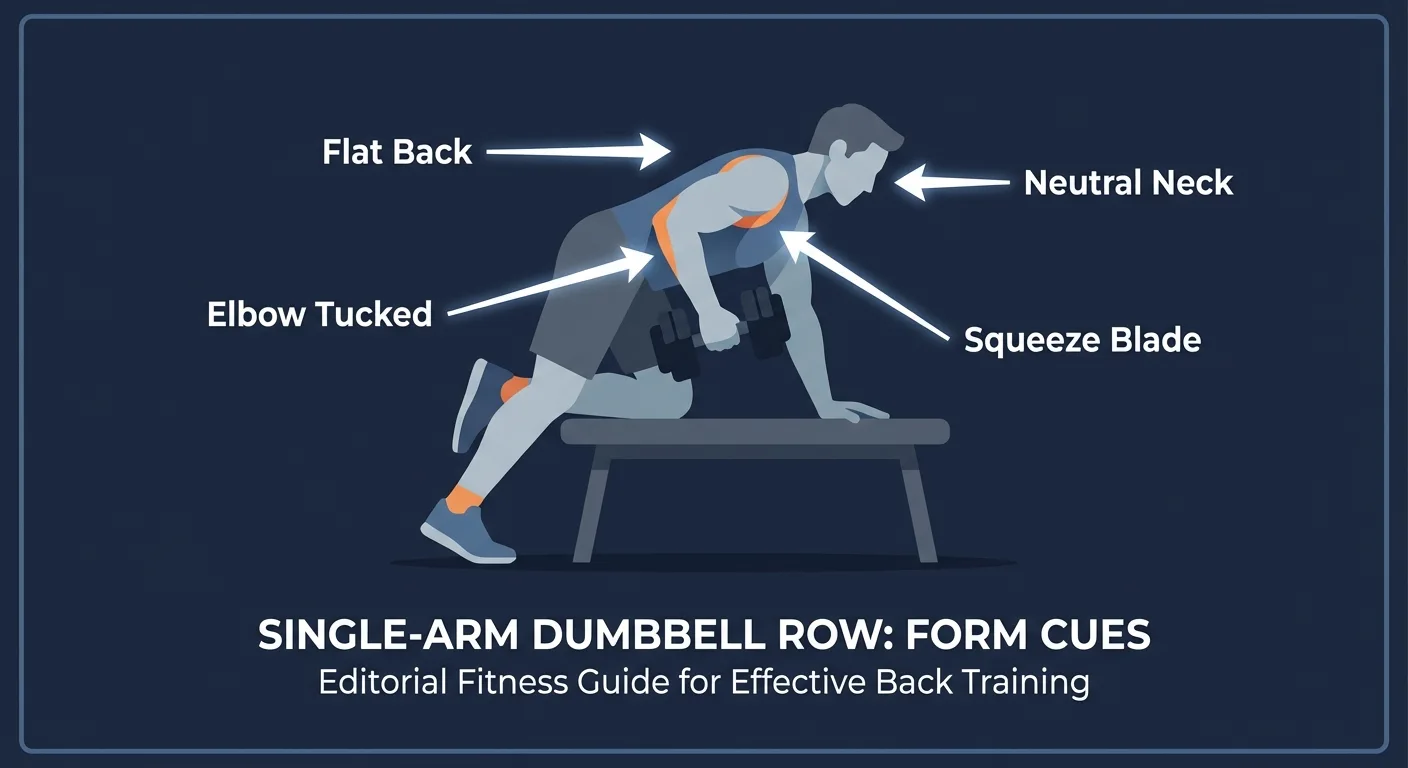
Common Mistakes (and How to Fix Them)
- Rowing with the arm first. If your biceps do all the work, the dumbbell may be too heavy or your shoulder blade may be passive. Fix it by starting the pull from the shoulder blade, then letting the elbow follow.
- Twisting the torso open. Rotating at the top turns the row into a momentum rep. Keep your chest square to the floor and stop the rep where you can still control your ribs and pelvis.
- Letting the elbow flare wide. A wide elbow shifts the bias toward the rear deltoid and away from the lat. For a back-focused row, keep the elbow close and row toward the lower ribs.
- Shrugging at the top. If your shoulder rises toward your ear, your upper trap is taking over. Think about sliding the shoulder blade down and back before you squeeze.
- Dropping the weight. The lowering phase still trains the back. Use a controlled descent instead of letting gravity finish the rep.
- Using an unstable support. A wobbly chair or soft surface makes the rep sloppy. Use a flat bench, sturdy box, or stable surface that doesn't move under your hand.
Supported Row Variations: Regressions and Progressions
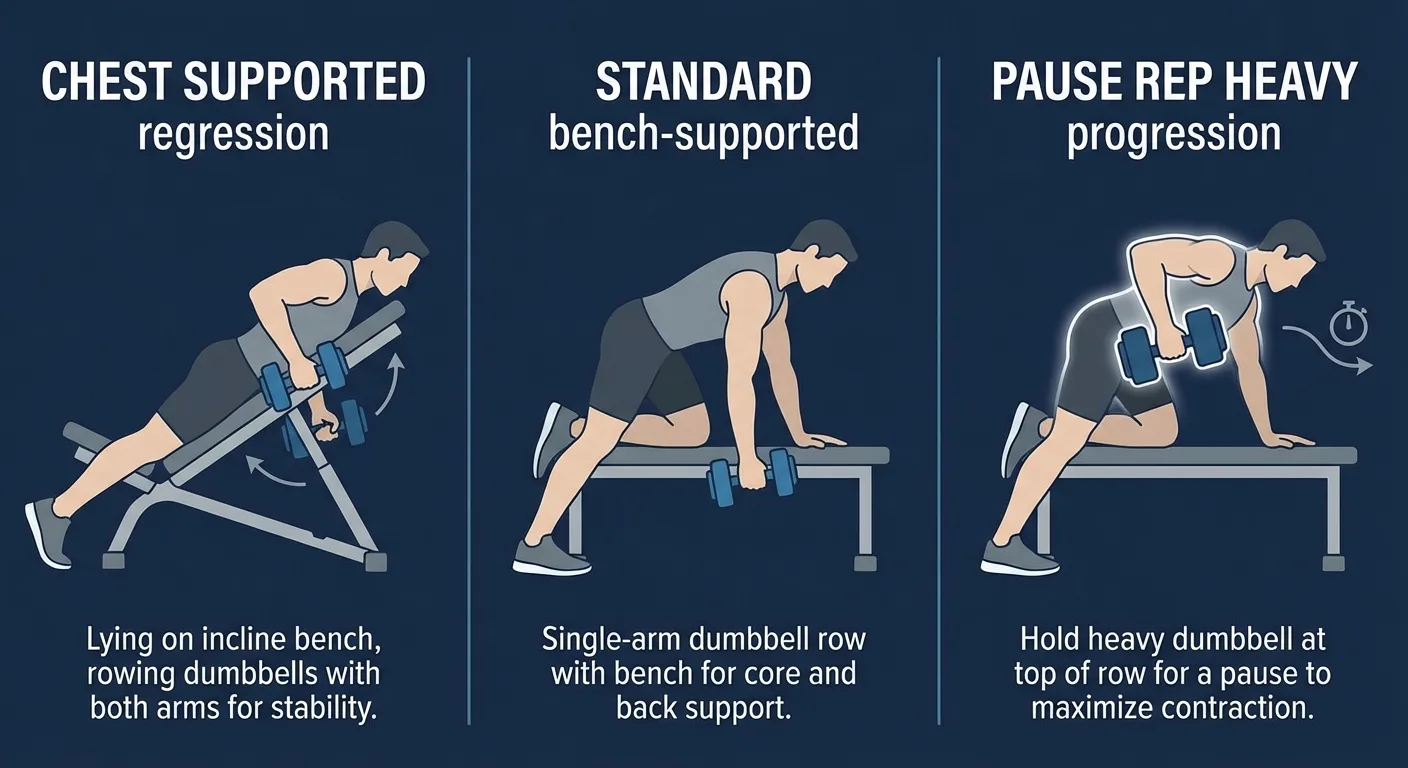
Choose the version that lets you keep your torso still and your shoulder comfortable.
Higher-Support Row (Beginner Regression)
Place your support hand on a higher box, counter, or rack so your torso is more upright. The range is easier to control, and the lower back has even less work to do.
Standard Bench-Supported Row
Use one hand and the same-side knee on a bench, with the opposite foot planted. This is the main version for most lifters because it balances support, range of motion, and load.
Paused Supported Row
Hold the top position for one or two seconds on every rep. The pause makes cheating obvious and increases time under tension for the lats and mid-back.
Slow-Eccentric Supported Row
Lower the dumbbell for three to five seconds. This adds difficulty without needing a much heavier dumbbell, and it teaches control through the full range.
Alternative Pulling Exercises
Use bent-over rows when your lower back can handle an unsupported hinge, inverted rows when you want a bodyweight pull, or corner rows when you want a heavier angled row.
When to Avoid or Modify Supported Rows
Supported rows are safe for most healthy adults, but a few conditions call for modification or a temporary swap. Always consult your physician or physical therapist for personalized guidance.
- Acute shoulder injury or rotator cuff irritation. Rowing can aggravate the shoulder if the humeral head doesn't track cleanly. Use a lighter dumbbell, shorten the range, try a band row, or pause rowing until a clinician clears you.
- Recent shoulder, elbow, wrist, or back surgery. Get clearance from your surgeon or physical therapist. Early rehab usually starts with low-load scapular activation and controlled range before loaded rows return.
- Tennis elbow or golfer's elbow. The gripping and pulling demand can irritate elbow tendons. Reduce load and volume, use a neutral wrist, and build back through pain-free rows or isometric grip work.
- Lower-back pain that worsens when bracing. The support reduces hinge stress, but it doesn't remove all trunk demand. Use a higher support, lighter load, shorter sets, and rebuild bracing with deadbugs and bird-dogs.
- Wrist pain on the support hand. A flat bench can load the wrist in extension. Use a dumbbell handle as a neutral-grip support, brace on a fist if comfortable, or switch to a chest-supported variation.
- Uncontrolled hypertension or cardiovascular disease. Avoid breath-holding and heavy grinding reps. Use lighter sets, steady breathing, and medical guidance if you have known cardiovascular risk.
Related Exercises
If supported rows fit your training, these exercises build the same pulling pattern or shore up the foundations around it:
- Same muscle group: Bent-Over Rows and Overhead Pullovers train the lats and upper back with external load.
- Easier bodyweight pulls: Inverted Rows, Reverse Rows, and Corner Rows let you practice horizontal pulling with different support angles.
- Strength-builder eccentric: Chin Negatives train the lowering strength needed for harder vertical pulls.
- Grip and shoulder foundation: Engaged Hangs and Top Chin Holds build scapular control and grip endurance.
- Core anti-swing foundation: Deadbugs, Bird-Dogs, and Hollow Holds teach the trunk stiffness that keeps rows clean.
How to Program Supported Rows
Supported rows follow the same broad progression model used for resistance training. The ACSM Position Stand on resistance training recommends matching sets, reps, rest, and frequency to training status, then progressing volume or intensity as form allows (Ratamess et al., 2009).
| Level | Sets x Reps | Rest between sets | Frequency |
|---|---|---|---|
| Beginner (higher support or light dumbbell) | 2-3 x 5-10 per side | 60-90 seconds | 2-3 sessions/week |
| Intermediate (standard bench-supported row) | 3-4 x 5-12 per side | 90-120 seconds | 2-3 sessions/week |
| Advanced (paused, slow eccentric, or heavier load) | 3-5 x 4-10 per side | 90-180 seconds | 2-4 sessions/week |
Where in your workout: place supported rows early in an upper-body or pull session, when your grip and shoulder control are fresh. Pulling is grip-limited, so doing rows after heavy carries or a long arm block can under-train the back.
Form floor over rep targets: stop the set when your torso twists, your shoulder shrugs, your elbow path changes, or the dumbbell starts dropping on the way down. Clean reps beat extra reps.
How FitCraft Programs This Exercise
Knowing how to row is one piece. Knowing which pulling variation belongs in your week, how many sets to use, and when to progress is where planning matters.
FitCraft's AI coach Ty uses your free assessment, goals, and available equipment to place pulling exercises inside a balanced program. As you build strength, Ty adjusts the variation and volume to match your level while keeping the program designed by an Ivy League-trained exercise scientist and NSCA-certified strength coach.
Frequently Asked Questions
What muscles does the supported row work?
The supported row primarily trains the latissimus dorsi, rhomboids, middle trapezius, lower trapezius, and posterior deltoids. The biceps, brachialis, forearms, rotator cuff, and core assist so the shoulder and torso stay stable.
Can I do supported rows with shoulder pain?
Modify or skip supported rows if rowing causes sharp shoulder pain, pinching, or symptoms from a recent rotator cuff or labral injury. Use a lighter load, shorter range, higher support, or a band row, and get guidance from a qualified clinician if pain persists.
Why use a supported row instead of a regular bent-over row?
The supported row reduces the need for your spinal erectors to hold a long hip hinge. That makes it useful when you want to train your back hard while keeping lower-back fatigue lower than it would be in a strict bent-over row.
How heavy should I go on supported rows?
Start with a load you can row for 8 to 12 clean reps per side without twisting, shrugging, or losing the top squeeze. If you can't pause briefly at the top, the dumbbell is too heavy.
Is a supported row the same as a one-arm dumbbell row?
They overlap heavily. A supported row usually means one hand and one knee, or one hand and both feet, are braced on a stable surface while one arm rows a dumbbell. Many coaches also call this a one-arm dumbbell row.