The corner row is one of the most accessible pulling exercises that exists. No bar. No bands. No doorway that might not hold your weight. Just a wall corner. And yet most bodyweight programs completely ignore it. That is a problem, because most people who train at home with no equipment end up with a program that is all push and no pull: push-ups, planks, squats, lunges. The back gets nothing. Over time, that imbalance shows up as rounded shoulders, a weak mid-back, and sometimes nagging shoulder pain from the front of the joint doing all the work without the rear muscles to balance it out.
The corner row fixes that gap with the lowest possible barrier to entry. A 2010 study in the Journal of Physical Therapy Science found that scapular retraction exercises, the exact movement pattern of a corner row, improved upper back muscle activation and reduced forward shoulder posture in desk workers who trained 3 times per week for 8 weeks (Lee et al., 2010). You don't need a gym membership to start addressing that problem. You need a corner.
FitCraft's catalog includes 3 corner row variations. Coach Ty programs them based on your pulling strength and available equipment. If you have nothing at all, no bar, no table sturdy enough for inverted rows, no door frame you trust, the corner row is where your back training starts.
Quick Facts: Corner Row
- Equipment needed: None, just an inside wall corner
- Difficulty: Beginner to Intermediate (adjustable via foot distance)
- Modality: Strength
- Body region: Upper body (back and rear shoulders)
- FitCraft quest category: Strength
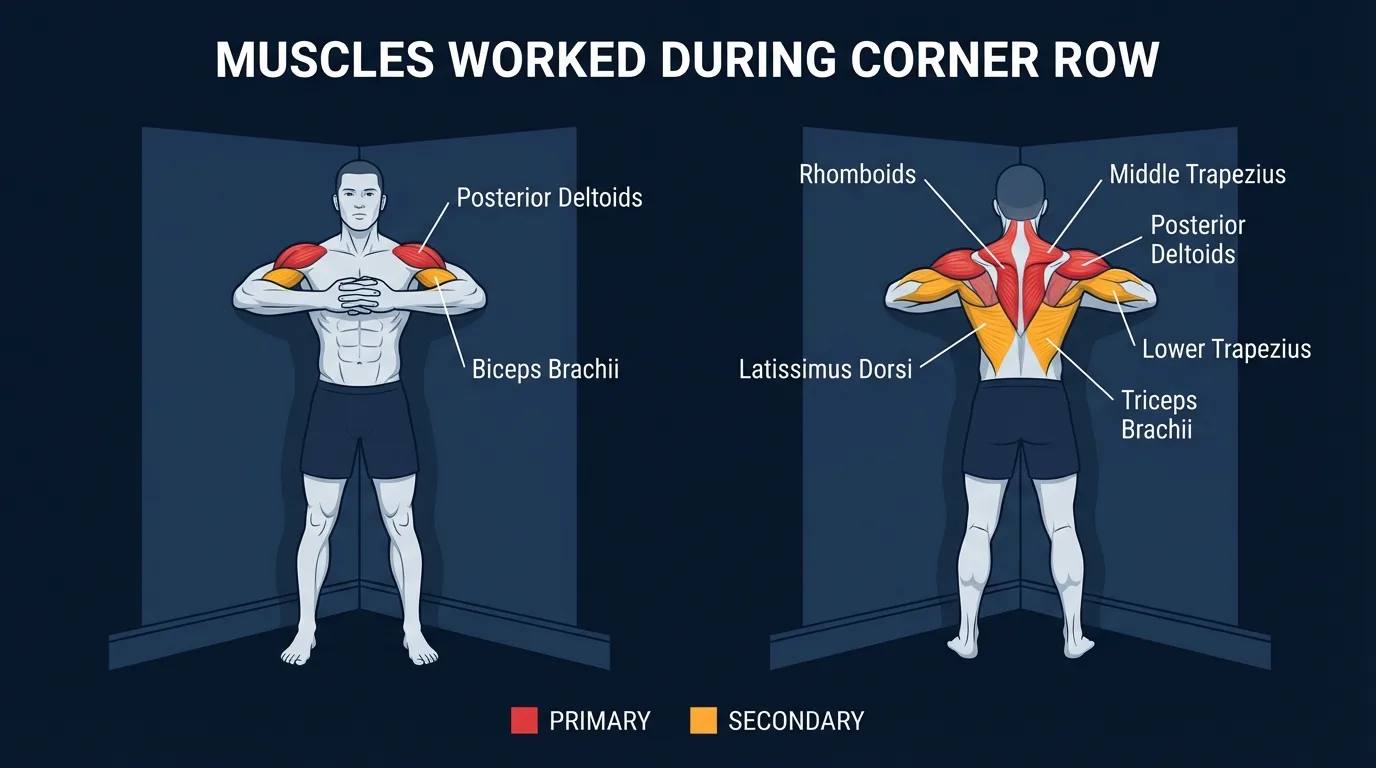
Muscles Worked
Primary movers: the rhomboids (major and minor), middle trapezius, and posterior (rear) deltoids. These are the muscles that retract the scapulae and drive the pulling motion. They shorten as you pull your chest toward the corner (concentric phase) and lengthen under tension as you extend your arms back out (eccentric phase), which is what produces the strength and postural stimulus.
Secondary movers: the latissimus dorsi, biceps brachii, and brachialis. The lats assist with the pull but contribute less than they would on a wider-grip row because the close hand position dictated by the corner keeps the elbows tracking close to the torso. The biceps and brachialis flex the elbow during the pull.
Stabilizers: forearm flexors and extensors hold the grip on the wall edges, the rotator cuff controls the shoulder joint through the pull, and the core (rectus abdominis, transverse abdominis, obliques) plus the glutes hold the body in a rigid line from head to heels. The serratus anterior and lower trapezius assist with scapular control.
Why the close-grip geometry matters: a 2010 study in the Journal of Physical Therapy Science showed that scapular retraction exercises improved upper back muscle activation and reduced forward shoulder posture in desk workers after 8 weeks of training 3 times per week (Lee et al., 2010). The corner row is essentially a loaded scapular retraction movement. The wall corner geometry forces the hands close together, which biases the work toward the rhomboids and mid-traps rather than the lats, making it a precise tool for addressing the postural muscles that desk workers most need.
How to Do a Corner Row (Step-by-Step)
The corner row uses the geometry of an inside wall corner to give you something to pull against. The cues below apply at any foot distance, whether you're starting upright or working toward a more horizontal angle.
Step 1: Stand Facing the Wall Corner
Position yourself at arm's length from a wall corner. Feet about hip-width apart, roughly 2 to 3 feet from the corner. Reach out and grip both edges of the wall at about chest height, one hand on each side of the corner. Your fingers wrap around the wall edges, thumbs resting on the flat surfaces.
Coach Ty's cue: "Make sure the corner edge is solid and your grip is secure before you lean back. A loose grip means you can't lean back far enough to get the load you need."
Step 2: Lean Back and Set Your Body Line
Shift your weight onto your heels and lean back so your arms are fully extended. The wall corner now supports your bodyweight through your grip. Your body should form a straight line from head to heels, core braced, glutes squeezed, chest open. The farther your feet are from the wall, the more horizontal you become and the harder the exercise gets.
Ty's cue: "Beginners, keep your feet closer to the wall for a more upright angle. You can always step them out as you get stronger."
Step 3: Pull Your Chest Toward the Corner
Initiate the movement by squeezing your shoulder blades together, as if pinching something between them. Then bend your elbows and drive them back to pull your chest toward the wall corner. Pull until your chest nearly touches the corner edge. Keep your elbows at roughly 45 degrees relative to your torso. Take 1 to 2 seconds on the pull.
Ty's key cue: "Shoulder blades first, always. The elbows follow. If the biceps are burning but the back feels nothing, you're pulling with the wrong muscles."
Step 4: Lower with Control
Extend your arms to return to the leaned-back starting position. Take 2 to 3 seconds on the descent. This slow eccentric phase builds more strength than dropping back quickly. Reach full arm extension at the bottom and avoid half reps.
Ty's reminder: "Re-check your body line before every rep. If your hips sag, your core is fatiguing. Shorten the set or move your feet closer to the wall."
Get this exercise in a personalized workout
FitCraft, our mobile fitness app, uses its AI coach Ty to program pulling exercises like this into your plan at the right volume and intensity, based on your level, goals, and equipment. Ty was designed and trained by Domenic Angelino, MPH (Brown University) and NSCA-CSCS, with research published in the Journal of Strength and Conditioning Research and Medicine & Science in Sports & Exercise.
Take the Free Assessment Free · 2 minutes · No credit card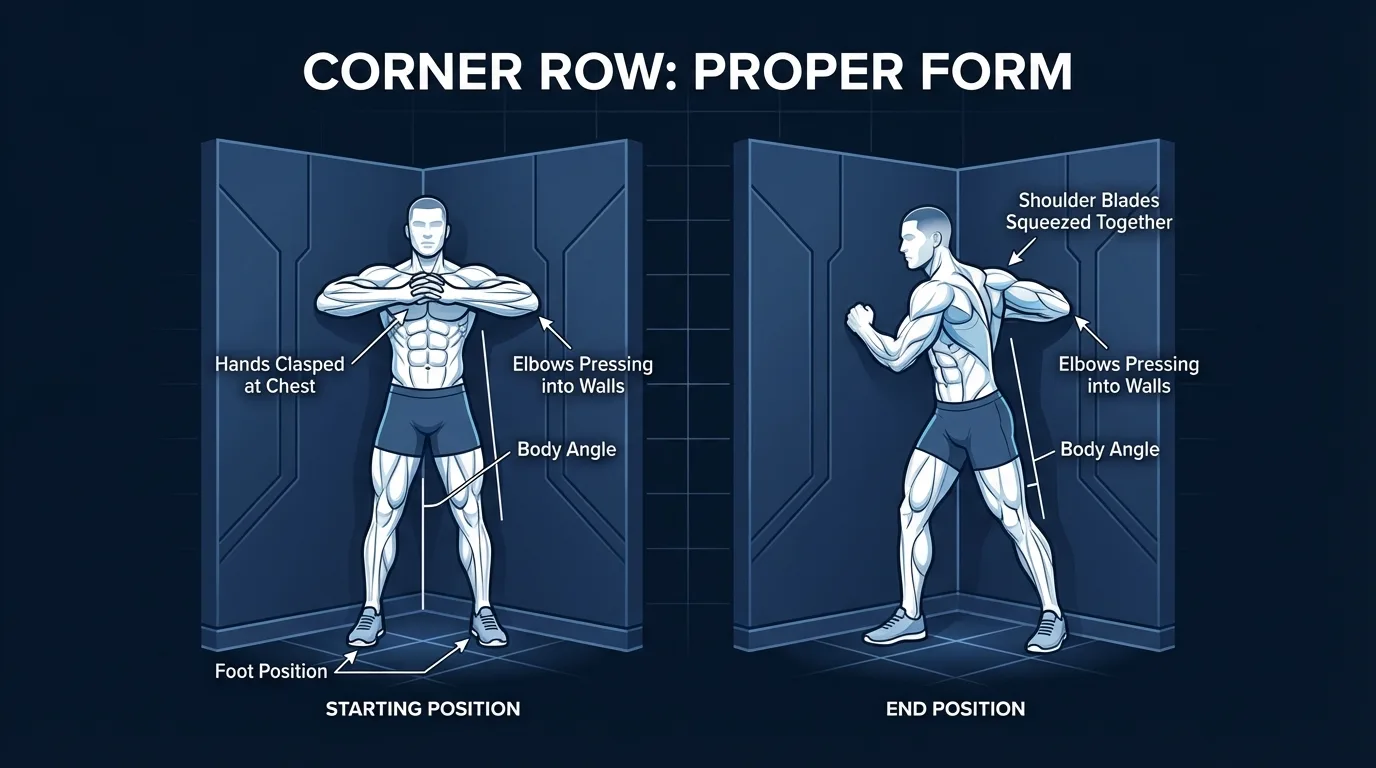
Common Mistakes (and How to Fix Them)
The corner row looks deceptively simple, but these form errors reduce its effectiveness or shift the work away from the target muscles.
- Pulling with the arms instead of the back. Bending the elbows before retracting the shoulder blades means the biceps dominate and the back barely activates. Fix: think "squeeze the shoulder blades" before you think "pull." The first movement should be your shoulders moving back, then the elbows bend.
- Sagging hips. When the core fatigues, the hips drop and the body line breaks. This makes the exercise easier and reduces loading on the back muscles. Keep the glutes squeezed and the core braced throughout. If your hips sag before your back fatigues, your core is the weak link. Build it separately with forearm planks, deadbugs, and bird-dogs.
- Standing too close to the wall. If your feet are right next to the corner, your body stays almost vertical and there is barely any load on the pulling muscles. You're essentially just standing and bending your arms. Step your feet back far enough that you actually have to work to pull yourself in. You should feel your bodyweight being supported by your grip.
- Shrugging the shoulders up. Hiking the shoulders toward the ears during the pull shifts the work to the upper trapezius and neck muscles instead of the mid-back. Actively depress your shoulders, pulling them down and back, throughout every rep. If you feel tension in your neck during corner rows, you're shrugging.
- Weak grip on the corner edge. Your fingers need to wrap solidly around the wall edge. If the corner is sharp or uncomfortable, drape a towel over it for padding. A weak grip means you can't lean back far enough to create a meaningful angle, and the exercise becomes too easy to be useful.
Corner Row Variations: Regressions and Progressions
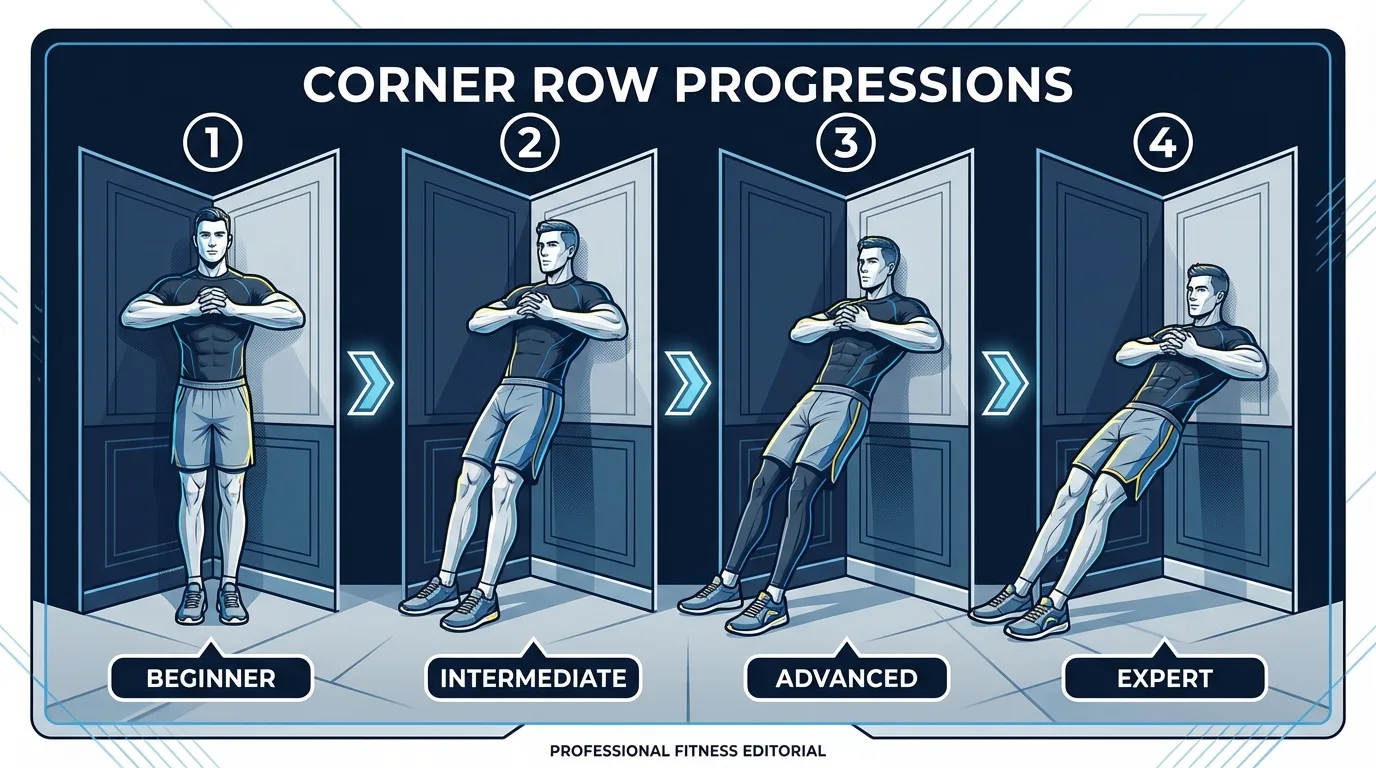
FitCraft's catalog includes 3 corner row variations. Here are all of them, organized by difficulty.
Standard Corner Row (Beginner)
Feet about 2 feet from the wall, body at a moderate angle. This is the version described in the step-by-step above and the one Coach Ty programs most frequently for beginners. The upright angle means you are pulling a manageable percentage of your bodyweight. Build up to 3 sets of 15 with controlled form before progressing.
Deep Corner Row (Beginner-Intermediate)
Feet farther from the wall, roughly 3 to 3.5 feet, so your body is closer to horizontal. The deeper angle increases the percentage of bodyweight you are pulling and makes the exercise meaningfully harder. Grip strength becomes more of a factor here since you're supporting more weight through your hands. If the corner edge is uncomfortable at this angle, wrap a towel around it. The key form difference: your core has to work harder to maintain the body line as the angle drops.
Tempo Corner Row (Intermediate)
Same setup as the deep corner row, but with a prescribed tempo: 2 seconds pulling in, 1 second hold at the top with shoulder blades fully squeezed, 3 seconds lowering back out. The pause at peak contraction forces the mid-back muscles to work under sustained tension. The slow eccentric builds more strength per rep. This variation turns a seemingly simple exercise into something that leaves the rhomboids and mid-traps genuinely fatigued. If you can do 3 sets of 12 tempo corner rows at a deep angle with perfect form, you're ready to progress to inverted rows.
When to Avoid or Modify Corner Rows
Corner rows are safe for most healthy adults, but a few conditions call for modification or temporarily swapping the deeper angles for the upright beginner version. None of these are permanent restrictions. They're starting points. Always consult your physician or physical therapist for personalized guidance.
- Acute shoulder injury or rotator cuff irritation. The press-off and pull pattern can aggravate impingement and recent rotator cuff injuries, especially at deeper body angles. Stay upright (feet close to the wall) and work only within a pain-free range of shoulder blade retraction. If sharp pain persists for more than a week or two, see a physical therapist before progressing the angle.
- Recent shoulder or elbow surgery. Get clearance from your surgeon before any pulling exercise. Most post-surgical protocols start with isolated scapular activation against zero load, then progress to assisted variations like a supported row before introducing bodyweight pulls.
- Tennis elbow or medial/lateral epicondylitis. Grip and pull patterns aggravate elbow tendons. Reduce volume, keep the angle upright (less grip load), and avoid the tempo variation until the tendon settles. Eccentric-only protocols may be appropriate but should be guided by a physical therapist.
- Wrist pain. Gripping the wall corner loads the wrists at a near-neutral angle, which is gentler than push-ups, but sustained grip can still aggravate carpal tunnel or arthritic wrists. Limit set duration, avoid the deep angle (which increases grip load), and consider switching to a supported row with a towel or strap if grip remains painful.
- Lower-back pain that worsens when bracing. If your hips visibly sag and cueing doesn't fix it, the exercise is loading the lumbar spine. Drop to the upright beginner version and rebuild bracing strength with forearm planks, deadbugs, and bird-dogs first.
- First 6 to 8 weeks postpartum or active diastasis recti. The leaned-back body line demands real deep-core engagement. If the core can't hold a neutral spine, the lumbar will sag and intra-abdominal pressure can worsen abdominal separation. Start with very upright standing rows against minimal load, prioritize diaphragmatic breathing and transverse abdominis activation with deadbugs and bird-dogs, and progress only when you can hold a flat body line without doming.
Related Exercises
If corner rows are part of your routine, these movements complement or extend the same training pattern:
- Same muscle group (pull): Inverted Rows and Bent-Over Rows train the same horizontal pull pattern with heavier loading once corner rows feel easy.
- Easier regression: Supported Row and Reverse Row reduce the load further and are useful for users who can't yet maintain a straight body line in a leaned-back position.
- Vertical-pull progression: Chin Negative and Top Chin Hold build the eccentric and isometric strength that bridges into full chin-ups and pull-ups.
- Grip and shoulder foundation: Engaged Hang develops the scapular activation pattern and grip endurance that supports every pulling exercise.
- Core anti-swing foundation: Deadbugs, Bird-Dogs, and Forearm Planks isolate the bracing pattern that keeps your hips from sagging during a row.
- Loaded back accessory: Overhead Pullover and Pull-Apart add isolated lat and rear-deltoid work using dumbbells or a band.
How to Program Corner Rows
Corner row programming follows the same evidence-based ranges as any bodyweight pulling exercise. The American College of Sports Medicine (ACSM) Position Stand on resistance training recommends roughly 8 to 12 reps per set for strength and 12 to 20 for muscular endurance, with at least 48 hours between sessions training the same muscle group (Ratamess et al., 2009).
| Level | Sets × Reps | Rest between sets | Frequency |
|---|---|---|---|
| Beginner (standard, upright angle) | 2–3 × 10–15 | 60–90 seconds | 2–3 sessions/week |
| Beginner-Intermediate (deep angle) | 3 × 8–12 | 90–120 seconds | 2–3 sessions/week |
| Intermediate (tempo, deep angle) | 3–4 × 6–10 | 90–120 seconds | 2–3 sessions/week |
Where in your workout: Corner rows work best near the beginning of an upper-body session, when your grip and back are fresh. Pulling is grip-limited, and gripping a wall corner is more demanding than gripping a bar, so don't push corner rows to the end of a fatigued workout. Pair them with push-ups for a balanced push/pull pairing, doing the rows first when grip is sharp.
Form floor over rep targets: if your last 2 reps of a set break form (hips sagging, shoulders shrugging, elbows leading the pull), stop the set there. Hitting a target rep count with broken form is worse than hitting fewer reps cleanly.
How FitCraft Programs This Exercise
Knowing how to do a corner row is step one. Knowing when to do it, which variation matches your level, and when to progress is where most people get stuck.
FitCraft's AI coach Ty handles that. During your personalized diagnostic assessment, Ty maps your fitness level, goals, and available equipment. Then Ty builds a personalized program that slots corner rows into a balanced training plan at the right variation for your level.
As you get stronger, Ty adjusts the variation and volume to match your level. The upright standard angle becomes a deeper angle. The deep angle gets layered with tempo. Eventually corner rows hand off to inverted rows when you have a sturdy table or bar available. Every program is designed by an Ivy League-trained exercise scientist and NSCA-certified strength coach using evidence-based periodization, then adapted to you by the AI. The 3D demonstrations are especially useful for this exercise because the shoulder blade retraction and body angle details are easier to see from Ty's camera angles than to learn from text descriptions alone.
Frequently Asked Questions
Can I do corner rows if I have shoulder pain?
Mild posterior shoulder fatigue is normal during corner rows because the rear deltoids and rhomboids are the target. Sharp pain in the front of the shoulder, the rotator cuff, or the AC joint is a sign to stop. The press-off and pull pattern can aggravate impingement and recent rotator cuff injuries. Modify by keeping your feet closer to the wall to reduce the angle and load, work only within a pain-free range, and limit shoulder blade retraction to where it feels neutral. If sharp pain persists for more than a week or two, see a physical therapist before continuing. Get clearance from your surgeon if you've had recent shoulder surgery.
What muscles do corner rows work?
Corner rows primarily target the rhomboids, middle trapezius, and rear deltoids, with secondary activation of the latissimus dorsi, biceps, and core stabilizers. Because of the close hand position dictated by the wall corner, corner rows emphasize the mid-back muscles more than wider-grip pulling variations like inverted rows.
How is a corner row different from a regular bodyweight row?
A standard bodyweight row (inverted row) has you hanging under a bar or table with your feet on the ground and your body nearly horizontal. A corner row is done standing: your feet stay firmly planted, you grip the edges of an inside wall corner at chest height, and you lean back and pull your chest toward the corner. There is no bar, no hanging, and no horizontal body position. This makes corner rows accessible to beginners who cannot yet support their bodyweight in a hanging position.
How many corner rows should I do?
Beginners start with 2 to 3 sets of 10 to 15 reps. Adjust difficulty by changing your foot distance from the wall, with farther away being harder. When you can do 3 sets of 15 with controlled form at a challenging angle, progress to the deep or tempo variation, or move to inverted rows if you have a bar or sturdy table available.
Are corner rows good for fixing posture?
Corner rows directly strengthen the rhomboids and middle trapezius, the muscles responsible for pulling your shoulder blades back and down. Weak mid-back muscles are a primary contributor to rounded shoulders and forward head posture. The standing setup with feet firmly grounded also makes corner rows accessible for deconditioned desk workers who find floor-based back exercises awkward.