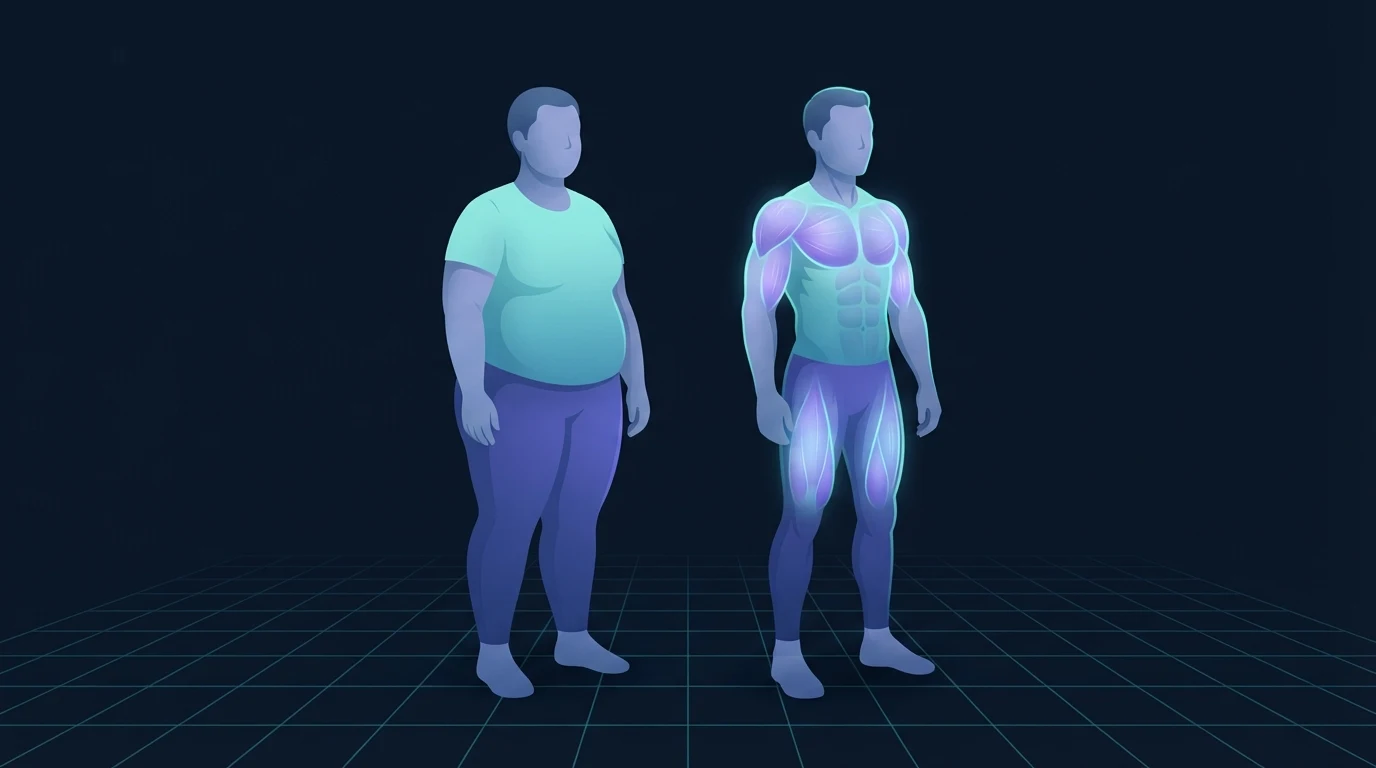
The phrase "muscle weighs more than fat" is one of the most repeated lines in fitness, and taken literally it is false. Weight is weight. A pound of feathers, a pound of lead, a pound of fat and a pound of muscle all weigh one pound. What people are actually reaching for is a claim about density, and that claim is true. It is also smaller than most people assume, and it is not the main reason the scale disappoints you.
This matters because the misunderstanding cuts both ways. Some people use it as a shield and tell themselves a stalled scale must be muscle gain when it is not. Others panic when the number rises in week two of a new program and quit, when the increase was water bound to newly stored glycogen. Both mistakes come from treating one number as a body composition report.
Here is what the measurement literature actually says: the real density values, how much volume the difference buys you, why weight moves for reasons that have nothing to do with fat, and what to measure instead.
What Does the Density Research Actually Say?
Fat was measured at 0.9007 g/mL in 1953
The number most body composition math still runs on comes from Fidanza, Keys and Anderson (1953), published in the Journal of Applied Physiology. They measured the density of human body fat and reported 0.9007 g/mL at 37 degrees Celsius, body temperature. Fat is lighter than water, which is why body fat floats and why hydrostatic weighing works at all.
A decade later, Brozek, Grande, Anderson and Keys (1963) published the revision of densitometry assumptions in the Annals of the New York Academy of Sciences that gave the field its companion figure: fat-free mass at 1.100 g/cm3. Every two-compartment body fat estimate, including the underwater weighing that DXA later replaced, rests on that pair of constants.
Skeletal muscle sits near 1.06 g/cm3
Fat-free mass includes bone, which is much denser than muscle, so muscle on its own is a little lighter than the 1.100 figure. The value used across biomechanics is 1.0597 g/cm3, usually rounded to 1.06. Ward and Lieber (2005), writing in the Journal of Biomechanics, pointed out that this widely used constant was originally derived from unfixed rabbit and canine tissue rather than human muscle. They measured cadaveric human muscle samples and reported 1.112 g/cm3 in 4 percent formaldehyde-fixed tissue and 1.055 g/cm3 in 37 percent fixed tissue, noting that using the wrong value introduces 5 to 10 percent errors downstream.
So the honest statement is a range, not a point. Muscle sits somewhere around 1.06 g/cm3, and depending on which constant you pick it is 15 to 20 percent denser than fat. Here is what that buys you in actual volume.
| Tissue | Density | Volume of one pound | Volume of one kilogram |
|---|---|---|---|
| Body fat (Fidanza 1953, at 37 C) | 0.9007 g/mL | 504 mL, about 2.1 US cups | 1,110 mL |
| Skeletal muscle (conventional value) | 1.06 g/cm3 | 428 mL, about 1.8 cups | 943 mL |
| Fat-free mass (Brozek 1963, two-compartment model) | 1.100 g/cm3 | 412 mL, about 1.7 cups | 909 mL |
Read the middle column again, because it is the whole article in one line. The difference between a pound of fat and a pound of muscle is about 76 mL, roughly a third of a cup. Swap ten pounds of fat for ten pounds of muscle and you have removed about three cups of volume from your body. Distributed across a whole torso and four limbs, that is a real change in how a waistband sits. It is not the internet-photo transformation people picture when they imagine the difference.

Why Does the Scale Go Up When You Start Training?
Beginners who start lifting often gain weight in the first two weeks and conclude the program is backfiring. Almost none of that is fat, and almost none of it is new muscle protein either. It is water, and the mechanism is well characterised. If that is where you are right now, our blog post on why you gain weight while working out breaks the first eight weeks down mechanism by mechanism.
Muscle stores carbohydrate as glycogen, and glycogen is stored hydrated. Fernandez-Elias, Ortega, Nelson and Mora-Rodriguez (2015), in the European Journal of Applied Physiology, tested the textbook ratio directly. Nine aerobically trained subjects cycled for 150 minutes in a hot dry environment until they had dehydrated by 4.6 percent, then refed 250 g of carbohydrate. Muscle biopsies taken before, one hour after and four hours after exercise confirmed the long-held figure: at least 3 g of water is stored in muscle per gram of glycogen, and the ratio ran far higher when fluid losses were fully replaced.
The arithmetic follows. Training increases how much glycogen your muscles hold. Add 300 g of stored glycogen and you have added at least 900 g of water with it: about 1.2 kg, or 2.6 pounds, appearing on the scale inside two weeks with zero fat gain. Eat more carbohydrate than usual for two days and you can move the same number in the other direction, which is where most "I lost four pounds this week" stories come from.
Weight also has a predictable weekly rhythm. Orsama and colleagues (2014) analysed 4,657 daily weight measurements from 80 adults tracked for 15 to 330 days and published the pattern in Obesity Facts. Weight peaked on Sunday and Monday, started falling on Tuesday, and started rising again on Saturday. The compensation pattern was strongest in the people who lost or maintained weight and weakest in those slowly gaining. Their conclusion was blunt: weekend-to-weekday variation should be treated as normal rather than as a sign of weight gain. A Monday weigh-in compared against last Thursday is measuring the day of the week.
Get an evidence-based plan built for you
FitCraft, our mobile fitness app, pairs you with an AI coach who builds you a personalized plan around your goals, schedule, and fitness level. Every FitCraft program is designed by Domenic Angelino, MPH (Brown University) and NSCA-CSCS, with research published in the Journal of Strength and Conditioning Research and Medicine & Science in Sports & Exercise.
Take the Free Assessment Free • 2 minutes • No credit cardCan You Lose Fat and Gain Muscle at the Same Time?
This is where the density point stops being trivia and starts mattering. If you lose fat and add lean tissue at the same rate, the scale does not move at all. That is not failure. It is the outcome most people say they want, arriving in the one form they are not equipped to see.
The cleanest demonstration is Demling and DeSanti (2000) in Annals of Nutrition and Metabolism. They randomised 38 overweight police officers to 12 weeks on one of three protocols: a hypocaloric diet alone, or the same diet plus resistance training plus 1.5 g/kg/day of protein from either a casein hydrolysate or a whey hydrolysate. Every group lost roughly 2.5 kg of body weight. Underneath that identical scale result:
- Diet alone: 2.5 kg of fat lost, no change in lean mass. Body fat moved from 27 to 25 percent.
- Diet plus training plus whey: 4.2 kg of fat lost, 2 kg of lean mass gained. Body fat moved from 27 to 23 percent. Strength up 29 percent.
- Diet plus training plus casein: 7.0 kg of fat lost, 4 kg of lean mass gained. Body fat moved from 26 to 18 percent. Strength up 59 percent.
Three groups, one scale number, three completely different bodies at the end. If you had judged those officers on weight alone you would have called the whole intervention a wash.
Longland, Oikawa, Mitchell, Devries and Phillips (2016) pushed the same idea harder in the American Journal of Clinical Nutrition. Forty young men spent four weeks in a roughly 40 percent energy deficit while resistance training and doing high-intensity intervals six days a week, split between 1.2 and 2.4 g/kg/day of protein, with body composition measured by a four-compartment model. The higher-protein group gained 1.2 kg of lean mass and lost 4.8 kg of fat. The lower-protein group gained 0.1 kg and lost 3.5 kg. Gaining lean tissue during a severe deficit is possible, and protein is the lever.
Barakat, Pearson, Escalante, Campbell and De Souza (2020) reviewed this literature for the Strength and Conditioning Journal and reached the sensible synthesis: simultaneous fat loss and lean gain is best documented in people who are untrained, carrying more body fat, or returning after a layoff, and it stays achievable in trained lifters given genuinely progressive overload and elevated protein intake. Our deeper writeup on what the body recomposition research shows covers the protocol variables in full, and the skinny fat research page covers the specific case where weight looks fine and composition does not.
What Should You Measure Instead of Body Weight?
None of this means throw the scale away. It means demoting it from verdict to data point, and pairing it with measurements that can see what it cannot.
Ross and colleagues (2020), writing for the IAS and ICCR Working Group on Visceral Obesity in Nature Reviews Endocrinology, made the clinical version of this argument. Their consensus statement recommended that waist circumference be measured routinely alongside body weight and BMI, because weight alone says nothing about where tissue sits, and abdominal fat carries risk that total mass does not capture.
| What to track | What it catches that weight misses | How often |
|---|---|---|
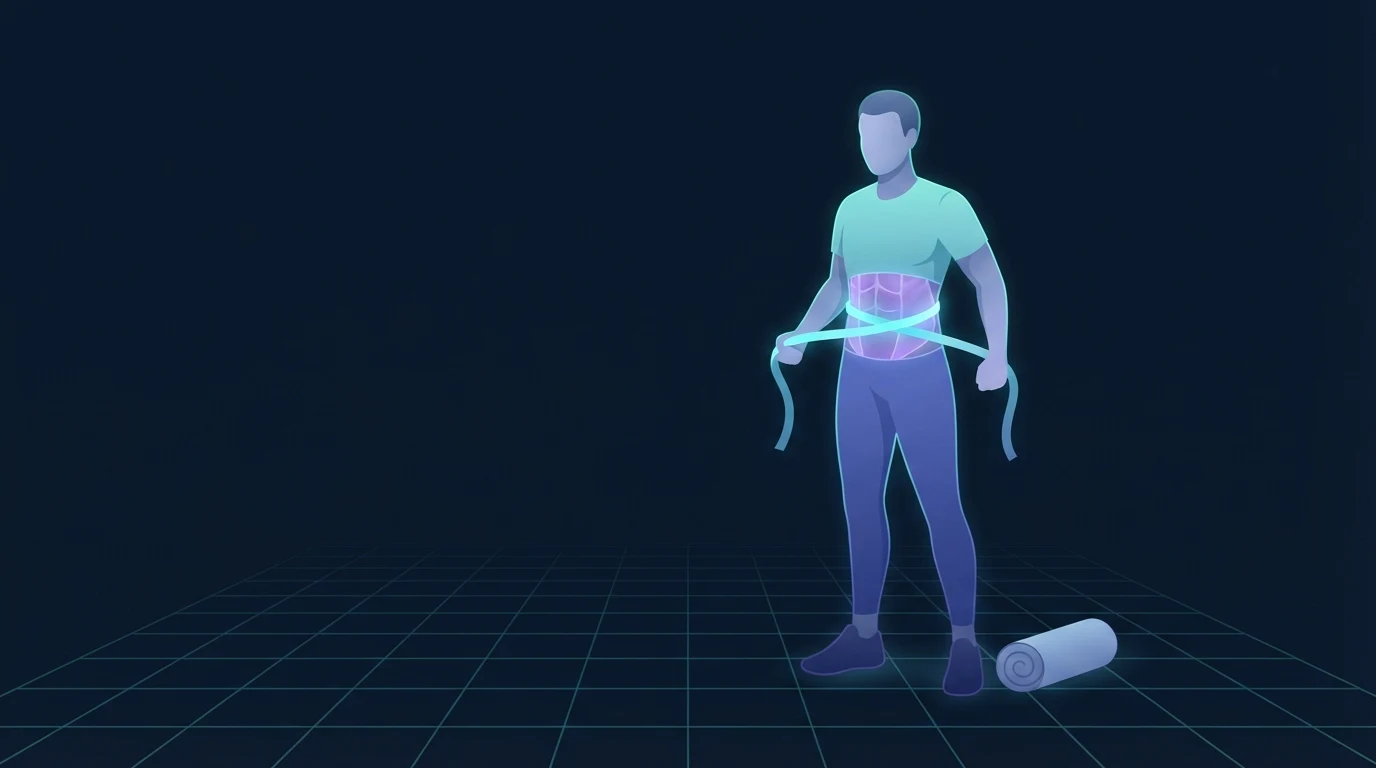
| Waist circumference, tape level at the navel, relaxed exhale | Abdominal and visceral fat change at a stable weight. The measure Ross (2020) argues belongs beside every weigh-in. | Every 2 weeks, same time of day |
| Rolling 7-day average weight | The trend underneath water noise and the Sunday-to-Thursday rhythm Orsama (2014) documented | Weigh daily, read weekly |
| Load and reps on 2 or 3 lifts | The cheapest available proxy for lean tissue change. Strength climbed 29 to 59 percent in the Demling (2000) training groups. | Every session |
| Photos, same light, same pose, same time of day | Shape change while the number is flat, which is exactly what recomposition looks like from outside | Every 4 weeks |
| How clothes fit at the waist and shoulders | Volume redistribution. This is the density gap in the table above, made wearable. | Continuous, no equipment |
| A body fat estimate (tape-based, bioimpedance or DXA) | The split itself, with the caveat that consumer methods carry wide error bars and are best read as a trend | Every 8 to 12 weeks |
If you want a starting estimate without a lab, our body fat calculator runs the US Navy tape method, which needs nothing but a tape measure. Treat its output the way you should treat a bathroom scale: useful as a series, unreliable as a single reading.
Why This Matters for Your Training
The practical damage from the muscle-versus-fat confusion is that people quit during the exact stretch where the program is working. Weeks one and two bring glycogen water and a rising number. Weeks four through twelve, if resistance training and protein are in place, bring a composition change that a scale is structurally incapable of reporting. Somewhere in that window people conclude nothing is happening and stop.
The fix is choosing a feedback signal that responds to what you are actually doing. Load on the bar responds to training within days. Waist circumference responds to fat loss within a couple of weeks. Both are honest, and neither one lies to you on a Monday because you ate pasta on Saturday.
It also changes what a good program should look like. If composition rather than mass is the target, resistance training stops being the optional add-on to a diet and becomes the part that decides which tissue you lose. Demling's diet-only group is the control condition for what happens without it. If you are choosing an app to run that side of things, our roundup of the best workout apps for weight loss ranks the options on whether they actually program progressive resistance work rather than just counting calories.
Common Misconceptions
"Muscle weighs more than fat, so my weight gain is fine"
Sometimes it is, in the first fortnight, and mostly as water. Beyond that, untrained beginners in a modest deficit gain lean mass at a rate measured in single kilograms over months, not weeks. Longland's high-protein group gained 1.2 kg of lean mass in four weeks of supervised, six-days-a-week training, and that is close to a ceiling for the trained-hard, fed-well scenario. If your weight is climbing steadily over three months with no strength gain and a growing waist measurement, the tissue involved is not muscle.
"A pound of muscle burns 50 calories a day"
Resting skeletal muscle is metabolically modest, roughly 6 kcal per pound per day, against about 2 kcal per pound per day for fat tissue. Adding five pounds of muscle moves resting burn by about 20 kcal a day, not 250. Resistance training earns its place through what it does to composition, strength and function, not through a large shift in resting metabolic rate.
"The scale is useless"
It is a perfectly good instrument that answers one narrow question accurately. The failure is interpretive, not mechanical. Read it as a seven-day average alongside a tape measure and it becomes useful again.
References
- Fidanza F, Keys A, Anderson JT. "Density of body fat in man and other mammals." J Appl Physiol. 1953;6(4):252-256. doi:10.1152/jappl.1953.6.4.252
- Brozek J, Grande F, Anderson JT, Keys A. "Densitometric analysis of body composition: revision of some quantitative assumptions." Ann N Y Acad Sci. 1963;110(1):113-140. doi:10.1111/j.1749-6632.1963.tb17079.x
- Ward SR, Lieber RL. "Density and hydration of fresh and fixed human skeletal muscle." J Biomech. 2005;38(11):2317-2320. doi:10.1016/j.jbiomech.2004.10.001
- Fernandez-Elias VE, Ortega JF, Nelson RK, Mora-Rodriguez R. "Relationship between muscle water and glycogen recovery after prolonged exercise in the heat in humans." Eur J Appl Physiol. 2015;115(9):1919-1926. doi:10.1007/s00421-015-3175-z
- Orsama AL, Mattila E, Ermes M, van Gils M, Wansink B, Korhonen I. "Weight rhythms: weight increases during weekends and decreases during weekdays." Obes Facts. 2014;7(1):36-47. doi:10.1159/000356147
- Demling RH, DeSanti L. "Effect of a hypocaloric diet, increased protein intake and resistance training on lean mass gains and fat mass loss in overweight police officers." Ann Nutr Metab. 2000;44(1):21-29. doi:10.1159/000012817
- Longland TM, Oikawa SY, Mitchell CJ, Devries MC, Phillips SM. "Higher compared with lower dietary protein during an energy deficit combined with intense exercise promotes greater lean mass gain and fat mass loss: a randomized trial." Am J Clin Nutr. 2016;103(3):738-746. doi:10.3945/ajcn.115.119339
- Barakat C, Pearson J, Escalante G, Campbell B, De Souza EO. "Body recomposition: can trained individuals build muscle and lose fat at the same time?" Strength Cond J. 2020;42(5):7-21. doi:10.1519/SSC.0000000000000584
- Ross R, Neeland IJ, Yamashita S, et al. "Waist circumference as a vital sign in clinical practice: a Consensus Statement from the IAS and ICCR Working Group on Visceral Obesity." Nat Rev Endocrinol. 2020;16(3):177-189. doi:10.1038/s41574-019-0310-7
Frequently Asked Questions
Does muscle weigh more than fat?
No. A pound of muscle and a pound of fat both weigh exactly one pound. The phrase people are reaching for is density, not weight. Muscle is denser than fat, so a pound of muscle occupies less space than a pound of fat. Fidanza, Keys and Anderson (1953) measured the density of human body fat at 0.9007 g/mL at body temperature. Brozek and colleagues (1963) set the density of fat-free mass at 1.100 g/cm3 in the classic two-compartment model. That makes fat-free tissue about 22 percent denser than fat, so a pound of fat takes up about 22 percent more volume than a pound of fat-free tissue.
How much denser is muscle than fat, in real numbers?
Using the density value most commonly applied to skeletal muscle, 1.06 g/cm3, muscle is about 18 percent denser than fat. One pound of fat occupies roughly 504 mL, about 2.1 US cups. One pound of muscle occupies roughly 428 mL, about 1.8 cups. The difference is about 76 mL per pound, which is a third of a cup. Ten pounds of fat swapped for ten pounds of muscle is a volume change of roughly three cups, spread across your whole body. That is a visible change in how clothes fit at an unchanged scale weight, but it is not the dramatic transformation that side-by-side internet photos imply.
Why did I gain weight after I started lifting?
Water, in almost every case. Muscle stores carbohydrate as glycogen, and glycogen is stored with water. Fernandez-Elias and colleagues (2015) took muscle biopsies from nine trained cyclists during recovery and confirmed the long-held ratio of at least 3 g of water stored per gram of glycogen. Training raises how much glycogen your muscles hold, so topping up 300 g of glycogen brings roughly 900 g of water with it. That is about 1.2 kg, or 2.6 pounds, of scale weight that is neither fat nor muscle protein. It appears in the first week or two of training and it is not fat gain.
Can you lose fat and gain muscle at the same time?
Yes, and the clearest demonstration is Demling and DeSanti (2000), who put 38 overweight police officers through 12 weeks of dieting. All three groups lost about the same 2.5 kg of body weight. The diet-only group lost 2.5 kg of fat and gained no lean mass. The group that added resistance training and 1.5 g/kg/day of protein from a casein hydrolysate lost 7.0 kg of fat and gained 4 kg of lean mass, moving from 26 to 18 percent body fat. Identical scale change, completely different bodies. Longland and colleagues (2016) replicated the pattern in 40 young men over four weeks: on 2.4 g/kg/day of protein the men gained 1.2 kg of lean mass and lost 4.8 kg of fat during a 40 percent energy deficit.
What should I measure instead of body weight?
Measure waist circumference, track a rolling average of daily weights rather than single readings, take monthly photos in the same light and pose, and log the load and reps on two or three lifts. Ross and colleagues (2020), writing for the IAS and ICCR Working Group on Visceral Obesity, recommended that waist circumference be measured routinely alongside body weight and BMI, because weight alone misses where the fat sits. Strength progression is the cheapest available proxy for lean tissue change. Orsama and colleagues (2014) showed why single weigh-ins mislead: across 4,657 daily weights from 80 adults, body weight predictably peaked on Sunday and Monday and fell through the week.
Is BMI useless if I carry a lot of muscle?
It is not useless, but it is blind to composition. BMI is mass divided by height squared, and it cannot tell dense lean tissue from fat. A heavily muscled person and a person carrying substantial fat can share a BMI. That is precisely why the Ross and colleagues (2020) consensus statement argued for waist circumference as a routine companion measure rather than a replacement: the pair together says something about how much you weigh and where the tissue sits, which neither number does alone.
Does a pound of muscle burn a lot more calories than a pound of fat?
It burns more, but far less than fitness marketing claims. Resting skeletal muscle is metabolically modest, in the range of roughly 6 kcal per pound per day, versus about 2 kcal per pound per day for adipose tissue. Gaining five pounds of muscle does not add hundreds of calories to your daily burn. The real metabolic value of resistance training comes from the training itself and from what carrying more lean tissue lets you do, not from a large shift in resting metabolic rate.