Most online body fat calculators do one of two things. They quietly run a BMI-based estimate (the Deurenberg equation, with a published standard error around 5 percentage points) and present a single decimal figure as if it were measured, or they use the US Navy circumference method without telling you the citation, the validation correlation, or the error bar.
This calculator does the Navy method honestly. It cites the original 1984 Naval Health Research Center technical reports by Hodgdon and Beckett, shows the validated correlation against hydrostatic underwater weighing (r=0.90), and prints an explicit confidence interval next to the percentage. Because field methods always carry uncertainty, hiding the error bar is the most common and most misleading thing a body fat tool can do.
How this calculator works
The default mode runs the US Navy circumference equations developed by Hodgdon and Beckett (1984) at the Naval Health Research Center in San Diego. These were derived from regression analyses on a large Navy population and validated against hydrostatic underwater weighing, the field's reference standard at the time. The published correlation was r=0.90, and the standard error of estimate is approximately 3 to 4 percentage points.
The two equations are sex-specific because male and female fat distribution patterns differ enough that a single equation cannot fit both well. For men, body fat percentage is calculated as 495 / (1.0324 - 0.19077 × log10(waist - neck) + 0.15456 × log10(height)) - 450, with all measurements in centimeters. For women, the equation adds hip circumference: 495 / (1.29579 - 0.35004 × log10(waist + hip - neck) + 0.22100 × log10(height)) - 450.
The optional skinfold modes use the 3-site and 7-site Jackson-Pollock equations from Jackson and Pollock (1978, Br J Nutr) for men and Jackson, Pollock, and Ward (1980, Med Sci Sports Exerc) for women. These were also validated against hydrostatic weighing, with a standard error around 3.5 percentage points (Peterson et al. 2003 later cross-validated the equations against a 4-compartment model). The Jackson-Pollock equations produce a body density figure, which the calculator then converts to body fat percentage using the Siri (1961) two-compartment formula: %BF = (495 / density) - 450.
The 7-site mode uses the generalized sum-of-seven equations from the same two papers. For men: density = 1.112 - 0.00043499 × S + 0.00000055 × S² - 0.00028826 × age. For women: density = 1.097 - 0.00046971 × S + 0.00000056 × S² - 0.00012828 × age, where S is the sum of the chest, midaxillary, triceps, subscapular, abdomen, suprailiac, and thigh skinfolds in millimeters. Both papers report standard errors close to the 3-site versions (about 0.008 g/ml of body density, roughly 3.5 percentage points of body fat), so the 7-site protocol is not meaningfully more accurate on paper. Its practical advantage is that one badly pinched site contributes less to the total.
Once a body fat percentage is computed, the calculator derives lean body mass as weight × (1 - BF%/100) and fat mass as weight × BF%/100. The category label maps the percentage onto the sex-specific bands published in the ACSM Guidelines for Exercise Testing and Prescription, which themselves draw on data from the National Health and Nutrition Examination Survey and earlier work by Heyward and Wagner.
Body composition categories (ACSM standards)
The ACSM publishes sex-specific body fat categories grounded in measured cardiometabolic and functional outcomes. These are the bands the calculator uses for the colored category pill.
- Essential fat: 2 to 5 percent (men), 10 to 13 percent (women). The minimum required for normal physiology. Female essential fat is higher because of reproductive and hormonal physiology, and that is biologically normal.
- Athlete: 6 to 13 percent (men), 14 to 20 percent (women). Typical for competitive endurance and strength athletes.
- Fitness: 14 to 17 percent (men), 21 to 24 percent (women). Visible muscle definition, low cardiometabolic risk.
- Acceptable: 18 to 24 percent (men), 25 to 31 percent (women). Within healthy population norms.
- Obese: 25 percent or higher (men), 32 percent or higher (women). Elevated risk for metabolic disease independent of BMI.
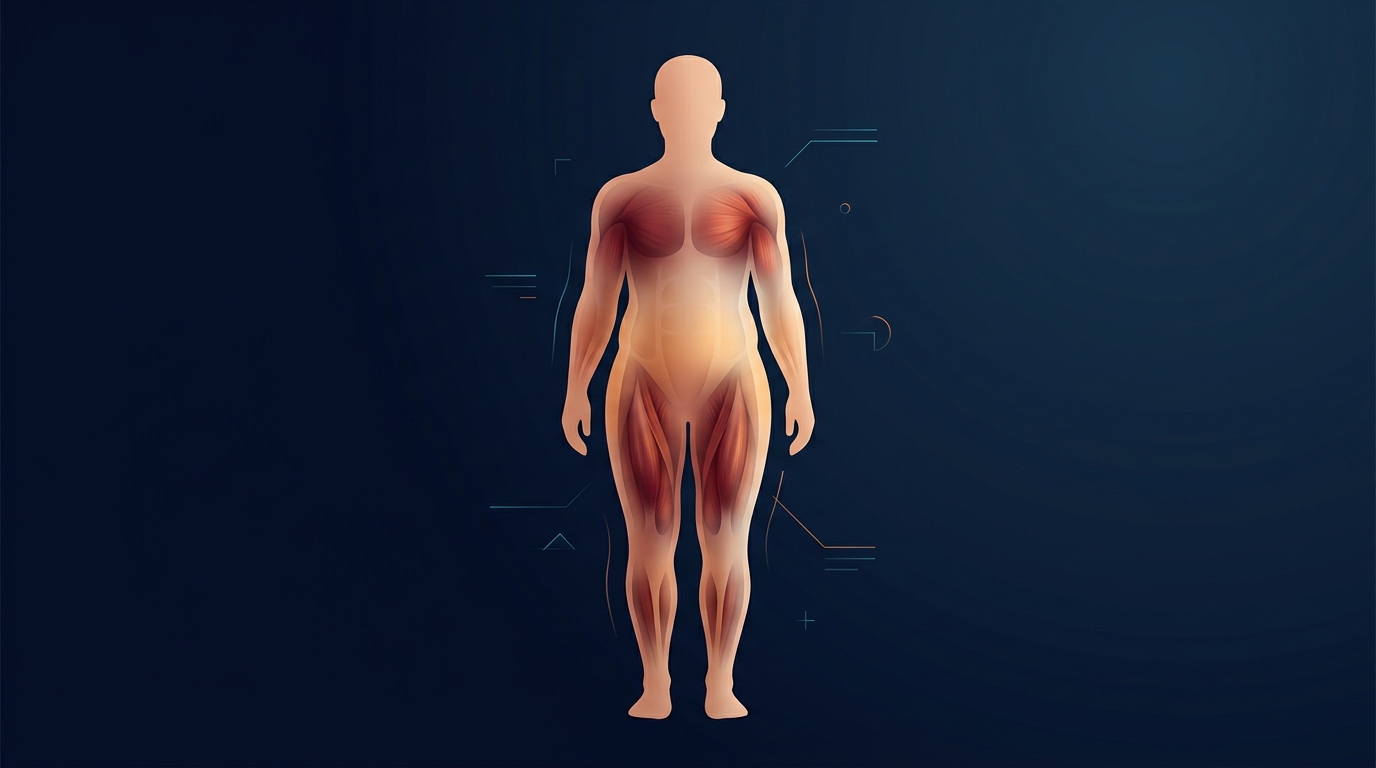
Two notes on the category bands. First, very low body fat is not safer than the acceptable range. Sustained essential-fat-zone body composition in non-athletes is associated with hormonal disruption, bone density loss, and immune impairment. Second, the bands shift slightly with age; ACSM allows a few percentage points more in older adults because some normal age-related fat redistribution is expected.
How to take the measurements correctly
Neck circumference
Stand upright, look straight ahead, and let your shoulders relax. Wrap a flexible cloth or vinyl tape around your neck just below the larynx (Adam's apple in men). The tape should be level and snug against the skin, not compressed. If the tape sinks into the skin, it's too tight. If you can slide a finger under it, it's too loose.
Waist circumference
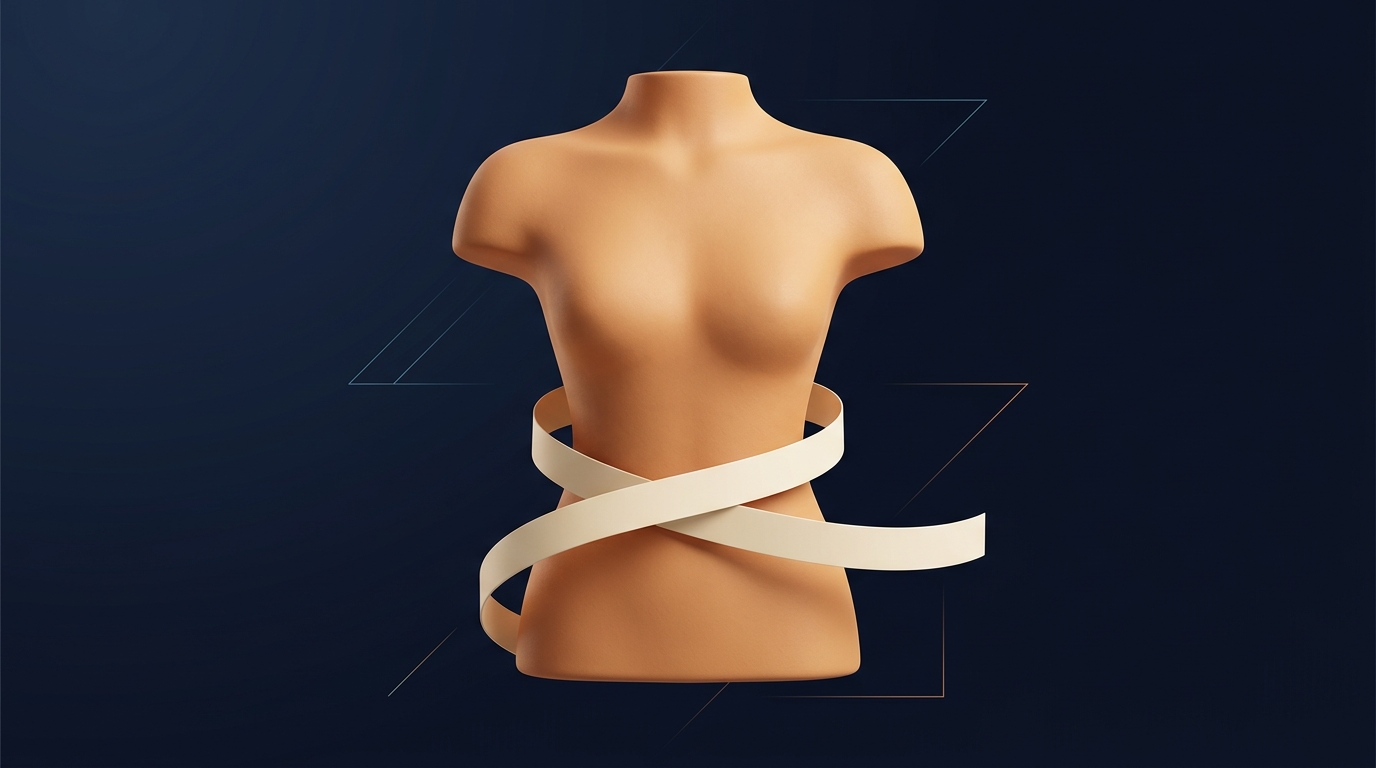
For men, the Navy protocol measures at the level of the navel. For women, it measures at the narrowest point between the bottom of the rib cage and the top of the hip bones. The tape stays parallel to the floor and is read after a normal exhale, never after sucking in. Holding the breath or pulling the abdomen in will give an artificially low reading and overstate your leanness.
Hip circumference (women only)
Stand with feet together. Wrap the tape around the widest point of the buttocks, keeping it parallel to the floor on both sides. The hip measurement is what makes the female equation as accurate as the male equation, so it cannot be skipped or estimated.
Skinfolds (3-site and 7-site Jackson-Pollock)
The 3-site Jackson-Pollock protocol uses chest, abdomen, and thigh in men, and tricep, suprailiac, and thigh in women. All sites are measured on the right side of the body. Pinch the skin and underlying fat between thumb and forefinger an inch above the marked site, lift it cleanly off the muscle, place the caliper jaws perpendicular to the fold direction at the marked site, and release the trigger. Read after roughly two seconds, before the fat compresses fully. Take three readings at each site and average them. The technique requires real practice; the published 3 to 4 percent accuracy assumes a trained tester.
The 7-site protocol adds four sites and uses the same seven for both sexes: chest (diagonal fold between the nipple and the front of the armpit), midaxillary (vertical fold on the side of the torso, level with the bottom of the sternum), triceps (vertical fold on the back of the upper arm, midway between shoulder and elbow), subscapular (diagonal fold just below the lower tip of the shoulder blade), abdomen (vertical fold 2 cm to the right of the navel), suprailiac (diagonal fold just above the front of the hip bone), and thigh (vertical fold on the front of the thigh, midway between hip and knee). Enter each site in millimeters; the calculator sums them and applies the age-adjusted equation for your sex.
Worked examples (for quick reference)
Six common scenarios calculated with the Navy circumference method, so you can sanity-check the tool against your own measurements.
| Person | Measurements | Body fat % | Lean / fat mass |
|---|---|---|---|
| Man, 5'10", 176 lb178 cm, 80 kg | Neck 15.0"38 cm, waist 34.6"88 cm | 18.7% (acceptable) | 143.3 lb lean / 33.1 lb fat65.0 kg lean / 15.0 kg fat |
| Man, 6'0", 198 lb183 cm, 90 kg | Neck 15.7"40 cm, waist 37.4"95 cm | 21.4% (acceptable) | 155.9 lb lean / 42.5 lb fat70.7 kg lean / 19.3 kg fat |
| Man, 5'9", 165 lb175 cm, 75 kg, lean | Neck 14.6"37 cm, waist 30.7"78 cm | 12.0% (athlete) | 145.5 lb lean / 19.8 lb fat66.0 kg lean / 9.0 kg fat |
| Woman, 5'5", 137 lb165 cm, 62 kg | Neck 12.6"32 cm, waist 28.3"72 cm, hip 37.8"96 cm | 26.4% (acceptable) | 100.5 lb lean / 36.2 lb fat45.6 kg lean / 16.4 kg fat |
| Woman, 5'7", 143 lb170 cm, 65 kg, athletic | Neck 12.6"32 cm, waist 27.6"70 cm, hip 36.2"92 cm | 22.0% (fitness) | 111.8 lb lean / 31.5 lb fat50.7 kg lean / 14.3 kg fat |
| Woman, 5'3", 154 lb160 cm, 70 kg | Neck 13.0"33 cm, waist 33.1"84 cm, hip 40.9"104 cm | 37.1% (obese) | 97.0 lb lean / 57.3 lb fat44.0 kg lean / 26.0 kg fat |
Knowing your body fat is one number. Changing it takes a plan.
FitCraft's AI coach Ty builds a personalized training and nutrition plan based on your starting point and your goals. Free version available.
Take the Free Assessment Free • 2 minutes • No credit cardNavy method vs. Jackson-Pollock skinfolds: which to use
Which method should I use? Use the US Navy tape method unless you own a quality caliper and have been trained to use it. If you do have calipers, the 3-site protocol is enough for routine tracking and takes under two minutes. Pick the 7-site protocol when you want a single measurement to lean on for a while, when your fat distribution is unusual for your sex (for example, a woman who stores fat on the trunk more than the hips, or a man with heavy lower-body fat), or when the tester is still building technique, because a mistake at one of seven sites moves the total less than a mistake at one of three. Whatever you pick, use the same method, the same tester, and the same time of day every time.
Both methods carry roughly the same published error band against hydrostatic underwater weighing, around 3 to 4 percentage points of standard error. The decision tree is mostly practical.
Use the Navy circumference method if you do not own a quality skinfold caliper, if you have never been formally trained on caliper technique, or if you want a method whose accuracy does not depend on your tester. Tape measurement has near-zero inter-rater variability. Two people measuring the same waist will get nearly the same number.
Use the Jackson-Pollock 3-site skinfold method if you own a Lange, Harpenden, or Slim Guide caliper, you have been taught the pinch-lift-place technique, and you want a second opinion that uses different anatomy. Skinfolds directly measure subcutaneous fat at known sites; the Navy method infers fat from torso shape. They are complementary rather than competing.
Neither field method substitutes for a DEXA scan or a BodPod. If you need a clinical-grade single measurement (for medical, athletic, or research purposes), book the lab test. The field equations are for tracking change over time, where the systematic error tends to cancel out and you can detect real trends with confidence.
Three myths the calculator deliberately ignores
Myth 1: BMI tells you the same thing as body fat percentage
BMI is body weight divided by height squared. It cannot distinguish muscle from fat. A heavily-muscled lifter with 12 percent body fat can register a BMI in the obese range. A sedentary "skinny-fat" adult with 28 percent body fat can register a normal BMI and assume they are healthy. The Wang et al. (2000) review in Annals of the New York Academy of Sciences on anthropometry in body composition makes the point clearly: BMI is a population screening tool, not an individual diagnostic. For fitness and body composition decisions, the Navy or Jackson-Pollock estimate is far more meaningful than BMI.
Myth 2: smart scales (BIA) are more accurate than circumference methods
Bioelectrical impedance analysis (BIA), the technology in consumer smart scales and hand-held analyzers, has a published standard error of roughly 3 to 5 percentage points against DEXA, slightly worse than the Navy method in most published comparisons. BIA readings also swing several points based on hydration status, recent food intake, and skin temperature. The same person can register a five-point change between morning and evening with no real change in body composition. The Navy method, anchored to skeletal landmarks, is more stable day to day.
Myth 3: body fat is a single precise number
Even DEXA, the gold-standard reference for non-research settings, has a measurement error of roughly 1 to 2 percentage points and varies by manufacturer and software. Hydrostatic weighing assumes a standard density for fat-free mass that varies modestly between individuals. There is no single true body fat number that everyone would converge on if they measured carefully enough. Field methods give you a defensible range, and the right way to read this calculator's output is "17 percent, plus or minus 3 to 4 percent" rather than "17.4 percent." The trend over time matters far more than the absolute value at any single measurement.
When should you ignore this calculator?
You should ignore it whenever you fall into a group the equations were never validated on. The Navy and Jackson-Pollock equations were built and tested in healthy non-pregnant adults, and several populations need a different approach.
- Pregnancy and lactation. Total body water rises substantially in pregnancy, abdominal circumference does not reflect adipose tissue, and the equations were not validated in pregnant samples. Defer to your obstetric care team for any body composition guidance.
- Athletes with very low body fat. The Navy method tends to underestimate body fat in extreme low-body-fat populations (competitive bodybuilders, elite endurance athletes near contest weight). Caliper or DEXA is more appropriate at the lean extreme.
- Older adults (roughly 65 and older). Age-related changes in lean body mass distribution and the loss of subcutaneous fat in some sites reduce the accuracy of both circumference and skinfold equations. A clinical body composition assessment is more appropriate for sarcopenia and frailty assessment.
- People with central abdominal obesity. When a large amount of fat is concentrated at the navel, the Navy waist measurement may overestimate total body fat percentage somewhat. The directional information (your trend over time) is still useful.
- Eating disorders or recent recovery. A registered dietitian who specializes in eating disorders is a better fit than a generic body composition tool, and tracking body fat percentage during recovery can be counterproductive.
- Clinical decisions. The Navy method is a fitness tool. It is not a substitute for DEXA, BodPod, or 4-compartment-model body composition assessment when a clinical decision (medical care, athletic categorization, research) depends on the number.
For everyone else, the calculator gives you a defensible starting point and a way to track change. Re-measure every four to six weeks under similar conditions (time of day, hydration, post-exhale) and watch the trend, not the single value.

Related reading
References
- Hodgdon JA, Beckett MB. "Prediction of percent body fat for U.S. Navy men from body circumferences and height." Naval Health Research Center Technical Report 84-11. San Diego, CA: 1984. DTIC ADA143890
- Hodgdon JA, Beckett MB. "Prediction of percent body fat for U.S. Navy women from body circumferences and height." Naval Health Research Center Technical Report 84-29. San Diego, CA: 1984. DTIC ADA146456
- Jackson AS, Pollock ML. "Generalized equations for predicting body density of men." Br J Nutr. 1978;40(3):497-504. doi:10.1079/bjn19780152
- Jackson AS, Pollock ML, Ward A. "Generalized equations for predicting body density of women." Med Sci Sports Exerc. 1980;12(3):175-181. doi:10.1249/00005768-198023000-00009, PubMed 7402053
- Siri WE. "Body composition from fluid spaces and density: analysis of methods." In: Brozek J, Henschel A, eds. Techniques for Measuring Body Composition. Washington, DC: National Academy of Sciences; 1961:223-244. PubMed 14289980
- Peterson MJ, Czerwinski SA, Siervogel RM. "Development and validation of skinfold-thickness prediction equations with a 4-compartment model." Am J Clin Nutr. 2003;77(5):1186-1191. doi:10.1093/ajcn/77.5.1186
- Wang J, Thornton JC, Kolesnik S, Pierson RN Jr. "Anthropometry in body composition: an overview." Ann N Y Acad Sci. 2000;904:317-326. doi:10.1111/j.1749-6632.2000.tb06474.x
- American College of Sports Medicine. ACSM's Guidelines for Exercise Testing and Prescription. 11th ed. Philadelphia: Wolters Kluwer; 2021. ACSM Guidelines, 11th ed.
- Heyward VH, Wagner DR. Applied Body Composition Assessment. 2nd ed. Champaign, IL: Human Kinetics; 2004. Human Kinetics
How this calculator differs from typical body fat calculators
Most body fat calculators online do one of three things: they run the Deurenberg BMI-based equation and call it body fat (it is really just a BMI re-skin), they use a circumference method but report a single percentage with no error band, or they ask for skinfolds without surfacing how much technique error inflates the result. None of those tells the user what they actually need to act on, because anthropometric body fat estimation is precision-bounded and pretending otherwise produces fake confidence.
This calculator uses the validated US Navy circumference method as the default (Hodgdon and Beckett 1984, Naval Health Research Center technical reports), which reported r=0.90 against hydrostatic weighing in over 600 personnel. It offers Jackson-Pollock 3-site and 7-site skinfolds (Jackson and Pollock 1978; Jackson, Pollock and Ward 1980) for users with calipers, with explicit confidence bands so the reader does not over-interpret the percentage. ACSM-aligned category bands replace ad-hoc cutoffs. Sex-specific input handling (hip circumference for women, age-aware skinfold equations) prevents nonsense outputs at the form layer. The cost of doing things this way is honesty about a wider error band. The benefit is that the number you walk away with is one you can defend.
Frequently Asked Questions
How accurate is the US Navy body fat calculator?
The Navy circumference method has a standard error of roughly 3 to 4 percentage points compared to hydrostatic underwater weighing. The original validation by Hodgdon and Beckett (1984) at the Naval Health Research Center reported a correlation of r=0.90 between the equation and hydrostatic weighing in US Navy personnel. That makes it one of the most accurate field methods available without specialized equipment, though it is still less precise than DEXA, BodPod, or a 4-compartment model. Expect a true body fat percentage within roughly 3 to 4 points of the calculator's result for most people.
What is a healthy body fat percentage?
ACSM and the American Council on Exercise publish sex-specific body composition categories. For men: essential fat sits at 2 to 5 percent, athlete range at 6 to 13 percent, fitness range at 14 to 17 percent, acceptable at 18 to 24 percent, and obese at 25 percent or higher. For women: essential fat is 10 to 13 percent, athlete 14 to 20 percent, fitness 21 to 24 percent, acceptable 25 to 31 percent, and obese 32 percent or higher. Women carry more essential fat because of reproductive and hormonal physiology, and that is biologically normal.
Navy method or skinfolds: which is more accurate?
Both have a published standard error of roughly 3 to 4 percentage points against hydrostatic weighing. The 3-site Jackson-Pollock skinfold method (Jackson and Pollock 1978 and 1980) is slightly more precise in trained testers, with a published standard error around 3.5 percent. The Navy method requires only a flexible tape and produces nearly identical accuracy in untrained users because there is no inter-rater variability in measuring a circumference. If you do not own quality calipers and have not been trained on caliper technique, use the Navy method. If you own Lange or Harpenden calipers and have been taught the technique, the 3-site Jackson-Pollock method is a reasonable second opinion.
What is the difference between the 3-site and 7-site Jackson-Pollock methods?
Both come from the same two papers (Jackson and Pollock 1978 for men; Jackson, Pollock and Ward 1980 for women) and both convert the sum of skinfolds into body density, then into body fat percentage with the Siri equation. The 3-site version uses chest, abdomen, and thigh for men and triceps, suprailiac, and thigh for women. The 7-site version uses the same seven sites for everyone: chest, midaxillary, triceps, subscapular, abdomen, suprailiac, and thigh. The published standard errors are nearly identical, about 3.5 percentage points against hydrostatic weighing, so the 7-site protocol is not more accurate by design. It is more forgiving of a single mis-measured site and it samples both the upper and lower body, which helps when your fat distribution is unusual for your sex. Use 3-site for quick routine tracking and 7-site when you want a more robust single reading.
Why does the calculator ask for hip measurement only for women?
The female Navy equation includes hip circumference because women's body fat distribution is more variable across the lower body, and hip data substantially improves the prediction. The male equation uses only neck and waist because adding hips did not improve fit in male validation samples. This is not a design choice. It comes directly from the original Hodgdon and Beckett 1984 Navy regression analyses, where the best-fit equations were sex-specific.
Why is my body fat percentage so different from my BMI?
BMI is body weight divided by height squared. It cannot distinguish muscle from fat. A heavily-muscled lifter with 12 percent body fat can register a BMI in the obese range. A sedentary 'skinny-fat' adult with 28 percent body fat can register a normal BMI. Body composition methods such as the Navy circumference equations or skinfolds directly estimate the fat-to-lean ratio, which is what actually correlates with cardiometabolic risk and physical capacity. If your BMI and body fat percentage disagree sharply, the body fat number is the more meaningful one for fitness decisions.
Can I use this calculator if I am pregnant or postpartum?
No. Body composition calculators built for non-pregnant adults will not produce meaningful results during pregnancy or the early postpartum period. Total body water rises substantially in pregnancy, abdominal circumference does not reflect adipose tissue, and the Navy and Jackson-Pollock equations were validated in non-pregnant populations. Defer to your obstetric care team for any body composition or weight-management guidance during pregnancy and lactation.
Is body fat percentage a substitute for a DEXA scan?
No. DEXA, BodPod, and 4-compartment models are the reference methods for body composition and remain more accurate than any field equation. The Navy and Jackson-Pollock methods are practical estimates that are good enough for tracking changes over time and answering general fitness questions. They are not appropriate for clinical decisions about disease risk, athletic categorization at a high level, or research. Use a DEXA scan if you need a single high-precision measurement, and use the calculator for the regular check-ins between scans.