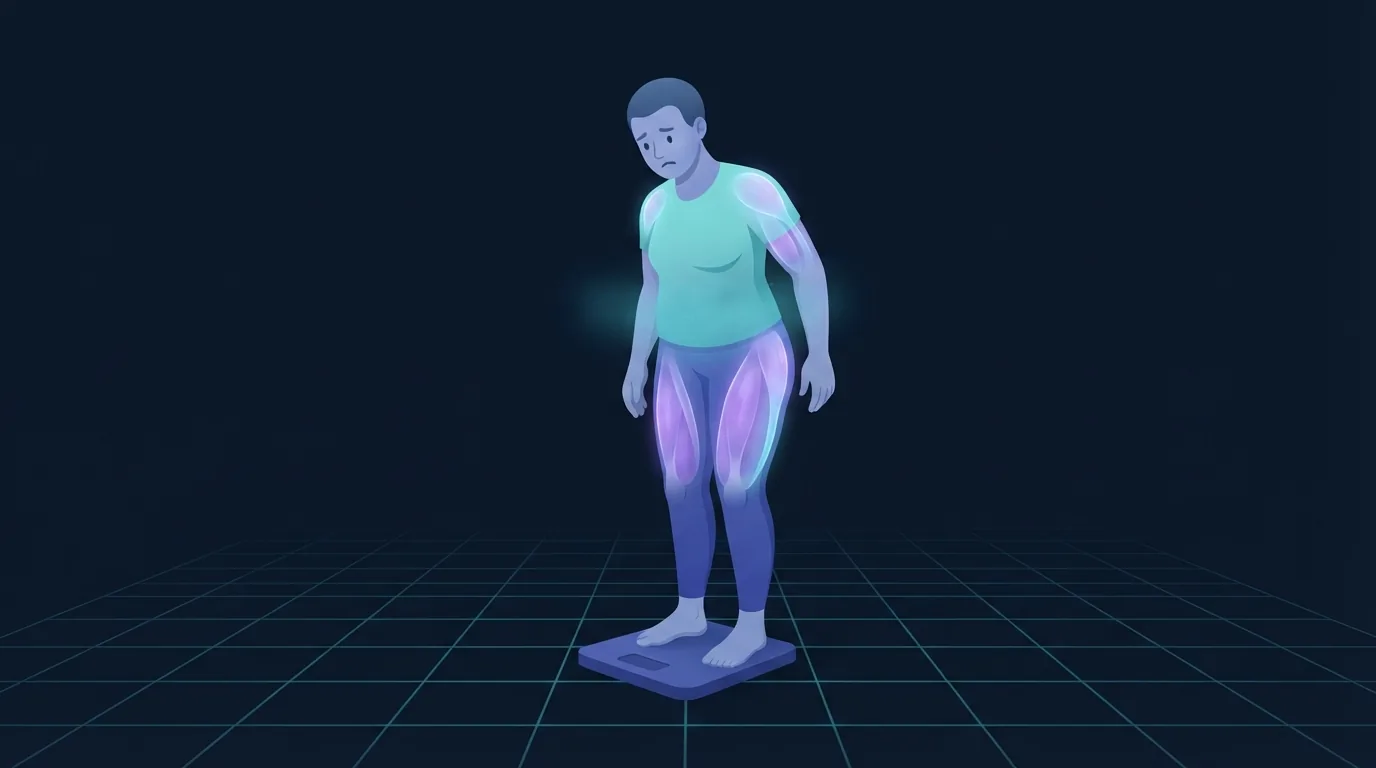
Here's the sequence almost everyone runs into. You finally start training. You're sore, you're eating better, you feel like you're doing everything right. Then you step on the scale two weeks in and you're up three pounds. It feels like a betrayal, and the usual reaction is to slash calories, which is the worst possible move at that exact moment.
The good news is that this is one of the most predictable things in exercise physiology. Weight is not the same thing as fat. Your body weight includes muscle, bone, organs, the food currently in your gut, and several kilograms of water that moves around based on what you ate, how hard you trained and where you are in your cycle. Starting a training program changes several of those at once, and it changes them fast.
Below: what actually adds weight in the first month, how fast fat and muscle can realistically move, why some people genuinely do gain fat while exercising, and the measurements that will tell you whether your program is working long before the scale does.
The First Four Weeks Are Mostly Water
Three separate mechanisms load water into your body when you start training, and they stack. Together they explain almost every case of "I gained weight in my first month."
Glycogen brings water with it
Muscle stores carbohydrate as glycogen, and untrained muscle stores less of it than trained muscle does. Start lifting or running regularly and your muscles adapt by holding more. That is a good thing, because glycogen is the fuel for hard sets and hard intervals. It is also heavy, because glycogen is stored hydrated.
Fernandez-Elias, Ortega, Nelson, and Mora-Rodriguez (2015) tested the long-assumed 1:3 ratio directly with muscle biopsies in European Journal of Applied Physiology. Nine trained cyclists dehydrated themselves 4.6 percent in the heat, then refuelled with 250 g of carbohydrate. When water intake was restricted, every gram of glycogen stored came with about 3 grams of water. Their conclusion was that each gram of glycogen is stored with at least 3 grams of water.
Run that math on a real person. A trained adult can carry roughly 400 to 500 g of muscle glycogen, an untrained one considerably less. Adding a few hundred grams of glycogen over a few weeks drags 1 to 1.5 kg of water along with it. That is two to three pounds on the scale with zero fat gained, and it happens fastest in exactly the group most likely to be watching the scale: beginners.

New training causes swelling
Unfamiliar training damages muscle fibres slightly, and the repair process pulls fluid into the tissue. That is why your legs feel tight and look bigger three days after your first real leg session.
Damas and colleagues (2016) put ten untrained young men through 10 weeks of resistance training and scanned their vastus lateralis at three points. Muscle cross-sectional area rose about 2.7 percent by week 3 and about 10.4 percent by week 10. But myoglobin and interleukin-6, both markers of muscle damage and inflammation, were elevated at week 3 and had dropped by week 10. Their conclusion was blunt: early increases in muscle size in untrained people are "not purely hypertrophy" because edema-induced swelling accounts for a large share of them.
So in weeks 1 through 4 you are carrying extra glycogen water in every trained muscle plus extra inflammatory fluid in the ones you hit hardest. Add sodium from a diet you changed at the same time and a normal 1 to 2 kg swing from food volume and hormonal fluid, and a 2 to 4 kg jump on the scale needs no fat at all to explain it.
Creatine, if you started it, adds more
If you began supplementing at the same time you started training, that compounds the effect, because creatine pulls water into muscle cells directly. It is a real weight gain and it is not fat. Our review of whether creatine makes you gain weight covers how much to expect and how long it takes to stabilise.
How Fast Can Fat and Muscle Actually Move?
This is the check that settles most panics. Body tissue has a price in calories, and the price is high enough to rule things out.
- Fat. A pound of body fat represents roughly 3,500 kcal of stored energy. To gain 4 lb of fat in a week you would need a surplus of about 14,000 kcal across seven days, which is 2,000 kcal per day above maintenance, every single day. If you're training regularly and eating normally, that didn't happen.
- Muscle. Muscle protein accrues slowly. A well-fed beginner training hard might add 0.5 to 1 kg of lean tissue per month for the first few months, and far less after that. A 4 lb jump inside a week is not muscle either.
- Water. Water moves kilograms in days. It is the only tissue that can explain fast changes, which is why it is almost always the answer.
Longer term, though, weight gain from training can be entirely real and entirely good. In the STRRIDE AT/RT trial, Willis and colleagues (2012) randomised 119 sedentary overweight adults to 8 months of aerobic training, resistance training, or both. The resistance training group finished 0.83 kg heavier on the scale. They also finished with 1.09 kg more lean mass and slightly less fat mass. A scale reading that said "you gained weight" described a group that had unambiguously improved its body composition.
The reverse holds too. Longland and colleagues (2016) in the American Journal of Clinical Nutrition put young men in a punishing 40 percent energy deficit for 4 weeks with resistance and interval training. The higher-protein group gained 1.2 kg of lean mass and lost 4.8 kg of fat at the same time. If lean mass can go up and fat can go down inside the same month, scale weight is obviously a poor proxy for either one.
Knowing what to do is the easy part.
FitCraft, our mobile fitness app, pairs you with an AI coach who builds you a personalized plan around your goals, schedule, and fitness level. Every FitCraft program is designed by Domenic Angelino, MPH (Brown University) and NSCA-CSCS, with research published in the Journal of Strength and Conditioning Research and Medicine & Science in Sports & Exercise.
Take the Free Assessment Free • 2 minutes • No credit cardDensity Is Why the Mirror and the Scale Disagree
The phrase you'll hear is that muscle weighs more than fat, which is a sloppy way of saying muscle is denser. A pound is a pound. But a pound of muscle occupies noticeably less space than a pound of fat, so swapping one for the other shrinks you at a constant body weight. Our review of whether muscle weighs more than fat works through the actual density values and how much volume the difference buys.
Where this gets misused is as an explanation for fast gains. Density explains why your jeans fit better at the same weight over three months. It cannot explain three pounds in ten days, because nobody builds three pounds of muscle protein in ten days. Two different questions, two different answers: density for the slow story, water for the fast one.
When It Really Is Not Water: Appetite Compensation
Past the 6 to 8 week mark, glycogen and swelling have settled into a new baseline. If the scale is still climbing after that, the honest answer is usually energy intake, and exercise itself can be what drives it up.
King, Hopkins, Caudwell, Stubbs, and Blundell (2008) in the International Journal of Obesity supervised 35 overweight adults through 12 weeks of exercise, five sessions a week. The group average was a 3.7 kg loss, which looked like the prescription had worked exactly as predicted. Then they looked at individuals. Weight change ranged from a 14.7 kg loss to a 1.7 kg gain. The researchers split the group into compensators and non-compensators, and the compensators reported significantly greater hunger at week 12. Same program, same supervision, opposite outcomes.
Thomas and colleagues (2012) in Obesity Reviews reviewed exercise trials that actually monitored compliance and measured body composition, then reconstructed the energy balance. Their conclusion: the disappointing weight loss in most exercise studies comes primarily from modest prescribed exercise energy expenditures combined with a rise in calorie intake. Not broken metabolisms. Just more food.
Compensation is not only about eating, either. It also shows up as NEAT, the calories you burn fidgeting, walking around and generally not sitting still. Add a hard evening session and you may spend the rest of the night on the couch, quietly giving back a chunk of what you burned. Our deeper breakdown of why the scale stalls in a calorie deficit covers the logging and step-count diagnostics that catch this.
None of this means exercise fails at fat loss. It means exercise alone is a weaker lever on body weight than most people expect, and a strong lever on body composition, health markers and how you feel. Pair it with an honest look at intake and the picture changes fast.
How to Measure Progress Without the Scale
Use four measurements together. Any one on its own will mislead you.
- A 7-day rolling average of daily weigh-ins. Weigh at the same time each morning, after the bathroom, before food. Then ignore every individual number and only look at the weekly average. Daily fluctuation from food volume, sodium, glycogen and hormonal fluid routinely exceeds a full week of genuine fat loss, which is exactly how a good week gets mistaken for a bad one.
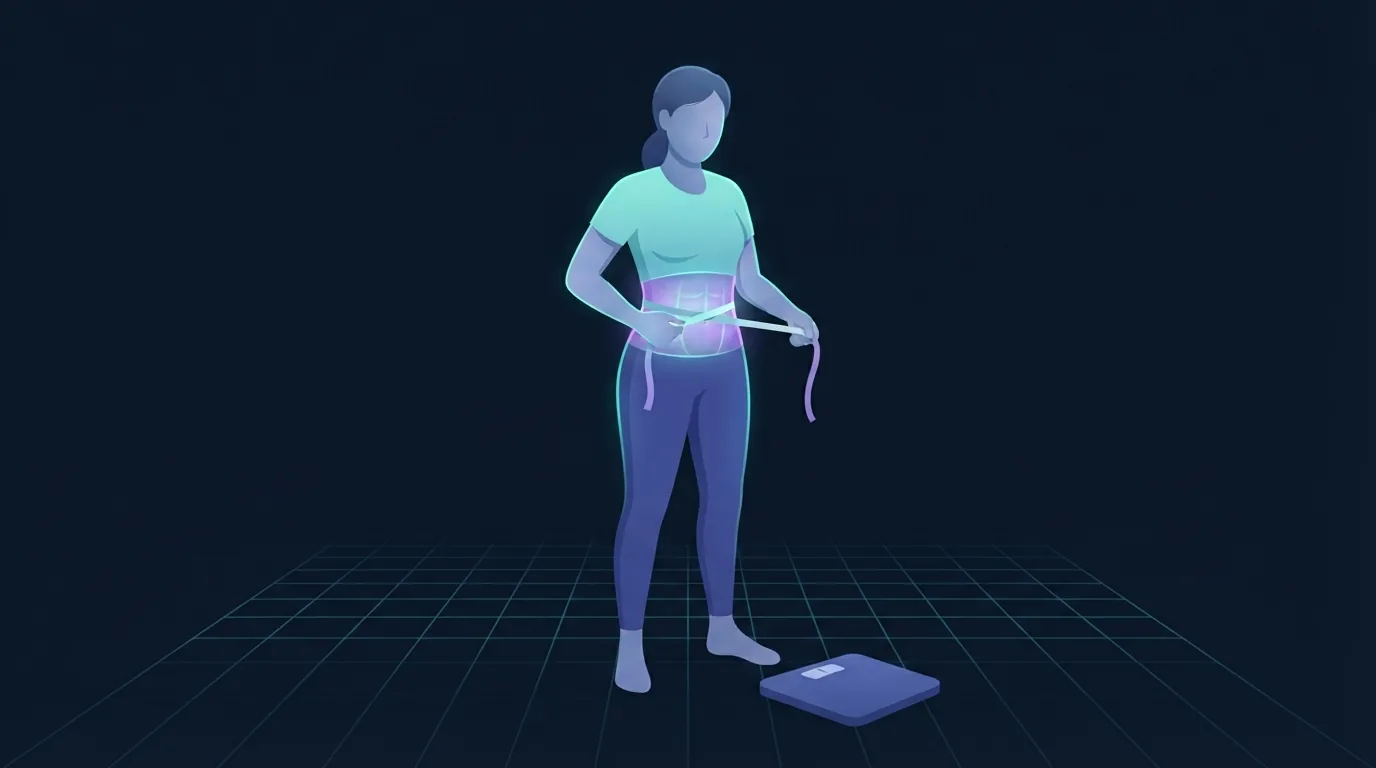
- Waist circumference every 2 weeks. Measure at the navel, relaxed, same time of day. This is the single best cheap proxy for fat. If the scale is up and the waist is flat or down, you gained lean tissue or water. If both are up, you gained fat.
- Photos every 4 weeks. Same lighting, same spot, same clothing, front and side. Recomposition is invisible day to day and obvious across a month of photos.
- Your training log. Loads going up on the same rep ranges is direct evidence that you're building something. Strength gain and fat gain do not usually travel together.
If you want to keep lean mass while the fat comes off, the training and protein side matters more than the cardio side. Our guide to losing fat without losing muscle walks through the deficit size, protein targets and lifting volume that protect lean tissue. And if you're looking for an app that tracks the training side rather than only the food side, our roundup of the best workout apps for weight loss compares what each one actually measures.
When to Actually Adjust Your Intake
Give a new program 4 to 6 weeks before you judge it. That is long enough for glycogen and swelling to settle and short enough that you haven't wasted a season. Then work through this in order:
- Check the two signals. Is the 7-day rolling average rising AND the waist rising? If only the scale is up, you have a water and lean-mass story. Keep going.
- If both are up, log honestly for 7 to 10 days. Weigh food, count the cooking oil, count the drinks, count the weekend. Most people find several hundred calories a day they had not accounted for. Fix the accuracy before changing the target.
- Then cut 150 to 250 kcal per day. Small enough that training quality survives, big enough to move over a month. Aggressive cuts cost lean mass and get reversed.
- Hold protein at 1.6 to 2.2 g per kilogram of body weight. This is the lever that decides whether the weight you lose comes off as fat or as muscle.
- Keep lifting. Dropping resistance training in a deficit is the fastest way to lose the lean tissue you just spent two months building.
And if you're in the first month, do nothing. The scale is telling you about water. Cutting calories in response to a water signal is how good programs get abandoned in week three.
What This Means for You
The number on the scale is a single, noisy summary of a body that's changing in several directions at once. In your first month of training it is mostly reporting hydration. Over a year it reports something much more useful, but only if you read the trend instead of the daily reading.
So give yourself the 4 to 6 week window. Take the waist measurement and the photos today so you have a baseline that is not made of water. Keep the log. Then look back in six weeks at four data points instead of one, and you'll usually find that the program you almost quit in week two was working the whole time.
Frequently Asked Questions
Why am I gaining weight while working out?
In the first 2 to 6 weeks, almost always because your muscles are holding more glycogen and more water, and because hard training causes short-term swelling in the trained tissue. Fernandez-Elias and colleagues (2015) measured about 3 grams of water stored in muscle per gram of glycogen, so topping up glycogen stores alone can add 1 to 2 kg to the scale. Damas and colleagues (2016) found thigh muscle cross-sectional area up roughly 2.7 percent by week 3 of a new lifting program with muscle damage markers elevated at the same time, which means part of that early size is fluid. None of it is fat. Past 6 to 8 weeks, a scale that keeps climbing is usually about how much you are eating, not about the training.
How do I know if the weight I gained is muscle or fat?
Look at your waist and your lifts, not the scale. Muscle gain shows up as a stable or shrinking waist measurement, clothes that fit better around the middle, and steadily rising training loads. Fat gain shows up as a waist that grows with the scale. Timing helps too: fat gain requires a real surplus of roughly 3,500 kcal per pound, so a 4 lb jump inside a week is physiologically almost impossible to be fat and is almost certainly water. Take a waist measurement and a set of photos on day one of any new program so you have something to compare against.
How long does water weight from starting exercise last?
The glycogen and water portion settles within about 2 to 4 weeks and then stays there as a new baseline, because trained muscle simply stores more glycogen than untrained muscle. The swelling portion from muscle damage fades faster as you adapt: Damas and colleagues (2016) found damage markers highest at week 3 and much lower by week 10 on the same program. So expect the scale to move up, plateau, and then start reflecting real body composition change somewhere around week 4 to 6.
Does muscle weigh more than fat?
A pound is a pound. Muscle is denser than fat, roughly 15 to 20 percent depending on the reference values used, so a pound of muscle takes up less space than a pound of fat. That is why people get visibly leaner at the same body weight. What it does not do is explain a 4 lb jump in a week, because nobody builds 4 lb of muscle protein in a week. Density explains why your reflection and the scale disagree over months. Water explains why they disagree over days.
Can exercise make you gain fat?
Not directly, but it can raise your appetite enough to offset the calories you burned. King and colleagues (2008) put 35 overweight adults through 12 weeks of supervised exercise 5 days a week and found the average person lost 3.7 kg while individual results ran from 14.7 kg lost to 1.7 kg gained. The people who gained reported more hunger at week 12. Thomas and colleagues (2012) reviewed the exercise trial literature and concluded that smaller than expected weight loss is mostly explained by modest prescribed exercise doses plus a rise in calorie intake. Training is not the problem. The post-workout compensation is.
Should I stop weighing myself when I start a new program?
Keep weighing, change how you read it. Weigh at the same time each morning, then track the 7-day rolling average rather than any single reading, because daily fluctuation from food volume, sodium, glycogen and hormonal fluid easily exceeds a week of genuine fat loss. Add a waist measurement every 2 weeks, monthly progress photos, and a running log of your working weights. Those four together tell you what is happening. One scale reading on a Tuesday tells you almost nothing.
When should I actually cut calories if the scale keeps going up?
Give any new program 4 to 6 weeks before judging it, then act only if the 7-day rolling average and the waist measurement are both rising. If they are, weigh and log your food honestly for 7 to 10 days before changing anything, since intake is usually underestimated. Then cut 150 to 250 kcal per day, keep protein at roughly 1.6 to 2.2 grams per kilogram of body weight to protect lean mass, and keep lifting. Cutting harder than that tends to cost muscle and rarely speeds anything up.