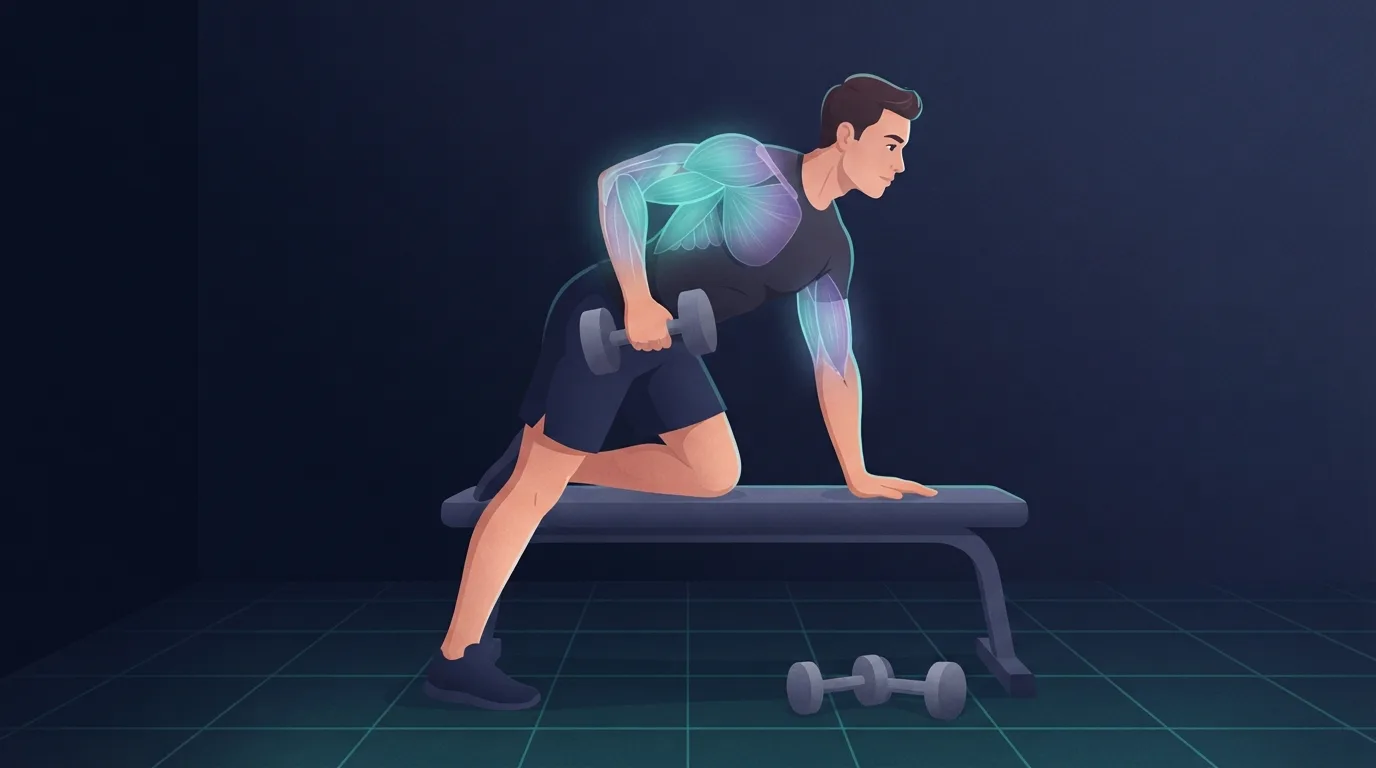
You want to gain weight and muscle, not weight and a softer waist. So you eat more, train hard and watch the scale climb. Then eight weeks in, your jeans are tight at the waist before your sleeves are tight at the arms, and you start to wonder whether the extra food went anywhere useful.
That's a frustrating place to land, because you did what you were told. The usual advice on how to gain weight in muscle mass is to eat big and lift heavy, and the eat-big half is where it goes wrong. Muscle grows at a pace set by your training, not by your appetite. Every calorie beyond what that pace can use has only one other place to go.
So the fix isn't less food in general. It's matching the size of your surplus to the speed your muscles can actually grow, and that speed depends mostly on how long you've been lifting. The six steps below do exactly that, with the study behind each one.
Do You Have to Gain Fat to Gain Muscle?
No, you don't have to gain fat to gain muscle, but some fat gain is normal whenever you eat in a surplus, and the amount is set mostly by how big that surplus is.
The clearest evidence comes from a metabolic ward. Bray and colleagues (2012), publishing in JAMA, housed 25 healthy adults in an inpatient unit and overfed them by about 954 calories a day for eight weeks, on diets with 5, 15 or 25 percent of energy from protein. Fat gain was similar in all three groups and accounted for between half and more than 90 percent of the extra stored energy. Protein changed something else entirely: the normal and high protein groups also gained 2.87 and 3.18 kg of lean body mass, while the low protein group gained none.
Think of that as two separate dials. The size of the surplus sets how much fat you store. Protein and training decide whether muscle gets built alongside it. Those volunteers weren't lifting, and they were overfed by roughly 40 percent, about four times what a lean bulk calls for. Shrink the surplus, add a real training signal, and the fat side of the ledger gets much smaller.
Some people can even gain muscle at maintenance calories, especially beginners and anyone returning after a break. That's recomposition, and it gets its own section further down.
Step 1: Set Your Rate of Gain by Training Age
Your weekly rate of gain is the number that decides everything else, so pick it first. Muscle can only be added so fast, and that speed falls the longer you've been training.
There's a ceiling, and it's lower than social media suggests. Kouri and colleagues (1995) measured fat-free mass index, which is lean mass scaled to height, in 157 male athletes and found that drug-free lifters topped out at a normalized value of about 25. A beginner is far from that ceiling and can add muscle quickly. A lifter with five good years behind them is close to it, and the surplus that once fed fast growth now mostly turns into fat. Our FFMI calculator estimates where you stand from your height, weight and body fat.
Iraki and colleagues (2019), reviewing off-season nutrition for natural bodybuilders in the journal Sports, recommend gaining about 0.25 to 0.5 percent of body weight a week for novice and intermediate lifters, and a more conservative rate for advanced ones. The tiers below split that band by training age. The split is my coaching judgment built on their range, so treat the advanced row as a starting point rather than a trial result.
| Training age | Weekly gain target | 65 kg (143 lb) lifter, per month | 95 kg (209 lb) lifter, per month | Starting surplus |
|---|---|---|---|---|
| Under 1 year of consistent lifting | 0.25 to 0.5% of body weight | 0.7 to 1.4 kg (1.6 to 3.1 lb) | 1.0 to 2.1 kg (2.3 to 4.5 lb) | About 10% above maintenance |
| 1 to 3 years, lifts still climbing most months | About 0.25% | About 0.7 kg (1.6 lb) | About 1.0 kg (2.3 lb) | 5 to 10% |
| 3 years or more, lifts move only every few months | 0.1 to 0.2% | 0.3 to 0.6 kg (0.6 to 1.2 lb) | 0.4 to 0.8 kg (0.9 to 1.8 lb) | 5% or less |
The same percentages work for women. Roberts, Nuckols and Krieger (2020) meta-analysed studies that put men and women on identical programs and found no significant difference in relative muscle growth. A woman's target looks smaller in kilograms only because it's calculated from a smaller body weight, which is why the table works in percentages rather than fixed amounts.
One adjustment: if you've had months off, put yourself a row higher than your training history suggests. Rebuilding muscle you've had before goes faster than building it the first time.
Step 2: Turn That Rate Into a Small Daily Surplus
Start from your maintenance calories, the intake that holds your weight steady. Our TDEE calculator gives you a first estimate, and two weeks of steady weigh-ins at that intake will confirm or correct it. Then add the percentage from your row of the table.
In practice the numbers are small. At a maintenance of 2,500 calories, a 5 percent surplus is 125 calories and a 10 percent surplus is 250. That's a glass of milk, or a banana with a spoonful of peanut butter. It feels too small to matter, and that's exactly why it works.
Bigger surpluses have been tested, and they mostly add fat. In Garthe and colleagues (2013), elite athletes given a meal plan to gain weight ate 3,585 calories a day against 2,964 for athletes eating freely; they gained more weight (3.9 versus 1.5 percent) and far more fat mass (15 versus 3 percent), with no difference in lean mass. Helms and colleagues (2023) randomised 21 trained lifters to maintenance, a 5 percent surplus or a 15 percent surplus for eight weeks (17 finished), and found that change in body weight explained about half the variation in skinfold change, while it did little for squat strength or muscle thickness. Our guide to bulking vs cutting walks through both trials and whether you should cut before you bulk at all.
Adjust in small moves. If two to three weeks of weigh-ins show you above your target rate, take away 100 to 150 calories a day. If you're below it, add the same amount. Never change it after a single week.
Step 3: Eat Your Protein First, Then Fill In Carbs and Fat
Protein is the dial that decides whether the surplus builds anything, so hit your protein number before you think about the rest of the plate.
How much? Morton and colleagues (2018) pooled 49 randomised trials with 1,863 participants in the British Journal of Sports Medicine and found that training gains in fat-free mass stopped improving at a total protein intake of about 1.6 g/kg a day. Iraki's review puts the useful range at 1.6 to 2.2 g/kg, which covers almost everyone. For a 75 kg lifter, that's about 120 to 165 grams a day.

Spread it across your day. Iraki's review suggests 0.40 to 0.55 g/kg per meal over three to six meals, which for that 75 kg lifter means roughly 30 to 40 grams at a time. If you're over 60, aim for the top of that range: Moore and colleagues (2015) found older men needed about 0.40 g/kg in a single serving to maximize muscle protein synthesis, against 0.24 g/kg for young men.
Extra protein doesn't cancel out an oversized surplus. In the Bray trial, fat gain was the same whether the extra calories came with low, normal or high protein. There's one interesting result in trained lifters: when Antonio and colleagues (2014) had resistance-trained men and women eat 4.4 g/kg of protein a day for eight weeks, their calorie intake rose but their body fat didn't. That study relied on self-reported food diaries in people living normally, so treat it as a hint rather than a rule. It does suggest that if you need extra calories, extra protein is an unlikely place for them to become fat.
Don't strip dietary fat to stay lean. Iraki's review suggests 0.5 to 1.5 g/kg of fat a day, and a meta-analysis by Whittaker and Wu (2021) found low-fat diets lowered total and free testosterone in men compared with higher-fat diets. Give the remaining calories to carbohydrate, which fuels the training itself. The same review suggests at least 3 to 5 g/kg a day, with some of it in the meals before and after you lift.
Find out what's really holding you back
FitCraft, our mobile fitness app, pairs you with an AI coach who builds you a personalized plan around your goals, schedule, and fitness level. Every FitCraft program is designed by Domenic Angelino, MPH (Brown University) and NSCA-CSCS, with research published in the Journal of Strength and Conditioning Research and Medicine & Science in Sports & Exercise.
Take the Free Assessment Free • 2 minutes • No credit cardStep 4: Train Hard Enough to Use the Extra Food
A surplus without a training signal is just weight gain. The overfed volunteers in the Bray trial didn't lift, which is part of why most of their extra energy became fat. Your training is what tells your body to spend the surplus on muscle.
Volume is the main lever you control. Schoenfeld, Ogborn and Krieger (2017) meta-analysed 15 studies and found a graded dose-response: each extra weekly set per muscle added about 0.37 percent to the gain in muscle size, with a trend favouring 10 or more weekly sets per muscle over fewer than five.
For a lean bulk, that comes down to three rules:
- Give each muscle at least 10 hard sets a week, split over two or more sessions.
- Take most sets close to failure, to the point where the last couple of reps slow down noticeably.
- Add a rep or a little load when a set gets easy. If your lifts aren't climbing during a bulk, the surplus isn't being used.
Dumbbells and bodyweight are enough for all of it. Goblet squats, split squats, Romanian deadlifts, rows, presses and push-ups cover every major muscle group, and progress can come from reps, tempo and pauses as well as heavier dumbbells. If you'd rather not program the sets yourself, a personalized training program can lay out the weekly volume and the progressions for you.
How to Bulk Without Getting Fat
To bulk without getting fat, keep your weekly gain inside your training-age target and keep moving as much outside the gym as you did before you started eating more. The second half is the part almost nobody mentions.
When Levine, Eberhardt and Jensen (1999) overfed 16 non-obese adults by 1,000 calories a day for eight weeks, fat storage varied tenfold from one person to the next. The best predictor was the change in non-exercise activity thermogenesis (NEAT), the energy spent walking, fidgeting and standing, which correlated with resistance to fat gain at 0.77. The people who stayed lean moved more without trying. You can do it on purpose: keep your daily steps at least where they were before the bulk, because a surplus plus a quieter week adds up to a bigger surplus than you planned.
Your genes play a part too. Bouchard and colleagues (1990) overfed 12 pairs of identical twins by 1,000 calories a day, six days a week, for 84 days. The average gain was 8.1 kg, but individual gains ranged from 4.3 to 13.3 kg, and twins resembled each other far more than they resembled other pairs. Nobody can tell you in advance which end of that range you're on, which is why the next step is measuring rather than trusting a formula.
A few habits keep a bulk lean:
- Add the surplus to food you already eat: an extra portion of rice at dinner, a second yogurt, milk instead of water in your oats.
- Use liquid calories only if appetite is your limit. A shake of milk, oats, banana and peanut butter adds calories with almost no effort, which is exactly why it overshoots for people who aren't struggling to eat.
- Skip the dirty bulk. Fast food every day makes the surplus impossible to size, and most people overshoot their target rate within two weeks.
How to avoid belly fat when bulking
You can't choose where fat goes, so the only way to avoid belly fat when bulking is to limit how much fat you gain overall. In the twin study, the pattern of fat storage, including the amount of deep abdominal fat, was one of the most strongly shared traits within each pair. Crunches won't redirect it. A smaller surplus will, and your waist measurement will show you whether it's working.
Step 5: Check Your Weight, Waist and Lifts Every Two Weeks
Two weeks is long enough to see a trend and short enough to fix a mistake before it costs you much. Collect three numbers.
- Your average weight for the week. Weigh yourself most mornings after the bathroom and before breakfast, then compare one week's average with the next, since a single morning can swing by a kilogram on water and salt.
- Your waist, measured at the belly button after a normal breath out, at the same time of day each check.
- Your top sets. The reps and load on two or three main lifts tell you whether the weight you're adding is doing anything.
The waist matters most on a bulk because it tracks the abdominal and deep visceral fat that body weight hides. An international consensus statement led by Ross and colleagues (2020) calls waist circumference a vital sign for exactly that reason. In a lean bulk it's also your earliest fat signal.

Then read the three numbers together:
| What you see over two to four weeks | What it usually means | What to change |
|---|---|---|
| Weight on target, waist steady, lifts climbing | The bulk is working | Nothing. Resist the urge to speed it up. |
| Weight on target, waist up, lifts flat | The surplus is going to fat, not muscle | Check that you're adding reps or load, then trim 100 calories a day |
| Weight above target and waist up | The surplus is too big | Cut 100 to 150 calories a day and recheck in two weeks |
| Weight flat for three weeks, lifts stalling | The surplus is too small, or you're moving more | Add 100 to 150 calories a day |
| A jump of 1 to 2 kg in the first week | Water and stored carbohydrate from eating more | Nothing. Judge the trend from week three onward. |
Expect the first week to mislead you. That early jump comes from more food in your gut and more carbohydrate stored in muscle, not from fat, and reacting to it is how people abandon a bulk that was going fine.
Step 6: What to Do When Fat Creeps Up
Some fat gain on a bulk is expected. Act when your waist is rising faster than your lifts, and use the smallest step that fixes it.
Trim the surplus first
Drop your intake by 100 to 150 calories a day and change nothing else. Two weeks later, measure your waist again. Most fat creep is a surplus that drifted upward as your appetite grew, and a small trim brings you back to your target rate.
Hold maintenance for a few weeks
If your waist keeps climbing after a trim, eat at maintenance for two to four weeks while you keep training hard. Your lifts usually keep moving, and you get time to fix whatever slipped: daily steps that fell, sessions you missed, protein that drifted down.
End the bulk when you pass your ceiling
If your waist has grown enough that you'd no longer call yourself lean, finish the bulk with a short, moderate cut. Our guide on how to lose fat without losing muscle covers how to run that phase so you keep what you built. Then start the next bulk at the bottom of your rate band.
When Recomposition Works Better Than a Bulk
You don't always need a surplus. Can you gain muscle without gaining weight? If you're new to lifting, coming back after months off, or carrying more body fat, often yes: you can build muscle at maintenance or even in a small deficit, and the scale stays flat while your shape changes. Lean lifters with years of training are the exception and usually need the small surplus described above. Our review of the body recomposition research covers the trials and who they apply to.
What a Lean Bulk Looks Like Six Months In
A good lean bulk is boring to watch week to week. Your weight creeps up by a few hundred grams. Your waist barely moves. Your top sets keep climbing. After six months, the person in your photos has fuller shoulders and arms at nearly the same waist, and the clothes that fit differently are your shirts.
The thing most likely to wreck it isn't the food. It's the weeks you miss. Extra calories with no training behind them are the fastest way to gain fat on purpose, so the plan only works if the sessions keep happening. Mike, 23, who got visibly stronger over four months with FitCraft, put it simply: "The streak system got me hooked. I didn't want to break my chain."
Frequently Asked Questions
How to bulk without getting fat?
Keep the surplus small enough that you gain about 0.25 to 0.5 percent of body weight a week as a newer lifter, or less after a few years of training, and get protein to about 1.6 g/kg a day. Keep your daily steps where they were before the bulk, because people who moved less when they overate stored far more fat in Levine's 1999 overfeeding study. Check your waist every two weeks and trim 100 to 150 calories a day if it rises faster than your lifts.
Do you need to gain fat to gain muscle?
No. Beginners, returning lifters and people with more body fat can build muscle at maintenance calories, and even in a surplus the fat you gain scales with the size of the surplus. In a metabolic-ward trial, fat gain tracked the extra calories while protein decided whether lean mass was added too (Bray 2012). A small surplus with hard, progressive training keeps the fat side small.
Is 3000 calories a day a bulk?
Only if 3,000 calories is more than you burn. For a large, active man it can be close to maintenance, while for a smaller or less active person it can be a surplus of several hundred calories or more. Estimate your maintenance first, add 5 to 10 percent, and let two to three weeks of weigh-ins tell you whether the rate of gain is right.
Why am I gaining fat instead of muscle?
Usually the surplus is bigger than your muscles can use, your protein is low, or your training isn't progressing. Garthe and colleagues (2013) found elite athletes who ate about 600 calories a day more than a free-eating group gained 15 percent fat mass against 3 percent, with no extra lean mass. Check that your lifts are climbing, protein is near 1.6 g/kg a day and your weekly gain matches your training age.
Do you need fat to build muscle?
You need some dietary fat, but not a lot: a review of off-season bodybuilding nutrition suggests 0.5 to 1.5 g/kg a day. Going very low can backfire, since a meta-analysis found low-fat diets lowered total and free testosterone in men compared with higher-fat diets (Whittaker and Wu 2021). Give the rest of your calories to carbohydrate to fuel your training.
Do you lose abs during bulk?
Usually a little, because some fat gain is normal in a surplus and the lower abs are often the first place it shows. A slow bulk at 0.25 percent of body weight a week or less keeps the change small, and a waist measurement will show it before the mirror does. If keeping visible abs matters more than the speed of muscle gain, train hard at maintenance and accept slower progress.
What kills muscle gains the most?
Inconsistent training kills muscle gains more than anything else, because extra food and protein only build tissue when there's a regular training signal to respond to. Low protein comes next: in Bray's overfeeding trial, the group eating 5 percent of energy as protein gained no lean mass on about 954 extra calories a day. Short sleep and heavy drinking can also blunt recovery.
How do I build muscle but stay lean?
Gain weight slowly, at the rate your training age supports, with protein at 1.6 to 2.2 g/kg a day and at least 10 hard sets per muscle each week. Weigh yourself most mornings, measure your waist every two weeks, and trim the surplus by 100 to 150 calories when the waist outpaces your lifts. If you're new or returning to lifting, you can often skip the surplus and build at maintenance.