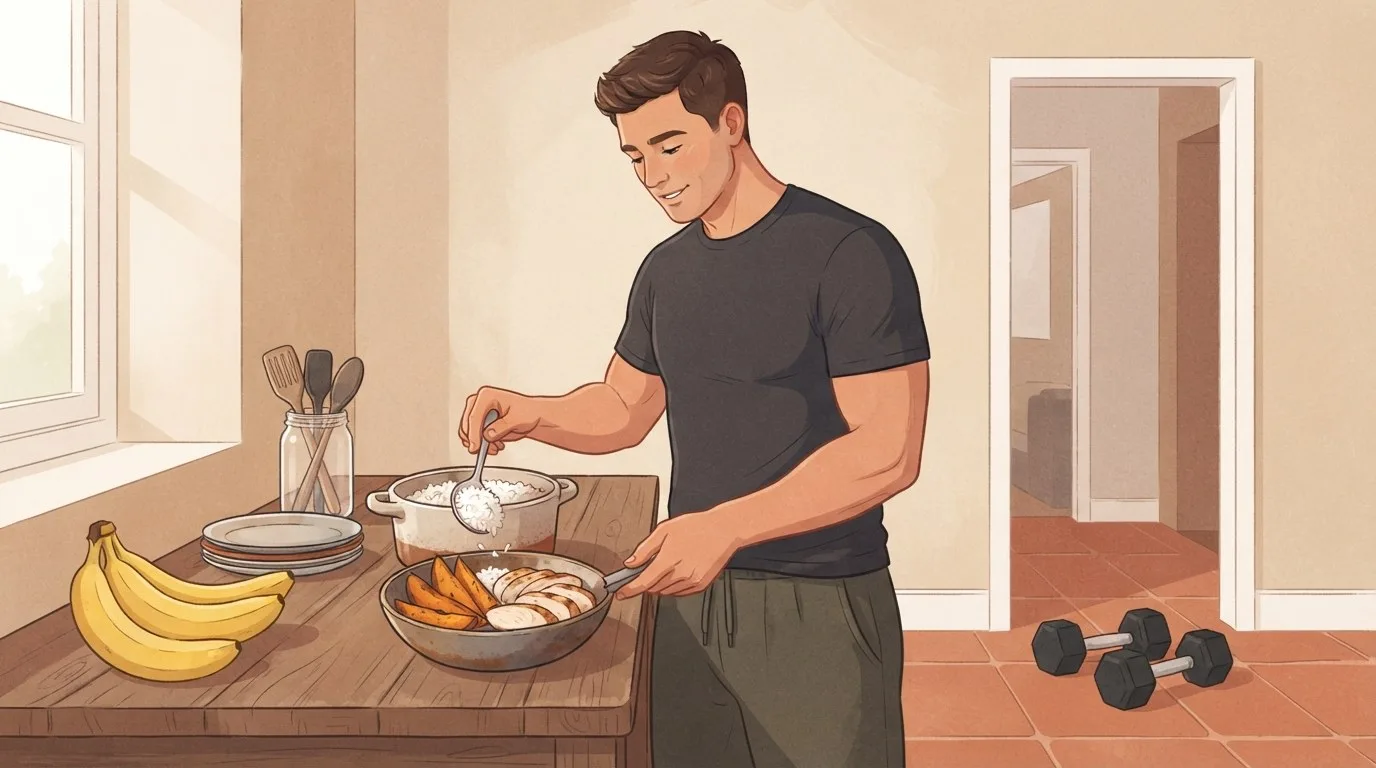
You've probably heard both versions. One coach says you need a mountain of rice to grow. Another says carbs make you fat and you should build muscle on eggs and steak. Then you look at your own plate and can't tell which advice fits three dumbbell sessions a week in your living room.
That confusion costs people results. Some cut carbs and wonder why their sets feel flat by the third exercise. Others eat a bulk's worth of cereal, gain mostly fat and decide that building muscle just isn't for them.
The research is clearer than the arguments. Below you'll find what carbohydrate actually does for muscle growth, how many grams you need for your training load, what happened when trials put lifters on low-carb diets, when to eat carbs around a session, and a food table with the grams per serving from USDA FoodData Central.
Do Carbs Build Muscle?
No. Protein supplies the amino acids that become new muscle tissue, and training is the signal that tells your body to use them. Carbohydrate supports both jobs, but it isn't a building material.
The best evidence comes from studies that add carbs to protein and measure what changes. Staples and colleagues (2011) had nine young men do four sets of leg extensions to failure, then drink either 25 grams of whey protein or the same whey with 50 grams of maltodextrin, a fast-digesting carbohydrate. The carb version raised blood glucose about 17 times more and insulin about 5 times more, measured as the area under the curve. Muscle protein synthesis and muscle protein breakdown came out the same in both trials.
Koopman and colleagues (2007) saw the same result over six hours of recovery. Ten fit men took protein after an hour of resistance exercise along with no carbohydrate, a little or a lot. Insulin rose more than tenfold from the lowest to the highest carb dose, yet the rate of muscle building sat at 0.10 to 0.11 percent per hour in every condition.
That undercuts the old idea that the insulin spike from carbs drives growth. A systematic review by Trommelen and colleagues (2015) concluded that insulin given into the bloodstream doesn't increase muscle protein synthesis in healthy young adults, and that the gains seen in some studies came from the amino acids given with it.
Months of training tell the same story. Hulmi and colleagues (2015) trained previously untrained men for 12 weeks and gave them 30 grams of whey, the same calories as carbohydrate, or both after each session. Muscle size and strength rose by similar amounts in all three groups, and the whey group lost more belly fat than the carbohydrate group. So protein builds and carbs fuel. If you're short on either, fix protein first, and our guide to when to drink a protein shake covers that side of the day.
What Carbs Actually Do for Muscle Growth
Carbs earn their place in three ways. None of them is direct, and all of them matter more as your training volume grows.
They fuel the sets that build muscle
Hard lifting runs largely on glycogen, the form in which your muscles store carbohydrate. Robergs and colleagues (1991) took muscle biopsies from eight men doing six sets of leg extensions and found that glycogen fell by about 47 mmol per kilogram of muscle, whether they lifted 70 percent or 35 percent of their one-rep max. The International Society of Sports Nutrition position stand on nutrient timing (Kerksick and colleagues, 2017) puts that drop at 39 percent.
That's a real dent but not an empty tank, which is why extra carbs mostly matter for long sessions. In Haff and colleagues (2000), eight experienced lifters drank either a carbohydrate drink or a placebo before and during a 39-minute leg workout. The carbs reduced the loss of glycogen, yet performance on the strength test that followed didn't change.
Henselmans and colleagues (2022) pulled the whole question together in a systematic review of 49 studies. More carbohydrate improved lifting performance in only 6 of 19 acute studies, mostly when the comparison group trained fasted or the workout ran past 10 sets per muscle group. None of the 7 short-term studies found a benefit, and 15 of 17 longer studies found carb intake made no difference to strength gains. The authors concluded that in a fed state, carbs are unlikely to limit workouts of up to about 10 sets per muscle group.
A typical home dumbbell session of three or four exercises at three sets each sits well under that line. A long, high-volume day, or lifting plus a run, is where carbs start to earn their keep.
They make a calorie surplus easier to eat
Muscle grows faster with a small calorie surplus, and carbohydrate is where most of those extra calories usually come from. Iraki and colleagues (2019), reviewing nutrition for natural bodybuilders in the off-season, recommend eating 10 to 20 percent above maintenance, protein at 1.6 to 2.2 g/kg and fat at 0.5 to 1.5 g/kg, with the remaining calories from carbohydrate and at least 3 to 5 g/kg of it to cover the energy cost of training. How large your surplus should be is its own question, and our guide to what a lean bulk is works through the calories.
Rice, potatoes, oats and fruit are also cheap, easy to eat in volume and gentle on most stomachs. That matters a lot when you're trying to eat a few hundred calories more than your appetite asks for.
They change how full your muscles look
Each gram of glycogen is stored with at least 3 grams of water (Fernández-Elías and colleagues, 2015), so more carbs means fuller muscles. Bone and colleagues (2017) measured how big that effect is. When trained cyclists went from 6 to 12 grams of carbs per kilogram for 48 hours, their DXA scans read about 2 percent more lean mass. The authors put that down to stored glycogen and water, since almost no new muscle protein could appear in two days.
The same thing shows up in lifting research. In Wilson and colleagues (2020), men on a ketogenic diet gained 2.4 percent lean body mass over 10 weeks of training, against 4.4 percent in a group eating a standard diet. When the keto group added carbs back for one week, their lean mass jumped by another 4.8 percent. Muscle doesn't grow that much in seven days, so most of that jump was glycogen and water returning.
So do carbs make muscles look bigger? Yes, a little, and for a real reason. It also explains why the scale climbs a kilogram or two when you add carbs back after a low-carb stretch, and why that number isn't fat.
How Many Carbs for Muscle Gain? Grams per Kilogram by Training Load
Sports nutrition position stands set carbohydrate targets by how much you train, in grams per kilogram of body weight per day. The joint position of the Academy of Nutrition and Dietetics, Dietitians of Canada and the American College of Sports Medicine (Thomas, Erdman and Burke, 2016) gives 3 to 5 g/kg for light training, 5 to 7 g/kg for about an hour a day of moderate exercise, and 6 to 10 g/kg for 1 to 3 hours a day of moderate to hard work.
Lifters may need less than those endurance-built numbers suggest. Iraki's off-season review lands on at least 3 to 5 g/kg for bodybuilders. Escobar, VanDusseldorp and Kerksick (2016) point out that the usual 3 to 7 g/kg advice for resistance training was borrowed largely from endurance research, and that lifting rarely empties glycogen the way long cardio does.
| Your training | Carbs per day | 60 kg (132 lb) | 75 kg (165 lb) | 90 kg (198 lb) |
|---|---|---|---|---|
| 3 or 4 strength sessions a week of 30 to 45 minutes, little other exercise | 3 to 5 g/kg | 180 to 300 g | 225 to 375 g | 270 to 450 g |
| About an hour of hard training most days, such as long lifting sessions or lifting plus cardio | 5 to 7 g/kg | 300 to 420 g | 375 to 525 g | 450 to 630 g |
| Lifting plus 1 to 3 hours a day of running, cycling or sport | 6 to 10 g/kg | 360 to 600 g | 450 to 750 g | 540 to 900 g |
Most people building muscle at home sit in the first row. Start near the bottom of your range if staying lean matters to you, and move up if your sessions feel flat or your weight isn't climbing. The macro calculator turns your weight and goal into protein, fat and carb numbers in one step.
How many grams of carbs per day to build muscle?
Take a 75-kilogram (165-pound) person who lifts with dumbbells four times a week. The light-training range of 3 to 5 g/kg gives 225 to 375 grams a day, so a sensible start is the middle, about 300 grams. Then let the scale steer. Iraki's review suggests gaining about 0.25 to 0.5 percent of body weight a week for novice and intermediate lifters. If your weekly average isn't moving at that rate, add 25 to 50 grams of carbs a day and check again in two weeks.
What does 400 grams of carbs look like?
More food than most people expect. Using USDA FoodData Central values, this day comes to about 395 grams of carbohydrate:
- Breakfast: 1 cup of dry oats (55 g) cooked in 2 cups of 2% milk (23 g), topped with a banana (27 g) and a tablespoon of honey (17 g).
- Lunch: 2 cups of cooked white rice (89 g) with a cup of cooked lentils (40 g).
- Snack: a medium plain bagel (55 g) and an apple (25 g).
- Dinner: a medium baked potato (37 g) with 2 slices of whole-wheat bread on the side (27 g).
For a 75-kilogram lifter, that's about 5.3 g/kg, the bottom of the moderate range. If it looks like a lot of food, it is. People who train hard for an hour a day often under-eat carbs without noticing, and their training is usually the first thing to suffer.
Low-Carb vs Moderate-Carb Lifting: What the Trials Found
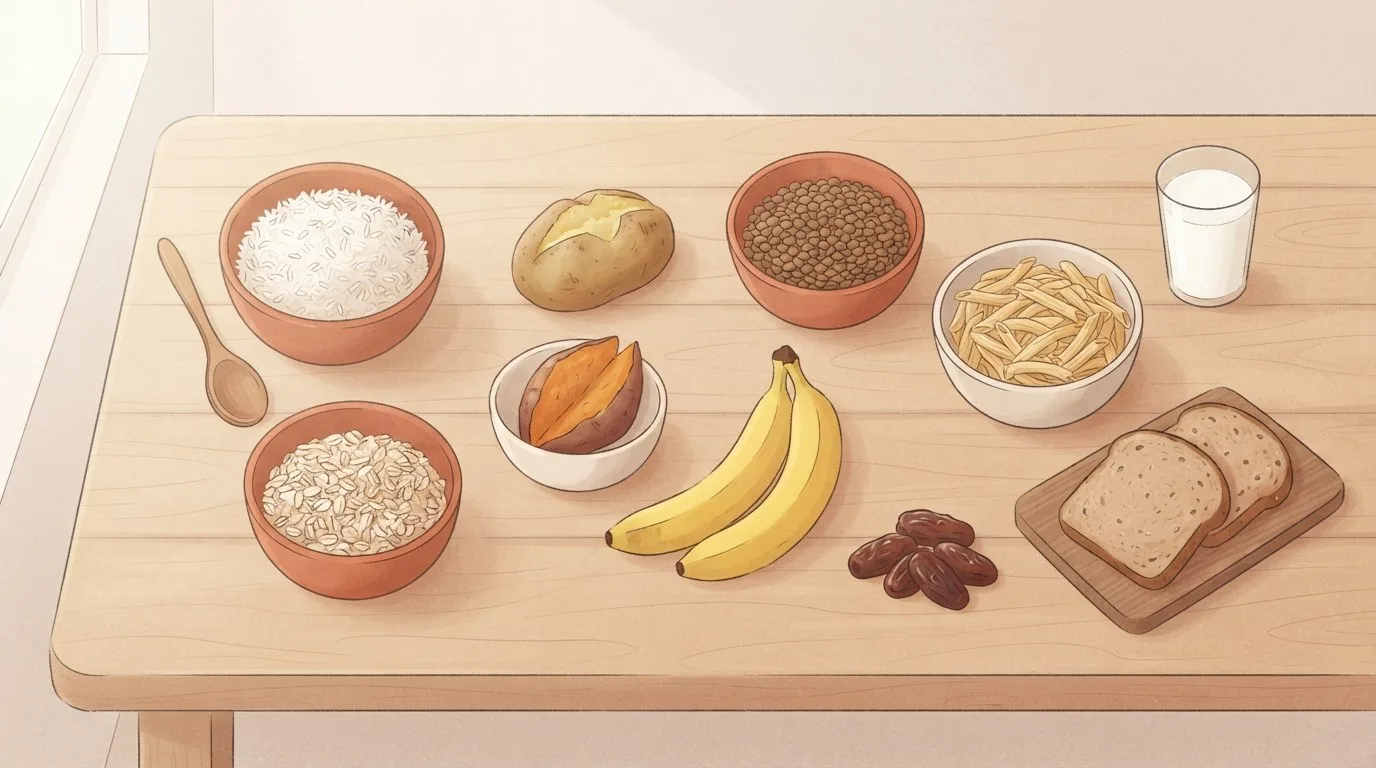
Low-carb and ketogenic diets are popular with lifters, so researchers have tested them head to head with higher-carb diets. The results are consistent. You can hold on to muscle and lose fat on very few carbs, but adding muscle gets harder.
Vargas and colleagues (2018) put 24 trained men on an 8-week lifting program while eating more calories than they burned. The ketogenic group lost 0.8 kilograms of fat but gained no muscle mass. The non-ketogenic group, eating normal carbs, gained 1.3 kilograms of muscle mass. The authors concluded that keto may not be useful for building muscle during a surplus.
Pooled data point the same way. Ashtary-Larky and colleagues (2022) combined 13 randomized trials with 244 people who lifted while eating either a ketogenic or a non-ketogenic diet. The keto groups lost 2.2 kilograms more fat on average, and they also ended up with 1.3 kilograms less fat-free mass. Some of that fat-free mass is glycogen and water rather than muscle, as the Wilson trial shows. Even so, the authors judged the effect on lean mass to be negative and noted that lifting didn't prevent it.
Strength usually holds up better than size. In Wilson's trial, strength and power rose by the same amount on both diets. Greene and colleagues (2018) had 14 competitive powerlifters and weightlifters spend three months on a ketogenic diet and three on their usual diet. On keto they lost 3.3 kilograms of body mass, 2.3 of it lean mass, while their lifts stayed level.
So the trade is clear. Very low carb can work for cutting weight while keeping strength. For building muscle, a moderate carb intake makes the surplus easier to eat and backs more training volume with glycogen, and the trials favor it.
Why do bodybuilders avoid carbs?
Mostly they don't, outside of contest preparation. Before a show, calories have to come down. Helms, Aragon and Fitschen (2014) recommend that natural bodybuilders in that phase set protein at 2.3 to 3.1 g/kg of lean body mass and fat at 15 to 30 percent of calories, with carbohydrate taking whatever is left. As calories fall, carbs are the macro that shrinks. Some competitors then raise carbs in the final days to fill out their muscles, a practice the same review calls understudied. Our review of carb cycling research covers the high-day and low-day versions of this idea.
Find out what's really holding you back
FitCraft, our mobile fitness app, pairs you with an AI coach who builds you a personalized plan around your goals, schedule, and fitness level. Every FitCraft program is designed by Domenic Angelino, MPH (Brown University) and NSCA-CSCS, with research published in the Journal of Strength and Conditioning Research and Medicine & Science in Sports & Exercise.
Take the Free Assessment Free • 2 minutes • No credit cardBest Time to Eat Carbs for Muscle Growth
Your daily total matters far more than the clock. Still, a few placements make training feel better, and one of them has decent evidence behind it.
Before training
A meal with carbs and some protein one to three hours before you lift is the simplest habit to build. If you train first thing and can't face a meal, a banana or a slice of toast 30 to 60 minutes beforehand is enough for most sessions. This is the placement with the most support: the few acute benefits in Henselmans' review showed up mostly against fasted training.
During training
Only worth it for long, high-volume sessions or a second workout on the same day. Past roughly 10 sets per muscle group, a sports drink or diluted juice keeps glycogen higher, as it did in the Haff trial. For a 40-minute home session, water is fine.
After training
Carbs after lifting refill glycogen, but after a normal session you have a full day to do that, so your next ordinary meal covers it. Your protein shake doesn't need sugar alongside it to work, as the Staples trial showed. Long runs, double sessions and sweaty summer workouts are different, and our guide to the best recovery drink after a workout covers when post-session carbs and fluids actually matter.
Best Carbs for Muscle Growth: Grams per Serving
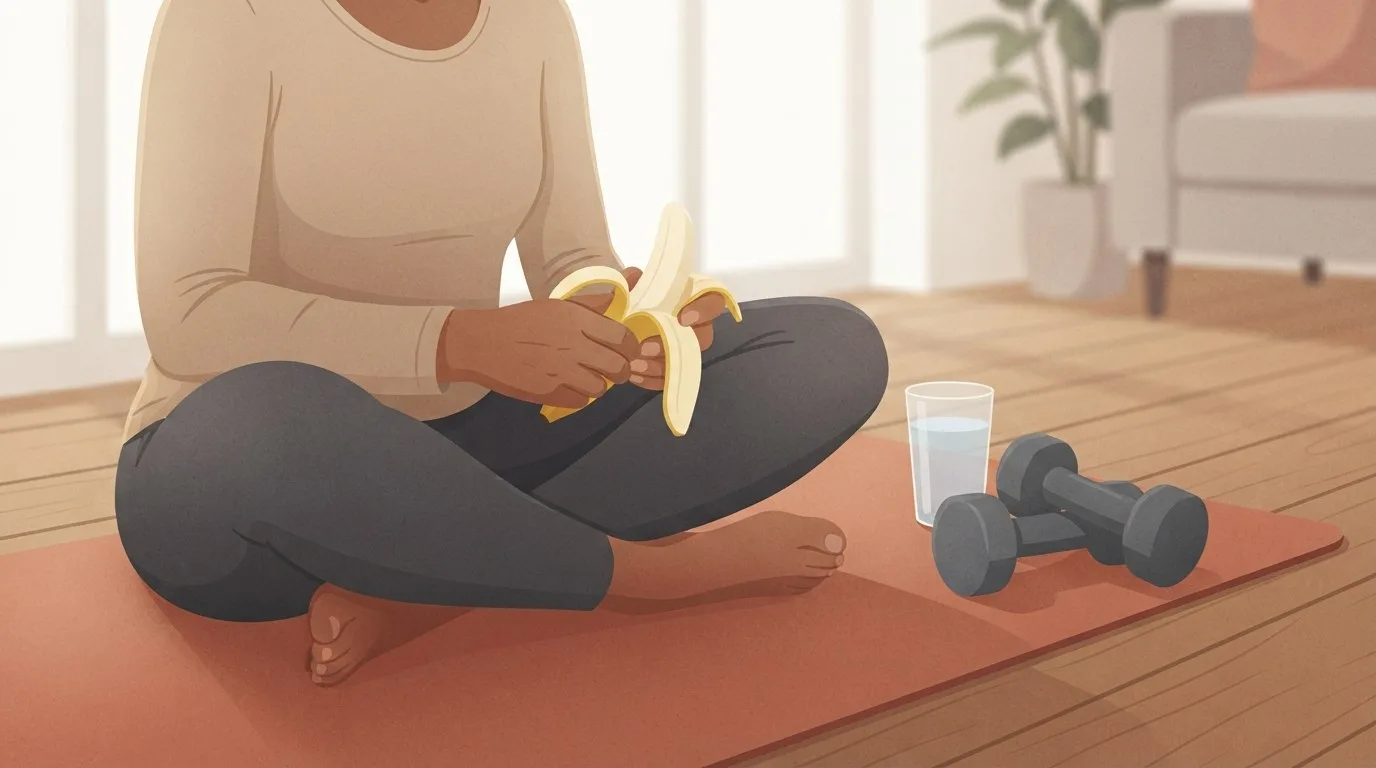
The best carbs for muscle growth are the ones that also bring fiber, potassium or protein, and that you'll actually eat most days. This table lists carbohydrate and protein per serving from USDA FoodData Central (SR Legacy data), rounded to the nearest gram.
| Food | Serving | Carbs (g) | Protein (g) |
|---|---|---|---|
| White rice, cooked | 1 cup (158 g) | 45 | 4 |
| Brown rice, cooked | 1 cup (202 g) | 52 | 6 |
| Rolled oats, dry | 1/2 cup (40 g) | 27 | 5 |
| Potato, baked with skin | 1 medium (173 g) | 37 | 4 |
| Sweet potato, baked | 1 medium (114 g) | 24 | 2 |
| Pasta, cooked | 1 cup (124 g) | 38 | 7 |
| Whole-wheat bread | 2 slices (64 g) | 27 | 8 |
| Plain bagel | 1 medium (105 g) | 55 | 11 |
| Quinoa, cooked | 1 cup (185 g) | 39 | 8 |
| Lentils, cooked | 1 cup (198 g) | 40 | 18 |
| Black beans, cooked | 1 cup (172 g) | 41 | 15 |
| Chickpeas, cooked | 1 cup (164 g) | 45 | 15 |
| Banana | 1 medium (118 g) | 27 | 1 |
| Apple | 1 medium (182 g) | 25 | under 1 |
| Medjool dates | 2 dates (48 g) | 36 | 1 |
| Milk, 2% | 1 cup (244 g) | 12 | 8 |
| Greek yogurt, plain nonfat | 1 container (170 g) | 6 | 17 |
| Honey | 1 tablespoon (21 g) | 17 | 0 |
Complex carbs for muscle growth
Complex carbs, the starches in grains, potatoes and legumes, digest more slowly than sugars, and the whole-food versions bring fiber and micronutrients with them. They make the best base for most meals. Lentils, beans and chickpeas do double duty, with 15 to 18 grams of protein per cooked cup alongside 40 to 45 grams of carbs. Faster carbs such as white rice, bananas, bagels, honey and juice are handy in the hour or two around training, when you want fuel without a heavy stomach. Neither type builds muscle better than the other, so choose by comfort and food quality.
High-carb foods for bulking
If eating enough is your problem, pick carbs that pack energy into a small volume. A medium bagel holds 55 grams, two dates hold 36 and a cup of white rice holds 45. Oats cooked in milk instead of water add carbs and protein to the same bowl. Liquid calories are the easiest to add once appetite runs out, so a glass of milk or juice with meals is a common bulking trick.
Which carbs should I avoid?
None are off limits, but a few make muscle gain harder. Sugary drinks and sweets add calories without filling you up or bringing anything else, and the Dietary Guidelines for Americans recommend keeping added sugars under 10 percent of calories. Fried snacks and pastries bring more fat than carbohydrate, which makes it easy to overshoot a lean surplus. And a big high-fiber bean bowl right before training can sit heavily in your stomach, so save it for afterward.
What are some examples of high-carb meals?
These five use the table values above:
- Banana-honey oats: 1/2 cup of dry oats cooked in a cup of 2% milk, with a banana and a tablespoon of honey. About 83 grams of carbs and 15 grams of protein.
- Rice and bean bowl: a cup of white rice and a cup of black beans with grilled chicken. About 85 grams of carbs before the chicken adds its protein.
- Loaded baked potato: a medium potato topped with a cup of chickpeas and a container of Greek yogurt. About 88 grams of carbs and 36 grams of protein.
- Lentil pasta: a cup of spaghetti with a cup of lentils in tomato sauce. About 78 grams of carbs and 25 grams of protein before the sauce.
- Bagel snack plate: a medium bagel, two dates and a glass of milk. About 103 grams of carbs and 20 grams of protein.
Carbs for Muscle Growth and Fat Loss at the Same Time
Building muscle while losing fat works best for beginners and people coming back to training, and our guide to how to gain muscle without gaining fat explains when that approach beats a bulk. The carb question is simpler. In a calorie deficit, carbs get whatever is left after protein and fat.
Here's the arithmetic for a 75-kilogram person eating 2,200 calories a day. Protein at 2.2 g/kg is 165 grams, or 660 calories. Fat at 25 percent of calories is about 60 grams, or 550 calories. That leaves about 990 calories, roughly 250 grams of carbohydrate or 3.3 g/kg. Put a decent share of those carbs in the meal before you train, so your sessions don't suffer while calories are lower.
Common Carb Mistakes When Building Muscle
- Cutting carbs and protein together. A low-carb day can work. A low-carb, low-protein day takes away both the fuel and the building material.
- Expecting post-workout sugar to build muscle. Protein after training does that job, with or without carbs alongside it.
- Eating the same carbs on every day. Position stands scale carbs with training load, so a long, hard day deserves more than a rest day.
- Panicking at the scale after adding carbs back. A jump of a kilogram or two in a few days is mostly glycogen and water.
- Using keto as a bulking diet. The trials above found it held muscle better than it built muscle.
The Bottom Line
Eat about 3 to 5 grams of carbs per kilogram of body weight if you lift a few times a week, and 5 to 7 if you train hard for an hour most days. Get protein right first, put some carbs in the meal before you train, and build your plate from rice, potatoes, oats, legumes, fruit and milk. Carbs fuel the work, and the work builds the muscle.
That last step is where most plans stall. Diet details are easy to argue about and hard to use when the training itself keeps stopping. If you want structure for the lifting side, our comparison of the best strength training apps weighs the options side by side. FitCraft is one of them. Your AI coach is a 3D character who demonstrates each dumbbell and bodyweight move in a 3D model you can zoom and turn, calls you by name during the session and keeps your streak visible, so showing up becomes the easy choice. As Matt put it: "The real win is I actually want to work out now. That's never happened before."
Frequently Asked Questions
What are the building blocks of carbohydrates?
The building blocks of carbohydrates are monosaccharides, single sugar units such as glucose, fructose and galactose. Two linked together make a disaccharide like sucrose or lactose, and long chains of glucose make starch in plants and glycogen in your muscles and liver. Your gut has to break digestible carbs down into these single sugars before it can absorb them.
Do carbs give you a pump?
They can make it a little fuller. The pump during a workout comes mainly from blood flow and fluid moving into the working muscle, and well-stocked glycogen holds extra water inside the muscle cells, about 3 grams for every gram of glycogen. Lifting on very low carbs often feels flatter for that reason, even when strength is unchanged.
Do carbs make muscles look bigger?
Yes, slightly, because glycogen is stored with water inside the muscle. In Bone and colleagues (2017), 48 hours of very high carbohydrate intake raised DXA estimates of lean mass by about 2 percent without any new muscle protein. The effect reverses when carbs drop, which is why muscles can look flat on a low-carb diet.
What carbs are best for muscle growth?
Whole-food starches such as rice, potatoes, oats, pasta, quinoa and legumes make the best daily base, with fruit, bagels, honey or juice around training when you want something light. Lentils, beans and chickpeas add 15 to 18 grams of protein per cooked cup on top of 40 to 45 grams of carbs. Your daily total matters more than the type.
How many grams of carbs per day to build muscle and lose fat?
In a calorie deficit, set protein high and fat moderate, then let carbs fill the calories that remain. For a 75-kilogram person on 2,200 calories with 165 grams of protein and about 60 grams of fat, that leaves roughly 250 grams of carbs, or about 3.3 grams per kilogram. Bigger deficits leave fewer carbs, so keep some in the meal before training.
Can you build muscle on a low-carb diet?
You can keep muscle on a low-carb diet, but gaining it is harder. In Vargas and colleagues (2018), trained men eating a calorie surplus gained 1.3 kilograms of muscle mass in 8 weeks on a normal diet and none on a ketogenic one. A 2022 meta-analysis of 13 trials found keto lifters ended with 1.3 kilograms less fat-free mass than lifters eating more carbs.
Why do bodybuilders avoid carbs?
Mostly during contest preparation, when calories fall and carbs are the macro that shrinks once protein and fat are set. Helms and colleagues (2014) recommend high protein, 15 to 30 percent of calories from fat and the rest from carbohydrate in that phase. In the off-season, natural bodybuilders are advised to eat at least 3 to 5 grams of carbs per kilogram.