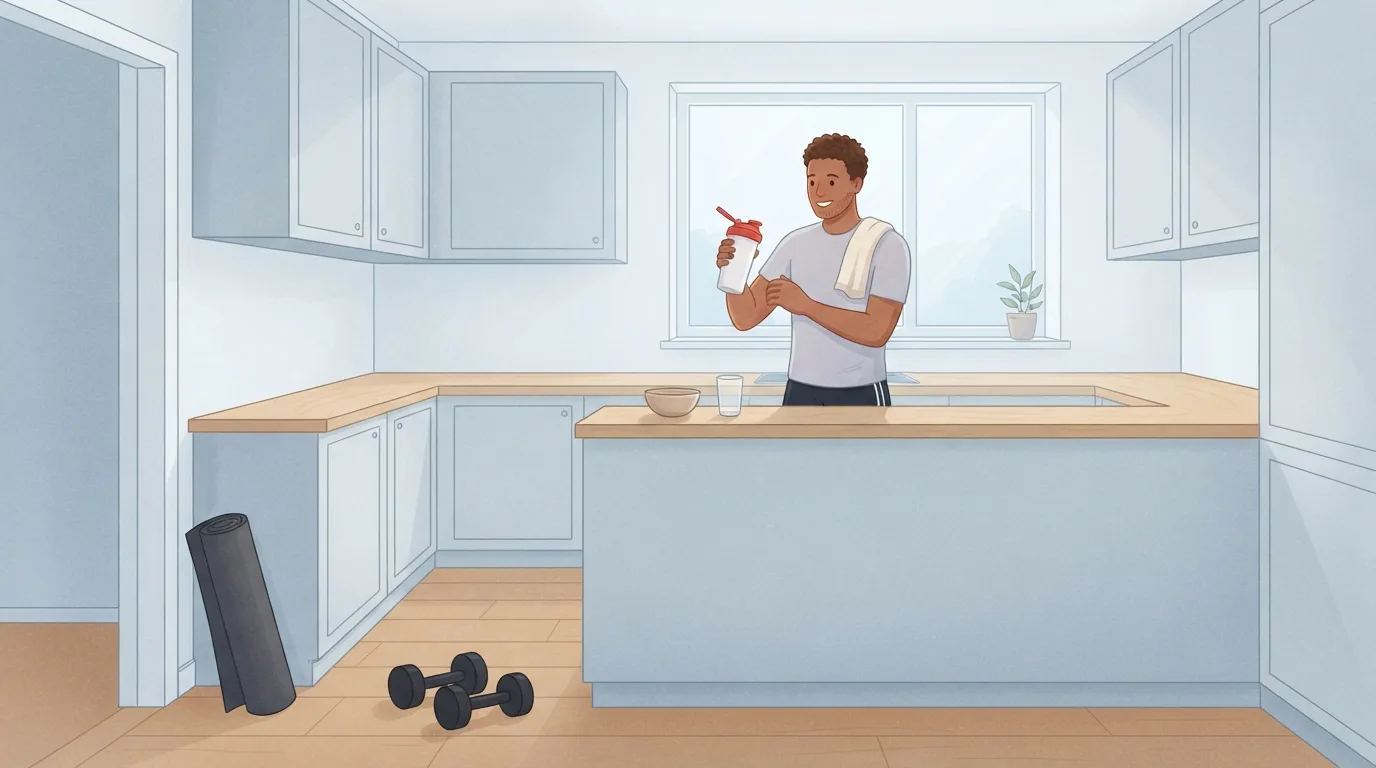
You finish your last set and the clock in your head starts ticking. Somewhere you read that you have 30 minutes to get protein in or the workout is wasted, so you rush the shake down before you've even caught your breath. On a busy morning you skip it entirely and feel like the session didn't count.
That worry is common, and it's misplaced. The research on protein timing is one of the clearer stories in sports nutrition: the shake works before training, after training and a couple of hours either side, as long as your protein adds up across the day. The exact minute is far down the list.
Below you'll find what the trials comparing a protein shake before or after a workout actually found, how much protein the shake should hold, the best time to drink it for building muscle, losing fat, running and rest days, whether morning or night is better, and a simple schedule you can copy.
Protein Shake Before or After a Workout: What the Trials Found
Researchers have tested this question head to head, and the answer is the same at both levels they've measured. In the short term, Tipton and colleagues (2007) gave healthy volunteers a whey protein drink either immediately before or immediately after a hard leg workout and measured amino acid uptake across the leg. Both drinks switched the muscle from breaking down to building up, and the uptake was statistically the same whether it was counted from the start of the workout or from each drink.
Over months, the result held. Schoenfeld and colleagues (2017) split 21 men with more than a year of training experience into two groups. One drank a shake with 25 grams of protein right before each workout, the other drank the identical shake right after. After 10 weeks of three full-body sessions a week, strength, muscle thickness and body composition had improved by the same amount in both groups. The authors concluded that the window for protein may be as wide as several hours, depending on when you last ate.
So when people ask whether to drink a protein shake before or after a workout, the evidence answer is whichever you'll do every time. Pick the slot that fits your stomach and your schedule:
- Before works if you train within an hour or two of waking and can't face a meal, or if you like having something in your stomach. Drink it 30 to 60 minutes before you start so it has time to settle.
- After works if a full stomach makes you queasy during training, or if the shake is part of a post-workout ritual that helps you stay consistent.
- Either side within a few hours works when the shake is simply the easiest way to reach your daily target.
Why the Exact Minute Matters Less Than Your Daily Total
The idea of a 30-minute anabolic window came from short lab studies showing that muscle is especially responsive to protein after exercise. That part is true. What didn't hold up is the claim that missing a narrow slot cancels the benefit.
The key evidence is a meta-analysis by Schoenfeld, Aragon and Krieger (2013), which pooled 23 randomized trials on muscle growth and 20 on strength. It defined timing as at least 6 grams of essential amino acids within an hour before or after training, against control groups that had no protein within two hours. A simple pooled comparison showed a small advantage for timing on muscle size (effect size 0.24). But the timed groups were also eating more protein overall, about 1.66 versus 1.33 grams per kilogram a day. Once the analysis controlled for that, the timing effect disappeared, and total protein intake was the strongest predictor of muscle gain. Only three trials had matched the daily protein between groups, and two of them found no benefit from timing.
In other words, many of the older studies that made protein timing look important were really testing extra protein. That fits the largest analysis of protein supplements to date: Morton and colleagues (2018) pooled 49 trials with 1,863 people and found that supplements added a modest 0.3 kilograms of fat-free mass on average, with no further gains once total intake passed about 1.62 grams of protein per kilogram of body weight per day.
One situation tightens the clock. If you train first thing in the morning on an empty stomach, your last protein was the previous evening, and a review of the anabolic window by Aragon and Schoenfeld (2013) recommends getting protein in soon after a fasted session. For what to eat alongside or instead of the shake after training, our guide to the best post-workout meal covers carbs, leucine and whole-food options.
How Much Protein Should Your Shake Have?
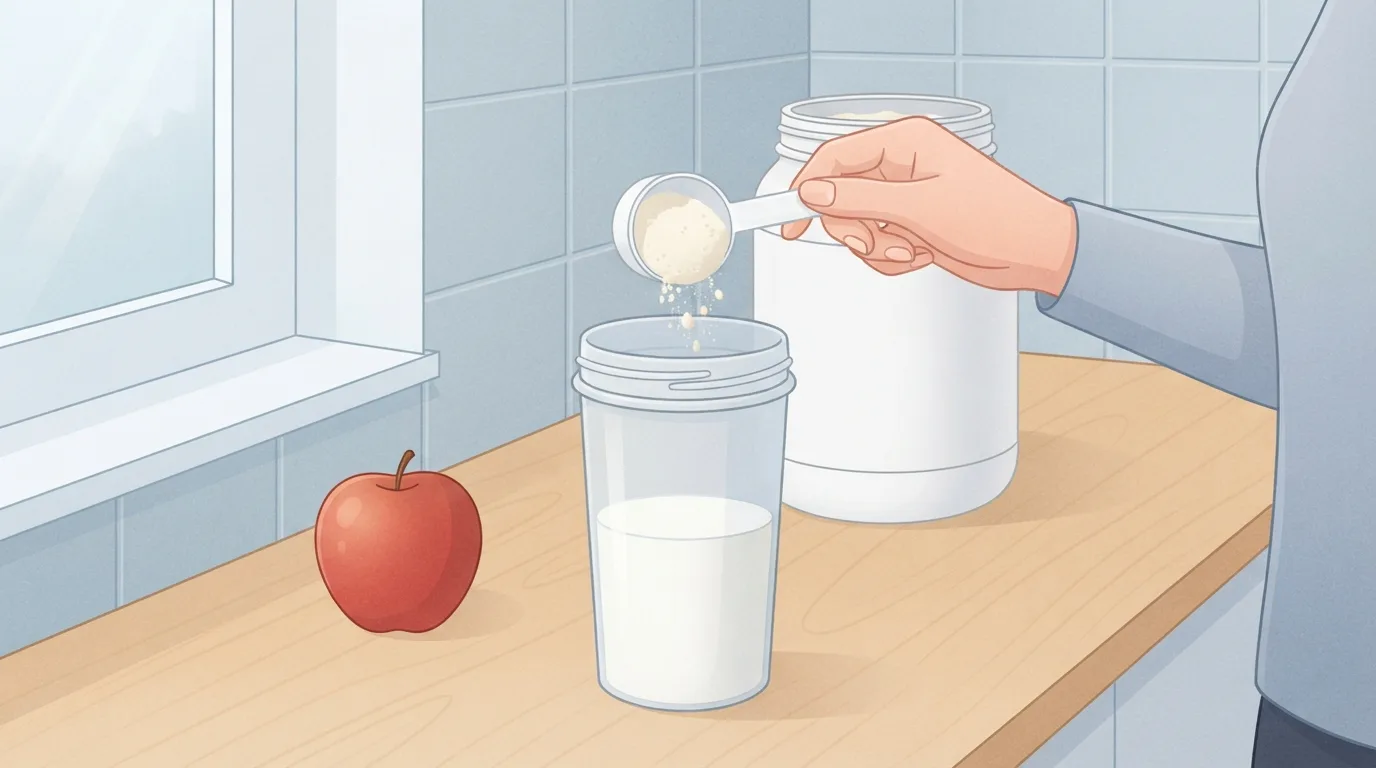
The International Society of Sports Nutrition position stand on protein (Jäger and colleagues, 2017) recommends 20 to 40 grams per serving, or about 0.25 grams per kilogram of body weight, spread every three to four hours, inside a daily total of 1.4 to 2.0 grams per kilogram for people who train. For a 70-kilogram adult, that's a serving of roughly 18 to 25 grams and a day of about 100 to 140 grams.
The upper end of a serving is less fixed than it used to seem. Macnaughton and colleagues (2016) found that after a whole-body workout, 40 grams of whey raised muscle protein synthesis about 20% more than 20 grams did. And Trommelen and colleagues (2023) showed that a 100-gram dose after exercise produced a larger anabolic response that lasted more than 12 hours, compared with 25 grams. The body doesn't simply waste protein above 25 grams; it uses it more slowly.
For a shake, that adds up to a practical rule:
- One scoop (20 to 30 grams) suits most people most of the time.
- Two scoops, or one scoop in milk (35 to 50 grams) makes sense after a full-body session, for larger or older lifters, or when the shake is replacing a meal.
- Count every shake toward the day. Our protein calculator gives you a daily number from your weight and goal, and our guide to how much protein per day explains where the targets come from.
Find out what's really holding you back
FitCraft, our mobile fitness app, pairs you with an AI coach who builds you a personalized plan around your goals, schedule, and fitness level. Every FitCraft program is designed by Domenic Angelino, MPH (Brown University) and NSCA-CSCS, with research published in the Journal of Strength and Conditioning Research and Medicine & Science in Sports & Exercise.
Take the Free Assessment Free • 2 minutes • No credit cardWhen to Drink a Protein Shake for Your Goal
The best time to drink a protein shake shifts a little with what you're training for. This table is the short version, and the sections under it explain each row.
| Your goal | Best time for the shake | Why |
|---|---|---|
| Build muscle | Within a few hours before or after lifting, plus any meal that's light on protein | Before and after give equal results; the daily total drives growth |
| Lose fat | With a meal, or in place of part of one | More trial groups lost fat when shakes came with meals than between them |
| Running or cycling | Soon after a long or hard session, with carbs | About 30 grams maximized muscle rebuilding after endurance work |
| No workout today | At whichever meal is lowest in protein | Evenly spread servings support muscle on rest days too |
| Overnight recovery | An hour or two before bed, ideally casein | A pre-sleep shake added muscle in a 12-week trial |
When to Drink a Protein Shake to Build Muscle
Drink it on the side of your workout that's easiest, and don't let it be your only good protein of the day. The muscle-building effect of a single session lasts well beyond an hour; the ISSN position stand describes the anabolic effect of exercise as lasting at least 24 hours, though it fades as time passes. A shake within a few hours of training, plus three meals with 25 to 40 grams of protein each, covers it. If you train with dumbbells or bodyweight at home, the rule is the same as in a gym: total protein and progressive training do the work, and the shake makes the total easier to hit.
After Running or Other Endurance Training
Protein isn't only for lifters. Churchward-Venne and colleagues (2020) gave 48 endurance-trained men 45 grams of carbohydrate with 0, 15, 30 or 45 grams of milk protein after a long, hard session. About 70% of the protein reached the bloodstream, and 30 grams was enough to maximize the rebuilding of muscle fibres; 45 grams added nothing more. So after a long run or ride, a 30-gram shake made with milk, or a shake beside a banana or a bowl of cereal, refuels and repairs at once. After an easy 20-minute jog, a normal meal does the same job.
Best Time to Drink a Protein Shake Without a Workout
On rest days, use the shake to fill the gap in your day rather than to hit a time slot. Areta and colleagues (2013) compared three ways of eating 80 grams of whey over 12 hours after exercise and found that four 20-gram servings every three hours raised muscle protein synthesis more than eight small servings or two large ones. Most people eat a small, carb-heavy breakfast and a large dinner, so a morning or mid-afternoon shake on a rest day evens that out. Our review of protein distribution research covers what spreading protein across meals does and doesn't change.
When to Drink a Protein Shake for Weight Loss
If fat loss is the goal, have the shake with a meal or let it replace part of one, rather than adding it as an extra snack. Hudson, Bergia and Campbell (2018) reviewed 34 randomized trials in which adults lifted weights and took protein supplements for at least six weeks. Among groups that took the supplement with meals, 87% reduced their fat mass; among groups that took it between meals, 59% did. Lean mass rose in almost all groups either way (94% versus 90%), while body weight went up in more of the between-meal groups (72% versus 56%).
The likely reason is simple arithmetic: a between-meal shake tends to add calories on top of everything else, while a shake with breakfast often stands in for something less filling. These were counts of study groups rather than a pooled effect, so treat the finding as a strong hint rather than a rule. The same advice applies to women and men. If you're asking when to drink protein shakes for weight loss as a woman, the trials Hudson reviewed included both, and the timing logic doesn't change.
Morning or Night: When Should You Drink Your Protein Shake?
Both can work, and they do different jobs.
A morning shake makes the most sense when breakfast is light. Toast and coffee might hold 5 to 10 grams of protein, so a shake beside it brings that meal up to the 25 to 40 grams the rest of your meals probably already reach. It's also the natural choice if you train early and fasted.
An evening shake supports overnight recovery. In Snijders and colleagues (2015), 44 young men followed a 12-week lifting program, and half drank 27.5 grams of casein protein with a little carbohydrate every night before sleep. Their total strength on the tested lifts rose more (by 164 versus 130 kilograms) and their thigh muscle grew more (8.4 versus 4.8 square centimetres) than in the group given a placebo with no protein. That placebo group ate less protein overall, so the trial shows that a pre-sleep shake is a good place to add protein, not that night beats morning for the same total. Our review of pre-sleep protein research goes through the overnight studies in detail.
So is it a good idea to drink a protein shake after dinner? Yes, if dinner was light on protein or you train in the evening, and if the extra calories fit your plan. If you had a big chicken dinner an hour ago, the shake is mostly extra calories.
Whey, Casein or Plant Protein: Does the Type Change the Timing?
A little. Different powders reach your bloodstream at different speeds, and that's the one place where type and time interact.
- Whey is fast. Boirie and colleagues (1997) found that whey caused a sharp but short rise in blood amino acids, while casein produced a lower plateau that lasted for hours because it empties from the stomach slowly. That makes whey a natural fit around training.
- Casein is slow. Its long, steady release is why it's the usual choice before bed, and why the pre-sleep trials used it.
- Plant blends sit in between. In Tang and colleagues (2009), muscle protein synthesis after a leg workout was about 122% higher with whey than with casein and 31% higher than with soy, at the same dose of essential amino acids. Over weeks of training, those short-term gaps shrink when daily protein is high enough, so a plant protein you enjoy is better than a whey you skip.
A Simple Protein Shake Schedule
If you'd rather not think about it, copy the row that matches when you train.
| When you train | When to drink the shake |
|---|---|
| Early morning, fasted | Straight after the session, or with breakfast within an hour |
| Morning after breakfast | With lunch, or after training if lunch is hours away |
| Lunchtime | Before or after, whichever your stomach prefers |
| Evening | After training, or an hour or two before bed in place of a late snack |
| Rest day | With the meal that has the least protein, often breakfast |
Protein Shake Timing Mistakes to Avoid
- Treating the shake as the plan. One shake a day on top of low-protein meals rarely gets you to your target. Fix the meals first, then use the shake to fill the gap.
- Rushing it down mid-cooldown. There's no 30-minute deadline. If drinking it immediately makes you feel sick, wait an hour.
- Skipping it because you missed the window. A shake three hours after training still counts toward the day's total, which is what the trials say matters.
- Adding it as a between-meal extra while trying to lose fat. Use it with a meal or in place of part of one instead.
- Worrying about timing more than training. Protein amplifies a workout; it doesn't replace one. Morton's analysis found supplements helped people who were lifting regularly.
The Bottom Line
Drink your protein shake within a few hours before or after training, whichever you'll stick with, and make sure your daily protein reaches about 1.6 grams per kilogram of body weight. For fat loss, have it with a meal. After a long run, 30 grams with some carbs is plenty. On rest days, use it to fix your lowest-protein meal. Before bed is a good extra slot if you need more protein.
The bigger variable is whether the training happens at all. A shake can't build muscle you haven't asked your body to build, and most people stall because their workouts stop, not because their shake was 40 minutes late. Our roundup of the best strength training apps compares the options for staying on a lifting plan. FitCraft is one of them: an AI coach demonstrates every dumbbell and bodyweight exercise as a 3D character, says your name mid-workout, and keeps a streak going that makes skipping a session feel like it costs something. As Mike, 23, put it after four months: "The streak system got me hooked. I didn't want to break my chain."
Frequently Asked Questions
Is it a good idea to drink a protein shake after dinner?
Yes, if it fits your daily protein target and doesn't push you over your calories. An evening shake an hour or two before bed works like a pre-sleep protein feed: in Snijders and colleagues (2015), 27.5 grams of casein protein every night before sleep produced larger strength and muscle gains over 12 weeks of training than a placebo. If dinner already gave you 30 grams or more of protein, an extra shake adds little.
Is it a good idea to drink a protein shake after running?
Yes. Protein helps rebuild muscle after endurance exercise too, not only after lifting. In Churchward-Venne and colleagues (2020), 30 grams of milk protein taken with carbohydrate after a long endurance session maximized muscle protein synthesis, and 45 grams added no more. Mix the shake with milk or have it beside a carb-rich snack to refuel at the same time.
How long does protein powder take to work?
Whey protein raises the amino acids in your blood within about an hour, and the building response in muscle lasts several hours after that. The visible effect takes much longer: in training studies, the difference between people who took extra protein and people who didn't shows up over 6 to 12 weeks of consistent workouts, not after one shake.
Can I shower after drinking a protein shake?
Yes. A shower has no effect on how you digest or use the protein, so drink the shake before, during or after your post-workout routine, whichever is easiest. The only reason to wait is comfort if a large, cold shake on a full stomach leaves you feeling bloated.
Is it okay to take 2 scoops of protein powder a day?
For most healthy adults, yes. Two scoops usually add 40 to 60 grams of protein, which fits comfortably inside the 1.4 to 2.0 grams per kilogram of body weight per day that the International Society of Sports Nutrition recommends for people who train. Count the shakes toward your daily total rather than on top of it, and talk to your doctor first if you have kidney disease.
How to use whey protein powder?
Mix one level scoop, usually 20 to 30 grams of protein, into about 250 to 350 milliliters of water or milk and shake it for 20 seconds. Drink it within a few hours before or after training, or with a meal that's short on protein. You can also stir it into oats, yogurt or a smoothie, since heat and blending don't destroy its value as protein.