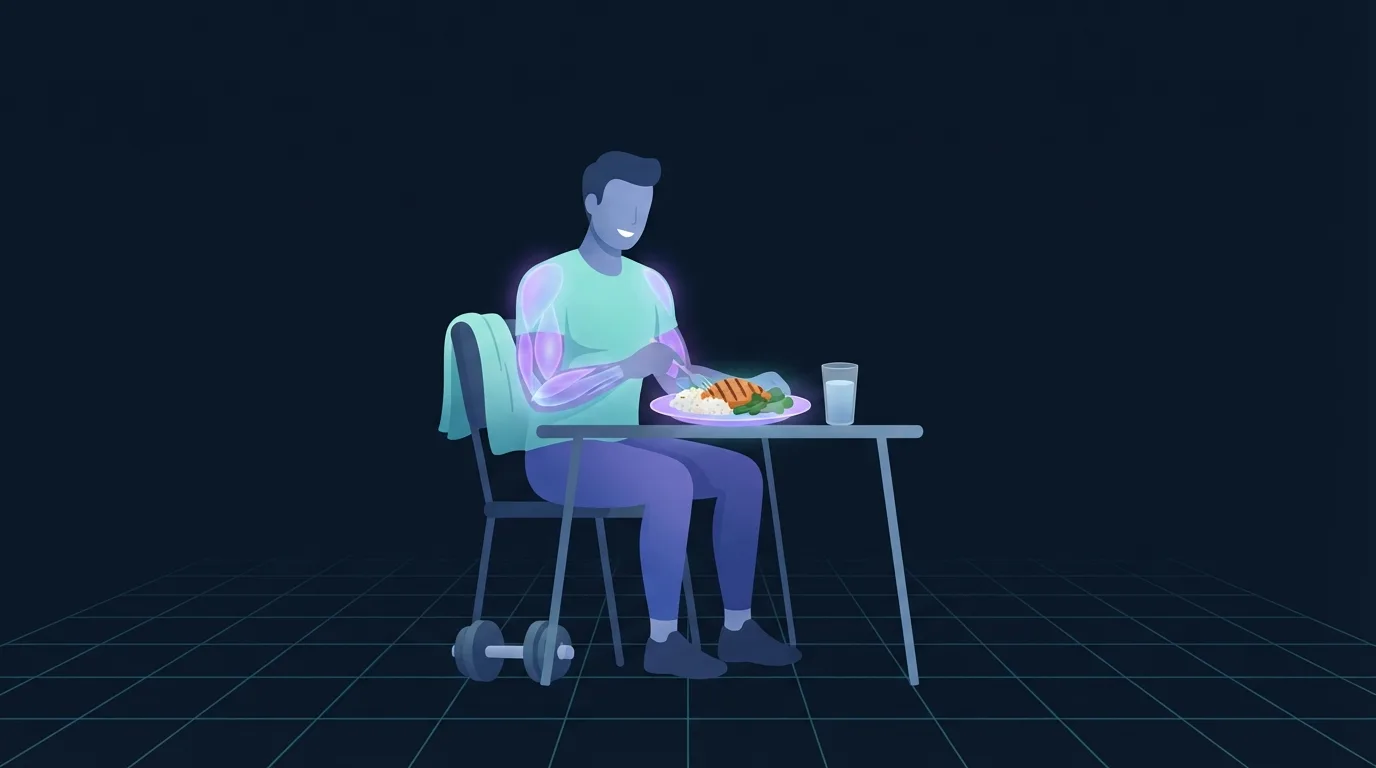
You finish the session, and somewhere in the back of your head a timer starts. Thirty minutes. You have thirty minutes to get protein in or the whole thing was wasted. So you drink something in the car park that you didn't want, on top of the dinner you're going to eat anyway.
That timer was never real, and the anxiety it creates does more damage than the missed shake ever could. People skip meals because they think they missed the window. People add hundreds of calories they didn't need because they think they have to. Both are the same mistake, which is treating one meal as the thing that decides the outcome.
What follows is what the post-workout meal actually has to accomplish, the numbers that matter, twelve real meals sorted by goal and by budget, and the short list of things genuinely worth skipping.
What a Post-Workout Meal Actually Has to Do
Three jobs, in descending order of importance for most people.
Deliver enough protein. Resistance training raises muscle protein synthesis for something like 24 to 48 hours afterwards. Amino acids in the bloodstream during that period are what the elevated synthesis rate builds with. The post-workout meal is one of three or four opportunities that day to supply them, and it doesn't carry more weight than the others just because it happens to be closest.
Replace what you burned, appropriately. A 45-minute lifting session uses a modest amount of muscle glycogen. A two-hour ride or a long run uses a lot. The carbohydrate portion should reflect that difference, and most post-workout advice fails by giving the same answer to both.
Replace fluid and electrolytes. Unglamorous and routinely forgotten. If you finished the session visibly sweaty, drink with the meal rather than sipping throughout the evening. Rehydration is a real recovery variable and it costs nothing.
Notice what is not on that list: anything that has to happen within a specific number of minutes.
The Anabolic Window, Honestly
The 30-minute rule came from a real observation misread at scale. Early studies showed that muscle protein synthesis responds to amino acids more strongly shortly after training, which is true. The leap to "you must eat within 30 minutes or lose the adaptation" was never supported.
Aragon and Schoenfeld (2013) reviewed the literature directly and concluded that the window is likely much wider than claimed, probably several hours on either side of the session, and that total daily protein intake is the dominant variable. Their own meta-analysis the same year, Schoenfeld, Aragon and Krieger (2013), pooled 23 studies and found that the apparent benefit of protein timing disappeared once total protein intake was controlled for.
Then they tested it directly. Schoenfeld and colleagues (2017) randomised 21 resistance-trained men to take 25 grams of protein either immediately before or immediately after training, three days a week for 10 weeks. Strength, muscle thickness and body composition all improved. Nothing differed between the groups. The authors concluded the interval for protein intake may be as wide as several hours, depending on when the pre-workout meal was eaten.
The International Society of Sports Nutrition position stand on nutrient timing (Kerksick et al., 2017) says much the same, while keeping two genuine exceptions alive: athletes training more than once a day, and athletes who trained fasted. Both are covered below.
Our deeper review of why the anabolic window is a myth works through the mechanistic studies that started it. The practical takeaway is simple: if you ate a real meal within about three hours before training, your bloodstream is still delivering amino acids and the post-workout clock is nearly irrelevant. If you didn't, it tightens.
How Much Protein, and Why Leucine Matters
This is the number worth getting right, and it's the one most people guess at.
Witard and colleagues (2014) fed resistance-trained men 0, 10, 20 or 40 grams of whey after a leg session and measured myofibrillar muscle protein synthesis. Twenty grams raised synthesis by 49 percent above baseline. Forty grams raised it by 56 percent, a small extra return for double the protein. Ten grams did nothing measurable. Their subjects averaged about 80 kg.
Schoenfeld and Aragon (2018) took that and the surrounding literature and landed on a practical per-meal target of roughly 0.4 grams per kilogram of body weight, spread across at least four meals. That's about 28 grams for a 70 kg adult and 40 grams for a 100 kg adult. The higher target than Witard's 20 grams covers whole foods rather than isolated whey, larger bodies, and the blunted response older adults show.
The mechanism underneath is leucine. Leucine is the branched-chain amino acid that acts as the trigger signal for muscle protein synthesis, and most sources agree the leucine threshold sits around 2 to 3 grams in a meal. That's roughly what you get from 25 to 30 grams of whey, a large chicken breast, 200 grams of Greek yogurt plus a scoop of whey, or a generously sized plant-protein meal. Plant proteins are lower in leucine per gram, which is why plant-based eaters do better with slightly larger portions or a blend. Our review of whey versus plant protein covers the gap and how to close it.
Daily total still outranks all of this. Morton and colleagues (2018) pooled 49 studies and found resistance-training gains improved with protein intake up to roughly 1.6 grams per kilogram per day, with no reliable benefit beyond. If you want your own number rather than an average, our protein calculator works it out from your weight, training and goal.
Find out what's really holding you back
FitCraft, our mobile fitness app, pairs you with an AI coach who builds you a personalized plan around your goals, schedule, and fitness level. Every FitCraft program is designed by Domenic Angelino, MPH (Brown University) and NSCA-CSCS, with research published in the Journal of Strength and Conditioning Research and Medicine & Science in Sports & Exercise.
Take the Free Assessment Free • 2 minutes • No credit cardCarbs After Training, Sized by What You Just Did
Carbohydrate is where generic advice goes wrong, because "eat carbs after your workout" means something completely different to a person who lifted for 40 minutes and a person who rode for three hours.
Burke, van Loon and Hawley (2017) reviewed post-exercise glycogen resynthesis and made the useful distinction. Aggressive early carbohydrate feeding, on the order of 1 to 1.2 grams per kilogram per hour for the first few hours, meaningfully speeds refuelling and matters when the next hard session is less than about eight hours away. When you have a full day before the next session, total daily carbohydrate intake determines glycogen restoration and the urgency disappears.
| What you just did | Carbohydrate after | Why |
|---|---|---|
| 45 to 60 min lifting | A normal portion: rice, potato, oats, bread or fruit | Glycogen use is modest and you have 24 hours to replace it |
| Easy cardio under 45 min | Whatever your normal meal contains | Very little glycogen depleted |
| Long run or ride over 90 min | A larger portion, roughly 1 g per kg of body weight | Substantial glycogen depletion, and appetite is often suppressed |
| Intervals or a hard team session | A larger portion, plus fluid and sodium | High glycolytic demand plus meaningful sweat loss |
| Second session within 8 hours | Fast carbs immediately, then a full meal | The one case where refuelling speed is the limiting factor |
| Fat loss phase, normal session | Smaller portion, more vegetables, protein unchanged | Protein protects muscle in a deficit; carbohydrate flexes with intake |
Fat is the third macro and it's genuinely uncontroversial here. Dietary fat slows gastric emptying, so a very high-fat meal delays the amino acids slightly, which does not matter on a normal day and does matter when you're refuelling for a second session. Otherwise, eat it. If you want your three numbers rather than three rules of thumb, our macro calculator splits them by goal.
If You Trained Fasted, the Clock Actually Tightens
Here's the one place the old advice earns its keep. Aragon and Schoenfeld's argument rests on the pre-workout meal still circulating during and after training. Remove it and the logic changes.
If you rolled out of bed and lifted before breakfast, your last meal was ten or twelve hours ago, amino acid availability is low, and muscle protein breakdown is running ahead of synthesis. Eating within roughly an hour is a reasonable target, and it is the situation where a shake is genuinely the right tool, because it digests quickly and needs no appetite.
This does not mean fasted training is a mistake. For most goals it's neutral, as our review of the research on fasted cardio lays out. It just means the meal after it is doing double duty, and treating it casually costs you more than it would on a fed day.

12 Post Workout Meals That Actually Get Eaten
Protein figures are approximate and assume standard supermarket portions. Cost tiers are relative, not absolute.
| Meal | Protein | Best for | Cost |
|---|---|---|---|
| Tin of tuna, microwave rice pouch, frozen peas | ~35 g | Muscle gain with zero cooking | Low |
| Turkey mince chilli with rice and kidney beans, batch cooked | ~40 g | Muscle gain on a tight budget | Low |
| Two whole eggs plus three egg whites on wholegrain toast | ~30 g | Early sessions and evening training alike | Low |
| Greek yogurt with berries, honey and a banana | ~20 g | Light sessions, small appetite | Low |
| Cottage cheese with pineapple and oats | ~30 g | Fat loss, high satiety per calorie | Low |
| Chicken thigh, jasmine rice, roasted vegetables | ~40 g | A heavy lower-body day | Moderate |
| Whey shake in milk with a banana | ~35 g | Trained fasted, or no appetite yet | Moderate |
| Salmon fillet, potatoes, green beans | ~35 g | Long endurance sessions | Higher |
| Tofu and edamame stir fry with noodles | ~30 g | Plant-based, high volume | Moderate |
| Lentil and chickpea bowl with quinoa and tahini | ~25 g | Plant-based on a budget | Low |
| Chocolate milk plus a bagel with peanut butter | ~30 g | Second session within a few hours | Low |
| Cottage cheese with whey stirred through, before bed | ~40 g | Late evening training | Moderate |
That last row is doing something specific. If you train at 9pm and eat at 10:30pm, a slower-digesting protein before sleep keeps amino acid delivery going overnight, which the research on pre-sleep protein supports reasonably well. It's the closest thing on this page to genuine timing advice.
Spreading protein across the day is the other structural decision worth making, and it's covered in our review of protein distribution research. Four meals of 30 grams beats one meal of 120 grams, and the post-workout meal is simply one of the four.
What to Skip After a Workout
Nothing at all. The most common failure isn't the wrong meal, it's no meal. People finish an evening session, feel appetite suppression, eat a biscuit and go to bed. Do that three nights a week and your weekly protein total quietly falls short of everything in the studies above.
Amino acid powders instead of food. Branched-chain amino acids on their own supply leucine without the other essential amino acids needed to actually build tissue, and the trials reflect that. Our review of the BCAA research covers why they underperform a normal protein source. If you can eat protein, eat protein.
Sports drinks and gels after a gym session. These exist to deliver fast carbohydrate during or immediately after prolonged endurance work. After 40 minutes of dumbbell work they're just sugar you didn't need, and they displace the meal that would have done the job better.
Alcohol, if the session mattered. Drinking heavily after training suppresses the muscle protein synthesis response and worsens next-day performance, which our review of alcohol and muscle recovery covers in detail. A drink with dinner is a different thing from four of them.
An extra meal you didn't budget for. If you're in a deficit, a post-workout meal added on top of your normal eating is how a session's worth of energy expenditure disappears. Fit the meal inside the day, not alongside it.
How This Differs From Eating Before You Train
The two meals have different jobs and different constraints. The pre-workout meal is about availability and comfort: enough carbohydrate to fuel the session, low enough in fat and fibre that it doesn't sit in your stomach, timed so digestion isn't competing with effort. The post-workout meal is about supply: hitting the protein number, replacing what the session cost, and rehydrating.
They also trade off against each other. A solid meal two to three hours before training buys you a relaxed post-workout window. Train fasted and the post-workout meal carries everything. Our guide on what to eat before a workout handles the front half of that equation, including the caffeine question and the fasted-training decision.
If the harder problem is getting to the session at all rather than what you eat after it, that's a programming and adherence question, not a nutrition one. Our roundup of the best fitness apps for beginners compares how the main options handle scheduling, progression and restarting after a missed week.
The Bottom Line
Eat a normal meal with 25 to 40 grams of protein and a carbohydrate portion that matches what you just did, within a couple of hours of finishing. That's it. Get your daily protein to roughly 1.6 grams per kilogram, split across three or four meals, and the post-workout one stops being special because every meal is doing its share.
The window was never a countdown. It's an afternoon. You didn't ruin anything by showering first, and you're not obligated to drink something in a car park to prove you trained. Cook the thing you were going to cook, make sure the protein is on the plate, and go to bed.
Frequently Asked Questions
What is the best post workout meal?
The best post workout meal is 25 to 40 grams of a complete protein plus a carbohydrate portion sized to the session you just did, eaten within a couple of hours. Chicken with rice and vegetables, a tin of tuna with a rice pouch and peas, or Greek yogurt with fruit and oats all qualify. The specific food matters far less than hitting the protein number and getting your total daily intake where it needs to be.
How long after a workout should you eat?
Within about two hours for most people, and there is no 30-minute emergency. Aragon and Schoenfeld (2013) reviewed the evidence and concluded the post-exercise window is likely much wider than the popular claim, and Schoenfeld and colleagues (2017) found no difference in strength or hypertrophy between trained men who took 25 grams of protein immediately before versus immediately after lifting for 10 weeks. The one real exception is training fasted, where your last meal was the night before and eating sooner genuinely helps.
How much protein do you need after a workout?
Roughly 0.4 grams per kilogram of body weight in that meal, which is about 28 grams for a 70 kg adult and 40 grams for a 100 kg adult. Witard and colleagues (2014) found that 20 grams of whey maximally stimulated muscle protein synthesis in 80 kg trained men, while Schoenfeld and Aragon (2018) recommend the slightly higher per-meal target to cover whole foods, larger bodies and older adults.
Do you need carbs after a workout?
You need carbohydrate across the day, but urgent post-workout carbs only matter when you have another hard session within about eight hours. Burke and colleagues (2017) concluded that aggressive early refuelling is a priority for athletes on tight turnarounds, and much less important when you have 24 hours before the next session. After a normal lifting workout, a regular portion of rice, potato, oats or fruit is enough.
What should you eat after a workout to lose weight?
The same protein target with a smaller carbohydrate portion and more vegetables, eaten as a real meal rather than an extra one. The most common mistake in a deficit is adding a post-workout snack on top of normal meals and quietly erasing the session. Keep protein high, since protein is the nutrient that protects muscle while you lose fat, and fit the meal inside your daily intake instead of alongside it.
Is a protein shake enough after a workout?
A shake is enough to cover the protein requirement, and it is the right call when you have no appetite or no time. It is not enough on its own if the shake replaces a meal you needed for total calories or carbohydrate, which is common for people training twice a day or in the evening. Treat the shake as a bridge to your next real meal, not a substitute for it.