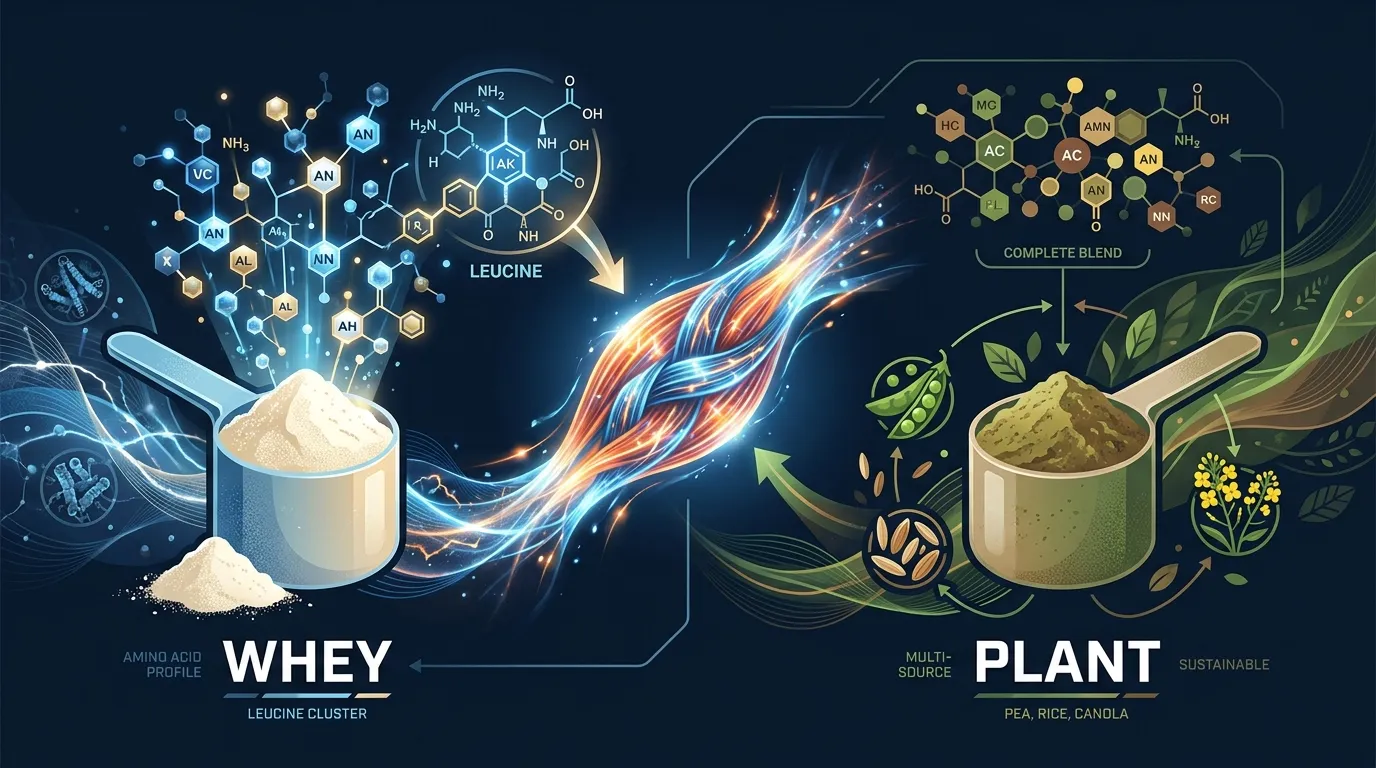
The whey versus plant protein debate is one of those places where the internet consensus and the peer-reviewed literature have drifted a long way apart. The popular story says whey is dramatically superior for muscle growth because it is a "complete" protein with a bioavailability score close to perfect, while plant proteins are "incomplete" and force the body to leave gains on the table. The literature says the gap is real, small, and mostly closes once you either bump the plant dose or blend sources. Almost all the strength and hypertrophy trials that ran head-to-head at adequate doses came out approximately even.
That does not mean whey and plant protein are identical. Whey has a genuine biochemical advantage in leucine content per gram, absorption speed, and the height of the acute muscle protein synthesis spike after a single dose. Those advantages are measurable, replicable, and predict short-term synthesis rates well. What they do not predict, at least not cleanly, is how much muscle you actually gain over months of training when total daily protein intake is adequate. That is the finding that keeps replicating and the one worth building a plan around.
The rest of this article walks through what the meta-analytic pool actually shows, why single-source plant proteins fall a little short, how blends and leucine-matching close the gap, and how to make a defensible plant-based protein plan if you want one. If dairy is still on the table for you, our casein vs whey comparison covers the other split inside milk protein and when each fraction is worth using.
The Research: What Studies Show
Reid-McCann 2025: The Largest Systematic Meta-Analysis
The most complete synthesis of the whole question is Reid-McCann, Brennan, McKinley, and McEvoy (2025), published in Nutrition Reviews. The team screened randomized controlled trials in adults comparing plant with animal protein, then pooled 30 trials with 1,538 participants for the muscle mass outcome.
The pooled result: a small but statistically significant advantage for animal protein on muscle mass, standardized mean difference -0.20 (95 percent CI -0.37 to -0.03, p=0.02). In plain terms, animal protein produced modestly larger muscle mass changes than plant protein across the pooled trials, and the difference was large enough to survive the pooling but small enough that a well-powered individual trial could easily miss it.
Two subgroup findings do most of the interpretive work. First, the advantage was larger in younger adults (under 60) than in older adults (60 and over). Second, and more importantly, the advantage disappeared when soy was compared with milk protein. It only persisted when non-soy plant proteins (rice, chia, oat, potato) were compared with animal protein. Muscle strength and physical performance showed no statistically significant difference in either subgroup. So the "animal is better for muscle mass" finding is real but narrow: it applies to single-source non-soy plant proteins, and it does not extend to strength or function.
The authors are appropriately careful in the discussion. They note that no trials examined sarcopenia status directly, that trial durations were mostly under 6 months, and that the effect size of -0.20 is at the boundary of what a recreational lifter would notice. Their bottom line is that plant proteins are a viable choice for muscle health when quantity and quality are attended to. That framing matches the head-to-head trial evidence below almost exactly.
Hevia-Larraín 2021: Habitual Vegans vs Omnivores, 12 Weeks
The clearest real-world head-to-head trial is Hevia-Larraín, Gualano, Longobardi, and colleagues (2021), published in Sports Medicine. The team recruited 19 male vegans and 19 male omnivores who had followed their diets for at least a year, then ran both groups through a supervised 12-week lower-body resistance-training program.
Both groups had their total protein intake raised to 1.6 g per kg of body weight per day, a dose right at the upper edge of what current sports nutrition guidance recommends for muscle-building. Omnivores hit the target with whole foods plus whey protein isolate. Vegans hit the same target with whole foods plus soy protein isolate. To reach 1.6 g/kg, vegans used about 58 g/day of soy protein isolate compared with about 39 g/day of whey for omnivores. That is roughly a 50 percent higher supplemental protein bolus for vegans to net the same total daily intake, mostly because the plant-based whole-food starting point delivered less protein per calorie.
The outcome measurements were leg lean mass, quadriceps cross-sectional area, and 1-rep-max leg press. All three moved in the same direction with no statistically significant between-group differences. Vegans and omnivores gained similar amounts of muscle and similar strength across the 12 weeks. The authors' conclusion, restated: a high-protein plant-based diet, when protein-matched to an omnivorous diet, supports resistance training adaptations equivalently in habitual vegans and habitual omnivores. That is the "protein source does not matter when dose is adequate" finding in its cleanest experimental form.
Lynch 2020: Soy vs Whey, Matched for Leucine
If you want the head-to-head trial where the two supplements were closest in dose composition, that is Lynch, Buman, Dickinson, Ransdell, Johnston, and Wharton (2020), published in the International Journal of Environmental Research and Public Health. Recreationally active men and women were randomized to soy protein isolate or whey protein isolate for 12 weeks alongside a standardized resistance-training program. The two supplements were matched for leucine content (rather than for total grams), which meant the soy group ate slightly more grams overall to hit the same leucine dose per serving.
At 12 weeks, lean body mass and 1-rep-max strength on the trained lifts had increased in both groups with no significant between-group difference. The trial is smaller than Hevia-Larraín (roughly 25 completers per group after dropouts), so its confidence interval is wider. But the direction and magnitude of change match Hevia-Larraín closely: when the supplements deliver the same leucine per serving, the outcomes come out approximately even.
The Lynch trial matters for one specific reason. It isolates leucine as the mechanism. If matching leucine content abolishes the source difference, then the source difference in the meta-analytic pool is largely a leucine-content difference, not a "plant protein is bad" difference. That is the mechanism the van der Heijden 2024 acute study confirms in the next section.
van der Heijden 2024: Post-Exercise Myofibrillar Synthesis, Blend vs Whey
Acute muscle-protein-synthesis trials are a different kind of evidence. They use stable-isotope tracers to measure how fast the body is building new muscle proteins in the hours after a single dose. They cannot directly prove long-term hypertrophy, but they map the acute synthesis response almost perfectly, and that response over many meals is the mechanism underlying long-term hypertrophy.
The most useful recent acute trial for the blend question is van der Heijden, Monteyne, West, and colleagues (2024), published in Medicine and Science in Sports and Exercise. Ten resistance-trained young adults (8 men, 2 women, average age 26) completed a single bout of resistance exercise, then ingested 32 g of protein from either whey or a plant blend made of 39.5 percent pea, 39.5 percent brown rice, and 21 percent canola. Myofibrillar protein synthesis rates were measured over the next 5 hours using primed continuous infusion of L-[ring-13C6]-phenylalanine.
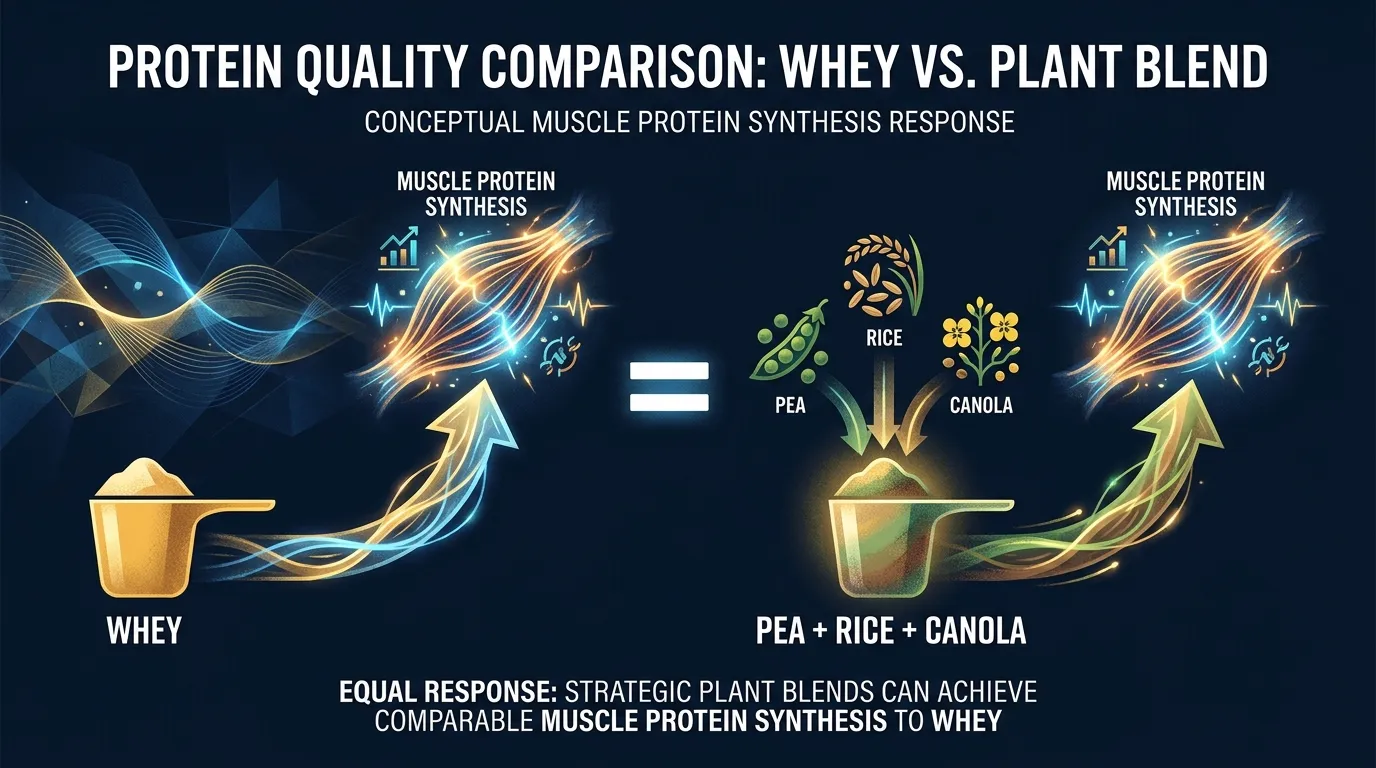
Result: post-exercise myofibrillar protein synthesis rates did not differ significantly between the plant blend and whey. Both raised synthesis rates substantially above resting values, and both produced a similar area-under-the-curve response over the measurement window. That is the mechanistic proof that a well-designed plant blend hits the same acute anabolic response as whey.
The reason it works is a genuine matter of amino acid chemistry. Pea protein is high in lysine but relatively low in methionine and cysteine. Rice protein is the mirror image, high in methionine and cysteine but relatively low in lysine. Canola contributes leucine and a favorable overall essential amino acid profile. Blending them approximates the amino acid pattern of a high-quality animal protein, which is why the synthesis response comes out equivalent. Single-source pea or rice or oat or potato does not do that, which is why the Reid-McCann meta-analysis found a gap for those sources specifically.
Gorissen 2018: Why the Leucine Difference Exists
The biochemistry underneath every finding above traces back to amino acid composition. The definitive audit is Gorissen, Crombag, Senden, and colleagues (2018), published in Amino Acids. The team ran gold-standard amino acid analyses on commercial protein isolates covering whey, milk, casein, egg, soy, pea, oat, hemp, potato, wheat, brown rice, and corn.
Two numbers matter. Leucine content averaged 8.8 percent of total protein for animal isolates versus 7.1 percent for plant isolates. Whey specifically came in around 11 percent leucine per gram; pea came in around 8.5 percent; brown rice around 8 percent; corn was actually the highest plant source at over 13 percent, though corn protein is otherwise unbalanced. Essential amino acid content overall averaged 43 percent for animal isolates versus 37 percent for plants.
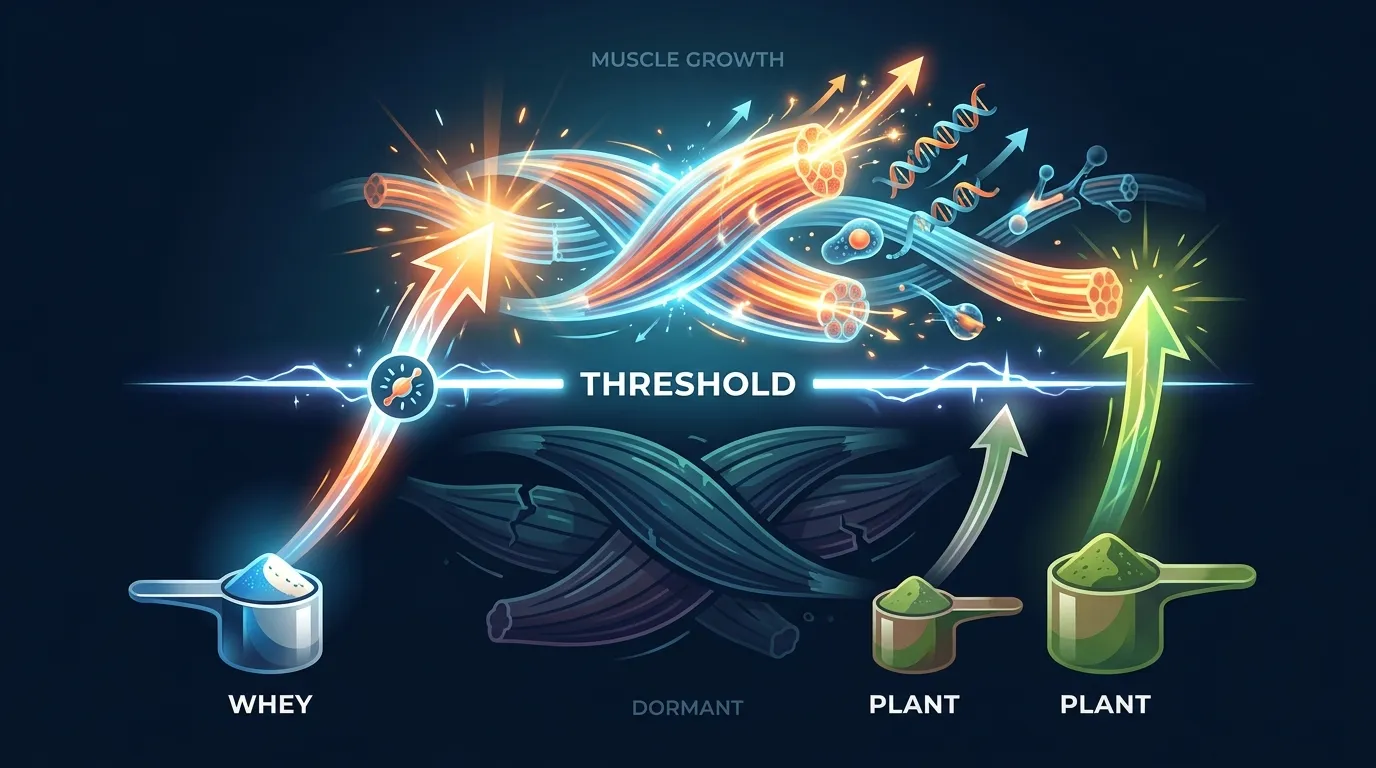
These are not enormous gaps in relative terms, but the leucine gap matters more than the number suggests. Leucine is the amino acid that flips on mTORC1, the molecular switch that starts a muscle protein synthesis session. Below roughly 2.5 to 3 g of leucine per meal, synthesis under-fires. Above 3 g, the response saturates. That leucine threshold is why a 25 g scoop of whey (about 3 g leucine) reliably hits the maximum synthesis response but a 25 g scoop of pea (about 2.1 g leucine) sometimes falls short. Add roughly 30 to 50 percent more grams of the plant protein and you clear the threshold. That is the whole story of the source difference, in one paragraph.
Why This Matters for Your Fitness
If you eat animal products and tolerate dairy, whey is a legitimate first choice. It hits the leucine threshold at a smaller dose, absorbs fast, mixes cleanly in water, and costs less per gram of protein than most plant isolates. If your training is aggressive and you are trying to hit high daily protein targets (1.6 to 2.2 g/kg per day) without eating enormous volumes of food, whey concentrate or isolate is the easiest way to get there.
If you avoid dairy, are lactose intolerant, follow a vegan diet, or just prefer plant protein for GI or ethical reasons, the Reid-McCann meta-analysis and the head-to-head RCTs say you can build the same muscle and strength as an omnivore. The catch is that "same" requires either a higher gram dose per serving to clear the leucine threshold or a well-designed blend (pea and rice at minimum, ideally with canola or another leucine-rich source). Single-source pea, single-source rice, or single-source oat protein at whey-sized doses are the specific combinations most likely to underperform.
The trial that best models "real life" is Hevia-Larraín. Both groups ate mostly whole foods, both hit 1.6 g/kg per day, and both trained the same program for 12 weeks. Both groups gained equivalent leg mass and strength. That is the practical case for plant protein: if you actually hit your total daily protein target, the source does not visibly change the outcome. If you routinely fall short of the target (which is common on plant-based diets because of lower protein per calorie in whole plant foods), that gap will show up.
This all sits inside the larger question of how much protein to eat per day, which we cover in How much protein you should eat per day, and when to eat it, which is the subject of protein distribution across meals and pre-sleep protein. Source is a smaller decision than dose. Dose is a smaller decision than total daily intake. Total daily intake is the number that actually moves body composition.
Get an evidence-based plan built for you
FitCraft, our mobile fitness app, pairs you with an AI coach who builds you a personalized plan around your goals, schedule, and fitness level. Every FitCraft program is designed by Domenic Angelino, MPH (Brown University) and NSCA-CSCS, with research published in the Journal of Strength and Conditioning Research and Medicine & Science in Sports & Exercise.
Take the Free Assessment Free • 2 minutes • No credit cardHow to Use Plant vs Whey Protein in Practice
The rule set from the trial evidence, translated into a working plan:
- Target 1.6 to 2.2 g of protein per kg per day. That is the range where the resistance-training trials that showed the source-agnostic effect actually landed. Below 1.2 g/kg, source questions start to matter more because you have less margin to clear leucine thresholds at each meal.
- Whey: about 25 g per dose clears the leucine threshold. A standard scoop of whey concentrate or isolate delivers roughly 20 to 25 g of protein and about 2.5 to 3 g of leucine, which reliably hits the muscle protein synthesis maximum for most adults.
- Plant protein: bump the dose to about 35 to 40 g, or blend sources. A single-source pea or rice serving at 25 g often falls short of the leucine threshold. Two effective fixes: raise the dose to 35 to 40 g, or use a blended plant protein (pea plus rice plus canola or similar) that reaches the same leucine total in a smaller dose.
- Soy is the single-source exception. Soy protein isolate clears the leucine threshold at a whey-sized dose (roughly 25 to 30 g) and matched milk protein in the Reid-McCann meta-analysis on muscle mass. If you want a single-source plant protein without blending, soy is the highest-evidence choice.
- Distribute across 3 to 5 meals a day. The protein distribution literature is clear that spreading protein into 3 to 5 doses across the day produces higher 24-hour muscle protein synthesis than the same total protein bunched into 1 or 2 meals. This matters more for plant protein because the per-meal leucine dose is closer to the threshold.
- For older adults, add a bit more. Muscle protein synthesis is less sensitive to a given leucine dose in adults over 60. The Reid-McCann meta-analysis found a smaller source gap in older adults, but the practical implication is that older adults on plant protein benefit from either a leucine-enriched supplement or a higher per-meal protein dose (35 to 40 g) to clear the higher threshold reliably. See sarcopenia and resistance training for the broader picture.
- Do not obsess about "complete" versus "incomplete" labels. Almost every plant protein isolate on the market contains all 9 essential amino acids. "Incomplete" in a nutrition-label sense meant one or more essential amino acids fell below reference levels, and that framing has been largely abandoned in the scientific literature because the total daily amino acid intake (not the per-meal profile) is what matters over weeks. Focus on total daily protein and leucine per meal.
- Whey and casein are still the fastest and slowest-digesting proteins on the shelf. If you want a fast synthesis spike (post-workout), whey wins on speed. If you want a slow overnight release (pre-sleep protein), casein wins on duration. Plant proteins sit somewhere between. This matters more at the margins of a competitive-athlete program than for a general lifter.
Individual Variation: Who Sees the Biggest Difference
Older Adults
The Reid-McCann subgroup analysis found a smaller advantage for animal protein in adults 60 and over, which sounds counterintuitive (older adults have blunted muscle protein synthesis and should theoretically benefit more from a leucine-rich source). One explanation is that the older-adult trials mostly used protein doses at or above 30 g per serving, which cleared the leucine threshold for both animal and plant sources. Practically: if you are over 60 and going plant-based, do not skimp on dose. Aim for 35 to 40 g of plant protein per meal rather than the 25 to 30 g range that suffices for younger adults.
Habitual Vegans vs New Switchers
The Hevia-Larraín trial specifically recruited people who had been vegan for at least a year, not omnivores switching to plants for the study. This matters because gut microbiome adaptation to a plant-based diet appears to modestly improve amino acid absorption from plant sources over months of consistent intake. Someone brand new to plant protein may see a slightly larger source gap in the first few weeks that closes over time. This is speculative from a mechanistic standpoint. The practical impact on hypertrophy is likely small.
People Training in a Caloric Deficit
Every trial cited above ran in energy balance or a small energy surplus. Muscle protein synthesis is more sensitive to leucine dose during an energy deficit (the state where muscle preservation matters most). If you are cutting weight while training, the argument for hitting a clean 3 g leucine dose per meal becomes stronger, which nudges the practical case toward whey or soy or a well-designed plant blend rather than a marginal-dose single-source plant protein.
Sex Differences
Most trials in this literature were run in men. The Lynch 2020 trial and the Reid-McCann meta-analysis both included women, and neither found a significant sex-by-source interaction. Practically, the same dose-and-leucine rules apply to women, scaled to body weight. Women following a plant-based diet during perimenopause or postmenopause (see our page on strength training after menopause) should aim for the higher end of the 1.6 to 2.2 g/kg range given the reduced anabolic sensitivity of older adults.
Common Misconceptions
Misconception 1: "Plant protein is 'incomplete' and cannot build muscle."
This is the oldest myth in the aisle and it has been dead in the peer-reviewed literature for at least a decade. Almost every commercial plant protein isolate contains all 9 essential amino acids. The relevant question is not "complete or incomplete" but "does this dose deliver enough leucine and total EAAs to trigger muscle protein synthesis." Single-source pea or rice at 25 g sometimes falls short. Soy at 25 to 30 g, a pea and rice blend at 25 g, or a single-source plant at 35 to 40 g clears the threshold. Muscle grows either way.
Misconception 2: "Whey is dramatically superior to plant protein for hypertrophy."
The Reid-McCann meta-analysis of 30 RCTs put a specific number on the source difference: standardized mean difference -0.20 for muscle mass, no significant difference for strength or performance. That is a small effect, and it disappears entirely for soy versus milk. In head-to-head RCTs where doses were matched properly (Hevia-Larraín, Lynch), muscle and strength gains came out equivalent. The "whey is dramatically superior" framing is a marketing claim, not a research finding.
Misconception 3: "You need to combine plant proteins at every meal to get complete protein."
The old "complementary proteins" idea (rice plus beans at the same meal) came from a 1971 book and was walked back by its own author in 1981. Amino acid pools in circulation are stable across a day. Any leucine or lysine or methionine deficit at one meal is buffered by the amino acids released from tissue turnover, and it does not need to be corrected within a single meal to matter for muscle protein synthesis at the next one. Total daily amino acid intake is what counts. That said, using a pea and rice blend in one shake is still slightly better than pea alone in one shake, because it clears the leucine threshold at a smaller total dose. The mechanism is per-meal saturation, not per-meal completion.
Misconception 4: "Soy protein raises estrogen and should be avoided by men."
The isoflavones in soy are phytoestrogens, and the "soy feminizes men" claim has been tested repeatedly. Meta-analyses of controlled trials in men consistently find no meaningful effect on testosterone, estradiol, or other reproductive hormones at intake levels reached with typical protein supplementation (up to about 50 g/day). Soy protein isolate is one of the most-studied hypertrophy supplements outside whey, and it matches milk protein for muscle mass in the Reid-McCann pool. The hormone worry is not supported by the trial data.
Misconception 5: "Plant blends are just marketing fluff on top of a cheap pea base."
Some blends are exactly that. Look at the ingredient panel. A pea-first blend that lists "brown rice protein" or "canola protein" in trace amounts is decorative. The van der Heijden 2024 trial used a specific ratio (39.5 percent pea, 39.5 percent brown rice, 21 percent canola) chosen for amino acid complementarity, and that formulation matched whey for post-exercise muscle protein synthesis. If a blend actually uses meaningful proportions of two or three complementary sources, the amino acid pattern approaches whey's. If it uses 95 percent pea and a pinch of rice, it functions as single-source pea.
What the Research Suggests Going Forward
The whey versus plant protein literature is in genuinely good shape for a nutrition topic. The largest meta-analysis (Reid-McCann 2025) covers 30 RCTs and 1,538 participants and puts a small confidence interval on the source difference. Two 12-week head-to-head RCTs (Hevia-Larraín 2021, Lynch 2020) triangulate the meta-analysis result with matched-dose trial data. One acute mechanistic trial (van der Heijden 2024) shows a well-designed plant blend hits the same acute synthesis response as whey. And an amino acid analysis (Gorissen 2018) explains why the source difference exists in the first place. That is a coherent, converging evidence base.
What is still open:
- Whether the small muscle-mass advantage for animal protein in the Reid-McCann pool holds up in trials longer than 12 weeks. Most existing trials are 8 to 16 weeks. Multi-year data is thin.
- Whether the older-adult effect actually reverses (rather than just shrinks) with adequate dose. A dedicated well-powered RCT of 35 to 40 g plant protein per meal versus 25 g whey in adults over 65 has not been run cleanly.
- Whether specific blended plant formulations (pea-rice, pea-rice-canola, mycoprotein-based, etc.) differ from one another meaningfully. Head-to-head plant-blend trials are still rare.
- Whether long-term chronic soy protein intake at high doses (60+ g/day) affects any hormonal or clinical outcome. Existing trials mostly ran under 50 g/day.
- Whether the "get more grams" strategy for closing the leucine gap creates any GI-tolerance issues at scale for people on high plant-protein diets. Anecdotally common; systematically studied less.
The bottom line for someone deciding what to buy: whey is a safe, cheap, effective first choice if you tolerate dairy. Soy is the closest single-source plant alternative and matches milk protein on muscle mass in the pooled evidence. A pea-and-rice-and-canola blend at a meaningful ratio hits the same acute synthesis response as whey. Single-source pea or rice or oat at a whey-sized dose is where the small source gap actually shows up, and the fix is to either bump the dose by 30 to 50 percent or switch to a blend. Total daily protein intake matters more than which source you pick, and consistency of intake over months matters more than either.
Almost every serious hypertrophy question comes down to consistency at the end. Consistency beats optimization in almost every nutrition study that runs long enough to detect it, and the source of your protein is not the exception.
References
- Reid-McCann RJ, Brennan SF, Ward NA, Logan D, McKinley MC, McEvoy CT. "Effect of Plant Versus Animal Protein on Muscle Mass, Strength, Physical Performance, and Sarcopenia: A Systematic Review and Meta-analysis of Randomized Controlled Trials." Nutr Rev. 2025;83(7):e1581-e1603. doi:10.1093/nutrit/nuae200
- van der Heijden I, Monteyne AJ, West S, Morton JP, Langan-Evans C, Hearris MA, Abdelrahman DR, Murton AJ, Stephens FB, Wall BT. "Plant Protein Blend Ingestion Stimulates Post-exercise Myofibrillar Protein Synthesis Rates Equivalently to Whey in Resistance-trained Adults." Med Sci Sports Exerc. 2024;56(8):1467-1479. doi:10.1249/MSS.0000000000003432
- Hevia-Larraín V, Gualano B, Longobardi I, Gil S, Fernandes AL, Costa LAR, Pereira RMR, Artioli GG, Phillips SM, Roschel H. "High-Protein Plant-Based Diet Versus a Protein-Matched Omnivorous Diet to Support Resistance Training Adaptations: A Comparison Between Habitual Vegans and Omnivores." Sports Med. 2021;51(6):1317-1330. doi:10.1007/s40279-021-01434-9
- Lynch HM, Buman MP, Dickinson JM, Ransdell LB, Johnston CS, Wharton CM. "No Significant Differences in Muscle Growth and Strength Development When Consuming Soy and Whey Protein Supplements Matched for Leucine Following a 12 Week Resistance Training Program in Men and Women: A Randomized Trial." Int J Environ Res Public Health. 2020;17(11):3871. doi:10.3390/ijerph17113871
- Gorissen SHM, Crombag JJR, Senden JMG, Waterval WAH, Bierau J, Verdijk LB, van Loon LJC. "Protein content and amino acid composition of commercially available plant-based protein isolates." Amino Acids. 2018;50(12):1685-1695. doi:10.1007/s00726-018-2640-5
Frequently Asked Questions
Does whey protein build more muscle than plant protein?
Barely, and only in specific cases. The Reid-McCann and colleagues (2025, Nutrition Reviews) meta-analysis of 30 randomized controlled trials and 1,538 participants found a small overall muscle-mass advantage for animal protein (standardized mean difference -0.20, p=0.02). The advantage disappeared for soy compared with milk protein. It persisted for non-soy single-source plant proteins (rice, chia, oat, potato) versus animal protein. Strength and physical performance were equivalent across both categories. In head-to-head resistance-training RCTs (Hevia-Larraín 2021, Lynch 2020), muscle mass and strength gains matched when protein doses were adequate.
Is whey protein better absorbed than plant protein?
Whey is absorbed faster and has a higher leucine content per gram (about 11 percent leucine versus 5 to 8 percent for most plant proteins, per Gorissen and colleagues 2018, Amino Acids). Faster absorption drives a sharper muscle protein synthesis spike after a dose. But the total 24-hour synthesis response is what actually builds muscle over months, and it depends more on hitting a sufficient dose of essential amino acids than on the source. Plant proteins reach the same total daily synthesis when the dose is a bit larger or when sources are blended.
How much plant protein equals a scoop of whey?
To match the roughly 3 g of leucine in a 25 g scoop of whey, you need about 40 g of soy, 38 g of pea, or 37 g of brown rice protein. That is a rough 30 to 50 percent bump in grams. In the Hevia-Larraín and colleagues (2021, Sports Medicine) trial, habitual vegans hit the same 1.6 g/kg total daily protein target as omnivores using about 58 g of soy protein isolate per day compared with 39 g of whey for omnivores, and both groups gained similar amounts of muscle mass over 12 weeks of resistance training.
Do plant protein blends work as well as whey?
Yes, when the blend is designed to fill amino acid gaps. van der Heijden and colleagues (2024, Medicine and Science in Sports and Exercise) gave 10 resistance-trained young adults 32 g of protein from either whey or a plant blend of 39.5 percent pea, 39.5 percent brown rice, and 21 percent canola after a resistance training session. Post-exercise myofibrillar protein synthesis rates did not differ between the two. The blend works because pea contributes leucine while brown rice contributes methionine, covering the amino acid weak points of each single source.
Should I switch from whey to plant protein?
Only if you want to for dietary, ethical, or GI reasons. The performance difference between whey and a well-formulated plant blend is small enough that most people will not notice it in the mirror. If you tolerate dairy and prefer whey, keep it. If you avoid dairy, choose soy (equivalent to milk protein in the Reid-McCann meta-analysis) or a pea and rice blend. Whichever you pick, hitting your total daily protein target (roughly 1.6 to 2.0 g per kg of body weight) matters more than which source you use to get there.