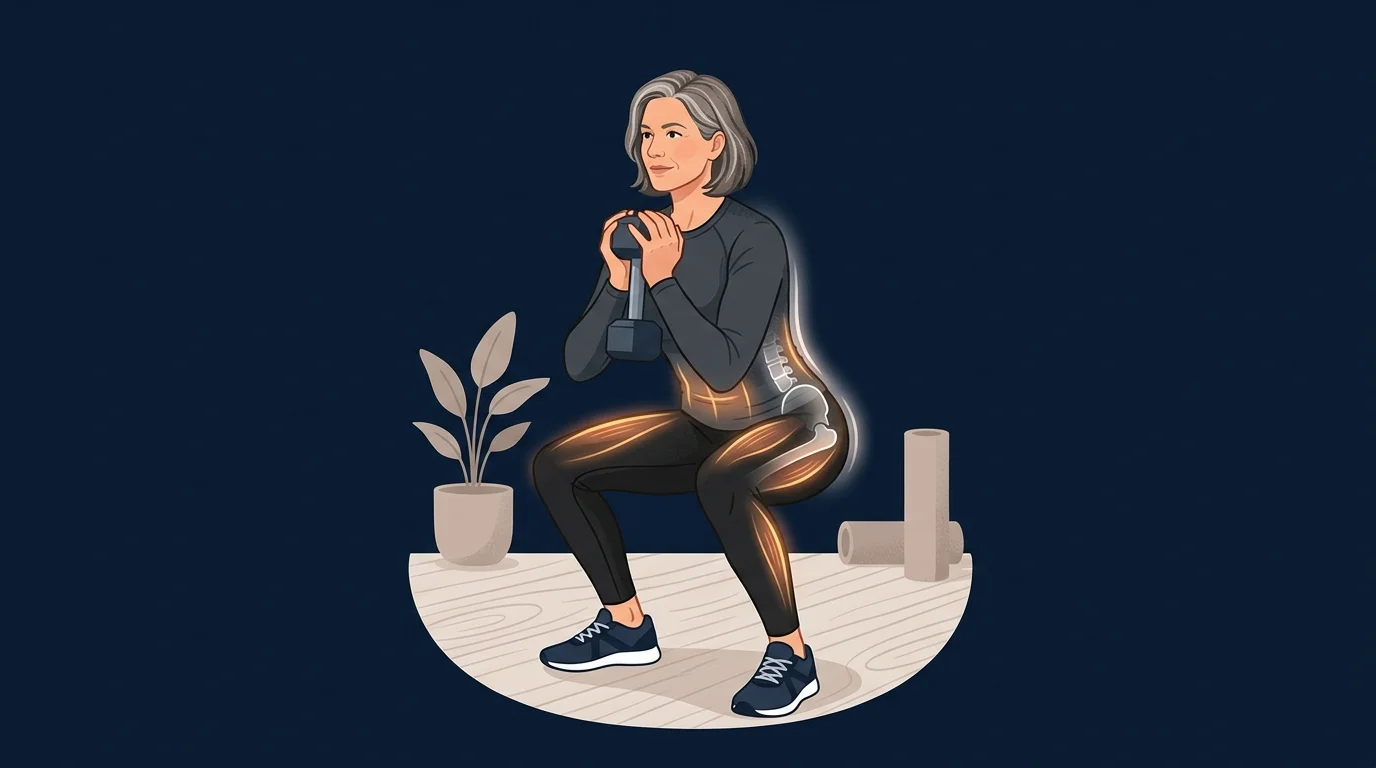
Here is the part nobody tells you clearly enough. The joint aches, the muscle that seems to melt off, the bones quietly thinning: a large chunk of that is reversible, and the thing that reverses it is not a supplement or a walk. It is lifting.
Estrogen drops through the menopausal transition, and that drop reaches into muscle, bone, and connective tissue. Muscle responds less to the same training stimulus. Bone resorption outpaces bone formation. Researchers now group these changes under a single name, the musculoskeletal syndrome of menopause, because they share one driver. It can feel like your body turned on you. It did not. The biology changed, and the response has to change with it.
The good news is that the response is well-mapped. This guide walks through why strength training works after menopause, then gives you a specific week-by-week plan you can run at home. It is deliberately conservative. Start where you are, progress slowly, and clear it with your doctor if you have any bone or heart condition.
Why Strength Training Is the Priority After Menopause
Plenty of exercise is good for you. But if you only had time for one type after menopause, the evidence points hard at resistance training. Three reasons.
It Is the Best-Supported Way to Protect Bone
Bone loss accelerates sharply around the final menstrual period. In the LIFTMOR trial, Watson, Weeks, Weis, Harding, Horan, and Beck (2018) in the Journal of Bone and Mineral Research randomized 101 postmenopausal women with low bone mass to 8 months of twice-weekly, 30-minute supervised resistance and impact training or a home-based low-intensity control. The trained group gained 2.9 percent bone density at the lumbar spine while the control group lost ground, a between-group difference of 4.1 percent. They also improved on the timed up-and-go, back extensor strength, and functional reach. Adherence was above 90 percent and there were no serious adverse events. Real bone gained, not just loss slowed.
It Rebuilds Muscle, Even When Estrogen Is Low
Estrogen supports the muscle-building signal, so after menopause the same workout does less. That is real. But resistance training still works. A 2025 network meta-analysis by Radaelli et al. in Sports Medicine pooled 151 randomized trials with 6,306 adults over 60 and found resistance training reliably improved lean mass, muscle size, strength, and walking speed. The response is smaller and slower than it would have been at 30. It is still there, and it is worth having.
It Helps Symptoms Beyond Bone and Muscle
A 2023 systematic review by Capel-Alcaraz et al. in the Journal of Clinical Medicine found strength training was associated with improvements in leg strength, physical activity, bone density, and several metabolic and hormonal markers, with mixed but generally favorable effects on hot flashes. The symptom-relief effects tend to appear after several weeks of consistent training, not overnight. Consistency is the active ingredient. We cover the broader picture in our perimenopause fitness guide.
The Principles Before the Plan
The plan below only works if you understand the two rules underneath it.
Progression is the whole game. The word "progressive" in progressive overload is load-bearing. If you lift the same light dumbbells forever, your body adapts and stops changing within a few months. The goal each week is to make the work a little harder: a heavier dumbbell, a stronger band, one more rep, a deeper range of motion, or a harder version of the same movement. Slow and steady, but always creeping up.
Challenging is relative, not absolute. A 4 kg dumbbell overhead press can be genuinely hard for one person and trivial for another. The target is that the last 1 to 2 reps of your last set feel hard but doable with good form. Trainers call this leaving a couple of reps in reserve. Absolute weight does not matter. Effort relative to your capacity does.
What You Need at Home
You can run this entire plan with a small kit. Nothing fancy.
- Adjustable dumbbells or a few fixed pairs. A light, medium, and slightly heavier pair covers most people. Even a couple of pairs is enough to start.
- Resistance bands. A set of loop or handled bands for rows, presses, and pull-aparts.
- A sturdy chair or bench. For sit-to-stands, step-ups, incline push-ups, and support during single-leg work.
- A little floor space and a mat. That is it.
No dumbbells yet? Weeks 1 and 2 use mostly bodyweight anyway, so you can start today and add equipment as you go.
Find out what's really holding you back
FitCraft, our mobile fitness app, pairs you with an AI coach who builds you a personalized plan around your goals, schedule, and fitness level. Every FitCraft program is designed by Domenic Angelino, MPH (Brown University) and NSCA-CSCS, with research published in the Journal of Strength and Conditioning Research and Medicine & Science in Sports & Exercise.
Take the Free Assessment Free • 2 minutes • No credit cardThe Movement Patterns
LIFTMOR built its results on a handful of compound patterns. This home version keeps the same patterns and just scales the load down to what you can do without supervision. Every session touches most of these.
- Hinge: the hip-driven bend that protects your back and loads the whole posterior chain. Start with a bodyweight hip hinge or glute bridge, progress to a dumbbell Romanian deadlift.
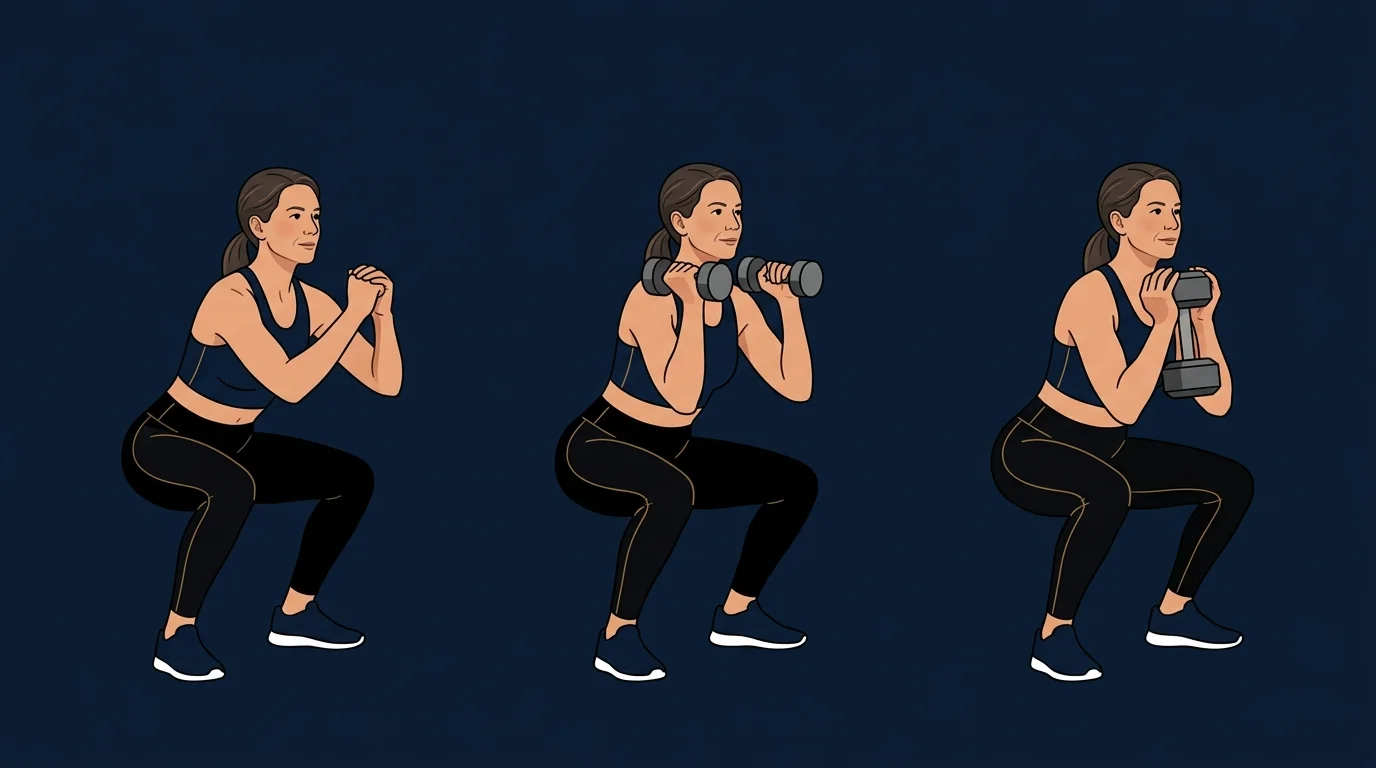
- Squat: the foundational lower-body strength and bone pattern. Start with a sit-to-stand from a chair, progress to a goblet squat holding a dumbbell.
- Push: upper-body pressing. Start with incline push-ups against a counter or wall, progress to a dumbbell overhead or floor press.
- Pull: upper-back and grip. Start with band rows and band pull-aparts, progress to single-arm dumbbell rows.
- Carry: hold a dumbbell in each hand and walk. Simple, and one of the best whole-body and grip builders there is.
- Gentle impact: bone responds to impact plus load. Start with heel drops (rise onto your toes, drop your heels firmly) and light hops in place. Progress cautiously, and skip impact entirely if you have osteoporosis until cleared.
The 8-Week Starting Plan
Two full-body sessions a week, on non-consecutive days (for example Monday and Thursday). Each session is about 30 to 40 minutes including a warm-up. Warm up with 5 minutes of easy walking or marching in place plus a few arm circles and bodyweight squats.
Weeks 1 to 2: Learn the Patterns
The goal here is not to be sore. It is to groove the movements so they feel natural and safe. Use bodyweight and your lightest dumbbells only.
- Sit-to-stand from a chair: 2 sets of 8 to 10
- Glute bridge: 2 sets of 10
- Incline push-up against a counter: 2 sets of 6 to 8
- Band row: 2 sets of 10 to 12
- Band pull-apart: 2 sets of 12
- Farmer carry with light dumbbells: 2 walks of 20 to 30 seconds
- Heel drops: 2 sets of 10 (skip if you have osteoporosis until cleared)
Rest 60 to 90 seconds between sets. Every rep should feel controlled. If a movement hurts a joint (not muscle effort, actual joint pain), stop that movement and swap it.
Weeks 3 to 4: Add Load
Now the patterns feel familiar, so start challenging them. Move to goblet squats, add dumbbells, and push each set closer to hard.
- Goblet squat (hold one dumbbell at your chest): 3 sets of 8 to 10
- Dumbbell Romanian deadlift: 3 sets of 8 to 10
- Dumbbell floor press or incline push-up: 3 sets of 8
- Single-arm dumbbell row: 3 sets of 8 to 10 per side
- Standing dumbbell overhead press: 2 sets of 8 to 10
- Farmer carry: 3 walks of 30 seconds, heavier
- Heel drops or light hops in place: 2 sets of 10 (cleared individuals only)
The rule for adding weight: when the top of the rep range starts to feel easy, go up. The last 1 to 2 reps of your last set should feel genuinely hard.
Weeks 5 to 6: Build Real Strength
Keep the same movements and keep nudging the load up. This is where strength gains become obvious in daily life: stairs feel easier, groceries feel lighter.
- Goblet squat: 3 sets of 8, heavier than week 4
- Dumbbell Romanian deadlift: 3 sets of 8
- Dumbbell overhead press: 3 sets of 8
- Single-arm dumbbell row: 3 sets of 8 per side
- Dumbbell floor press: 3 sets of 8
- Step-up onto a low sturdy step: 2 sets of 8 per leg
- Farmer carry: 3 walks of 40 seconds
- Hops or low box step-downs for impact: 2 sets of 8 (cleared individuals only)
Weeks 7 to 8: Lock In the Habit
By now the plan is a routine, not a project. The job of these two weeks is to prove to yourself you can keep it going. Keep progressing load where you can, and treat this as the template you carry forward. After week 8, you simply keep running this structure and keep adding load over the months. That long, slow, progressive climb is exactly what produced the bone density gains in LIFTMOR.
If a week ever feels like too much (poor sleep, high stress, a cold), it is fine to take an easier session or a rest day. One planned easier week every couple of months, a deload, can actually help. Missing one session is not failure. Quitting is the only real failure, and this plan is built to be sustainable specifically so you do not.
Protein and Recovery Support the Training
Training is the stimulus. Protein and sleep are what let your body respond to it. After menopause, muscle shows some anabolic resistance, meaning it takes a bit more protein to trigger the same building response. Most of the literature on older adults points toward 1.2 to 1.6 grams of protein per kilogram of body weight per day, spread across meals, aiming for 25 to 40 grams per meal. Sleep matters too, both for recovery and because poor sleep amplifies pain and blunts progress.
One honest note on hormones. A small randomized trial by Dam et al. (2021) in Frontiers in Physiology found that early postmenopausal women who added transdermal estrogen to 12 weeks of resistance training gained more muscle (a 7.4 percent increase in quadriceps cross-sectional area versus 3.9 percent on placebo). That is a medical decision for you and your doctor, not something to start from an article. But it shows the training works with or without it, and estrogen therapy is worth discussing with a clinician if symptoms warrant.
What to Expect
Weeks 1 and 2 often feel almost too easy. That is by design. Around weeks 3 and 4, when you add load, you will feel some good muscle soreness and probably notice you are getting stronger fast. That early jump is mostly your nervous system learning to recruit muscle, and it is genuinely encouraging.
The deeper changes take longer. Visible muscle and measurable bone density gains come from months, not weeks. The LIFTMOR bone results came after 8 months. So the mindset that wins is not "8-week transformation." It is "I am someone who lifts twice a week now." The bone and muscle follow from the habit. Balance improves along the way too, which matters more than it sounds: falls are how the syndrome does its worst damage, and we cover the research in our balance training and falls writeup. For the broader case on lifting in later decades, see our strength training after 60 piece. If you would rather have an app run the progression, our roundup of the best fitness apps for women ranks the strength options.

The Bottom Line
You are not stuck with decline. The research is unusually clear here: progressive strength training, twice a week, protects bone and rebuilds muscle after menopause, and you can start it at home with dumbbells and bands. Start light, learn the patterns, then add load week by week and keep going. You do not need to be an athlete. You need to be consistent, and this plan is built so you can be.
Frequently Asked Questions
How often should a postmenopausal woman strength train?
Twice a week is the evidence-based floor, and it is what the LIFTMOR trial used to produce bone density gains in postmenopausal women. Three sessions a week is better for building muscle. The two non-negotiables are that the sessions are full-body and that the load progresses over time. Two challenging full-body sessions beat five easy ones for both bone and muscle.
Can you start strength training after menopause with no experience?
Yes. The research on resistance training in older and postmenopausal women consistently shows meaningful strength and function gains in people who had never lifted before. The right starting point is bodyweight and light dumbbells with a focus on learning the movement patterns, then adding load week by week. You do not need to start heavy. You need to start, then progress.
Do you need heavy weights to protect your bones after menopause?
Higher relative loads produce a stronger bone response, but progression matters more than any single absolute weight. LIFTMOR trained women above 85 percent of their one-rep max, which is heavy, and it worked. But dumbbell, resistance-band, and bodyweight strength work still produce measurable bone-loading stimulus, especially when built up progressively over months. Intensity relative to your current capacity is the lever, not the number on the dumbbell.
Can strength training help menopause symptoms besides bone loss?
A 2023 systematic review in the Journal of Clinical Medicine by Capel-Alcaraz et al. found strength training was associated with improvements in leg strength, physical activity, bone density, and some metabolic and hormonal markers, with mixed but generally favorable effects on hot flashes. Individual responses vary. Consistency over several weeks matters more than intensity for the symptom-relief benefits.
How long until you see results from strength training after menopause?
Strength and confidence in the movements usually improve within 2 to 4 weeks, mostly from neural adaptation. Visible muscle and measurable bone density changes take longer, on the order of 3 to 8 months of consistent progressive training. The LIFTMOR bone density gains came from 8 months of twice-weekly work. The early wins are functional: easier stairs, easier carrying, better balance.