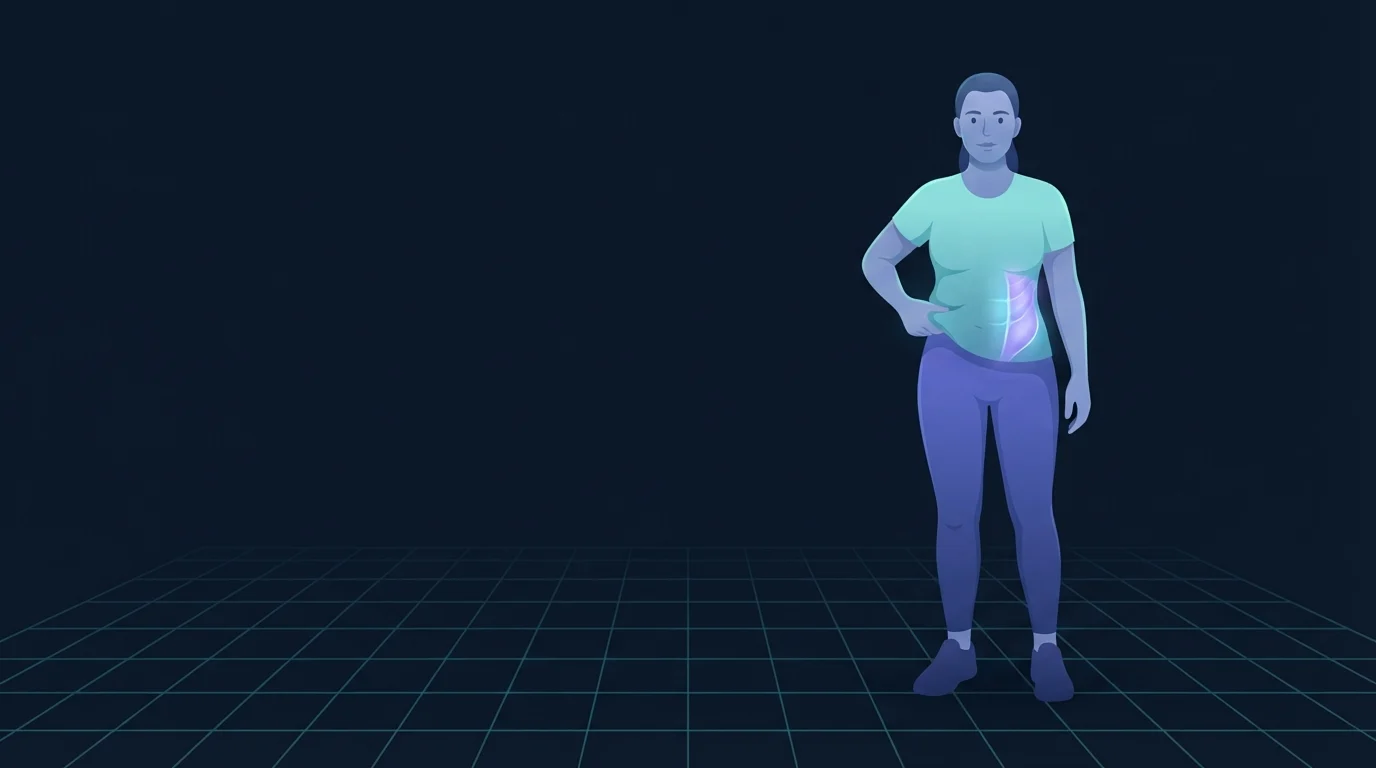
You can see your jaw change. Your arms look different, your chest looks different, the number on the scale has moved. And the sides of your waist look exactly the same as they did in July.
That's the part nobody warns you about, and it's why so many good plans get abandoned at week eight. The effort was real, the fat loss was real, and none of it showed up where you were looking. It feels like proof that your body is broken in some specific, personal way.
It isn't. Fat leaves in an order your body chooses, and the flank sits near the end of that queue for most people. Once you know that, the plan stops being a guessing game about which exercise targets the sides and starts being a question of whether you can hold a modest deficit long enough to reach the back of the line.
What Are Love Handles?
Love handles are the soft subcutaneous fat deposited over the external and internal obliques at the top of the hip, just above the iliac crest, often continuing back toward the upper glute. The name is slang, not a diagnosis. The same deposit gets called flank fat, a muffin top, or a spare tyre depending on who's describing it, and none of those are medical terms either.
Two facts about that tissue matter for everything below.
- It's the layer you can pinch. Subcutaneous fat sits between the skin and the abdominal wall. It's a storage depot, relatively inert, slow to mobilise, and it's what you actually see in a mirror.
- It isn't visceral fat. Visceral fat packs in around the organs, behind the abdominal wall, and you can't pinch it at all. It responds faster to training and carries most of the metabolic risk. Our guide to the best exercises to lose belly fat covers that deeper deposit and the aerobic dose that shifts it.
Underneath the love handle you have the external oblique, the internal oblique and the quadratus lumborum. Those muscles rotate and side-bend the trunk and resist it being rotated or bent. They're worth training. Training them does not consume the fat sitting on top of them, and the next section is the evidence for that unglamorous sentence.
One number is worth adopting before you start: waist circumference. Ross and colleagues (2020), in a consensus statement in Nature Reviews Endocrinology from the International Atherosclerosis Society and the International Chair on Cardiometabolic Risk, argued that waist circumference should be measured routinely alongside weight because it predicts health risk in ways body weight alone misses. It also happens to be the most sensitive way to see love handles changing, long before a photo shows it.
Why No Exercise Empties the Flank
This is the shared evidence behind every "lose fat from X" question on the internet, so here it is once, compactly.
Vispute, Smith, LeCheminant and Hurley (2011), in the Journal of Strength and Conditioning Research, put 24 adults through six weeks of seven abdominal exercises, five days a week. Abdominal muscular endurance improved. Body weight, body fat percentage, android fat, abdominal circumference and abdominal skinfold thickness did not change.
Kostek and colleagues (2007), in Medicine and Science in Sports and Exercise, ran 104 adults through twelve weeks of resistance training in one arm only, then measured subcutaneous fat by MRI. Fat came off, and it came off generally rather than from the arm that did the work.
Ramirez-Campillo and colleagues (2013), also in the Journal of Strength and Conditioning Research, had participants train one leg with high-repetition endurance work for twelve weeks. Fat mass fell in the trunk and upper body. The trained leg didn't change.
Three different body regions, three different protocols, the same answer. The muscle under a fat deposit doesn't have preferential access to it, so the exercise you pick decides which muscle gets stronger, not which drawer gets emptied. What decides the drawer is genetics, sex hormones and where you are in the fat-loss process, and none of those are on the menu of things you choose.
How to Get Rid of Love Handles: The Four Levers That Work
Everything that actually moves the flank is whole-body. There are four levers, in rough order of how much they matter.
1. A deficit you can hold for months, not weeks
Fat loss needs an energy deficit, and the flank needs that deficit sustained long enough to get past the depots ahead of it in the queue. That's an argument for a smaller deficit than most people pick. Somewhere around 300 to 500 calories below maintenance loses roughly 0.25 to 0.5 kg of body weight a week and is survivable alongside a job and a social life. A 1,000-calorie deficit works beautifully for three weeks and then collapses.
If you've never estimated your maintenance intake, our TDEE calculator gives you a starting number, and our review of what a calorie deficit actually is explains why the arithmetic drifts as you get lighter.
2. Protein and resistance training, so the loss is fat
A deficit alone shrinks you. A deficit plus lifting and protein shrinks the fat and keeps the muscle, which is the difference between looking leaner and looking deflated. Longland and colleagues (2016), in the American Journal of Clinical Nutrition, put 40 young men into a 40% energy deficit for four weeks with resistance and interval training six days a week. The group eating 2.4 g of protein per kg of body weight gained 1.2 kg of lean mass and lost 4.8 kg of fat. The group at 1.2 g/kg gained almost no lean mass and lost 3.5 kg of fat. Same deficit, different outcome.
You don't need 2.4 g/kg. Something in the range of 1.6 to 2.0 g/kg covers most people in a deficit, and our guide on losing fat without losing muscle walks through the training side.
3. Daily movement, not just workouts
The calories you burn outside of training, from walking, fidgeting, standing and errands, are called NEAT, and they swing far more than people expect. Levine, Eberhardt and Jensen (1999), in Science, overfed 16 adults by 1,000 calories a day for eight weeks and found fat gain varied roughly ten-fold between individuals. The variation in non-exercise activity explained most of it. Our review of non-exercise activity thermogenesis unpacks how that plays out during a deficit, when NEAT tends to quietly fall.
The practical version is a step floor. Pick a number you hit every day regardless of whether you trained, somewhere between 7,000 and 10,000, and treat it as non-negotiable.
4. Sleep, which is not a wellness garnish
Nedeltcheva and colleagues (2010), in the Annals of Internal Medicine, ran ten overweight adults through two 14-day periods in the same moderate deficit, once sleeping 8.5 hours a night and once sleeping 5.5. Total weight loss was nearly identical. The composition was not: fat loss dropped by roughly 55% on short sleep, and the shortfall came out of lean tissue instead. Hunger ratings went up as well.
If you're trying to get rid of love handles on six hours of sleep, you're asking the deficit to do a job it can't do alone.
Find out what's really holding you back
FitCraft, our mobile fitness app, pairs you with an AI coach who builds you a personalized plan around your goals, schedule, and fitness level. Every FitCraft program is designed by Domenic Angelino, MPH (Brown University) and NSCA-CSCS, with research published in the Journal of Strength and Conditioning Research and Medicine & Science in Sports & Exercise.
Take the Free Assessment Free • 2 minutes • No credit cardHow to Get a Flat Stomach
People asking how to get a flat stomach are usually asking about three different problems at once, and only one of them is fat.
Layer one is the fat. That's the slow one, and it's the whole article above. Months, not days.
Layer two is what's inside. Abdominal distension moves fast and is often mistaken for fat gain. Seo, Kim and Oh (2013), reviewing abdominal bloating in the Journal of Neurogastroenterology and Motility, describe a specific reflex worth knowing about: the diaphragm descends while the abdominal wall relaxes, so the contents get pushed forward and the belly visibly protrudes without any extra gas being present. Which means a stomach can look genuinely rounder in the evening than it did at breakfast, on an identical body. Large meals, carbonation, eating fast and a sudden jump in fibre all feed this.
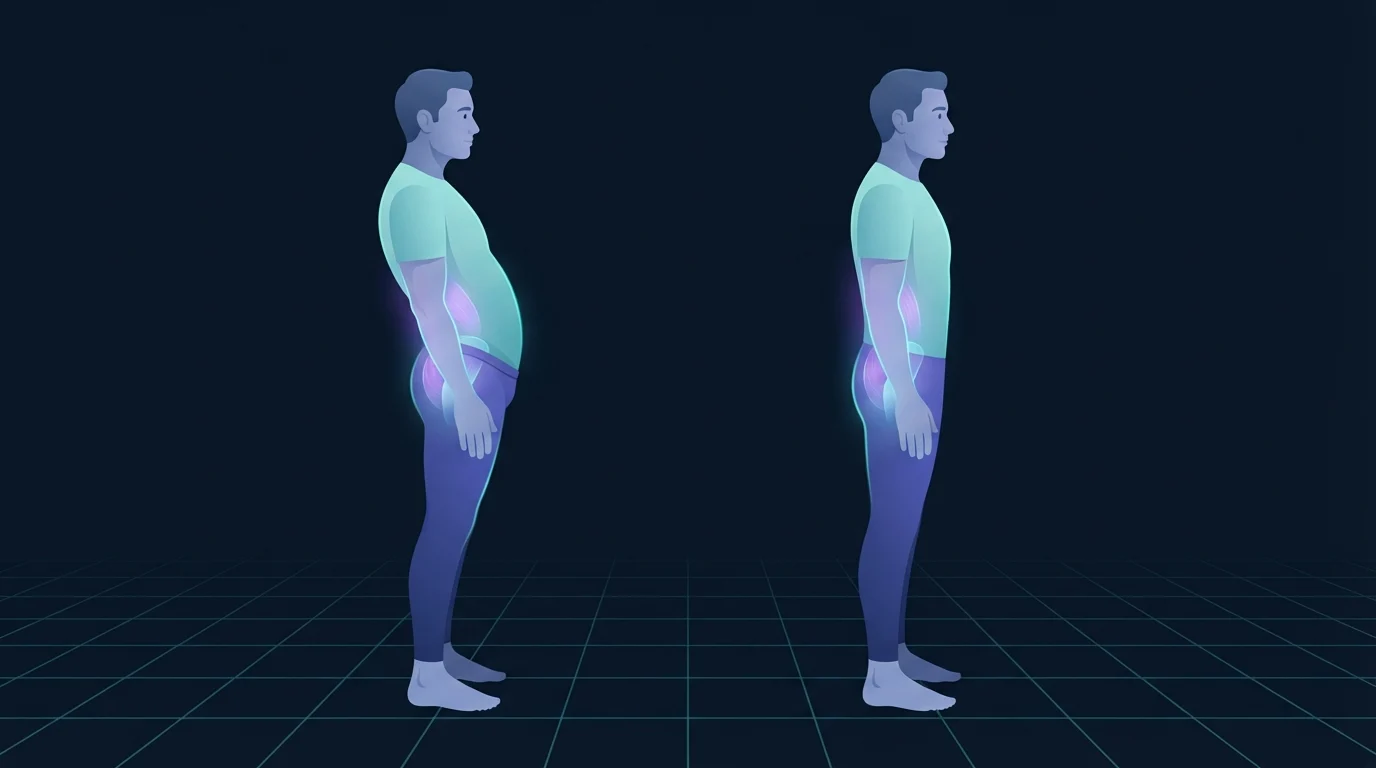
Layer three is how you're stacked. If the pelvis tips forward, the lumbar spine extends and the abdominal wall gets pushed out in front of you. Same body fat, rounder silhouette. Our guide to fixing anterior pelvic tilt covers the honest version of this, including how to check whether you actually have it, because the internet dramatically over-diagnoses it.
The practical upshot: measure once a week, in the morning, before eating, and stop rendering verdicts on your stomach after dinner. If the tape is moving and the evening silhouette isn't, layer two is what's talking.
How to Get a Smaller Waist
A waist measurement is the sum of two things: the fat over the obliques and the size of the muscle under them. That framing answers most of the questions people ask about it.
Abdominal endurance work changes neither. Vispute and colleagues measured abdominal circumference directly after six weeks of daily ab training and found it unchanged. Two sets of ten, five days a week, isn't enough load to grow a muscle and isn't a meaningful energy cost either.
Heavy, progressively loaded side bends and weighted rotation are a different story. Muscle that's trained hard with added load over months gets thicker, and the obliques are muscle like any other. If your only goal is a narrower tape measure, that's working against you. So the trunk plan for a smaller waist is:
- Train the trunk to resist motion, not to produce it. Anti-rotation work, side planks and loaded carries build the control you want without chasing oblique growth.
- Skip the weighted side bend. It's a fine exercise with a specific purpose. Waist narrowing isn't it.
- Build the frame around the waist. Shoulders, upper back and glutes change the ratio the eye reads, and they're trainable much faster than the fat layer is. Our glute activation guide is a reasonable entry point for the lower half.
On waist trainers and corsets: they compress soft tissue while you wear them and the effect ends when you take them off. There's no mechanism by which external pressure removes fat cells, and wearing one tight enough to reshape you for hours makes breathing and bracing worse, not better.
A Healthy Diet for Love Handles
There's no food that targets the flank, so a healthy diet for love handles is just a diet that makes a small deficit easy to keep. Four things do most of the work.
| Lever | What to aim for | Why it helps |
|---|---|---|
| Protein | 1.6 to 2.0 g per kg body weight | Protects muscle in a deficit and is the most filling macronutrient per calorie |
| Fibre and volume | Vegetables or fruit at most meals | More food weight for the same energy, so the deficit costs you less hunger |
| Alcohol | Less, or none, during the cut | Energy with no satiety return, and it reliably loosens the rest of the plan |
| Meal rhythm | Three or four anchored eating windows | Removes the decision fatigue that turns a 400-calorie deficit into a rounding error |
The alcohol line deserves a sentence of evidence. Schroder and colleagues (2007), in the European Journal of Nutrition, surveyed roughly 3,000 adults and found heavier drinking was associated with abdominal obesity independently of total energy intake. That's a population association rather than proof of cause, and the practical reading is modest: alcohol adds calories you don't feel, and it tends to take the evening's food choices with it.
For the fruit side of the volume argument, our guide to the best fruits for weight loss ranks them by what they actually do for fullness.
Love Handles in Men and Women
Where your body puts fat isn't random and isn't the same across sexes. Karastergiou, Smith, Greenberg and Fried (2012), reviewing sex differences in adipose tissue in Biology of Sex Differences, describe how fat cells above and below the waist differ in how readily they store and release fat, and how sex hormones drive the split.
The practical summary looks like this.
- Men store in an android pattern, concentrated at the abdomen and flank. That depot fills first and empties last, which is why a man can lose visible fat from his face, arms and chest for two months while the sides of his waist look untouched. The finish line is real, it's just further away than the first visible progress suggests.
- Women store more gluteofemorally, at the hips and thighs, and Manolopoulos, Karpe and Frayn (2010), in the International Journal of Obesity, review the evidence that this pattern is metabolically protective rather than a problem to solve. Waist and flank gain often shows up later, and it commonly shows up around the menopausal transition as the storage pattern shifts. Our review of menopause belly research covers that shift and what changes about training.
Neither pattern changes the plan. It changes the expected timeline and which progress photo will disappoint you first.
Training That Changes the Shape
Two jobs here, and they're separate. Full-body resistance training protects muscle while the deficit runs. Trunk training builds the control and the shape under the fat. Neither one burns the flank directly.
A reasonable trunk block, twice a week, after your main lifts:
| Exercise | Dose | What it's for |
|---|---|---|
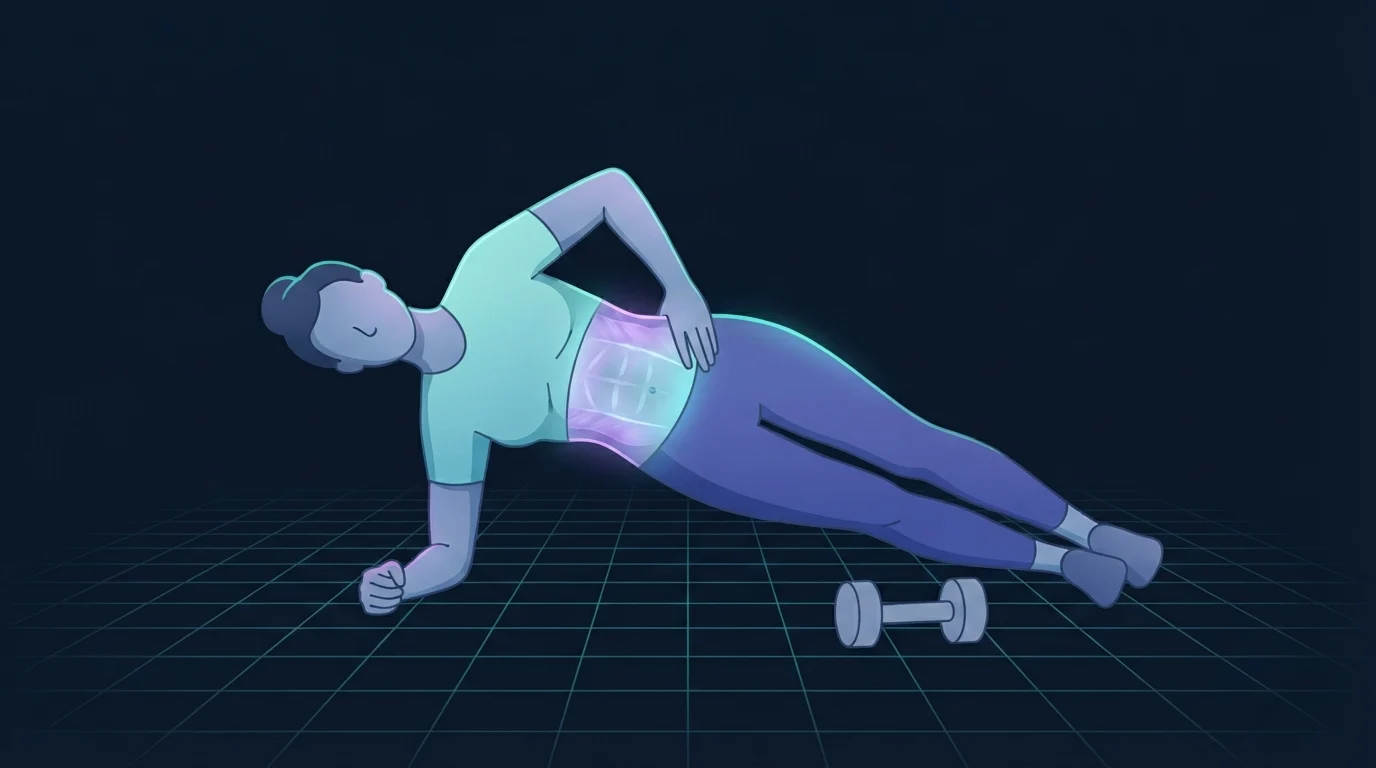
| Side plank | 3 x 20-40 sec per side | Lateral trunk stiffness, the obliques' actual day job |
| Side plank reach-through | 3 x 8 per side | Controlled rotation under a stable pelvis |
| Dead bug | 3 x 8 per side, slow | Anti-extension, the counterweight to a tipped pelvis |
| Bird dog | 3 x 8 per side | Anti-rotation with the hip and shoulder loaded diagonally |
| Suitcase carry, one dumbbell | 3 x 30 m per side | Loaded side-bend resistance, the honest version of a side bend |
The carry is the one people skip and the one that transfers most. Our review of the farmer's carry research covers the loading and the grip side of it. If you want a fuller trunk programme, core stability exercises has the progressions, and how to get abs covers the body-fat side of visible abdominal definition.
For the lifting that protects muscle during the deficit, three full-body sessions a week is enough, and it doesn't need a gym. A workout app built for weight loss can keep the sessions progressing while the deficit runs, which matters more than the exercise selection does.
How Long It Takes
Here's the honest calendar, assuming a 300 to 500 calorie deficit held consistently.
- Weeks 1 to 2. The scale drops faster than fat loss can explain, mostly water and gut contents. Waist circumference may move a centimetre. Don't extrapolate from this.
- Weeks 3 to 6. The scale slows to something sane. Face, hands and upper body usually change first. The flank looks identical. This is the most common quitting point and the least justified one.
- Weeks 7 to 12. Waist circumference is now clearly moving and clothes tell you before photos do. For many men the flank starts to change here rather than earlier.
- Weeks 12 to 20. Visible change at the sides, assuming the deficit stayed intact and you didn't spend six of those weeks at maintenance without noticing.
Track two things and nothing else: waist circumference at the navel, measured every two weeks on the same morning under the same conditions, and whether your lifts are holding. If the waist is shrinking and the lifts are holding, the plan is working no matter what the mirror says on a Thursday evening.
The Bottom Line
Love handles are subcutaneous fat over the obliques, and they come off the way every other fat deposit does: through a deficit you can sustain, with enough protein and lifting to keep the loss honest, enough daily movement to keep the deficit real, and enough sleep to let it work. Oblique training builds the muscle underneath, which is worth doing, and does nothing to the layer on top.
You aren't stuck with a body that refuses to change in one specific place. You're standing in a queue whose order you didn't pick, at a spot near the back. Everyone who ever got rid of theirs waited out the same two months you're currently deciding to quit in.
Frequently Asked Questions
What are love handles?
Love handles are the soft subcutaneous fat that sits over the external and internal obliques at the top of the hip, just above the waistband, sometimes reaching back toward the upper glute. The name is descriptive slang rather than a medical term, and the same deposit gets called flank fat or a muffin top. It's the layer you can pinch, which makes it different from visceral fat, the deeper fat packed around the organs that you can't pinch at all.
What is the best way to get rid of love handles?
The best way to get rid of love handles is a moderate energy deficit you can hold for three to four months, enough protein and resistance training that the loss comes from fat instead of muscle, daily steps outside your workouts, and protected sleep. No exercise removes fat from the spot it trains: six weeks of abdominal training five days a week changed abdominal fat and waist circumference by nothing in Vispute and colleagues (2011). The flank is usually one of the last depots to shrink, so judge progress by waist circumference every two weeks rather than by the mirror.
How do you get a flat stomach?
A flat stomach is three separate things stacked on top of each other: the fat layer, the contents of your gut, and the angle of your pelvis. Fat responds to a deficit over months. Distension responds to what and how fast you ate, and Seo and colleagues (2013) describe a reflex where the diaphragm drops while the abdominal wall relaxes, pushing the belly visibly forward with no extra gas at all. Pelvic position responds to training. Measure at the same time of day, because the same person can differ by several centimetres between morning and evening.
How do you get a smaller waist?
Two things change a waist measurement: less fat over the obliques and less muscle bulk under them. Abdominal endurance work does neither, since Vispute and colleagues (2011) found six weeks of it left waist circumference unchanged. If a smaller number is the goal, drive the deficit, train the trunk for stiffness with anti-rotation work and carries rather than loaded side bends, and build the shoulders, upper back and glutes so the waist reads narrower by contrast. Waist trainers compress tissue for a few hours and remove no fat.
Why are love handles harder to lose for men?
Men store fat in an android pattern, concentrated at the abdomen and flank, and that depot tends to be both the first to fill and the last to empty. Karastergiou and colleagues (2012) review the hormonal and cellular reasons the same person stores fat differently above and below the waist. Practically it means a man can lose visible fat from his face, arms and chest for two months before the flank looks different, which is exactly when most people decide the plan failed.
Do side bends and twists get rid of love handles?
No. Side bends and twists train the obliques, and trained muscle gets stronger and slightly thicker, which is the opposite of what someone chasing a narrower waist usually wants. Fat above the muscle isn't fuelled preferentially by the muscle underneath it, which is why unilateral training studies keep finding generalised rather than local fat loss. Train the obliques for trunk control, and let the deficit handle the layer on top.