Most people train their core the way a magazine taught them in 2004: lie down, curl up, repeat until it burns. Then they stand up and go about a day in which the trunk is never once asked to curl, and is asked constantly to stay rigid while an arm reaches, a leg steps, or a suitcase pulls them sideways.
That mismatch is why so many people have visibly trained abs and a back that still complains on the third hour of a long drive. It also explains the odd frustration of doing hundreds of crunches and still feeling loose and unsupported when you pick something heavy off the floor.
Core stability exercises fix the mismatch by training the job the trunk actually has. If you're here for the aesthetic side instead, our guide to an abs workout at home covers the muscle-building version, and how to get abs covers the body fat side that decides whether any of it shows. This page is about function, and it will not make your abs visible. It will change how your trunk behaves.
What Core Stability Actually Means, and Why It Isn't "Abs"
"Core" is not the rectus abdominis. It's a cylinder: the rectus and the obliques at the front and sides, the transverse abdominis wrapping underneath them, the spinal erectors and multifidus at the back, the diaphragm on top and the pelvic floor at the bottom, with the glutes and lats anchoring it to your limbs.
Stability is what that cylinder produces. Sports medicine reviews draw a useful distinction between core stability, the ability to control trunk position and motion over the pelvis so force can transfer to your limbs, and core strength, the raw force the trunk muscles can generate (Hibbs et al., 2008). They're related, and they're not the same thing. A person can crunch a lot of weight and still let their lumbar spine sag the moment they carry something on one side.
Two practical consequences follow. First, stability is mostly an endurance quality, not a max-effort one. It has to be available for hours, not for one heroic rep. Second, it's trained by holding positions against a challenge rather than by moving through a range. That single reframe is what makes the exercise selection below look so different from an ab circuit.
The Anti-Movement Model: Three Jobs Your Core Has
Every core stability exercise worth doing is a resistance to one of three things happening to your spine. Once you see the categories, you can build a session in about ten seconds and you can tell instantly when a routine has a hole in it.
Anti-extension: stopping your low back from arching
Your lumbar spine wants to arch whenever load pulls your ribs up and away from your pelvis: an overhead press, a plank, a heavy bag held in front, standing for a long time. Anti-extension work teaches the front of the cylinder to keep the ribs stacked over the pelvis. The dead bug and the plank family live here, and so does almost every time you've been told to "stop arching your back" under a barbell.
Anti-rotation: stopping your torso from twisting
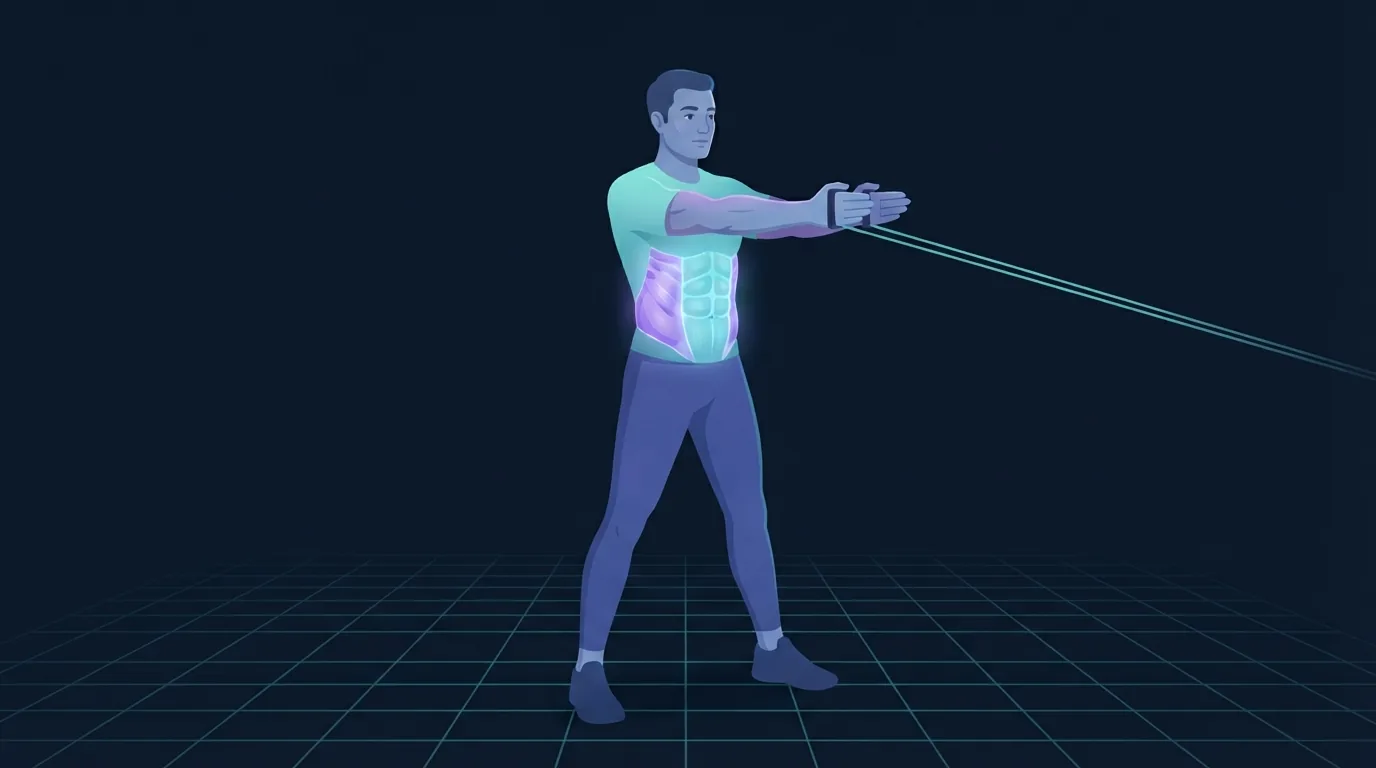
Anything loaded on one side, or any limb moving asymmetrically, tries to spin your trunk. Walking does it. Carrying groceries in one hand does it. Throwing and swinging do it hard. Anti-rotation work teaches the obliques to resist that spin so the force goes into the ground rather than into your spine. The Pallof press and the bird dog are the reference drills, and this category is the one most home routines skip entirely.
Anti-lateral flexion: stopping your torso from tipping sideways
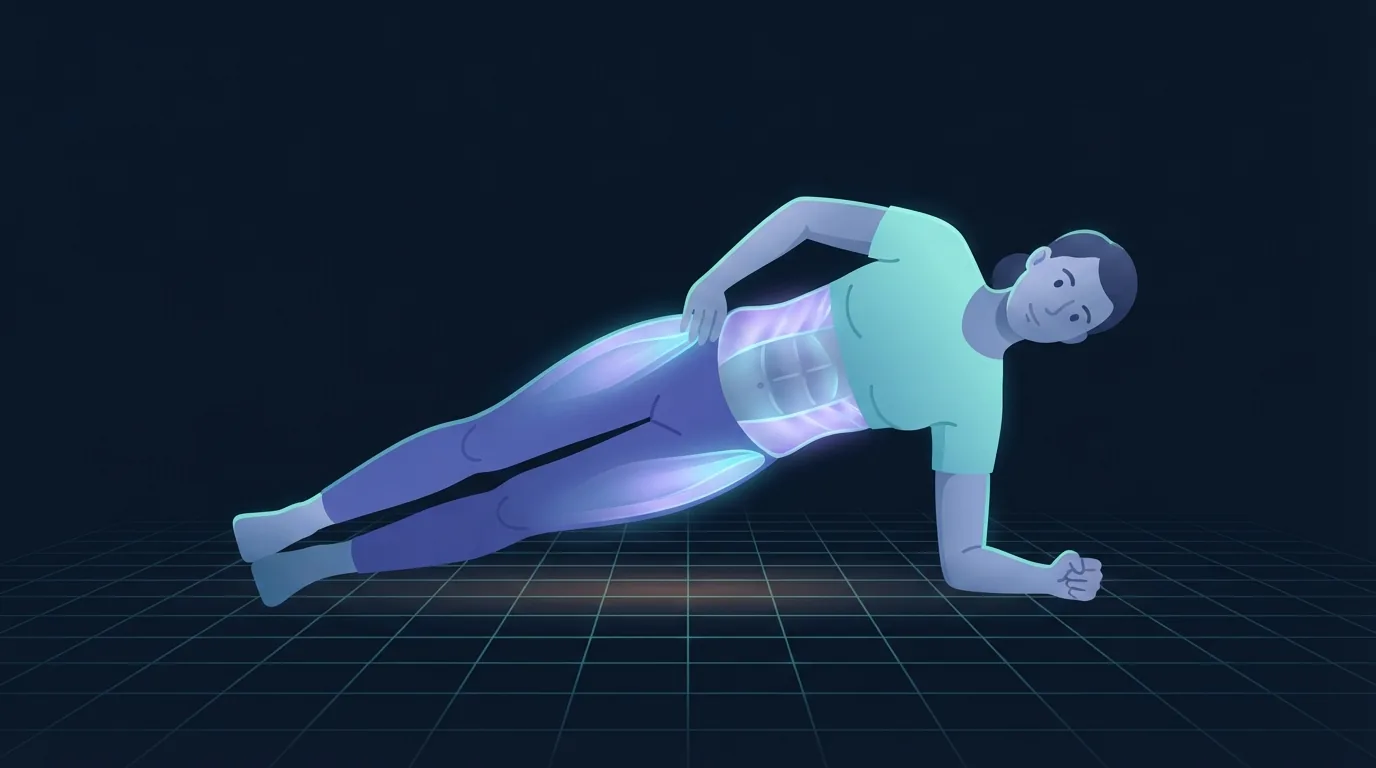
A weight in one hand makes you bend toward it. The side of the trunk, the quadratus lumborum, the obliques and the glute medius at the hip, keeps you upright instead. Side planks and single-sided carries train this. It's the category with the clearest evidence of real strengthening effect: in an EMG study of nine common rehabilitation exercises, the side bridge produced activation above 45 percent of maximum voluntary contraction in the gluteus medius and external obliques, high enough to build strength rather than just endurance, while most of the other drills sat below that threshold (Ekstrom et al., 2007).
A complete week touches all three. A routine of planks and crunches touches one.
The McGill Big Three, and How to Dose Them
Stuart McGill's spine biomechanics laboratory spent decades measuring what different trunk exercises cost the spine and what they activate. The result was a short list, usually called the big three: the modified curl-up, the side bridge and the bird dog. They earned that status because each delivers meaningful activation at a low spine load, and because each has a documented ladder of regressions and progressions you can climb (McGill and Karpowicz, 2009). That same study found bracing the abdominal wall changes which muscles do the work, and that adding small controlled movement to a traditionally static hold, like drawing squares in the air with the extended hand or foot in the bird dog, raises activation across many muscle groups at once.
The modified curl-up
Lie on your back. One knee bent with that foot flat, the other leg straight. Hands under the small of your back to hold the lumbar curve. Lift your head and shoulders a couple of centimetres, just enough to clear the floor, with no attempt to curl the spine. Hold. The point is that your low back never flattens into the floor, which is exactly what a normal crunch does.
The side bridge
Start on your side on your forearm with your knees bent, hips pushed up into a straight line from knees to shoulders. From there the progression is straightening the legs into a full side plank, then rolling from one elbow to the other without dropping the hips. Push the down-side shoulder away from the floor rather than sagging into it.
The bird dog
On hands and knees, extend one arm and the opposite leg until both are level with the trunk, with the hips square and the low back still. Hold, return, switch. The bird dog is the only drill in the set that trains anti-extension and anti-rotation at the same time, which is why it survives in almost every rehabilitation protocol.
Reps, not minutes: the descending pyramid
This is where most people get it wrong. The big three are dosed as short repeated holds, not as one long hold. About 10 seconds per repetition, in a descending pyramid: six repetitions, rest, four repetitions, rest, two repetitions. Then move to the next exercise.
The reason is endurance decay. Holding a plank for three minutes trains your tolerance for discomfort more than it trains your stabilizers, and the last two minutes are spent accumulating spine compression at a steadily worse quality of position. Repeated short holds keep every rep at a high standard. Build total time by adding repetitions, and only then consider adding seconds.
The endurance framing has normative data behind it. McGill and colleagues measured isometric holding times in 75 healthy young adults across trunk flexion, extension and side bridging, and found the ratios between them mattered more than any single number (McGill, Childs and Liebenson, 1999). Men could hold the side bridge for 65 percent of their extensor time and 99 percent of their flexion time, while women managed 39 and 79 percent. A side that lags badly behind the other, or a flexor score that dwarfs the extensor score, is the pattern worth correcting, and the tests were highly repeatable, with reliability coefficients above 0.97.
Find out what's really holding you back
FitCraft, our mobile fitness app, pairs you with an AI coach who builds you a personalized plan around your goals, schedule, and fitness level. Every FitCraft program is designed by Domenic Angelino, MPH (Brown University) and NSCA-CSCS, with research published in the Journal of Strength and Conditioning Research and Medicine & Science in Sports & Exercise.
Take the Free Assessment Free • 2 minutes • No credit card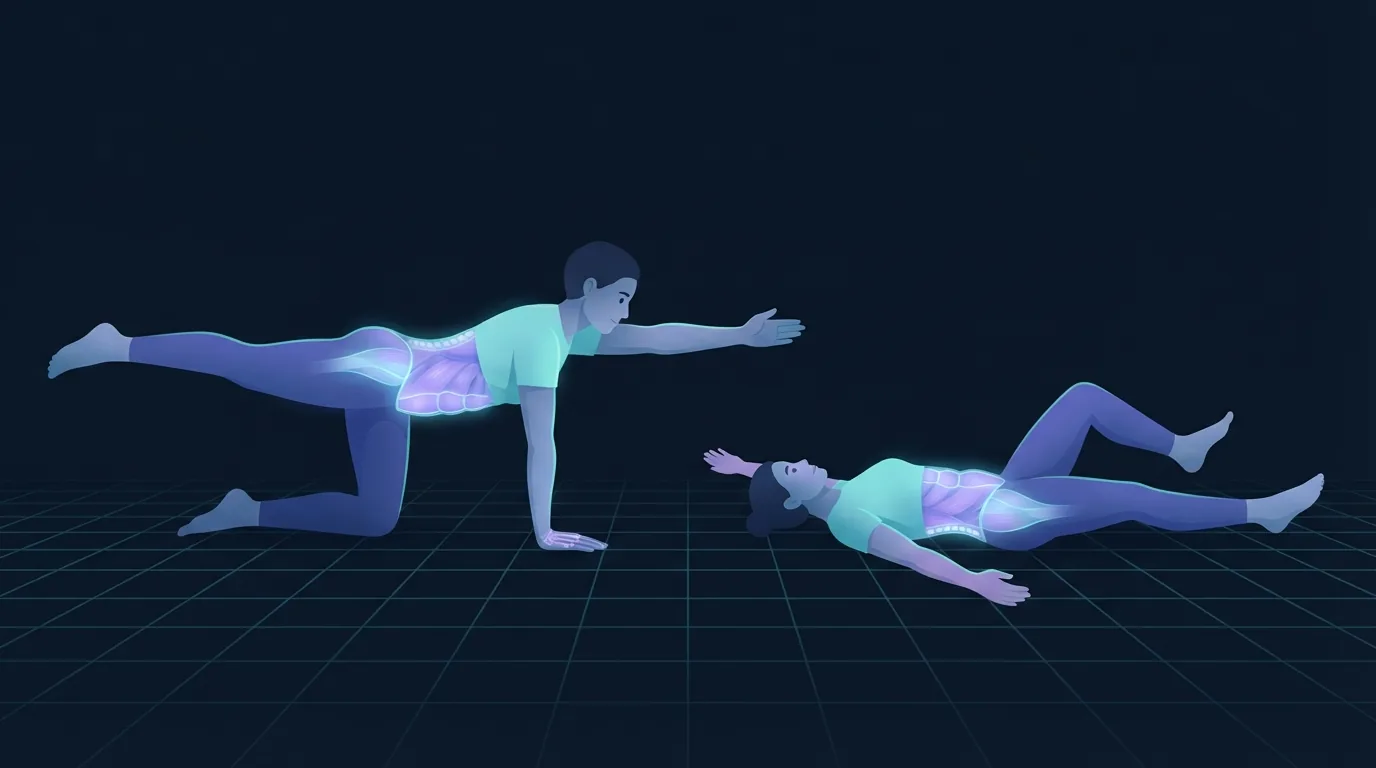
Ten Core Stability Exercises Worth Your Time
Sorted by the job each one does. You don't need all ten in a session. You need one from each category, rotated.
| Exercise | Job | Why it earns a slot |
|---|---|---|
| Dead bug | Anti-extension | The gentlest way to learn ribs-over-pelvis. Nearly nobody is too deconditioned for it. |
| Forearm plank | Anti-extension | The baseline. Squeeze the glutes and tuck the ribs so it isn't just a hang on the low back. |
| Hollow hold | Anti-extension | A harder version of the dead bug with both limbs out. Regress by bending the knees. |
| Plank walk-out | Anti-extension, moving | Adds a moving challenge to a static skill, which is closer to how the trunk is actually used. |
| Bird dog | Anti-extension and anti-rotation | Two jobs at once, minimal spine load, endless progressions. |
| Pallof press with a band | Anti-rotation | The purest anti-rotation drill there is. Anchor a band at chest height, stand side-on, press straight out and refuse to twist. |
| Renegade row | Anti-rotation, loaded | Rowing one dumbbell from a plank forces the other side to stop the hips rolling. |
| Side plank | Anti-lateral flexion | The one drill with EMG evidence of strengthening-level activation in the obliques and glute medius. |
| Side plank raise | Anti-lateral flexion, loaded | The natural progression once a straight-leg side plank feels controlled. |
| Glute bridge | Posterior support | Not a core drill by itself, but weak glutes hand the job back to the low back on every carry and step. |
Two honourable mentions. A suitcase carry, one heavy dumbbell in one hand, walking slowly and refusing to lean, is the most transferable anti-lateral flexion drill in existence, and our review of farmer's carry research covers why loaded carries punch above their weight. And the superman hold covers the spinal extensors, which most core routines quietly ignore even though the extensor endurance score is the one the McGill ratios are built around.
A 12-Minute Core Stability Routine
One exercise from each category plus a posterior finisher. No equipment beyond a mat, which makes it a reasonable candidate for the bodyweight slot in any home workout app with no equipment.
| Order | Exercise | Dose | Cue |
|---|---|---|---|
| 1 | Dead bug | 6, 4, 2 reps per side, 10 sec each | Low back stays lightly pressed toward the floor the whole time |
| 2 | Side plank, knees or feet | 6, 4, 2 reps per side, 10 sec each | Push the bottom shoulder away from the floor |
| 3 | Bird dog | 6, 4, 2 reps per side, 10 sec each | Balance an imaginary glass of water on your low back |
| 4 | Pallof press, or plank walk-out if you have no band | 3 sets of 8 slow reps per side | Press straight out, not up. Let the pull try to turn you and refuse it |
| 5 | Glute bridge | 2 sets of 12 | Ribs down, squeeze at the top, no arching to get higher |
Do it five or six days a week. These are endurance muscles and they recover fast, so frequency beats intensity here. Ten to fifteen minutes daily is the protocol shape used across the rehabilitation literature, and a six-week study comparing isometric against dynamic core training in 24 men found that the isometric approach produced the larger increase in passive torso stiffness in both trained Muay Thai athletes and complete beginners (Lee and McGill, 2015).
What the Evidence Says About Core Stability and Low Back Pain
Low back pain is the single largest cause of years lived with disability worldwide, with a point prevalence around 9 percent of adults at any given moment (Hoy et al., 2014). That scale is why core training gets sold so hard, and why it's worth being precise about what the trials actually show.
A 2022 systematic review screened the clinical trial literature on core stabilization exercises in non-specific low back pain and found five moderate-quality studies supporting them, concluding with Grade B evidence that core stabilization is a favourable method for reducing pain, improving function and increasing core strength (Smrcina et al., 2022). That's a genuine result, and it's a Grade B rather than an A for a reason.
The head-to-head question is more interesting. A meta-analysis of five randomised trials covering 414 patients with chronic low back pain compared core stability exercise against general exercise (Wang et al., 2012). Core stability won at short-term follow-up, reducing pain by a mean of 1.29 points and disability by 7.14 points more than general exercise. By six months the difference had disappeared.
That six-month result matters more than it looks. It's consistent with the biggest pooled analysis in the field, the 2021 Cochrane review of 249 trials in 24,486 adults, which found exercise therapy reduces chronic back pain by roughly 15 points on a 100-point scale compared with no treatment, with no single mode standing clearly above the rest (Hayden et al., 2021). Our fuller review of the exercise and lower back pain research walks through that literature in detail.
The honest summary: core stability exercises are a good on-ramp, especially in the first weeks when general exercise feels threatening and a specific, low-load, controllable routine feels safe. What they are not is a uniquely effective long-term treatment. The thing that separates people who get better from people who don't is that they kept training something.
If back pain is the reason you landed here rather than performance, two companion guides pick up where this one stops. Our best exercises for lower back pain lays out a four-week plan that blends stabilization with the general movement the Cochrane data favours, and McKenzie exercises covers the directional-preference extension progression, which is a different tool for a different presentation. Stabilization work sits comfortably alongside both.
How to Progress Core Stability Exercises
Progression here isn't about adding weight. Four levers, in roughly this order:
- Add repetitions. Six, four, two becomes eight, six, four. Same 10-second holds, more total time at a high standard.
- Lengthen the lever. Knees to feet in the side plank. Bent knee to straight leg in the dead bug. A longer lever is a bigger challenge with no equipment.
- Add movement inside the hold. This is the McGill and Karpowicz finding: drawing shapes in the air with the extended hand or foot in a bird dog raises activation across multiple muscle groups without changing the position of your spine.
- Add external load or instability, last. A dumbbell in one hand for carries, a band for the Pallof press, a suspended foot for a plank. Load goes on top of a position you already own, never instead of owning it.
A reliable tell that you're ready to progress: you can hold the current version for the full 10 seconds on every repetition of the pyramid without your breathing stopping and without your hips sagging on the last two. If the last rep looks worse than the first, you're not progressing, you're accumulating bad reps.
What Core Stability Training Won't Do
Three claims to retire, because the field oversells all three.
It won't flatten your stomach. Visible abs are a body fat outcome. No amount of anti-rotation work changes your energy balance, and spot reduction isn't a mechanism.
It probably won't prevent injury on its own. A widely cited critique argued the field over-reached, pointing out that weak trunk muscles, specific deep-muscle timing and spinal instability have not been shown to cause back pain in the way the marketing implies, and that general exercise produces similar clinical outcomes (Lederman, 2010). That critique is fifteen years old and the field has moved, but its core point survived the Cochrane data: exercise helps, and the specific flavour matters less than the consistency.
It won't automatically make you better at your sport. Core stability supports force transfer, and reviews of the performance literature find the link between core training and sports performance is inconsistent (Escamilla et al., 2010; Hibbs 2008). Train it because a trunk that holds position makes everything else safer and smoother, not because ten minutes of planks will add to your vertical jump.
The Bottom Line
Core stability exercises are the training your trunk was actually built for: holding a neutral spine while something tries to bend, twist or tip it. Cover all three jobs, use the big three as your base, dose them as repeated 10-second holds rather than one long grind, and do ten to fifteen minutes most days. The change shows up quietly, in the third hour of a drive and the last bag out of the car rather than in the mirror.
If you've been doing planks for months and nothing feels different, the problem usually isn't your discipline. It's that you've been training one of three jobs, for too long per rep, with no progression. Fix the design and the work starts paying.
Frequently Asked Questions
What are core stability exercises?
Core stability exercises train your trunk to resist movement rather than produce it. Instead of bending the spine the way a crunch does, they ask you to hold a neutral spine while your arms, legs or an external load try to bend, twist or tip it. The three categories are anti-extension, anti-rotation and anti-lateral flexion, and the classic examples are the dead bug, the bird dog, the side plank and the Pallof press.
What are the McGill big three exercises?
The modified curl-up, the side bridge and the bird dog. Stuart McGill's laboratory work showed each has a clear ladder of easier and harder versions and each loads the spine far less than the exercises people usually reach for. They're trained for endurance with short holds of about 10 seconds in a descending pyramid, such as six reps, then four, then two, not for maximum hold times.
Do core stability exercises help lower back pain?
The evidence supports them, with an important caveat. A 2022 systematic review graded the evidence B, finding core stabilization exercises reduce pain and improve function in non-specific low back pain. A 2012 meta-analysis of 5 trials in 414 patients found core stability beat general exercise for pain and disability in the short term, but the advantage disappeared by six months. The 2021 Cochrane review of 249 trials found exercise works broadly, with no single mode clearly superior.
How long should you hold a plank for core stability?
Around 10 seconds per repetition, repeated, rather than one long hold. Holding a plank for minutes trains tolerance to discomfort more than it trains the stabilizers, and long holds accumulate spine compression for no extra benefit. Build total time through repetitions, so six 10-second holds rather than one 60-second hold, then progress by adding repetitions before you add seconds.
How often should you do core stability exercises?
Most days. Core stabilizers are endurance muscles that recover quickly, so daily or near-daily short sessions work better than two hard sessions a week. Ten to fifteen minutes, five or six days a week, is the pattern used in most of the rehabilitation protocols, and a six-week isometric training study found that pattern raised passive torso stiffness measurably in both trained and untrained men.
Are core stability exercises the same as ab workouts?
No. Ab workouts usually train the rectus abdominis through repeated spinal flexion to build visible muscle. Core stability exercises train the whole trunk cylinder, including the obliques, the deep abdominal wall, the spinal erectors and the glutes, to hold a position under load. The two goals overlap but the training looks different, and neither one reduces belly fat, which is decided by your energy balance.