- Planks build stiffness, and stiffness is the point. Lee and McGill (2015) trained 24 men for six weeks and found isometric core work produced greater torso stiffness than dynamic core work.
- A plank is a hip exercise. Boren et al. (2011) measured gluteus maximus at 106% of maximum voluntary contraction in a front plank with hip extension, and gluteus medius at 103% in a side plank with abduction. Both beat a single-leg squat.
- It spares the spine that sit-ups load. McGill (1995) modelled lumbar compression above 3,000 newtons for sit-ups, close to the roughly 3,400 newton limit used in occupational lifting guidance.
- It helps back pain, but not uniquely. Wang et al. (2012) pooled 5 trials and 414 patients: core stability work beat general exercise at three months and matched it by six and twelve.
- The clock is the wrong progression. Schellenberg et al. (2007) put the healthy mean prone bridge at 72.5 seconds. Past a clean minute, harder leverage beats more time.
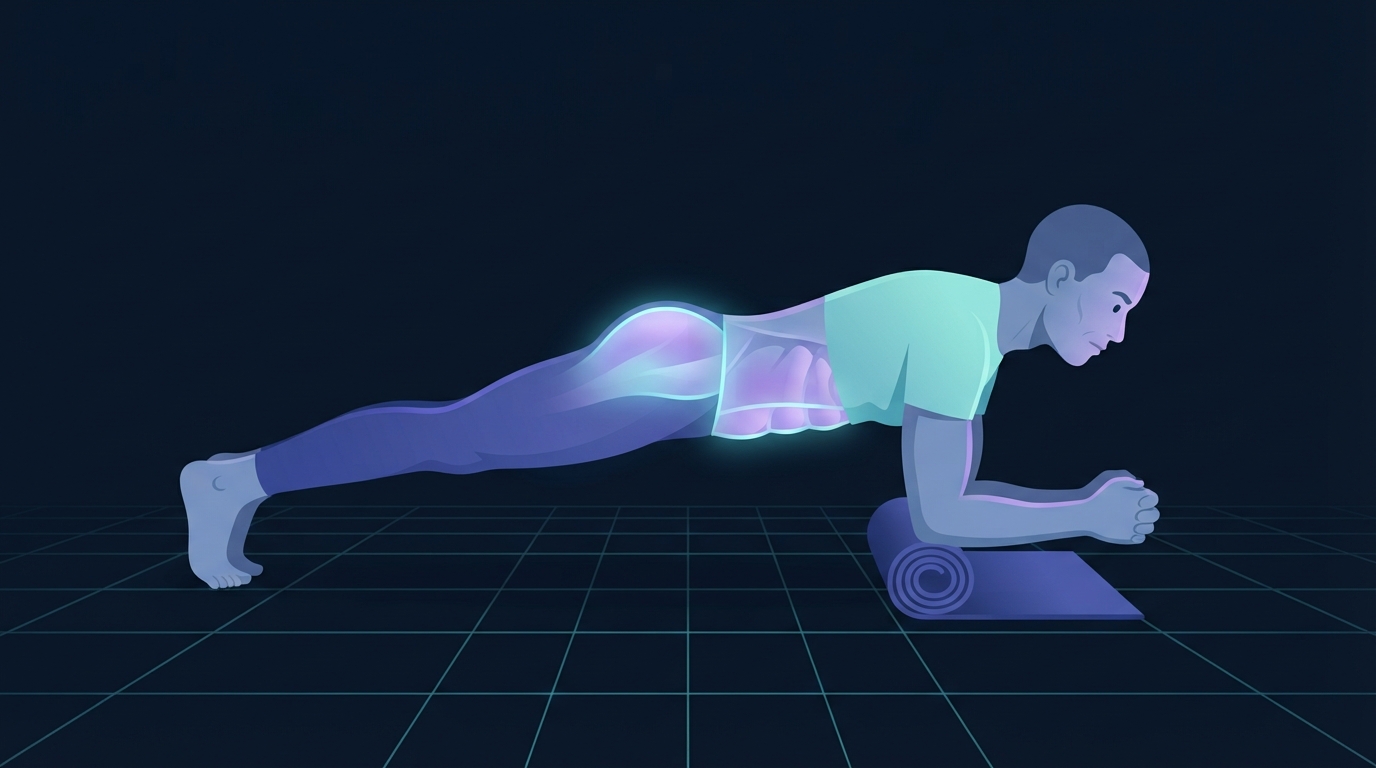
The plank is the most-performed core exercise on earth and one of the most misunderstood. People do it to get abs, they measure it in minutes, and they quit it when the minutes stop climbing. All three of those instincts point away from what the exercise is actually good at.
What the research supports is narrower and more useful than the marketing. Planks build torso stiffness, which is the quality that lets you transmit force through your trunk without your spine paying for it. They load the glutes hard, harder than most people expect. They reduce pain in people with non-specific low back pain. And because they're a sustained isometric hold, they sit inside the exercise category with the strongest blood pressure evidence of any.
Below is what each of those claims rests on, where the evidence gets thin, how long the hold should actually be, and why the side plank and the wall sit belong in the same conversation.
What a plank actually trains
A crunch is a trunk flexion exercise: the spine bends, the rectus abdominis shortens. A plank is an anti-extension exercise: gravity tries to drop your hips and arch your lower back, and the whole abdominal wall fires to stop it. Nothing moves. The joint angles stay put while the muscles produce force, which is the definition of an isometric contraction.
That distinction matters because the trunk's real job in daily life is rarely to curl. It's to stay rigid while an arm reaches, a leg steps, or a suitcase pulls you sideways. Our guide to core stability exercises organizes the whole category around that idea, sorting exercises by which direction of unwanted movement they resist. This page is about what happens physiologically when you train that way.
The Research: What Studies Show
Lee and McGill 2015: isometric holds built more stiffness than dynamic work
Lee and McGill (2015) in the Journal of Strength and Conditioning Research took 24 healthy men, half of them completely untrained in core work and half of them Muay Thai athletes, and put them through six weeks of core training. One protocol was isometric, built on held positions. The other was dynamic, built on movement through range. Passive and active torso stiffness were measured before and after.
The isometric approach came out ahead on core stiffness. That's a specific and slightly unglamorous outcome, so it's worth saying why it matters. A stiffer torso bears load better, which is what protects the spine under a heavy lift. It damps the small painful vertebral movements that drive a lot of mechanical back pain. And it gives an arm or a leg something rigid to push against, which is why athletes who can't hold a plank tend to leak force at the trunk.
Twenty-four subjects is a small study. The mechanism it supports, though, lines up with the broader isometric literature we cover in our isometric exercise research review, where holding a position with high intent turns out to drive neural adaptations that moving through a range does not.
Boren 2011: the plank is one of the best glute exercises tested
This is the finding that surprises people. Boren and colleagues (2011) in the International Journal of Sports Physical Therapy put surface electrodes on 26 healthy adults and ranked common rehabilitation exercises by gluteal activation as a percentage of maximum voluntary contraction. The top of each list:
- Gluteus maximus: front plank with hip extension, 106%. Then a gluteal squeeze at 81%, side plank with abduction at 71% to 73%, and single-limb squat at 71%.
- Gluteus medius: side plank with abduction, 103% with the dominant leg underneath and 89% with it on top. Then single-limb squat at 82%, a clamshell progression at 77%, and front plank with hip extension at 75%.
Read that again: a plank variation topped both lists. Values above 100% look strange but are normal in this kind of research, because the reference contraction is a specific manual muscle test rather than a true physiological maximum. The ranking is what matters, and the ranking says that adding a lifted leg to a plank turns an abdominal exercise into a serious posterior chain exercise.
Ekstrom 2007: the side plank and the lateral chain
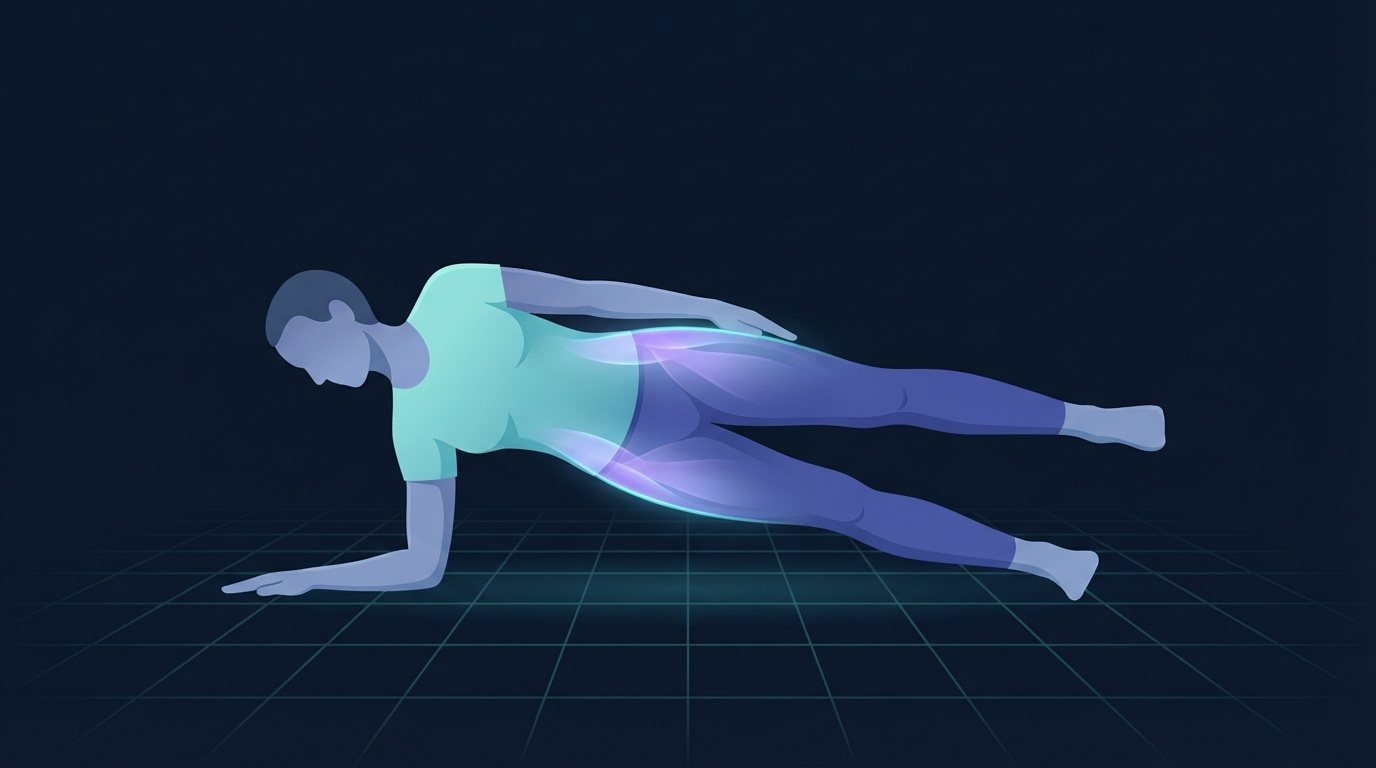
Ekstrom, Donatelli, and Carp (2007) in the Journal of Orthopaedic & Sports Physical Therapy tested nine rehabilitation exercises across 30 healthy adults with surface electromyography on trunk, hip, and thigh muscles. Their conclusion for the side bridge was direct: it's the exercise they'd choose for strengthening gluteus medius and the external oblique. Most of the other exercises they tested came in below 45% of maximum voluntary contraction, which they treated as the threshold worth training at.
So the side plank is not a lesser variation of the front plank. It trains a different job, resisting sideways collapse, and it's one of the few floor exercises that loads the hip abductors and the obliques at the same time.
McGill 1995 and Kavcic 2004: the spine-load argument
The reason planks displaced sit-ups in most professional programming is mechanical, not fashionable. McGill (1995) in Clinical Biomechanics used a three-dimensional model sensitive to lumbar curvature and muscle activation in 12 young men and predicted lumbar compressive loads above 3,000 newtons for both straight-leg and bent-knee sit-ups. There was no meaningful difference between the two techniques, which retires a piece of gym advice that has outlived its evidence by thirty years. For scale, roughly 3,400 newtons is the compression limit used in occupational lifting guidance.
Kavcic, Grenier, and McGill (2004) in Spine followed that up by quantifying muscle activation, L4-L5 compression, and spine stability across seven commonly prescribed stabilization exercises at once. Their point was that no single exercise is best for everyone: you match the exercise to how much load the person in front of you can tolerate and what direction of stability they're missing. That's the practical version of the same argument. A plank gives you a lever you can dial up or down without ever asking the spine to bend under load.
Wang 2012 and Smrcina 2022: planks and low back pain
Wang and colleagues (2012) in PLOS One pooled five randomized controlled trials with 414 patients comparing core stability exercise against general exercise for chronic low back pain. At three months, core stability work won on both outcomes: pain intensity by a mean difference of 1.29 points and disability by a mean difference of 7.14 points. At six months the pain difference had shrunk to 0.50 and was no longer significant. At twelve months it was 0.32 and still not significant.
Smrcina, Woelfel, and Burcal (2022) in the International Journal of Sports Physical Therapy reviewed five moderate-quality trials and concluded that core stabilization exercise decreases pain, improves function, and increases core strength in non-specific low back pain, rating the evidence Grade B.
The honest summary: planks and their relatives are a good way into exercise for a painful back, and they're better than nothing by a wide margin. Their advantage over just moving more fades within a year. If back pain is the reason you're here, our guide to the best exercises for lower back pain puts the plank in the context of everything else that helps.
Hung 2019 and Tong 2014: core endurance and running
Hung and colleagues (2019) in PLOS One gave 21 male college athletes eight weeks of core training, three 30-minute sessions a week built on plank variations plus stabilization and functional work, with a home component of three one-minute prone planks. Core endurance on a sport-specific plank test rose from 193.5 seconds to 241.5 seconds in the training group and didn't move in controls. More interestingly, running economy improved: oxygen cost at a given treadmill stage dropped from 52.4 to 50.0 ml/kg/min, and heart rate was lower across the first three stages. Maximal oxygen uptake didn't change, which is the point. They got more efficient, not fitter.
That fits Tong and colleagues (2014) in the Journal of Sports Science and Medicine, who fatigued the core muscles of nine recreational runners before a treadmill run at 85% of maximal oxygen uptake and watched running capacity fall. A tired trunk costs you running endurance, and part of that fatigue traces back to the breathing muscles working inside the same cylinder.
Wall sits benefits, and what planks share with them
The wall sit gets asked about in the same breath as the plank, and the two have more in common than their body parts suggest. Both are sustained isometric holds against bodyweight. Both are free, equipment-free, and easy to scale. And both belong to the exercise category with the single best blood pressure evidence in the literature.
Edwards and colleagues (2023) in British Journal of Sports Medicine pooled 270 randomized controlled trials with 15,827 participants across five exercise modes. Isometric training produced the largest reduction in resting blood pressure of any mode tested, at 8.24 mmHg systolic and 4.00 mmHg diastolic. The isometric wall squat ranked first for systolic reduction with a SUCRA score of 90.4%. Typical dosing in that literature is four holds of two minutes, three times a week.
Two caveats before anyone plans their week around it. The wall sit is the variation that was actually studied, so the blood pressure evidence belongs to it, not to the plank by association. And a plank held near your limit is a much more demanding whole-body effort than a wall sit at a comfortable knee angle, which makes it a worse fit for a two-minute protocol. Our review of isometric exercise and blood pressure works through the protocol variants and who should be cautious. The wall sit exercise page covers the setup.
Get an evidence-based plan built for you
FitCraft, our mobile fitness app, pairs you with an AI coach who builds you a personalized plan around your goals, schedule, and fitness level. Every FitCraft program is designed by Domenic Angelino, MPH (Brown University) and NSCA-CSCS, with research published in the Journal of Strength and Conditioning Research and Medicine & Science in Sports & Exercise.
Take the Free Assessment Free • 2 minutes • No credit cardHow long should you hold a plank
The most useful number in this literature isn't a world record. It's a norm. Schellenberg, Lang, Chan, and Burnham (2007) in the American Journal of Physical Medicine & Rehabilitation validated the prone bridge as an office test of lumbar stabilization endurance and collected times from 43 adults without back pain and 32 adults with chronic mechanical low back pain.
- No back pain: prone bridge 72.5 seconds on average, with a standard deviation of 32.6.
- Chronic low back pain: 28.3 seconds on average, standard deviation 26.8.
- Supine bridge, no back pain: 170.4 seconds, versus 76.7 seconds with back pain.
- Test-retest reliability: 0.78 for the prone bridge, 0.84 for the supine bridge.
So a clean 60 to 90 seconds puts you in normal territory for an adult without back pain, and it's a reasonable working target. The spread is wide, which is why comparing your number to a friend's tells you very little.
What matters more is what you do once you get there. Adding time to the same position has steeply diminishing returns, because the limiting factor stops being the abdominal wall and starts being your tolerance for discomfort. The productive moves instead:
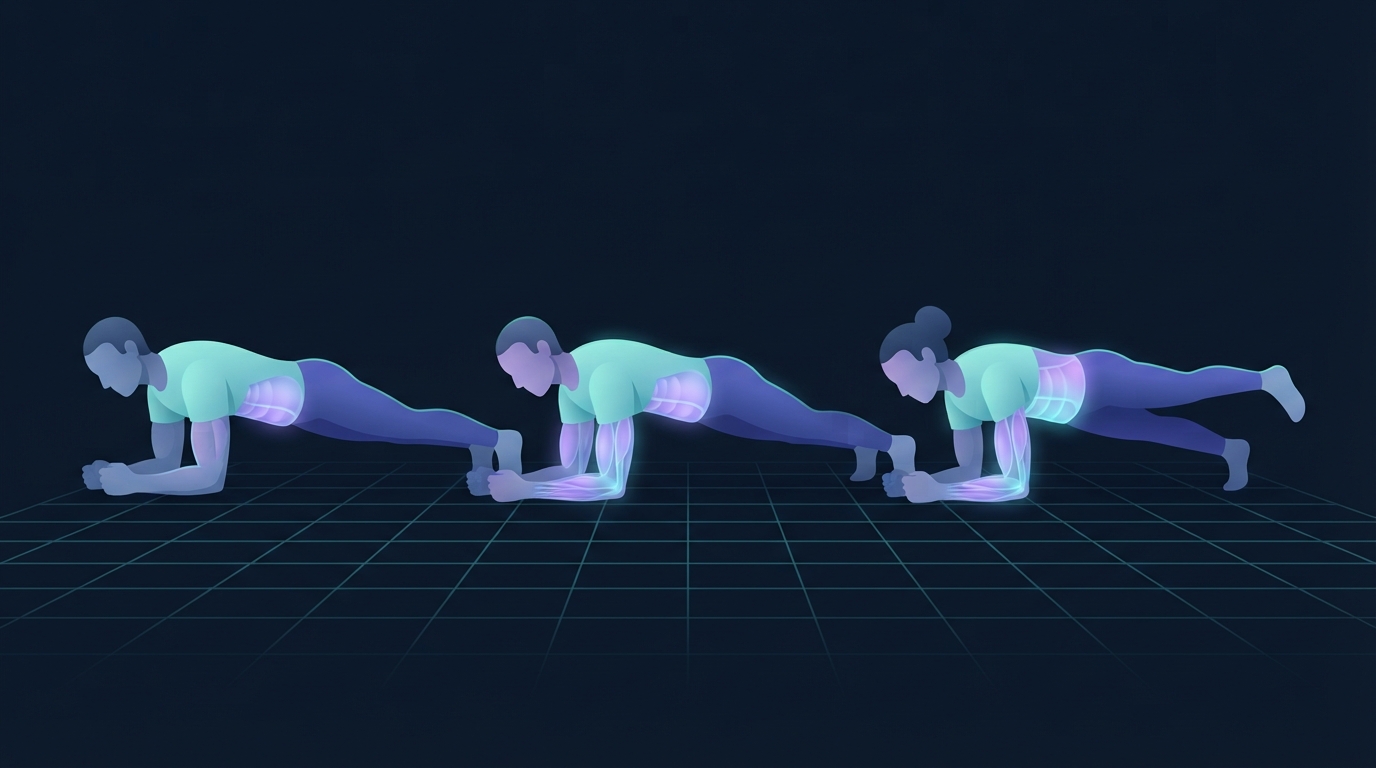
- Lengthen the lever. Walk the elbows further forward. The load climbs fast and the position gets honest very quickly.
- Remove a support point. Lift one foot, then one arm. This is also how you get the 106% gluteus maximus number from Boren's data.
- Change the direction. Add side planks so the obliques and hip abductors get their own work.
- Add movement to the limbs, not the spine. Plank shoulder taps, slow reaches, or a controlled drag. The trunk's job is still to refuse to move.
- Do more short sets. Several clean 20 to 30 second holds beat one sagging three-minute hold, because form collapses long before the clock does.
If you want the specific set-up cues, the forearm plank exercise page and the side plank exercise page cover positioning in detail. All of these are floor-only, which makes them easy to keep going anywhere. If that's the appeal, our comparison of no-equipment workout apps looks at which ones program bodyweight holds sensibly rather than just stacking minutes.
Common Misconceptions
Misconception: "Planks burn belly fat"
They don't, and no exercise does. A plank is close to the lowest-calorie exercise you can perform, because nothing is moving through a range. Spot reduction has been tested repeatedly and fails every time: the fat that comes off during a deficit comes off systemically, not from the region you trained. Planks improve what's underneath the fat. Our guide to getting abs is blunt about which part of that equation does the visible work.
Misconception: "Longer is always better"
Past a clean minute or two, extra time mostly trains discomfort tolerance. The Schellenberg norms put healthy adults at 72.5 seconds on average, and a five-minute hold in a sagging position loads the lower back in exactly the pattern the exercise exists to avoid. Progress by leverage, not by clock.
Misconception: "Planks build a six-pack"
Isometric holds at a fixed muscle length are a weak hypertrophy stimulus compared with loaded movement through a full range. Planks make the abdominal wall stiffer and more enduring. Visible abdominal size comes from progressive loading, and visible abdominal definition comes from body fat. The plank isn't the tool for either.
Misconception: "Planks are safe for everyone with back pain"
Mostly safe, but not universally. Kavcic's whole argument was that exercise selection should be matched to the individual's load tolerance and the direction of instability. Someone with an extension-sensitive back can find a long-lever plank provocative. Someone with uncontrolled high blood pressure should be careful with any long breath-held isometric. Regress the position, keep breathing, and get assessed if a position reliably hurts.
What the Research Suggests Going Forward
A few limits are worth naming before the plank gets more credit than the evidence gives it.
First, most of the training studies are small. Lee and McGill used 24 men. Hung used 21 male college athletes. Tong used nine runners. These are mechanistically informative and statistically fragile, and almost none of them recruited women in meaningful numbers.
Second, "core training" in the trials is almost never just planks. Hung's protocol included crunches, trunk twists, mini-bands, air pads, and BOSU balls alongside plank variations. Attributing the running economy improvement to the plank specifically overstates what was tested.
Third, the blood pressure evidence belongs to the wall squat and the handgrip, which are what most of the trials in the Edwards network actually used. Extending that result to a front plank is a reasonable hypothesis, not a finding.
Fourth, the back pain advantage is real and temporary. Wang's data shows core stability work pulling ahead at three months and converging with general exercise by six. The most defensible reading is that the plank is an excellent entry point for someone who isn't currently moving, and that what it buys you long term is the capacity to do harder things.
References
- Lee BCY, McGill SM. "Effect of long-term isometric training on core/torso stiffness." J Strength Cond Res. 2015;29(6):1515-1526. doi:10.1519/JSC.0000000000000740
- Boren K, Conrey C, Le Coguic J, Paprocki L, Voight M, Robinson TK. "Electromyographic analysis of gluteus medius and gluteus maximus during rehabilitation exercises." Int J Sports Phys Ther. 2011;6(3):206-223. PMC3201064
- Ekstrom RA, Donatelli RA, Carp KC. "Electromyographic analysis of core trunk, hip, and thigh muscles during 9 rehabilitation exercises." J Orthop Sports Phys Ther. 2007;37(12):754-762. doi:10.2519/jospt.2007.2471
- McGill SM. "The mechanics of torso flexion: situps and standing dynamic flexion manoeuvres." Clin Biomech. 1995;10(4):184-192. doi:10.1016/0268-0033(95)93703-V
- Kavcic N, Grenier S, McGill SM. "Quantifying tissue loads and spine stability while performing commonly prescribed low back stabilization exercises." Spine. 2004;29(20):2319-2329. doi:10.1097/01.brs.0000142222.62203.67
- Wang XQ, Zheng JJ, Yu ZW, et al. "A meta-analysis of core stability exercise versus general exercise for chronic low back pain." PLoS One. 2012;7(12):e52082. doi:10.1371/journal.pone.0052082
- Smrcina Z, Woelfel S, Burcal C. "A systematic review of the effectiveness of core stability exercises in patients with non-specific low back pain." Int J Sports Phys Ther. 2022;17(5):766-774. doi:10.26603/001c.37251
- Hung KC, Chung HW, Yu CCW, Lai HC, Sun FH. "Effects of 8-week core training on core endurance and running economy." PLoS One. 2019;14(3):e0213158. doi:10.1371/journal.pone.0213158
- Schellenberg KL, Lang JM, Chan KM, Burnham RS. "A clinical tool for office assessment of lumbar spine stabilization endurance: prone and supine bridge maneuvers." Am J Phys Med Rehabil. 2007;86(5):380-386. doi:10.1097/PHM.0b013e318032156a
- Edwards JJ, Deenmamode AHP, Griffiths M, et al. "Exercise training and resting blood pressure: a large-scale pairwise and network meta-analysis of randomised controlled trials." Br J Sports Med. 2023;57(20):1317-1326. doi:10.1136/bjsports-2022-106503
- Tong TK, Wu S, Nie J, Baker JS, Lin H. "The occurrence of core muscle fatigue during high-intensity running exercise and its limitation to performance: the role of respiratory work." J Sports Sci Med. 2014;13(2):244-251. PMC3990875
Frequently Asked Questions
What are the benefits of planks?
The plank benefits with the best evidence behind them are torso stiffness, hip and lateral-chain strength, reduced low back pain, and the blood pressure effect that comes with any sustained isometric hold. Lee and McGill (2015) found six weeks of isometric core training produced greater increases in torso stiffness than dynamic training. Boren and colleagues (2011) measured gluteus maximus at 106% of maximum voluntary contraction during a front plank with hip extension. What planks don't do well is build visible abdominal size or burn abdominal fat.
How long should you hold a plank?
Around 60 to 90 seconds is a sensible working target, and past roughly two minutes you're mostly training patience. Schellenberg and colleagues (2007) recorded a mean prone bridge hold of 72.5 seconds in 43 adults without back pain, against 28.3 seconds in 32 adults with chronic mechanical low back pain. Once you can hold a clean 60 seconds, the productive next step is a harder version, such as a long-lever plank, a single-leg plank, or a side plank, rather than more time in the same position.
Do planks help with lower back pain?
Often, yes, though the advantage over general exercise is short lived. Wang and colleagues (2012) pooled five randomized trials with 414 patients and found core stability exercise beat general exercise for pain at three months, with a mean difference of 1.29 points, and for disability, with a mean difference of 7.14 points. By six and twelve months the two approaches were equivalent. Smrcina and colleagues (2022) reached a similar conclusion, rating the evidence Grade B for reducing pain.
Do planks burn belly fat?
No. A plank burns very few calories because nothing moves, and no exercise strips fat from the area it trains. Spot reduction has failed every time it's been tested. Planks make the abdominal wall stiffer and more capable, which helps with posture and load tolerance, but the fat sitting over that wall responds to an overall energy deficit rather than to any abdominal exercise.
Are planks better than sit-ups?
For most people training the trunk for stability, yes. McGill (1995) modelled lumbar compression above 3,000 newtons for both straight-leg and bent-knee sit-ups, which sits close to the roughly 3,400 newton limit used for occupational lifting, and repeated spinal flexion under load is exactly what an irritable disc tolerates worst. A plank produces meaningful abdominal activation with the spine held neutral. Sit-ups aren't banned, they're just a poor default for high-repetition training.