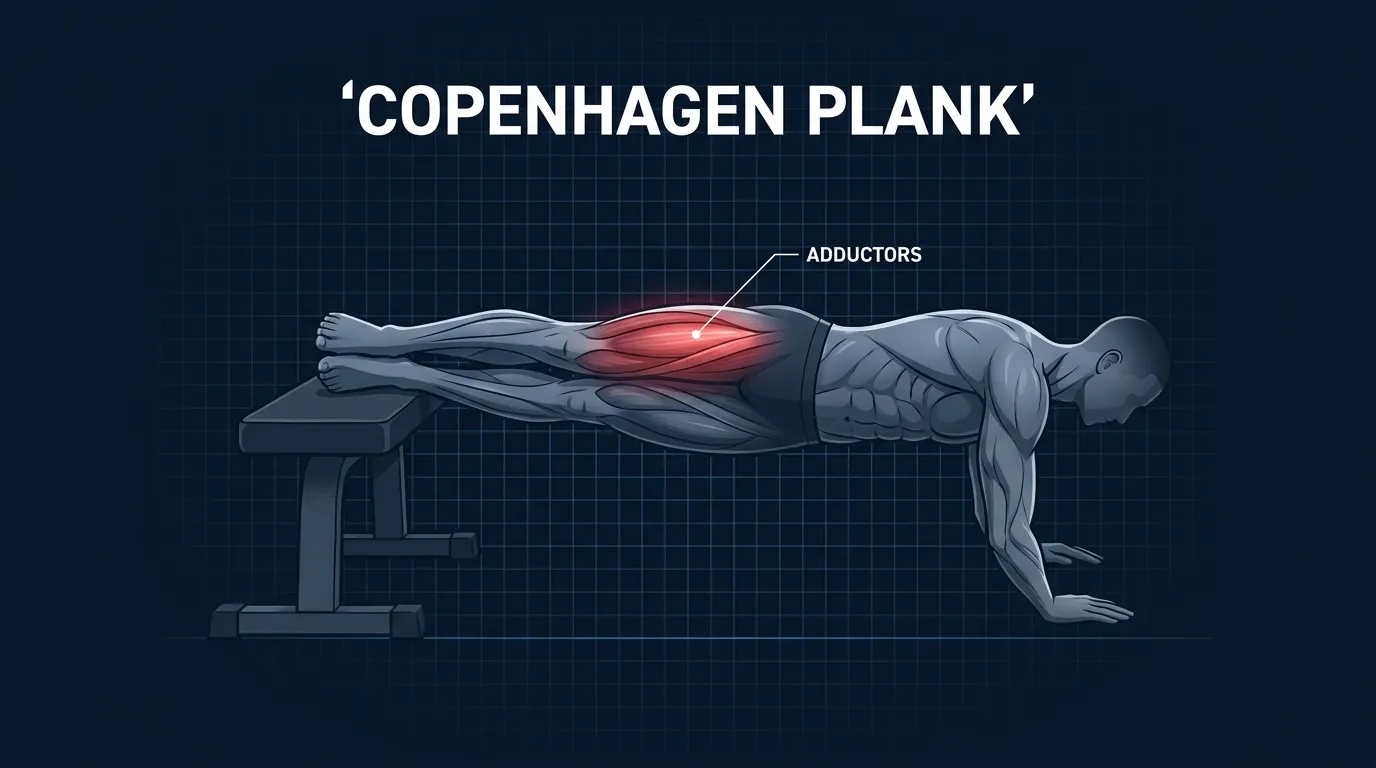
Most adductor training in commercial gyms is a seated machine that pulls the knees together against a pad. It targets the right muscles at short muscle lengths, mostly concentrically, and mostly at low to moderate loads. The problem is that groin injuries almost never happen in that position. They happen in long-length eccentric loading: a defender lunges sideways for a tackle, a runner catches a slick spot, a soccer player extends the trail leg on a change of direction. The adductor is at length, the load is high, and the direction of force is lengthening the muscle. If the adductor cannot decelerate that motion, something tears.
The Copenhagen plank exists to train exactly that. Physiotherapist Kristian Thorborg and colleagues at Copenhagen University Hospital developed it in the early 2010s as a bodyweight exercise that loads the adductors at long length under high eccentric force, without needing any machine at all. In the decade since, it has become the best-supported exercise for adductor strength and groin injury prevention in the peer-reviewed literature.
This piece walks through what the Copenhagen plank actually is (biomechanically, not just as a picture), what the four best-designed trials show about strength gains and injury prevention, how the Serner EMG data explains why it works better than a machine, and how to use it in practice. Including the regressions you need if the full version is out of reach on day one.
What the Copenhagen Plank Actually Is
The classic setup looks like this. Lie on your side with a bench (or a chair seat, or a coffee table) at hip height beside you. Prop yourself on your bottom forearm in a standard side-plank position. Lift the top leg onto the bench so the inside of the ankle rests on the top of the bench. The bottom leg is unsupported, hanging in mid-air. From there, push up so the pelvis is level and the bottom leg lifts to meet the top leg. Hold, or lower the bottom leg slowly toward the floor and press it back up.
The load is your own bodyweight, but the leverage is brutal. The top-leg adductor group has to squeeze into the bench to keep the pelvis stacked, and the further the bench is from the hip (ankle support is furthest), the harder that squeeze has to work. That is why the classic Copenhagen with the bench under the ankle is a serious exercise even for professional athletes, and why the regressions matter.
The relevant muscle group is the hip adductors: adductor longus, adductor magnus, adductor brevis, gracilis, and pectineus. Adductor longus is the most commonly injured of the group in change-of-direction sports and the primary target of the Copenhagen adduction exercise. See our adductors glossary entry for a short definition.
The Research: What Studies Show
Ishøi 2016: Eccentric Hip Adduction Strength Jumps in 8 Weeks
Ishøi and colleagues (2016) published the first well-designed strength trial in the Scandinavian Journal of Medicine & Science in Sports. They took 24 male U-19 sub-elite football players from two teams and randomized them to an 8-week supervised progressive Copenhagen adduction program on top of usual training, or usual training alone. Sessions ran twice a week. The protocol ramped from short-lever isometric holds in weeks 1 to 2 up to the full long-lever version with 6 to 10 controlled reps per side by week 8.
The primary outcome was eccentric hip adduction strength (EHAD) measured with a hand-held dynamometer at a standardized position. Ishøi reported a significant interaction between group and time on EHAD, on eccentric hip abduction strength (EHAB), and on the EHAD/EHAB ratio. In plain language: the Copenhagen group got substantially stronger in exactly the strength quality that matters for adductor injury risk, and the strength ratio (a marker of groin injury risk) moved in the healthier direction.
The trial is small (24 players) and short (8 weeks), and the population is narrow (male sub-elite adolescents). Those are honest limits. What it establishes cleanly is that the exercise works. You add a Copenhagen plank program to a training week and the target strength quality changes fast.
Harøy 2019: Roughly 41% Fewer Groin Problems Across a Season
Harøy and colleagues (2019) published the definitive injury prevention trial in the British Journal of Sports Medicine. This one is huge for a preventive exercise study: 35 semi-professional Norwegian football teams, 652 players, cluster-randomised to an Adductor Strengthening Programme (18 teams, 339 players) or control (17 teams, 313 players). The intervention was one exercise (the Copenhagen adduction exercise) at three progression levels, three sessions per week during the 6 to 8-week preseason, then once per week across the 28-week competitive season.
The primary outcome was the prevalence of groin problems affecting performance, measured with the OSTRC overuse injury questionnaire. The intervention group had roughly a 41% lower average prevalence of groin problems affecting performance across the season versus controls (odds ratio 0.59, 95% CI 0.40 to 0.86). Substantial reductions also showed up on secondary outcomes (any groin problem, time-loss groin injury).
Two things make this trial stand out. First, the dose is low. One exercise, once a week in-season, was enough to change season-long injury rates. That is exceptional efficiency. Second, the effect size is large for an injury-prevention trial. Most exercise-based prevention studies find null or modest effects because compliance is poor and the interventions are complicated. This one used a simple protocol and got a meaningful season-long reduction.
Serner 2014: Why the Copenhagen Beats an Adductor Machine (EMG)
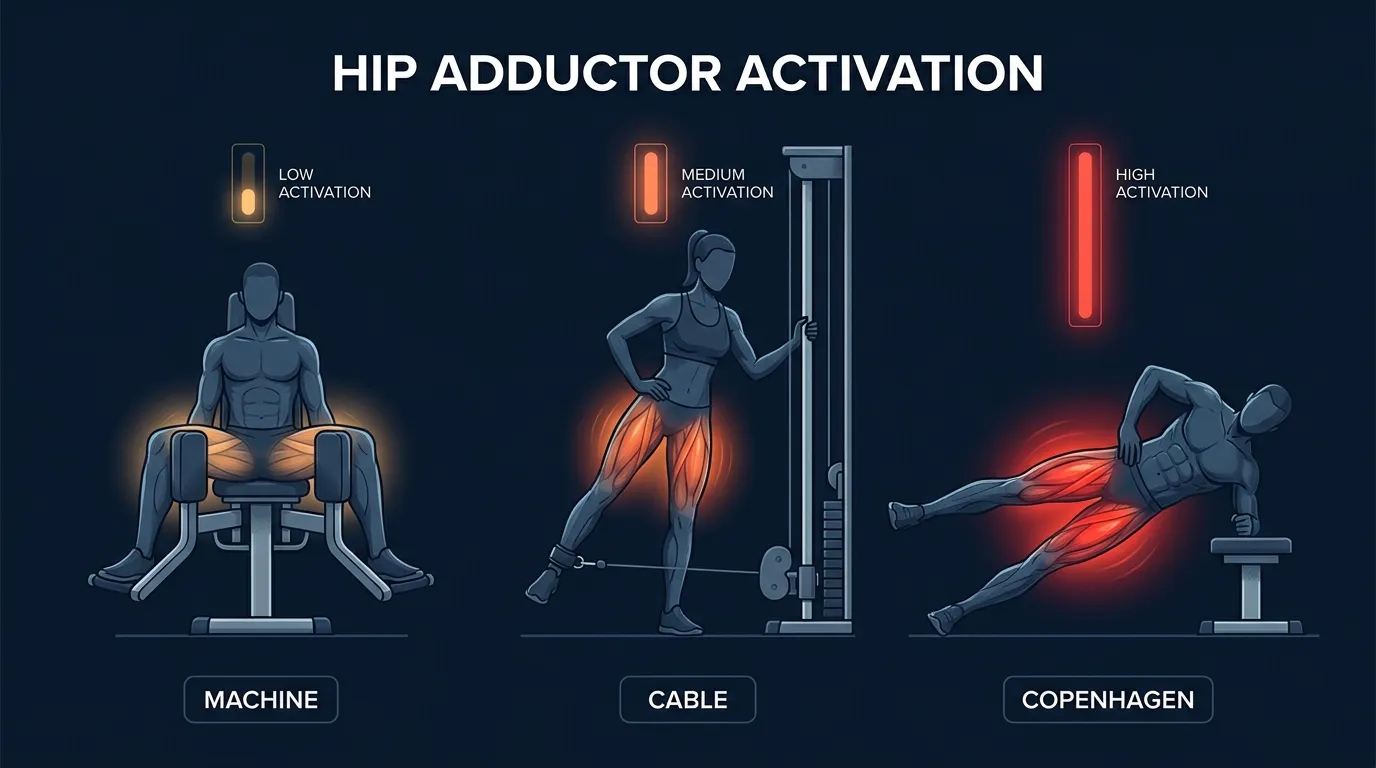
Serner and colleagues (2014), also in the British Journal of Sports Medicine, is the mechanistic paper. They took 40 healthy male soccer players and had each perform a battery of hip adduction exercises with surface EMG electrodes on adductor longus. Exercises included the seated squeeze, the standing cable adduction, the ball squeeze, and the Copenhagen adduction exercise. The outcome was normalized adductor longus activation as a percentage of a maximum voluntary isometric contraction (MVIC).
Peak adductor longus activation across the tested battery reached 108% of MVIC, with values across the battery ranging from 14% at the low end. The Copenhagen adduction exercise was one of only two exercises the authors classified as dynamic high-intensity (alongside standing hip adduction with an elastic band). Every rehabilitation and prevention protocol that has been published since draws on this ranking to justify Copenhagen as a primary strengthening choice for adductor rehab and groin injury prevention.
Two implications matter for a general reader. First, if you want to bias adductor loading toward hypertrophy or strength, the Copenhagen plank is the best single choice available. It beats every machine in the room. Second, EMG activation does not automatically equal strength or hypertrophy gains, but when EMG data are paired with a strength trial in the same muscle group in the same population (as Ishøi 2016 does) and a large injury-prevention trial (Harøy 2019), you have converging evidence that is unusually strong for a single exercise.
Polglass 2019: A Progressive Version Cuts the Soreness Problem
The classic Copenhagen protocol has one real drawback. It produces significant delayed-onset muscle soreness (DOMS) in the first two weeks, especially in players who have never trained the adductors eccentrically at long length. That soreness is a compliance killer.
Polglass and colleagues (2019) in BMJ Open Sport & Exercise Medicine addressed this. They took 25 senior professional footballers and ran a modified progressive Copenhagen adduction (MPCA) program: 8 weeks, twice a week, six progression levels from short-lever isometric holds through to the classic eccentric-concentric long-lever version. Progression was driven by RPE, DOMS ratings, and performance rather than a fixed weekly ramp.
The players finished the program with reduced DOMS relative to earlier reports and with meaningful increases in eccentric hip adduction strength, eccentric hip abduction strength, and the adduction-to-abduction strength ratio. The takeaway is that you do not have to trade off soreness against strength gains. A ramped progression that meets you where you are gets you the same strength change with a fraction of the soreness cost.
Why This Matters for Your Fitness
If you play a sport that changes direction (soccer, basketball, tennis, hockey, ultimate, rec-league flag football) the Copenhagen plank is one of the highest-return preventive exercises you can do. The dose that worked in Harøy (2019) is roughly 15 minutes a week in-season for a season-long risk reduction. That is a rounding error on training time.
If you do not play a change-of-direction sport, the case is still real but softer. Adductor weakness is common in general populations, especially in people who sit a lot or who train predominantly in the sagittal plane (running, cycling, straight-line lifting). A weak adductor group underneath a lot of hip flexor tightness contributes to hip and low back problems that are harder to attribute cleanly, and the Copenhagen plank is a fast way to close that gap. Two to three sets per side, twice a week, is enough to move the needle in 6 to 8 weeks.
If you are rehabbing a current groin problem, this is not a self-serve situation. Groin pain has many causes (adductor strain, sports hernia, femoroacetabular impingement, hip labral pathology) and the Copenhagen plank is contraindicated in the acute phase of some of them. Work with a sports physiotherapist. Most well-designed rehab protocols will introduce a regressed Copenhagen once acute pain has settled, but the timing and dose are individual.
How to Use It in Practice
The dose is deliberately small because the exercise is dense. Start conservative, ramp weekly, and put it inside a full lower-body program rather than treating it as a standalone.
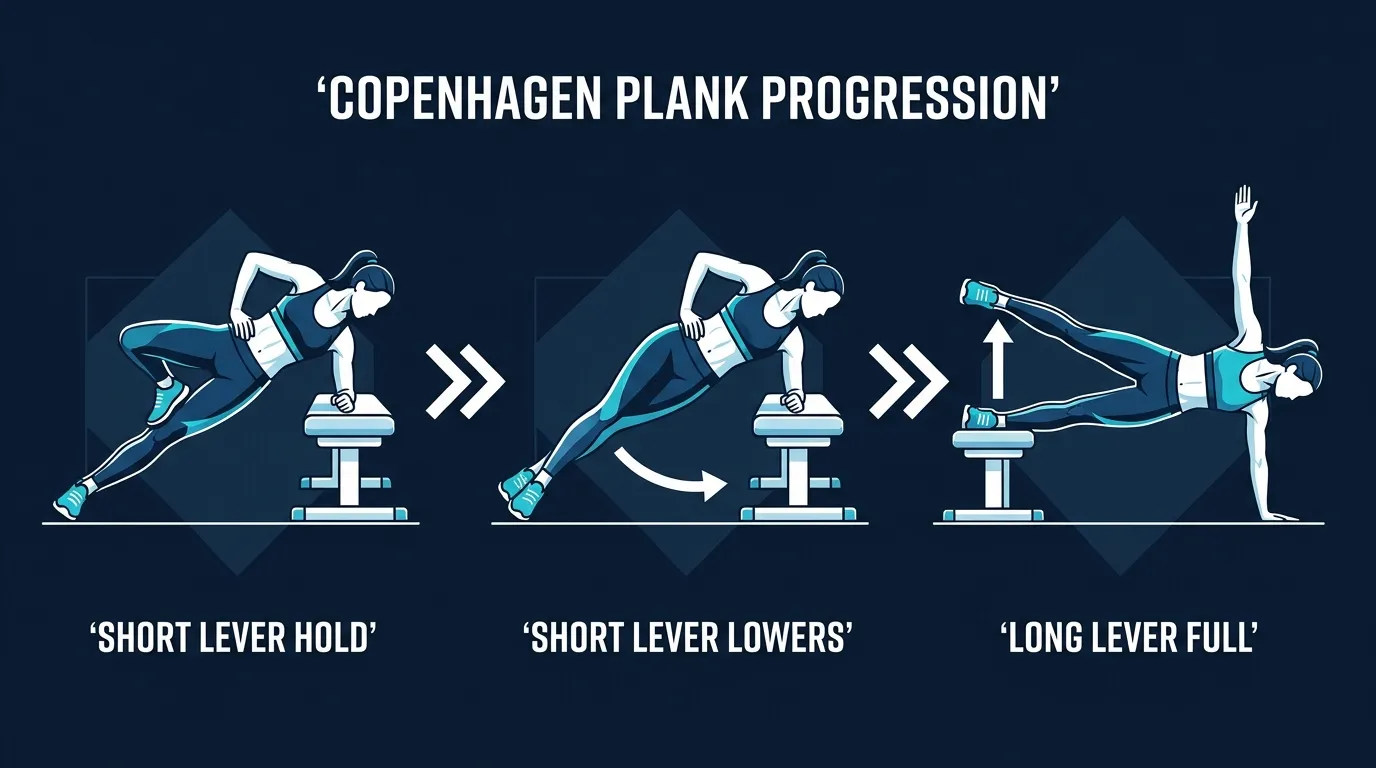
Weeks 1 to 2 (introduction): Short-lever isometric holds. Rest the top leg on the bench at the knee, not the ankle. Hold the side-plank position with the bottom leg lifted to meet the top leg. 3 sets of 15 to 30 seconds per side, twice a week. Expect soreness in the top-leg adductors the day after your first session. That is normal and fades quickly.
Weeks 3 to 4 (short-lever eccentric): Same short-lever setup. Now add slow lowers. Start with the bottom leg lifted, lower it slowly toward the floor over 3 seconds, drive it back up. 3 sets of 3 to 6 controlled reps per side, twice a week.
Weeks 5 to 6 (long-lever isometric): Move the bench under the ankle instead of the knee. Hold the position with the bottom leg lifted. 3 sets of 10 to 20 seconds per side, twice a week. This is a big jump in difficulty. If 10 seconds is too much, stay in the previous phase for another week.
Weeks 7+ (classic Copenhagen): Long lever, slow eccentric lowers, driven back up. 3 sets of 3 to 8 reps per side, twice a week for strength maintenance. If you are training for injury prevention in-season, the Harøy 2019 protocol drops to once per week and stays there.
A few practical notes. First, use a stable surface. A bench, a low box, or a chair with a padded seat all work. A partner's thigh is what elite teams use, but it is not necessary. Second, keep the pelvis stacked square to the front, not rotated. Rotation lets other muscles cheat. Third, if you feel groin pain (not soreness) during or after the exercise, stop and see a sports physio. Sharp pain in the adductor tendon area is not soreness.
For adjacent lower-body preventive exercises with similarly strong evidence, our writeups on the Nordic hamstring curl (the hamstring version of this idea) and single-leg training research cover the two other pieces of a serious lower-body prevention program. The ordinary front and side plank have an evidence base of their own, which our review of the plank benefits research goes through study by study.
Get an evidence-based plan built for you
FitCraft, our mobile fitness app, pairs you with an AI coach who builds you a personalized plan around your goals, schedule, and fitness level. Every FitCraft program is designed by Domenic Angelino, MPH (Brown University) and NSCA-CSCS, with research published in the Journal of Strength and Conditioning Research and Medicine & Science in Sports & Exercise.
Take the Free Assessment Free • 2 minutes • No credit cardCommon Misconceptions
"The Copenhagen Plank Is Just for Soccer Players"
Most of the published trials are in male footballers, so this reads as a fair assumption. It is not. The reason the trials were run in football is that adductor injuries are extremely common in football (up to 17% of all injuries in some cohorts), so recruiting a large enough sample to detect an injury prevention effect is feasible. The underlying mechanism (loading the adductors eccentrically at long lengths under high force) is not sport-specific. Any sport with sideways movement or rapid changes of direction is loading the same tissues under similar demands. And any lifter or runner with weak adductors relative to abductors is carrying a similar risk profile at lower absolute demands.
"You Need a Partner or a Special Bench"
No. The elite-team version uses a partner because it is convenient in a team setting, but the exercise works just as well with a bench, a low box, an ottoman, or a padded chair seat. The only requirement is that the surface is stable at about hip height and does not slide when you press into it. A yoga block on top of a chair, a foam roller wedged against a wall, or a plyometric box all work. The published trials mostly used gym benches. Anything similar works at home.
"It Will Just Make My Adductors Tight"
Strength work at long muscle lengths, which is exactly what the Copenhagen plank does, does not shorten the muscle. Long-length loaded training is the strongest known driver of stretch-tolerant strength. In fact, both Ishøi (2016) and Polglass (2019) reported no reduction in hip range of motion after the intervention, and multiple rehab protocols use the Copenhagen adduction exercise specifically to restore length and load tolerance in players returning from adductor injury. Tight adductors are usually a strength problem, not a length problem.
"Machine Adductor Work Is the Same Thing"
Not close. The seated adductor machine loads the muscle at short lengths, mostly concentrically, at moderate loads. The Copenhagen plank loads it at long lengths, eccentrically, at high force. Serner (2014) directly compared them and found the Copenhagen produced three to four times the adductor longus EMG activation of a seated squeeze. The machine is fine for general hip health. It is not equivalent for injury prevention or return-to-sport adductor strength.
What the Research Suggests Going Forward
The Copenhagen plank sits on unusually converging evidence for a single exercise. Serner (2014) established the mechanistic case: it activates the target muscle harder than anything else tested. Ishøi (2016) established the strength case: the target strength quality changes fast, in exactly the direction you want. Harøy (2019) established the injury prevention case at scale: 652 players, cluster-randomised, roughly a 41% cut in groin problems across a season. Polglass (2019) established the practical case: a ramped progression captures the strength gains without the soreness penalty. The 2026 Apunts systematic review on Copenhagen adduction in groin pain management pulled these threads together and concluded the exercise consistently improves eccentric hip adduction strength, hip range of motion, and dynamic balance, and reduces groin-related symptoms.
Honest limits. Most trials are in male athletes. Female athletes have similar groin injury rates in some sports (ice hockey, soccer) but a dedicated Copenhagen trial in women is still small in scale. Recreational and older populations are underrepresented. Trial durations are 6 to 12 weeks; the very long-term dose-response is not well studied. And Copenhagen alone will not fix hip and pelvic problems that involve other structures (hip flexors, core, glutes, femoroacetabular geometry). It is a piece of a program, not a standalone fix.
The practical bottom line. If you play a change-of-direction sport, run the Harøy 2019 protocol: three preseason sessions per week for 6 to 8 weeks, then once weekly in-season. If you do not play a sport but you train seriously, add 2 to 3 Copenhagen sets per side twice a week to your lower-body work. If you are new to the exercise, start with the short-lever isometric regression and ramp over 4 to 6 weeks. In all cases, the dose is small, the payoff is disproportionate, and it costs nothing but a bench and 10 minutes a session. For the rest of the menu around it, our roundup of the best inner thigh exercises ranks eight adductor moves and builds them into a two-day week.
References
- Ishøi L, Sørensen CN, Kaae NM, Jørgensen LB, Hölmich P, Serner A. "Large eccentric strength increase using the Copenhagen Adduction exercise in football: A randomized controlled trial." Scandinavian Journal of Medicine & Science in Sports. 2016;26(11):1334-1342. doi:10.1111/sms.12585 · PubMed: 26589483
- Harøy J, Clarsen B, Wiger EG, Øyen MG, Serner A, Thorborg K, Hölmich P, Andersen TE, Bahr R. "The Adductor Strengthening Programme prevents groin problems among male football players: a cluster-randomised controlled trial." British Journal of Sports Medicine. 2019;53(3):145-152. doi:10.1136/bjsports-2017-098937 · PubMed: 29891614
- Serner A, Jakobsen MD, Andersen LL, Hölmich P, Sundstrup E, Thorborg K. "EMG evaluation of hip adduction exercises for soccer players: implications for exercise selection in prevention and treatment of groin injuries." British Journal of Sports Medicine. 2014;48(14):1108-1114. doi:10.1136/bjsports-2012-091746 · PubMed: 23511698
- Polglass G, Burrows A, Willett M. "Impact of a modified progressive Copenhagen adduction exercise programme on hip adduction strength and postexercise muscle soreness in professional footballers." BMJ Open Sport & Exercise Medicine. 2019;5(1):e000570. doi:10.1136/bmjsem-2019-000570
- Fernández-Galván LM, López-Nuevo C, Romero-Martínez JA. "The influence of Copenhagen adduction exercise on the management of groin pain: A systematic review." Apunts Sports Medicine. 2026. doi:10.1016/j.apunsm.2026.100514 · ScienceDirect S2666506926000027
Frequently Asked Questions
What is a Copenhagen plank?
The Copenhagen plank (also called the Copenhagen adduction exercise) is a side plank in which the top leg rests on a bench, a partner's thigh, or a similar elevated surface, and the bottom leg is unsupported. You hold the side-plank position while the top-leg adductor group actively squeezes into the bench to keep the pelvis level and the bottom leg lifted. Ishøi and colleagues' 2016 randomized trial used it as a progressive strength exercise in male sub-elite footballers and showed large increases in eccentric hip adduction strength after 8 weeks. It is one of the highest-EMG-activation adductor exercises in the Serner 2014 lab evaluation.
Does the Copenhagen plank actually prevent groin injuries?
In male footballers, yes, with the strongest evidence so far. Harøy et al. (2019), a cluster-randomised trial across 35 semi-professional Norwegian teams (652 players) published in the British Journal of Sports Medicine, ran the Adductor Strengthening Programme built around the Copenhagen adduction exercise three times per week in preseason and once per week in-season. The intervention group had about a 41% lower rate of groin problems affecting performance across the season versus controls. That is the biggest and best-designed groin-prevention trial to date. The generalization to non-footballers, women, and recreational athletes is not directly established, but the mechanism (low eccentric hip adduction strength is a risk factor for groin injuries, and this exercise raises that strength substantially) is population-agnostic.
How much stronger does the Copenhagen plank make your adductors?
A lot, in the trials that measured it. Ishøi et al. (2016), an 8-week supervised randomized trial in male U-19 sub-elite footballers, reported large increases in eccentric hip adduction strength (EHAD) in the intervention group versus controls, with a significant interaction between group and time and improvements in the eccentric adduction to abduction strength ratio (a marker of groin injury risk). Polglass and colleagues' 2019 modified progressive protocol in professional footballers replicated the strength gains and also produced increases in eccentric hip abduction strength and the strength ratio, with meaningfully less delayed-onset muscle soreness than the classic protocol.
Why does the Copenhagen plank work better than a hip adductor machine?
Two reasons. First, activation. Serner and colleagues' 2014 EMG evaluation in the British Journal of Sports Medicine tested a range of hip adduction exercises. Peak adductor longus activation across the tested battery reached 108% of a maximum voluntary isometric reference contraction (the low end was 14%), and the Copenhagen adduction exercise was one of only two exercises the authors classified as dynamic high-intensity (alongside standing hip adduction with an elastic band). Second, mechanics. The Copenhagen plank loads the adductors eccentrically at long muscle lengths under high force, and eccentric strength at long lengths is the specific strength quality most strongly linked to groin injury risk. A seated adductor machine trains the same muscle group but at shorter lengths and mostly concentrically, so it is a weaker match for the injury-risk profile you are trying to change.
How do you start the Copenhagen plank if you can't hold the full position?
Regress the lever arm. The classic Copenhagen holds the top leg with the bench under the ankle and the body fully extended, which is the hardest version. Regress in three steps. First, short lever: rest the top leg on the bench at the knee rather than the ankle, cutting the moment arm at the hip in half. Second, isometric hold at the shorter lever, three sets of 15 to 30 seconds per side. Third, add slow eccentric lowers of the bottom leg toward the floor from the short-lever hold, three sets of 3 to 6 controlled reps per side. Progress to the long-lever ankle-supported hold when the short-lever version is easy for 30-plus seconds. Polglass et al. (2019) used a progressive five-week ramp of exactly this shape and produced strength gains with meaningfully less soreness than jumping to the full protocol.