- The injury-prevention effect is unusually consistent. A 2019 meta-analysis of 15 trials and 8,459 athletes (van Dyk et al.) found that programs including the Nordic hamstring curl roughly halved hamstring strain rates.
- The original RCT was striking. Petersen et al. (2011) trained 461 Danish soccer players in 50 teams and saw a 59% reduction in new hamstring injuries and an 86% reduction in recurrent ones over one season.
- The adaptation is structural. The Nordic curl loads the hamstring at long muscle lengths, which lengthens biceps femoris fascicles. Timmins et al. (2016) showed that short fascicles carry a 4.1-fold higher hamstring-injury risk.
- Low doses seem to work. Newer trials indicate you don't need the full Petersen volume. One set a few reps, one or two times per week, is enough to hold most of the adaptation once you've built it.
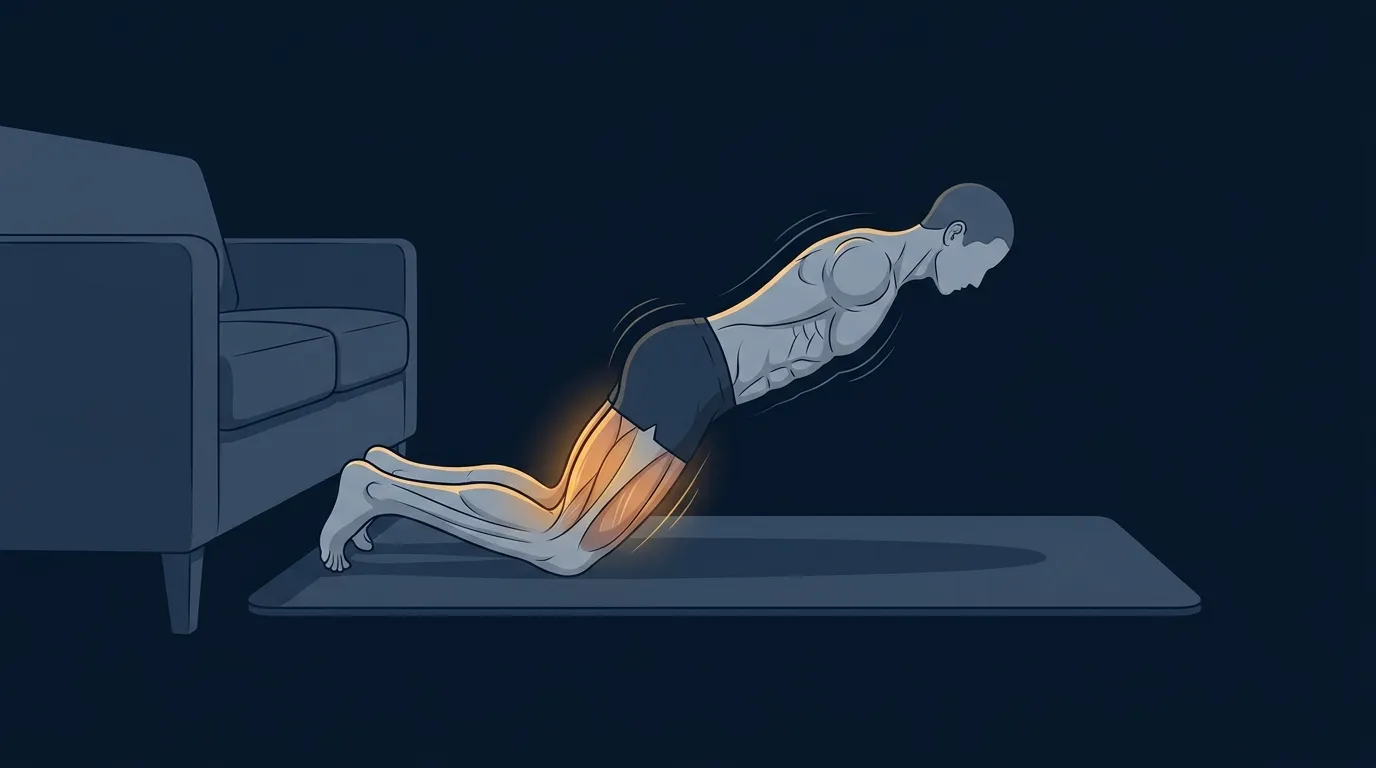
- You can do it at home. No barbell, no gym. Anchor your heels under a couch, a squat rack, or a partner's hands, and lower yourself under control.
Hamstring strains are the most common non-contact injury in sports that involve sprinting. For decades the standard advice was to stretch more and warm up longer. Neither helped much. Reinjury rates hovered near a third, and the same athletes kept pulling the same muscle year after year. Then in 2011 a Danish team ran a randomized trial that changed the conversation.
That trial, and the ones that followed, kept pointing to the same conclusion. A single bodyweight exercise, done a couple of times per week, cut hamstring injuries roughly in half. Not modestly. Not "with a trend toward significance." In half. The exercise is the Nordic hamstring curl, and the evidence base behind it is now one of the largest for any single movement in exercise science.
This piece walks through what the research shows, what it doesn't, and how a healthy adult can build the movement at home. The short version: if you sprint, run, hike, or play any sport with change-of-direction demands, the Nordic curl earns its slot in your week.
The Research: What Studies Show
Petersen 2011: The RCT That Started It All
The foundational trial is Petersen et al. (2011) in the American Journal of Sports Medicine. Fifty Danish soccer teams (942 players across the top five divisions) were cluster-randomized to either an eccentric hamstring program using the Nordic curl or usual training. The intervention group did 27 sessions across a 10-week preseason block, then once per week during the season. Sessions were short: two to three sets of five to twelve reps, ramping over the block.
Over one full season the intervention group logged 15 acute hamstring injuries. The control group logged 52. That worked out to a rate ratio of 0.410 (95% CI 0.180 to 0.933) for new injuries, roughly a 59% reduction. The reduction in recurrent injuries was even larger: a rate ratio of 0.137 (95% CI 0.037 to 0.509), roughly 86%. The authors flagged the recurrence effect specifically. Previously injured hamstrings are notoriously fragile. The Nordic curl reshaped that.
van der Horst 2015: The Amateur Replication
Elite-athlete findings often melt when you test them in weekend warriors. The Nordic curl didn't. van der Horst et al. (2015), also in AJSM, randomized 40 amateur Dutch soccer teams (579 players) to either a 13-week Nordic program (25 sessions total, working up to 3 sets of 12) or usual training. The intervention group cut hamstring-injury odds to an odds ratio of 0.282, roughly a 72% reduction. Severity of the injuries that did occur was unchanged, which was a fair caveat.
Two big trials, two different populations, same direction. That's not what you usually see in exercise-science literature. The signal was strong enough that FIFA folded a Nordic-inclusive protocol into its 11+ warm-up in the years that followed.
The Meta-Analyses: The Effect Holds Up at Scale
By the late 2010s the trials had piled up enough for a proper synthesis. Al Attar et al. (2017) in Sports Medicine pooled the available RCTs and reported that teams running injury-prevention programs that included the Nordic curl cut hamstring injury rates by 51% (injury risk ratio 0.490, 95% CI 0.291 to 0.827). Two years later van Dyk, Behan, and Whiteley (2019) published a larger meta-analysis in the British Journal of Sports Medicine covering 15 studies, 8,459 athletes, and 525 hamstring injuries. Their headline: the Nordic curl halves hamstring-injury rates. A more recent 2025 update on 15 pooled trials came in almost identically at a rate ratio of 0.51.
Not everyone agrees the effect is that clean. A 2021 methodological reappraisal in the Journal of Clinical Epidemiology argued that once you correct for cluster-randomization issues and compliance drift, the pooled estimate is less certain than the headline suggests. Fair point. But even the skeptics don't argue the Nordic curl is useless. They argue the size of the effect is smaller than the earliest trials implied. Somewhere between "halves injuries" and "meaningfully reduces injuries" is the honest range.
Why It Works: Fascicle Length and Eccentric Strength
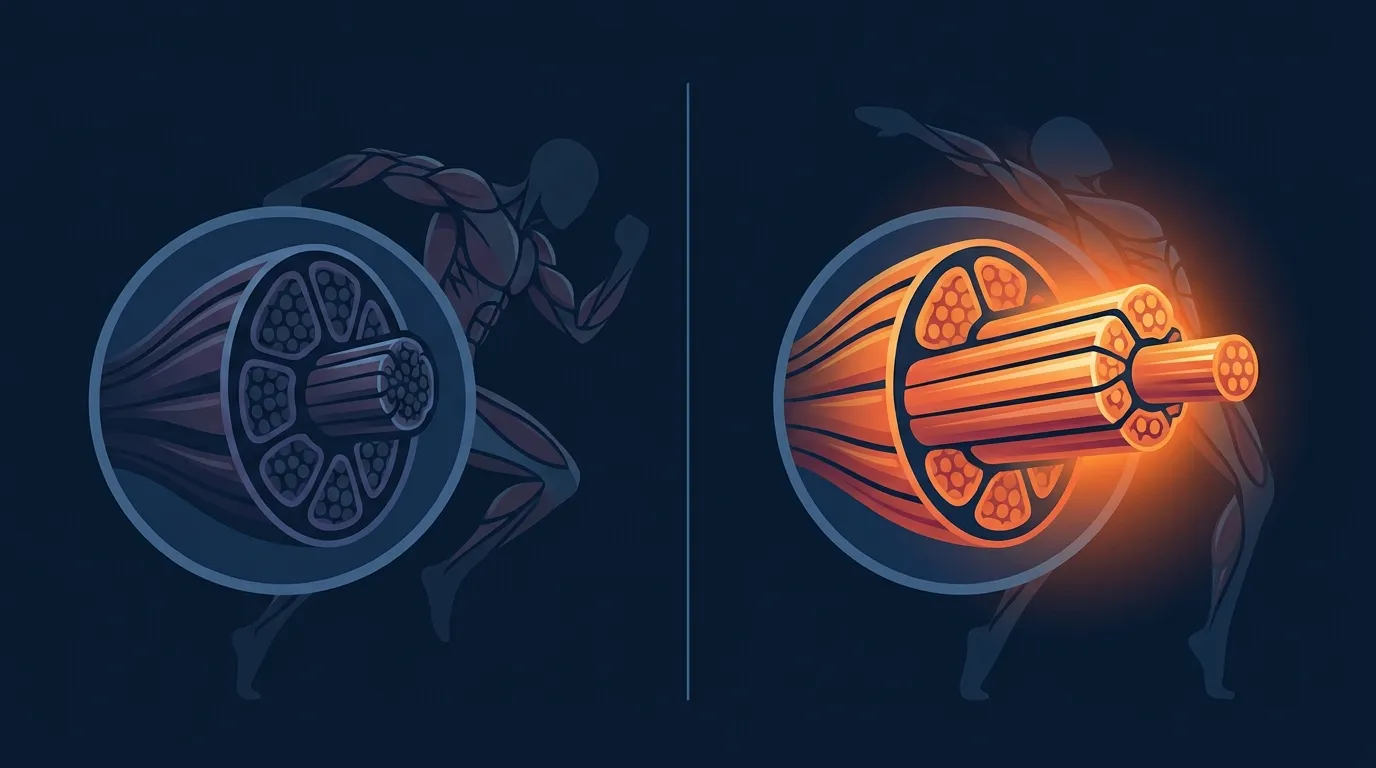
The mechanism story is the interesting part. The hamstrings tear during the late swing phase of a sprint, when the muscle is being lengthened at high speed under load. Two properties protect the tissue in that window. First, longer biceps femoris long-head fascicles, which let the muscle stretch further before sarcomeres reach failure length. Second, higher eccentric strength, which means the muscle can absorb more force during that lengthening.
The Nordic curl trains both. Timmins et al. (2016) prospectively followed 152 elite soccer players across a season. Athletes whose biceps femoris long-head fascicles measured shorter than 10.56 cm at preseason had a relative risk of 4.1 (95% CI 1.9 to 8.7) for a hamstring strain over the season. Eccentric weakness compounded the risk. Follow-up architecture studies have shown that a few weeks of Nordic training lengthens those fascicles by roughly 20 to 25%, though the adaptation partly reverses within two weeks of stopping. Eccentric strength gains hold longer.
Why This Matters for Your Fitness
You're probably not a Danish soccer player. That doesn't mean the finding doesn't apply. Any activity that involves sprinting, jumping, sudden direction changes, or downhill running loads the hamstring in the same long-length, high-velocity pattern that strains occur in. That includes recreational running, pickup basketball, tennis, ultimate, hiking with a pack, and playing tag with your kids at full speed.
The tissue-level adaptation isn't sport-specific. Longer fascicles and stronger eccentric contractions protect anyone who asks the hamstring to decelerate load. So the Nordic curl is one of the highest-return exercises a recreational athlete can add to a week. It's brief, requires no equipment, and buys real biological insurance against an injury that most people will otherwise deal with sooner or later.
There's a secondary benefit too. The Nordic curl builds hamstrings that look and feel more capable in daily life. Better hip-hinge control, more stable knees during descents, less discomfort loading the posterior chain during activities like carrying groceries or picking things up off the floor. This is the same trainable pattern our eccentric training benefits piece unpacks in more detail. If range rather than injury risk is what you are chasing, our guide to the best stretches for hamstrings covers the passive positions that pair with this loaded work.
How Nordic Curls Work in Practice
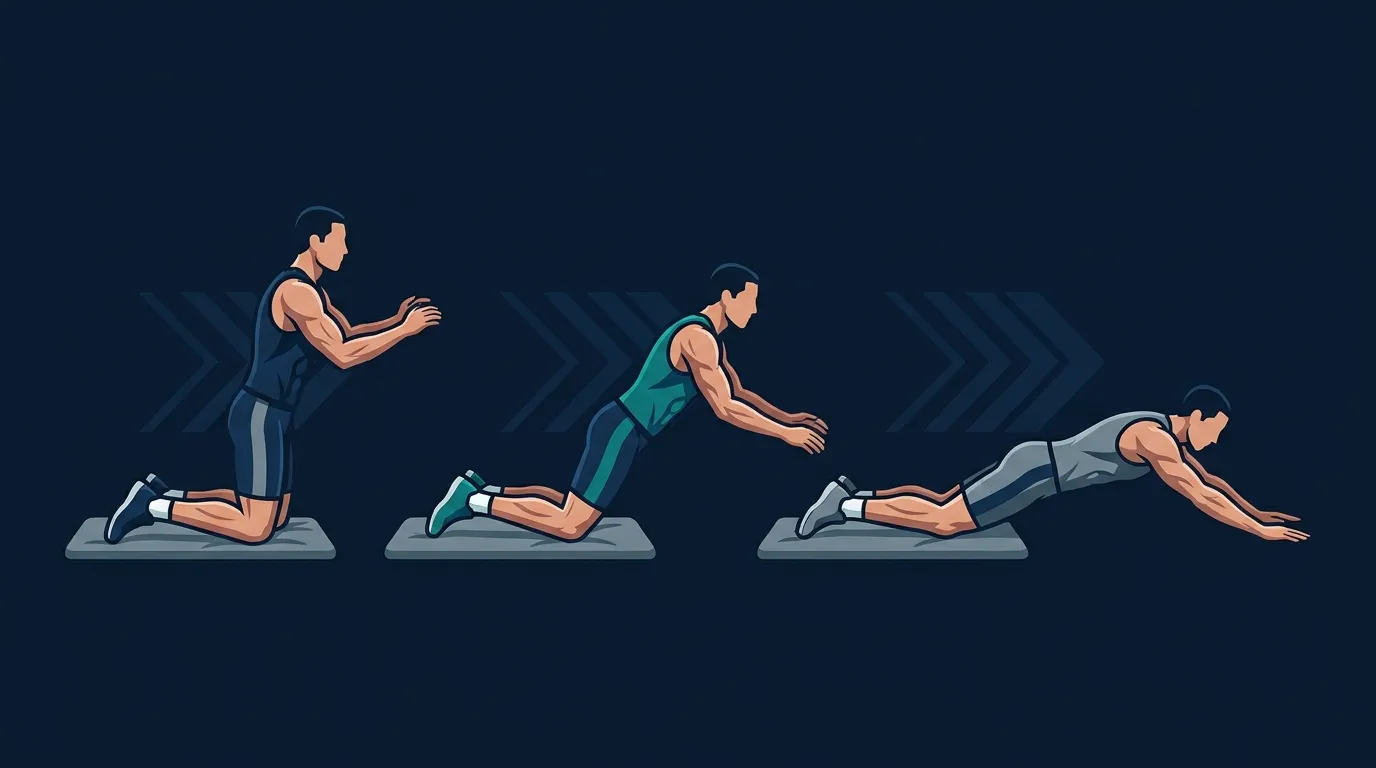
The setup is simple. Kneel on a soft surface (a folded towel or a yoga mat works). Anchor your ankles under something that will not budge: a partner's hands, the base of a heavy couch, the front of a squat rack, or a barbell loaded on the floor. Keep the hips fully extended, glutes tight, torso in a straight line from knee to head. Lower yourself toward the floor as slowly as you can control. When you can no longer hold the eccentric, catch yourself with your hands and push back to the start.
The most common mistake is bending at the hips. Watch your knees to head line and keep it rigid. The second common mistake is skipping the slow lowering and turning it into a fall. The whole training effect lives in the eccentric portion. If you crash to the floor after two inches of descent, you haven't loaded the muscle. Better to lower an inch under control than half a foot in freefall.
You will be very sore after the first session. This is normal, well-documented, and not a sign you overdid it. It fades within a week. Second-session soreness is usually a fraction of the first, and by session four most people barely feel it. Related pattern work on single-leg deadlifts and glute bridges pairs well and hits the posterior chain from complementary angles.
A Realistic Starting Progression
Weeks one and two: 1 set of 3 to 5 reps, once a week. Lower only as far as you can control. Push back with your arms for every rep. This is a range-of-motion week, not a load week.
Weeks three and four: 2 sets of 5 reps, once a week. Extend the eccentric a bit further each session. You should be lowering to roughly halfway between vertical and the floor by the end of week four.
Weeks five through eight: 2 to 3 sets of 6 to 8 reps, once or twice a week. Aim to lower under control to within a foot of the floor. Full-range Nordic curls (touching the chest to the floor without arm assistance) are an advanced skill. Most people never need to get there.
Maintenance: 1 to 2 sets of 4 to 6 reps, once a week. That's it. The adaptation is surprisingly resilient at low doses, provided you keep the eccentric slow and the range honest.
Get an evidence-based plan built for you
FitCraft, our mobile fitness app, pairs you with an AI coach who builds you a personalized plan around your goals, schedule, and fitness level. Every FitCraft program is designed by Domenic Angelino, MPH (Brown University) and NSCA-CSCS, with research published in the Journal of Strength and Conditioning Research and Medicine & Science in Sports & Exercise.
Take the Free Assessment Free • 2 minutes • No credit cardCommon Misconceptions
"You need a partner to do a real Nordic curl."
You don't. A heavy couch, a loaded barbell in a rack, or a foam roller wedged under a doorway all work. The mechanical requirement is a stable ankle anchor that won't slip forward. Test whatever you use with a slow, low-load pull before committing your body weight to it. Multiple published trials have used home-friendly anchors with the same protective effect.
"Nordic curls will make your hamstrings bulky."
They won't, at the doses used in the injury-prevention literature. Two sets of six to eight reps once or twice a week is a strength and architecture stimulus, not a hypertrophy stimulus. If you're trying to grow the hamstrings visibly, that's a different program (much higher volume, additional exercises, close-to-failure work). The typical Nordic protocol makes your hamstrings stronger and more durable without adding meaningful size.
"If you never sprint, you don't need Nordic curls."
Partly true, partly not. If you truly never load the hamstring at long lengths (no running, no downhill hiking, no pickup sports), the injury-prevention case is weaker. But most adults occasionally end up in a scenario where the hamstring gets loaded fast and long: chasing a bus, catching a stumble on a curb, playing with a kid, or picking up a new sport in midlife. Those unplanned moments are exactly when strains happen. A minute of Nordic curls a week buys cheap insurance against them.
What the Research Suggests Going Forward
The literature has largely settled on three points. The Nordic curl meaningfully reduces hamstring strain injuries, especially recurrences. The mechanism is real (longer fascicles plus stronger eccentric contractions). And low-dose maintenance protocols preserve most of the benefit once you've built the base, which matters because compliance is the single biggest predictor of whether teams get the pooled meta-analytic effect.
Where the research is still developing: dose-response curves for recreational adults, whether alternatives like the single-leg Romanian deadlift can substitute for the Nordic curl (a 2024 trial found comparable strength gains but did not measure injury rates), and how the exercise compares to hip-extension-dominant options for people who genuinely cannot tolerate the eccentric loading. For adjacent injury-prevention discussion see our strength training for injury prevention and single-leg training research pieces.
If you're a healthy adult who moves at all, the practical takeaway is simple. Add one short Nordic-curl session to your week. Build the pattern slowly across the first month. Then maintain it forever. The exercise costs almost nothing in time or equipment and returns one of the largest documented injury-prevention effects in sports medicine.
References
- Petersen J, Thorborg K, Nielsen MB, Budtz-Jørgensen E, Hölmich P. Preventive effect of eccentric training on acute hamstring injuries in men's soccer: a cluster-randomized controlled trial. American Journal of Sports Medicine. 2011;39(11):2296–2303. PMID: 21825112.
- van der Horst N, Smits DW, Petersen J, Goedhart EA, Backx FJG. The preventive effect of the Nordic hamstring exercise on hamstring injuries in amateur soccer players: a randomized controlled trial. American Journal of Sports Medicine. 2015;43(6):1316–1323. PMID: 25794868.
- Al Attar WSA, Soomro N, Sinclair PJ, Pappas E, Sanders RH. Effect of injury prevention programs that include the Nordic hamstring exercise on hamstring injury rates in soccer players: a systematic review and meta-analysis. Sports Medicine. 2017;47(5):907–916. PMID: 27752982.
- van Dyk N, Behan FP, Whiteley R. Including the Nordic hamstring exercise in injury prevention programmes halves the rate of hamstring injuries: a systematic review and meta-analysis of 8459 athletes. British Journal of Sports Medicine. 2019;53(21):1362–1370. PMID: 30808663.
- Timmins RG, Bourne MN, Shield AJ, Williams MD, Lorenzen C, Opar DA. Short biceps femoris fascicles and eccentric knee flexor weakness increase the risk of hamstring injury in elite football (soccer): a prospective cohort study. British Journal of Sports Medicine. 2016;50(24):1524–1535. PMID: 26675089.
Frequently Asked Questions
Does the Nordic hamstring curl actually prevent injuries?
Yes, and the evidence is unusually consistent. A 2019 meta-analysis of 15 trials covering 8,459 athletes (van Dyk et al., British Journal of Sports Medicine) found that programs including the Nordic hamstring exercise cut hamstring strain injury rates roughly in half. The 2011 Petersen trial in Danish soccer (942 players) reported a 59% reduction in new hamstring injuries and an 86% reduction in recurrences. Not every trial replicates those exact numbers, but the direction is remarkably stable across studies.
How many Nordic curls per week do I need to see the injury-prevention effect?
The classic Petersen protocol used 27 sessions across a preseason and in-season block, working up to 3 sets of 12 reps twice per week. The van der Horst 2015 trial used 25 sessions across 13 weeks. Newer work suggests you can maintain the strength and fascicle-length adaptations on much less. One set of a few reps once or twice per week is enough for many athletes to keep the protective adaptation, provided the movement is done through the full range.
Can I do Nordic curls at home without a partner?
Yes. The classic setup has a partner pin your ankles, but you can hook your heels under the base of a heavy couch, a loaded barbell in a rack, or a foam roller wedged under a doorway. What matters is a stable anchor that will not slip. Kneel on padding, engage the glutes, and lower your torso toward the floor as slowly as you can control. Push back to the start with your arms if you cannot pull yourself back with the hamstrings alone.
Is the Nordic hamstring curl safe for non-athletes?
For healthy adults with no lower-back or knee contraindications, yes. The trials that showed injury reduction were done in soccer players, but the underlying adaptation (eccentric hamstring strength at long muscle lengths) is protective for any hip-hinge dominant activity, including running, hiking, and pickup sports. Expect intense soreness the first two sessions. Start with 1 set of 3 to 5 half-range reps, then add range and volume slowly over four to six weeks.
Why does short biceps femoris fascicle length matter?
Timmins et al. (2016) prospectively followed 152 elite soccer players and found that those with biceps femoris long-head fascicles shorter than about 10.6 cm at preseason had a 4.1-fold higher risk of a hamstring strain over the season, after controlling for eccentric strength. Longer fascicles let the muscle absorb load at the long-length positions where strains happen. The Nordic curl trains the muscle in exactly that lengthened state, which is why it drives fascicle-length adaptations that other hamstring exercises do not.