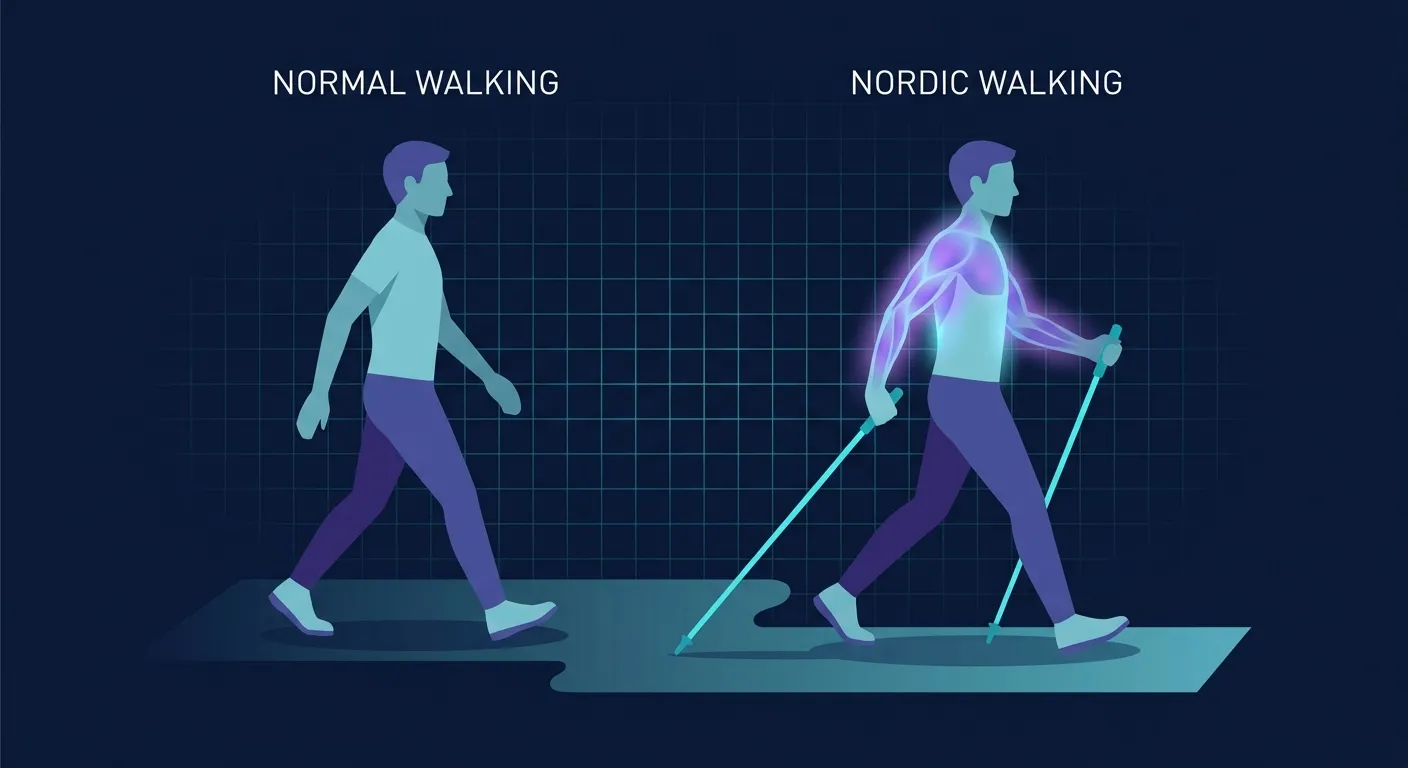
Regular walking is the honest default. It's cheap, low-impact, and it works. The trade-off is that a comfortable walking pace maxes out around 3 to 4 mph before it stops feeling like walking. Beyond that, most people either speed up to a jog or accept a lower training stimulus. Nordic walking is one of the few ways to raise the ceiling on walking-based cardio without switching to running.
The mechanism is straightforward. Two lightweight poles, angled backward, get planted alongside the foot and pushed into the ground behind the hip on each stride. That push loads the triceps, chest, lats, and rotators of the trunk. Your legs are still doing the walking. Your upper body is now doing work too. And because the poles give you a stability point on every step, cadence gets more consistent and stride length usually opens up a little.
This piece walks through the five best trials and reviews on Nordic walking, what happens acutely versus over months, where it shows the biggest advantage (older adults, Parkinson's, chronic conditions), and how to actually do it well if you want to try.
What Nordic Walking Actually Is
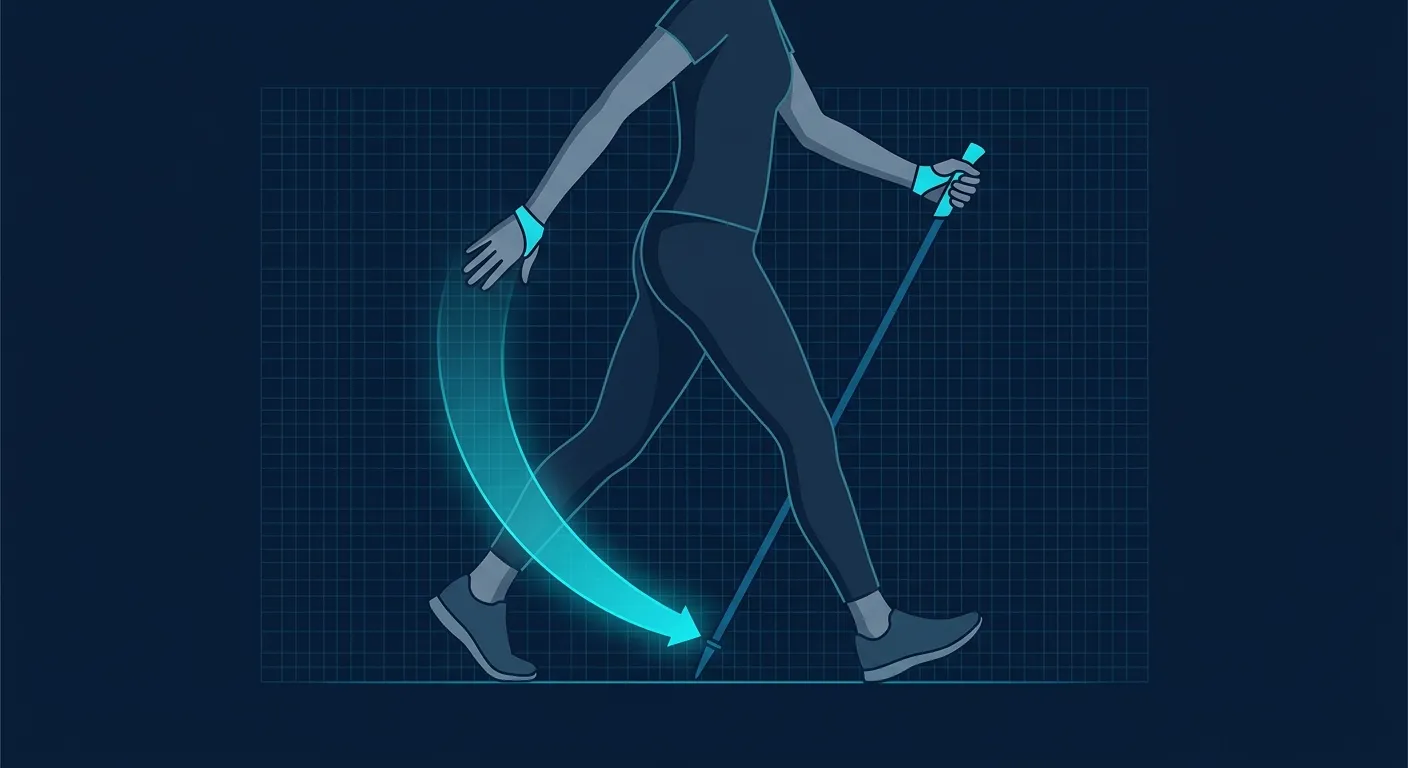
The technique matters. Nordic walking is not "walking while holding trekking poles." The poles are shorter than trekking poles (roughly 68 percent of your standing height, or about 0.68 x height in cm), have a soft rubber tip for road use and a metal spike underneath, and clip to a strap that keeps the grip loose during the push phase. On each stride the opposite arm swings forward, the pole plants angled backward next to the lead foot, and the walker pushes the pole into the ground behind the hip as the trailing leg swings through.
The core movement pattern is a diagonal, contralateral push: right pole with left leg, left pole with right leg. The arms swing further behind the body than they do in a regular walk, and the grip opens on the back of the push so the strap does most of the load transfer. Done well, the poles look like they're propelling the walker forward. Done poorly, they look like walking sticks that plant in front of the body and act as brakes.
A few terms worth pinning down:
- Nordic walking: the technique above. Poles push behind the hip. Full-body cardio.
- Trekking or hiking poles: longer, planted more vertically for balance and load-sharing on uneven terrain. Not the same mechanism.
- Urban poling / Activator poling: a rehab-oriented variant with a wider grip and forward pole plant, often used for balance support rather than propulsion.
- Pole walking: generic term. Not always technically correct Nordic walking.
The research below is on classic Nordic walking, with a taught technique. When trials report "Nordic walking" they generally mean an INWA (International Nordic Walking Federation) or ONWF-style technique with a coached progression. Reading it as "walking with random poles" understates what the technique actually does.
The Research: What Studies Show
Church et al. (2002): The Acute Oxygen and Calorie Response
The clearest look at what Nordic walking does in a single session comes from Church, Earnest, and Morss (2002) in Research Quarterly for Exercise and Sport. Twenty-two healthy adults (11 women, 11 men) walked 1,600 m on a level 200 m track twice: once with poles using Nordic walking technique, once without. Oxygen consumption, heart rate, and rating of perceived exertion (RPE) were measured throughout.
The pole condition raised oxygen consumption and caloric expenditure significantly at the same self-selected walking speed. Perceived exertion did not rise in step with the metabolic cost. Put another way: the walkers were doing meaningfully more work at the same pace, and their brains largely didn't register it as harder. That RPE mismatch is part of why Nordic walking scales well as a general cardio intervention. People will keep doing it because it doesn't feel much worse than walking, while the physiological dose is higher.
The typical estimate that shows up in secondary sources is a 15 to 25 percent bump in energy expenditure at the same speed. The exact number depends heavily on pole pressure and technique. Casual pole planting adds almost nothing. A committed push behind the hip adds a lot.
Tschentscher et al. (2013): The Big Systematic Review
The definitive summary is Tschentscher, Niederseer, and Niebauer (2013) in the American Journal of Preventive Medicine. The review pulled 16 randomized controlled trials (1,062 patients) and 11 observational studies (831 patients), covering healthy adults, cardiovascular patients, and metabolic-disease populations. Across the pooled evidence, Nordic walking outperformed brisk walking without poles on:
- Resting heart rate: small but consistent reductions
- Blood pressure: reductions in systolic and diastolic in hypertensive subgroups
- Exercise capacity: measured as time to exhaustion or 6-minute walk distance
- Maximal oxygen consumption (VO2 max): the aerobic-fitness marker
- Quality of life: self-reported, across several validated instruments
The authors' conclusion: Nordic walking can be recommended as primary and secondary prevention across a broad range of populations. That's a strong statement for a preventive-medicine review, and it's supported by the number of trials in the pool.
One nuance worth naming. Comparing "Nordic walking versus brisk walking" tends to show a Nordic advantage in trials where both groups walked the same distance or the same time. When trials matched the two groups on effort (RPE) instead, the differences shrank, because Nordic walkers self-selected a slower pace to hold the same RPE. Both readings are honest. If you have a fixed time budget and want more work done in it, Nordic walking wins. If you're already going as hard as you comfortably can, adding poles doesn't multiply what you get.
Bullo et al. (2018): The Older-Adult Meta-Analysis
The most quantitative summary in older adults is Bullo, Gobbo, Vendramin, and colleagues (2018) in Rejuvenation Research. The meta-analysis pooled 15 studies in adults aged 60 to 92 and reported effect sizes for Nordic walking versus sedentary control across a wide range of outcomes:
- Aerobic capacity: 0.92 (large effect)
- Upper-body strength: 0.66 (moderate-to-large)
- Lipid profile: 0.67 (moderate-to-large)
- Functional balance: 0.62 (moderate-to-large)
- Lower-body strength: 0.43 (moderate)
- Dynamic balance: 0.30 (small)
- Cardiovascular outcomes: 0.23 (small)
- Body composition: 0.30 (small)
The upper-body strength result is worth pausing on. Regular walking builds essentially no upper-body strength. Nordic walking does. The pole push loads the triceps, chest, lats, and shoulder external rotators through a small but repeated range of motion. Over months, that's enough to move the needle on upper-body strength markers in a population where preserving strength is protective against falls, disability, and mortality. Our write-up on grip strength and longevity covers the mortality side of that story, and the Nordic walking data slots in as one of the few cardio modalities that also does some strength work.
Reuter et al. (2011): The Parkinson's Trial
The best trial in a clinical population is Reuter, Mehnert, Leone, and colleagues (2011) in the Journal of Aging Research. Ninety adults with Parkinson's disease were randomized to one of three six-month interventions, three sessions per week, 70 minutes per session: a flexibility and relaxation program, regular walking, or Nordic walking.
All three groups improved on pain, balance, and health-related quality of life. But two things separated the walking arms from the flexibility arm, and Nordic walking from regular walking:
- Gait: stride length, gait variability, and maximal walking speed improved in both walking groups, with Nordic walking producing the largest changes.
- Motor function: UPDRS motor scores improved more in the Nordic walking arm than in the flexibility arm.
- Exercise capacity: submaximal exercise capacity rose in both walking groups, with the Nordic advantage tracking the higher metabolic load per stride.
The plausible mechanism has two parts. First, the pole cadence gives an external rhythm cue, which helps with the shuffling, festinating gait pattern common in Parkinson's. Second, the cross-body diagonal (opposite pole with opposite leg) reinforces contralateral limb coordination, which weakens as the disease progresses. Reuter (2011) isn't a large trial by cardiology standards, but for Parkinson's it's substantial, and the effect is consistent with several smaller trials that came before and after.
Chen et al. (2026): The Diabetes Meta-Analysis
The most recent quantitative synthesis in a metabolic-disease population is Chen, An, Wu, and colleagues (2026) in the Journal of Diabetes Research. The meta-analysis pooled randomized controlled trials of Nordic walking in adults with prediabetes or diabetes and looked at anthropometrics, glycemia, and lipid profile.
The positive signals:
- Body weight: significantly reduced
- HbA1c: significantly reduced (the clinically meaningful glycemic marker for diabetes control)
- HDL cholesterol: significantly increased
The null signals in this pooled dataset:
- Total cholesterol, LDL, triglycerides: no significant change
- Blood pressure: no significant change
The honest read: Nordic walking helps on the endpoints that most consistently respond to cardio in diabetic populations (weight, HbA1c, HDL) and doesn't reliably move the lipid or blood pressure endpoints that need higher doses or medication. It's a real adjunct to standard diabetes care, especially for people who don't tolerate higher-impact cardio, but it isn't a substitute for medication, diet work, or resistance training. Our exercise and insulin sensitivity write-up covers the broader picture of cardio and glycemic control.
Why This Matters for Your Fitness
Four practical use cases fall out of the research.
You want harder cardio at the same walking pace. Church (2002) is the case for this. Poles add roughly 15 to 25 percent to oxygen consumption at the same speed without a matching rise in perceived exertion. If you already walk daily and want a stronger cardio stimulus without switching to running, Nordic walking is one of the few ways to get it. This is the "same walk, more work" case.
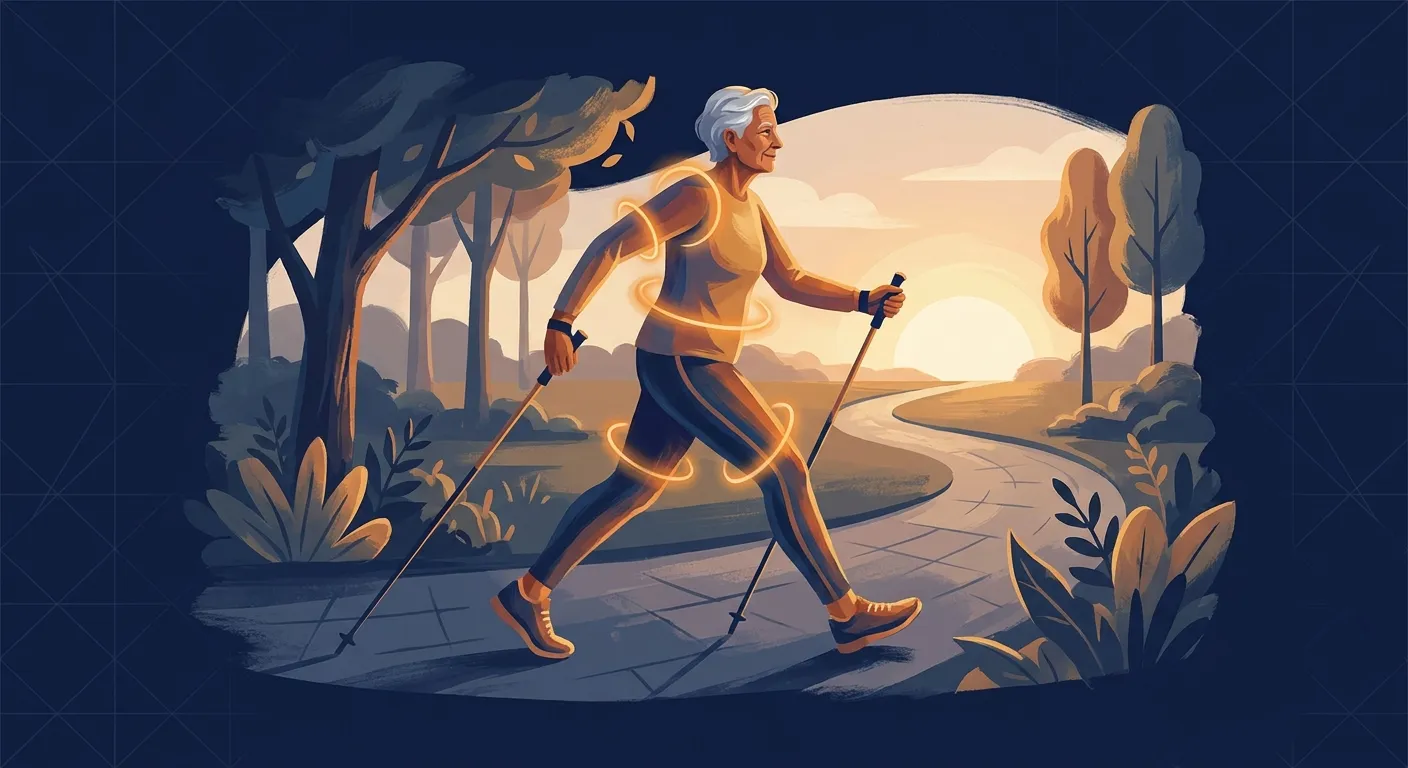
You're an older adult who wants full-body cardio without joint impact. Bullo (2018) is the case for this. Effect sizes for aerobic capacity, balance, and upper-body strength are large in 60-to-92-year-olds, and the joint impact stays walking-low. This is the strongest single argument for Nordic walking as a general recommendation in older populations. Our fitness-over-60 guide and joint-pain fitness guide both include Nordic walking as a first-line option for a reason.
You have Parkinson's, and your care team is looking for a movement modality with real gait data behind it. Reuter (2011) is the case for this. Not every clinical population has a six-month, three-arm randomized trial with 90 participants. Parkinson's does, and Nordic walking has the best evidence in that trial for improving stride length, walking speed, and UPDRS motor scores. Any decision like this should be run past a neurologist and a physical therapist. The research just gives you a well-supported option to bring to that conversation.
You have prediabetes or type 2 diabetes and want a walking-based cardio option with meta-analytic support for glycemic control. Chen (2026) is the case for this. HbA1c, body weight, and HDL move in the right direction. Blood pressure and LDL don't, in the pooled data, so don't rely on Nordic walking alone for those. Combine it with resistance training and diet work.
Where Nordic walking is a weaker choice. If your goal is maximum VO2 max development in a young, healthy population, running or cycling will get you there faster. If you're time-crunched and can tolerate high intensity, HIIT or Zone 2 on a bike will pack more stimulus into 20 minutes than Nordic walking. And if you hate carrying poles, don't have anywhere to store them, or feel self-conscious using them in public, the modality that you'll actually do beats the one you won't.
Get an evidence-based plan built for you
FitCraft, our mobile fitness app, pairs you with an AI coach who builds you a personalized plan around your goals, schedule, and fitness level. Every FitCraft program is designed by Domenic Angelino, MPH (Brown University) and NSCA-CSCS, with research published in the Journal of Strength and Conditioning Research and Medicine & Science in Sports & Exercise.
Take the Free Assessment Free • 2 minutes • No credit cardHow to Actually Do Nordic Walking
The technique is worth learning correctly. A one-hour lesson from an INWA-certified instructor is the highest-yield spend you'll make on this. Barring that, the essentials:
- Pole length. Multiply your height in cm by 0.68 (roughly). A 170 cm walker uses 115 cm poles. Round down. Poles that are too long force you to plant them in front of your body, which turns them into brakes.
- Grip. The strap does most of the work. You close the hand on the plant, open the hand on the push behind the hip. If your hand is death-gripping the pole through the whole stride, you're not using the technique. Your forearms will be sore in a way that tells you.
- Plant angle. Angled backward, next to the opposite foot. Never in front of the body. The pole tip lands between your foot and where your foot just was.
- Push. The pole tip stays planted while your body walks past it. You push through the strap until the pole is behind your hip. The arm ends up extended behind your body, hand open.
- Rhythm. Contralateral. Right pole with left foot, left pole with right foot. This is the same natural arm-swing cadence you already use walking, just amplified.
The most common technique fault, by a wide margin, is planting the pole out in front. That converts the tool from a propulsion aid to a brake. If you find yourself pushing "down" on the poles instead of "back", check the plant angle first.
How much per week is where the research is helpful. Most Bullo (2018) and Tschentscher (2013) trials ran three to five 30-to-60-minute sessions per week for 8 to 12 weeks. Reuter (2011) ran three 70-minute sessions per week for six months. That's a reasonable dose range: 90 to 300 minutes per week, with lower doses for beginners and higher doses tolerable in trained walkers or when the modality is the primary cardio.
Terrain. Level or gently rolling paved paths are the easiest. Grass and packed dirt are fine. Deep gravel and loose sand can trip the tips. Slippery surfaces (wet leaves, ice) turn poles into a fall hazard. On roads, use the rubber pavement tips. On dirt, the metal spike underneath.
Common Misconceptions
"Nordic Walking Is Just Walking With Sticks"
No. The mechanics are meaningfully different. Trekking poles are longer, planted more vertically, and used mostly for balance on uneven ground. Nordic walking poles are shorter, planted angled backward, and used to actively push behind the hip on each stride. Church (2002) documented that the difference in oxygen consumption isn't small: real Nordic technique bumps energy expenditure meaningfully at the same speed. Grip a pair of trekking poles vertically and walk with them and you'll get almost none of that benefit.
"Nordic Walking Is Only for Seniors"
The research is disproportionately in older adults because that's the population where the trials get funded, and because Nordic walking has clear appeal in populations that can't or shouldn't run. But Tschentscher (2013) pooled trials across a broad age range and included healthy adults, cardiovascular patients, and metabolic-disease populations. Church (2002) tested young healthy adults (mean age around 30). The physiology of pole-assisted propulsion doesn't care about age. Older adults benefit more relative to sedentary controls because their baseline is lower, but the modality works fine in any adult who wants a full-body, low-impact cardio option.
"You Burn a Lot More Calories, So It's a Weight-Loss Shortcut"
The calorie bump is real (15 to 25 percent at the same speed in most reports) but modest in absolute terms. A 30-minute regular walk that burns 150 kcal becomes maybe 180 to 190 kcal with poles. Meaningful over a month, not transformative in one session. Chen (2026) found significant body-weight reductions in prediabetic and diabetic populations, but the dose was months of consistent training, not a few walks. Nordic walking supports weight management. It doesn't replace the caloric arithmetic.
"Nordic Walking Replaces Strength Training"
No. Bullo (2018) reported a moderate-to-large upper-body strength effect (0.66) versus sedentary controls, which is meaningful in the elderly. But those effect sizes are relative to doing nothing, not relative to a proper resistance training program. If you already lift or do bodyweight strength work, Nordic walking is a strong cardio complement. If you don't lift at all, Nordic walking does more for your upper body than regular walking, but it isn't a substitute for actual resistance training, especially for the lower body.
What the Research Suggests Going Forward
The Nordic walking literature is unusual in that it has been reasonably consistent across populations for over two decades. Church (2002) established the acute metabolic case. Tschentscher (2013) pulled 27 studies into a well-powered systematic review and gave the field a broad recommendation. Bullo (2018) quantified the older-adult case with real effect sizes. Reuter (2011) showed the modality survives translation into a clinical population and produces measurable gait and motor improvements. Chen (2026) added the most recent metabolic-disease evidence with a clean, methodologically current meta-analysis.
The honest limits worth naming. Technique quality is a huge confounder. Two participants in the same trial can produce very different metabolic responses depending on whether they're actually pushing behind the hip or dragging the poles. Most trials use INWA-taught technique with periodic form checks, so the reported effects are what you get when the technique is done well. Untaught pole-carrying is not the same intervention. Sample sizes are moderate. Long-term (multi-year) adherence data is thin. And the modality has a cultural inertia in North America that it doesn't have in Northern Europe, so the population-level uptake is much lower here than the evidence would justify.
Practical takeaway. If you already walk, buying a pair of correctly sized poles and taking one lesson is a small investment for a modality with a broad, decades-deep evidence base. If you're older, sedentary, or working around joint impact restrictions, Nordic walking is one of the highest-yield movement recommendations in the exercise-science literature. And if you have a chronic condition where the trials support it (Parkinson's, prediabetes, mild-to-moderate cardiovascular disease), it's worth naming to your care team specifically, because "walking" and "Nordic walking" are not the same intervention and the evidence base isn't the same either.
References
- Church TS, Earnest CP, Morss GM. "Field testing of physiological responses associated with Nordic Walking." Research Quarterly for Exercise and Sport. 2002;73(3):296-300. doi:10.1080/02701367.2002.10609023 · PubMed: 12230336
- Reuter I, Mehnert S, Leone P, Kaps M, Oechsner M, Engelhardt M. "Effects of a flexibility and relaxation programme, walking, and nordic walking on Parkinson's disease." Journal of Aging Research. 2011;2011:232473. doi:10.4061/2011/232473 · PubMed: 21603199
- Tschentscher M, Niederseer D, Niebauer J. "Health benefits of Nordic walking: a systematic review." American Journal of Preventive Medicine. 2013;44(1):76-84. doi:10.1016/j.amepre.2012.09.043 · PubMed: 23253654
- Bullo V, Gobbo S, Vendramin B, Duregon F, Cugusi L, Di Blasio A, Sales Bocalini D, Zaccaria M, Bergamin M, Ermolao A. "Nordic Walking Can Be Incorporated in the Exercise Prescription to Increase Aerobic Capacity, Strength, and Quality of Life for Elderly: A Systematic Review and Meta-Analysis." Rejuvenation Research. 2018;21(2):141-161. doi:10.1089/rej.2017.1921 · PubMed: 28756746
- Chen S, An X, Wu A, Liu Y, Lebaka VR, Bhaskar LVKS, Korivi M, Ye W. "Effect of Nordic Walking on Anthropometrics, Glycemia, and Lipid Profile in Adults With Prediabetes or Diabetes: A Systematic Review and Meta-Analysis of Randomized Controlled Trials." Journal of Diabetes Research. 2026;2026:5886930. doi:10.1155/jdr/5886930 · PMC12782928
Frequently Asked Questions
What is Nordic walking?
Nordic walking is a walking style that uses two specially designed poles to push against the ground with each stride, recruiting the arms, shoulders, chest, and upper back. The poles are angled backward on plant, and the walker actively pushes them into the ground behind the hip rather than planting them out in front. The result is more muscle groups working at once and a higher aerobic and caloric cost than regular walking at the same speed. Church et al. (2002) in Research Quarterly for Exercise and Sport documented the physiological response in a field trial: 22 healthy adults walked 1,600 m with and without poles on a level track, and the pole condition significantly raised oxygen consumption and caloric expenditure without a matching rise in perceived exertion.
Does Nordic walking burn more calories than regular walking?
Yes, in most well-controlled field and lab trials. Church et al. (2002) found that adding poles to walking increased oxygen consumption and caloric expenditure significantly at the same walking speed and on the same track. The Tschentscher et al. (2013) systematic review in the American Journal of Preventive Medicine, pooling 16 randomized trials and 11 observational studies across 1,893 people, concluded that Nordic walking was superior to brisk walking without poles on multiple aerobic and cardiovascular endpoints, including maximal oxygen consumption. The typical estimate from the literature is roughly a 15 to 25 percent increase in energy expenditure at the same speed, with wider ranges reported depending on technique quality and pole pressure.
Is Nordic walking good for older adults?
The evidence in older adults is stronger for Nordic walking than for almost any other low-impact modality. Bullo et al. (2018) in Rejuvenation Research pooled 15 studies in adults aged 60 to 92 and reported meaningful effect-size improvements from Nordic walking versus sedentary controls: aerobic capacity (0.92), functional balance (0.62), upper-body strength (0.66), lower-body strength (0.43), lipid profile (0.67), body composition (0.30), and dynamic balance (0.30). The added trunk and arm work, combined with the balance point of the poles, is what makes it useful in this population. It's a full-body cardio session that keeps ground contact and low joint impact.
Does Nordic walking help with Parkinson's disease?
Yes, in the best-designed trial to date. Reuter et al. (2011) in the Journal of Aging Research randomized 90 people with Parkinson's disease to a flexibility and relaxation program, walking, or Nordic walking for six months, with three 70-minute sessions per week. Pain, balance, and health-related quality of life improved in all three groups. But walking and Nordic walking specifically improved stride length, gait variability, maximal walking speed, submaximal exercise capacity, and the UPDRS motor score, with Nordic walking producing the largest changes on several gait endpoints. The pole cadence gives an external rhythm cue and a small proprioceptive input that can help with the shuffling and small-step gait pattern common in Parkinson's.
Can Nordic walking help with blood sugar and cardiovascular risk?
The most recent meta-analysis is cautiously positive but selective. Chen et al. (2026) in the Journal of Diabetes Research pooled randomized trials of Nordic walking in adults with prediabetes or diabetes and found significant improvements in body weight, HbA1c, and HDL cholesterol. Effects on total cholesterol, LDL, triglycerides, and blood pressure were not significant in the pooled analysis. The signal is real but modest: Nordic walking is a reasonable adjunct to standard diabetes care, particularly for people who won't tolerate higher-impact cardio, but it isn't a substitute for medication, diet work, or resistance training.