
Walking is the safest cardio recommendation on the planet. It's also, for a lot of people, not quite enough to move the needle on long-term health. Slow jogging exists in the small gap between "brisk walk" and "actual run", and it turns out to be the sweet spot for a big chunk of the mortality literature.
The framing you'll see in Japanese sports science is Hiroaki Tanaka's niko niko pace: run only as fast as you can smile. In Western terms, that lands around 50 to 60 percent of heart-rate reserve. Fast enough to be jogging. Slow enough to be sustainable. Slow enough that most people who "hate running" will actually keep doing it.
This piece walks through the five largest and most durable studies on slow jogging and low-intensity running, what the dose-response curves look like, why the joint concern is mostly misplaced, and how to actually start if you've been walking and want a small step up.
What Slow Jogging Actually Is
The physiological definition is easier than the cultural one. Slow jogging is running (both feet leave the ground at some point in the gait cycle) at an intensity you could sustain for 30 to 60 minutes without gasping. Most sources put the pace at 4 to 6 km/h (2.5 to 3.7 mph), which for many people is slower than their brisk walking pace. The trick is that a jog at 5 km/h costs meaningfully more energy than a walk at 5 km/h, because you're briefly airborne on each stride and reloading through more range of motion.
Tanaka's niko niko framing translates directly to RPE: run at an intensity where you can hold a smile and a conversation. If your face tightens or the sentences get short, back off. Most people land at a heart rate 50 to 60 percent of their reserve, which is roughly the top of Zone 1 or the bottom of Zone 2 depending on how you split the zones. Compared with fast running (Zone 3 and up), the perceived effort is low. Compared with walking, the metabolic cost is meaningfully higher.
A quick vocabulary check:
- Slow jogging (niko niko pace): conversational-pace running, roughly 4 to 6 km/h, low impact, sustainable.
- Jog-walk intervals: alternating 1 to 3 minutes of jogging with 1 to 2 minutes of walking. A common on-ramp for beginners.
- Easy run: a term used by runners for their slow days, which for a trained runner may still be 8 to 10 km/h, faster than niko niko.
- Zone 2: the aerobic-base intensity, defined by heart rate (roughly 60 to 70 percent of max) or blood lactate (under 2 mmol/L). Slow jogging often lives at the low end of Zone 2 or the top of Zone 1.
What matters for the research below: the studies pool a range of self-reported paces. When they say "slow" or "light", they mean subjectively slow to the participant, not race pace. That covers most of what Tanaka would call niko niko.
The Research: What Studies Show
Schnohr et al. (2015): The Copenhagen City Heart Study
The most-cited dose-response study for jogging is Schnohr, O'Keefe, Marott, Lange, and Jensen (2015) in the Journal of the American College of Cardiology. The Copenhagen City Heart Study followed 1,098 healthy joggers and 3,950 healthy non-joggers prospectively from 2001 onward. Joggers self-reported their weekly hours, session frequency, and typical pace ("slow", "average", or "fast").
The mortality curve was U-shaped and steep. Compared with sedentary non-joggers, the lowest all-cause mortality was in people who jogged:
- 1 to 2.4 hours per week
- 2 to 3 sessions per week
- at a slow to average pace
The hazard ratio for that group was 0.29, meaning roughly 71 percent lower mortality than sedentary controls over the follow-up window. Strenuous joggers, who logged much higher volumes at faster paces, had mortality risk that approached the sedentary group in the pooled data. That U-shape has been debated (some later analyses have questioned the statistical power in the "strenuous" tail), but the low-end result is robust across cohorts. Small doses of slow jogging produce large mortality reductions, and adding more is subject to diminishing returns.
Lee et al. (2014): The Aerobics Center Longitudinal Study
The largest single-cohort study on running and mortality is Lee, Pate, Lavie, Sui, Church, and Blair (2014) in the same journal. The Aerobics Center Longitudinal Study followed 55,137 adults aged 18 to 100 for a mean of 15 years. Roughly 24 percent were runners.
Compared with non-runners, runners had:
- 30 percent lower all-cause mortality
- 45 percent lower cardiovascular mortality
- a life-expectancy gain of roughly 3 years
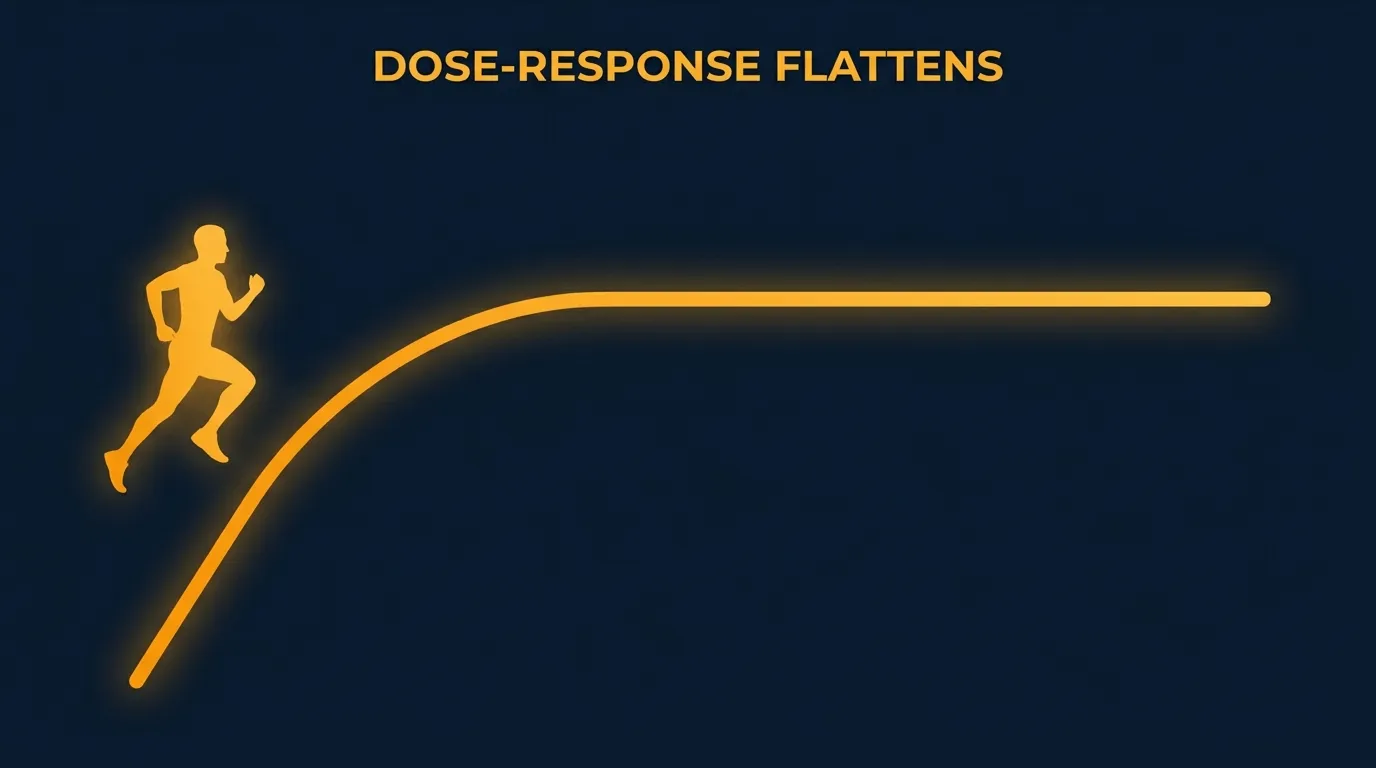
Two details from this paper matter most for the slow-jogging case. First, the dose-response curve was strikingly flat: benefits were similar in people who ran less than 51 minutes per week and those who ran much more. Even 5 to 10 minutes per day of running, at slow speeds under 6 mph, captured essentially the same mortality reduction as much larger weekly doses. Second, "runners" in this cohort included many people running at slow speeds. The mortality benefit didn't hinge on being fast. It hinged on being a runner at all.
That flat dose-response curve is the single most important finding in the running-and-mortality literature. It reframes running from a high-cost endurance sport into a low-dose, high-yield longevity habit. Slow jogging is exactly the entry point that lets people harvest most of that benefit without any of the volume.
Chakravarty et al. (2008): The Stanford Runners Study
The best long-term data on aging runners specifically comes from Chakravarty, Hubert, Lingala, and Fries (2008) in Archives of Internal Medicine. This was a 21-year prospective cohort of 538 members of a running club (mean age 59 at baseline) and 423 healthy community controls, tracked from 1984 through 2005.
At 21-year follow-up:
- Runners had 39 percent lower all-cause mortality than controls (15 percent versus 34 percent died during follow-up).
- Disability, measured by the Health Assessment Questionnaire, developed 16 years later in the runners than in the controls.
- The advantage held after adjustment for BMI, alcohol, smoking, and prior comorbidities.
- Osteoarthritis rates and joint-related disability were not higher in the runners. In several endpoints, they were lower.
The "running wrecks your knees" narrative is culturally sticky and empirically wrong for healthy adults. Chakravarty (2008) is the cleanest counterpoint. Impact loading, done at moderate doses and reasonable technique, remodels bone density, tendon stiffness, and cartilage in protective directions. That doesn't mean everyone can run pain-free (a small percentage of people have gait mechanics, joint anatomy, or prior injuries that make jogging a bad fit), but the population-level story is unambiguous: aging runners age better than aging non-runners, on almost every endpoint that matters.
Pedisić et al. (2020): The Meta-Analysis
The best pooled synthesis is Pedisić, Shrestha, Kovalchik, Stamatakis, Liangruenrom, Grgic, Titze, Biddle, Bauman, and Oja (2020) in the British Journal of Sports Medicine. The meta-analysis pooled 14 prospective studies covering 232,149 participants with 25,951 deaths across follow-up periods averaging 5.5 to 35 years.
The pooled effect estimates:
- 27 percent lower risk of all-cause mortality in runners versus non-runners
- 30 percent lower risk of cardiovascular mortality
- 23 percent lower risk of cancer mortality
The dose-response analysis in this paper is the piece worth reading carefully. The authors modeled the relationship between weekly running volume and mortality across the pooled cohorts. Their conclusion: any amount of running was associated with a significantly lower mortality risk, and the more-is-better assumption did not hold. Weekly running frequencies as low as once per week, and doses as small as 50 minutes per week, produced statistically significant mortality reductions comparable to much larger doses.
That is a strong finding for slow jogging specifically. It says the returns on the modality don't require training volume that displaces the rest of your life. A 20-minute slow jog twice a week, at a pace you can sustain with a smile, sits inside the window that captures most of the pooled mortality benefit.
Williams and Thompson (2013): Running vs Walking Head-to-Head
The most direct comparison of running against walking is Williams and Thompson (2013) in Arteriosclerosis, Thrombosis, and Vascular Biology. The paper pooled the National Runners' Health Study (33,060 runners) and the National Walkers' Health Study (15,945 walkers), matched on baseline demographics, and compared 6-year incidence of hypertension, hypercholesterolemia, diabetes, and coronary heart disease across the two exposure groups.
The authors compared incidence of the four endpoints across matched levels of self-reported weekly energy expenditure in the two cohorts. The pooled conclusion, in the authors' own framing:
- At equivalent energy expenditure (calories burned per week), running and walking produced similar reductions in the risk of incident hypertension, hypercholesterolemia, and diabetes.
- Running-vs-walking differences on coronary heart disease were also not significant at matched energy expenditure.
- Walking showed a marginally larger reduction than running for hypercholesterolemia.
The framing that matters for slow jogging: when the two modalities are matched on energy expenditure, running and walking are essentially interchangeable for these cardiometabolic endpoints. But per unit of time, running packs more energy expenditure into the same window, so a 30-minute jog moves the same needles as a longer walk. Slow jogging inherits that time-efficiency edge. It's harder than walking per minute, so a 30-minute slow jog does more than a 30-minute walk. It's not so hard that it feels like running, so people will actually do it.
Williams and Thompson (2013) closed a real gap in the literature. It gave clinicians and coaches a defensible answer to the "is jogging really better than walking?" question. Per unit energy expenditure, the two are roughly equivalent, which is the honest read the authors emphasize. Per unit time, jogging still wins by default because it produces more energy expenditure per minute. So the pragmatic recommendation for time-crunched adults is: if you'll walk 60 minutes, walk. If you have 30 minutes, jog it.
Why This Matters for Your Fitness
Four practical use cases fall out of the research.
You're a lifelong walker looking for the next step. Schnohr (2015) and Lee (2014) both suggest that adding a couple of slow jogging sessions per week produces a meaningful mortality reduction on top of your walking base. You don't need to become a runner. You need to add 60 to 90 minutes per week of conversational-pace jogging. That is a small addition to an already-active life with an outsize payoff.
You want to start running but bounced off it before. Slow jogging is the on-ramp. Most people who quit running quit because they tried to run at 8 or 9 km/h and it felt awful. Niko niko pace at 5 km/h feels sustainable. The distance is less impressive on paper, but the physiology dose is what matters, and the physiology dose at that pace is enough. Our guide to starting running out of shape uses this exact approach.
You're 55+ and worried about mobility loss. Chakravarty (2008) is the argument for you. Aging runners preserve function, delay disability, and lower mortality substantially compared with age-matched non-runners. The Stanford cohort ran slower and shorter as they aged, but they kept running, and the benefits held. If your knees and hips are healthy and you can start at very short intervals (a minute of jog, a minute of walk), the long-term case is strong.
You need cardio that doesn't need equipment. Shoes and a sidewalk. That's the whole kit. Compared with rucking, cycling, or gym cardio, slow jogging has the lowest logistical friction of any cardio modality with this evidence base. Our write-up on walking speed and longevity covers the walking side of that trade-off, and slow jogging picks up where a fast walk stops feeling like walking.
Where slow jogging is a weaker choice. If you have knee osteoarthritis, meniscus damage, or recent lower-body injury, get medical clearance before starting. If you're significantly overweight, the impact loading may be too high initially, and walking or cycling with a gradual jog-walk progression is safer. If you live somewhere with air-quality problems, jogging outdoors can do more harm than good on high-pollution days.
Get an evidence-based plan built for you
FitCraft, our mobile fitness app, pairs you with an AI coach who builds you a personalized plan around your goals, schedule, and fitness level. Every FitCraft program is designed by Domenic Angelino, MPH (Brown University) and NSCA-CSCS, with research published in the Journal of Strength and Conditioning Research and Medicine & Science in Sports & Exercise.
Take the Free Assessment Free • 2 minutes • No credit cardHow to Actually Do Slow Jogging
Tanaka's niko niko test is the whole thing. If you can smile and hold a conversation, you're at the right pace. If you can't, slow down. That is a much better cue than a heart rate zone or a GPS pace, because it self-adjusts to your fitness on any given day.
A workable starter progression:
- Week 1 to 2. Walk 5 minutes to warm up. Alternate 1 minute of slow jogging with 2 minutes of walking, 6 to 8 rounds. Total workout 25 to 30 minutes. Two to three sessions per week.
- Week 3 to 4. Same warm-up. Alternate 2 minutes of slow jogging with 1 minute of walking, 6 to 8 rounds. Two to three sessions per week.
- Week 5 to 8. Same warm-up. Continuous slow jogging for 15 to 20 minutes at niko niko pace, walking bookends. Two to three sessions per week.
- Beyond week 8. Continuous slow jogging for 30 to 40 minutes, two to three times per week. That is the mid-range of the Schnohr (2015) sweet spot.
Technique cues that reduce injury risk:
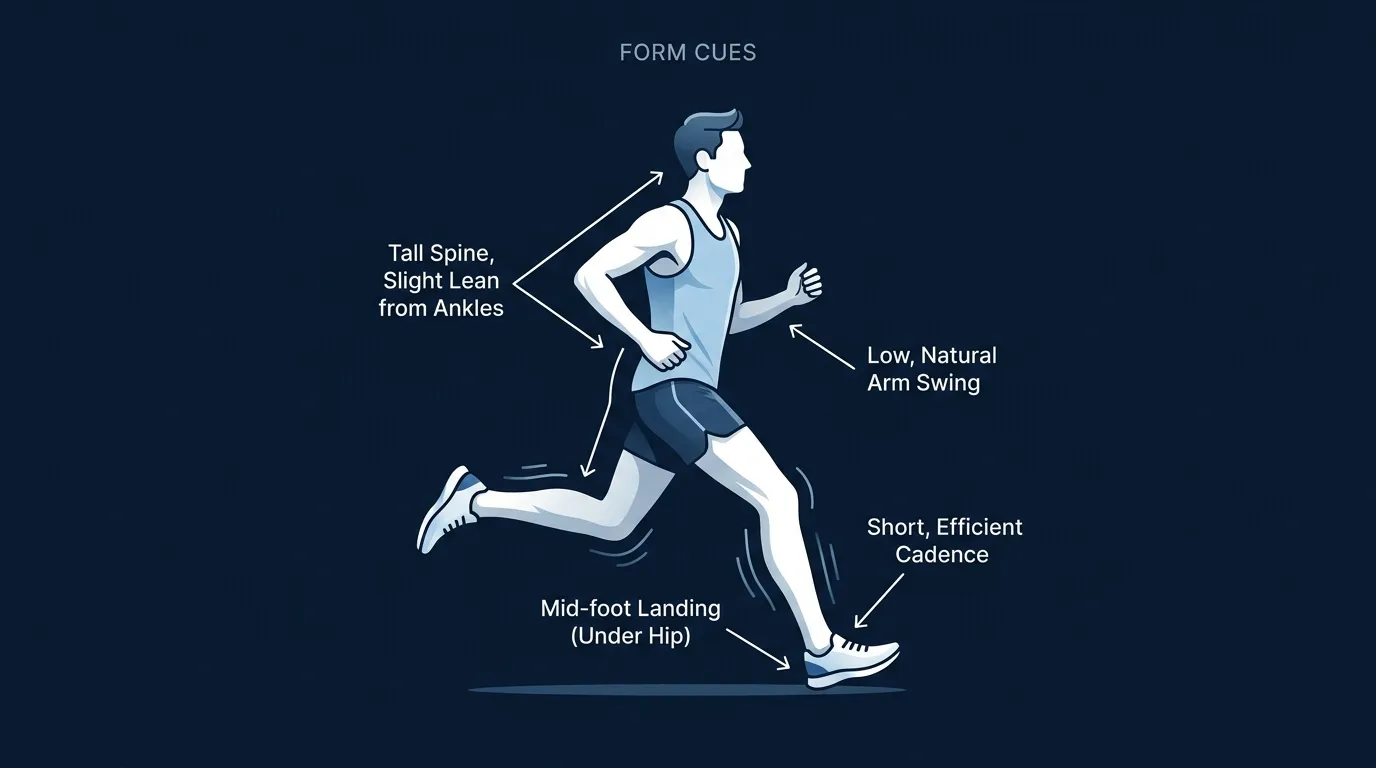
- Cadence. Aim for 170 to 180 steps per minute even at slow paces. Shorter, lighter strides reduce impact. If you're taking long, heel-first strides at a slow pace, you're overreaching. See our running cadence research write-up for the details.
- Landing. Under your hip, not out in front. A mid-foot or gentle heel strike close to your center of mass is fine. What you want to avoid is a big heel-first braking action.
- Posture. Tall and slightly forward from the ankles. Not folded at the hip. Chin level, shoulders relaxed.
- Breathing. Through the nose if you can. If you're mouth-breathing hard, you're running too fast for niko niko. Slow down.
- Shoes. Whatever you already wear for walking, if they fit. Cushion helps for the first weeks. Neutral shoes are fine for most people.
Frequency and rest. Two to three sessions per week is the mortality sweet spot from Schnohr (2015). More is fine if you love it, but the returns flatten. Give at least one full rest day between sessions in the first month while your tendons and bones adapt to the impact.
Common Misconceptions
"Slow Jogging Is Slower Than Walking, So What's the Point?"
Slow jogging is often at the same speed as brisk walking, but the metabolic cost is meaningfully higher because you're airborne on each stride. Williams and Thompson (2013) documented this directly: matched on time, running produces larger risk-factor reductions than walking. The point isn't the ground speed. It's the energy expenditure per minute, and the ability to fit real cardio into a 20-to-30-minute window without pushing intensity high enough to feel awful.
"Running Ruins Your Knees"
In healthy adults, the evidence points the other way. Chakravarty (2008) tracked aging runners for 21 years and found no excess osteoarthritis, and lower disability rates, versus non-runner controls. Moderate impact loading appears to remodel joint tissues protectively. The population where jogging is a bad first-line recommendation is small: existing symptomatic knee arthritis, prior knee surgery with poor outcomes, or specific gait pathologies. If you don't fall into those buckets, jogging isn't your knee's enemy. Being sedentary might be.
"You Have to Run at Least 30 Minutes to Get Any Benefit"
Wrong, and this is the most useful thing the last decade of running research has established. Lee (2014) and Pedisić (2020) both show that mortality benefits kick in at very small doses. Five to ten minutes of slow jogging per day, or a couple of 20-minute sessions per week, captures most of the pooled benefit. The idea that you need an hour to make it "count" is a cultural holdover from marathon-era training programs, not a scientific finding.
"Fast Running Is Better Than Slow Jogging"
Not for general health, and possibly worse. Schnohr (2015) found that light and moderate joggers had significantly lower mortality than strenuous joggers, whose risk approached that of sedentary controls in the pooled analysis. That doesn't make fast running unsafe. It means the marginal health return on going faster is small (or negative at extreme volumes), while the injury and recovery costs go up. If your goal is racing, train fast. If your goal is living longer with less pain, slow is the target.
What the Research Suggests Going Forward
The slow-jogging literature is unusually consistent for an exercise-science topic. Five large cohorts, spanning three continents and covering more than 300,000 people, all converge on the same picture. Small weekly doses of low-intensity running produce large all-cause and cardiovascular mortality reductions. The dose-response curve flattens quickly. Impact loading, at moderate volumes and reasonable technique, doesn't damage joints in healthy adults. And the physiological cost of a jog at the same speed as a walk is meaningfully higher, so per unit time, slow jogging beats walking on almost every cardiometabolic endpoint.
The honest limits. Self-selection is a real confounder in every cohort study of runners. Runners are, on average, leaner, less likely to smoke, and more affluent than non-runners. The mortality analyses adjust for these, but residual confounding is possible. Long-term randomized trials of jogging are logistically hard and don't exist at the population level. The U-shape in Schnohr (2015) has been criticized on statistical-power grounds, so the "strenuous jogging is as bad as sedentary" claim should be held loosely; the low-end result (small doses of slow jogging drop mortality substantially) is on much firmer ground.
Practical takeaway. If you already walk daily, adding 60 to 145 minutes per week of slow jogging (Schnohr's sweet spot) is one of the highest-yield movement changes in the exercise-science literature. If you don't currently do any cardio, a jog-walk progression starting at 1 minute on, 2 minutes off is a safe on-ramp. If you have joint issues, cardiovascular disease, or you're substantially overweight, talk to a physician before starting. And when in doubt, run at the pace where you can smile. That's the whole method.
References
- Schnohr P, O'Keefe JH, Marott JL, Lange P, Jensen GB. "Dose of jogging and long-term mortality: the Copenhagen City Heart Study." Journal of the American College of Cardiology. 2015;65(5):411-419. doi:10.1016/j.jacc.2014.11.023 · PubMed: 25660917
- Lee DC, Pate RR, Lavie CJ, Sui X, Church TS, Blair SN. "Leisure-time running reduces all-cause and cardiovascular mortality risk." Journal of the American College of Cardiology. 2014;64(5):472-481. doi:10.1016/j.jacc.2014.04.058 · PubMed: 25082581
- Chakravarty EF, Hubert HB, Lingala VB, Fries JF. "Reduced disability and mortality among aging runners: a 21-year longitudinal study." Archives of Internal Medicine. 2008;168(15):1638-1646. doi:10.1001/archinte.168.15.1638 · PubMed: 18695077
- Pedisić Ž, Shrestha N, Kovalchik S, Stamatakis E, Liangruenrom N, Grgic J, Titze S, Biddle SJH, Bauman AE, Oja P. "Is running associated with a lower risk of all-cause, cardiovascular and cancer mortality, and is the more the better? A systematic review and meta-analysis." British Journal of Sports Medicine. 2020;54(15):898-905. doi:10.1136/bjsports-2018-100493 · PubMed: 31685526
- Williams PT, Thompson PD. "Walking versus running for hypertension, cholesterol, and diabetes mellitus risk reduction." Arteriosclerosis, Thrombosis, and Vascular Biology. 2013;33(5):1085-1091. doi:10.1161/ATVBAHA.112.300878 · PubMed: 23559628
Frequently Asked Questions
What is slow jogging?
Slow jogging is running at a pace slow enough that you can hold a conversation, or even a smile, without breathing hard. The Japanese sports physiologist Hiroaki Tanaka at Fukuoka University popularized it as the niko niko pace (niko niko means "smile" in Japanese), typically around 4 to 6 km/h. That pace lands roughly between brisk walking and easy running. The point isn't to be fast. The point is to hit a low, sustainable intensity that most people can maintain for 30 to 60 minutes without the joint impact or breathlessness of harder running.
Is slow jogging better than walking for longevity?
Yes, for most people, at the same time investment. Lee et al. (2014) in the Journal of the American College of Cardiology followed 55,137 adults for a mean of 15 years and found that runners had a 30 percent lower risk of all-cause mortality and 45 percent lower risk of cardiovascular mortality than non-runners. Runners lived on average 3 years longer. The dose-response curve flattened quickly: even 5 to 10 minutes of daily running at slow speeds under 6 mph gave most of the mortality benefit. Walking works too, but you generally need to walk longer to get an equivalent effect.
How much slow jogging is enough?
Schnohr et al. (2015) in the Copenhagen City Heart Study found the lowest mortality in people who jogged 1 to 2.4 hours per week, spread across 2 to 3 sessions, at a slow to average pace. That is roughly 60 to 145 minutes per week. More was not clearly better in that cohort, and strenuous joggers who ran much higher volumes at faster paces lost some of the mortality advantage. Pedisić et al. (2020), meta-analyzing 14 studies across 232,149 participants, found meaningful mortality reductions kick in at very low doses of running and don't require large weekly volumes.
Does slow jogging damage the knees?
In healthy adults, no, and probably the opposite. Chakravarty et al. (2008) in Archives of Internal Medicine tracked 538 aging runners and 423 non-runner controls for 21 years and found that runners had lower rates of disability, lower rates of osteoarthritis-related complications, and 39 percent lower all-cause mortality. Impact loading appears to remodel cartilage and bone in ways that protect joints when the dose is moderate and the technique is reasonable. That said, if you already have knee osteoarthritis, meniscus damage, prior surgery, or a fresh injury, get medical guidance before starting a jogging program.
Is slow jogging better than fast running?
For all-cause mortality and long-term health, slow jogging appears at least as good as faster running, and possibly better. Schnohr et al. (2015) reported that light and moderate joggers had significantly lower mortality than strenuous joggers, whose risk approached that of sedentary controls in the pooled data. That doesn't mean fast running is harmful for everyone. It means the health return on jogging appears to plateau at modest doses and pace, and pushing higher intensities has more downside risk (injuries, hormonal stress) than upside for general health. If your goal is racing, fast is required. If your goal is living longer, slow is enough.