
Incline walking has had a long second act. The 12-3-30 (12% incline, 3 mph, 30 minutes) went viral around 2020 and has stayed in heavy rotation on every fitness feed since. Hill-walking-as-longevity has its own micro-genre. And under-desk walking pads, treadmill gyms, and incline-only training rooms have turned a once-niche modality into the default cardio for a lot of people.
The marketing pitch is suspiciously clean. You walk on a tilt. You burn more calories. You build glutes and hamstrings without lifting weights. Your knees thank you. Pick any three and the thing has to be too good to be true.
The published research, taken together, is more interesting than that. Some of the claims are flatly true. Some are partially true with important caveats. And one widely-shared assumption (that incline walking is worse for the knees) appears to be backward. Here is what five controlled studies actually say.
The Research: What Studies Show
Wong et al. (2025): The 12-3-30 Under Indirect Calorimetry
The viral 12-3-30 protocol finally got a controlled metabolic test. Michael Wong and colleagues at UNLV enrolled 16 regularly active adults (7 female, 9 male, mean age 25.3), and 14 completed both sessions and ran them through two crossover sessions: the full 12-3-30 protocol and a self-paced treadmill run, with sessions matched for total energy expenditure. Gas exchange was measured by indirect calorimetry throughout.
The headline number: 307.58 (SD 58.73) kcal across the 30-minute incline session, averaging 10.23 kcal per minute. The matched-energy running condition came in at 309.74 kcal but in just 23.89 minutes, averaging 13.08 kcal per minute. So running burns calories faster per minute. But if you compare equal time blocks, the 12-3-30 holds its own at lower impact stress. To price the same 12 percent, 3 mph, 30 minute session at your own body weight, run it through our calories burned calculator, which adds grade using the ACSM vertical term rather than a grade-banded average.
The more interesting finding was the fuel mix. The 12-3-30 condition averaged 40.56% fat oxidation versus 33.12% during running (p = 0.00079, a clean and statistically robust difference). Both bouts ran below the lactate threshold, but the lower absolute intensity of the incline walk kept participants in a fuller fat-burning zone for longer. For people optimizing for fat oxidation rate specifically, the incline condition has a measurable edge. For people optimizing for total calorie burn per unit time, running wins.
Citation: Wong MWH, Davis DW, Perez OR, et al. An Exploratory Study Comparing the Metabolic Responses between the 12-3-30 Treadmill Workout and Self-Paced Treadmill Running. Int J Exerc Sci. 2025;18(6):56-64.
Minetti et al. (2002): The Foundational Energy-Cost Curve
Long before 12-3-30 had a name, Alberto Minetti and colleagues mapped the full energy-cost-versus-gradient curve. They tested 10 trained adults on treadmills set between -45% and +45%, measuring oxygen consumption at multiple speeds within each grade.
The level walking cost was 1.64 J/kg/m (the joules of metabolic energy needed to move a kilogram of body mass one meter). At a 12% grade, that cost roughly doubles to triples. At a 30% grade it quintuples. At the extreme 45% grade it reaches 17.33 J/kg/m, more than tenfold the level value. Running on the same grades produced a parallel but flatter curve, because running's level cost (3.40 J/kg/m) is already higher.
The practical takeaway is that grade is one of the strongest single levers on energy cost in any human-locomotion equation. Doubling your speed roughly doubles power. Going from a 0% to a 12% grade at the same walking speed produces a similar effect, without the impact loading that comes from moving faster. This is the physiology behind every "walk slower but tilt the deck" recommendation that has shown up since. If you want that lever turned into actual sessions, our treadmill walking workout guide puts speed, grade and duration into 20, 30 and 45 minute plans.
Citation: Minetti AE, Moia C, Roi GS, Susta D, Ferretti G. Energy cost of walking and running at extreme uphill and downhill slopes. J Appl Physiol. 2002;93(3):1039-1046.
Himmelreich, Vogt, and Banzer (2008): The Gluteus Maximus Bump
Does incline really work the glutes more, or is that gym folklore? Helmut Himmelreich and colleagues at Goethe University Frankfurt put 20 healthy adults (and 12 with chronic low back pain, for a separate analysis) through level walking, 10% incline walking, and stair climbing, with surface EMG recording gluteus maximus activity throughout (Himmelreich, Vogt, & Banzer, 2008).
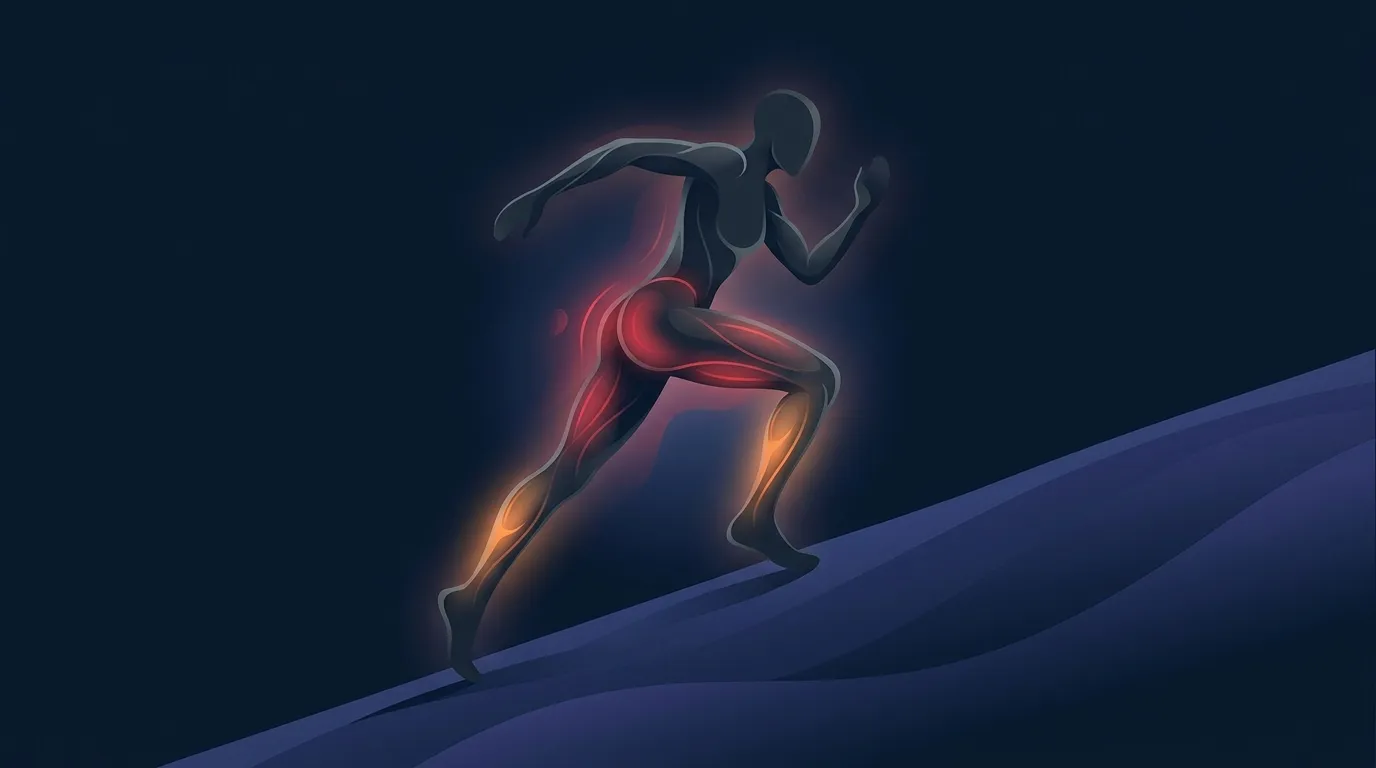
In healthy subjects, the 10% incline condition produced roughly a 25% increase in gluteus maximus activity compared to level walking. Stair ascent doubled that effect, with about 50% more activity than level. The chronic low back pain group showed similar relative increases, although their absolute activation was lower at baseline.
The "glute-builder" framing of incline walking is well-supported. The 25% per-step bump is not enormous, but it accumulates across thousands of steps. Over a 30-minute session at 100 steps per minute, that is 3,000 strides at 25% higher gluteal load than a flat walk would produce. Not a strength session, but a credible volume contribution to the posterior chain.
Citation: Himmelreich H, Vogt L, Banzer W. Gluteal muscle recruitment during level, incline and stair ambulation in healthy subjects and chronic low back pain patients. J Back Musculoskelet Rehabil. 2008;21(3):193-199.
Wall-Scheffler et al. (2010): The Full Posterior Chain Picture
Wall-Scheffler and colleagues ran a broader EMG study across 34 adults at four grades (0%, 10%, 15%, 20%) and three walking speeds, recording from seven lower-limb muscle groups simultaneously. The grade effect was highly significant (p less than 0.001) across every muscle they measured.
The hip adductors, gluteus maximus, and hamstrings showed the largest jumps. The quadriceps and gastrocnemius also climbed. Steeper inclines did not just recruit more muscle, they extended activation duration across the gait cycle. The posterior chain dominance is the consistent finding: incline walking is a hip-extension-heavy task in a way that level walking simply is not.
This is part of why incline walking transfers well to people training for hiking, trail running, and sport activities where uphill capacity matters. The muscles that drive uphill propulsion (gluteus maximus, hamstrings, calves) are exactly the ones the EMG data show getting taxed. If a low-impact machine is the alternative you are weighing, our guide to elliptical vs treadmill training covers how the two compare on joint loading and on carryover to walking outdoors.
Citation: Wall-Scheffler CM, Chumanov E, Steudel-Numbers K, Heiderscheit B. EMG activity across gait and incline: The impact of muscular activity on human morphology. Am J Phys Anthropol. 2010;143(4):601-611.
Higgins et al. (2025): The Knee Surprise
The intuition is that walking uphill must be harder on the knees, because it is harder, period. Seth Higgins and colleagues at Ball State tested that assumption directly. They put 12 healthy older men on treadmills at 0%, 5%, 10%, 15%, and 20% grades at a controlled 1.34 m/s and measured the full lower-extremity kinetic profile, including peak knee abduction moment, the standard lab proxy for medial knee compartment load.
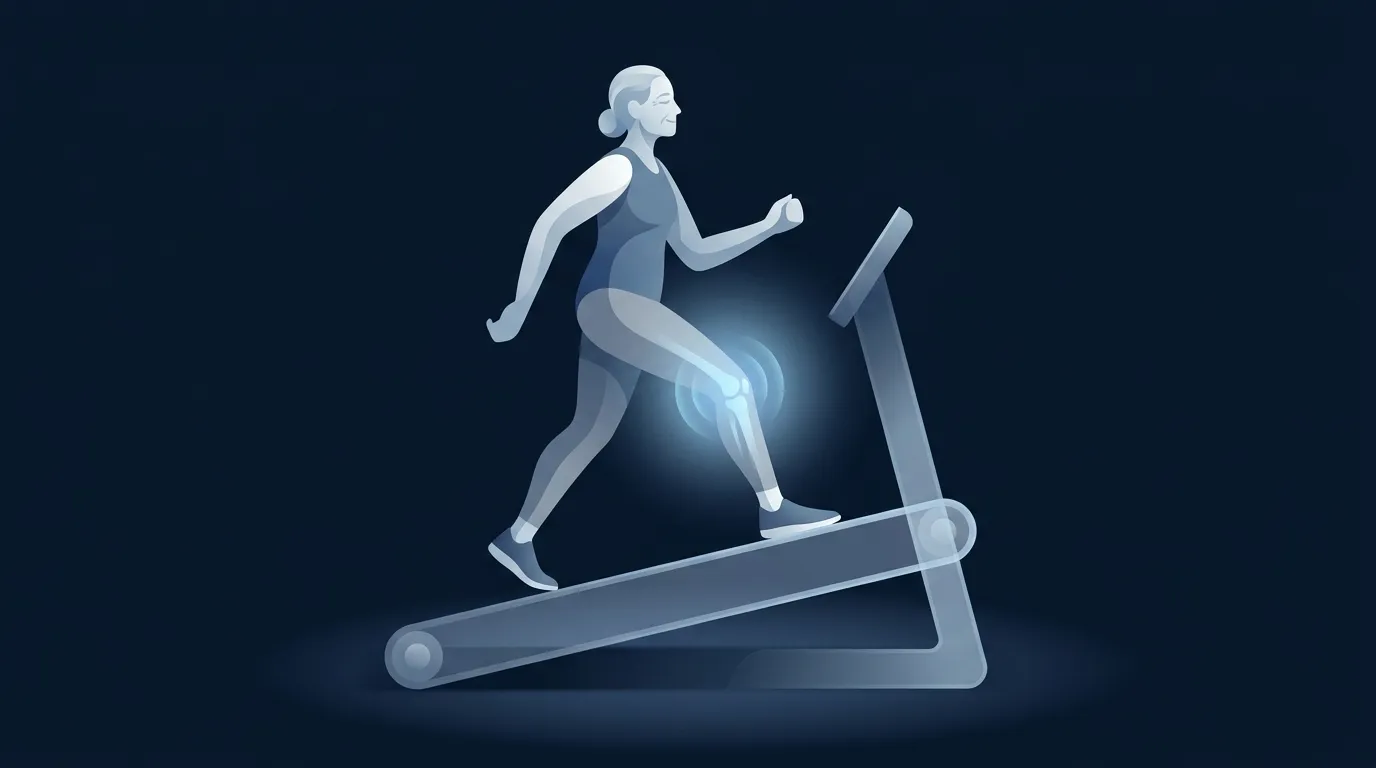
The peak knee abduction moment dropped significantly at every 10-point grade comparison (0% to 10%: p less than 0.001; 5% to 15%: p less than 0.002; 10% to 20%: p = 0.04). The medial compartment, which is the part of the knee most commonly affected by osteoarthritis, was loaded less during the inclined conditions than during the level walk.
The mechanism is partly geometric. Walking uphill shifts the body's vertical work pattern and changes how ground reaction forces line up with the knee joint center. Total joint demand is higher (the knee extensor moment goes up, the quads work harder), but the side-to-side compressive load on the medial compartment goes down. For older adults with early knee osteoarthritis, this is a potentially useful finding. Incline walking may be a way to keep training without aggravating the most commonly degenerating part of the knee.
Citation: Higgins S, Dickin DC, Hankemeier D, Wells MD, Wang H. The effect of incline walking on lower extremity and trunk mechanics in older adults. Sports Med Health Sci. 2025;7(1):56-60.
| Study | What it measured | Key finding |
|---|---|---|
| Wong et al. 2025 | 12-3-30 energy cost and fuel mix | 307.58 kcal in 30 min; 40.56% fat as fuel vs 33.12% for running |
| Minetti et al. 2002 | Energy cost vs grade | Cost rises from 1.64 J/kg/m level to 17.33 at a 45% grade (10x+) |
| Himmelreich et al. 2008 | Gluteus maximus EMG | About 25% more glute activity at a 10% incline vs level |
| Wall-Scheffler et al. 2010 | Full lower-limb EMG | Grade significantly raised glutes, hamstrings, and adductors (p<0.001) |
| Higgins et al. 2025 | Knee biomechanics in older men | Peak knee abduction moment dropped at every 10-point grade increase |
Why This Matters for Your Fitness
Incline walking sits in a specific niche. It is not a substitute for structured resistance training. It is not a substitute for higher-intensity intervals if you are chasing VO2 max. But it does sit at an unusually favorable intersection of properties: high energy cost per minute, high fat oxidation share, real posterior-chain recruitment, low impact, and a possible knee-offloading effect.
For people who cannot run because of joint pain, injury history, or current body weight, incline walking buys back most of running's metabolic benefit without the eccentric impact loading that aggravates knees and hips. The Wong 2025 data is the cleanest demonstration of this so far. Matched for total energy, a 30-minute 12-3-30 block does the same work as a 24-minute run, with the bonus of higher fat oxidation and zero impact peaks.
For people who can run but want a recovery-day modality, incline walking offers a way to get aerobic volume without compounding the orthopedic load. Zone 2 cardio, which sits at roughly 60-70% of max heart rate, is exactly the intensity band that a brisk incline walk lands in. The walking speed and longevity literature argues that the upper end of that band is where the mortality signal lives, and incline walking pushes a normal walking pace into that zone without making you sprint.
For older adults, the Higgins knee data is the most underappreciated finding in the set. The popular intuition that hills are bad for arthritic knees is partly backward. Total joint demand rises, but the type of load shifts away from the compartment that usually degenerates. If you have early knee OA and a doctor's clearance, the data argues that a moderate incline (10% to 15%) at a comfortable speed may be friendlier to the medial knee than the same time spent on a flat treadmill.
Does Walking Build Glutes, and Does Incline Walking Build Glutes?
These are the two questions people actually bring to a treadmill, and they have different answers. Walking maintains the glutes. Incline walking loads them considerably harder per step. Neither one grows them, and the reason why is worth understanding, because it also explains what incline walking is genuinely good for. If you want incline sessions programmed next to strength work, the best workout apps for weight loss roundup ranks the options.
Start with where level walking sits on the scale. Bartlett, Sumner, Ellis, and Kram (2014) did something the earlier EMG work had not: they recorded gluteal activity during walking, running, sprinting, and climbing in the same subjects, so the amplitudes could be compared directly instead of across separate studies. Gluteus maximus activity during running was greater than walking and similar to climbing. Sprinting was much greater than running. Their conclusion was that the unusually large human gluteus maximus reflects a role in rapid and powerful movement rather than an adaptation for a single submaximal task like endurance walking or running.
Read that ranking as a ladder and level walking is the bottom rung. It is close to the least gluteally demanding thing a human leg does under load. So the honest answer to "does walking build glutes" is that for anyone already walking daily, it maintains what you have and builds very little. For someone coming off bed rest, a long illness, or a genuinely sedentary year, walking sits above their current training threshold and will produce some change, which is where the anecdotes come from. For the whole leg rather than the glutes alone, our breakdown of whether walking tones your legs covers the interval and long-term walking trials that measured thigh strength and muscle thickness.
What incline adds, and where it stops
Incline moves you up that ladder without changing anything else about the movement. The Himmelreich 2008 EMG data above puts the gluteus maximus increase at roughly 25% at a 10% grade, with stair ascent about double that. Wall-Scheffler et al. (2010) found grade was a highly significant driver across the whole posterior chain, and that steeper grades also stretched out how much of the gait cycle each muscle stayed active for. So "does incline walking build glutes" earns a better answer than the flat version: more force per step, more time under load per step, thousands of steps per session.
What it still does not do is meet the condition that drives growth. The largest meta-analysis on training load and hypertrophy pooled trials of light versus heavy lifting and found muscle growth was similar across a wide spectrum of loads, with maximal strength still favouring heavy work. The loads in those trials came with one requirement attached: every set was taken to momentary muscular failure (Schoenfeld et al., 2017). That requirement is the gate incline walking never passes. A walking stride, at any grade, comes nowhere near momentary failure of the gluteus maximus. You end an incline session because you're out of breath, out of time, or because your calves are complaining, not because your glutes cannot produce one more contraction. Light loads can build muscle. Light loads you never take anywhere near failure cannot.
How to get the most glute work out of a hill
- Let go of the handrails. Holding on offloads part of your body weight and lets you pull yourself forward from the arms instead of extending from the hip. It's the single biggest thing separating a 12% incline that trains the glutes from a 12% incline that does not.
- Go steeper and slower rather than flatter and faster. Grade is the variable the EMG studies found significant across every muscle they measured. Speed mostly buys you calories and impact.
- Take a longer step and finish it. Short choppy steps keep the work at the quad and the calf. Driving the trailing leg all the way through is what the hip extensors are for.
- Treat it as volume, not as a session. The gluteal contribution here is cumulative across thousands of strides, which is why 30 minutes counts for something and 5 minutes counts for very little.
If growth is the actual goal, the fix is not a steeper treadmill. It's hip extension loaded heavily enough that a set can be taken close to failure, which makes it a resistance session rather than a cardio one. Our guide to glute activation exercises covers how to sequence that work, and the glute bridge page has the mechanics. Incline walking is the aerobic and maintenance leg of that plan, and it is very good at that job.
How should you use incline walking?
Match the incline to your goal: 12% at 3 mph for a hard 30-minute session, 5 to 8% for an easy daily walk, or 10 to 15% at a slower pace to offload the knees. Build up gradually rather than starting at the steepest grade. Here is how the main protocols break down.
- The 12-3-30 (12% incline, 3 mph, 30 minutes). This is the validated protocol from Wong et al. (2025). Expect roughly 300 to 350 kcal of energy expenditure, with about 40% from fat. Use it as your daily aerobic session or two to three times per week alongside other training. It is harder than it sounds the first few sessions, especially the last 10 minutes.
- A moderate-incline daily walk (5% to 8% incline, 3.0 to 3.5 mph, 30 to 45 minutes). Lower demand, easier to do every day. Captures most of the posterior-chain and fat-oxidation benefits without the breathing intensity of 12%. Good for habit-building, recovery days, or people new to incline work.
- Knee-friendly incline (10% to 15% incline, 2.5 to 3.0 mph, 20 to 30 minutes). The Higgins 2025 data argues this range offloads the medial knee compartment compared to flat walking at the same speed. For people with early knee OA, this can replace flat walking on most days. Get clearance from a clinician if you have a diagnosed joint condition.
- Outdoor hill walking. The research generalizes. Streets and trails with sustained grades produce similar metabolic and muscular demands. The benefit of outdoor hills is that downhills tax the quads eccentrically, which is its own trainable adaptation. Treadmills do not replicate this because the belt does the eccentric work for you.
- Wear shoes that fit. The combination of incline plus duration is hard on the forefoot and toes. Shoes with a roomy toe box matter more than they do at flat walking. Foot, shin, and lower-back complaints in incline-heavy programs cluster around shoe issues.
Build up gradually. If you have never sustained 12% incline at 3 mph for 30 minutes, do not attempt it cold. Start at 6% for 20 minutes, add 1 to 2 percentage points per week, and stretch the calves and hip flexors afterward. The first few sessions at full 12-3-30 will leave the calves and glutes sore in a way that flat walking does not. For a week-by-week ramp, the handrail data and who should modify the routine, see our 12-3-30 workout guide.
Get an evidence-based plan built for you
FitCraft, our mobile fitness app, pairs you with an AI coach who builds you a personalized plan around your goals, schedule, and fitness level. Every FitCraft program is designed by Domenic Angelino, MPH (Brown University) and NSCA-CSCS, with research published in the Journal of Strength and Conditioning Research and Medicine & Science in Sports & Exercise.
Take the Free Assessment Free • 2 minutes • No credit cardCommon Misconceptions
Misconception: "Incline walking burns more calories than running"
Per minute, no. Wong et al. (2025) measured 13.08 kcal/min during self-paced running versus 10.23 kcal/min during 12-3-30. Running has a higher per-minute calorie burn at the speeds most active adults use. What incline walking offers is comparable total energy in a slightly longer block, with higher fat oxidation share and far less impact. If you have 30 minutes and joints that do not love running, 12-3-30 is the better trade. If you have 24 minutes and your knees are fine, running wins on pure efficiency.
Misconception: "Incline walking is bad for your knees"
The peer-reviewed biomechanics data do not support this and may argue the opposite. Higgins et al. (2025) found that peak knee abduction moment, the lab measure most strongly linked to medial knee compartment loading and osteoarthritis progression, dropped significantly at every 10-point grade increase compared to level walking. Total work goes up; the specific load on the part of the knee that usually degenerates goes down. This does not mean every knee problem is helped by hills (patellofemoral pain often gets worse on inclines, for example), but the "hills hurt knees" intuition does not survive the data for medial compartment OA.
Misconception: "12-3-30 will build big glutes"
It contributes meaningfully but it will not replace resistance training for growth. The Himmelreich 2008 EMG data put the gluteus maximus jump at about 25% at a 10% incline versus level walking. That is real volume, especially across thousands of strides per session, and it helps maintain glute mass and function. But hypertrophy requires loads close enough to failure to drive the mechanical tension stimulus, which slow incline walking does not provide. Use incline walking as the aerobic-and-maintenance leg of a program. Use loaded hip extension work (glute bridges, hip thrusts, weighted step-ups) to actually grow the muscle. The light weights and hypertrophy research outlines where the resistance threshold sits.
What the Research Suggests Going Forward
The incline walking literature is in a healthier state than most fitness-trend research. The 12-3-30 protocol now has direct controlled data behind it from Wong 2025. The energy cost curve has been mapped for two decades by Minetti and others. The muscle activation data from Himmelreich and Wall-Scheffler are independent and converge. And the Higgins knee data, while small (N=12), is mechanistically clean and consistent with prior biomechanics work on uphill gait.
What is still missing is long-term outcome data. We do not yet have multi-year randomized trials comparing flat walking, incline walking, and running on cardiometabolic markers, weight maintenance, or longevity. Most existing trials run for 4 to 12 weeks and look at acute or subacute outcomes. The available evidence strongly suggests incline walking should produce health gains in the same family as brisk flat walking or jogging, but the dose-response curve over years has not been formally tested.
For now, the honest summary is that incline walking is a high-value, low-impact aerobic modality with credible evidence for energy expenditure, fat oxidation share, posterior-chain recruitment, and knee compartment offloading. The case for adding it to a weekly schedule is strong. The case for replacing all other cardio with it is weaker. As with most things in fitness, the right answer is "and" rather than "or".
Honest Limitations
A few caveats worth flagging. The Wong 2025 study had only 14 completers, all young (mean age 25) and regularly active. Results may not transfer cleanly to older adults, deconditioned individuals, or people with substantial body fat to lose. The fat oxidation finding, though statistically robust in this sample, has not yet been replicated in a larger cohort.
The Higgins knee data used 12 healthy older men. Whether the medial knee offloading effect generalizes to women, to adults with diagnosed knee osteoarthritis, or to patellofemoral pain (where the patella-on-femur load may rise with incline) is unclear. The biomechanics argues for transfer, but the specific population needs more testing.
The EMG studies are short acute measurements. They tell us what muscles work during incline walking. They do not tell us whether that activation translates to hypertrophy over weeks of training (the answer is probably "no, not at walking loads", but maintenance and endurance adaptations are plausible).
Finally, all the controlled studies used treadmills with calibrated grades. Outdoor hills are messier. Steep urban streets, trails with variable terrain, and stair-and-incline mixes will produce broadly similar physiology but the specific numbers will vary. The treadmill data is a clean experimental signal, not a precise outdoor predictor.
References
- Wong MWH, Davis DW, Perez OR, Weyers B, Green DM, Garcia AV, Navalta JW. "An Exploratory Study Comparing the Metabolic Responses between the 12-3-30 Treadmill Workout and Self-Paced Treadmill Running." International Journal of Exercise Science 18.6 (2025): 56-64. doi:10.70252/UBIX5911
- Minetti AE, Moia C, Roi GS, Susta D, Ferretti G. "Energy cost of walking and running at extreme uphill and downhill slopes." Journal of Applied Physiology 93.3 (2002): 1039-1046. doi:10.1152/japplphysiol.01177.2001
- Himmelreich H, Vogt L, Banzer W. "Gluteal muscle recruitment during level, incline and stair ambulation in healthy subjects and chronic low back pain patients." Journal of Back and Musculoskeletal Rehabilitation 21.3 (2008): 193-199. doi:10.3233/BMR-2008-21307
- Wall-Scheffler CM, Chumanov E, Steudel-Numbers K, Heiderscheit B. "EMG activity across gait and incline: The impact of muscular activity on human morphology." American Journal of Physical Anthropology 143.4 (2010): 601-611. doi:10.1002/ajpa.21356
- Higgins S, Dickin DC, Hankemeier D, Wells MD, Wang H. "The effect of incline walking on lower extremity and trunk mechanics in older adults." Sports Medicine and Health Science 7.1 (2025): 56-60. doi:10.1016/j.smhs.2024.03.010
- Bartlett JL, Sumner B, Ellis RG, Kram R. "Activity and functions of the human gluteal muscles in walking, running, sprinting, and climbing." American Journal of Physical Anthropology 153.1 (2014): 124-131. doi:10.1002/ajpa.22419
- Schoenfeld BJ, Grgic J, Ogborn D, Krieger JW. "Strength and Hypertrophy Adaptations Between Low- vs. High-Load Resistance Training: A Systematic Review and Meta-analysis." Journal of Strength and Conditioning Research 31.12 (2017): 3508-3523. doi:10.1519/JSC.0000000000002200
Frequently Asked Questions
How many calories does the 12-3-30 incline walk burn?
A 2025 UNLV study (Wong et al.) measured energy expenditure during the 12-3-30 treadmill workout in 14 regularly active adults. Participants burned 307.58 (SD 58.73) kcal across the 30-minute session, averaging about 10.23 kcal per minute. Self-paced running over the same energy total took 23.89 minutes, so running burns calories faster per minute, but incline walking matches the total in a flat-out 30-minute block.
Does incline walking really work the glutes more?
Yes, measurably. Himmelreich, Vogt, and Banzer (2008) used surface EMG on 20 healthy adults and found that walking at a 10% incline produced roughly a 25% increase in gluteus maximus activity compared to level walking. Wall-Scheffler et al. (2010) tested 34 adults across 0%, 10%, 15%, and 20% grades and found incline was a highly significant driver of activation in the gluteus maximus, hip adductors, and hamstrings (p less than 0.001). The steeper the grade, the more the posterior chain works.
Is incline walking bad for your knees?
Counter to what most people assume, the biomechanics data say no, and possibly the opposite. Higgins et al. (2025) put 12 healthy older men on treadmills at 0%, 5%, 10%, 15%, and 20% grades and measured peak knee abduction moment, the lab proxy for inner-knee compartment loading. That moment dropped significantly at every 10-percentage-point grade increase compared to level walking. The interpretation: incline walking shifts load away from the medial knee compartment, which makes it a potential offloading option for people with medial knee osteoarthritis. Total joint demand still goes up, but the type of load changes.
How much harder is incline walking than flat walking?
A lot. Minetti et al. (2002) measured the energy cost of walking on treadmill grades from -45% to +45% in 10 trained adults. The cost at a level surface was 1.64 J/kg/m. At a 45% (extremely steep) grade it climbed to 17.33 J/kg/m, more than a tenfold increase. At a more typical 12% grade, the cost roughly doubles to triples flat walking, which is why incline walking can produce running-level metabolic demand at walking speed.
Is incline walking better than running for weight loss?
Not for calorie burn rate, but possibly for fat oxidation. Wong et al. (2025) found running burned roughly 13.08 kcal/min versus 10.23 kcal/min during 12-3-30, so running has the per-minute edge. But the 12-3-30 condition used 40.56% fat as fuel compared to 33.12% during self-paced running (p = 0.00079). For people who cannot run because of joint pain, injury, or low fitness, incline walking matches running's total energy output in a slightly longer block at much lower impact.
What incline should I use on the treadmill?
Depends on your goal. For general aerobic fitness, 3% to 6% adds meaningful work without the joint demand spike of higher grades. For the viral 12-3-30 protocol, 12% at 3 mph for 30 minutes is the original prescription and matches the UNLV study conditions. For knee offloading in older adults, the Higgins 2025 data shows benefits at 10% and steeper. Start at 3% to 5% if you are new to incline work and build up over several weeks. Sustained 12% incline at 3 mph is harder than it sounds the first few times.
Does walking build glutes?
It maintains them far more than it builds them. Bartlett et al. (2014) recorded gluteal EMG during walking, running, sprinting, and climbing in the same subjects, so the amplitudes could be compared directly, and found walking at the bottom of the range, running higher and similar to climbing, and sprinting far above both. Their conclusion was that the large human gluteus maximus reflects a role in rapid and powerful movement rather than an adaptation for submaximal endurance tasks. For anyone already walking daily, level walking holds the muscle you have rather than adding to it. For someone coming off bed rest or a long sedentary stretch it sits above their current threshold and can produce some change.
Does incline walking build glutes?
It works them considerably harder than flat walking and still will not grow them much. Himmelreich et al. (2008) measured roughly 25% more gluteus maximus activity at a 10% incline than on the level, and Wall-Scheffler et al. (2010) found grade was a highly significant driver across the glutes, hamstrings, and hip adductors. That is real volume across thousands of strides and it maintains glute mass and endurance well. What it misses is the requirement running through the hypertrophy literature that sets be taken near momentary muscular failure, which a walking stride never approaches at any grade. If the glutes are the goal, let go of the handrails and go steeper rather than faster.
Does FitCraft include incline walking workouts?
FitCraft programs include cardio sessions across modalities including walking, cycling, and bodyweight conditioning. The free FitCraft assessment builds a personalized program around your schedule, fitness level, and goals, pairing you with an AI coach who walks you through each workout with interactive 3D exercise demos. Use the assessment to get a plan that fits your equipment (treadmill at home, gym access, outdoor only) and your goals.