A treadmill walking workout is one of the few pieces of training that survives a bad week. It doesn't need daylight, decent weather, a sports bra you can run in, or the nerve to be seen jogging around your neighbourhood. It asks for a machine and a number on a screen. That's a low enough bar that people actually clear it, which is most of why it works.
The trouble is that almost nobody programs it. They step on, punch 3.5 mph, walk until the timer runs out, and do the exact same thing eleven weeks later. Then they conclude walking doesn't do anything. The walking was never the problem. The unchanged dial was.
What follows is the dial that matters, three sessions sized to where you actually are, the heart rate numbers worth chasing, and an honest read on the viral workout that put incline walking back on everyone's feed.
Speed or Incline: Which Dial Does the Work?
Grade is the stronger lever, and it isn't close. Ludlow and Weyand (2017), writing in the Journal of Applied Physiology, measured 32 adults across 90 different walking conditions: five speeds from 0.4 to 1.6 m/s, six gradients from 6 degrees downhill to 9 degrees uphill, with and without carried loads. Their conclusion was that the rate at which people burn energy while walking varies roughly tenfold, and that three variables predict almost all of it: speed, grade, and how much mass you're carrying against gravity.
The practical version fits in a table. Below is what the American College of Sports Medicine walking equation predicts in METs, where one MET is roughly what you burn sitting still.
| Speed | 0% grade | 4% | 8% | 12% | 15% |
|---|---|---|---|---|---|
| 2.5 mph | 2.9 METs | 4.3 | 5.7 | 7.1 | 8.1 |
| 3.0 mph | 3.3 METs | 5.0 | 6.6 | 8.3 | 9.5 |
| 3.5 mph | 3.7 METs | 5.6 | 7.5 | 9.5 | 10.9 |
| 4.0 mph | 4.1 METs | 6.3 | 8.5 | 10.7 | 12.3 |
Read the rows against the columns and the asymmetry jumps out. Going from 2.5 to 4.0 mph on a flat deck, a 60 percent increase in speed, buys you 1.2 METs. Going from 0 to 12 percent at 3.0 mph buys you 5.0. The grade column is where the training lives.
Two caveats keep this honest. The ACSM equation was validated on walking speeds up to about 3.7 mph, so the 4.0 mph row is an extrapolation and should be read as a direction rather than a number. And the equation itself was built on a very small original sample, which is precisely the gap the Ludlow and Weyand dataset was assembled to fill. Treat the table as a map, not a calorie counter. For the mechanism underneath it, including the EMG data on what incline does to the glutes, see our review of the incline walking research.
The 12-3-30 Workout, Evaluated Honestly
The 12-3-30 workout is a social media routine credited to creator Lauren Giraldo: 12 percent incline, 3 mph, 30 minutes, no handrails, no variation. It went viral because it's specific, repeatable and doesn't require you to run. Those are real virtues.
It's also genuinely hard, and now there's direct data. Wong and colleagues (2025), in the International Journal of Exercise Science, had 14 adults with a mean age of 25 complete both a 12-3-30 session and a self-paced treadmill run matched for total energy expenditure. The incline walk averaged 10.23 kcal per minute over 30.08 minutes. The run averaged 13.08 kcal per minute and finished the same total in 23.89 minutes. So running is faster per minute, and 12-3-30 gets to the same place by taking longer.
The fuel mix went the other way. The 12-3-30 condition ran 40.56 percent of its energy from fat against 33.12 percent during the run, a clean difference at p = 0.00079. That's what lower absolute intensity does, and it matters less for weight change than the total does. Energy expenditure is still the number that moves the scale.
Worth noting: the ACSM prediction for 3 mph at 12 percent is 8.3 METs, which for a 70 kg adult works out to about 10.1 kcal per minute. The measured figure was 10.23. The table above is doing its job.
The honest criticism of 12-3-30 has nothing to do with whether it burns calories. It's that the workout is a fixed point. Twelve, three and thirty never change, so the session that was an 8 out of 10 in week one is a 5 out of 10 by week eight, and the stimulus quietly disappears while the routine stays. A protocol with no progression built into it is a starting line, not a program.
Find out what's really holding you back
FitCraft, our mobile fitness app, pairs you with an AI coach who builds you a personalized plan around your goals, schedule, and fitness level. Every FitCraft program is designed by Domenic Angelino, MPH (Brown University) and NSCA-CSCS, with research published in the Journal of Strength and Conditioning Research and Medicine & Science in Sports & Exercise.
Take the Free Assessment Free • 2 minutes • No credit card
Three Treadmill Walking Workouts
Pick the one that matches where you are, not where you'd like to be. Every block below assumes hands off the handrails. If you can't hold the incline without gripping, the incline is too high, and the fix is to lower it rather than to hang on.
The 20-minute starter walk
For anyone coming back from a long gap, carrying extra weight, or nervous about the deck. The goal is to finish feeling like you could have done five more minutes.
| Minutes | Speed | Incline | Effort |
|---|---|---|---|
| 0 to 4 | 2.5 mph | 0% | Warm up, easy conversation |
| 4 to 7 | 3.0 mph | 2% | RPE 4 |
| 7 to 10 | 3.0 mph | 4% | RPE 5 |
| 10 to 13 | 3.0 mph | 2% | RPE 4 |
| 13 to 16 | 3.0 mph | 5% | RPE 5 to 6 |
| 16 to 20 | 2.5 mph | 0% | Cool down |
The 30-minute incline ladder
The workhorse. Climb up, climb back down, and spend the middle third somewhere genuinely uncomfortable. This is the session to repeat three or four times a week.
| Minutes | Speed | Incline | Effort |
|---|---|---|---|
| 0 to 5 | 3.0 mph | 1% | Warm up |
| 5 to 9 | 3.0 mph | 4% | RPE 4 |
| 9 to 13 | 3.0 mph | 7% | RPE 5 |
| 13 to 17 | 3.0 mph | 10% | RPE 6 to 7 |
| 17 to 21 | 3.0 mph | 7% | RPE 5 |
| 21 to 25 | 3.0 mph | 4% | RPE 4 |
| 25 to 30 | 2.8 mph | 0% | Cool down |
The 45-minute climbing block
For people already walking four days a week who want the session to move something. The floats between climbs are not optional. They're what lets the climbs be hard.
| Minutes | Speed | Incline | Effort |
|---|---|---|---|
| 0 to 5 | 3.2 mph | 1% | Warm up |
| 5 to 12 | 3.4 mph | 6% | RPE 5 |
| 12 to 15 | 3.4 mph | 2% | Float, RPE 3 |
| 15 to 22 | 3.0 mph | 12% | RPE 7 |
| 22 to 25 | 3.4 mph | 2% | Float, RPE 3 |
| 25 to 31 | 2.8 mph | 15% | RPE 8 |
| 31 to 34 | 3.4 mph | 2% | Float, RPE 3 |
| 34 to 40 | 3.2 mph | 8% | RPE 6 |
| 40 to 45 | 2.8 mph | 0% | Cool down |
If you're doing these on a walking pad rather than a full treadmill, the incline ceiling is usually much lower and sometimes fixed at zero, which changes what the machine can do for you. We covered that trade in our walking pad research review.
Heart Rate Targets for a Walking Workout
RPE is fine and free. A chest strap is better, because walking is the one modality where people routinely think they're working harder than they are.
The 2011 ACSM position stand in Medicine & Science in Sports & Exercise puts moderate intensity at 40 to 59 percent of heart rate reserve and vigorous at 60 to 89 percent, and asks for at least 150 minutes a week of the moderate stuff. Heart rate reserve is your maximum heart rate minus your resting heart rate, and it's a better anchor than raw percent of max because it accounts for how fit you already are.
For maximum heart rate, use 208 minus 0.7 times your age rather than the old 220 minus age. Tanaka and colleagues (2001) in the Journal of the American College of Cardiology showed the classic formula systematically underestimates maximum heart rate in older adults, which quietly sets everyone over 40 a target that's too easy.
| Zone | % heart rate reserve | RPE | Talk test | Where it goes |
|---|---|---|---|---|
| Warm up and cool down | 30 to 39% | 2 to 3 | Full conversation, easy | First and last 5 minutes |
| Steady walking | 40 to 59% | 4 to 6 | Full sentences, breathing audible | Most of every session |
| Climbing blocks | 60 to 89% | 7 to 8 | Short phrases only | The 10 to 15% grades |
Worked example. A 40-year-old with a resting heart rate of 65 has an estimated maximum of 180 and a heart rate reserve of 115. Moderate lands at 111 to 133 beats per minute. The climbing blocks land at 134 to 167. If your steady walking is pushing 150, you have built a hard interval session and labelled it a walk, and you will not be able to repeat it four times a week.
A Six-Week Progression
Change one variable at a time. Most treadmill walking plans fail because people raise the speed, the incline and the duration in the same week, feel wrecked, and blame the machine.
| Week | Sessions | Length | Peak incline | Weekly minutes |
|---|---|---|---|---|
| 1 | 3 | 20 min | 4% | 60 |
| 2 | 3 | 25 min | 6% | 75 |
| 3 | 4 | 25 min | 8% | 100 |
| 4 | 4 | 30 min | 10% | 120 |
| 5 | 4 | 30 min, one 40 | 12% | 130 |
| 6 | 4 | 30 min, one 45 | 12 to 15% | 150 |
Week 6 lands on the 150-minute guideline, which is not an accident. From there you have two roads: hold 150 minutes and push the incline, or hold the incline and add a fifth session. Do not do both in the same month. And if a week feels flat, repeat it rather than advancing. Nothing about walking rewards a week that sends you to a physio.
Distance is the other way to frame the same progression, and some people track it better that way. Our guide on how many miles you should walk a day works the same question from the mileage side.
Form and Safety on a Tilted Deck
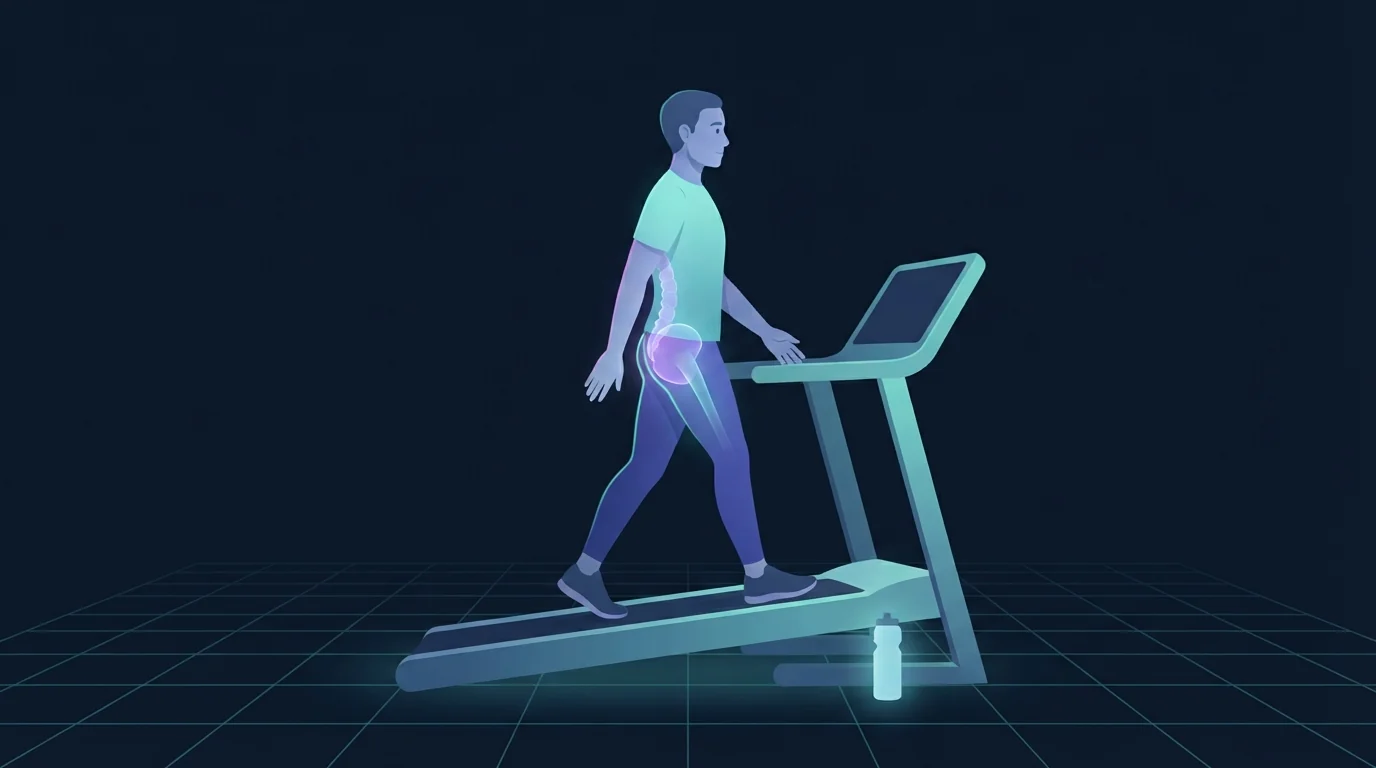
Hands off, or at most resting. This is the one that eats entire training blocks. Hofmann and colleagues (2014) put 13 healthy adults through four conditions and measured energy cost directly. Walking unsupported at 5 percent cost 6.32 kcal per minute. At 10 percent while holding the rails and leaning backward, it cost 6.02, statistically indistinguishable from half the grade. Holding the rails while staying upright cost 7.77, which was not a significant reduction. So the culprit is the backward lean, not the contact. Rest a hand for balance if you need it. Do not hang.
Stack your ribs over your hips. On a climb the instinct is to fold at the waist and push the hips back. Stay tall, let the ankle and hip do the work, and look at the wall rather than your feet.
Clip the safety key to your shirt. Every time. A treadmill belt does not stop because you stopped.
Don't let the belt set your stride. If you find yourself reaching forward to catch the deck, the speed is too high for the incline. Shorten the stride and drop the speed a notch.
Step off before you change the grade steeply. Dropping from 15 percent to zero mid-stride is a good way to turn an ankle. Step to the side rails, change it, step back on.
Skip the decline unless you have a reason. Downhill walking loads the knee eccentrically and tends to produce next-day soreness out of proportion to the effort. It's a tool, not a default.
Does Treadmill Walking Actually Change Anything?
Yes, and the size of the change is known. Murtagh and colleagues (2015) pooled 32 randomised controlled trials in Preventive Medicine where walking was the only intervention and found aerobic capacity rose by 3.04 mL/kg/min (95% CI 2.48 to 3.60), systolic blood pressure fell 3.58 mmHg, diastolic fell 1.54 mmHg, body mass fell 1.37 kg, body fat fell 1.22 percent and waist circumference fell 1.51 cm. Blood lipids did not budge.
Read those numbers as what walking alone does, on average, without any change in diet. That's a real effect on fitness and blood pressure and a modest one on the scale, which is exactly what you'd expect. If bodyweight is the goal, walking is the engine and food is the steering wheel, and the trial evidence on that split is covered in our piece on whether you can lose weight by walking.
The other half of the answer is impact. Krieger and colleagues (2025) put 19 inactive adults through high-incline walking at a 20 percent grade and level jogging, matched for calories burned. Foot accelerations came in at 22.14 m/s² during jogging against 10.48 during the incline walk, and sacrum accelerations at 27.21 against 12.58. Roughly half the impact, for the same energy cost. For anyone with knees, shins or a bodyweight that makes running unpleasant, that's the entire argument for tilting the deck instead of speeding it up. If you're weighing apps to keep the habit going while you lose weight, our roundup of the best workout apps for weight loss compares how each one handles cardio programming.
The Bottom Line
A treadmill walking workout is an incline problem, not a speed problem. Grade buys you more intensity per unit of joint stress than speed does, which is why a 3 mph walk at 12 percent sits at the same metabolic cost as a light jog while producing about half the impact. Keep most of the session at 40 to 59 percent of heart rate reserve, put the climbs in the middle, and keep your hands off the rails.
Practical rule: start at 20 minutes three times a week, add one variable a week, and be at 150 weekly minutes with a 12 percent peak by week six. If you like 12-3-30, use it as week four of that plan rather than as the whole plan.
Barry, 42, lost 28 pounds in four months and put it this way: "Lost weight during breakfast while kids ate, worked around my life." He didn't find the perfect incline. He found a slot in his day that survived contact with a real week, which is the variable this whole article has been circling.
Frequently Asked Questions
How long should a treadmill walking workout be?
Twenty minutes is enough to be worth doing, thirty is the sweet spot for most people, and forty-five is where the weekly totals start looking like the ones in the trials. The 2011 ACSM position stand asks for 150 minutes a week of moderate work, which is five thirty-minute walks or roughly three and a half forty-five-minute ones. Session length matters less than how many sessions survive a normal week.
Is 12-3-30 actually a good workout?
It's a genuinely hard moderate-intensity walk, and the measured numbers back it up. A 2025 study had 14 adults complete both 12-3-30 and a self-paced run and recorded 10.23 kcal per minute during the incline walk against 13.08 during the run, with the walk running a higher share of fat as fuel. The weakness is that it's one fixed session with no built-in progression, so it stops being a stimulus once your fitness catches up to it.
Should I raise the speed or the incline on a treadmill?
Raise the incline first if joints, shins or balance are your limiter, and raise the speed first if you want to be better at walking fast. Grade is the stronger dial per unit of joint stress: at 3 mph, going from a flat deck to a 12 percent grade takes the session from roughly 3.3 METs to 8.3 METs without asking your legs to move any faster. Changing both at once is how most people end up hanging off the handrails.
What heart rate should I hit during treadmill walking?
Most of a walking workout should sit at 40 to 59 percent of heart rate reserve, which is the moderate band in the ACSM position stand, with harder climbing blocks reaching 60 to 89 percent. For a 40-year-old with a resting heart rate of 65, that's roughly 111 to 133 beats per minute for the steady work and 134 to 167 for the climbs. If you cannot finish a sentence during the steady part, the treadmill is set too high.
Is it bad to hold the handrails while walking on an incline?
Resting a hand on the rail for balance is fine. Leaning back against the rails is what erases the workout. A 2014 study of 13 adults found that holding the handrails while leaning backward at a 10 percent grade dropped energy cost to 6.02 kcal per minute, statistically no different from walking unsupported at half that incline, while holding the rails and staying upright made no significant difference. Fix the posture rather than banning the rail.
Can treadmill walking replace running?
For health outcomes, largely yes. For time efficiency, no. A 2025 crossover study matched high-incline walking at a 20 percent grade against level jogging for calories burned and found the jogging condition produced roughly double the foot and sacrum accelerations, which is the impact cost you avoid by tilting the deck instead. Running still gets you there faster per minute, so the trade is time against joint load.