
You bought the tracker, it told you 10,000, and you've been quietly failing that number ever since. Some days you get 4,000 and feel like you cheated. Some days you get 12,000 because of an airport, and nothing about your body seems different.
That's a measurement problem, not a discipline problem. The 10,000-step target came from a 1960s Japanese pedometer marketing campaign, not from a trial, and the research that has accumulated since points somewhere lower and somewhere more specific. It also points in different directions depending on why you're walking. We dug into where the round number came from in our piece on why you can forget 10,000 steps.
Here is what the evidence supports, converted out of steps and into miles, because miles are what people actually plan a walk around.
The Short Answer, by Goal
Three goals, three doses. Find your row, then read the section that explains it.
| Your goal | Miles per day | Steps per day | Roughly how long |
|---|---|---|---|
| Lower mortality and disease risk | 3 to 3.5 | 6,000 to 7,500 | 60 to 75 min easy |
| Same, if you're over 60 | 2.5 to 3 | 5,000 to 6,500 | 55 to 70 min easy |
| Beat a sedentary baseline | 1.5 to 2 | 3,000 to 4,500 | 30 to 45 min easy |
| Weight loss, with a food change | 3 to 5 | 6,500 to 11,000 | 60 to 100 min |
| Cardiorespiratory fitness | 2 to 3, but brisk | 100+ steps per min | 30 to 50 min hard enough to notice |
| Mobility and joint health | 1 to 2, most days | 2,500 to 4,500 | 20 to 40 min, split is fine |
Two things worth flagging before the detail. These are daily totals, not extra walks on top of your life, so the 3,000 steps you already take getting through a normal day count. And the split doesn't matter: three ten-minute walks and one thirty-minute walk produce broadly the same benefit at the same total.
What the Research Actually Found
The largest and most recent synthesis is a 2025 systematic review and dose-response meta-analysis in Lancet Public Health covering 57 studies across 35 cohorts, which looked at daily steps against mortality, cardiovascular disease, cancer, type 2 diabetes, cognitive outcomes, depression, physical function and falls (Ding et al., 2025). Benefits started appearing as low as 3,000 to 4,000 steps a day, climbed steeply through the middle of the range, and flattened for most outcomes at around 7,000 steps. Going from 7,000 to 10,000 bought comparatively little.
That finding sits on top of a 2022 meta-analysis of 15 international cohorts covering 47,471 adults and 3,013 deaths, which found the mortality curve leveling off at about 6,000 to 8,000 steps a day for adults 60 and older, and about 8,000 to 10,000 for adults under 60 (Paluch et al., 2022). Older adults need fewer steps to reach their plateau, which is the opposite of what most people assume.
The size of the effect is what makes this worth your evening. In a 2020 JAMA analysis of 4,840 US adults wearing accelerometers, taking 8,000 steps a day rather than 4,000 was associated with a hazard ratio of 0.49 for all-cause mortality (Saint-Maurice et al., 2020). That's roughly half the death rate over the follow-up period, for two extra miles.
And the entry point is lower than the marketing suggests. A 2019 study of 16,741 women with a mean age of 72 found that about 4,400 steps a day was associated with significantly lower mortality than about 2,700, with the curve continuing to fall until it leveled at roughly 7,500 (Lee et al., 2019). Two miles beats one. You don't have to reach the plateau to collect most of the benefit.
From Steps to Miles: The Conversion Everyone Gets Slightly Wrong
Every study above counted steps, so converting to miles introduces error. The commonly quoted 2,000 steps per mile implies a step length of about 2.6 feet, which fits a fairly tall adult walking briskly and nobody else.
A 2008 study that measured one-mile step counts across a range of walking and running speeds found the number varies with pace, height and sex enough that a single conversion misleads (Hoeger et al., 2008). Practical ranges:
- Strolling, about 2.5 mph: 2,300 to 2,600 steps per mile
- Normal pace, about 3 mph: 2,100 to 2,400 steps per mile
- Brisk, about 4 mph: 1,900 to 2,100 steps per mile
- Shorter adults land at the top of each range, taller adults at the bottom
So 7,000 steps is about 3 miles for most people and about 3.4 miles for a shorter person strolling. Close enough to plan around, not close enough to argue about. If you want the number that's actually yours, walk a measured mile on a track and count.
Distance, Time, or Pace: Which Number to Chase
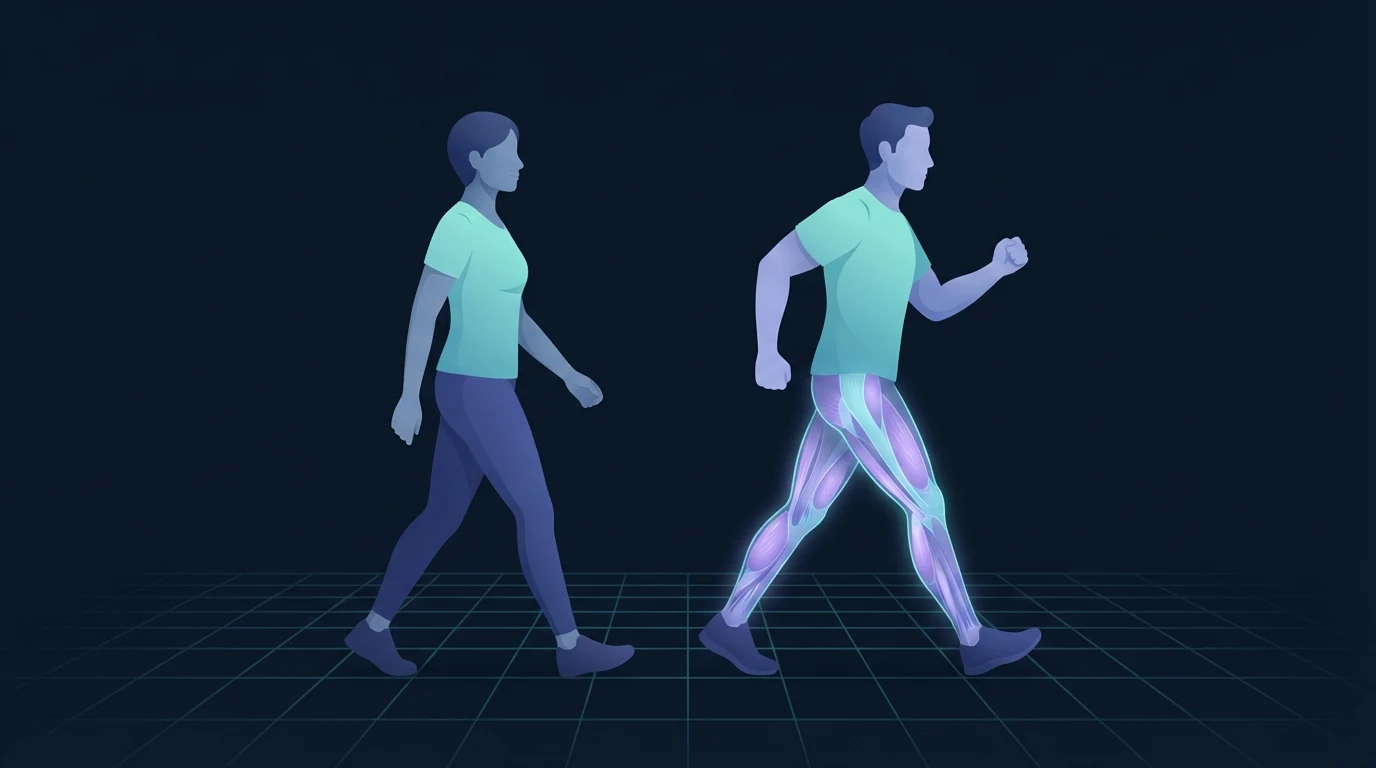
For mortality and disease risk, total volume does nearly all the work. Both the 2020 JAMA analysis and the 2019 study of older women tested step intensity separately and found it was not clearly associated with mortality once total daily steps were accounted for. Slow miles count.
For fitness, pace is the whole game. A narrative review of walking cadence concluded that about 100 steps a minute is a reliable heuristic for absolutely defined moderate intensity, roughly 3 METs, with about 130 steps a minute marking vigorous intensity (Tudor-Locke et al., 2018). Below 100, you're accumulating health benefit but not asking your cardiovascular system to adapt.
The practical read: track miles if your goal is health, track cadence or breathlessness if your goal is fitness, and track minutes if your goal is a habit that survives a bad week. Pace also has its own independent literature, which we cover in our review of walking speed and longevity.
Find out what's really holding you back
FitCraft, our mobile fitness app, pairs you with an AI coach who builds you a personalized plan around your goals, schedule, and fitness level. Every FitCraft program is designed by Domenic Angelino, MPH (Brown University) and NSCA-CSCS, with research published in the Journal of Strength and Conditioning Research and Medicine & Science in Sports & Exercise.
Take the Free Assessment Free • 2 minutes • No credit cardWalking for Weight Loss Is a Different Number
This is where most walking advice quietly breaks. The step counts that move mortality risk aren't the step counts that move the scale, and nobody tells you that when they hand you the tracker.
The American College of Sports Medicine's position stand on physical activity for weight loss concluded that 225 to 420 minutes a week of moderate activity produces the largest losses, in the range of 5 to 7.5 kg, while smaller doses around 150 to 225 minutes produce modest results at best (Donnelly et al., 2009). At a brisk 3 mph, 225 to 420 minutes a week is roughly 11 to 21 miles, or about 1.6 to 3 extra miles a day on top of whatever you already do.
Two honest caveats. Walking burns fewer calories than the machine display suggests, somewhere near 80 to 110 calories per mile for most adults depending on body weight. And appetite compensates: some of the deficit you create gets eaten back without you noticing. That's why walking-only interventions produce smaller losses than the arithmetic predicts, which is the finding we walk through in can you lose weight by walking.
None of that makes walking a bad weight-loss tool. It makes it a supporting tool. It's the single easiest way to raise NEAT, it's sustainable in a way that hard cardio isn't, and it preserves the appetite and recovery capacity you need to actually lift. If you want to see how different apps structure the food side alongside the movement side, our roundup of the best workout apps for weight loss compares the approaches.
Start Here: Miles by Where You Are Now
The target isn't the starting point. Pick the row that matches your current daily average, not the one that matches your ambition.
| Current daily average | First target | Add per week | Realistic time to 3 miles a day |
|---|---|---|---|
| Under 2,000 steps (under 1 mile) | 1.5 miles | 0.25 miles | 6 to 8 weeks |
| 2,000 to 4,000 steps (1 to 2 miles) | 2.5 miles | 0.3 miles | 4 to 6 weeks |
| 4,000 to 6,000 steps (2 to 3 miles) | 3.5 miles | 0.4 miles | Already close |
| 6,000 to 8,000 steps (3 to 4 miles) | Hold, raise pace instead | Add cadence, not distance | Done, move the goal |
If you're in the bottom row, adding miles isn't your best next move. Adding cadence, hills or a loaded pack is. Our review of incline walking research covers what a gradient does to the same number of minutes.
How to Add Miles Without Wrecking Your Shins
Walking is low impact, not no impact. Going from 2,000 to 10,000 steps in a single week is a reliable way to produce plantar fasciitis, shin splints or a grumpy knee, and then to stop entirely.
- Add about 10 to 15 percent a week. Your heart adapts in weeks and your tendons adapt in months. Progress the slower tissue.
- Split the miles at first. Two twenty-minute walks are gentler on the feet than one forty-minute walk, and easier to fit around a workday.
- Change one variable at a time. New distance, new shoes and new hills in the same week means you won't know what hurt you.
- Shoes with more than 400 to 500 miles on them have lost most of their midsole cushioning. That's about six months at 3 miles a day.
- Take a lighter week every fourth or fifth week. Hold distance rather than climbing. Nothing about the mortality curve rewards a week that ends your habit.
One more structural tip: anchor the walk to something that already happens. After lunch, after the school run, after the last meeting. A walk with a trigger survives; a walk that depends on remembering doesn't. Walking straight after eating has its own small metabolic bonus, which we cover in walking after meals.
If Walking Is the Only Thing You Do, Add This
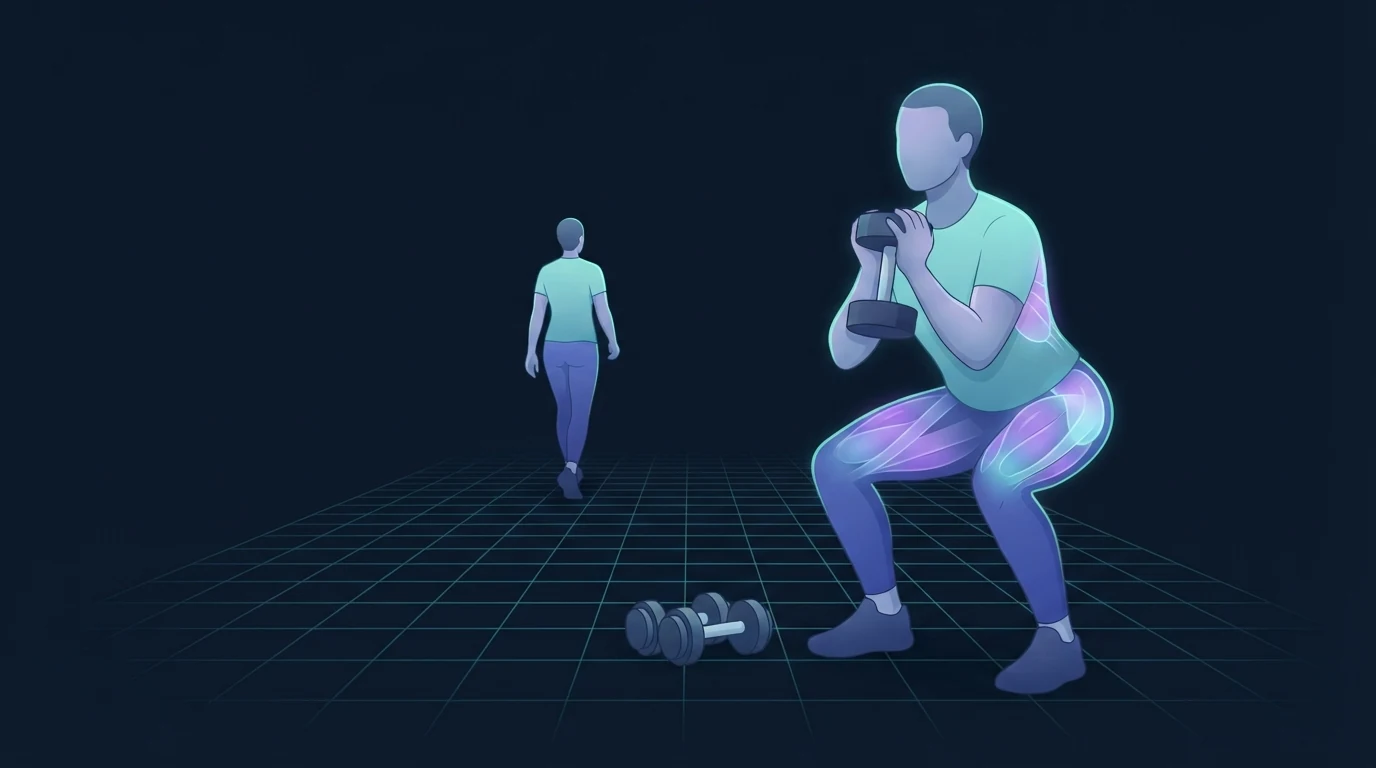
Walking is excellent at exactly the things it's excellent at. It's close to useless for maintaining muscle mass and bone density, and after about 40 those two decline whether or not you walk.
The cleanest evidence comes from a trial in the New England Journal of Medicine that randomized dieting older adults with obesity to aerobic exercise, resistance exercise, both, or neither over a year (Villareal et al., 2017). The aerobic-only group lost about 5 percent of their lean mass. The resistance group lost about 2 percent and the combined group about 3 percent, and the combined group improved physical function the most. If you're walking to lose weight, that difference is the whole difference between losing fat and losing yourself.
Two sessions a week is enough to change this, and they don't have to be long or involve a gym. Bodyweight squats, split squats, push-ups, rows with a pair of dumbbells and a hip hinge cover it in about twenty minutes. Your walking doesn't suffer; leg strength tends to make the miles feel easier, not harder.
The Bottom Line
If you want one number: 3 miles a day, most days, at whatever pace gets you out the door. That puts you near the top of the benefit curve for mortality and chronic disease, it's achievable from almost any starting point inside two months, and it leaves room to add pace or strength when you want more. If your goal is weight loss, push toward 4 or 5 and pair it with a change to what you eat. If your goal is fitness, stop counting miles and start counting cadence.
What breaks this for most people isn't the distance. It's the day the weather turns, the week work eats the evenings, and the quiet decision that a broken streak means the whole thing failed. Barry, 42, put it plainly after losing 28 pounds in four months: he stopped trying to find a perfect slot and started moving in the one he already had, during breakfast while his kids ate. Our guide on why consistency beats intensity is the one to read when that week arrives, because it will.
Frequently Asked Questions
How many miles should I walk a day to be healthy?
About 3 to 3.5 miles a day, which is roughly 7,000 steps for most adults. A 2025 dose-response meta-analysis of 57 studies found health benefits starting as low as 3,000 to 4,000 steps and most outcomes flattening near 7,000, with 10,000 adding little on top. If you're over 60, the curve flattens earlier, closer to 6,000 steps or about 2.5 miles.
How many miles should I walk a day to lose weight?
Roughly 3 to 5 miles a day, alongside a change to what you eat. The American College of Sports Medicine's position stand puts meaningful weight loss at 225 to 420 minutes of moderate activity a week, which at a brisk 3 mph pace is about 11 to 21 miles a week. Walking on its own with no dietary change usually produces small losses, because appetite quietly makes up part of the gap.
How many steps are in a mile?
Between about 1,900 and 2,500 steps, depending on your height, your sex and how fast you're walking. Taller people and faster walkers cover a mile in fewer steps. A 2008 study that measured one-mile step counts across walking and running speeds found the count varies enough that a single number misleads, so 2,000 steps per mile is a planning estimate, not a measurement.
Is walking 5 miles a day too much?
Not for most healthy adults, as long as you built up to it rather than jumping there in a week. Five miles is roughly 10,000 to 12,000 steps and about 80 to 100 minutes at an easy pace. The mortality curve doesn't turn around at high step counts, so the extra miles aren't harmful, they just buy less additional health than the first three did.
Does walking faster matter more than walking further?
For mortality risk, total volume does most of the work. Both the 2020 JAMA analysis of 4,840 US adults and the 2019 study of 16,741 older women found that step intensity was not clearly associated with mortality once total daily steps were accounted for. Pace still matters for fitness and for time efficiency: about 100 steps a minute is the threshold for moderate intensity.
Is walking enough exercise on its own?
Walking covers cardiovascular health and daily energy expenditure well, and it covers muscle and bone poorly. In a 2017 NEJM trial of dieting older adults, the group doing aerobic exercise alone lost about 5 percent of their lean mass while the groups that added resistance training lost 2 to 3 percent. Two short strength sessions a week is the cheapest fix, and it doesn't reduce the walking.