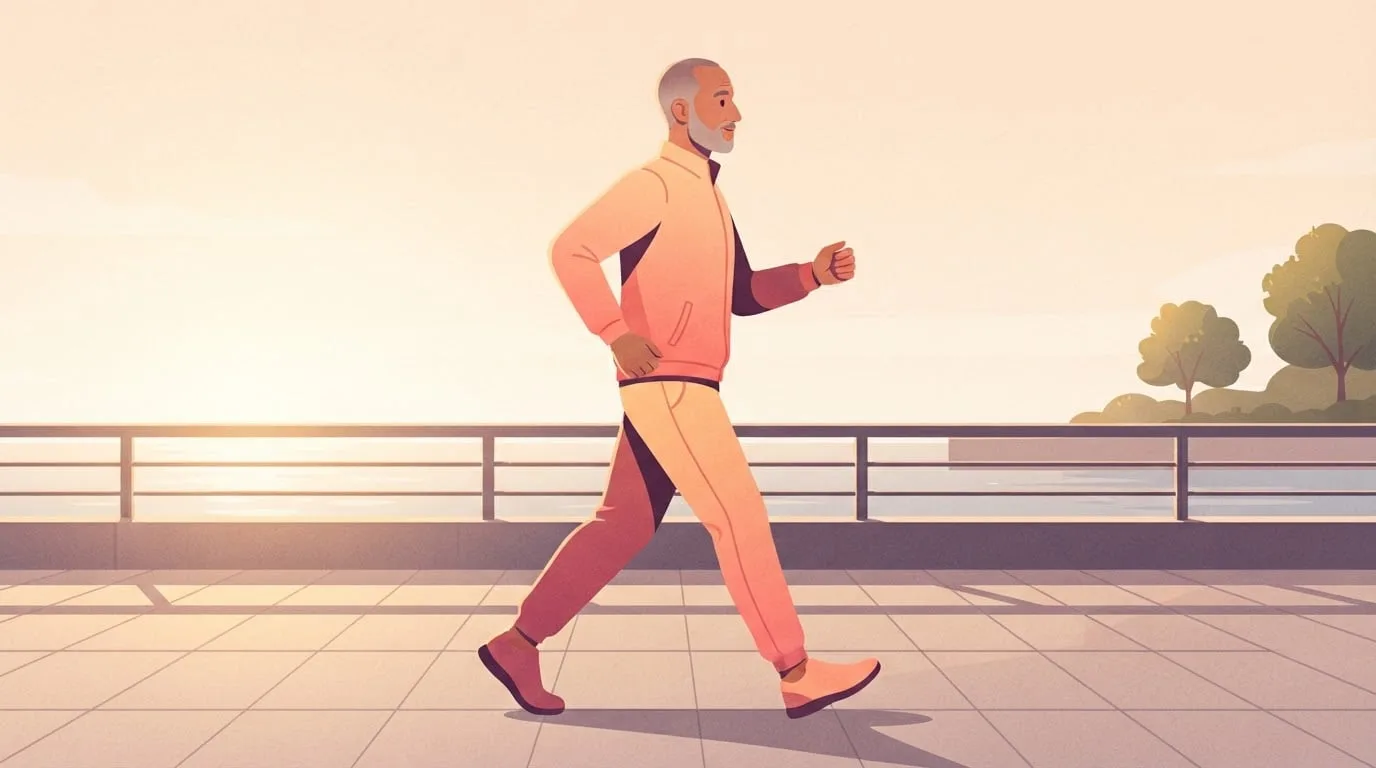
You're out with a friend, and every few minutes you notice you've drifted half a step behind. Or you've started walking for exercise, your watch says 22 minutes a mile, and it feels like hard work without much speed to show for it. The usual tip, to lengthen your stride, makes it worse. Your heel reaches out in front, your shins start to burn, and you finish more tired but not much faster.
It's frustrating, because walking is supposed to be the easy one. It's tempting to decide you're just a slow walker. You aren't. Walking speed is part technique and part fitness, and both respond to practice within weeks.
So this guide puts the technique first, because that's what changes your pace this week. Then it covers what counts as a brisk walk, why walking speed is worth improving, a six-week plan to walk faster for good, and the mistakes that hold most people back.
How to Walk Faster: 5 Technique Steps
Your walking speed is your step length multiplied by your step rate. You can raise either one, but they don't cost you the same amount of energy. The five steps below are in the order to practice them.
1. Take Shorter, Quicker Steps
Raise your step rate, called cadence, before you try to lengthen your stride. With every step, your body has to redirect its weight from one leg onto the other, and that changeover is where much of the energy in walking goes. Donelan, Kram and Kuo (2002) had nine people walk with longer and longer steps while keeping their step rate fixed. The work of those step-to-step changeovers, and the energy cost along with it, rose with roughly the fourth power of step length. Double the step and that cost goes up about sixteen-fold.
That's why reaching out with long steps feels so tiring, and why fast walkers have quick feet rather than huge strides. To practice, count your steps for 15 seconds and multiply by four. That number is your cadence in steps per minute. Then try to add five to ten steps a minute while keeping each step a comfortable length. A song with a beat close to your target makes the new rhythm easier to hold.
Your stride will lengthen a little on its own as you speed up. Let that happen behind you, through a stronger push-off, instead of reaching forward with your front foot.
2. Bend Your Elbows and Drive Your Arms
Your arms set the rhythm for your legs. Bend your elbows to about 90 degrees, keep your hands loose, and swing your arms forward and back close to your sides rather than across your body. Your hand comes up to about chest height in front, and your elbow goes back past your hip. A bent arm is a shorter pendulum, so it can keep up with quicker legs in a way a straight arm can't.
Arm swing does real work. In Collins, Adamczyk and Kuo (2009), people who held their arms still while walking used 12% more energy than when they swung them normally, and swinging them in step with the same-side leg raised the cost by 26%. Normal arm swing counters the twist your legs put through your body. Driving your arms a little harder simply speeds up that rhythm. If you carry a phone, a bag or a bottle in one hand, you lose part of the benefit, so move it to a pocket, a belt or a small backpack.
3. Land on Your Heel and Roll Through to Your Toes
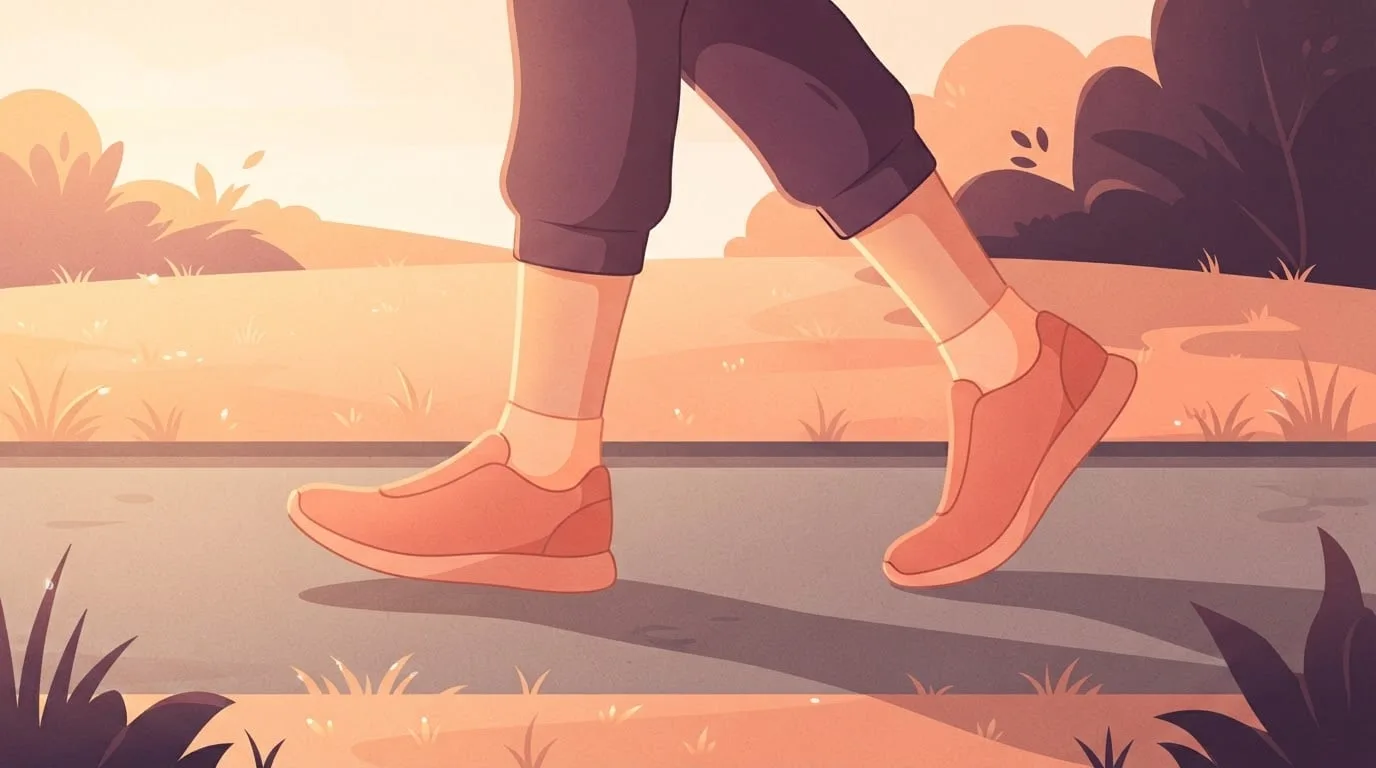
Let your front foot land on the heel, close beneath your body rather than far out in front. Then roll through the foot and push off firmly from the ball of the foot and the big toe. That push-off from your calf and ankle is what drives you forward. Keep it smooth and quiet. A slapping sound usually means your foot is landing flat or your step is too long.
Flexible, light shoes make the roll easier. A stiff, heavy shoe fights the ankle movement you're trying to use.
4. Stand Tall and Look Ahead
Walk tall, with your head stacked over your shoulders and your shoulders over your hips. Look 10 to 20 feet ahead instead of at the ground. If you lean at all, tip very slightly forward from the ankles so your whole body moves as one piece. Bending at the waist cuts your stride short at the hips and loads your lower back. Keep your shoulders down and relaxed, especially as your arms start working harder.
5. Practice the New Speed in Short Bursts
You won't hold a new cadence for 45 minutes on the first day. Practice it in bursts of one to two minutes with easy walking in between, and let the bursts grow over the weeks. Short bursts let you rehearse the faster rhythm before fatigue pulls you back into your old one. That's the idea behind the plan further down.
What Counts as Brisk Walking?
Brisk walking means walking fast enough to reach moderate intensity, which starts at about 100 steps a minute, or roughly 2.5 miles per hour, for most adults. At that pace you can still talk in sentences, but you couldn't sing.
A narrative review by Tudor-Locke and colleagues (2018) concluded that about 100 steps a minute is a reliable sign of moderate intensity in adults. Their lab study of 76 healthy 21- to 40-year-olds then measured oxygen use directly on a treadmill: 100 steps a minute matched moderate intensity (3 METs), and 130 steps a minute matched vigorous intensity (6 METs) (Tudor-Locke and colleagues, 2019). In 98 adults aged 61 to 85, cadences of 100, 110 and 120 steps a minute lined up with 3, 4 and 5 METs (Tudor-Locke and colleagues, 2021).
The CDC lists walking at 2.5 miles per hour or faster as moderate-intensity activity, with a simple rule of thumb: at moderate intensity you can talk, but not sing. That talk test holds up in the lab. In Persinger and colleagues (2004), the point where speech first became difficult matched the ventilatory threshold, the effort level where your breathing starts to climb faster than the work, on both a treadmill and a bike.
| Walking pace | Steps per minute | Rough speed | Mile time | Talk test |
|---|---|---|---|---|
| Easy stroll | Under 100 | Under 2.5 mph | Over 24 min | You could sing |
| Brisk | 100 to 120 | 2.5 to 3.5 mph | 17 to 24 min | Full sentences, no singing |
| Fast (power walking) | 120 to 130 | 3.5 to 4.2 mph | 14 to 17 min | Short sentences |
| Very fast | 130 and up | Over 4.2 mph | Under 14 min | A few words at a time |
The step-to-speed figures are approximate. Taller people cover more ground with each step, so they reach the same speed at a lower cadence. Many healthy adults already walk at around 100 to 120 steps a minute, so a walk that feels brisk usually sits toward the top of that range. For the normal ranges of cadence, stride length and comfortable walking speed, see our guide to normal walking gait.
There's also a ceiling. In Hreljac (1993), 20 young adults chose to switch from walking to running at an average of 2.06 meters per second, about 4.6 miles per hour, and they rated walking at that speed as clearly harder than running at it. Going faster than that as a walker takes race-walking technique, which is a sport of its own. For most people, a fast walk they can keep up lands somewhere between 3.5 and 4.5 miles per hour.
Why Walking Speed Matters
Walking speed is one of the strongest single markers of health in later life. In a pooled analysis of nine cohort studies covering 34,485 adults aged 65 and over, every 0.1 meter per second of usual walking speed went with about a 12% lower risk of death (Studenski and colleagues, 2011). Speed is a marker rather than a switch, though. It reflects leg strength, heart and lung fitness, balance and joint health all at once. Our review of walking speed and longevity covers the larger studies and what they can and can't show.
The encouraging part is that what sits behind your walking speed can be trained. Hortobágyi and colleagues (2015) pooled 42 trials with 2,495 healthy adults over 65. Strength training, balance and coordination training, and mixed programs all raised walking speed, by 0.10 meters per second on average, or about 8%. Strength training on its own added 0.11 meters per second. That's the same size of step the longevity studies use, although no trial has shown that raising your pace this way adds years. Either way, a faster walk turns the same 30 minutes into more exercise.
Find out what's really holding you back
FitCraft, our mobile fitness app, pairs you with an AI coach who builds you a personalized plan around your goals, schedule, and fitness level. Every FitCraft program is designed by Domenic Angelino, MPH (Brown University) and NSCA-CSCS, with research published in the Journal of Strength and Conditioning Research and Medicine & Science in Sports & Exercise.
Take the Free Assessment Free • 2 minutes • No credit cardA 6-Week Plan to Walk Faster
This plan uses three walks and two short strength sessions a week. It assumes you can already walk for 30 minutes without trouble. If you can't yet, build up to that first by adding a little each week, as our guide to how many miles to walk a day explains.
Before Week 1: Test Your Pace
Find a flat, measured mile. Four laps in the inside lane of a standard 400-meter track is close enough. Warm up with five minutes of easy walking, then walk the mile as fast as you can while still walking, and write down the time. Halfway through, count your steps for 30 seconds and double it to get your cadence. You'll repeat the same test at the end of week 6.
The Weekly Walks
"Fast" in the table means your quicker cadence with all five technique steps working, at a pace where you can only manage short sentences. "Easy" means relaxed walking at your normal pace. Take at least one rest day or an easy day between the interval walks.
| Week | Interval walk | Steady walk | Longer easy walk |
|---|---|---|---|
| 1 | 5 rounds of 1 min fast, 2 min easy | 30 min brisk, focus on arms | 30 to 40 min easy |
| 2 | 6 rounds of 1 min fast, 2 min easy | 30 min brisk, last 5 min fast | 40 min easy |
| 3 | 5 rounds of 2 min fast, 2 min easy | 35 min brisk | 40 min easy |
| 4 | 5 rounds of 3 min fast, 3 min easy | 6 rounds of 1 min fast up a gentle hill, easy walk down | 40 to 45 min easy |
| 5 | 4 rounds of 4 min fast, 2 min easy | 40 min brisk, middle 10 min fast | 45 min easy |
| 6 | 3 rounds of 6 min fast, 2 min easy | Retest your mile | 45 min easy |
Warm up with five minutes of easy walking before each interval walk and cool down with five more afterwards. The week 4 pattern, three minutes fast and three minutes easy, is the same structure used in Japanese interval walking studies, so you can keep using it after the six weeks are up.
The Two Strength Sessions
Leg strength powers your push-off, and strength training is the type of exercise with the most trials behind it for raising walking speed: 24 of the 42 studies in the Hortobágyi review tested it. Two sessions of about 20 minutes a week cover it, with bodyweight or a pair of dumbbells:
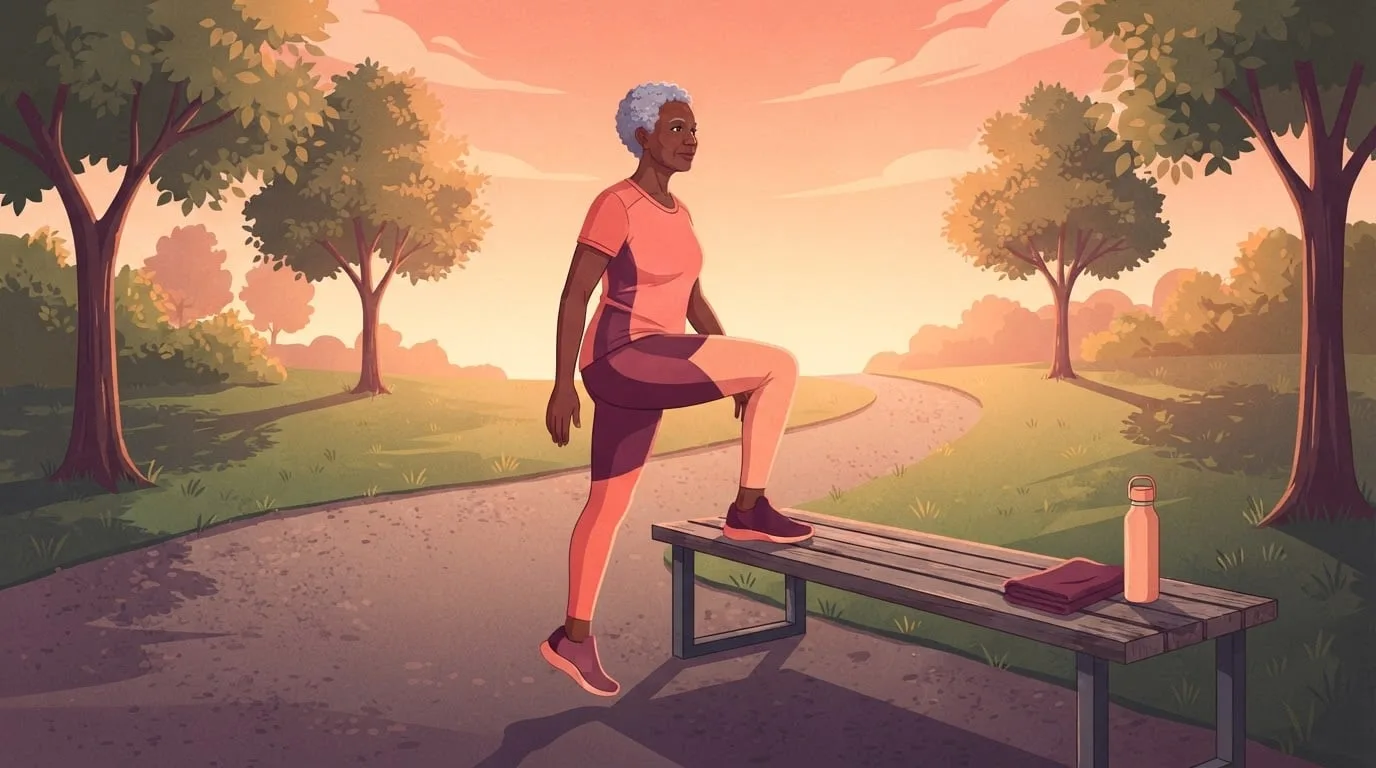
- Step-ups onto a stair or a sturdy, low bench: 3 sets of 8 to 10 on each leg.
- Split squats, holding dumbbells once bodyweight feels easy: 3 sets of 8 on each leg.
- Single-leg calf raises on the edge of a step, for push-off strength: 3 sets of 12 on each leg.
- Glute bridges or dumbbell Romanian deadlifts: 3 sets of 10.
- Single-leg balance, standing near a wall or counter: 3 holds of 30 seconds on each leg.
The strength sessions are the part most people skip, because they feel less rewarding than a walk outside. Our roundup of the best strength training apps compares tools that lay these sessions out for you at home. FitCraft is one of them: a 3D AI coach demonstrates every exercise, says your name during the workout and keeps your streak going, with dumbbell and bodyweight workouts you can do at home. As one user, Katie, put it: "I've tried everything. This is the first time I've stuck with something past two weeks."
What to Expect
The technique changes show up first. Within a week or two of practice, a quicker cadence usually starts to feel normal rather than forced. Fitness gains take longer. In the trials above, the average gain was about 8%, which on a 20-minute mile works out to roughly 18 and a half minutes. Treat that as a realistic target, not a ceiling.
Common Mistakes That Slow You Down
- Overstriding. Reaching your front heel far out in front of your body acts as a brake on every step and drives up the step-to-step cost Donelan measured. Shorten the step and make it quicker.
- Straight arms, or arms swinging across your body. Both slow your rhythm and waste effort sideways. Bend the elbows and swing forward and back.
- Walking with your hands full. A phone or bag in one hand stops that arm from swinging. Free your hands.
- Looking at your feet. Your head drops, your back rounds and your stride shortens from the hips. Look 10 to 20 feet ahead.
- Going all out on every walk. Your shins, calves and feet need time to adapt. A burning feeling in the front of the shins is common in the first weeks, because the muscle there lowers your foot after each heel strike and works harder at a quicker pace. Ease off when it hits. Sharp or lasting pain is different: stop and get it checked.
The Bottom Line
To walk faster, raise your step rate before your step length, bend your elbows and drive your arms, land on your heel and push off from your toes, and stand tall. Brisk walking starts at about 100 steps a minute, and the talk test tells you when you've reached it. Practice the new rhythm in short bursts, add two short strength sessions a week, and retest your mile after six weeks.
You're not a slow walker. You just haven't practiced walking fast yet.
Frequently Asked Questions
How can I walk faster without getting tired?
Raise your step rate in short bursts instead of lengthening your stride, because longer steps cost disproportionately more energy. Bend your elbows and swing your arms, which costs less energy than holding them still, and alternate one to three minutes of fast walking with two minutes easy until the quicker rhythm feels normal.
How do I increase my walking speed without a treadmill?
Use your normal walks and count your steps. Count for 15 seconds, multiply by four, and aim to add five to ten steps a minute in short bursts. Gentle hills and stairs build the push-off muscles, and two short bodyweight or dumbbell strength sessions a week help your pace too.
How do I start speed walking?
Start with technique: quicker steps, bent arms, a heel-to-toe roll and tall posture, practiced in one-minute bursts inside a normal walk. Build the bursts toward three to six minutes over about six weeks. Power walking at roughly 3.5 to 4.5 mph needs no special skill, while race walking has its own rules and is best learned from a club or coach.
How fast should you walk for exercise?
Walk at least briskly, which means about 100 steps a minute or 2.5 mph and up, fast enough that you can talk but not sing. That's the threshold for moderate-intensity activity. About 130 steps a minute marks vigorous intensity for most adults aged 21 to 40.
Is it better to walk faster or longer?
For overall health, total walking volume does most of the work, so a longer walk at a comfortable pace still counts. For fitness and for getting more out of limited time, pace matters. Most people do best with mostly brisk walks plus one or two walks a week that include faster intervals.
Why do my shins hurt when I walk fast?
A burning feeling in the front of the shins usually comes from the muscle that lowers your foot after each heel strike, which works harder at a quicker pace. Slow down for a minute when it starts, keep your steps short and build fast intervals gradually. Sharp pain, pain on the bone or pain that lasts after the walk needs a doctor or physical therapist.