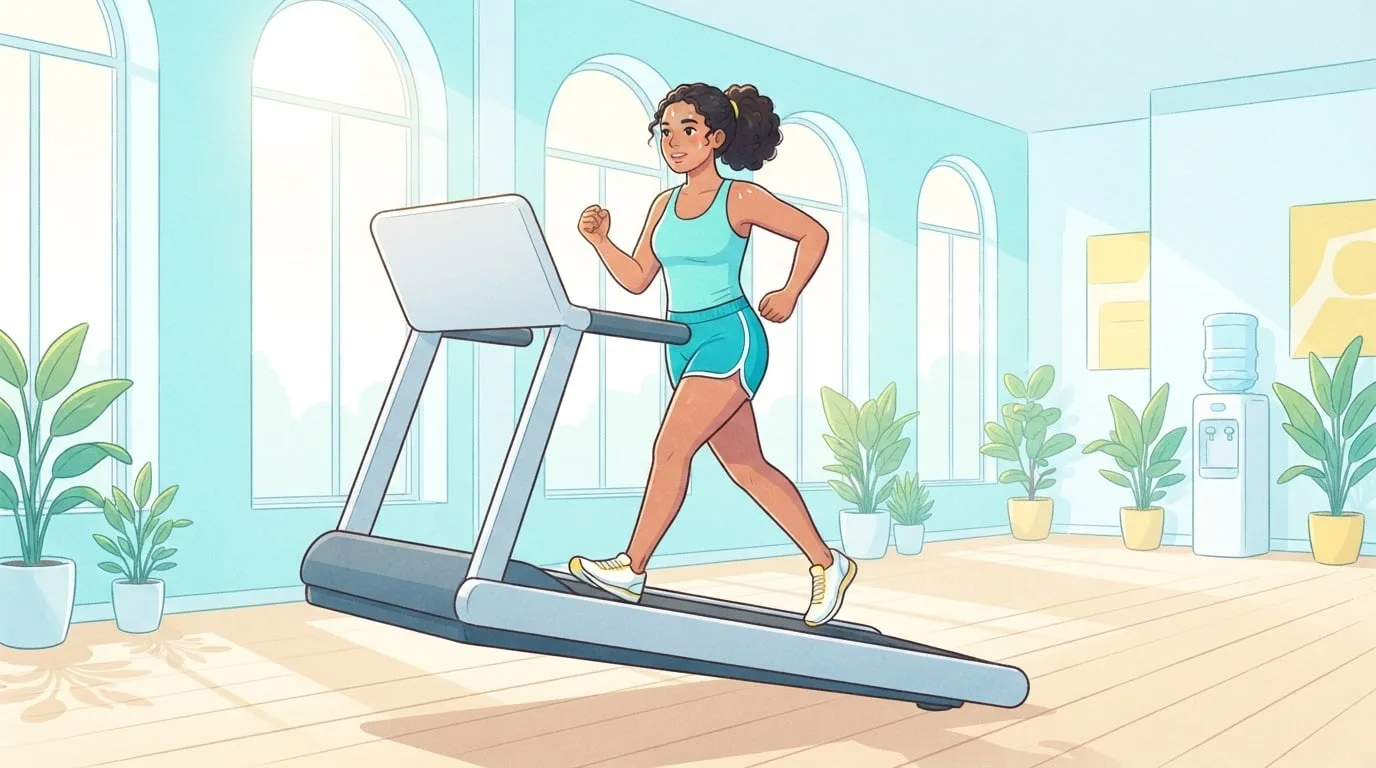
You've probably seen the videos. Someone walks on a treadmill tilted so far it looks like a ramp, at a pace that seems easy, and is soaked by minute ten. Then you try it yourself, and by minute six your calves are burning and you're gripping the rails just to stay on.
That's the frustrating part of 12-3-30. The numbers look so simple that falling short feels personal. It isn't. A 12 percent grade at 3 mph is a vigorous workout for most people, and nobody starts a running plan at their goal pace.
So treat 12-3-30 as a destination with a road to it. Below you'll find what the 12-3-30 workout is and where it came from, what it burns, a six-week build-up, the form that keeps the work in your legs, who should change it, and how it compares with running and the stair stepper.
What Is the 12-3-30 Workout?
The 12-3-30 workout is three treadmill settings held for the whole session: the incline at 12 percent, the speed at 3 miles per hour, and the timer at 30 minutes. There are no intervals and no running. You step on and walk uphill for half an hour.
- In metric: 3 mph is about 4.8 km/h, and 30 minutes at that speed covers 1.5 miles, or about 2.4 km of belt.
- A 12 percent incline is not 12 degrees. Treadmill incline is a grade: 12 feet of rise for every 100 feet of travel. That works out to about 6.8 degrees. A real 12-degree slope would be roughly a 21 percent grade, steeper than most standard treadmills go.
- You climb about 290 meters in one session. That's roughly 940 feet, or close to 90 floors of stairs, spread over half an hour.
- Outside, a 12 percent grade is a steep street or trail. Few hills hold that grade for 30 minutes, so the outdoor version is usually hill repeats: walk up for several minutes, walk back down easy, and repeat.
Where the 12-3-30 Workout Came From
Lauren Giraldo, a social media creator, first described the routine in a YouTube video posted on November 8, 2019. It took off a year later, when she shared it on TikTok on November 13, 2020. Those dates come from the reference list of the first lab study of the workout, which also quotes her reason for sticking with it: she found the gym intimidating, and one simple routine gave her something she could walk in and do.
That detail explains the trend better than the calorie numbers do. 12-3-30 spread because it removes decisions. You don't need a plan, a playlist or a coach. You need one treadmill and three numbers, and for anyone who has started and stopped before, a routine that simple is easier to repeat.
She also didn't follow the hands-off rule her fans repeat. The study's authors note that she held the rails about 30 percent of the time and let go for the rest. The form section below shows why that matters for what the workout costs.
Does 12-3-30 Actually Work?
Yes, as a cardio workout. It's a hard, low-impact aerobic session, and the research on incline walking backs that up.
Here's what that research shows in brief. The energy cost of walking climbs steeply as the grade rises, so tilting the belt makes a slow walk cost about as much as a slow jog. Because the absolute intensity stays below running, a bigger share of the energy comes from fat. And because one foot is always on the belt, the impact is far lower than running's. The one study of 12-3-30 itself, by Wong and colleagues (2025) at the University of Nevada, Las Vegas, enrolled 16 active adults, and the 14 who finished both sessions burned 308 calories in the 30-minute walk. About 41 percent of that energy came from fat, against 33 percent during a run that burned the same total in about 24 minutes. Our incline walking research review covers that study and four others, including what incline does to your glutes and knees.
What 12-3-30 does well:
- It builds aerobic fitness without running.
- It burns a useful number of calories in 30 minutes.
- It's simple enough to repeat week after week.
What it won't do:
- It won't build much muscle. It's endurance work for your calves, glutes and hamstrings, not strength training.
- It won't keep getting harder on its own. Once you've adapted, the same three numbers become an easier workout.
- It won't burn fat from one chosen spot, such as your belly.
12-3-30 results: what to expect
Most people notice three changes in the first month. The session gets easier, so your breathing settles and you stop wanting the rails. Your calves stop complaining after the first week or two. And the scale moves slowly, or not at all if you eat more to match.
Three sessions a week at about 300 calories each adds up to roughly 900 calories a week. That's real, but food decides most of the weight you lose. The Wong team made the same point in their own discussion: your energy balance drives weight loss, not the share of fat you burn during the workout. Before-and-after photos on social media mix the walk with diet changes, so they can't tell you what the walk did on its own.
Can you lose belly fat with 12-3-30?
You can't choose where you lose fat, but aerobic exercise does reduce the deep belly fat around your organs. A meta-analysis of 35 randomized trials by Ismail and colleagues (2012) found that aerobic training reduced this visceral fat compared with no exercise, while resistance training alone showed no clear effect. Incline walking is aerobic training. The waistline change you can see still depends mostly on your calorie balance over months.
How Many Calories Does the 12-3-30 Workout Burn?
The 12-3-30 workout burns about 4 calories per kilogram of body weight, or roughly 1.85 calories per pound, in 30 minutes. That's the rate measured in the Wong study, where participants averaged 75 kilograms (166 pounds) and burned 308 calories. The table scales that rate to other body weights and sets it beside the American College of Sports Medicine's standard walking equation, which predicts a little higher.
| Body weight | From the measured rate | From the ACSM walking equation |
|---|---|---|
| 120 lb (54 kg) | About 220 calories | About 235 calories |
| 150 lb (68 kg) | About 275 calories | About 295 calories |
| 180 lb (82 kg) | About 335 calories | About 355 calories |
| 210 lb (95 kg) | About 390 calories | About 415 calories |
| 240 lb (109 kg) | About 445 calories | About 470 calories |
Read these as estimates that rest on four assumptions. Your hands stay off the rails the whole time. The treadmill's speed and grade are accurate. You walk a steady 30 minutes. And the totals are gross calories, which include the roughly 1 calorie per kilogram per hour you'd burn sitting still, so the workout's extra burn is about 30 to 50 calories lower.
Body size explains most of the spread between people. In the study, the men averaged 337 calories and the women 254, mostly because the men were heavier. Gripping the rails lowers every number in the table. And the calorie readout on the console is a guess based on the weight you typed in, or a default weight if you didn't.
For comparison, the same 30 minutes at 3 mph on a flat belt burns well under half as much. At that speed, each percentage point of incline adds roughly 15 calories to a 30-minute walk for a 155-pound person, which is why the incline, not the speed, does most of the work in 12-3-30.
Find out what's really holding you back
FitCraft, our mobile fitness app, pairs you with an AI coach who builds you a personalized plan around your goals, schedule, and fitness level. Every FitCraft program is designed by Domenic Angelino, MPH (Brown University) and NSCA-CSCS, with research published in the Journal of Strength and Conditioning Research and Medicine & Science in Sports & Exercise.
Take the Free Assessment Free • 2 minutes • No credit cardHow to Build Up to 12-3-30
If you can't finish 12-3-30 today, build up to it over about six weeks. Change one setting at a time, and move on only when the current week feels like a hard effort you could repeat tomorrow.
| Week | Incline | Speed | Time | Sessions |
|---|---|---|---|---|
| 1 | 4% | 3.0 mph | 20 min | 3 |
| 2 | 6% | 3.0 mph | 20 min | 3 |
| 3 | 8% | 3.0 mph | 25 min | 3 |
| 4 | 10% | 3.0 mph | 25 min | 3 |
| 5 | 12% | 2.6 to 2.8 mph | 30 min | 3 |
| 6 | 12% | 3.0 mph | 30 min | 3 |
Walk for 3 to 5 minutes on a flat belt before you raise the incline, and finish with 3 minutes flat. Those minutes don't count toward the session time. The original routine skips them, but your calves and Achilles tendons will thank you.
Use a simple test before you move up a row. You can still say a short sentence at the end of the session, your hands stayed off the rails, and your calves feel normal the next morning. If any of those fails, repeat the week. Losing a week costs you nothing, while a sore Achilles can cost you a month.
Two other ways in, if the table doesn't suit you:
- Split the climb. Do three 10-minute blocks at 12 percent with 2 minutes on the flat between them, then shrink the flat breaks over a few weeks.
- Slow down instead of holding on. Keep the 12 percent incline and drop to 2.5 mph. A slower walk with free arms keeps more of the work in your legs than a faster one with your hands on the rails.
12-3-30 Form: Why the Handrails Matter
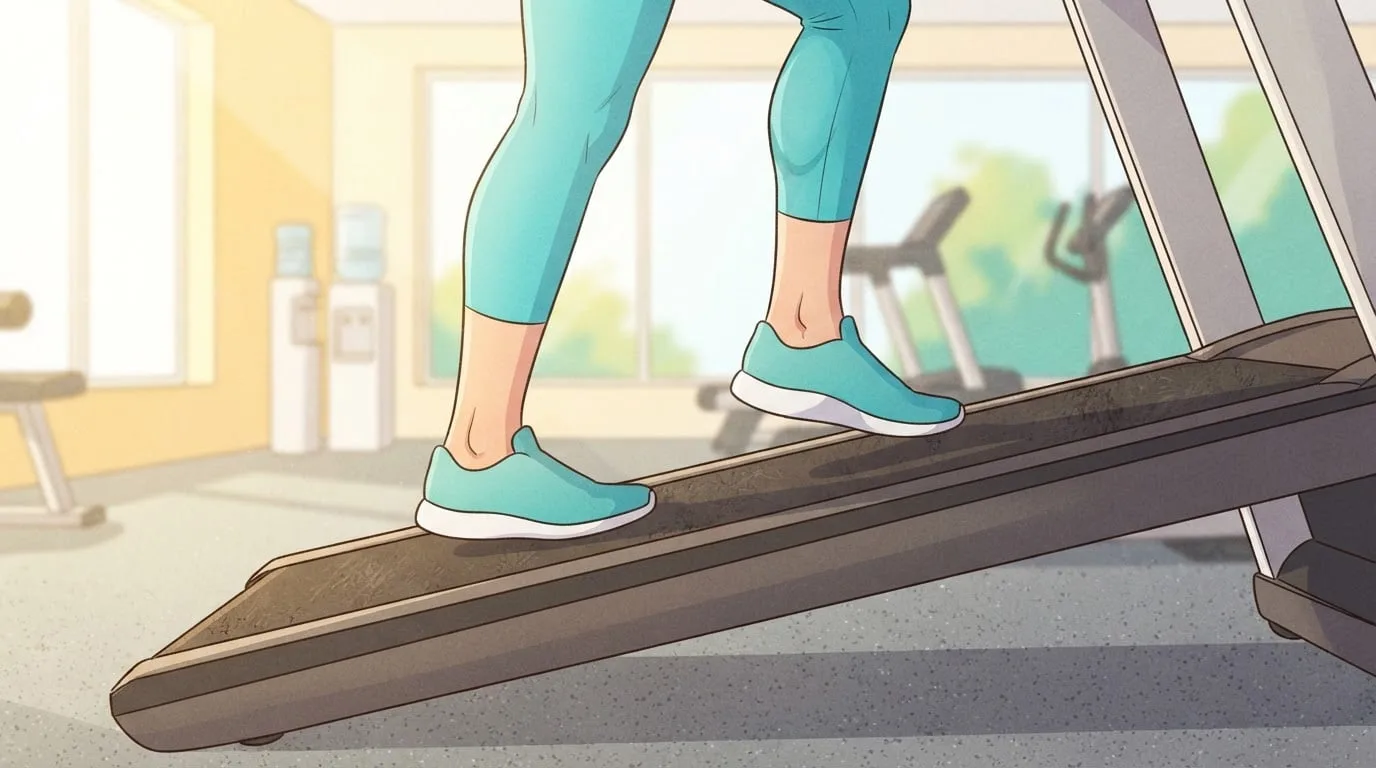
The rule people repeat about 12-3-30 is "don't hold the handrails," and it has data behind it. Berling and colleagues (2006) had 10 healthy adults aged 38 to 60 walk at three steady training intensities in three ways: arms swinging freely, hands resting on the rails, and hands gripping them. Gripping cut oxygen use by about 15 to 21 percent and heart rate by 12 to 21 beats a minute compared with free arm swing. Resting the hands lightly cut oxygen use by only 4 to 8 percent.
So a fingertip on the rail for balance costs you little. Gripping, and especially leaning back while you grip, lets the rails carry part of your weight up the hill. The console still says 12 percent while your legs do less. If you need to grip to finish, the incline or the speed is too high for today, so lower one of them.
Remember that Giraldo herself held on for part of each session. Her version probably cost a little less than the hands-free walk the researchers measured.
Form cues for a steep incline
- Stand tall and lean slightly forward from the ankles. Folding at the hips shifts the load to your lower back.
- Take shorter steps than you would on the flat, and push off through your whole foot.
- Let your arms swing with your elbows bent. They help you balance and keep your rhythm.
- Look ahead, not down at the console. Your head position steers your posture.
- Clip the safety key to your clothing, start the belt flat, and raise the incline once you're walking.
- Bring the incline down before you slow the belt at the end, and step off only once it has stopped.
Who Should Skip or Modify 12-3-30
12-3-30 is low impact, but it isn't low effort, and the steep grade loads some tissues far more than flat walking does. In a treadmill study of 10 young adults, Franz and Kram (2012) found that the glutes, hamstrings, thighs and calves all worked much harder walking uphill than on the flat. The extra work grew as the grade steepened from 3 to 9 degrees and as the walkers went faster. The 12-3-30 grade of about 6.8 degrees sits inside that range.
Skip it for now or change it if any of these apply:
- Calf, Achilles or plantar fascia problems. The incline keeps your ankle bent upward and your calves loaded on every step. Stay at 4 to 6 percent, or walk flat until the problem settles.
- Heart disease, high blood pressure, or chest pain or dizziness during exercise. At roughly 8 METs, 12-3-30 is vigorous for most adults. Get medical clearance first.
- Balance problems or a history of falls. A steep moving belt is a fall risk. Use the rails for balance, lower the speed and accept the smaller calorie burn, because staying upright matters more.
- Lower back pain. If leaning into the hill aggravates it, a lower incline lets you stay upright.
- Pregnancy. Ask your provider first. A lower incline and the talk test are the usual starting point.
- You're new to exercise. Start at the week 1 row of the table, not the full workout.
Knee pain on its own isn't an automatic reason to skip 12-3-30. Uphill walking avoids both the braking load of walking downhill and the impact of running, and our research review covers the knee data in detail. Stop if your knees hurt during the walk or the next day.
12-3-30 vs Running vs the Stair Stepper
All three are solid cardio. They differ mainly in how fast they burn calories and how much impact they cost. The intensities below come from the Wong measurements and the 2024 Adult Compendium of Physical Activities, which lists hill walking at an 11 to 20 percent grade at 8.8 METs, close to the measured value for 12-3-30.
| Workout | Rough intensity | 30 minutes at 155 lb (70 kg) | Impact |
|---|---|---|---|
| 12-3-30 incline walk | About 8 METs | About 285 to 305 calories | Low: one foot always on the belt |
| Running at 6 mph (10-minute mile) | 9.3 METs | About 325 calories | Highest of the three |
| Stair stepper, steady pace | 9.3 METs | About 325 calories | Low: feet stay on the steps |
Running gets the same calories done faster. In the Wong study, the matched run burned the same total about 6 minutes sooner. The price is impact. In force-plate measurements by Keller and colleagues (1996), the peak vertical force on each step rose from about 1.2 times body weight when walking to about 2.5 times at fast running speeds, and slow jogging produced peaks more than 50 percent higher than walking. If your knees, shins or body weight make running miserable, 12-3-30 gets you most of running's calorie burn with a fraction of the pounding.
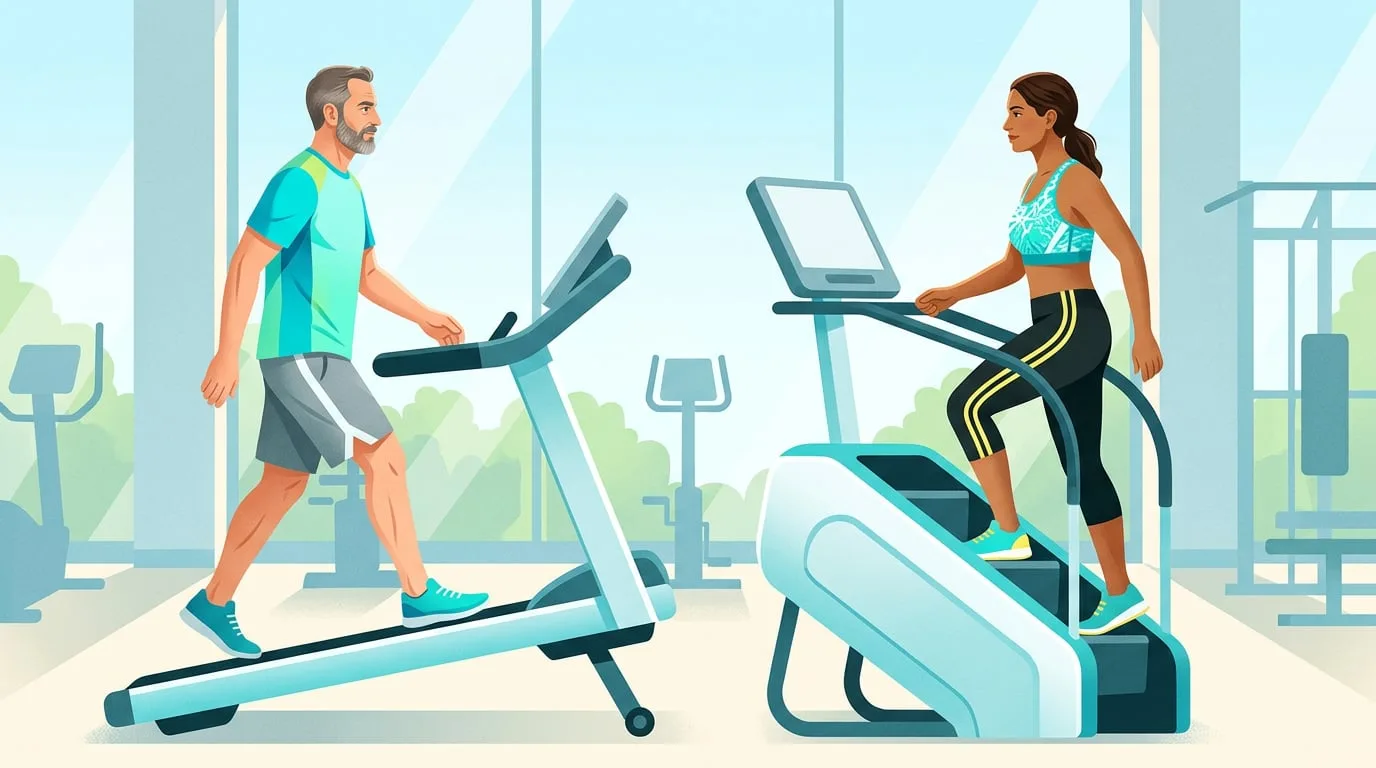
The stair stepper is the closer cousin. The Compendium rates a stair-treadmill machine at 9.3 METs, a little above 12-3-30, and like incline walking it keeps your feet in contact with a surface, so impact stays low. It also has the same handrail trap. Our stair stepper workout guide has three sessions and the calorie numbers by body weight. If your gym has both machines, alternating them works well, and it gives your calves a different kind of climb on different days.
How Often Should You Do the 12-3-30 Workout?
Three to four times a week works for most people, with the other days used for strength training or easy movement. The World Health Organization's 2020 guidelines (Bull and colleagues, 2020) recommend 150 to 300 minutes of moderate aerobic activity or 75 to 150 minutes of vigorous activity a week, plus muscle-strengthening work on two or more days. At about 8 METs, 12-3-30 counts as vigorous, so three sessions, or 90 minutes, already sit inside that range.
Start on non-consecutive days while your calves adapt. Daily 12-3-30 is possible once you're used to it, but the same session every day gives your lower legs no rest and your fitness no new reason to improve.
That's the other limit of the routine. Once 12-3-30 feels easy, the workout has stopped progressing. Change one number: a little more speed, a few minutes at a steeper grade, or a longer session. Our treadmill walking workout guide has three sessions that move both speed and incline, which keeps the challenge rising after 12-3-30 stops being hard.
Fill two of the remaining days with strength work. Incline walking trains your heart and legs, but it doesn't load your upper body or build much muscle, and two short sessions with bodyweight or dumbbells cover that. FitCraft's workouts include cardio and dumbbell and bodyweight strength training, with an AI coach who demonstrates every exercise on an interactive 3D model, says your name as you train and keeps your streak going. If you're weighing options, our roundup of the best workout apps for weight loss compares how each one handles cardio and strength together. As Sarah, 27, put it after losing 18 pounds in three months: "First app that made exercise feel like something I chose, not forced."
The Bottom Line
The 12-3-30 workout is a 30-minute walk at a 12 percent incline and 3 mph. It's a hard, low-impact cardio session that burns roughly 250 to 350 calories for most adults. Build up to it over a few weeks, keep your hands off the rails, do it three or four times a week, and change one setting once it gets easy.
The routine went viral because it's simple enough to repeat, and that's still its best feature. You don't need more discipline to make it stick. You need a starting point you can finish and a reason to come back on Thursday.
Frequently Asked Questions
Does 12/3/30 actually work?
Yes, 12-3-30 works as a cardio workout. In a 2025 lab study it burned about 308 calories in 30 minutes for adults averaging 166 pounds, an effort of roughly 8 METs, with far less impact than running. It won't spot-reduce fat or build much muscle, and weight loss still depends on your overall calorie balance.
How often should I do the 12-3-30 workout on the treadmill?
Three to four times a week suits most people, on non-consecutive days at first while your calves adapt. Three sessions give you 90 minutes of vigorous cardio, which sits inside the WHO's range of 75 to 150 vigorous minutes a week. Use two of the other days for strength training.
How many calories can I burn walking on an incline treadmill?
At 3 mph, a 155-pound person burns about 120 to 135 calories in 30 minutes on a flat belt and about 285 to 305 at a 12 percent incline. Each percentage point of incline adds roughly 15 calories to that 30-minute walk. Heavier people burn more, and gripping the rails burns less.
Can I lose belly fat by incline walking?
You can lose belly fat with incline walking as part of overall fat loss, but you can't target it. A meta-analysis of 35 randomized trials found that aerobic exercise reduces the deep visceral fat around your organs, and incline walking is aerobic exercise. How much your waist shrinks depends mostly on your calorie balance over months.
How many minutes on the treadmill is 10,000 steps?
At 3 mph, 10,000 steps takes most people about 80 to 100 minutes, because 10,000 steps is roughly 4 to 5 miles. A 30-minute 12-3-30 session comes to about 3,000 to 3,600 steps, since your steps get a little shorter on a steep incline.
What is the 12-3-30 workout in km?
In metric, 12-3-30 is a 12 percent incline at about 4.8 km/h for 30 minutes. That covers about 2.4 km of belt and roughly 290 meters of climbing. A 12 percent incline is about 6.8 degrees, not 12 degrees.