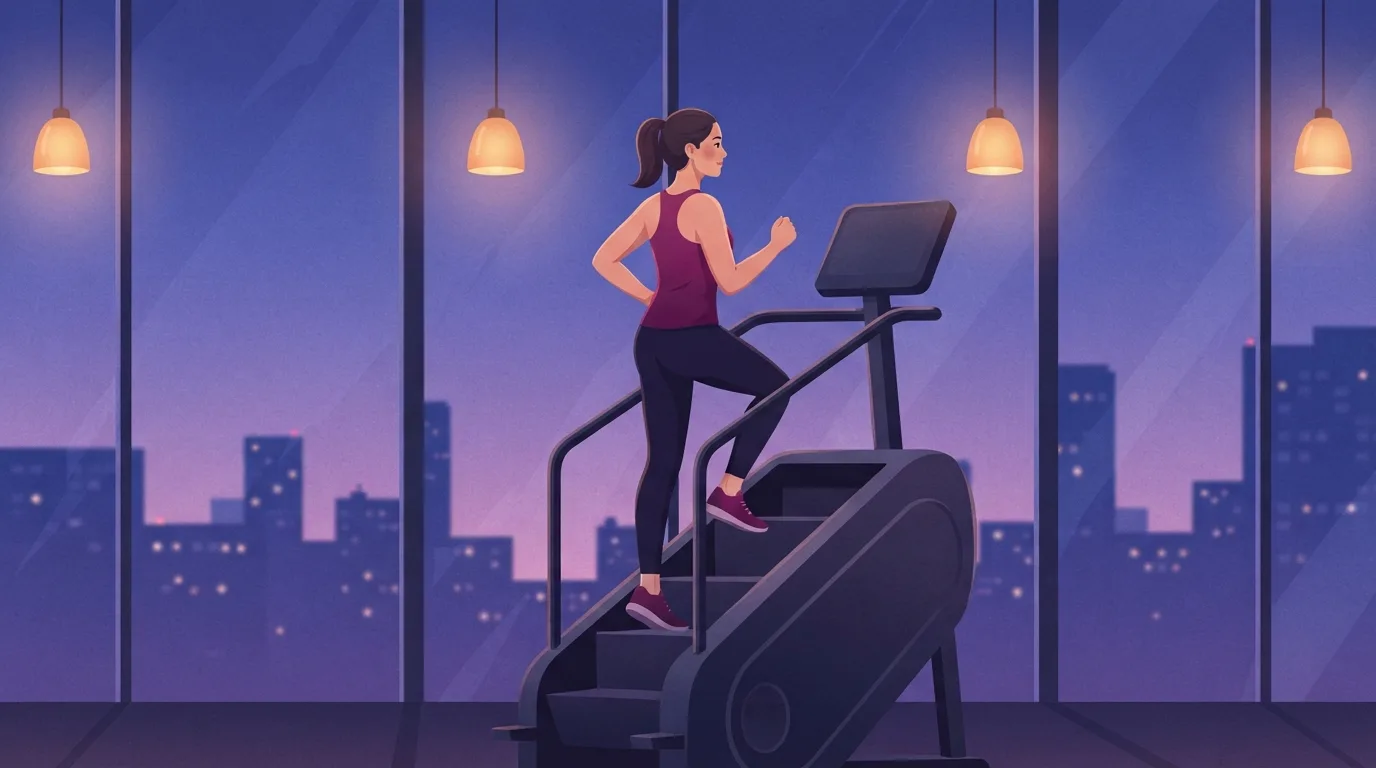
Most people's first stair stepper workout goes the same way. You pick a level that looks respectable, the steps start rolling, and five minutes later you're hanging on the side rails with locked elbows while your feet keep moving. The console says you're burning a lot. Your legs don't quite agree.
That's not a willpower problem. Stair machines are hard because they make you lift your body weight with every step, and the rails offer an easy way to stop lifting all of it. Once you lean, the machine keeps counting, but your legs and heart do less of the work.
Below are three sessions that work at any fitness level, with times and effort ratings for every block, followed by the calorie numbers, the form evidence and a version for home. If you want to know why stair climbing matters for long-term health, our review of the stair climbing longevity research covers the large population studies. This page is about the workout itself.
What Does the StairMaster Do? StairMaster vs Stair Stepper
StairMaster is a brand name, but most people use it for any stair machine, whoever made it. The machines come in two types, and the workouts below work on both.
- Pedal stepper. Two independent foot pedals that sink under your weight. You control how deep each step goes, and a short, shallow step is easier than a full one.
- Stepmill or stair climber. A revolving staircase of real steps that keeps coming at you. It's harder to cheat on because each step is a fixed height.
Both do the same basic job: they make you lift your body weight against gravity, step after step, while staying in one place. That's why a stair machine feels so much harder than walking on flat ground, and why your thighs and glutes feel it within minutes. The research below used both types: Howley's handrail study and both calorie studies used pedal steppers, the second handrail study used a step treadmill, and the nine-week training study used a revolving-stair climber.
What Muscles Does the Stair Stepper Work?
Every step is a small single-leg lift. Your front leg straightens at the knee and the hip to raise your body onto the next step, then the back leg pushes off and swings through. That works these muscles in this order of importance:
- Quadriceps straighten the knee on every step and do the most work.
- Glutes and hamstrings straighten the hip. They work harder on deeper steps and when you lean slightly forward from the hips.
- Calves push off the back foot and steady the ankle.
- Trunk muscles hold you upright, but only if your hands aren't carrying part of your weight.
Posture changes how the lift is shared between the knee and the hip. Atkins and colleagues (2022) had 20 women climb an instrumented staircase twice, once in their normal posture and once leaning their trunk forward. The forward lean, about 35 degrees more than usual, raised the demand on the hip extensors, which are mainly the glutes and hamstrings. It also reduced the inward collapse of the hip that's linked to knee pain. That finding is the basis of the glute-focused session below.
Stair Stepper Form: Why Leaning on the Rails Cuts the Work
The rails are for balance. Once you start leaning on them, your arms carry part of your body weight, and the measurements show it.
Howley and colleagues (1992) had six people climb a pedal stepper at fixed machine settings, first without support and then holding on. At the highest setting, holding on significantly lowered both heart rate and oxygen uptake. Christman and colleagues (2000) then tested 15 healthy women at 25 and 33 steps a minute with no support, very light support and light support. Even very light, continuous support significantly reduced oxygen uptake compared with climbing hands-free. In the university's summary, oxygen uptake fell by 6 to 8 percent and heart rate by about 5 percent.
Those studies tested light support. Hanging your weight off locked arms is far more support than that, so the real cut in a typical gym is probably bigger. The trade is worth knowing about before you choose a level. In a small crossover study at Walter Reed, Marin and colleagues (2008) compared short steps with the arms free against full steps with the arms supported. Climbing hands-free, people reached a "somewhat hard" effort about 105 seconds sooner and topped out nearly three machine levels lower, and 83 percent rated it the harder workout. A lower level with your hands free is a bigger workout than a higher level while you lean.
Form cues that keep the work in your legs
- Stand tall with your hips over your feet. A slight lean forward from the hips is fine. Hunching over the console isn't.
- Touch the rails with your fingertips only, or let your arms swing naturally as you would on real stairs.
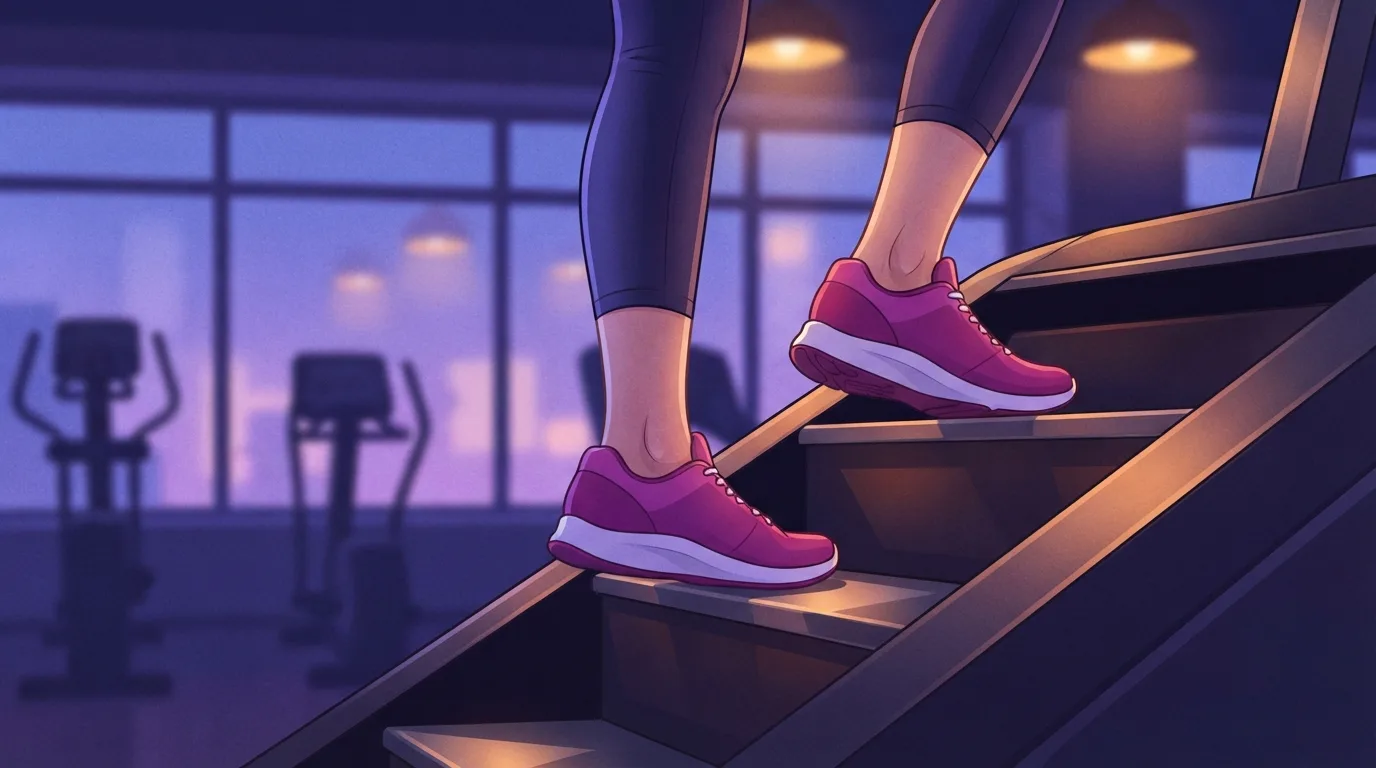
- Use your whole foot. On a stepmill, plant your full foot on each step. On a pedal stepper, use most of the pedal's range instead of short, bouncy steps on your toes.
- Slow down until you can let go. If you can't keep up without leaning, the speed is too high.
- Look ahead, not down. Staring at your feet rounds your upper back and pulls your weight forward onto the rails.
How Hard Should a Stair Stepper Workout Feel?
Machine levels mean different things on different brands and models, so the sessions below use a 1 to 10 effort scale instead. Rate how hard the whole body feels, breathing included.
| Effort (1-10) | How it feels | Talk test |
|---|---|---|
| 2-3 | Easy, a warm-up pace | You could hold a full conversation |
| 5-6 | Steady and working | You can speak in short sentences |
| 7 | Hard | A few words at a time |
| 8-9 | Very hard, only sustainable for a minute or two | You don't want to talk |
Effort beats heart rate here for a specific reason. Howley's team found that at the same oxygen cost, heart rate ran 7 to 11 beats a minute higher on the stepper than during uphill treadmill walking. Heart-rate zones you learned on a treadmill or bike will make a stepper session look harder than it is.
Workout 1: Steady Stair Stepper Workout for Beginners (30 Minutes)
This is the base session and the one to start with if you're new to stair machines. It builds the leg endurance and the aerobic fitness the other two sessions depend on.
| Minutes | What to do | Effort (1-10) |
|---|---|---|
| 0-5 | Warm-up at a slow speed, hands off the rails | 3 |
| 5-25 | Steady climb. Every 5 minutes, raise the speed one step only if you can stay upright without holding on | 5-6 |
| 25-30 | Cool-down at a slow speed | 2-3 |
Brand new to it? Start with 15 minutes: 3 easy, 9 steady and 3 easy. Add 3 to 5 minutes a week until you reach 30. Your calves and the fronts of your thighs will likely feel the first few sessions the next day, which is normal and fades within a week or two.
Find out what's really holding you back
FitCraft, our mobile fitness app, pairs you with an AI coach who builds you a personalized plan around your goals, schedule, and fitness level. Every FitCraft program is designed by Domenic Angelino, MPH (Brown University) and NSCA-CSCS, with research published in the Journal of Strength and Conditioning Research and Medicine & Science in Sports & Exercise.
Take the Free Assessment Free • 2 minutes • No credit cardWorkout 2: Stair Stepper Intervals (26 Minutes)
Intervals pack more hard work into less time by alternating short, hard climbs with easy recovery. Do this one after you can finish Workout 1 comfortably.
| Minutes | What to do | Effort (1-10) |
|---|---|---|
| 0-5 | Warm-up, building from slow to steady | 3-4 |
| 5-21 | 8 rounds of 1 minute fast and 1 minute slow | 8 fast, 3-4 slow |
| 21-26 | Cool-down at a slow speed | 2-3 |
Most machines take a few seconds to change speed, so press the button 5 to 10 seconds before each switch. Keep your hands off the rails during the fast minute even if that means a lower top speed, because that minute is the whole point of the session. For a gentler start, do 6 rounds of 30 seconds fast and 90 seconds slow, then work up to the full version over three or four weeks.
Workout 3: Glute-Focused Stair Stepper Workout (25 Minutes)
This session slows the machine down and makes every step bigger, so your hips do more of the lifting. It's a strength-endurance session with a cardio side effect, not a race.
The technique
- Lean forward from your hips by a small amount with a flat back, the way you would on a steep hill. Don't round over or lean on the rails.
- Push through your heel and midfoot, and finish each step by squeezing the glute of the top leg as the hip straightens.
- On a stepmill, take full steps. On a pedal stepper, use the full depth of each pedal.
| Minutes | What to do | Effort (1-10) |
|---|---|---|
| 0-5 | Warm-up at a slow speed, normal steps | 3 |
| 5-20 | 3 rounds of: 3 minutes of deep steps with the forward lean, 1 minute of skipping a step (stepmill) or pausing for a second at the top of each step (pedal stepper), then 1 minute of easy normal steps | 6, then 6-7, then 4 |
| 20-25 | Cool-down at a slow speed, upright | 2-3 |
Be realistic about what this does. Skipping a step is a bigger range of motion per step but a slower pace overall, which is why the 2024 Adult Compendium of Physical Activities rates climbing real stairs two at a time at 7.5 METs, below the 9.3 METs for climbing one at a time at a fast pace. In the Marin study, MRI scans showed the gluteus maximus working after both short and full steps, with no measurable difference between them. The lean and the deep steps shift some work toward your glutes, but the load is still only your body weight. For real glute growth, add the dumbbell moves in the home section below.
How Many Calories Does a Stair Stepper Burn?
The 2024 Compendium lists a stair-treadmill machine at 9.3 METs. One MET is roughly one calorie per kilogram of body weight per hour, so the estimate is 9.3 multiplied by your weight in kilograms and by the hours you climb. Here's what that gives at a steady, honest pace with your hands off the rails.
| Body weight | 20 minutes | 30 minutes | 45 minutes |
|---|---|---|---|
| 130 lb (59 kg) | 185 | 275 | 410 |
| 155 lb (70 kg) | 220 | 325 | 490 |
| 180 lb (82 kg) | 255 | 380 | 570 |
| 205 lb (93 kg) | 290 | 430 | 650 |
| 230 lb (104 kg) | 325 | 485 | 730 |
These totals include the roughly one calorie per kilogram per hour you'd burn sitting still, so the extra burn from the workout is about a ninth lower. Slower climbing burns less. For comparison, the Compendium puts climbing real stairs at 4.5 METs at a slow pace and 9.3 METs at a fast pace.
Don't trust the console to the calorie. On a pedal stepper, Howley's team measured MET values about 20 percent lower than the machine's settings claimed. Butts and colleagues (1993) tested 14 men and 14 women on another model and found the opposite: actual METs ran higher than the manufacturer's estimates at most stepping rates. Neither console knows whether you're leaning on the rails. Treat the display as a rough log, and use the table above as the better estimate.
Using the StairMaster for weight loss
Three 30-minute sessions a week burn roughly 1,000 calories at 155 pounds. That's a useful contribution, but your weight follows your weekly calorie balance, and food moves it faster than any machine. The harder part is still being on the machine in week six. Our roundup of the best workout apps for weight loss compares the options built to keep you going through that stretch. FitCraft is one of them, with streaks, leaderboards and an AI coach who says your name mid-workout.
Stair Stepper Workout at Home With Stairs or a Step and Dumbbells
No machine? A flight of stairs, or one sturdy step and a pair of dumbbells, covers the same ground.
Option 1: Staircase repeats (20 minutes)
Walk up one flight at a brisk pace, at an effort of about 7. Walk down slowly, holding the bannister, and treat the way down as your recovery. Repeat 8 to 12 times, then walk around for a few minutes to cool down. Always hold the rail on the way down, because descending is where people slip. The research on short stair bouts and long-term health is in our stair climbing research review.
Option 2: Step and dumbbell circuit (20 to 25 minutes)
Use a sturdy step or the bottom stair. A higher step is harder: the Compendium rates step aerobics at 7.3 METs on a 6- to 8-inch step and 9.0 METs on a 10- to 12-inch step, nearly matching the stair machine. Do 3 or 4 rounds with a minute's rest between rounds.
- Step-ups, 1 minute. Bodyweight only, alternating the lead leg, at an effort of 6 to 7.
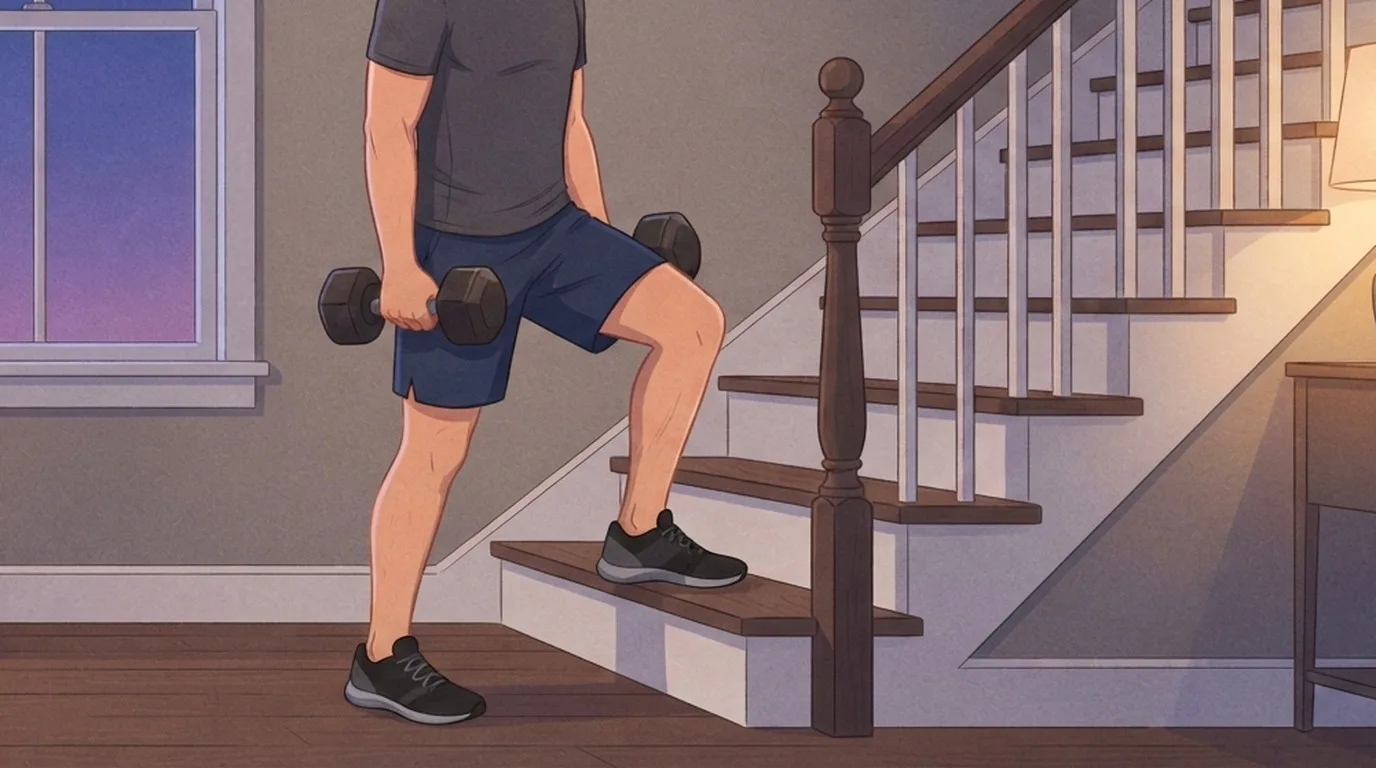
- Dumbbell step-ups, 10 per leg. Hold a dumbbell in each hand at your sides and drive up through the top foot without pushing off the bottom one.
- Goblet squats, 10 to 12. Hold one dumbbell at your chest and sit down between your heels.
- Rear lunges, 8 per leg. Step back and lower the back knee toward the floor.
- Single-leg deadlifts, 8 per leg. Hinge at the hip on one leg, the move that loads the glutes hardest of the five.
- Calf raises on the step edge, 15. Let the heels drop below the step, then rise all the way up.
The step-ups keep your heart rate up the way the machine does, and the dumbbell moves add the load the machine can't. If your knees complain on stairs, our guide to low impact cardio at home has gentler step-based options.
How Often Should I Do a Stair Stepper Workout?
Three sessions a week on non-consecutive days is a good target: one steady, one glute-focused and one interval session. Keep intervals to two a week at most, and add two short strength sessions if you can. That schedule lands inside the World Health Organization guideline of 150 to 300 minutes of moderate activity or 75 to 150 minutes of vigorous activity a week.
Expect the same level to feel easier within two or three weeks. Measurable fitness gains take a little longer. In Loy and colleagues (1993), active college women trained on a stair climber four days a week for nine weeks, working up from 30 minutes at 70 to 80 percent of maximum heart rate to 45 minutes at 85 to 90 percent. Their VO2 max rose 12 percent and their 2,414-meter run time dropped 8 percent, close to the 16 and 11 percent improvements of a matched running group. Visible changes in your legs take longer still and depend on your diet and strength work as much as the machine.
The Bottom Line
A stair stepper workout works when you stand tall, keep your hands off the rails and choose the speed you can hold that way. Rotate a steady climb, an interval session and a glute-focused session across the week, and expect roughly 275 to 485 calories per half hour for body weights between 130 and 230 pounds.
If you don't have a machine, your stairs and a pair of dumbbells do the same job. The level on the console matters far less than climbing upright three times a week, every week.
Frequently Asked Questions
What muscles does the stepper work?
A stair stepper works the quadriceps, glutes, hamstrings and calves, because every step lifts your body weight by straightening the knee and hip of the front leg. Your trunk muscles work to hold you upright, which they only do if you keep your hands off the rails. The heart and lungs get the biggest training effect of all.
Does stairclimber build glutes?
It trains them, and beginners may see some growth, but the load per step is only your body weight, so it's a modest glute builder. Deep steps and a slight forward lean from the hips put more of the lift on the hip extensors. For real glute growth, add loaded moves like dumbbell step-ups, rear lunges and single-leg deadlifts twice a week.
Is StairMaster good for toning legs?
Yes, if toning means firmer, slightly stronger legs with less fat over them. Regular stair climbing builds muscular endurance in the thighs, glutes and calves and burns plenty of energy, which helps with the fat side. Pair it with two short strength sessions a week to add the muscle that makes legs look defined.
How long to use StairMaster to see results?
Most people notice the same machine level feeling easier within two to three weeks of climbing three times a week. Measurable fitness gains take longer: in a 1993 trial, active women who climbed four days a week raised their VO2 max by 12 percent in nine weeks. Visible changes in your legs depend on your diet and strength training as well.
Is it OK to hold the handrails on a stair stepper?
A light touch for balance is fine, especially while you're learning. Leaning on the rails isn't, because it takes body weight off your legs. In lab studies even continuous light handrail support lowered oxygen uptake and heart rate, so slow the machine down until you can climb with your hands free or barely touching.
Is the StairMaster a good cardio workout?
Yes. The 2024 Adult Compendium of Physical Activities rates a stair-treadmill machine at 9.3 METs, a vigorous intensity, and active women who trained on a stair climber for nine weeks improved their VO2 max almost as much as women who trained by running. It's also low impact, because one foot always stays on a step.
What is the 25-7-2 StairMaster workout?
It's a routine popularized on social media: 25 minutes at level 7, twice a week. It's a reasonable steady session for many people, but machine levels aren't standardized between brands or models, so pick the speed that feels like a 5 or 6 out of 10 with your hands off the rails rather than chasing the number.