You live above someone. Or your knee has opinions. Or you tried a home workout video, spent 40 seconds on jumping jacks, and spent the next three days feeling it in your shins.
So cardio gets quietly filed under "not for me". And then it comes back as a low-level guilt, because you know cardiovascular fitness is the one number in exercise science with an obnoxiously strong link to how long and how well you live, and you're not touching it.
The fix isn't more willpower. It's a definition. Low impact is a rule about your feet, not a rule about your effort, and once you separate those two you can build a genuinely hard cardio session that makes no noise and asks nothing of your joints.
What Low Impact Actually Means
Low impact means at least one foot stays in contact with the ground at all times. No flight phase, so no landing, so no impact spike travelling up through the ankle, knee, hip and spine. That's the whole definition.
What it doesn't mean is low intensity. The two get bundled because early-1990s aerobics marketing bundled them, and the confusion stuck. The distinction is easy to keep straight once you have seen it measured.
Michaud and colleagues (1993), writing in the Journal of Sports Medicine and Physical Fitness, put experienced aerobics instructors on a force plate and compared matched high and low impact versions of the same movements. Vertical impact peak forces were consistently lower in the low impact versions. In the clearest pairing, the low impact front knee lift peaked at about 0.98 times body weight against 1.98 for the jumping version, and the rate at which the load arrived was roughly three times lower.
Two useful conclusions from that. First, halving the peak force and cutting the loading rate by two thirds is exactly what an irritable knee, a healing shin or a downstairs neighbour needs. Second, force through the floor isn't the same as demand on your heart. You can be breathing hard at a 0.98 body-weight peak, and you can be bored at 1.98.
One honest caveat from the same paper: lateral shear forces were similar between the two styles. Low impact protects you from vertical landing load. It's not a blanket promise about every tissue, so side-to-side work still deserves a real warm-up.
Does Low Impact Cardio Still Raise Your Fitness?
This is the question that decides whether the rest of the page is worth your time, and the answer is settled.
The cleanest demonstration comes from a trial that used a cycle ergometer, which is zero impact by definition. Reljic et al. (2020), in the Journal of Translational Medicine, randomised sedentary adults with obesity to either a 14-minute interval session (five one-minute efforts at 80 to 95 percent of maximum heart rate) done twice a week for 12 weeks, or a control group. The interval group raised VO2 max by 3.5 mL/kg/min, about a 16 percent increase. The control group's fitness fell despite losing weight through diet alone. That's 28 minutes of hard work a week, none of it involving a landing.
At the gentler end, the walking literature says the same thing in a much larger sample. Murtagh and colleagues (2015) pooled randomised controlled trials of walking in Preventive Medicine and found aerobic fitness improved by roughly 10.5 percent, along with reductions in systolic and diastolic blood pressure and several measures of body fat. Walking is the most low impact thing most people do.
And the "but I'm too old or too creaky for intervals" objection has been tested directly. Fosstveit et al. (2024) in the Scandinavian Journal of Medicine and Science in Sports randomised 233 adults aged 60 to 84 to a six-month home-based interval program built on bodyweight circuits and standing patterns, no gym required, and measured cardiorespiratory gains across the whole age band. A 2024 meta-analysis by Oliveira and colleagues in Archives of Gerontology and Geriatrics compared interval work against steady moderate training in older adults and found VO2 max improved with both.
Even in people who already have joint pain, hard low impact work holds up. A 2022 review and meta-analysis in Diagnostics by Cuenca-Martínez and colleagues examined interval training in patients with musculoskeletal disorders, where researchers had to keep intensity high without further irritating painful tissue. The modalities that let them do it were mostly cycling and other low impact formats. Our deeper review of the high-intensity low-impact research walks through those five trials in full.
On calories, the arithmetic is simpler than the marketing suggests. Energy cost tracks how much muscle you're moving, how fast, and for how long. A 20-minute low impact circuit performed at an effort where full sentences are difficult sits in the same range as a jumping circuit of the same length and effort. The jumping version isn't burning more because of the jumps. It's burning more only if it makes you work harder, and for most people with sore joints it does the opposite by ending the session early.
Find out what's really holding you back
FitCraft, our mobile fitness app, pairs you with an AI coach who builds you a personalized plan around your goals, schedule, and fitness level. Every FitCraft program is designed by Domenic Angelino, MPH (Brown University) and NSCA-CSCS, with research published in the Journal of Strength and Conditioning Research and Medicine & Science in Sports & Exercise.
Take the Free Assessment Free • 2 minutes • No credit card10 Low Impact Cardio Moves for a Home Workout
Every move below keeps a foot down, needs no equipment beyond a wall or a bottom stair, and can be done in roughly a two metre square. The cue after each one is the thing that usually goes wrong.
1. Marching in place
The baseline. Drive one knee to hip height, arms swinging in opposition, opposite foot flat. It's the warm-up, the recovery interval and the fallback when anything else flares. Marching in place gets hard surprisingly fast if you drive the knees high and keep the tempo honest. Cue: lift the knee, don't lean back to meet it.
2. Step touch
Step wide to the right, tap the left toe beside it, reverse. Add a bicep curl or an overhead reach and the heart rate climbs without the feet ever leaving the floor. Cue: push off the outside foot rather than shuffling. This is where the width comes from.
3. Shadow boxing
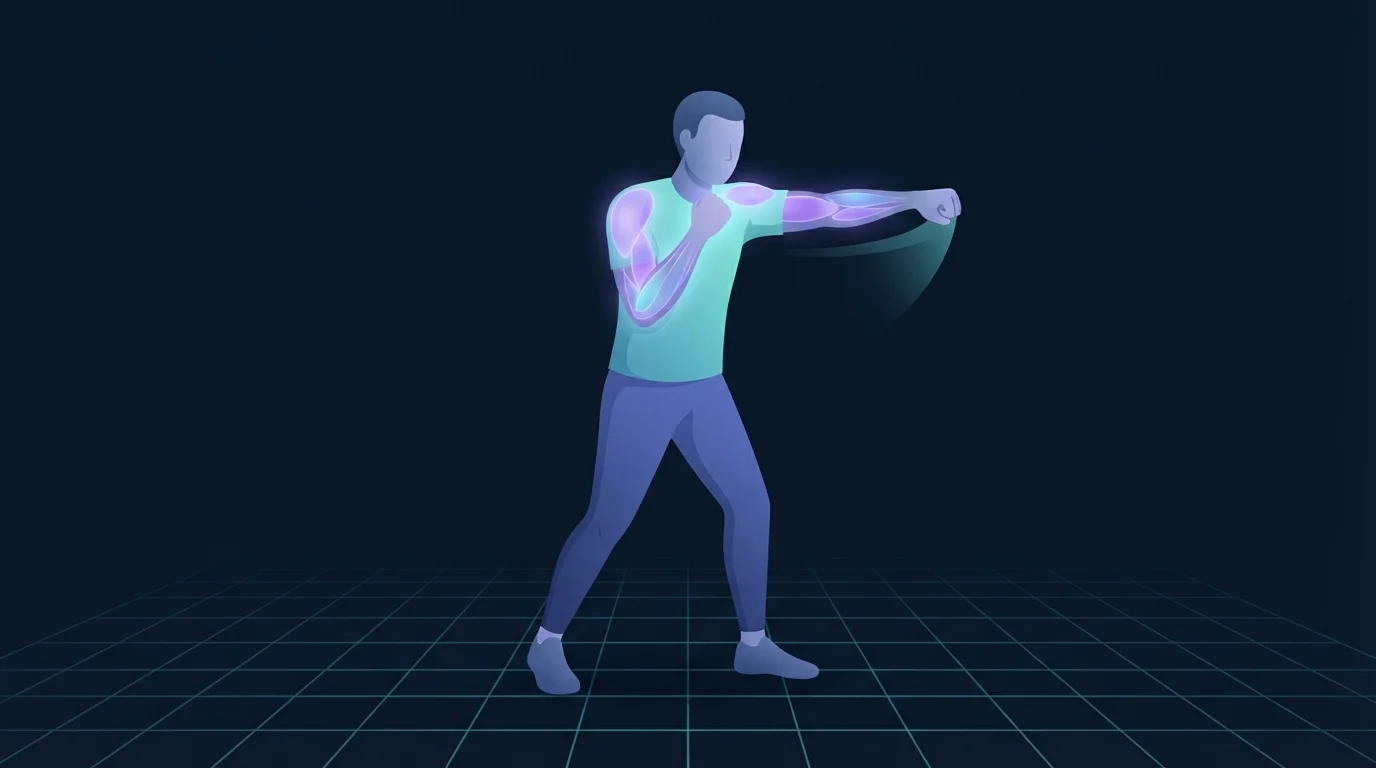
Feet in a staggered stance, both planted, and throw combinations: jab, cross, hook, or the step and punch pattern if you want the legs involved. Three minutes of honest punching will out-breathe most jumping circuits. Cue: rotate through the hip and let the fist come back to the chin every time.
4. Step-ups on a stair
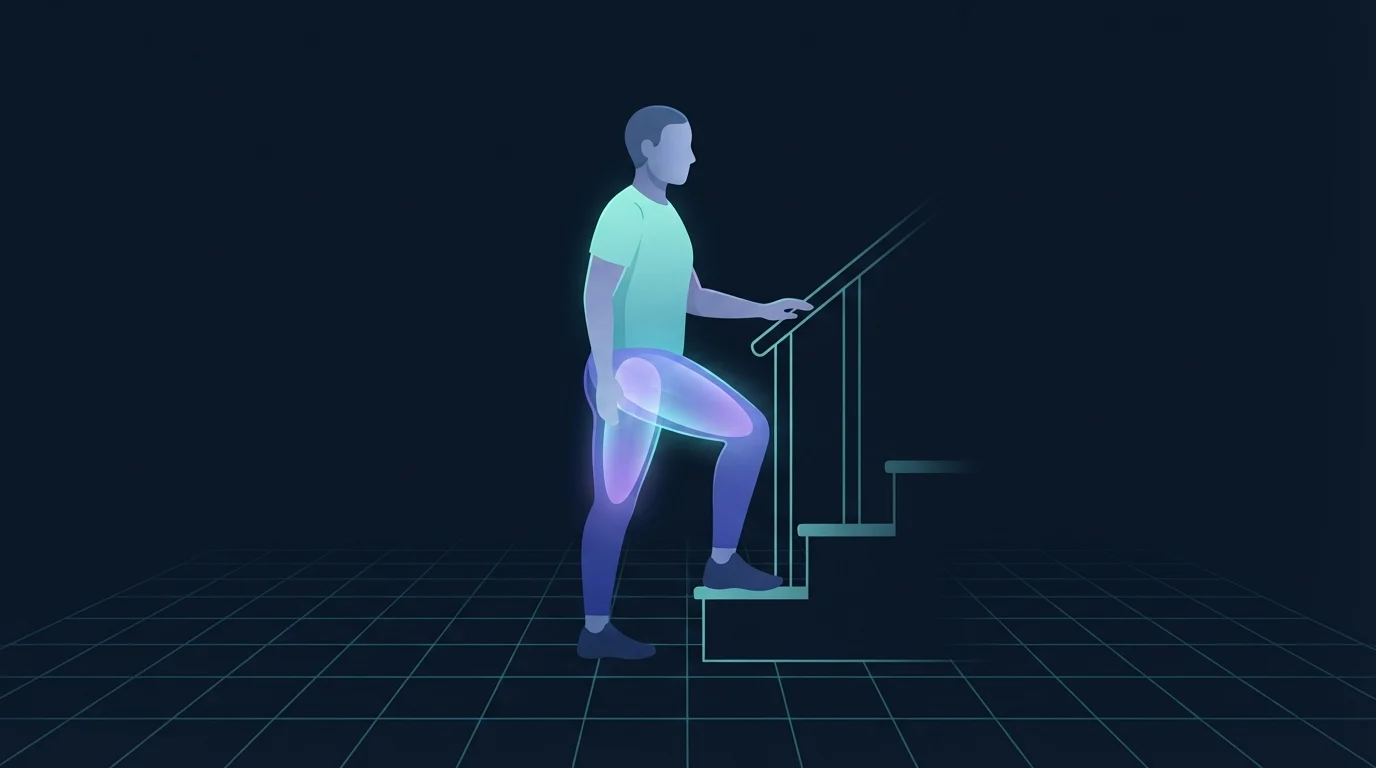
The bottom step of your staircase is a perfectly good box. Step up leading with one leg, step down under control, alternate every five reps. This is the single best low impact way to raise heart rate and build leg strength in the same movement. Cue: put the whole foot on the step and push through the heel, not the toes.
5. Squat pulses
Sit into a shallow squat, then pulse up and down through the top third at speed. The range stays small, the legs burn, and the knee never travels far. Cue: weight in the middle of the foot, chest tall, don't let the shallow range become a forward fold.
6. Lateral lunge and reach
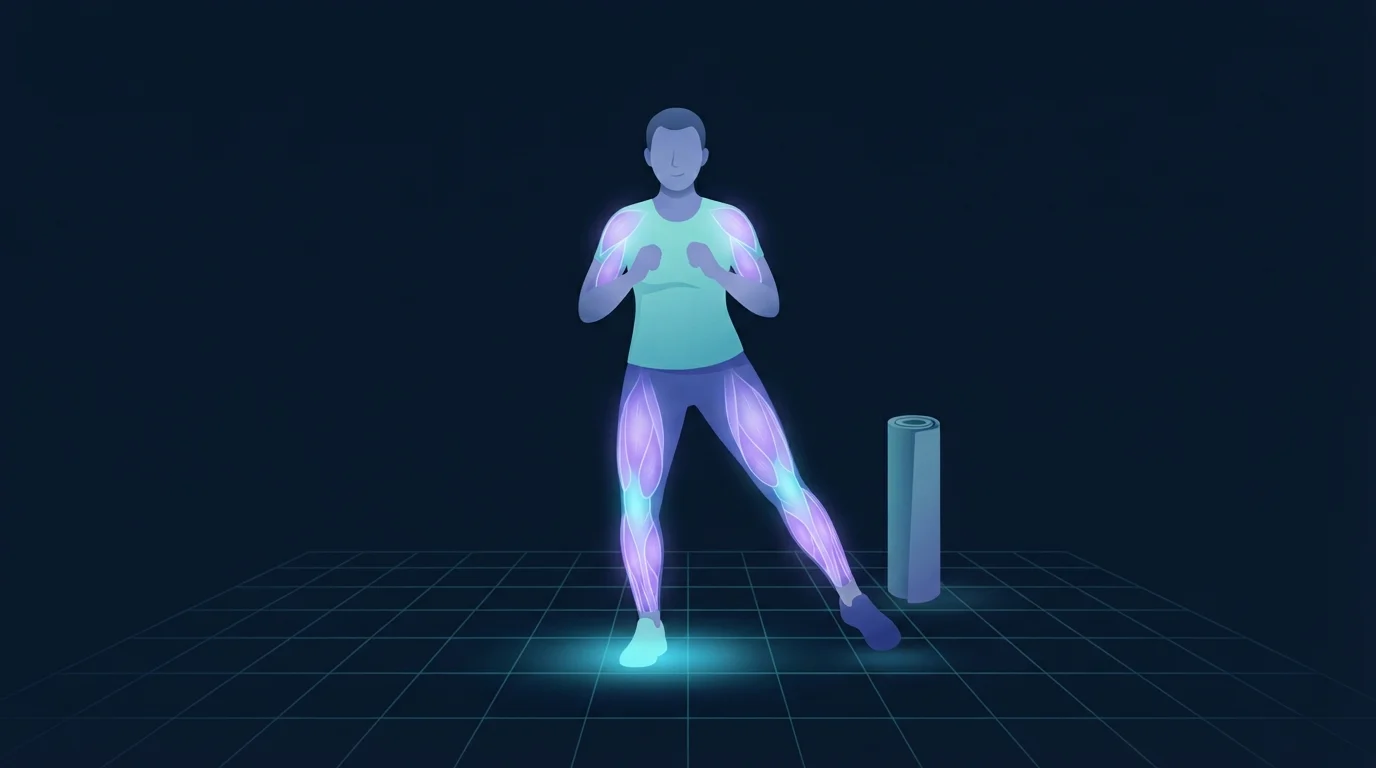
Step wide into a side lunge, sit the hips back, reach the opposite hand toward the front foot, then push back to standing. The side-to-side pattern adds a direction most home workouts ignore. Cue: the trailing leg stays straight and the trailing foot stays flat.
7. Standing knee-to-elbow
March, but bring the opposite elbow across to meet the knee. It turns a low-key cardio move into an abdominal one. Cue: rotate the ribcage toward the knee rather than just dropping the shoulder.
8. Slow mountain climbers
From a high plank, walk one knee at a time toward the chest with control. The slow version of mountain climbers keeps a hand and a foot down at all times and is close to silent. Cue: hips stay level with the shoulders. The moment they pike up, the abs stopped working.
9. Heel raises with an overhead reach
Rise onto the toes and press both arms overhead, then lower both together. Small movement, large circulatory demand because the arms are above the heart. Cue: pause at the top for a beat instead of bouncing.
10. Squat walks
Stay in a half squat and walk four steps one way, four steps back. Squat walks keep continuous tension on the quads and glutes while the feet never leave the floor. Cue: resist the urge to stand up between directions. That's the whole exercise.
Three 20-Minute Low Impact Routines
Pick one based on where you're today, not where you wish you were. Each runs 20 minutes including warm-up and cool-down, and all three use only the ten moves above.
Routine A: Beginner (steady effort)
| Block | What to do | Time |
|---|---|---|
| Warm-up | Marching in place, easy, arms swinging | 3 min |
| Round 1 | Step touch 60s, marching 30s, heel raises 60s, marching 30s | 3 min |
| Round 2 | Step-ups 60s, marching 30s, squat pulses 60s, marching 30s | 3 min |
| Round 3 | Shadow boxing 60s, marching 30s, knee-to-elbow 60s, marching 30s | 3 min |
| Rounds 4-5 | Repeat rounds 1 and 2 | 6 min |
| Cool-down | Slow marching, then easy calf and hip flexor stretches | 2 min |
Target effort: you can talk in full sentences the whole way through. If you can't, slow the tempo rather than shortening the session.
Routine B: Joint-friendly (knees, hips, ankles)
| Block | What to do | Time |
|---|---|---|
| Warm-up | Marching in place plus slow arm circles | 4 min |
| Round 1 | Shadow boxing 90s, step touch 90s | 3 min |
| Round 2 | Heel raises with overhead reach 90s, marching 90s | 3 min |
| Round 3 | Shallow squat pulses 60s, standing knee-to-elbow 60s, step touch 60s | 3 min |
| Round 4 | Repeat round 1, faster hands | 3 min |
| Cool-down | Easy marching, then seated calf and quad stretches | 4 min |
The design principle here is that the arms carry more of the cardiovascular load and the legs stay in a shallow, controlled range. If a knee is the limiting joint, pair this with strength work rather than avoidance. Our guide on how to strengthen your knees covers the loading side, and our list of low impact exercises for bad knees has the full move library.
Routine C: No-jump intervals (hard)
| Block | What to do | Time |
|---|---|---|
| Warm-up | Marching, then step touch building in tempo | 4 min |
| Interval 1 | 60s hard shadow boxing, 60s easy marching | 2 min |
| Interval 2 | 60s fast step-ups, 60s easy marching | 2 min |
| Interval 3 | 60s squat pulses, 60s easy marching | 2 min |
| Interval 4 | 60s slow mountain climbers, 60s easy marching | 2 min |
| Interval 5 | 60s squat walks, 60s easy marching | 2 min |
| Interval 6 | 60s shadow boxing, 60s easy marching | 2 min |
| Cool-down | Easy marching and full-body stretches | 4 min |
Hard means one or two words at a time, roughly 8 out of 10 on how it feels. Six one-minute efforts is close to the protocol Reljic's group used, and their participants did it twice a week for 12 weeks. Twice a week is a real dose, not a starter dose. If the flat is quiet enough that even this feels risky, our post on apartment workouts with no jumping covers the noise side specifically.
How to Progress Without Adding Impact
The reason people eventually add jumping is that they run out of ideas, not because jumping is required. There are five dials, and you turn one at a time.
- Tempo. The same move faster. The simplest dial and the first one to use. A step touch at 140 beats per minute is a different exercise from one at 100.
- Range. Bigger steps, higher knees, deeper squat pulses. More muscle travelling further costs more oxygen.
- Lever. Arms overhead instead of at your sides. Holding the arms above the heart raises heart rate at the same leg effort, which is the trick that makes heel raises surprisingly hard.
- Density. Shorten the easy interval from 60 seconds to 45, then 30. Same work, less recovery, higher average intensity.
- Load. A light dumbbell in each hand, a loaded backpack for step-ups, or a taller step. This is the last dial, not the first.
Hold each change for about two weeks before adding the next. The reason is that your cardiovascular system adapts in weeks while tendons and connective tissue adapt in months, and low impact work is still work. Progressing everything at once is how a joint-friendly plan stops being joint-friendly.
Who Low Impact Cardio Suits Best
Anyone with cranky knees, hips or ankles. Halving the vertical peak force and cutting the loading rate is the single most useful thing you can do for a joint that flares on landing, and the evidence says you keep the fitness benefit.
Complete beginners. The fastest way to end a new cardio habit is shin splints in week two. Tissue tolerance is the thing you have least of at the start, and it's the thing low impact protects.
Apartment dwellers. The whole list above is near silent. This isn't a small point. Noise anxiety ends more home workout habits than boredom does.
People carrying more body weight. Impact force scales with body mass, so the same jump costs a heavier body more. Reljic's trial is the direct evidence that a zero-impact interval protocol delivers real cardiorespiratory change in exactly this group.
Anyone in their sixties and beyond. The Fosstveit trial ran a home-based interval program in 233 adults aged 60 to 84 and got cardiorespiratory gains across the band. This is the population most often told they should not do intervals.
People coming back from illness or a layoff. Low impact is the right on-ramp when tissue tolerance and motivation are both low. If illness is the reason you stopped, our guide on working out while sick covers when to scale down and when to stop entirely.
The Bottom Line
Low impact cardio at home is a rule about your feet and nothing else. One foot stays down, the landing force disappears, and the demand on your heart is entirely up to you. The force-plate data shows roughly half the peak load and a third of the loading rate compared with the jumping version of the same move, and the trial data shows VO2 max rising anyway, in adults with obesity, in adults aged 60 to 84, and in people with existing joint pain.
Ten moves, three routines, five progression dials, no equipment, no noise. Sarah, 27, described the switch that made it stick for her: "First app that made exercise feel like something I chose, not forced." The version of cardio you will actually repeat four times a week beats the version that wins on paper and gets skipped. If you would rather follow a plan than assemble one, our home workout app with no equipment page covers the no-gear version of all of this.
You didn't fail at cardio. You were handed a format built for people with young knees and a detached house, and it was never the only option.
Frequently Asked Questions
What counts as low impact cardio?
Low impact means at least one foot stays in contact with the floor at all times, so there is no flight phase and no landing. Marching, step touches, step-ups, shadow boxing, cycling and swimming all qualify. Running, jumping jacks, burpees and skipping do not, because both feet leave the ground and the landing force has to go somewhere.
Is low impact cardio less effective than running?
No, because your heart responds to intensity, not to impact. A 12-week trial of 14-minute cycling interval sessions done twice a week raised VO2 max by 3.5 mL/kg/min, roughly 16 percent, in adults with obesity. A meta-analysis of walking trials found aerobic fitness improved by about 10.5 percent. Low impact limits the force through your joints, not the demand on your cardiovascular system.
Can you burn fat with low impact cardio at home?
Yes. Calorie burn tracks how hard you work and for how long, not how high you jump. A brisk 20-minute low impact circuit at a pace where talking is difficult burns a similar amount to a jumping circuit of the same duration and effort, and it is far easier to repeat four times a week without shin splints or an angry downstairs neighbour.
What is the best low impact cardio for bad knees?
Start with movements that keep the knee angle shallow and the foot planted: marching in place, step touches, standing punches, heel raises and shallow squat pulses. Add step-ups and low step-throughs once those feel easy. Avoid deep lunging and any landing until the joint is settled, and build the surrounding muscle in parallel rather than only avoiding load.
How do you make low impact cardio harder without jumping?
There are four dials and none of them involve leaving the ground: move faster, move through a bigger range, add a longer lever by raising the arms overhead, or shorten the rest between intervals. Adding a light dumbbell or a step platform is the fifth. Change one dial at a time and hold it for two weeks before adding another.