- The intensity is real. Eynur and colleagues (2026) measured 7.77 METs in the aerobic phase of a recreational mini-trampoline session and 11.52 METs in the anaerobic phase, with heart rates of 152 and 179 beats per minute.
- Body composition responds, slowly. Wang and Sui (2026) pooled nine trials and 234 adults with overweight or obesity. BMI fell (SMD 0.48), but only programs running longer than 12 weeks reached significance.
- Balance is the standout. The same meta-analysis found a balance effect of SMD -0.62 with zero heterogeneity, and Posch and colleagues (2019) improved one-leg stance, gait speed, chair-stand strength and fear of falling in older women with osteopenia.
- The famous NASA claim is not in the NASA paper. Bhattacharya and colleagues (1980) found jumping and running cost similar oxygen, with acceleration spread more evenly through the body when jumping. No 68 percent figure appears anywhere in it.
- Lymphatic drainage has no trial behind it. Every documented rebounder benefit is a fitness outcome, not a detox one.
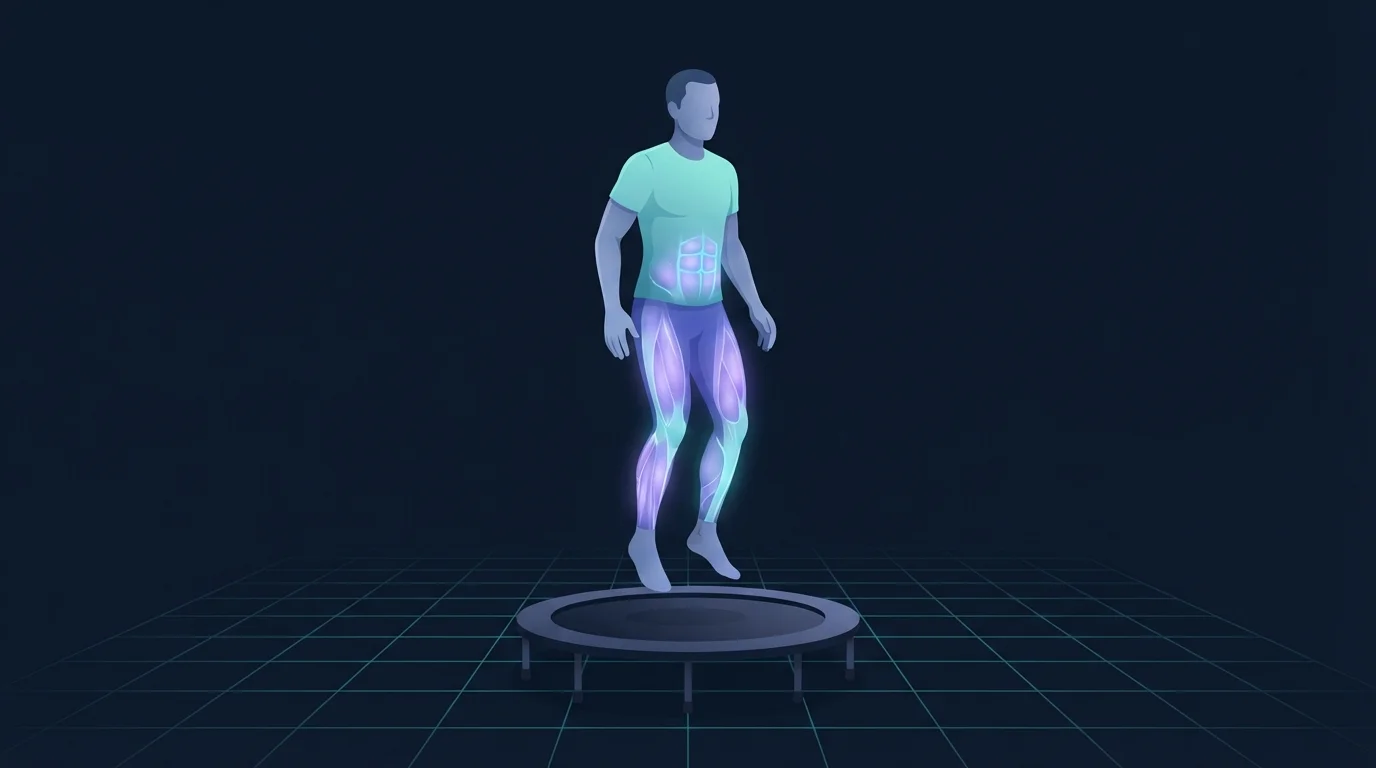
Rebounders sell themselves on a feeling. Ten minutes of bouncing does not feel like exercise, and for people who dread the treadmill that is the entire pitch. The trouble is that the marketing around mini trampolines reaches well past the feeling and into claims about lymph, detoxification and a NASA study that supposedly proves bouncing beats running by 68 percent.
So here is the split. Rebounding has a genuine, growing evidence base for aerobic intensity, balance, functional mobility and modest body-composition change. It also carries one of the most persistently misquoted studies in consumer fitness. This article works through both, study by study, and finishes with a programming template you can actually follow.
If you landed here because your knees, your neighbours or your floorboards rule out running, you're in the right place. Our guide to low-impact cardio at home covers the no-equipment versions of the same problem, and this page covers the machine.
What a Rebounder Actually Is
A rebounder is a small trampoline, typically 90 to 120 centimetres across and 20 to 35 centimetres off the floor, tensioned with either steel springs or elastic bungee cords. The bungee versions have a deeper, softer bounce and a longer ground-contact time. Spring versions are firmer and quicker. Most research-grade units sit in the middle.
The movement vocabulary is small. A health bounce keeps the feet in contact with the mat and simply loads and unloads the legs. A jog bounce lifts the feet alternately. From there you get jumping jacks, high knees, twists, tuck jumps and single-leg work. None of it is technically demanding, which is a real advantage over rowing, skipping or Olympic lifting, where technique gates the dose.
The thing that makes a rebounder physiologically interesting is the mat. On a hard floor, landing forces peak fast and concentrate at the first joint that meets the ground. On a sprung mat, the deceleration is spread over a much longer time window, so peak ground reaction force drops while total work stays similar. You are still doing repeated triple extension of the ankle, knee and hip a few hundred times per session. The mat just softens the receipt.
How Hard Is Rebounding? The Intensity Data
The most common objection to a rebounder is that bouncing cannot possibly be hard enough to matter. Two studies settle that.
Eynur 2026: Measured METs in a Real Session
Eynur and colleagues (2026) in BMC Sports Science, Medicine and Rehabilitation put 13 recreationally active women through a mini-trampoline session with a portable gas analyser running. They split the session into an aerobic phase and an anaerobic phase and reported both:
- Aerobic phase: 24.5 mL/kg/min of oxygen uptake, 7.77 METs, heart rate 152 beats per minute, respiratory exchange ratio 0.88.
- Anaerobic phase: 36.3 mL/kg/min, 11.52 METs, heart rate 179 beats per minute, respiratory exchange ratio 1.04.
For context, 7.77 METs is roughly the metabolic cost of jogging at a gentle pace or cycling at a firm 125 watts. The anaerobic phase at 11.52 METs sits in the same band as running at about 10 kilometres per hour. An RER above 1.0 in the second phase means those women were working well above their aerobic threshold. This is not gentle movement dressed up as exercise.
Hochsmann 2018: The Same Answer in Two Very Different Groups
Hochsmann and colleagues (2018) in the European Journal of Sport Science tested six standard mini-trampoline exercises in two groups: normal-weight endurance-trained adults, and inactive adults with overweight or obesity. The exercises produced 42 to 81 percent of VO2 max in the trained group and 58 to 87 percent in the inactive group.
That spread is the practical finding. The same six exercises land in the moderate zone for a fit person and in the vigorous zone for a deconditioned one, without either of them changing anything. Very few pieces of home cardio self-scale that cleanly, and it's a large part of why rebounding survives the first three weeks in people who bounce off other modalities.
The NASA Study and What It Really Said
Search for rebounder benefits and you will hit the same sentence within about four results: a NASA study found 10 minutes of rebounding is 68 percent more effective than 30 minutes of running. The source cited is nearly always Bhattacharya, McCutcheon, Shvartz and Greenleaf (1980) in the Journal of Applied Physiology, a paper written partly at NASA Ames Research Center and aimed at designing countermeasures for deconditioning in weightlessness.
Here is what the paper did. Eight men aged 19 to 26 walked and ran on a treadmill at four speeds, then jumped on a trampoline at four heights. Accelerometers sat at the ankle, the back and the forehead. Oxygen uptake and heart rate were recorded throughout.
Here is what it found. During running, peak acceleration at the ankle reached 3.0 to 12.0 Gz and always exceeded the back (0.9 to 5.0 Gz) and the forehead (0.8 to 3.9 Gz). Oxygen uptake ran 0.8 to 3.0 litres per minute and heart rate 90 to 180. During trampoline jumping, acceleration was distributed far more evenly: 3.0 to 7.0 Gz at the ankle, 3.9 to 6.0 at the back, 3.0 to 5.6 at the head. Oxygen uptake was 1.1 to 2.5 litres per minute and heart rate 102 to 175.
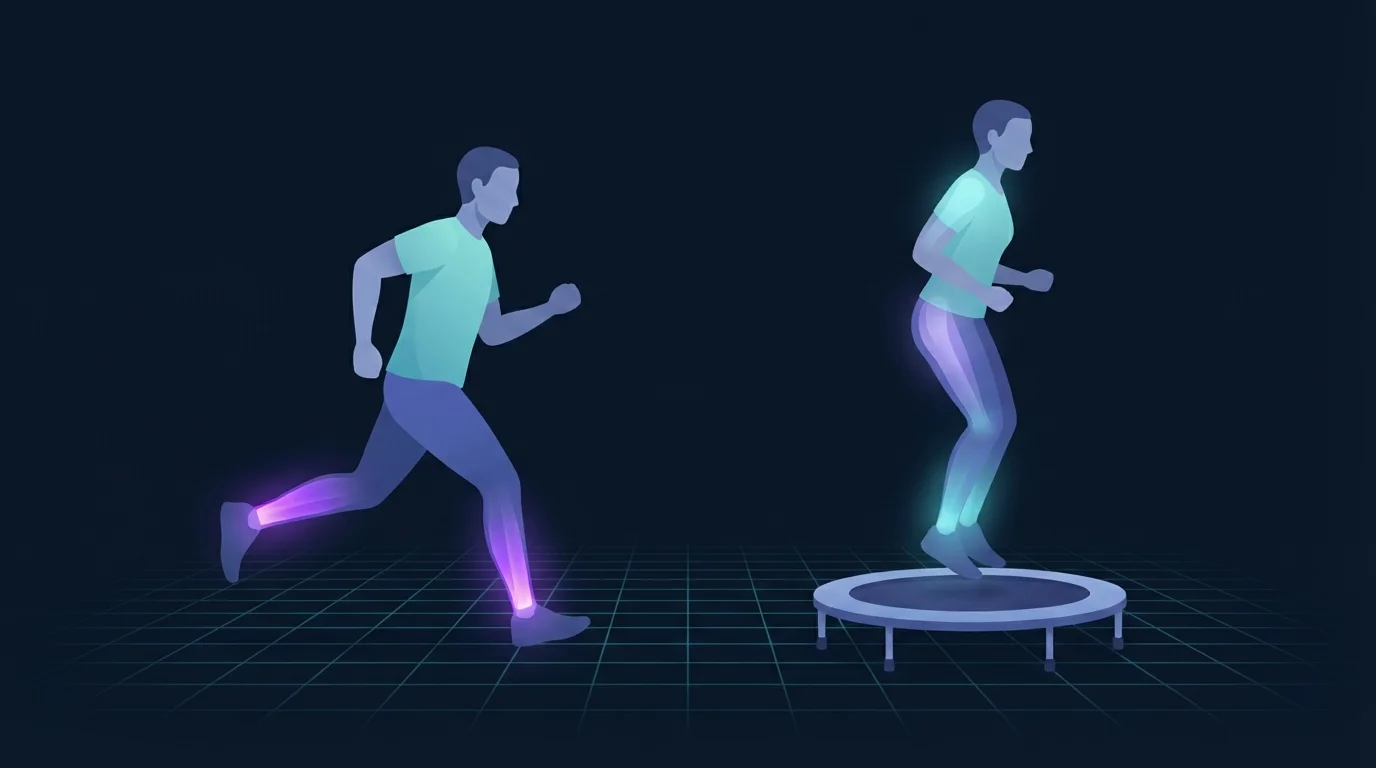
The authors' conclusion was that at similar heart rates and oxygen costs, the magnitude of the biomechanical stimulus is greater with trampoline jumping than with running. That is a statement about how mechanical loading is distributed through the skeleton, and it's genuinely interesting for anyone thinking about bone. It is not a statement that rebounding burns more calories, and there is no 68 percent anywhere in the text.
The honest version of the finding is still a selling point: a rebounder gives your spine, hips and upper body a share of the loading that running dumps almost entirely into your ankles, at a comparable cardiovascular price. That is a better argument than the fake one.
Body Composition: What Nine Trials Show
Wang and Sui (2026) in Endocrine Connections published the first meta-analysis dedicated to rebound exercise in adults with overweight and obesity. They searched four databases from January 2005 to January 2025 and kept nine trials covering 234 adults (61 men, 173 women), all with a BMI of 25 or above.
- BMI: standardised mean difference 0.48 (95% CI 0.26 to 0.69), p < 0.01, with moderate heterogeneity (I² = 56%).
- Balance: standardised mean difference -0.62 (95% CI -0.98 to -0.26), p < 0.01, with zero heterogeneity (I² = 0%).
- Programs under 12 weeks: SMD 0.25 (95% CI -0.03 to 0.53), p = 0.08. Not significant.
- Programs over 12 weeks: SMD 0.82 (95% CI 0.48 to 1.17), p < 0.01.
That duration split is the most useful number on this page. Rebounding for eight weeks produced an effect you cannot distinguish from noise. Rebounding past 12 weeks produced a large one. Anybody who buys a rebounder as a six-week weight-loss intervention is reading the wrong half of that table.
The earlier single-arm work fits the same shape. Cugusi and colleagues (2018) in the Journal of Sports Medicine and Physical Fitness ran 12 weeks of mini-trampoline training in overweight women and reported improvements in circumferences, fat mass, lean mass and muscle mass, alongside a VO2 max increase from 15.4 to 16.9 mL/kg/min. That is a 1.5 mL/kg/min gain, which is small in absolute terms and meaningful off a starting point that low. Four of the eight SF-36 quality-of-life domains improved, and both pain severity and pain interference scores dropped.
Read the body-composition literature the way you should read any single-modality literature. Rebounding contributes calorie expenditure and a small lean-mass stimulus. It does not override what you eat, and none of these trials pretend otherwise.
Get an evidence-based plan built for you
FitCraft, our mobile fitness app, pairs you with an AI coach who builds you a personalized plan around your goals, schedule, and fitness level. Every FitCraft program is designed by Domenic Angelino, MPH (Brown University) and NSCA-CSCS, with research published in the Journal of Strength and Conditioning Research and Medicine & Science in Sports & Exercise.
Take the Free Assessment Free • 2 minutes • No credit cardBalance, Falls and Older Adults
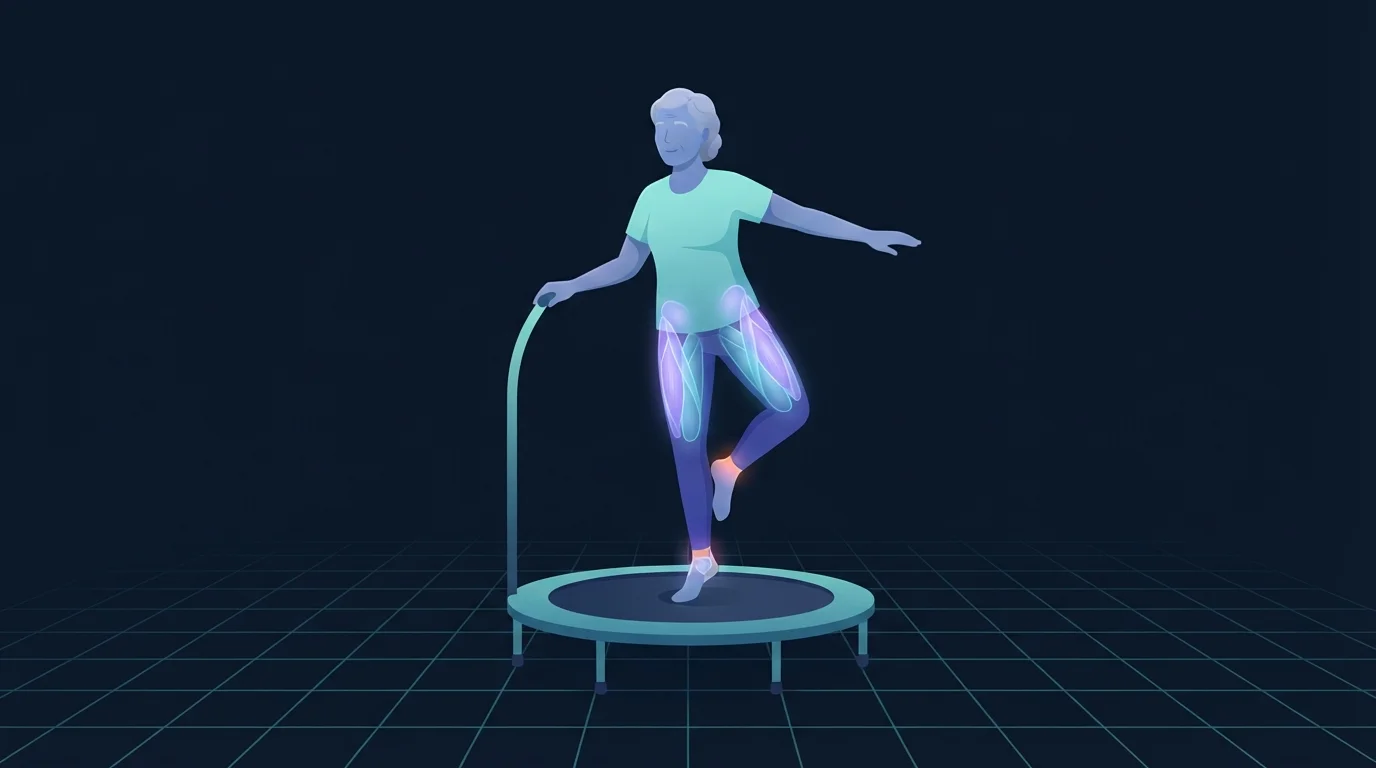
The balance result in the Wang and Sui meta-analysis had zero heterogeneity, which is unusual and means every included trial pointed the same way. The mechanism is not mysterious. A sprung mat is an unstable surface that changes shape under your foot on every contact, so the ankle and hip strategies that keep you upright get rehearsed hundreds of times per session instead of a dozen times in a standing balance drill.
Posch and colleagues (2019) in Clinical Interventions in Aging ran the most rigorous test of that idea in the population who needs it most. Forty women aged 56 to 83 with osteopenia were randomised to either 12 weeks of twice-weekly 45 to 60 minute mini-trampoline sessions combining balance, strength and jumping work, or to usual osteopenia care. Outcomes covered one-leg stance, timed up-and-go, a six-metre walking test, arm curl, 30-second chair stand, the Falls Efficacy Scale and DXA scans of the lumbar spine and femoral neck.
Balance, functional mobility, gait speed, upper and lower limb strength and fear of falling all improved significantly in the training group. Bone mineral density was the exception. Neither the lumbar spine (p = 0.064) nor the femoral neck (p = 0.073) reached a significant group-by-time difference, which is a fair result for a 12-week study on a tissue that remodels over quarters, not weeks.
So the accurate claim for older adults is a balance and confidence claim, not yet a bone claim. That still matters, because fear of falling predicts activity restriction, and activity restriction predicts the decline that follows. Our review of balance training and fall prevention covers how that dose compares with the standing, walking and tai chi protocols that dominate the falls literature.
Rebounding in Rehabilitation
Okemuo, Gallagher and Dairo (2023) in PLOS ONE reviewed rebound exercise in people with neurological conditions: five studies, 130 participants, mostly stroke, with multiple sclerosis, Parkinson's disease and spinal cord injury making up the rest. Mobility improved. Participants completed the timed up-and-go roughly 6.08 seconds faster than controls across three to eight weeks (pooled effect -0.53, p = 0.01).
Balance did not reach significance in that pooled analysis, which the authors attributed to small samples and a ceiling effect on the Berg Balance Scale. It is a useful reminder that a positive individual trial and a positive meta-analysis are different things, and that the instrument you measure with can hide a real effect.
The broader picture comes from Rathi and colleagues (2024) in Cureus, a scoping review of 11 reports across adolescents, adults with overweight, people with type 2 diabetes and gymnasts. They logged benefits across body composition, insulin resistance, muscle strength, vertical jump and quality of life, and then named the field's real problem: small studies, inconsistent equipment and no standard protocol. That caveat belongs on every claim on this page.
What a Rebounder Does Not Do
It does not drain your lymphatic system
This is the single biggest claim in rebounder marketing and the one with the least behind it. No human trial has shown that bouncing measurably increases lymph flow, clears toxins, or produces any of the outcomes the word detox implies. Lymph does move when muscles contract and when pressure in the chest changes, so any exercise moves it. That is a fact about exercise, not a special property of a mat.
It does not build much strength
Bouncing is a submaximal, high-repetition activity. Calf and foot musculature gets a real endurance stimulus, and jump work gives the quads and glutes a genuine power dose, but nothing on a rebounder approaches the loading that drives hypertrophy. If you want strength alongside it, that comes from resistance training, not from bouncing longer.
It is not the bone intervention it is sold as
The Bhattacharya acceleration data makes a rebounder a plausible bone-loading tool, and the Posch trial tested exactly that and did not clear the significance bar in 12 weeks. Plausible mechanism plus unproven outcome is where this sits today. High-impact protocols with hard-floor landings currently have the stronger bone evidence, which is the trade-off our jump rope research review works through.
It is not risk free because it is low impact
An unstable surface that lifts you off the ground is exactly the scenario a compromised balance system handles worst. Ankle sprains, falls off the edge of the mat and stress urinary incontinence in people with pelvic floor weakness are the three practical problems. A stability bar solves most of the first two.
How to Program a Rebounder Week
The trials that produced results clustered around a simple dose: two to five sessions a week, 20 to 45 minutes each, for at least 12 weeks. Here is how to get there from nothing.
Weeks 1 to 2: build the ankles
- 3 sessions a week, 8 to 10 minutes each, health bounces only (feet stay on the mat).
- Keep a hand on a stability bar or a wall for the first few sessions.
- Expect calf and foot soreness rather than breathlessness. That is the correct first adaptation.
Weeks 3 to 6: build the minutes
- 3 to 4 sessions a week, adding 2 to 3 minutes per session per week toward 20 minutes.
- Mix in jog bounces and jumping jacks. Aim for a pace you could hold a broken conversation at, which maps to the moderate end of the Hochsmann range.
- Stop adding minutes the week anything below the knee starts complaining between sessions.
Weeks 7 to 12: add intensity
- 3 to 5 sessions a week, 20 to 30 minutes.
- One or two of those sessions get intervals: 30 to 60 seconds of high knees or tuck jumps, then 90 seconds of health bouncing, repeated 6 to 10 times. That is the 11.5 MET phase Eynur measured.
- Add a single-leg balance hold of 20 to 30 seconds per side at the end of each session. It costs nothing and it is the outcome with the cleanest evidence.
Two sessions a week of resistance training still belong alongside this. Rebounding covers cardio, balance and enjoyment. It does not cover load. If the enjoyment part is what keeps you showing up, our roundup of the most enjoyable fitness apps looks at which apps treat that as a design goal rather than an afterthought, and our review of vibration plate research covers the other piece of home equipment sold on a similar promise with a very different evidence base.
What the Research Suggests Going Forward
What the literature currently supports:
- Recreational rebounding reaches 7.8 METs in its aerobic phase and 11.5 METs in its anaerobic phase (Eynur et al., 2026).
- The same exercises deliver moderate intensity to trained adults and vigorous intensity to deconditioned ones (Hochsmann et al., 2018).
- Rebound exercise improves balance with remarkable consistency across trials (Wang and Sui, 2026).
- Twelve weeks of mini-trampoline training improves gait, strength and fear of falling in older women with osteopenia (Posch et al., 2019).
- BMI reduction needs more than 12 weeks to separate from control (Wang and Sui, 2026).
What is still open:
- Whether the even acceleration distribution Bhattacharya documented translates into measurable bone density change over a year or more. Nobody has run that trial.
- How spring rebounders compare with bungee rebounders on intensity, joint load and balance outcomes. The equipment varies wildly across studies and is almost never reported in enough detail.
- Whether the balance gains reduce actual fall rates, as opposed to improving the tests used to predict falls.
- Long-term adherence. The enjoyment argument is the modality's loudest claim and has never been tested against a matched alternative.
For most people the practical read is short. A rebounder is a legitimate moderate-to-vigorous cardio option with the best balance evidence of any home cardio machine, a modest and slow body-composition effect, no detox properties whatsoever, and a real fall risk if you're already unsteady. Bought on those terms it is a good purchase. Bought on the marketing it is a disappointment waiting 12 weeks to arrive.
References
- Bhattacharya A, McCutcheon EP, Shvartz E, Greenleaf JE. "Body acceleration distribution and O2 uptake in humans during running and jumping." J Appl Physiol Respir Environ Exerc Physiol. 1980;49(5):881-887. doi:10.1152/jappl.1980.49.5.881
- Hochsmann C, Wagner J, Infanger D, Schmidt-Trucksass A. "Oxygen uptake during mini trampoline exercise in normal-weight, endurance-trained adults and in overweight-obese, inactive adults: A proof-of-concept study." Eur J Sport Sci. 2018;18(5). doi:10.1080/17461391.2018.1449894
- Cugusi L, Manca A, Serpe R, et al. "Effects of a mini-trampoline rebounding exercise program on functional parameters, body composition and quality of life in overweight women." J Sports Med Phys Fitness. 2018;58(3):287-294. doi:10.23736/S0022-4707.16.06588-9
- Posch M, Schranz A, Lener M, et al. "Effectiveness of a mini-trampoline training program on balance and functional mobility, gait performance, strength, fear of falling and bone mineral density in older women with osteopenia." Clin Interv Aging. 2019;14:2281-2293. doi:10.2147/CIA.S230008
- Wang L, Sui S. "The effects of rebound exercise on body mass index and balance in overweight and obese adults: a meta-analysis." Endocr Connect. 2026;15(4):e250825. doi:10.1530/EC-25-0825
- Eynur A, Unveren A, Harmanci H, et al. "Energy expenditure in women who participate to recreational mini-trampoline activities." BMC Sports Sci Med Rehabil. 2026;18:323. doi:10.1186/s13102-026-01757-y
- Okemuo AJ, Gallagher D, Dairo YM. "Effects of rebound exercises on balance and mobility of people with neurological disorders: A systematic review." PLoS One. 2023;18(10):e0292312. doi:10.1371/journal.pone.0292312
- Rathi MA, Joshi R, Munot P, Pandit S, Kulkarni CA. "Rebound exercises in rehabilitation: a scoping review." Cureus. 2024;16(7):e63711. doi:10.7759/cureus.63711
Frequently Asked Questions
What are the benefits of a rebounder?
The rebounder benefits with real trial support are aerobic intensity, body composition, and balance. Eynur and colleagues (2026) measured 7.77 METs during the aerobic phase of a recreational mini-trampoline session and 11.52 METs during the anaerobic phase, which puts rebounding in moderate to vigorous territory. Wang and Sui (2026) pooled nine trials and 234 adults with a BMI of 25 or above and found rebound exercise reduced BMI (SMD 0.48, 95% CI 0.26 to 0.69) and improved balance (SMD -0.62, 95% CI -0.98 to -0.26). Posch and colleagues (2019) improved balance, gait speed, chair-stand strength and fear of falling in older women with osteopenia over 12 weeks.
Is 10 minutes of rebounding really better than 30 minutes of running?
No, and the study that claim is attributed to does not say it. The paper is Bhattacharya and colleagues (1980) in the Journal of Applied Physiology, co-authored with NASA Ames researchers. Eight men ran on a treadmill and jumped on a trampoline while acceleration, oxygen uptake and heart rate were recorded. Trampoline jumping produced a similar oxygen cost to running (1.1 to 2.5 litres per minute versus 0.8 to 3.0) and spread acceleration far more evenly through the body instead of concentrating it at the ankle. The conclusion was that jumping delivers a larger biomechanical stimulus at a matched cardiovascular cost. The figure of 68 percent appears nowhere in the paper.
Does rebounding help you lose weight?
It helps modestly, and the duration matters more than the intensity. In the Wang and Sui (2026) meta-analysis of nine rebound-exercise trials, programs longer than 12 weeks produced a clear BMI reduction (SMD 0.82, 95% CI 0.48 to 1.17) while programs shorter than 12 weeks did not reach significance (SMD 0.25, 95% CI -0.03 to 0.53). Cugusi and colleagues (2018) also recorded reductions in circumferences and fat mass in overweight women after 12 weeks. Rebounding burns a respectable number of calories per minute, but the weight change still comes from total energy balance across months, not from the bounce itself.
Is rebounding good for your lymphatic system?
There is no human trial showing that bouncing on a mini trampoline measurably increases lymph flow or clears anything from the body. Lymph does move when skeletal muscle contracts and when intrathoracic pressure changes, so any exercise moves it, but the specific detox and drainage claims attached to rebounders are marketing language rather than a documented outcome. The evidence base for rebounding covers aerobic intensity, body composition, balance, mobility and quality of life. Lymphatic drainage is not on that list.
Is a rebounder good for seniors?
For balance and functional mobility, the evidence is encouraging. Posch and colleagues (2019) randomized 40 women aged 56 to 83 with osteopenia to 12 weeks of twice-weekly mini-trampoline sessions or usual care, and the training group improved significantly in one-leg stance, timed up-and-go, six-metre gait speed, 30-second chair stand, arm curl and fear of falling. Bone density did not reach a significant group-by-time difference at the lumbar spine (p = 0.064) or femoral neck (p = 0.073). An unstable surface is also a fall risk in itself, so a stability bar and medical clearance matter more here than in almost any other home cardio setup.
How long should you rebound for each day?
Start at 5 to 10 minutes of easy health bounces, three days a week, and build toward 20 to 30 minutes three to five days a week over six to eight weeks. Ankles, calves and the small stabilisers of the foot fatigue long before the lungs do, which is why most early soreness from a rebounder shows up below the knee. Once 20 minutes of steady bouncing feels conversational, the next step is short bursts of higher-effort work, such as 30 to 60 seconds of jogging bounces or tuck jumps, rather than simply adding more minutes.