- Rope skipping runs at roughly 8 to 12 METs. One minute of steady skipping burns about as much energy as several minutes of walking, which is why short protocols still work.
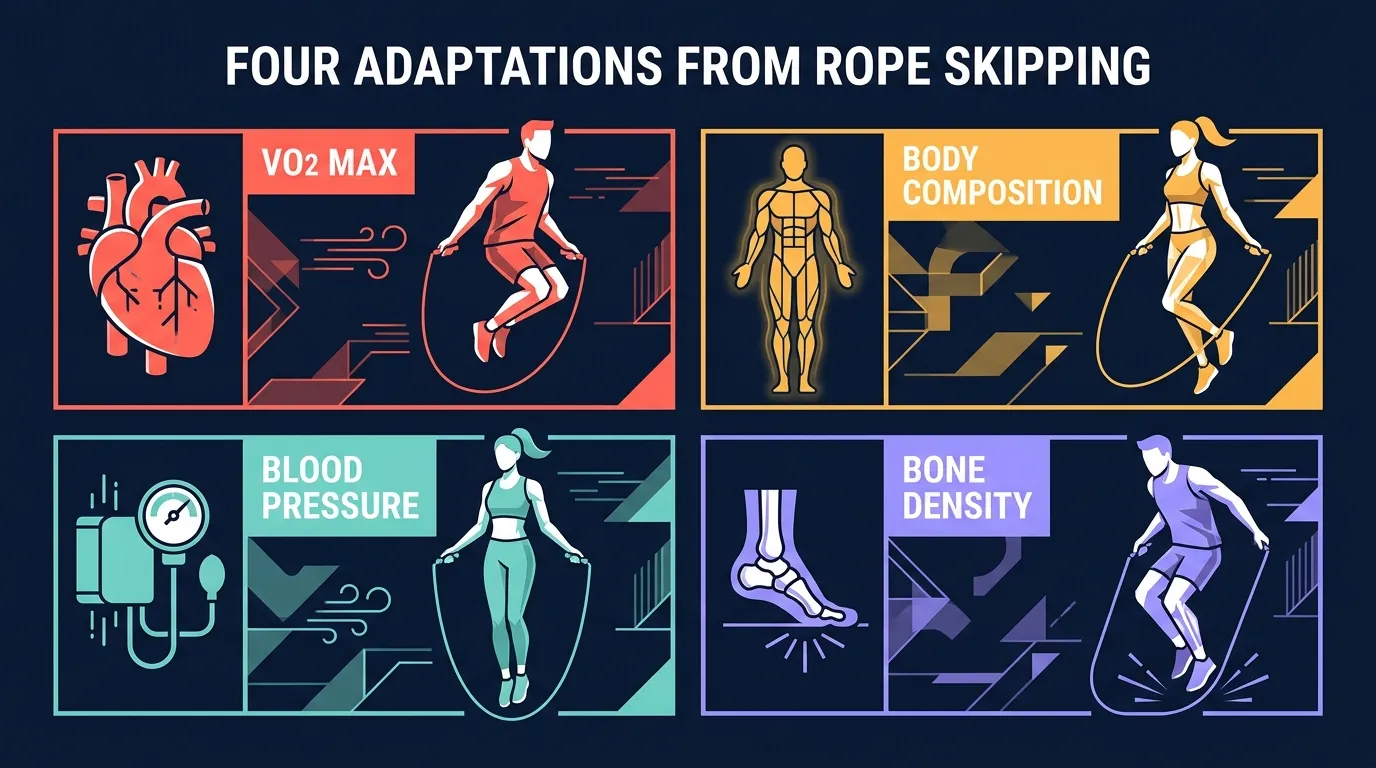
- VO2max improves inside 12 weeks. Shao and Cao (2025) reported a 4.0 mL/kg/min VO2max gain in adolescents with overweight after 12 weeks of interval jump rope, three days per week for 10 minutes per session.
- Body composition follows. The same trial saw BMI drop by 2.1 kg/m² and body fat drop 1.3% in the long-interval group; a no-training control gained BMI.
- Blood pressure and vascular function improve too. Sung et al. (2019) took 40 adolescent girls with prehypertension through 12 weeks and dropped systolic BP by 6 mmHg while pulse wave velocity and C-reactive protein both improved.
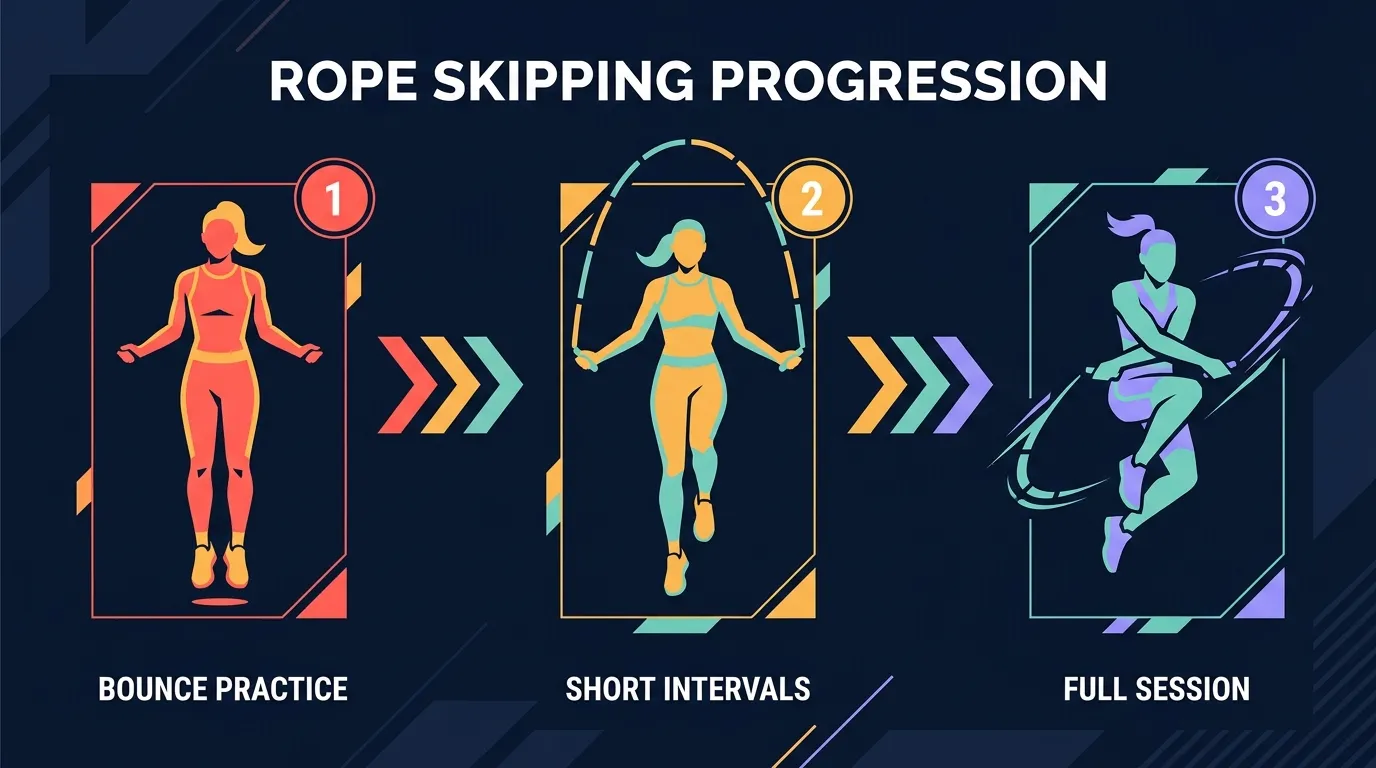
- The bell-curve start: practice two-foot bounces for two weeks, then add short intervals (30 seconds skipping, 30 to 60 seconds rest) for 8 to 12 total minutes, two or three times per week.

A jump rope costs less than a burrito and fits in a jacket pocket. It also, according to a growing pile of randomized controlled trials, delivers a cardiovascular training dose that competes with a treadmill and a bone-loading dose that competes with plyometrics. That is a very high value-per-gram ratio for a piece of fitness equipment, and it's why the rope keeps showing up in peer-reviewed journals every year.
The catch is that skipping runs hot. Depending on cadence, published metabolic measurements put continuous rope skipping between about 8 and 12 METs, which puts a 12-minute session in the same energy-expenditure ballpark as a brisk run. Beginners feel it. And because the mechanics involve landing impact, coordination, and calf endurance all at once, the on-ramp matters more than most people expect. For the calorie arithmetic behind that intensity, and an honest read of what the fat-loss trials did and did not find, see our companion piece on whether jump rope helps you lose weight.
What follows is a plain read of the evidence base. What rope skipping does. What it does not do. How to start without wrecking your calves in week one.
The Research: What Studies Show
Cardiorespiratory Fitness Rises Fast
The clearest recent adult evidence is Phongchin et al. (2025) in the European Journal of Clinical Nutrition. Fifty-nine healthy young adults (mean age about 22, nearly half women) were randomized to high-intensity interval rope skipping (nine rounds of two minutes), moderate-intensity continuous rope skipping, or a control. Both skipping groups improved cardiorespiratory fitness. Interestingly, the interval group also reported higher exercise enjoyment, which matters because enjoyment predicts whether people come back. Rope skipping is not just effective. It's actually kind of fun.
A larger trial in adolescents replicated the cardio signal. Shao and Cao (2025) in BMC Pediatrics randomized 101 middle-school students with overweight or obesity into three groups: 10-minute interval jump rope at 30 seconds on and 30 seconds off (JRE-1), 10-minute jump rope at 60 seconds on and 60 seconds off (JRE-2), or no training. Sessions ran three times per week in PE class for 12 weeks. Cadence started at 100 jumps per minute and ramped to 120 by week nine. VO2max improved by 3.4 mL/kg/min in JRE-1 and 4.0 mL/kg/min in JRE-2, versus 1.6 mL/kg/min in the control group. Both intervals worked; the longer work intervals worked slightly better.
Body Composition Follows the Cardio
The same Shao and Cao trial tracked body composition. BMI dropped by 1.4 kg/m² in JRE-1 and 2.1 kg/m² in JRE-2. Body fat percentage dropped by about 1.3 to 1.4% in both training groups. The no-training control gained BMI over the 12 weeks, which is typical for adolescents with existing overweight. Fasting insulin fell by roughly 2 µU/mL in both training groups. Triglycerides dropped significantly (p<0.01 in JRE-2). Those are meaningful metabolic wins from 30 minutes of skipping per week, and they land in a population where behavior change is notoriously hard.
An older but still relevant trial by Sung et al. (2019) in European Journal of Applied Physiology targeted 40 adolescent girls with prehypertension. Over 12 weeks of jump rope training, body fat percentage dropped from 33.8% to 30.2%, and central adiposity (waist) fell from 86.4 cm to 83.3 cm. Systolic blood pressure dropped from 126 to 120 mmHg. Brachial-to-ankle pulse wave velocity (an arterial-stiffness marker) improved from 8.2 to 7.4 m/s. C-reactive protein, an inflammation marker, dropped from 0.5 to 0.2 mg/L. That's a full-panel improvement from a single, simple exercise tool.
Muscular Strength Comes Along for the Ride
Most people think of skipping as pure cardio. The muscle side gets underrated. Sabău et al. (2025) in Sports ran an 8-week controlled study in 52 university students. The experimental group added 10 minutes of jump rope to their regular cardio class once per week; the control group did the cardio without the rope. Right-leg strength climbed from 8.83 to 10.67 kgf (Cohen's d = 1.03, a very large effect) and left-leg strength climbed from 9.06 to 10.54 kgf. Grip strength improved by roughly 20% in both arms. Cardiovascular fitness (measured by the Ruffier index) improved modestly. Adding one skipping block per week bumped nearly every fitness marker they tested.
The strength gains make mechanical sense. Every skip is a fast eccentric-to-concentric calf and quad action under body weight, essentially a low-height plyometric. Grip endurance builds because you're keeping wrist and forearm muscles firing to spin the rope handles for the whole session.
Bone Density Improves at Loaded Sites
Ha and Ng (2017) in PLoS ONE ran the largest rope-skipping bone-density study to date: 176 pubertal girls in Hong Kong followed for about 10 months across two academic years. The skipping group (weekly rope skipping) had significantly higher bone mineral density at the calcaneus, the heel bone, than controls (B = 0.023, p<0.01). Forearm BMD did not improve, and neither did cardiovascular fitness in this particular study. The pattern is exactly what a bone physiologist would predict: rope skipping loads the feet, shins, and hips through impact, so those sites remodel; the forearm doesn't see landing forces, so it doesn't. If your goal is heel and hip bone health, this is one of the best-studied at-home tools we have.
Why This Matters for Your Fitness
Most people don't have unlimited training time. Most people also live somewhere that a treadmill doesn't fit. A rope solves both problems. Ten to twenty minutes of skipping delivers the aerobic dose of a much longer walk, in less floor space than a yoga mat.
The intensity is the feature, not the bug. Because skipping runs so metabolically hot, you can get a full cardio session in the time it takes to warm up on most cardio machines. That's useful when your realistic training window is 15 minutes between a work call and dinner. It's less useful if you're brand new to impact-based training, in which case you'll want the ramp described below.
The bone-density piece is worth pausing on. Adults over 40 lose bone gradually, and postmenopausal women lose it faster. Every high-quality impact loading study points in the same direction: bone responds to the loading it sees. If your training week is entirely swimming, cycling, and machine work, bone gets nothing. Adding two to three short skipping sessions per week gives the heel and hip a real remodeling stimulus. See our companion piece on bone density exercises at home for the broader picture.
How Jump Rope Works in Practice
The form basics: feet close together, weight on the balls of your feet, wrists doing the rope work (not shoulders). Jump just enough to clear the rope, an inch or two off the floor. Land soft, absorbing through your ankles and knees. Elbows stay close to your ribs. If your shoulders are working hard, your grip is wrong.
Rope length matters more than beginners expect. A properly sized rope reaches from the floor to armpit level when you stand on the middle with one foot. Too long and it drags. Too short and it hits your feet. Speed ropes are quick to swing but punish miscues; a beaded PVC or leather rope is more forgiving for learning.
Getting Started: A Realistic Progression
Weeks one and two, practice the bounce without a rope. Feet together, tiny hops, count to 30. Then pick up a rope and try single-foot rotations: swing to one side, then the other, no jump. Then add the jump. Aim for 20 to 30 seconds of skipping, rest a minute, repeat five times. That's your first workout. Calves get sore fast. That's the biggest cause of week-one dropout.
Weeks three through six, work up to 30 seconds on and 30 seconds off for 10 rounds. That's 10 minutes total, with 5 minutes of actual skipping. Most people find their heart rate reaches 80% of max by round five. Cadence typically starts at 100 to 110 skips per minute and stabilizes around 120 with practice.
Weeks seven and beyond, you can lengthen work intervals for a cardio bias (60 seconds on, 60 seconds off, five rounds) or add double-unders and cross-overs for a coordination and power bias. Rotating between session types prevents the calf tightness that plateaus most people at week four.
Get an evidence-based plan built for you
FitCraft, our mobile fitness app, pairs you with an AI coach who builds you a personalized plan around your goals, schedule, and fitness level. Every FitCraft program is designed by Domenic Angelino, MPH (Brown University) and NSCA-CSCS, with research published in the Journal of Strength and Conditioning Research and Medicine & Science in Sports & Exercise.
Take the Free Assessment Free • 2 minutes • No credit cardCommon Misconceptions
"Jump rope is just cardio."
The Sabău et al. (2025) trial in university students recorded lower-body strength gains with a very large effect size (Cohen's d over 1.0) from adding just one weekly skipping block. Every jump is a small plyometric, and every rope rotation is grip work. Skipping is closer to a low-impact circuit than to pure aerobic exercise. That's why it moves body composition, strength, and cardio at once.
"You have to do 30 minutes at a time for it to count."
The published protocols that changed VO2max, body fat, and blood pressure used 10-minute sessions two or three times per week. Because skipping runs at 8 to 12 METs, 10 minutes of interval work is metabolically dense. Longer sessions are fine if you enjoy them, but the evidence does not support waiting until you can skip for a full half-hour before starting to see gains.
"Skipping wrecks your knees."
Landing forces during a standard bounce sit around 3 to 4 times body weight, which is comparable to a jog. Running produces similar loads. The knee-injury signal in the rope-skipping literature is actually low, in part because the movement is short-cycle and vertical: you're not decelerating from a stride, you're just absorbing and rebounding. What does happen frequently is calf soreness in week one, which resolves with progression. Pre-existing knee, Achilles, or plantar-fascia issues do warrant a physio conversation before starting; that's true for any impact activity.
What the Research Suggests Going Forward
The jump rope evidence base is smaller than for running or cycling, but its direction is consistent. Where studies exist, skipping improves cardiorespiratory fitness, body composition, blood pressure, arterial stiffness, muscular strength, and site-specific bone density. Where studies are missing (specifically, larger adult trials with resting-BP endpoints), the mechanistic case matches what an exercise scientist would predict: high-MET aerobic work with mild ground reaction forces should produce cardio, metabolic, and skeletal adaptations. There are no strong negative signals in the literature.
The realistic use case: rope skipping is a high-return, time-efficient, low-cost training tool for general fitness, home workouts, and anyone who needs cardio that doesn't require a gym membership or a 30-minute run. It's not a total training program. Pair it with resistance training (see the 2026 ACSM resistance training guidelines) and some walking, and you have a well-rounded week. For a lower-impact alternative when calves need a break, see our research page on incline walking.
If you can do 30 seconds of continuous skipping without stopping, the on-ramp is short. If you can't yet, spend two weeks building the pattern before adding load. That's the honest answer the research supports.
References
- Sabău AM, Ordean MN, Mancini N, et al. Jump Rope Training Improves Muscular Strength and Cardiovascular Fitness in University Students: A Controlled Educational Intervention. Sports (Basel). 2025;13(9):307. PMC12473967. DOI: 10.3390/sports13090307.
- Shao S, Cao M. Integrating interval jump rope exercise into a school setting improve body composition, cardiorespiratory fitness and glycolipid metabolism parameters in adolescents with overweight and obesity: a randomized controlled trial. BMC Pediatrics. 2025;25(1):870. DOI: 10.1186/s12887-025-06320-1.
- Sung KD, Pekas EJ, Scott SD, Son WM, Park SY. The effects of a 12-week jump rope exercise program on abdominal adiposity, vasoactive substances, inflammation, and vascular function in adolescent girls with prehypertension. European Journal of Applied Physiology. 2019;119(3):577–585. PMID: 30554386. DOI: 10.1007/s00421-018-4051-4.
- Ha AS, Ng JYY. Rope skipping increases bone mineral density at calcanei of pubertal girls in Hong Kong: A quasi-experimental investigation. PLoS ONE. 2017;12(12):e0189085. PMC5722366. DOI: 10.1371/journal.pone.0189085.
- Phongchin W, Tingsabhat S, Trongjitpituk R, et al. Effects of high-intensity interval rope-skipping on cardiorespiratory fitness, body composition, and enjoyment in young adults. European Journal of Clinical Nutrition. 2025;79(11):1227–1232. DOI: 10.1038/s41430-025-01575-4.
Frequently Asked Questions
Does jump rope actually build cardiovascular fitness?
Yes. Shao and Cao (2025) ran a 12-week randomized trial in 101 adolescents with overweight and reported VO2max gains of 4.0 mL/kg/min in the long-interval jump rope group (60 seconds on, 60 seconds off) versus 1.6 mL/kg/min in a no-training control. Phongchin et al. (2025) trained 59 healthy young adults with high-intensity interval rope skipping (9 rounds of 2 minutes) and improved cardiorespiratory fitness comparably to moderate continuous cycling. Rope skipping sustains heart rate in the aerobic-adaptation loading window at roughly 8 to 12 METs, similar to a brisk run.
How many minutes of jump rope per week is enough?
The published protocols cluster around 20 to 40 minutes of total skipping per week to see measurable gains. Sabău et al. (2025) added just 10 minutes of jump rope once per week to a college cardio class and saw strength and cardiovascular improvements over 8 weeks. Shao and Cao (2025) used three 10-minute sessions per week for 12 weeks and produced BMI drops of 2.1 kg/m² and body fat reductions of 1.3% in adolescents with overweight. Even short doses matter because rope skipping runs so intense (roughly 10 METs) that one minute of skipping is metabolically equivalent to several minutes of walking.
Is jump rope better than running?
They aren't strictly better or worse. Rope skipping delivers similar cardiorespiratory gains in less time per session and takes almost no space, but it demands higher coordination and lands ground reaction forces of roughly 3 to 4 times body weight per jump. Running builds tendon stiffness and running economy that rope skipping cannot fully replicate, while rope skipping builds calf endurance, ankle stiffness, and coordination running cannot. For time-crunched people who want cardio at home, rope is genuinely competitive with running on a per-minute basis.
Does jump rope help lower blood pressure?
In the population where it has been tested, yes. Sung et al. (2019) ran a 12-week jump rope program in 40 adolescent girls with prehypertension and saw systolic blood pressure drop from 126 to 120 mmHg, body fat percentage fall from 33.8% to 30.2%, C-reactive protein drop from 0.5 to 0.2 mg/L, and brachial-ankle pulse wave velocity (a stiffness marker) improve from 8.2 to 7.4 m/s. The vascular and inflammation improvements suggest the blood-pressure drop is coming from real physiological adaptation, not just the training-day carryover.
Does jump rope build bone density?
The available evidence is site-specific and strongest in younger populations. Ha and Ng (2017) followed 176 Hong Kong pubertal girls for about 10 months of weekly rope skipping and found the skipping group had higher bone mineral density at the calcaneus (the heel bone), the site directly loaded by landing forces. The forearm did not gain BMD. That pattern is consistent with the broader jumping-and-bone literature: high-impact loading builds bone at the sites the impact travels through, which for rope skipping means feet, shins, and hips. Adult evidence is thinner but mechanistically consistent.